
Continuous Manufacturing (Pharmaceuticals & Biopharmaceuticals) Market Size, Share, and Forecast 2026 to 2034
REPORT DETAILS
Continuous Manufacturing (Pharmaceuticals & Biopharmaceuticals) Market Summary
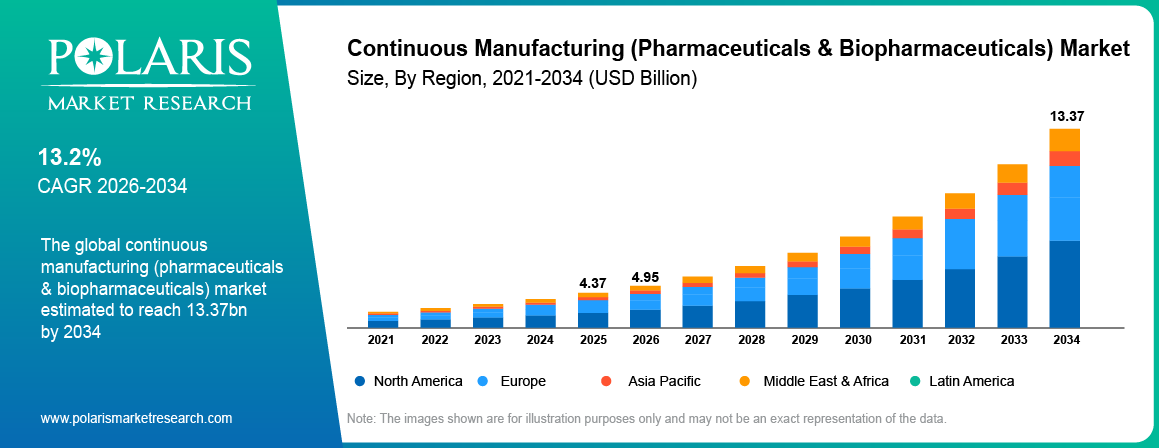
The global continuous manufacturing (pharmaceuticals & biopharmaceuticals) market size was valued at USD 4.37 billion in 2025. The market is expected to record a CAGR of 13.2% from 2026 to 2034. Growth is driven by pharmaceutical manufacturers' investment in integrated production lines, process intensification, continuous bioprocessing, and advanced process control.
Market Statistics
Key Takeaways
- North America dominated the continuous manufacturing (pharmaceuticals & biopharmaceuticals) market share with 40.42% in 2025. The leading share is fueled by FDA advanced manufacturing initiatives, pharmaceutical technology investments, and commercial continuous manufacturing deployments.
- The market in Asia Pacific is expected to grow at a CAGR of 15.58%, driven by pharmaceutical manufacturing expansion. Also, contract development and manufacturing activity and investment in continuous API and biologics production fuel the growth.
- Continuous solid dose lines accounted for 36.82% share in 2025, supported by commercial oral solid dose production, continuous direct compression, and integrated granulation and drying systems.
- Continuous bioprocessing is expected to record a CAGR of 15.72% during the forecast period. The growth is driven by investments in perfusion systems, integrated biologics production, and continuous processing of advanced therapeutic products.
- Small molecules led with 66.73% share in 2025. This is supported by established continuous tableting, API synthesis, and oral solid dose manufacturing applications.
- Large molecules are projected to record a CAGR of 14.78% during the projected period. The segment growth is attributed to the rising investments in continuous biomanufacturing, perfusion bioreactor systems, and integrated downstream processing.
- API manufacturing accounted for 47.65% of the application segment in 2025. This is propelled by flow chemistry, continuous reaction systems, and continuous production of active pharmaceutical ingredients.
Note: Figures and projections outlined in this report are the result of Polaris Market Research’s proprietary analytical processes, grounded in the latest available datasets and market observations.
Continuous Manufacturing (Pharmaceuticals & Biopharmaceuticals) Market Definition
The pharmaceutical continuous manufacturing market encompasses equipment, integrated production systems, process control technologies, and contract manufacturing services used to manufacture pharmaceutical and biopharmaceutical products through a continuous flow of materials across connected production steps. The market covers continuous solid dose lines, continuous flow synthesis, continuous bioprocessing, and controls and process analytics. Its commercial scope includes systems used in active pharmaceutical ingredient (API) manufacturing and finished drug product manufacturing across in-house and contract manufacturing operations.
Continuous manufacturing in pharma connects material feeding, processing, monitoring, and product collection through an integrated production sequence. Compared to conventional batch operations, continuous production keeps the movement of material between connected unit operations and allows the coordinated control of processes. Applications include continuous direct compression, twin-screw granulation, continuous wet granulation and drying, flow chemistry, and integrated oral solid dose production. Manufacturers rely on these platforms to coordinate process parameters, maintain product quality, and improve production flexibility. The development of modular equipment for pharmaceutical production is exemplified by continuous solid dose systems like GEA's ConsiGma CDC Flex platform, which was developed with Hovione and L.B. Bohle's QbCon technology.
The market also includes continuous biomanufacturing, advanced process control technologies, and flow chemistry. To sustain cell culture operations through continuous nutrient supply and product removal, continuous bioprocessing utilizes systems like perfusion bioreactors and continuous downstream processes for purification and product recovery. Flow chemistry allows for the controlled addition of reagents and reaction conditions in pharmaceutical synthesis for the production of APIs. Process analytical technology and real-time release testing enable process monitoring, automation, and quality assessment of interconnected production steps. The FDA’s Framework for Regulatory Advanced Manufacturing Evaluation (FRAME) initiative has identified end-to-end continuous manufacturing as a priority technology area, reflecting the increasing regulatory and industrial attention to integrated approaches to production.
Market Dynamics
Driver: Regulatory Support and Commercial Approvals Strengthen Continuous Manufacturing Adoption
The advancement and commercialization of continuous manufacturing in pharmaceutical production are being aided by regulatory engagement. The FDA Emerging Technology Program provides a forum for manufacturers to discuss advanced manufacturing technologies and regulatory issues with the agency. Since Orkambi’s first approval in July 2015, the FDA reported in May 2026 that 17 approved drugs were produced using continuous manufacturing.
The regulatory route has enabled continuous manufacturing to transition from development projects to commercial pharmaceutical production. Vertex Pharmaceuticals’ Orkambi is the first drug approved through a fully continuous drug product manufacturing process. Another Vertex product, Symdeko, was manufactured using continuous technology. Janssen’s Prezista was approved for a manufacturing change involving continuous manufacturing. End-to-end continuous manufacturing has also been identified as a priority advanced manufacturing technology by FDA’s FRAME initiative. Asymchem also said its carbapenem API manufacturing site received its first FDA pre-approval inspection on continuous API manufacturing in April 2026. These developments provide commercial and regulatory reference points for companies assessing the pharmaceutical continuous manufacturing market (Sources: RAPS.org).
Driver: Process Intensification and Integrated Production Systems Improve Manufacturing Efficiency
Pharmaceutical manufacturers are investing in process intensification to link together production steps, reduce handling of intermediates, and coordinate manufacturing operations with integrated equipment. Continuous production systems allow for the flow of material through interconnected unit operations. The production sequence allows the manufacturer to control the processing conditions and product quality. Continuous solid dose platforms, flow chemistry systems, and continuous bioprocessing equipment are broadening the scope of applications for pharmaceutical producers. Continuous direct compression and twin-screw granulation are key technologies in solid dose manufacturing, which integrate operations such as powder feeding, blending, granulation, drying and tableting.
Equipment development is broadening the availability of continuous manufacturing systems for development and commercial applications. In December 2025, GEA and Hovione announced a partnership to develop the ConsiGma CDC Flex platform. It is designed for production volumes from 1 kg/hour to 200 kg/hour and reported to have a smallest research and development batch of 1.5 kg. L.B. Bohle’s QbCon portfolio covers continuous wet granulation and drying, and equipment for solid dose production. Process intensification is coming to pharmaceutical synthesis through flow chemistry, and Corning is hosting Advanced Flow Reactor workshops in France in 2026 (Sources: GEA.com; LBBohle.com; Corning.com; Asymchem.co.uk).
Restraint: Process Integration and Technology Transfer Increase Implementation Requirements
The implementation of continuous manufacturing in pharma requires the coordination of connected unit operations, equipment, automation systems, and quality control processes. Pharmaceutical manufacturers need to have consistent material flow, process parameter controls, analytical monitoring, and operating procedures across the production line. Equipment selection depends on product formulation, process chemistry, scale of production, and manufacturing configuration. These requirements impact engineering design, process development, validation and technology transfer. Continuous systems also require integration between material feeding, processing equipment, process analytical technology and downstream collection, with manufacturers coordinating equipment configuration and control strategies throughout development and scale-up.
Technology transfer is the adaptation of process parameters and operating procedures from development to manufacturing environments. Lines that are built for one product may have to be reconfigured for another formulation, API, or therapeutic application. When a continuous process is transferred, the manufacturers consider the throughput of the equipment, the properties of the materials, the residence time of the process, the analytical measurement, and the handling of the product. Regulatory and quality requirements add further implementation activities such as control strategy development, analytical procedures, process validation, and documentation. Process integration and specialized technical expertise are key considerations for adopting continuous manufacturing systems, especially as contract manufacturers must balance customer needs with facility design, equipment compatibility, and commercial production capacity.
Opportunity: Continuous API Manufacturing Expands the Role of Flow Chemistry
Continuous API manufacturing is expected to present an opportunity for equipment suppliers and pharmaceutical companies. Also, API contract development and manufacturing organizations (CDMOs) are increasingly preferred to expand process intensification across pharmaceutical chemical production. Continuous reagent feeding and regulated reaction conditions are supported by flow chemistry systems, which enable producers to create linked synthesis processes. Such systems can be applied to selected reaction routes and API processes where continuous processing achieves a suitable manufacturing configuration. Also, advanced flow reactors facilitate process development and reaction optimization, thus expanding the technology base for continuous pharmaceutical synthesis.
Investments at the facility level and regulatory engagement are improving the visibility of commercialization of continuous API manufacturing. In 2026, Asymchem announced that its Dunhua 2 carbapenem API manufacturing site passed the first FDA pre-approval inspection for continuous API manufacturing. The inspection was conducted April 27 through April 30, 2026. The site manufactured commercial API by continuous feeding and reaction. Corning’s Advanced Flow Reactor workshops are slated for Avon, France, between March 25–27 and November 4–6, 2026, and offer technical engagement with flow reactor technology. These developments offer opportunities for CDMOs to expand specialized synthesis services and for pharmaceutical manufacturers to assess continuous production across API manufacturing operations (Sources: Corning.com).
Opportunity: Continuous Biomanufacturing Creates New Applications Across Large Molecules and RNA Products
Continuous biomanufacturing is expected to open lucrative opportunities for biologics, recombinant proteins and RNA-based products. Perfusion bioreactor systems enable continuous cell culture operation by supplying nutrients and removing products, and integrated downstream processing links purification stages with upstream production. Advanced manufacturing platforms are enabling manufacturers to create continuous processes that enhance coordination of production and broaden the range of biopharmaceutical applications. These trends are making continuous processing more important in the production of large molecules and in specialized healthcare contract manufacturing.
Enzene Biosciences developed EnzeneX as a continuous biomanufacturing platform. The company says it has more than 40 development programs and three commercial products in its platform portfolio in 2025. ReciBioPharm developed a continuous mRNA manufacturing process that cut the reported production timeline from 21–25 days to about five days and received a three-year grant from the Gates Foundation in January 2025. Such efforts demonstrate the growing application of continuous manufacturing technologies in the processing of biologics and the manufacture of RNA (Sources: PharmaManufacturing.com).
Continuous Manufacturing (Pharmaceuticals & Biopharmaceuticals) Market Segmentation Analysis
The continuous manufacturing (pharmaceuticals & biopharmaceuticals) market is segmented by technology platform, therapeutics type, application, mode, and region. These categories distinguish the production technology, therapeutic product class, manufacturing stage, and operating model used across continuous pharmaceutical and biopharmaceutical production.
Technology Platform Insights
The continuous solid dose lines segment accounted for the largest share of 36.82% in 2025. Continuous solid dose lines integrate processing steps used in oral solid dose manufacturing, including feeding, blending, granulation, drying, and compression. These systems allow for continuous direct compression and continuous wet granulation operations. Pharmaceutical companies and CDMOs use solid dose platforms for process development, scale-up, and commercial tablet manufacture. Suppliers of equipment are developing modular configurations that can be matched to production rates and formulation requirements.
The continuous bioprocessing segment is projected to exhibit the highest CAGR of 15.72% during the forecast period. Continuous bioprocessing encompasses perfusion-based cell culture, integrated downstream processing, and connected manufacturing operations for biologics. The segment is supported by the investment in continuous biomanufacturing platforms and process development for large-molecule products. Biologics and RNA manufacturing development covers Enzene Biosciences’ EnzeneX platform and ReciBioPharm’s continuous mRNA process (Source: PharmaManufacturing.com).
Therapeutics Type Insights
In 2025, the small molecules segment held a larger market share of 66.73%. Small molecule manufacturing includes continuous API synthesis and finished drug product manufacturing, especially oral solid dose manufacturing. The continuous flow synthesis allows the selected chemical reactions and the integration of processing stages in continuous solid dose lines for tablet production. Commercial examples include Orkambi, Symdeko, and Prezista, which are associated with the adoption of continuous manufacturing in marketed pharmaceutical products.
The large molecules segment is expected to grow at a CAGR of 14.78% during the forecast period. Large-molecule manufacturing includes biologics and other complex therapeutic products produced through cell culture and downstream processing. Continuous bioprocessing platforms use perfusion bioreactors and connected purification operations to support integrated manufacturing strategies. Investment in continuous biomanufacturing, including EnzeneX and integrated platforms developed by technology suppliers and pharmaceutical companies, is supporting segment development.
Application Insights
The API manufacturing segment held significant market share of 47.65% in 2025. API manufacturing includes continuous flow synthesis, continuous reaction systems, and linked processing operations for active pharmaceutical ingredients. Flow chemistry enables controlled addition of reagents and reaction conditions. Integrated process monitoring ensures coordination of production parameters. An example of commercial manufacturing in the contract manufacturing industry is Asymchem’s continuous API manufacturing site in China.
The finished drug product manufacturing segment is expected to grow at the significant rate, with a CAGR of 11.58% during the forecast period. Finished drug product manufacturing includes continuous solid dose processing, direct compression, granulation, drying, and integrated tablet manufacturing. The commercial use of continuous manufacturing for products like Orkambi and Symdeko has provided a reference base for pharmaceutical manufacturers. Thermo Fisher Scientific’s Greenville site also has a continuous oral solid dose line in production.
Mode Insights
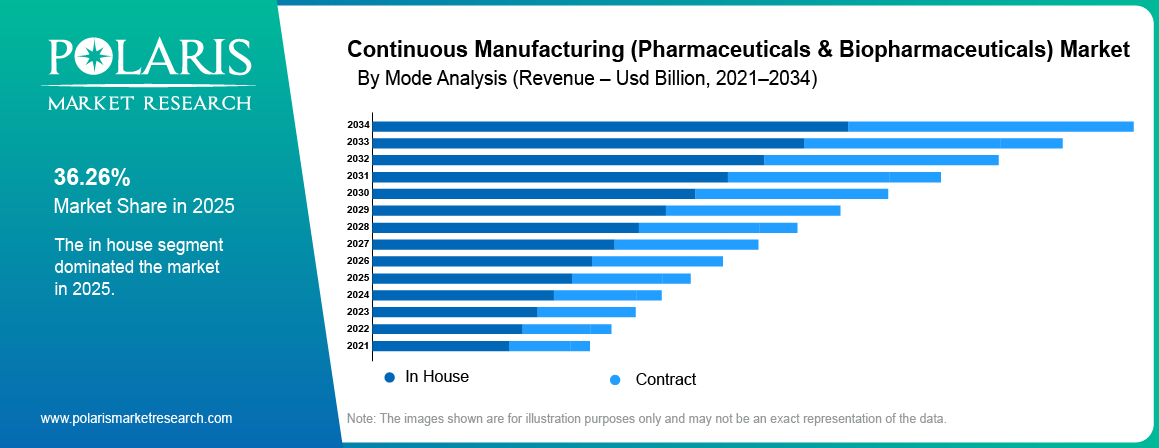
The in-house segment held 36.26% share of the mode segment in 2025. In-house continuous manufacturing refers to production systems owned or operated by pharmaceutical and biopharmaceutical companies within their manufacturing networks. Companies invest in continuous equipment, process development, automation, and analytical capabilities to support internal API and finished drug product manufacturing. Vertex Pharmaceuticals has set a precedent for in-house pharmaceutical process development and manufacturing with the commercial adoption of continuous manufacturing for Orkambi and Symdeko.
The contract segment is expected to grow at a CAGR of 12.68% during the forecast period. Contract manufacturing includes continuous production services offered by CDMOs to pharmaceutical and biopharmaceutical customers. Providers are building capabilities in continuous API synthesis, solid dose manufacturing, and bioprocessing. There’s activity in contract manufacturing as well as technology development, with Asymchem’s continuous API manufacturing site, Hovione’s collaboration with GEA, and ReciBioPharm’s continuous mRNA process.
Continuous Manufacturing (Pharmaceuticals & Biopharmaceuticals) Market Regional Analysis
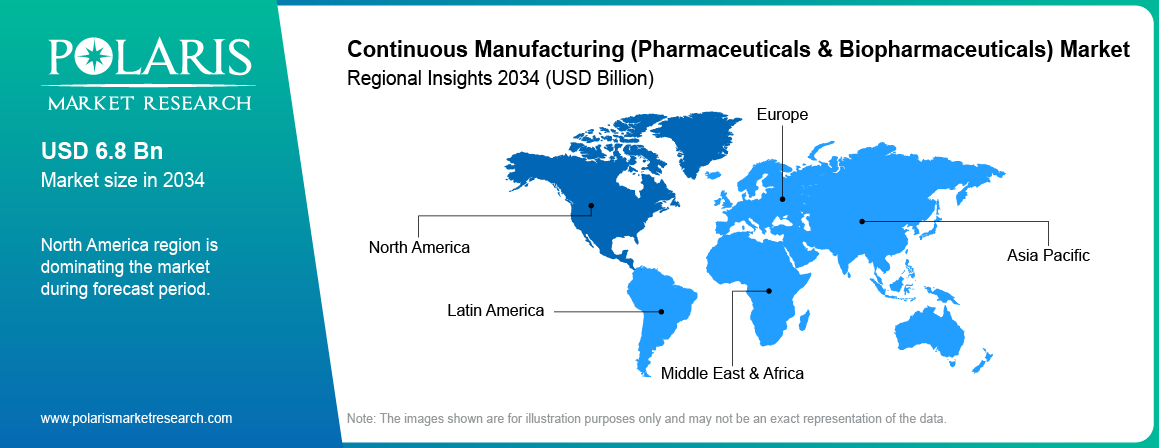
The continuous manufacturing (pharmaceuticals & biopharmaceuticals) market spans North America, Europe, Asia Pacific, Latin America, and the Middle East and Africa. Regional demand is influenced by pharmaceutical manufacturing infrastructure, regulatory engagement, technology investment, CDMO capacity, and the adoption of advanced production systems.
North America Continuous Manufacturing (Pharmaceuticals & Biopharmaceuticals) Market Trends
North America accounted for the largest share of 40.42% in 2025. The region’s dominance is attributed to FDA advanced manufacturing initiatives, existing pharmaceutical production infrastructure, and commercial continuous manufacturing deployments. The U.S. is a key regional market for continuous solid dose manufacturing, process analytics and regulatory engagement. The FDA's Emerging Technology Program and the FRAME initiative provide a regulatory framework for manufacturers developing advanced production technologies. The FDA reported 17 approved drugs made with continuous manufacturing as of May 2026, indicating the commercial experience of the region with these processes.
The region's commercial manufacturing base includes Vertex Pharmaceuticals' Orkambi and Symdeko, while Thermo Fisher Scientific operates a continuous oral solid dose production line at its Greenville, North Carolina, facility. Continuus Pharmaceuticals has also developed an integrated continuous manufacturing approach. These activities support demand for equipment, process analytical technology, automation, and integrated production systems across pharmaceutical manufacturing. Investment by pharmaceutical companies and CDMOs in connected production capabilities is expected to support the regional pharmaceutical continuous manufacturing market.
Europe Continuous Manufacturing (Pharmaceuticals & Biopharmaceuticals) Market Trends
In 2025, Europe accounted for 28.36% of the continuous manufacturing (pharmaceuticals & biopharmaceuticals) market revenue share. This is owing to investments in pharmaceutical manufacturing infrastructure, equipment development, process engineering capabilities, and advanced production technologies. Germany, the UK, France, Ireland, and Switzerland back the region’s pharmaceutical and biopharmaceutical manufacturing ecosystem. Continuous tableting, flow chemistry, and continuous bioprocessing are important areas of technology development with equipment suppliers developing modular systems for pharmaceutical production and process scale-up.
Regional equipment ecosystem includes GEA Group and L.B. Bohle. In December 2025 GEA and Hovione announced a partnership to develop the ConsiGma CDC Flex platform, a system capable of operating at production rates ranging from 1 kg/hour to 200 kg/hour. L.B. Bohle’s QbCon 1 technology enables continuous wet granulation and drying, and Corning’s Advanced Flow Reactor workshops in France offer technical engagement around flow chemistry. Such developments support regional activity in continuous solid dose production, API synthesis, and pharmaceutical process intensification.
Asia Pacific Continuous Manufacturing (Pharmaceuticals & Biopharmaceuticals) Market Trends
The Asia Pacific market is projected to register the fastest CAGR of 15.58% during the forecast period. Regional growth is supported by pharmaceutical manufacturing expansion, contract manufacturing activity, investment in API production, and the development of biopharmaceutical production capabilities. The region’s pharmaceutical supply chains and advanced manufacturing ecosystem include China, India, Japan, and South Korea. The demand for continuous manufacturing equipment and process control technologies is driven by the modernization of manufacturing facilities and the need to expand production capabilities for domestic and international pharmaceutical customers.
China is a key market for continuous API manufacturing and contract manufacturing. In 2026, Asymchem announced the successful completion of the first FDA pre-approval inspection of its Dunhua 2 carbapenem API manufacturing site for continuous API manufacturing. The site produced commercial API on a continuous feed and reaction basis, reflecting the evolution of continuous manufacturing capabilities in the regional contract manufacturing ecosystem. The regional technology landscape also includes Enzene Biosciences' EnzeneX continuous biomanufacturing platform, with the company reporting in 2025 that the platform had more than 40 development programs and three commercial products. These developments support regional opportunities across continuous API production and biopharmaceutical manufacturing services (Sources: Asymchem.co.uk; PharmaManufacturing.com).
Latin America Continuous Manufacturing (Pharmaceuticals & Biopharmaceuticals) Market Trends
Latin America accounted for 4.22% of the continuous manufacturing (pharmaceuticals & biopharmaceuticals) market in 2025. Regional market development is associated with pharmaceutical manufacturing, generic drug production, contract manufacturing, and investment in modern production infrastructure. Brazil and Mexico are important pharmaceutical production markets, alongside other countries contributing to regional medicine supply chains. Manufacturers seeking to update production operations can investigate continuous manufacturing systems for API synthesis and finished drug product manufacturing.
Manufacturers of tablets and other oral formulations have an application area with continuous solid dose platforms. Integrated equipment can connect material feeding, blending, granulation, drying, and tableting, while continuous API systems support process intensification in suitable chemical manufacturing operations. Contract manufacturers can also evaluate continuous production technologies to broaden their service capabilities for pharmaceutical customers. Investment in production infrastructure, equipment integration, and technical expertise will influence the development of the regional market.
Middle East and Africa Continuous Manufacturing (Pharmaceuticals & Biopharmaceuticals) Market Trends
The Middle East and Africa market held 3.82% share in 2025. Regional market development is associated with pharmaceutical manufacturing investment, healthcare infrastructure expansion, local production initiatives, and the development of biopharmaceutical capabilities. Key markets in the region include the pharmaceutical and healthcare manufacturing landscape in South Africa, the UAE, and Saudi Arabia. Building domestic production capacity opens opportunities for modern manufacturing technologies across API and finished drug product operations.
The technology options for continuous manufacturing systems span oral solid dose production, API synthesis and some biopharmaceutical processes. Continuous direct compression can combine powder handling with tablet manufacturing, and flow chemistry systems can enable continuous reaction processes for suitable pharmaceutical intermediates and APIs. Manufacturers evaluate these technologies based on production scale, process development requirements, equipment availability, and integration with existing facilities. These factors shape demand for integrated equipment and manufacturing technologies across the region.
Continuous Manufacturing (Pharmaceuticals & Biopharmaceuticals) Market Competitive Landscape
The continuous manufacturing (pharmaceuticals & biopharmaceuticals) market is characterized by competition among pharmaceutical equipment manufacturers, process technology providers, contract development and manufacturing organizations, and pharmaceutical companies with commercial continuous production capabilities. Suppliers compete through continuous solid dose systems, flow chemistry reactors, bioprocessing platforms, process analytical technology, and integrated manufacturing services. Product differentiation also depends on equipment throughput, process integration, scale-up capability, automation, and technical support.
The competitive landscape of the continuous manufacturing market includes equipment suppliers, process technology developers, pharmaceutical manufacturers, and contract development and manufacturing organizations (CDMOs). GEA Group and Hovione announced a partnership in December 2025 to develop the ConsiGma CDC Flex platform for continuous direct compression. L.B. Bohle’s QbCon 1 technology enables continuous wet granulation and drying, while Corning’s Advanced Flow Reactor portfolio addresses continuous chemical processing. These trends indicate supplier activities in solid dose production, flow chemistry, and integrated manufacturing equipment.
Contract manufacturing providers are expanding capabilities in both continuous API production and biopharmaceutical processing. Continuus Pharmaceuticals has an integrated platform for continuous manufacturing. Enzene Biosciences is involved in continuous biomanufacturing and ReciBioPharm in continuous RNA production. Other contributions come from commercial uptake, including Vertex Pharmaceuticals' Orkambi and Symdeko and Janssen's Prezista. Supplier comparisons increasingly consider equipment configuration, throughput, process integration, automation, analytical monitoring, and support across development and commercial production.
Vendor Positioning
| # | Company | HQ | Role in Value Chain | Continuous Manufacturing Strengths | Market Positioning / Strategic Focus | Tier |
| 1 | Thermo Fisher Scientific Inc. | Waltham, Massachusetts, US | Equipment + CDMO (Patheon) | Twin-screw extrusion and granulation equipment, PAT and process analytics, plus Patheon CDMO services for continuous oral solid dose development and manufacturing. | Broadest end-to-end offering among the ten players, pairing equipment supply with development and commercial manufacturing services; strong global scale and customer access. | Tier 1 – Leader |
| 2 | GEA Group AG | Düsseldorf, Germany | Equipment / technology provider | ConsiGma continuous tableting platform (continuous wet/dry granulation, drying, blending, compression, coating) with integrated PAT. | One of the most established commercial continuous solid-dose platforms, with multiple installations at innovator and generic manufacturers; strong process-engineering and service base. | Tier 1 – Leader |
| 3 | Corning Incorporated | Corning, New York, US | Equipment / technology provider (flow reactors) | Advanced-Flow glass and silicon carbide reactors for continuous flow chemistry in API synthesis, with lab-to-production scale-up. | Leading materials-science-based flow reactor supplier; enables continuous API synthesis, hazardous chemistry and process intensification; supplies both pharma companies and CDMOs. | Tier 1 – Leader |
| 4 | Vertex Pharmaceuticals Incorporated | Boston, Massachusetts, US | Innovator / end-user | Early adopter of continuous manufacturing for commercial drug products (CF portfolio, including Orkambi), a landmark for regulatory acceptance. | Acts as a reference case and demand-side signal for the market rather than a supplier; influences regulatory expectations and industry adoption. | Tier 1 – Innovator / Adopter |
| 5 | Hovione | Loures, Portugal | CDMO (API and drug product) | Continuous flow chemistry, spray drying and particle engineering, with continuous manufacturing capabilities across API and drug product. | Differentiated by integrated small-molecule API and particle-engineering expertise and a track record of process-intensification investments; strong in complex and inhaled products. | Tier 2 – Strong Challenger |
| 6 | Asymchem Inc. | Tianjin, China | CDMO (API) | Large-scale continuous flow reaction platforms for API manufacturing, supported by in-house engineering and process-development teams. | One of the largest Asia-based CDMOs deploying continuous flow at commercial scale; competes on scale, cost and speed for global innovators. | Tier 2 – Strong Challenger |
| 7 | L.B. Bohle Maschinen + Verfahren GmbH | Ennigerloh, Germany | Equipment / technology provider | QbCon continuous manufacturing line for granulation, drying, tableting and coating, with modular design and PAT integration. | Established German pharma equipment specialist; strong in oral solid dose process equipment and a recognized alternative to GEA in continuous granulation and tableting. | Tier 2 – Strong Challenger |
| 8 | Continuus Pharmaceuticals, Inc. | Woburn, Massachusetts, US | Technology developer / integrated CM provider | Integrated end-to-end continuous manufacturing from API to finished dosage form, originating from MIT–Novartis continuous manufacturing research. | Pure-play continuous manufacturing specialist with a focused technology and process-development proposition; smaller scale than the larger players. | Tier 2 – Specialist / Challenger |
| 9 | Enzene Biosciences Limited | India (Alkem Laboratories group) | Biologics CDMO / developer | Continuous manufacturing platform for biologics (monoclonal antibodies and other biosimilars), supporting cost-efficient biologics production. | Positions continuous bioprocessing as a cost and speed advantage for biosimilars, targeting regulated and emerging markets; early-stage compared with the leaders in global reach. | Tier 3 – Emerging |
| 10 | ReciBioPharm | Craigavon, Northern Ireland, UK (Recipharm division) | Advanced biologics CDMO | Continuous xRNA/mRNA manufacturing platform (CP1) with real-time PAT, developed with MIT under FDA-funded research and supported by a Gates Foundation grant. | Pioneering continuous production for RNA-based medicines; strategic focus on digital, PAT-enabled platforms; part of the Recipharm group. | Tier 3 – Emerging / Specialist |
Source: Polaris Market Research Analysis
Technology and Innovation Landscape
Continuous manufacturing integrates production equipment, automated material handling, process control, and analytical technologies to support continuous pharmaceutical and biopharmaceutical production. The technology architecture varies across solid dose manufacturing, flow chemistry, continuous bioprocessing, and process analytics. Continuous direct compression, twin screw granulation, continuous wet granulation and drying, perfusion bioreactors, and advanced flow reactors are important technologies supporting different production applications. Equipment suppliers are developing systems that connect multiple unit operations and accommodate pharmaceutical development, scale-up, and commercial manufacturing requirements.
Continuous solid dose manufacturing is advancing through integrated equipment designed to connect powder feeding, blending, granulation, drying, and tableting. GEA and Hovione's ConsiGma CDC Flex development addresses continuous direct compression, with a reported operating range of 1–200 kg/hour and a smallest research and development batch of 1.5 kg. L.B. Bohle’s QbCon 1 technology is designed for continuous wet granulation and drying and supports continuous processing in all solid dose manufacturing operations. Flow chemistry is another key technology for continuous API synthesis. Advanced flow reactors enable control of reaction conditions and continuous feeding of reagents. Asymchem’s continuous API manufacturing operations demonstrate the use of continuous feeding and reaction in commercial API production.
Perfusion bioreactor systems, integrated downstream operations, and continuous processing platforms are moving continuous bioprocessing forward for biologics. Technology development in large-molecule and RNA manufacturing is exemplified by Enzene Biosciences' EnzeneX platform and ReciBioPharm's continuous mRNA process. Process analytical technology enables the monitoring of critical process parameters and product quality attributes and real-time release testing associates process information with quality assessment. The FDA's FRAME initiative has identified end-to-end continuous manufacturing as a priority advanced manufacturing technology.
Technology Comparison
| Capability | Example | Company | Evidence | Stage |
| Continuous direct compression | ConsiGma CDC Flex | GEA | 1 to 200 kg per hour; 1.5 kg smallest R&D batch | Shown at CPHI Frankfurt, late 2025 |
| Continuous wet granulation and drying | QbCon 1 | L.B. Bohle | Shown at INTERPHEX, April 21 to 23, 2026 | Product showcase |
| Continuous coating | BFC 5 lab coater | L.B. Bohle | 2 L to 13 L batches | Product showcase |
| Continuous flow API synthesis | Advanced Flow Reactor | Corning | Workshops, March and November 2026 | Training offer |
| Continuous API manufacturing | Carbapenem API site | Asymchem | First FDA inspection, June 22, 2026 | Commercial |
| End to end integrated line | Integrated continuous manufacturing | Continuus Pharmaceuticals | Raw material to finished product | Commercial platform |
| Continuous RNA process | RNA continuous manufacturing | ReciBioPharm | Process cut from 21 to 25 days to about five | Development with grant funding |
| Continuous biologics | EnzeneX | Enzene Biosciences | Three commercial products | Commercial |
Source: Polaris Market Research Analysis
Use Case Analysis
Oral Solid Dose: Integrated Tablet Production
Oral solid dose manufacturing is an established application of continuous pharmaceutical production. Continuous solid dose lines connect powder feeding, blending, granulation, drying, and compression to support tablet production through integrated operations. Continuous direct compression provides a production route for suitable formulations, while twin screw granulation supports continuous wet granulation. GEA's ConsiGma CDC Flex development with Hovione and Equipment development for continuous solid dose manufacturing is demonstrated by L.B. Bohle's QbCon 1 technology. Examples of the adoption of continuous manufacturing in finished drug products include commercial products such as Orkambi and Symdeko. In addition, Thermo Fisher's facility in Greenville has a continuous oral solid dose line for production.
API Manufacturing: Continuous Flow Synthesis and Reaction Processing
Continuous API manufacturing utilizes flow chemistry and interconnected reaction systems to produce active pharmaceutical ingredients by means of continuous processing. Controlled feeding of reagents and reaction conditions support synthesis operations along chosen chemical routes. Advanced flow reactors offer equipment for process development and continuous feeding and reaction systems can be used in commercial API manufacturing. In April 2026, Asymchem’s Dunhua 2 carbapenem API site passed its first FDA pre-approval inspection for continuous API manufacturing. The company has demonstrated commercial API production with continuous feeding and reaction, setting an example for continuous manufacturing as it pertains to contract API production.
Biopharmaceutical Manufacturing: Continuous Processing of Biologics and RNA Products
Continuous bioprocessing enables production of biologics via perfusion-based cell culture and integrated downstream processing. Perfusion bioreactors continuously feed nutrients and remove products to maintain cell culture operations, while integrated manufacturing platforms link processing stages and enable process control across biologics production. An example of the development of continuous biomanufacturing is Enzene Biosciences’ EnzeneX platform. Rising developments illustrate the use of connected processing technologies across large-molecule manufacturing.
RNA manufacturing is application area for continuous production. ReciBioPharm reported a continuous mRNA process that reduced production time from 21–25 days to approximately five days. The company also received a three-year grant from the Gates Foundation in January 2025. This development exemplifies the application of continuous processing to RNA production and expands the range of biopharmaceutical applications addressed with continuous manufacturing technologies (Source: PharmaManufacturing.com).
Integrated Manufacturing: End-to-End Production and Process Control
In integrated continuous manufacturing, the steps in production are connected through coordinated equipment, material handling, process control, and analytical monitoring. The approach is applicable across API synthesis, finished drug product manufacturing, and biopharmaceutical production. Continuus Pharmaceuticals has developed a continuous manufacturing platform that is integrated. The FDA’s FRAME initiative has identified end-to-end continuous manufacturing as one of the priority technology areas. Process analytical technology and real-time release testing enable monitoring across integrated production operations. Automatic control of process parameters and material flow. Analytical tools provide information for quality control of integrated production processes.
Buyer Analysis
Buyer considerations include capital investment, facility integration, automation, and training. When selecting continuous production systems, pharmaceutical manufacturers and CDMOs consider equipment throughput, product compatibility, maintenance, service coverage, and operating requirements.
Coordination of operations between the engineering, manufacturing, and quality teams is crucial. Buyers evaluate suppliers on their process expertise, equipment reliability, technology transfer support, and integration of production controls with quality systems.
| Buyer Group | Typical Need | Decision Criteria |
| Pharmaceutical manufacturers | Continuous API and finished drug product production | Process fit, throughput, product quality controls and technology transfer |
| Biopharmaceutical manufacturers | Continuous biologics and RNA production | Perfusion capabilities, process integration, analytical control and scale up |
| CDMOs and contract manufacturers | Commercial continuous manufacturing services | Use of equipment, compatibility with the customer process, capacity of the facility and regulatory readiness |
| Process development and engineering teams | Continuous process development and scale-up | Equipment flexibility Process parameters Analytical capability and modularity |
| Quality and regulatory teams | Process monitoring and manufacturing control | Process Analytical Technology, Validation, Documentation and Quality Systems |
| Procurement and finance teams | Equipment and manufacturing service evaluation | Cost of Ownership, Terms of Service, Operating Requirements, Capital Investment |
Source: Polaris Market Research Analysis
Barriers to Market Entry
Supplier entry barriers include specialized process engineering, equipment integration, automation and process analytical technology. Continuous production systems require coordination of material feeding, processing, product collection, and process monitoring, supported by expertise across solid dose, API, and bio-pharmaceutical manufacturing.
Adoption is affected by technology transfer and process adaptation. When moving processes into continuous operation, manufacturers consider equipment compatibility, formulation characteristics, reaction conditions, and production throughput. CDMOs must align customer requirements to facility infrastructure and flexible equipment configurations to support development and scale-up.
Investment decisions are influenced by regulatory and quality requirements. Through the connected production steps, manufacturers develop process controls, analytical methods, validation procedures, and documentation. FDA’s Emerging Technology Program and FRAME initiative provide regulatory engagement for advanced manufacturing technologies, including end-to-end continuous manufacturing.
Premium Insights and Forward Outlook
Commercial Adoption Advances Through Approved Products and Manufacturing Deployments
In May 2026, the FDA announced 17 approved medications produced through continuous manufacturing, starting with Orkambi from Vertex Pharmaceuticals in July 2015. Examples of products on the market covered in this report are Orkambi, Symdeko, Prezista, and Verzenio.
Asymchem's continuous API manufacturing operations, GEA and Hovione's ConsiGma CDC Flex development, L.B. Bohle's QbCon technology, and Thermo Fisher Scientific's continuous oral solid dose line are examples of commercial activity. Enzene Biosciences and ReciBioPharm accelerate technology development for continuous biomanufacturing and RNA production.
DCAT Value Chain Insights reported that the FDA’s Emerging Technology Program had accepted 72 continuous manufacturing projects as of December 2025. The program's activity and the reported approved drug count provide indicators of regulatory engagement and commercial adoption.
Integrated Production and Bioprocessing Expand the Technology Base
The market spans continuous solid dose manufacturing, flow chemistry, API production, and continuous bioprocessing. In equipment development, the focus is on direct compression, wet granulation, and drying. Flow reactors enable continuous chemical synthesis. Perfusion-based systems and integrated processing platforms are extending continuous manufacturing applications across biologics and RNA products.
End-to-end continuous manufacturing increases the importance of integrated equipment, process analytical technology, and automated process control. The FDA's FRAME initiative has identified this approach as a priority advanced manufacturing technology.
Supplier partnerships and CDMO investments are expanding technology availability. GEA and Hovione's continuous direct compression collaboration, Asymchem's continuous API operations, and developments by Enzene Biosciences and ReciBioPharm illustrate activity across equipment and manufacturing services.
Industry Forecast Considerations
The pharmaceutical continuous manufacturing industry forecast considers investment in process intensification, continuous solid dose production, flow chemistry, and continuous bioprocessing. Regulatory engagement, approved drug manufacturing examples, equipment development, CDMO capacity, and process analytical technology are important market indicators.
Adoption across continuous direct compression, twin screw granulation, perfusion bioreactors, and flow chemistry systems will influence technology demand. Forecast assessments also consider modular manufacturing, differences between in-house and contract operations, small- and large-molecule production, and API versus finished drug product applications.
Regional market development will depend on pharmaceutical manufacturing infrastructure, CDMO activity, equipment availability, and investment in advanced production technologies. These factors shape adoption across the continuous manufacturing in pharma industry.
List of Key Players
- Asymchem Inc.
- Continuus Pharmaceuticals, Inc.
- Corning Incorporated
- Enzene Biosciences Limited
- GEA Group AG
- Hovione
- L.B. Bohle Maschinen + Verfahren GmbH
- ReciBioPharm
- Thermo Fisher Scientific Inc.
- Vertex Pharmaceuticals Incorporated
Industry Developments
- February 2026: DFE Pharma launched a Continuous Manufacturing platform with Gericke to support pharmaceutical formulation development, combining CM-ready excipients with flexible testing and processing capabilities in Hyderabad, India. (Source: DFEPharma.com)
- October 2026: Hovione announced a USD 35 million investment in the first ConsiGma CDC Flex continuous tableting line at its New Jersey facility. Developed with GEA, the system will support batch and continuous production, with commissioning planned for late 2027. (Source: Hovione.com)
- June 2026: Evotec Biologics launched J.TRAIN, a turnkey solution combining modular facilities, equipment, automation, and technology licensing to help biopharma companies implement continuous biologics manufacturing.
Continuous Manufacturing (Pharmaceuticals & Biopharmaceuticals) Market Segmentation
By Technology Platform Outlook (Revenue, USD Billion, 2021–2034)
- Continuous Solid Dose Lines
- Continuous Flow Synthesis
- Continuous Bioprocessing
- Controls and Process Analytics
By Therapeutics Type Outlook (Revenue, USD Billion, 2021–2034)
- Small Molecules
- Large Molecules
By Application Outlook (Revenue, USD Billion, 2021–2034)
- API Manufacturing
- Finished Drug Product Manufacturing
By Mode Outlook (Revenue, USD Billion, 2021–2034)
- Contract
- In House
By Region Outlook (Revenue, USD Billion, 2021–2034)
- North America
- U.S.
- Canada
- Europe
- Germany
- UK
- France
- Italy
- Rest of Europe
- Asia Pacific
- China
- Japan
- India
- South Korea
- Australia
- Rest of Asia Pacific
- Latin America
- Brazil
- Mexico
- Rest of Latin America
- Middle East & Africa
- Saudi Arabia
- UAE
- South Africa
- Rest of Middle East & Africa
Continuous Manufacturing (Pharmaceuticals & Biopharmaceuticals) Market Report Scope
| Report Attributes | Details |
| Market Size in 2025 | USD 4.37 Billion |
| Market Size in 2026 | USD 4.95 Billion |
| Revenue Forecast by 2034 | USD 13.37 Billion |
| CAGR | 13.2% from 2026–2034 |
| Base Year | 2025 |
| Historical Data | 2021–2024 |
| Forecast Period | 2026–2034 |
| Quantitative Units | Revenue in USD Billion and CAGR |
| Report Coverage | Revenue Forecast, Growth Factors, Competitive Landscape, Industry Trends, Technology Developments, and Strategic Analysis |
| Segments Covered |
|
| Regional Scope |
|
| Competitive Landscape | Continuous Manufacturing (Pharmaceuticals & Biopharmaceuticals) Market (2025) Company Profiling, Product Benchmarking, Financial Analysis, Market Developments, and Strategic Initiatives |
| Report Format | PDF + Excel |
| Customization | Available by Country, Region, Technology Platform, Therapeutics Type, Application, and Mode |
Source: Polaris Market Research Analysis
Why Choose Polaris Market Research
Polaris Market Research & Consulting, Inc. provides a structured assessment of the continuous manufacturing (pharmaceuticals & biopharmaceuticals) market report across technology platforms, therapeutic categories, manufacturing applications, operating modes, and regions. The research examines continuous solid dose lines, continuous flow synthesis, continuous bioprocessing, and controls and process analytics. Evaluate the influence of process intensification, continuous direct compression, flow chemistry and integrated biomanufacturing on pharmaceutical manufacturing strategies.
The report also assesses the competitive position of equipment manufacturers, drug companies, process technology suppliers and contract manufacturing organizations. The analysis includes continuous API production, oral solid dose manufacturing, perfusion bioreactors, process analytical technology, real-time release testing and modular manufacturing. Buyers can evaluate supplier capabilities in terms of in-house and contract production with a focus on technology development, manufacturing capacity and process integration.
The research also considers the commercial implications of regulatory engagement, examples of drug manufacturing approvals, equipment partnerships and investment in continuous production platforms. Customized research can be developed around technology platform, therapeutics type, application, mode, and regional demand. Buyers can also request additional supplier comparisons, equipment benchmarking, contract manufacturing assessment, and analysis of continuous manufacturing requirements across specific pharmaceutical and biopharmaceutical production environments.
Research Methodology
The continuous manufacturing (pharmaceuticals & biopharmaceuticals) market research begins by defining the commercial scope of equipment, integrated production systems, process control technologies, and contract manufacturing services used in continuous pharmaceutical and biopharmaceutical production. The study covers continuous solid dose lines, continuous flow synthesis, continuous bioprocessing, and controls and process analytics. Market segmentation considers small molecules and large molecules across API manufacturing, finished drug product manufacturing, contract operations, in-house production, and key regional markets.
Secondary research draws on regulatory publications, official company announcements, equipment specifications, manufacturing disclosures, technology documentation, and industry publications. The analysis covers progress in the FDA Emerging Technology Program, the FRAME initiative, commercial manufacturing approvals, continuous direct compression, flow chemistry, continuous API production and continuous bioprocessing. We track company partnerships, equipment launches, facility developments, and manufacturing announcements to evaluate supplier capabilities and technology progress. Supplier and buyer analysis also considers process analytical technology, equipment integration, production capacity, technology transfer, and manufacturing requirements.
Market estimation and forecasting use Polaris proprietary company and market datasets to assess qualifying revenue across the defined technology platforms, applications, manufacturing modes, and regions. Revenue allocation considers equipment, integrated systems, process control technologies, and contract manufacturing services. Forecast assumptions incorporate pharmaceutical manufacturing investment, regulatory engagement, commercial adoption, equipment development, CDMO capacity expansion, and continuous bioprocessing activity. Market estimates and forecasts undergo internal review against Polaris datasets to maintain consistency across the report's segmentation framework.
Five-Phase Research Methodology
| Phase | Activity | Output |
| 1. Scope Definition | Define continuous manufacturing, commercial limits, types of revenue, and market segmentation | Market boundary and segmentation framework |
| 2. Secondary Research | Consult regulatory filings, company press releases, equipment data sheets, manufacturing disclosures, and industry sources. | Source register and technology evidence |
| 3. Supplier and Buyer Mapping | Group suppliers by technology platform and manufacturing capability; evaluate buyer requirements | Supplier landscape and buyer analysis |
| 4. Market Estimation and Forecasting | Evaluate proprietary revenue forecasts by technology platforms, applications, types of therapeutics, modes, and regions | Market model and forecast |
| 5. Validation and Quality Review | Check numerical tables, source correctness, segmentation, company coverage, editorial consistency. | Validated report and forecast |
Source: Polaris Market Research Analysis
The research workflow combines technology analysis, primary-source research, supplier mapping, and market estimation. The source framework includes FDA advanced manufacturing program updates, company manufacturing announcements, equipment specifications, and industry publications covering continuous pharmaceutical and biopharmaceutical production. Market estimates and forecasts are reconciled against Polaris proprietary datasets before publication.
Continuous Manufacturing Market FAQ's
The market covers equipment, integrated systems, process controls, and contract manufacturing services used for continuous API and finished drug product production.
The global market was valued at USD 4.37 billion in 2025 and is projected to reach USD 13.37 billion by 2034, at a CAGR of 13.2%.
North America accounted for 40.42% of the market in 2025, supported by FDA initiatives and commercial manufacturing deployments.
Continuous solid dose lines accounted for 36.82% of the technology platform segment in 2025.
Vertex Pharmaceuticals' Orkambi became the first drug approved using continuous manufacturing in July 2015.
An FDA official reported 17 approved drugs in May 2026.
It provides a regulatory engagement pathway for manufacturers developing advanced manufacturing technologies.
It connects multiple production stages through continuous material flow, process control, and product collection.
Batch manufacturing processes defined quantities in separate stages, while continuous manufacturing moves materials through connected operations.
It integrates powder feeding, blending, and tablet compression into a continuous production line.
GEA Group and L.B. Bohle are key equipment providers. GEA and Hovione are developing the ConsiGma CDC Flex platform.
It applies continuous processing to biologics production, including perfusion-based cell culture and downstream processing.
Yes. Perfusion bioreactors and integrated downstream systems support continuous biologics production.
Flow chemistry uses continuous reagent feeding and controlled reactions for selected API and intermediate synthesis processes.
Janssen reported reducing Prezista production time from approximately two weeks to one day following a continuous manufacturing process change.

Download Sample Report of Continuous Manufacturing Market
Please fill out the form to request a customized copy of the research report.


