
Flow Chemistry Market Share, Size, Trends, Industry Analysis Report, 2026 - 2034
REPORT DETAILS
Flow Chemistry Market Summary
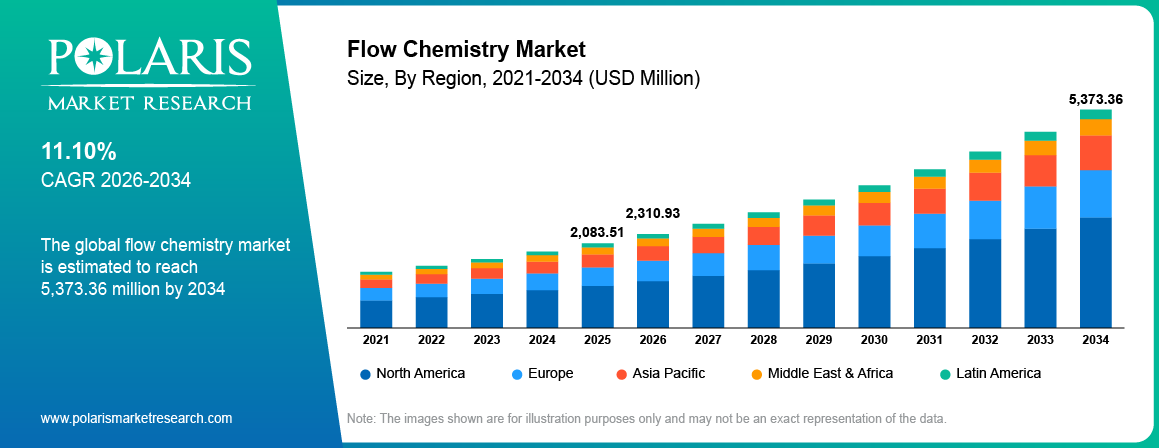
The global flow chemistry market is estimated around USD 2,083.51 million in 2025,?with consistent growth anticipated during 2026–2034. Growth is driven by growing adoption of continuous manufacturing and increasing demand for green and sustainable chemistry across chemical processing industries. The market is projected to grow at a CAGR of 11.10% during the forecast period.
Market Statistics
Industry Dynamics
- Increasing interest in continuous production technology is driving the need for flow chemistry technology in the production of pharmaceuticals and specialty chemicals.
- Increasing demand for green and sustainable chemistry is encouraging use of continuous reactors for efficient and low waste chemical synthesis.
- High capital investment requirements for flow reactor systems create adoption challenges for small and mid-scale manufacturers.
- Advancements in microreactor technology and digital manufacturing platforms are creating long term growth opportunities in the flow chemistry market.
What is Flow Chemistry?
Flow chemistry is a term used to describe a type of chemical processing in which chemicals are processed in a continuous flow instead of in stationary vessels. Reactants move through tubes or microreactor systems under controlled temperature and pressure conditions. Continuous chemical processing is a type of chemical processing that enhances control in chemical reactions and consistency in industrial production.
The flow chemistry market includes reactor systems, microreactor technology, and process control platforms used in pharmaceutical, specialty chemical, and fine chemical production. Continuous manufacturing chemistry enhances production yields, minimizes waste production, and optimizes complex chemical reaction handling.
Source: Polaris Market Research Analysis
To Understand More About this Research:Download Sample Report
Flow Chemistry vs Batch Processing
Batch processing is a type of chemical processing in which chemicals are processed in large vessels in which all chemicals are contained until completion. Flow chemistry operates through continuous streams where reactants pass through enclosed reactors under controlled process conditions.
Continuous flow chemistry improves heat transfer, reaction monitoring, and production efficiency. Smaller volumes of reaction help in handling hazardous reactions in a secure manner, thus lowering operational risks in chemical processing facilities.
Why Industries Are Transitioning to Continuous Manufacturing
Continuous chemical processing in industries is used to improve efficiency. This was made possible due to the use of flow chemistry systems, which have enabled the automation of processes in industries.
The use of continuous manufacturing chemistry in industries has been beneficial in improving yields while reducing wastes and improving efficiency in the use of energy. This has been seen in the use of microreactor technology in the global flow chemistry industry.
Drivers & Opportunities
Growing Adoption of Continuous Manufacturing: There is an increasing demand for flow chemistry systems due to the increased adoption of continuous manufacturing technology in pharmaceutical and specialty chemical manufacturing processes. Pharmaceutical companies are increasingly using flow reactors in the synthesis of APIs in order to improve the efficiency of the process. The microreactor technology has the potential to intensify the process in specialty chemical manufacturing.
Increasing Demand for Green and Sustainable Chemistry: The increasing focus on green chemistry trends is leading to the adoption of continuous chemical processing. For instance, the survey conducted by the Gordon and Betty Moore Foundation, where Morning Consult surveyed R&D leaders in 2026, indicates that over 90% of R&D leaders believe that green chemistry is a significant competitive advantage, while 76% have realized cost and innovation benefits due to the adoption of green chemistry. The flow reactors reduce the number of solvents and waste in the production of chemicals.
Restraints & Challenges
High Initial Equipment Costs: High capital costs are acting as one of the major impediments for adopting flow chemistry systems. Implementation of microreactor technology and automated control systems requires high capital costs. Small and medium-scale manufacturers may face difficulties in migrating to this technology from batch processing systems.
Opportunity
Integration with Automation and Digital Manufacturing: The integration of automation and digital manufacturing technologies is providing opportunities in the continuous flow chemistry market. Advanced control systems are used to monitor processes in real time, allowing for temperature, pressure, and flow rate monitoring. For instance, the automated pumps and control software from H.E.L Group including FlowCAT and WinISO are used to control processes in real-time to improve the efficiency of flow chemistry. These capabilities improve production control across API manufacturing, specialty chemicals, and petrochemical processing.
Source: Polaris Market Research Analysis
Segmental Insights
This report offers detailed coverage of the flow chemistry market by reactor type and application to help readers identify the fastest expanding and most attractive demand segments.
By Reactor Type
-
Microreactor Systems
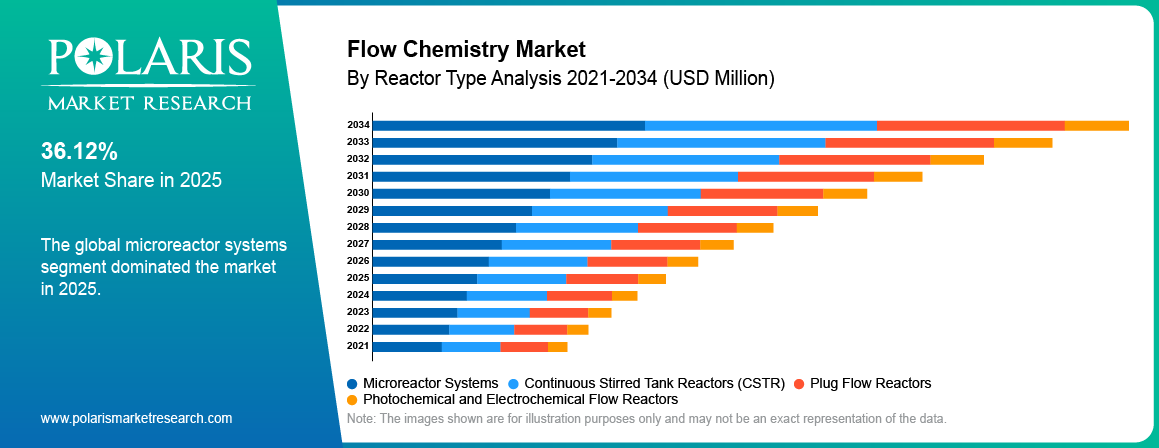
The microreactor systems segment dominated the market in 2025, driven by increasing adoption of microreactor technology in continuous chemical processing. These systems facilitate accurate control of the reaction as well as efficient heat transfer, which is required for chemical synthesis. The increasing trend of using chemical process intensification in the manufacture of pharmaceutical and specialty chemicals is fueling the growth of this segment.
-
Plug Flow Reactors
The plug flow reactors segment is expected to register the highest CAGR during the forecast period, owing to increasing demand for efficient continuous chemical processing systems. Plug flow reactors are chemical processing systems that allow reactants to pass through tubular systems where chemical reactions take place under controlled conditions.
By Application
-
Pharmaceutical Manufacturing
Pharmaceutical manufacturing segment accounted for the largest market share in 2025, owing to the increasing adoption of continuous flow chemistry for active pharmaceutical ingredients. Flow reactors are used for better control of chemical reactions and consistency of product quality in various pharmaceutical manufacturing processes. Growing demand for efficient drug production technologies is supporting segment growth.
-
Petrochemical Processing
The petrochemical processing segment is projected to grow at the fastest CAGR during the forecast period, due to increasing adoption of continuous reactors in large scale chemical production. Flow chemistry systems support improved reaction monitoring and production efficiency in petrochemical manufacturing facilities.
Source: Polaris Market Research Analysis
Regional Analysis
North America Market Assessment
The North America flow chemistry market dominated the global market in 2025. The US held a major pharmaceutical manufacturing hub and supports strong adoption of continuous manufacturing technologies. In September 2025, Hovione collaborated with Microinnova Engineering in assessing plug and play modular production equipment for flow chemistry, with the aim of improving scalability, efficiency, and speed in going from lab to industrial-scale pharmaceutical production. Large-scale API production and increased R&D spending are driving the demand for microreactor technology in different chemical processing plants. The region also benefits from strong chemical industry infrastructure and advanced industrial production capacity.
Asia Pacific Flow Chemistry Market Insights
Asia Pacific flow chemistry market is projected to grow at the fastest CAGR during the forecast period. Rapid industrial expansion across China, India, and Japan is increasing demand for advanced chemical processing technologies. For instance, National Bureau of Statistics stated that China’s value-added industrial output increased 4.9% year-on-year in October 2025, while cumulative industrial output increased by 6.1% during the first ten months of 2025 compared to the same period in 2024. China and India are expanding chemical manufacturing capacity across pharmaceutical, agrochemical, and specialty chemical production. Increasing R&D investment and growing pharmaceutical manufacturing hubs are supporting continuous manufacturing adoption by region.
Europe Flow Chemistry Market Overview
Europe flow chemistry market accounted for the second largest share in the global market. Strong regulatory focus on sustainable and green chemistry is encouraging adoption of continuous chemical processing across industrial manufacturing. For instance, the European Green Deal drives green pharmaceutical innovation and manufacturing across the EU through its carbon neutrality target for 2050, supported by regulatory frameworks such as REACH, the Strategic Approach to Pharmaceuticals in the Environment, and corporate net-zero emission commitments. In addition, Germany remains a key chemical production hub and supports development of advanced flow reactor technologies. Pharmaceutical and specialty chemical manufacturers across the UK and France are also increasing adoption of continuous manufacturing systems.
Latin America Market Outlook
The flow chemistry market in Latin America is witnessing gradual expansion due to increasing development of chemical manufacturing infrastructure. Countries across the region are investing in industrial production capacity and modern chemical processing technologies. Growing specialty chemical production is supporting early adoption of continuous flow chemistry systems.
Middle East & Africa Market Insights
The flow chemistry market in the Middle East is expanding due to increasing investments in petrochemical manufacturing and industrial processing technologies. For instance, in December 2025, ExxonMobil and Saudi Aramco have agreed to a Venture Framework Agreement to explore the possibility of converting their refinery in Yanbu into an integrated petrochemical plant, thus enhancing the availability of continuous chemical processing facilities and flow chemistry in large-scale production. Saudi Arabia and UAE are improving their chemical production facilities through large-scale petrochemical plant developments. Rising demand for advanced chemical processing is supporting adoption of continuous flow chemistry systems.

Source: Polaris Market Research Analysis
Key Players & Competitive Analysis Report
The competitive environment in the flow chemistry market is shaped by increasing development of advanced continuous reactor technologies and microreactor systems. The focus of companies is to enhance control over reaction control, process efficiency, and automation in continuous processing systems. Strategic alliances between chemical companies, technology companies, and research organizations are facilitating the use of flow chemistry in the synthesis of pharmaceuticals and specialty chemicals.
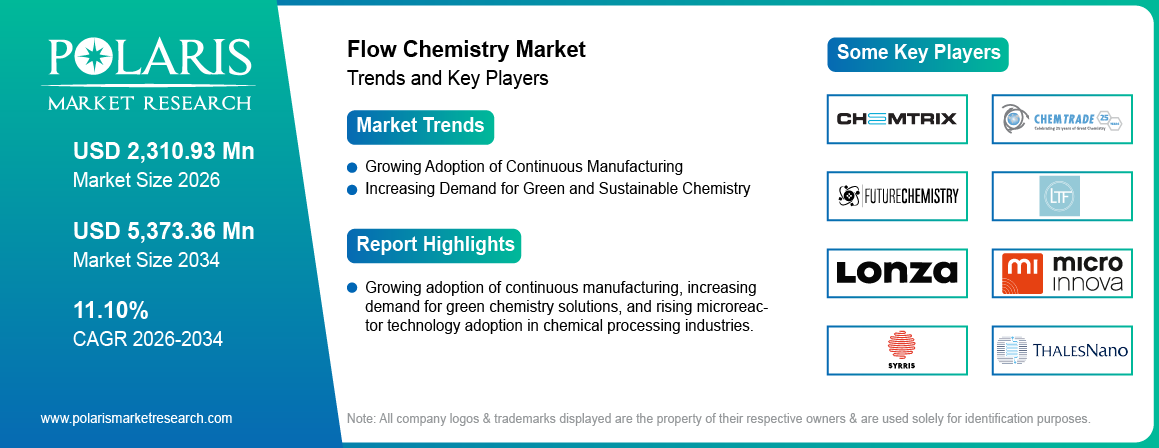
The key players operating in the flow chemistry market are Corning Incorporated, Syrris Ltd., ThalesNano Inc., Vapourtec Ltd., Lonza Group Ltd., Ehrfeld Mikrotechnik GmbH, Uniqsis Ltd., AM Technology Ltd., Microinnova Engineering GmbH, Chemtrix B.V., FutureChemistry Holding B.V., Little Things Factory GmbH, and many more.
Supply Chain, Pricing Trends & Regulatory Landscape
Flow Chemistry Supply Chain Analysis
The flow chemistry supply chain includes raw material suppliers, reactor manufacturers, and end user chemical producers. Equipment manufacturers develop microreactor systems, flow reactors, and process control platforms used in continuous chemical processing. Pharmaceutical, specialty chemical, and petrochemical industries function as key end users of flow chemistry technologies.
Pricing Trends in Flow Chemistry Equipment
Flow chemistry equipment pricing depends on reactor design, material composition, and automation capabilities. Microreactor systems, control systems, and monitoring systems add to the overall cost of the system. Installation, maintenance, and process integration costs are additional costs that influence the cost of the equipment in various production industries.
Regulatory Trends in Continuous Manufacturing
Regulations for continuous manufacturing are changing to support the development of advanced chemical processing technologies. The FDA and European authorities are supporting continuous manufacturing for pharmaceutical production. These are the regulatory frameworks that support better quality, monitoring, and manufacturing efficiency for the chemical and pharmaceutical industry.
Key Players
- AM Technology Ltd.
- Chemtrix B.V.
- Corning Incorporated
- Ehrfeld Mikrotechnik GmbH
- FutureChemistry Holding B.V.
- Little Things Factory GmbH
- Lonza Group Ltd.
- Microinnova Engineering GmbH
- Syrris Ltd.
- ThalesNano Inc.
- Uniqsis Ltd.
- Vapourtec Ltd.
Industry Developments
- August 2025: Asymchem expanded its flow chemistry capabilities at its Sandwich, UK facility by installing proprietary CE-certified flow equipment and advanced reactor platforms to support continuous manufacturing processes and future pilot-to-commercial scale production. (Source: asymchem.com)
- October 2025: Evonik launched the Noblyst F catalyst portfolio designed for flow chemistry applications, featuring precious metal catalysts on carbon granules in multiple particle sizes to improve catalytic efficiency and support continuous processing in pharmaceutical and fine chemical manufacturing. (Source: evonik.com)
Flow Chemistry Market Segmentation
By Reactor Type Outlook (Revenue, USD Million, 2021-2034)
- Microreactor Systems
- Continuous Stirred Tank Reactors (CSTR)
- Plug Flow Reactors
- Photochemical and Electrochemical Flow Reactors
By Application Outlook (Revenue, USD Million, 2021-2034)
- Pharmaceutical Manufacturing
- Specialty Chemicals Production
- Petrochemical Processing
- Academic & Research
By Regional Outlook (Revenue, USD Million, 2021-2034)
- North America
- US
- Canada
- Europe
- Germany
- France
- UK
- Italy
- Spain
- Netherlands
- Russia
- Rest of Europe
- Asia Pacific
- China
- Japan
- India
- Malaysia
- South Korea
- Indonesia
- Australia
- Vietnam
- Rest of Asia Pacific
- Middle East & Africa
- Saudi Arabia
- UAE
- Israel
- South Africa
- Rest of Middle East & Africa
- Latin America
- Mexico
- Brazil
- Argentina
- Rest of Latin America
Flow Chemistry Market Report Scope
| Report Attributes | Details |
| Market Size in 2025 | USD 2,083.51 Million |
| Market Size in 2026 | USD 2,310.93 Million |
| Revenue Forecast by 2034 | USD 5,373.36 Million |
| CAGR | 11.10% from 2026 to 2034 |
| Base Year | 2025 |
| Historical Data | 2021–2024 |
| Forecast Period | 2026–2034 |
| Quantitative Units | Revenue in USD Million and CAGR from 2026 to 2034 |
| Report Coverage | Revenue Forecast, Competitive Landscape, Growth Factors, and Industry Trends |
| Segments Covered |
|
| Regional Scope |
|
| Competitive Landscape |
|
| Report Format |
|
| Customization | Report customization as per your requirements with respect to countries, regions, and segmentation. |
Source: Polaris Market Research Analysis
Flow Chemistry Market FAQ's
The global market size was valued at USD 2,083.51 million in 2025 and is projected to grow to USD 5,373.36 million by 2034.
North America dominates the market due to strong pharmaceutical manufacturing capacity and high adoption of continuous chemical processing technologies.
Major applications include pharmaceutical manufacturing, specialty chemicals production, petrochemical processing, and chemical research.
A few of the key players in the market are Corning Incorporated, Syrris Ltd., ThalesNano Inc., Vapourtec Ltd., Lonza Group Ltd., Ehrfeld Mikrotechnik GmbH, Uniqsis Ltd., AM Technology Ltd., Microinnova Engineering GmbH, Chemtrix B.V., FutureChemistry Holding B.V., Little Things Factory GmbH, and others.
Key market drivers include growing continuous manufacturing adoption, rising demand for green chemistry, and increasing use of microreactor technology in chemical production.
Major end users include pharmaceutical companies, specialty chemical manufacturers, petrochemical producers, and research institutions.
The market outlook remains strong due to expanding continuous manufacturing adoption and increasing demand for efficient chemical production technologies.
Download Sample Report of Flow Chemistry Market
Please fill out the form to request a customized copy of the research report.


