
Counter Drone Systems for Critical Infrastructure and Airports Market Size, Share, Trends & Forecast, 2026–2034
REPORT DETAILS
Counter Drone Systems for Critical Infrastructure and Airports Market Summary
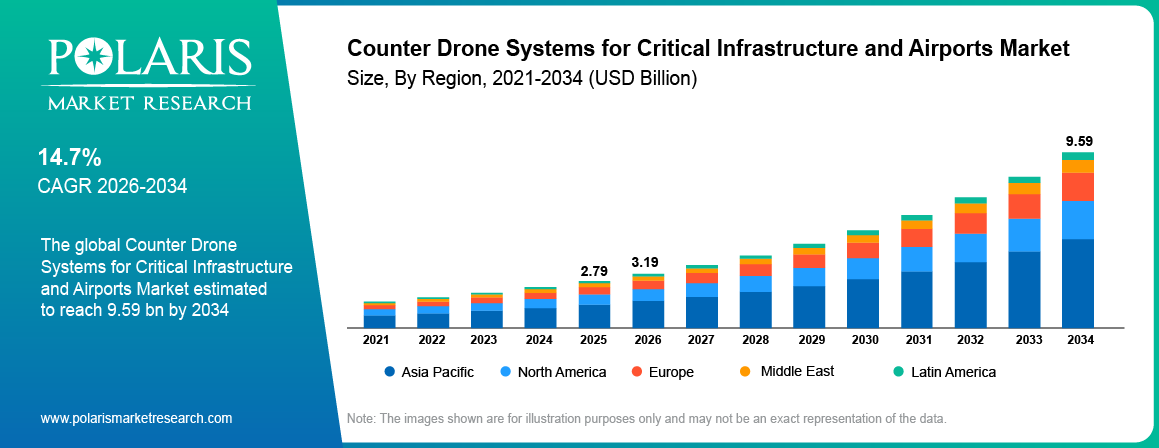
The global counter drone systems for critical infrastructure and airports market was valued at USD 2.79 billion in 2025 and is projected to grow at a CAGR of 14.7% from 2026 to 2034. Market growth is driven by persistent drone incursions, rising government procurement, and adoption of multi sensor fusion.
Market Statistics
Counter Drone Systems Market for Critical Infrastructure and Airports Market Key Takeaways
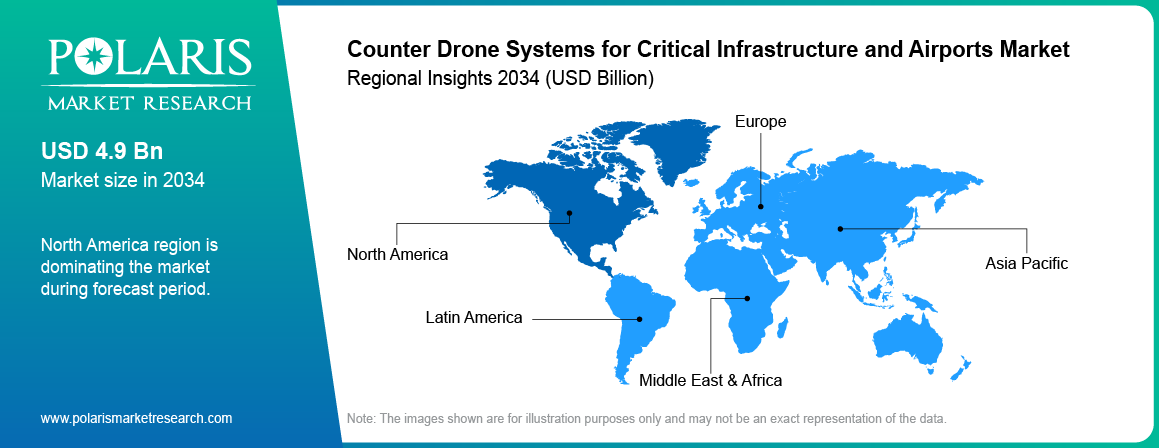
- The North America counter drone systems for critical infrastructure & airports market share was 44.58% in 2025. The dominance is driven by its large critical infrastructure base, and strong ecosystem of radar, RF, C2, and interceptor suppliers.
- The market in Asia Pacific is expected to exhibit a 17.44% CAGR during the forecast period. The growth is attributed to rising defense modernization, and rapid commercial drone adoption.
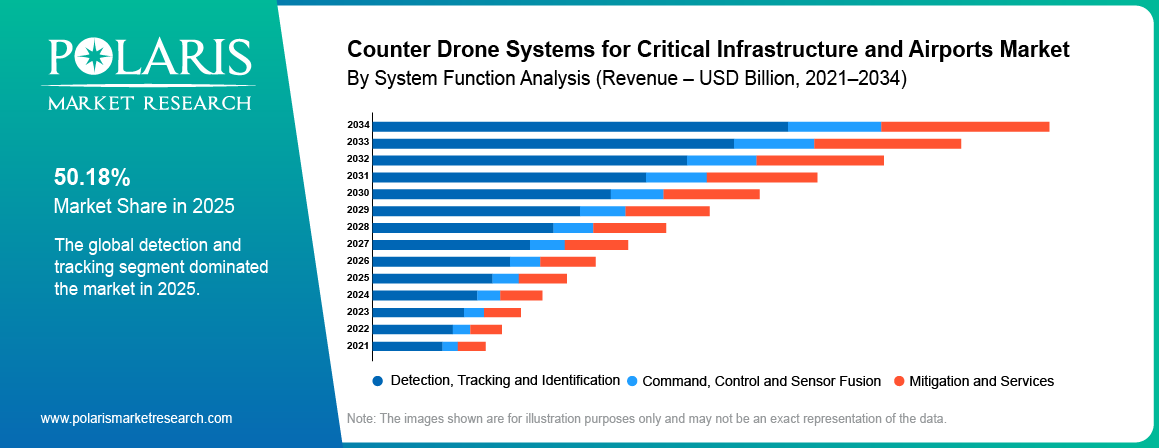
- The detection and tracking segment accounted for a major market share of 50.18% in 2025. The leading share is fueled by the growing need to identify, locate, and continuously monitor unauthorized drones around airports and critical infrastructure.
- The mobile and vehicle-mounted segment is projected to record a 15.27% CAGR during the forecast period, owing to the increasing requirement of flexible counter-drone deployment at various locations and temporary security zones.
- Radio frequency held significant share of 28.64% in the base year due to its ability to detect drone communication signals and identify unauthorized UAS activity at critical infrastructure and airports.
Note: Figures and projections outlined in this report are the result of Polaris Market Research’s proprietary analytical processes, grounded in the latest available datasets and market observations
What is Counter Drone Systems for Critical Infrastructure and Airports Market?
The counter drone systems for critical infrastructure and airports market comprise of technologies and services designed to detect, track, identify, monitor, and mitigate unauthorized or malicious uncrewed aircraft operating near protected sites. The market focuses on integrated counter-drone capabilities that support continuous aerial threat monitoring and coordinated responses.
The market includes detection and tracking systems, identification and classification technologies, command and control platforms, incident recording solutions, and drone mitigation systems. These solutions are used across airports, energy facilities, transportation infrastructure, government facilities, and industrial sites. Military battlefield applications, naval defense, and mobile force-protection systems are excluded unless they are used to protect fixed infrastructure assets.
Growth in the market is driven by increasing drone availability, lower barriers to unauthorized drone operations, and the operational and economic sensitivity of protected sites. Airports require continuous monitoring as unauthorized drones can disrupt runway and flight operations, while government complexes, and other industries require protection against unauthorized aircraft entering restricted airspace. These factors are driving the demand for critical infrastructure drone defense that integrates drone detection, tracking and response with existing physical security and surveillance systems.
Market Dynamics
Driver Impact Analysis
| Market Driver | Geographic Relevance | Impact Timeline |
| Persistent Drone Incursions Near Airports | North America, extending to Europe and Asia Pacific | Immediate and ongoing |
| Rising Government Procurement | Europe and North America, through NATO member states | Medium-term: five-year investment window through 2031 |
| SAFER SKIES Act and FEMA C-UAS Grant Program | North America | Near-term: authority granted December 2025 |
| Multi-Sensor Fusion Adoption | Global, led by North America and Europe | Near-term: already in commercial deployment, |
| Scalable Fixed-Site Protection Demand | Asia Pacific and Middle East | Medium-term |
Source: Polaris Market Research Analysis
Driver: Persistent Drone Incursions are Accelerating Demand for Continuous Airspace Security
The danger of unauthorized drone activity at airports and other critical infrastructure is increasing, which is leading to the need of airspace monitoring. For example, in 2026, the US Federal Aviation Administration (FAA) said it received more than 100 reports of UAS sightings near airports each month from pilots, citizens and law enforcement. This ongoing activity is driving demand for counter drone security solutions that can detect, track, identify and assess drone activity before it interferes with airport and critical infrastructure operations (Source: faa.gov).
It shows that there is an increasing demand for airport counter drone systems and critical infrastructure drone defense systems that can offer real-time airspace awareness and develop normal activity patterns. These requirements are supporting demand for counter UAS systems, integrated airspace monitoring and counter drone security solutions across airports, and other high-value sites.
Driver: Rising Government Procurement is Accelerating Layered Counter Drone Architectures
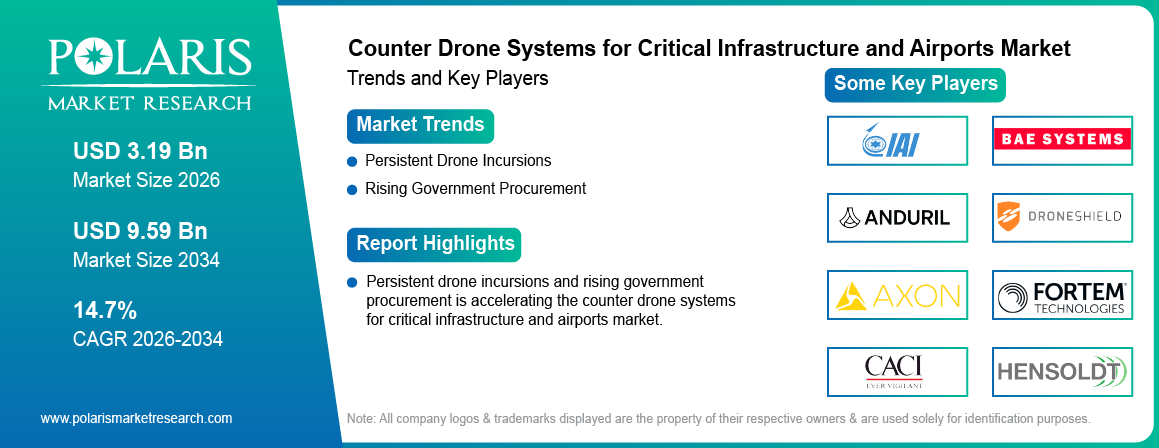
The increasing government procurement of counter drone technology is driving demand for counter drone systems for critical infrastructure and airports market. For instance, in 2026, NATO Allies announced to invest more than USD 40 billion in counter-drone capabilities over the next five years and also planning to increase the number of trained drone operators by five times by the end of 2027. Such programs are supporting modular systems that can combine radar, RF detection, optical sensing, command software, and different response options (Source: aero-space.eu).
These developments are leading to greater adoption of anti-drone systems for airports and other critical sites, where buyers need reliable protection instead of single-purpose equipment. New procurement programs are also increasing demand for command and control software, electronic warfare, EO and IR sensors, training, maintenance, and system integration.
Restraint: Legal Authority and Aviation Safety Limit Counter Drone Deployment
Legal hurdles are slowing down the deployment of counter drone systems at airports and critical infrastructure. Radio frequency drone detection is easier to use than jamming or other active drone defeat systems. They need special legal approval due to their ability to interfere with communication and navigation systems. This causes differences in deployment across countries and hinders the application of the entire counter drone solutions.
Safety requirements also add to time and cost of deployment. Airport operators must test systems including low altitude radar, jamming systems and laser systems before using near aircrafts. They need to check for interference, risk of debris, false engagement and safe areas of operation. These requirements add to testing and documentation requirements which can delay procurement of counter drone systems.
Opportunity: Adoption of Multi Sensor Fusion Can Reduce False Alarms and Operator Workload
Multi sensor fusion is one of the key opportunity areas in the counter drone systems market. Reliable drone detection is essential at airports and other critical infrastructure sites, regardless of weather or operating conditions. The combination of radar, radio frequency, cameras and acoustic sensors improve the detection, tracking and classification of drones. It can also provide electro optical infrared tracking for improved visual verification. This reduces false alarms and lets security teams focus on real threats.
The biggest opportunity is linking sensor fusion with existing airport and security systems. A single platform can combine sensor data, verify drone alerts, track the drone, and support faster response. It can also connect with CCTV and other security systems. For instance, Fortem Technologies announced that its SkyDome System combines radar, optics, and AI-enabled drone detection with existing sensors and security systems. Showing that sensor fusion can give security teams one clear view of drone threats (Source: fortemtech.com).
Opportunity: Critical Infrastructure Buyers are Moving Toward Scalable Fixed Site Protection
Critical infrastructure operators need continuous protection around airports, data centers, power plants, ports, and government sites. This creates demand for scalable counter drone systems that can start with basic detection and expand with radar, RF sensors, cameras, and drone remote identification. Suppliers can offer flexible systems that match the size, location, and risk level of each site.
Buyers are also moving toward integrated platforms that bring all sensor data into one view. Command and control software helps teams verify threats and reduce false alarms. Electronic warfare mitigation directed energy counter UAS, and interceptor drones can be added when legally permitted. This creates opportunities for modular systems that work with existing security networks and support different response options.
Counter Drone Systems for Critical Infrastructure and Airports Market Segmentation Analysis
The report provides a comprehensive analysis of the Counter drone systems for critical infrastructure and airports market by system function, deployment model, detection technology, mitigation method, end-use asset, and region to identify the leading revenue-generating segments and emerging growth opportunities.
System Function Insights
Detection, tracking and identification segment dominated with market with the estimated market share of 50.18% in 2025. This is majorly due to the growing need to identify, locate, and continuously monitor unauthorized drones around airports and critical infrastructure. Increasing drone activity and airspace security requirements are further supporting demand for these systems. These capabilities help security teams establish early awareness of drone threat classification events. They also support continuous surveillance across sites. Improved sensor performance enables operators to detect drones at greater distances and track their movement with consistency. Demand is further supported by the need to reduce response time and strengthen situational awareness during critical security incidents at facilities.
The command, control and sensor fusion segment is projected to record the highest CAGR of 16.17% during the forecast period. This is due to the growing need to integrate data from radar, RF, electro-optical, and acoustic sensors. Increasing demand for central monitoring and coordinated response will further drive the segment growth. These systems allow security teams to correlate information into a single view for security teams. They can improve the geolocation accuracy for the drone operators and allow them to make decisions quickly. Centralized platforms offer an interface for personnel to coordinate detection and mitigation activities. The growing complexity of systems is forcing operators to turn to more advanced data management capabilities.
The mitigation and service segment is expected to have a 31.06% market share in 2025. It includes soft-kill and hard-kill technologies, as well as installation and maintenance. This demand is driven by the demand for response capabilities that can be deployed, as well as the lifecycle support of critical infrastructure and airport security environments. Mitigation solutions allow security teams to take action when a drone is detected and classified as a threat. Service providers support system deployment, configuration, testing and upgrades. Demand is increasing as operators look to ensure reliable security through the system lifecycle. Further integrating with existing security infrastructure can enhance operational continuity. These requirements are driving adoption across facilities with different security and airspace protection requirements.
Deployment Model Insights
Fixed site dominated the industry with a market share of 48.83% in 2025. This growth is majorly due to the growing deployment of continuous drone detection and mitigation systems at airports and critical infrastructure facilities. Increasing need for persistent airspace monitoring, perimeter protection, and integration with existing security infrastructure is supporting the segment demand. These systems offer reliable security for facilities that need constant surveillance. Fixed installations give broader detection coverage and allow for coordinated response through established command networks. Their permanent positioning helps operators maintain consistent coverage without frequent relocation.
The mobile and vehicle-mounted segment is expected to grow at the highest CAGR of 15.27% during the forecast period. The main reason behind this growth is due to the increasing requirement for flexible counter-drone deployment at various locations and temporary security zones. The growth of the segment will be boosted by the increasing demand for rapidly deployable systems for airport operations, critical infrastructure protection and high-risk events. Mobile and vehicle-mounted solutions can be repositioned according to changing security requirements. Their mobility allows security teams to cover zones without installing permanent equipment. These systems can support surveillance during heightened security demand.
Portable systems are also growing rapidly with 14.95% CAGR from 2026 to 2034. It enables rapid deployment where permanent counter-UAS infrastructure is not feasible. They are used in emergency response, and maintaining operations, with compact detection and mitigation equipment that allows for rapid deployment and redeployment to different locations. Portable systems offer value in providing temporary coverage to existing security measures at sites where flexible systems are a requirement. These systems can be moved from location to location as priorities shift by operators. This mobility supports short-duration needs without the infrastructure investment of fixed installations.
Detection Technology Insights
Radio frequency held significant share of 28.64% in 2025. This dominance is due to its ability to detect drone communication signals and identify unauthorized UAS activity at critical infrastructure and airports. Growing deployment of RF-based detection for continuous airspace monitoring and early threat identification is further supporting demand. This technology also supports persistent surveillance and helps security teams detect threats before drones approach sensitive zones or restricted areas.
Radar segment accounted for the largest market share of 33.41% in 2025. This segment is gaining importance in the detection of drones that do not operate with known RF signals, including modified and autonomous UAS. Tracking of physical targets in critical infrastructure and airport environments address the need for strong detection and continuous surveillance of airspace. This provides early warning when communication signals are unavailable. It enables security teams to see aerial activity in complex operational areas and allows for rapid responses around sensitive facilities.
Electro-optical and infrared sensors accounted for 15.86% share in 2025, providing visual confirmation and classification once radar or RF sensors detect a possible threat. These systems help operators distinguish drones from birds and other aircraft, reducing false positive responses at airports and other sensitive sites.
Acoustic sensors and Remote ID and cooperative identification systems together accounted for 6.12% share in 2025. Acoustic sensors detect propeller and motor signatures in environments where RF and radar performance is degraded, while Remote ID correlates broadcast identification data from compliant drones with sensor tracks to reduce the pool of unidentified targets operators must investigate.
Mitigation Method Insights
RF and Electronic countermeasures segment accounted for a market share of 43.08% in 2025. This segment dominated the market due to their wide applicability in disrupting unauthorized drone communications and navigation signals. The increasing use of non-destructive mitigation solutions at airports and critical infrastructure sites is further boosting growth. The systems also enable security teams to neutralize drone threats with minimal disruption to operations.
The directed energy segment is projected to grow at the highest CAGR of 18.31% during the forecast period. Growing demand for accurate, quick and scalable drone neutralization systems are pushing its growth. Higher security requirements and progress in high-power laser and electromagnetic technologies will further boost segment growth. Their accuracy can improve responses in areas where traditional mitigation approaches are restricted. Through technology development, deployment flexibility and performance will be further improved.
Protocol takeover systems accounted for 15.92% share in 2025. Unlike jamming, these systems intercept and override a drone's control link to force a safe landing without broadcasting disruptive RF energy, an approach regulator increasingly favor because it avoids the risk of interfering with nearby aviation communications.
Kinetic interception and other physical mitigation methods together accounted for 28.04% share in 2025. These include interceptor drones, nets, and projectile systems used where electronic methods are unsuitable, such as against drones operating without a radio link to a controller.
End-Use Asset Insights
The airports segment is estimated to have the market share of 31.16% in 2025. This growth is due to the increasing need to protect aircraft operations, runways, and restricted airspace from unauthorized drone activity. Higher airport security requirements and operational disruption from drone incidents are boosting demand for counter drone systems. Airports are also increasing their detection capabilities to detect and respond to potential drone threats early. The growth of passenger traffic and airport infrastructure are generating further demand for reliable protection of the airspace. These systems enable security teams to continue operations and reduce the risk of unauthorized drone activity.
The data centers and telecommunication segment is expected to grow at the highest CAGR of 17.20% during the forecast period, due to the growing requirement to secure data center facilities from unauthorized drone surveillance and intrusion. For instance, in 2026, Terra Drone announced the development of a C-UAS system to protect critical infrastructure, with data centers and telecommunications facilities among its initial target sectors. The system combines interceptor drones, AI-based tracking, sensor integration, and command-and-control capabilities (Source: terra-drone.net).
Energy and utilities facilities accounted for 22.04% share in 2025, as power plants, substations, and pipeline infrastructure face growing drone-enabled surveillance and sabotage risk. These sites typically require wide-area perimeter coverage across terrain that is harder to monitor than an airport's controlled airspace.
Ports, transportation hubs, and government and public infrastructure together accounted for 26.85% share in 2025. Ports require coverage across mixed land and water approaches, while government facilities often need layered protection combined with strict audit and evidence trail requirements for any mitigation action taken.
Regional Analysis
The counter drone systems for critical infrastructure and airports market regional analysis comprises North America, Europe, Asia Pacific, Latin America, and Middle East and Africa. This segmentation is based on the rising need for airport security, drone detection and mitigation, regulatory requirements, and the availability of counter-UAS technology providers and security solutions across these regions.
North America Counter Drone Systems for Critical Infrastructure and Airports Market Trends
North America dominated the counter drone systems for critical infrastructure and airports market with 44.58% share in 2025. This is due to its large critical infrastructure base, and strong ecosystem of radar, RF, C2, and interceptor suppliers. The US leads the region, supported by airport security programs and federal procurement, driving demand for anti-drone systems for airports.
The region is expected to retain its leading position during the forecast period due to rising investment in airspace security and counter-UAS technologies. For instance, in 2026, DroneShield announced that it completed the US deployment and acceptance of its DroneSentry-X Mk2 counter-UAS systems under a JIATF-401 contract. The systems provide mobile drone detection and electronic countermeasures for US military forces (Source: droneshield.com).
Europe Counter Drone Systems for Critical Infrastructure and Airports Market Trends
Europe held a significant market share of 25.24% in the counter drone systems for critical infrastructure and airports market in 2025. This is driven by rising concerns over drone-related airport disruption and threats to critical infrastructure, with stronger focus on drone detection, coordinated response, and counter-drone deployment. This is further driving demand for low altitude radar and other airport and infrastructure protection systems.
It is projected that this region will continue to grow due to rising investment in counter-drone capabilities and the development of common procurement systems. For instance, in 2026, German deep-tech company INLEAP Photonics raised USD 22.98 million to scale production and expand its laser-based drone defense solutions. Growing focus on interoperable technologies is expected to support further demand for radar, command and control, and other integrated counter-drone systems across Europe (Source: inleap-photonics.com).
Asia Pacific Counter Drone Systems for Critical Infrastructure and Airports Market Trends
Asia Pacific is estimated to record the highest CAGR of 17.44% during the forecast period. This is due to rising defense modernization, and rapid commercial drone adoption. Countries such as China, India, and Australia are increasing their investments in airspace security and counter-drone systems which is further driving the market growth. For instance, in 2026, the Albanese Government announced that Australia will more than double its investment in counter-drone capabilities, with up to USD 7 billion allocated to the Australian Defence Force over the next decade (Source: defence.gov.au).
In addition, the region will benefit from increasing demand for sensor fusion and integrated drone detection across airports, ports, energy facilities, and other strategic sites. Dense urban areas and complex RF environments increasingly need radar, RF, electro-optical, and infrared sensors that can improve drone identification and reduce false alarms. Drone remote identification and data-sharing capabilities are also becoming important for improving airspace awareness and response coordination.
Latin America Counter Drone Systems for Critical Infrastructure and Airports Market Trends
The Latin America counter drone systems for critical infrastructure and airports market is growing at 14.84% CAGR from 2026 to 2034, owing to the need to protect strategic government and energy assets and address drone-enabled criminal activity. In 2025, DroneShield reported a USD 9.7 million contract package from a defense technology reseller in Latin America, showing active demand for counter drone systems in the region (Source: listcorp.com).
Further development of critical infrastructure security will lead to growing demand for counter drone solutions in the region. Buyers are likely to favor modular systems that can start at high-risk sites and expand as funding becomes available. Local training, spare parts, remote software support, and command and control software will also support regional deployment.
Middle East and Africa Counter Drone Systems for Critical Infrastructure and Airports Market Trends
The Middle East and Africa market is driven by the increasing security needs around airports, oil and gas facilities, government sites, and other high-value assets. Demand is supported by the need for integrated radar, EO/IR, and electronic warfare mitigation systems, particularly across Gulf countries. Harsh climate, dust, heat, and large perimeter distances are also increasing the need for reliable sensor performance and maintenance support.
The development of the regional market is expected to be driven by investments in airport security, energy infrastructure, government facilities, and integrated counter-UAS solutions. Buyers are looking for systems that connect sensors with command, control platforms and support future upgrades. This trend will create opportunities for layered detection and directed energy counter UAS solutions, while demand will also depend on national regulations, and the ability to integrate systems with existing security infrastructure.
Counter Drone Systems for Critical Infrastructure and Airports Market Competitive Landscape
Competition in the counter drone systems for critical infrastructure and airports market mainly revolves around RF detection, radar, electro optical verification, AI classification, command and control, electronic warfare, interceptor systems, and directed energy. Leading firms are moving toward integrated systems that combine multiple sensors and effectors into scalable counter-UAS architectures.
Counter Drone Systems for Critical Infrastructure and Airports Market Competitive Landscape Snapshot
| Company | Headquarters | Estimated Market Position | Notable Recent Move |
| RTX Corporation | United States | Market Leader | Coyote interceptor program continues to expand under US Army layered defeat contracts |
| Lockheed Martin Corporation | United States | Market Leader | Developing modular counter-drone architectures across its air defense portfolio |
| Thales Group | France | Established | Hologarde and Squire radar systems anchor European airport and event deployments |
| Leonardo S.p.A. | Italy | Established | Falcon Shield deployed across multi-domain, scalable sensor and effector architectures |
| Elbit Systems Ltd. | Israel | Established | Radar, EW, and EO/IR capabilities extended into critical infrastructure protection |
| Israel Aerospace Industries Ltd. | Israel | Established | Combat-proven detection and defeat systems adapted for civilian critical sites |
| Rafael Advanced Defense Systems Ltd. | Israel | Established | Drone Dome and C-Guard, combat-proven multi-domain integration |
| HENSOLDT AG | Germany | Established | Radar and sensor systems anchoring European C-UAS procurement |
| Saab AB | Sweden | Established | Integrated air defense and radar portfolio extended to C-UAS |
| BAE Systems plc | United Kingdom | Established | Defense-grade sensor and effector integration entering the civil C-UAS space |
| Anduril Industries, Inc. | United States | Emerging Challenger | Awarded a Dutch Ministry of Defence contract in May 2026, IOC in under one month using Lattice C2 |
| Motorola Solutions, Inc. (D-Fend Solutions) | United States (D-Fend: Israel) | Emerging Challenger | Completed USD 1.5B acquisition of D-Fend in August 2026, adding RF cyber-takeover to its public-safety distribution channel |
| DroneShield Limited | Australia | Emerging Challenger | Completed US deployment and acceptance of DroneSentry-X Mk2 under JIATF-401, 2026 |
| CACI International Inc. | United States | Emerging Challenger | Secured a USD 500M JIATF-401 IDIQ in July 2026, SkyValor moving to full-rate production |
| Axon Enterprise, Inc. (Dedrone) | United States | Emerging Challenger | DedroneTracker.AI extended across combined mobile and fixed airport deployments |
| Rohde & Schwarz GmbH & Co. KG | Germany | Niche Specialist | ARDRONIS RF-centric detection built specifically for airport workflows |
| General Dynamics Information Technology, Inc. | United States | Niche Specialist | Systems integration layered onto federal C-UAS programs |
| Robin Radar Systems B.V. | Netherlands | Niche Specialist | Dedicated counter-drone radar manufacturer serving fixed-site deployments |
| Fortem Technologies, Inc. | United States | Niche Specialist | SkyDome combines radar, optics, and AI-enabled detection into one operating view |
Source: Company filings and Polaris Market Research Analysis
Large defense and aerospace firms such as RTX, Leonardo, Thales, HENSOLDT, Saab, Elbit Systems, and Israel Aerospace Industries offer radar, electronic warfare, EO/IR, and systems integration capabilities. Specialized firms such as DroneShield and Dedrone by Axon compete through RF intelligence, software-based airspace awareness, mobile systems, and recurring services. CACI and Anduril also focus on common operating pictures and modular sensor and effector integration, including interceptor drones.
A critical differentiation factor is reliable drone threat classification and response across complex airspace. Detection accuracy, false alarm control, drone and operator localization, open C2 interfaces, cybersecurity, evidence retention, and aviation compatibility are key factors for airport deployments. Vendors also compete on their ability to integrate detection and mitigation systems with existing airport security procedures.
Counter Drone Systems for Critical Infrastructure and Airports Market Technology and Innovation Landscape
Counter Drone Systems for Critical Infrastructure and Airports Market Technology and Innovation Landscape Snapshot
| Technology | Leading Developer(s) | Key Capability | Status |
| Software-First Command and Control | Anduril (Lattice) | Links third-party sensors and effectors into one autonomous response network | Deployed; backbone of the Dutch MoD contract, IOC in under one month |
| RF Cyber-Takeover Mitigation | Motorola Solutions (D-Fend, EnforceAir) | Overrides drone communications for a controlled landing without jamming | Deployed in 30+ countries; expanding under Motorola's public-safety channel |
| Modular Non-Kinetic Detect and Defeat | CACI (SkyValor) | Detects and defeats small UAS beyond visual line of sight | In full-rate production under a USD 500M JIATF-401 IDIQ |
| Multi-Sensor Fusion Platforms | Fortem Technologies (SkyDome) | Combines radar, optics, and AI-enabled detection into one operating view | Commercially deployed |
| Mobile RF Detection and Electronic Countermeasures | DroneShield (DroneSentry-X Mk2) | Mobile drone detection paired with electronic countermeasures | Completed US deployment and acceptance under JIATF-401 |
| Laser-Based Directed Energy | INLEAP Photonics | Scalable laser drone defeat systems | Early commercial scale-up; raised USD 22.98M in 2026 |
| RF-Centric Detection and Localization | Rohde & Schwarz (ARDRONIS) | Detects, localizes, and verifies drones for airport-specific workflows | Deployed |
Source: Company filings and Polaris Market Research Analysis
Multi-sensor fusion is becoming an important technology for counter drone systems as small drones are difficult to detect at low altitude and in crowded airspace. AI systems can combine radar, RF, visual, and acoustic data to improve drone detection, tracking, and threat assessment. Edge processing can also reduce response time and support local data handling at airports and critical infrastructure sites.
Electronic countermeasures are also advancing toward more controlled and target-specific responses. Hard-kill systems such as interceptor drones, guided interceptors, and high-energy lasers are being combined with directional jamming, protocol-aware takeover and geolocation of drone operators. These technologies provide layered airspace security by allowing operators to select responses based on the type and level of the drone threat.
Software is becoming a key innovation layer in the counter drone market report as systems need to support new sensors, threat libraries, AI models, Remote ID data, and response rules. Open C2 interfaces, cybersecurity, automated threat classification, incident replay, and simulation are improving system flexibility. These capabilities allow vendors to update and integrate counter-drone systems without replacing the full hardware setup.
Buyer Analysis and Market Entry Barriers
Key participants in the airport counter UAS market analysis include airport operators, government security agencies, energy companies, data center operators, ports, transport hubs, and other critical infrastructure owners. The critical infrastructure drone security forecast considers evolving buyer requirements and security needs across these sites. Airports focus on aviation safety, false alarm management, ATC coordination, and continuity of operations. Other sites focus on Perimeter coverage, threat detection and authorized response.
Typically, a purchase involves four roles: security teams set out the threat scenarios, technical and IT teams evaluate the cyber risks and system integration, regulatory teams define the allowable responses, and procurement teams evaluate the vendor support and lifecycle costs. Buyers also prioritize coverage, detection accuracy, false alarms, maintenance, software updates and total cost of ownership.
The key entry barriers in counter drone systems industry analysis include proven performance against changing drone threats, regulatory and spectrum compliance, aviation compatibility, cybersecurity, and integration with sensitive networks. New vendors also need reference deployments, testing, certifications and partnerships with established security integrators to build procurement trust.
New entrants can compete in areas such as RF intelligence, low altitude radar, edge AI classification, camera cueing, and low cost interceptors. The most practical approach is to integrate with existing C2 platforms rather than replacing the entire security system. Partnerships with airport security integrators, radar companies, and authorized response agencies can help shorten the path to deployment of counter UAS systems.
Buyer Decision Framework Snapshot
| Buyer | Primary Need | Critical KPI | Typical Constraint |
| Airport operator | Continuity and safe airspace awareness | False alarm rate, localization, integration | Mitigation authority and aviation safety |
| Energy / utility | Persistent perimeter protection | Coverage, uptime, threat classification | Large site geometry and hazardous areas |
| Data center / telecom | Protection from surveillance or disruption | Passive detection, evidence, cyber security | Urban RF clutter and privacy |
| Port / transport hub | Wide area mixed terrain coverage | Sensor fusion and mobile response | Land and water approaches |
| Government facility | Layered protection and response | Interoperability and audit trail | Authority, procurement, classified requirements |
Source: Polaris Market Research Analysis
Counter Drone Systems for Critical Infrastructure and Airports Market Premium Insights and Forward Outlook
The airport counter drone systems market is expected to remain focused on detection-first solutions as mitigation is subject to legal and safety requirements. Airports and private infrastructure can first adopt persistent sensing, drone classification, localization, evidence collection, and command and control before adding mitigation systems. Modular solutions can also allow buyers to add sensors and other capabilities as their needs change.
The cost of protection is expected to become more important than the cost of individual devices in critical infrastructure drone defense. Permanent deployments require software, maintenance, calibration, training, network connectivity, and sensor replacement. Buyers will increasingly compare these costs with reduced disruption, faster incident response, and the ability to use one C2 platform across multiple sites.
The market is also expected to see greater use of defense technologies in civil security. Sensor fusion, low-cost interceptors, autonomous decision support, and common C2 systems can improve counter drone security solutions. However, civil deployments will continue to require strong safety, privacy, cybersecurity, evidence, and maintenance controls.
Cost and Pricing Benchmarking Analysis
| Reference | Public Value | Scope / Derived Insight | Caution |
| U.S. Army Coyote 2C award, Jan 2024 | $75 million for 600 interceptors | Approx. $125,000 per interceptor if contract value is divided by stated quantity | Contract value may include production related costs, not a retail unit price. |
| U.S. Department of State award to Echodyne, Jul 2025 | $35.316 million | Counter drone radars, technical support, and training | Quantity not shown in public summary. |
| DroneShield JIATF 401, Jun 2026 | $24.9 million total, $19.3 million initial plus $5.6 million options | Mobile and fixed site solutions with hardware, subscriptions, warranties, services, and third party integration | Multi year program value, not a per site price. |
| U.S. Army Domestic Shield IDIQ, Jul 2026 | $500 million ceiling | Rapid procurement vehicle for multiple C UAS systems and task orders | Ceiling is not committed spend. |
Source: Company websites and Polaris Market Research Analysis
Key Players in the Counter Drone Systems for Critical Infrastructure and Airports Market
- Anduril Industries, Inc.
- Axon Enterprise, Inc. (Dedrone)
- BAE Systems plc
- CACI International Inc.
- DroneShield Limited
- Elbit Systems Ltd.
- Fortem Technologies, Inc.
- General Dynamics Information Technology, Inc.
- HENSOLDT AG
- Israel Aerospace Industries Ltd.
- Leonardo S.p.a
- Lockheed Martin Corporation
- Motorola Solutions, Inc. (D-Fend Solutions)
- Northrop Grumman Corporation
- Rafael Advanced Defense Systems Ltd.
- Robin Radar Systems B.V.
- Rohde & Schwarz GmbH & Co. KG
- RTX Corporation
- Saab AB
- Thales Group
Industry Developments
- September 2026: UK Defence Innovation launched Project PANOPTES to develop an integrated Counter-UAS force-protection capability designed to detect, track, identify, decide, and defeat mass and low-cost threats in a cost-effective manner. (Source: gov.uk)
- September 2026: NATO Communications and Information Agency launched a Counter-UAS data challenge focused on AI-based fusion of radar, RF, camera, and acoustic data for drone detection, tracking, classification, and identification. (Source: ncia.nato.int)
- August 21, 2026: Motorola Solutions completed its USD 1.5 billion acquisition of D-Fend Solutions, adding RF cyber-takeover counter-drone technology to its public safety portfolio. D-Fend's CEO, Zohar Halachmi, remains in place and also becomes Motorola's SVP of Counter-Drone Solutions. (Source: dronelife.com)
- July 30, 2026: CACI secured a three-year, USD 500 million counter-UAS IDIQ contract from JIATF-401 under the Domestic Shield effort, with SkyValor selected for the first task order to support deployment at critical mission locations. (Source: investor.caci.com)
- July 2026: NSPA established five framework contracts for tactical and deployable C-UAS systems built around a common C2 backbone with modular sensing and effector subsystems. (Source: nspa.nato.int)
- May 7, 2026: Anduril was awarded a Dutch Ministry of Defence contract for integrated C-UAS solutions using Lattice as the command and control backbone, reaching initial operating capability in under one month. (Source: anduril.com)
- December 18, 2025: President Trump signed the SAFER SKIES Act into law as part of the FY2026 National Defense Authorization Act, extending counter-UAS detection and mitigation authority to certified state, local, tribal, and territorial law enforcement and correctional agencies for the first time, specifically covering critical infrastructure, airports, correctional facilities, and major public events. (Source: securityinfowatch.com)
Counter Drone Systems for Critical Infrastructure and Airports Market Report Segmentation
By System Function (Revenue, USD Billion, 2021–2034)
- Detection, Tracking and Identification
- Command, Control and Sensor Fusion
- Mitigation and Services
By Deployment Model (Revenue, USD Billion, 2021–2034)
- Fixed Site
- Mobile and Vehicle Mounted
- Portable
By Detection Technology (Revenue, USD Billion, 2021–2034)
- Radio Frequency
- Radar
- Electro-Optical and Infrared
- Acoustic
- Remote ID and Cooperative Identification
- Other Detection Technologies
By Mitigation Method (Revenue, USD Billion, 2021–2034)
- RF and Electronic Countermeasures
- Protocol Takeover
- Kinetic Interception
- Directed Energy
- Other Physical Mitigation
By End-Use Asset (Revenue, USD Billion, 2021–2034)
- Airports
- Energy and Utilities
- Data Centers and Telecommunications
- Ports and Transportation Hubs
- Rail and Transportation Hubs
- Government and Public Infrastructure
- Other Critical Infrastructure
By Regional Outlook (Revenue, USD Billion, 2021-2034)
- North America
- US
- Canada
- Europe
- Germany
- France
- UK
- Italy
- Spain
- Netherlands
- Russia
- Rest of Europe
- Asia Pacific
- China
- Japan
- India
- Malaysia
- South Korea
- Indonesia
- Australia
- Vietnam
- Rest of Asia Pacific
- Middle East & Africa
- Saudi Arabia
- UAE
- Israel
- South Africa
- Rest of Middle East & Africa
- Latin America
- Mexico
- Brazil
- Argentina
- Rest of Latin America
Report Scope
| Report Attributes | Details |
| Market Size in 2025 | USD 2.79 Billion |
| Market Size in 2026 | USD 3.19 Billion |
| Revenue Forecast by 2034 | USD 9.59 Billion |
| CAGR | 14.7% from 2026 to 2034 |
| Base Year | 2025 |
| Historical Data | 2021–2024 |
| Forecast Period | 2026–2034 |
| Quantitative Units | Revenue in USD Billion and CAGR from 2026 to 2034 |
| Report Coverage | Revenue Forecast, Competitive Landscape, Growth Factors, and Industry Trends |
| Segments Covered |
|
| Regional Scope |
|
| Competitive Landscape |
|
| Report Format |
|
| Customization | Report customization as per your requirements with respect to countries, regions, and segmentation. |
Source: Polaris Market Research Analysis
Why Choose Polaris Market Research
Polaris Market Research & Consulting, Inc. combines company and contract data with demand analysis, primary interviews, regulatory review, technology mapping, and public procurement data. The approach separates detection from mitigation and airport buyers from other critical infrastructure to support accurate radio frequency drone detection market analysis.
Clients can request customized analysis by protected asset, sensor type, mitigation authority, country, or procurement model. Additional analysis can cover airport demand, energy and utility deployments, passive detection systems, software, sensor fusion, low altitude radar, and vendor benchmarking based on installed base, interoperability, contract wins, and lifecycle support.
Research Methodology
The study uses five phases: market definition and scope control, secondary evidence collection, primary validation, model construction and triangulation, and analyst review. Secondary sources prioritize government aviation agencies, critical infrastructure authorities, procurement databases, company disclosures, and standards bodies. The methodology covers technologies such as electro optical infrared tracking and excludes syndicated market sizing firms as figure sources.
Primary research includes airport security executives, critical infrastructure security leaders, counter-UAS integrators, radar and RF vendors, C2 software providers, defense technology suppliers, consultants, and procurement specialists. Interviews validate system architecture, replacement cycles, software and support revenue, deployment limits, buying criteria, legal authority, and the conversion of pilot projects into permanent systems. Sensor fusion is also assessed across different system architectures.
The final forecast is reviewed by specialists in aerospace and defense, critical infrastructure security, technology analysis, and quantitative modeling. Market estimates are developed through data triangulation across protected assets, sensor types, deployment models, regulations, vendor activity, and procurement programs. Drone remote identification is also considered as part of the evolving detection and identification environment.
Five Phase Research Methodology
| Phase | Core Activity | Key Output |
| 1. Scope | Define included functions, assets, regions, and exclusions | Market boundary and taxonomy |
| 2. Secondary Research | Government, company, procurement, standards, and operational evidence | Source log and fact base |
| 3. Primary Research | Buyer, vendor, integrator, and expert interviews | Assumption validation |
| 4. Modeling | Revenue build, segmentation, regional split, scenario tests | Market model with internal Polaris figures |
| 5. Review | Cross checks, senior analyst review, QC | Final report and documented assumptions |
Source: Polaris Market Research Analysis
Counter Drone Systems for Critical Infrastructure and Airports Market FAQ's
The market was valued at USD 2.79 billion in 2025 and is projected to reach USD 9.59 billion by 2034. Persistent drone incursions near airports and critical infrastructure are the leading growth driver.
Airports use RF sensors, low-altitude radar, EO/IR cameras, acoustic sensors, and Remote ID data together, since no single sensor type reliably detects every drone type in every condition.
The market is projected to grow at a CAGR of 14.7% from 2026 to 2034, driven by rising government procurement and multi-sensor fusion adoption.
Generally no. Airports typically lack the legal authority to jam or disable drones directly; in the US, the SAFER SKIES Act extended limited mitigation authority to certified state, local, tribal, and territorial agencies for the first time in December 2025, not to airport operators themselves.
North America dominated in 2025, supported by its large critical infrastructure base and an established ecosystem of radar, RF, command and control, and interceptor suppliers.
Detection identifies, locates, and tracks a drone; mitigation takes action against it, such as jamming, protocol takeover, or interception. Most sites deploy detection first, since mitigation carries greater legal and safety restrictions.
Detection and tracking dominated in 2025, while command, control, and sensor fusion is projected to grow fastest as operators integrate radar, RF, and EO/IR data into a single view.
Combining radar, RF, camera, and acoustic data reduces false alarms and improves classification accuracy, letting security teams distinguish real threats from birds, weather, or friendly aircraft.
Key players include Anduril Industries, Motorola Solutions, which acquired D-Fend Solutions in August 2026, DroneShield, RTX Corporation, and CACI International, alongside established defense primes such as RTX, Leonardo, and Thales.
No. Remote ID depends on compliant broadcasts from cooperative drones; it cannot detect a drone whose operator has disabled or spoofed that broadcast, so independent sensors remain necessary.
Airports, energy facilities, data centers and telecommunications sites, ports, and government facilities are the most exposed, each with different response constraints depending on local regulation.
High system cost, legal restrictions on mitigation, integration complexity with existing airport or facility security systems, false alarm rates, and personnel training requirements.
Download Sample Report of Counter Drone Systems for Critical Infrastructure and Airports Market
Please fill out the form to request a customized copy of the research report.


