
Dark Fiber Network Market Size, Share, Trends and Forecast, 2026–2034
REPORT DETAILS
Dark Fiber Network Market Summary
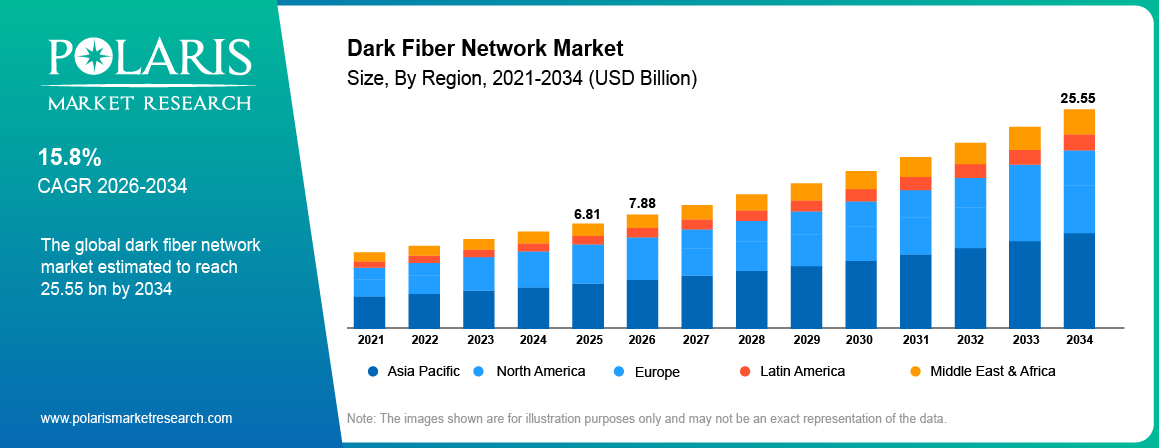
The global dark fiber network market size was valued at USD 6.81 billion in 2025. The market is projected to account for a 15.8% CAGR from 2026 to 2034. The rapid growth of hyperscale data centers has created the need for dark fiber networks. The rapid adoption of cloud computing and artificial intelligence (AI) is also shaping the market landscape.
Market Statistics
Key Takeaways
- Asia Pacific led with a 29.8% dark fiber network market share in 2025. Increased technology adoption in the telecommunications and administrative sectors drives the regional market dominance.
- North America is projected to witness rapid growth at an 17.4% CAGR. The high investments in smart cities and smart industries across the U.S. drive market growth in the region.
- By fiber type, the multi-mode segment accounted for the largest share of 63.7% in 2025. Multi-mode fiber is highly effective in applications that require reliable and high-speed data transmission.
- By material, the plastic segment is projected to grow at an 17.9% CAGR. This is owing to the unique benefits offered by plastics. In addition, the application areas of plastic are also expanding.
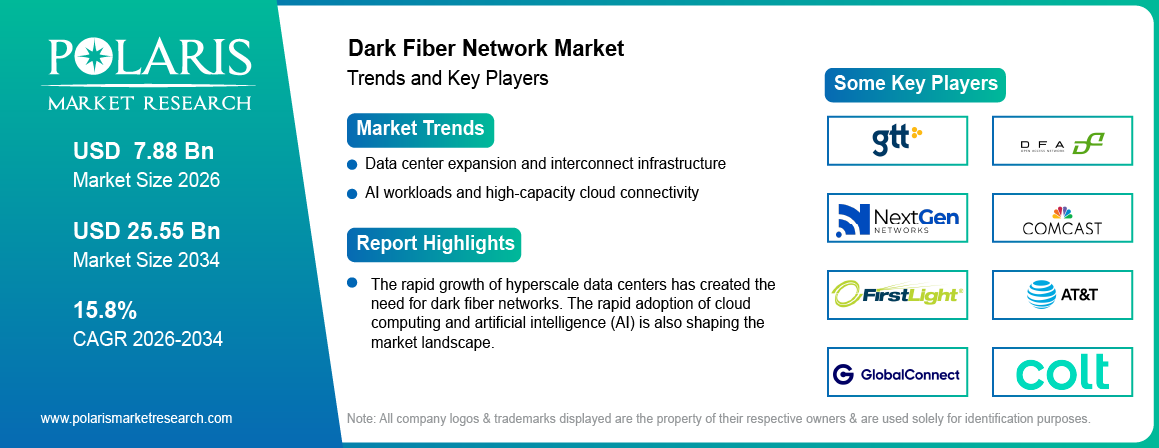
- By network, the metro segment dominated with an 42.6% share in 2025. The growing demand for high-speed connectivity in urban areas drives the segment’s leading market position.
- By end-user, the healthcare segment is projected to grow at an 18.6% CAGR. The rising digitization of healthcare systems has created the need for robust network infrastructure.
Note: Figures and projections outlined in this report are the result of Polaris Market Research’s proprietary analytical processes, grounded in the latest available datasets and market observations.
What Is a Dark Fiber Network?
A dark fiber network uses fiber optic cables that have been laid down but are not yet activated to transmit data. Also called unlit fiber, dark fiber requires transmission equipment to transfer data in the form of light signals.
Dark fibers allow telecom operators and businesses to manage their network capacity themselves through the installation of appropriate transmission equipment according to the network capacity needs. The model is useful for data centers, cloud services, and large corporations that need high-capacity fiber connectivity. Network operators may also expand network capacity without laying any new fiber cables.
How Dark Fiber Networks Work
Dark fiber networks follow a simple process where unused fiber-optic infrastructure is transformed into an active data channel.
Fiber deployment: The network provider deploys fiber optic cables beneath the ground, along roads, or in existing ducts.
Fiber lease: The provider leases unused fibers to either the customer or a telecom company.
Equipment installation: The customer installs optical communication equipment at both fiber ends.
Signal transmission: The optical equipment converts the data into light signals for transmission via the fiber link.
Network operation: The customer manages the active connection and adjusts capacity according to network demands.
This ensures that customers have complete control over their transmission equipment and network capacity.
Dark Fiber vs Lit Fiber: Key Differences
Dark fiber and lit fiber vary when it comes to the activation and management of the network. In the dark fiber arrangement, the customer has access to idle fiber strands that are to be activated using their own transmission equipment. Lit fiber, on the other hand, involves the use of active equipment for the transmission of data. The choice is based on the network needs of the customer and their budget.
| Feature | Dark fiber | Lit fiber (managed service) |
| What customers get | Unlit physical fiber strands, leased or bought (for example under a long-term right of use) | Fiber with provider-supplied equipment and committed bandwidth |
| Who lights the fiber | The customer, with its own optical equipment | The provider |
| Network control | Full control of wavelengths, topology, and encryption | Provider-managed within an SLA |
| Capacity scaling | Upgrade optical equipment (for example, higher-rate transceivers, more DWDM channels) | Usually buy additional bandwidth or a higher tier |
| Upfront cost | Higher (lease or purchase, equipment, engineering) | Lower (service fee) |
| Cost at scale | Often lower per unit of bandwidth at high, sustained capacity | Often higher at high capacity |
| Time to deploy | Longer (design, lighting, testing) | Faster (provider turn-up) |
| Operations | Customer runs equipment and monitoring; provider maintains the fiber plant | Provider runs the service end to end |
| Best fit | Carriers, hyperscalers, large enterprises, data center interconnect | SMEs, branch connectivity, fast turn-up |
Source: Polaris Market Research Analysis
Some companies offer managed fiber services, where fiber and network management are provided together. Such services can be appropriate for companies requiring higher control over connectivity but not having the capacity to manage all network activities internally.
Dark Fiber Network Market Dynamics
The dark fiber network market is driven by increasing data traffic and a need for more control over the capacity of the network. Data centers, telecommunications companies, and large organizations use dark fiber to establish connections with higher capacity between locations. However, the expenses and limitations related to the infrastructure could pose challenges to dark fiber industry development.
Driver: Data Center Expansion and Interconnect Infrastructure
The growth in the number of large data centers is resulting in an increased need for dedicated fiber connections. The operators require fiber connections that have the ability to handle large amounts of traffic. This is because it helps them transfer data and duplicate storage. It also helps ensure the continuity of services. Data center interconnect (DCI) is becoming important due to the need for organizations to distribute their computing capabilities in several places. Dark fiber ensures that operators can use their own optical devices and increase their capacity to transmit data. A January 2026 announcement from Uniti Wholesale demonstrates this demand. Uniti Wholesale planned to expand its existing dark fiber network by 1,100 route miles in the south-central region of the U.S. under a 20-year customer agreement valued at over $500 million. The expansion intends to connect major markets with emerging AI infrastructure hubs (source: uniti.com). Such investments indicate the need for hyperscale connectivity between data centers and new computing sites.
Driver: AI Workloads and High-Capacity Cloud Connectivity
Training of AI and cloud computing requires high-speed data transfer from and between computing centers and storage centers. With growing requirements, the data centers will have higher requirements for capacity for data transfer between the sites. Dark fibers allow operators to have full control over transmission equipment used on the routes. The transmission equipment can be upgraded to provide higher capacity without changing the fiber itself, if the fiber route itself supports such upgrades. This will be beneficial for hyperscalers and large enterprises, which operate their own network infrastructure. Demand will depend on requirements for dedicated routes and the availability of fiber routes.
Driver: Fiber Infrastructure Requirements for 5G Network Expansion
5G infrastructure and networks need to have fiber connectivity for the movement of traffic between the cell site, radio head, and core network. 5G backhaul connects radio access nodes to the broader network, whereas fronthaul transmits traffic between the remote radio head and centralized or decentralized baseband processing facilities. The links need to support high traffic volumes while maintaining network performance. Dark fiber provides telecom operators with the opportunity to install their own transmission equipment and control capacity along the chosen routes. This can be useful in cities with many small cells and upgraded mobile infrastructures. However, the suitability of dark fiber depends on route availability and the technical requirements of each deployment.
Driver: Growing Need for Low-Latency Edge Connectivity
Edge computing brings computational and storage capabilities nearer to users and associated devices. This minimizes the necessity of forwarding each request to a remote data center. The use of dark fiber enables connection of edge computing centers with central data centers and other locations in the network. There might be an increased demand in the future owing to the implementation of applications that require quick data transfer, such as industrial monitoring and real-time analysis. Fiber networks can also serve traffic between distributed edge locations in case the data processing is distributed to various sites. This creates the need for reliable communication channels that can handle large amounts of traffic.
Driver: Enterprise Network Control and Security Requirements
Data-sensitive firms may want more control over their networking infrastructure. The use of dark fiber gives customers control over the transmission equipment and network access based on security considerations. This can support data-centric security by allowing organizations to manage how their network handles sensitive information. It is ideal for financial institutions, health care organizations, and governments with stringent internal policies. However, dark fiber is not enough to secure transmitted data by itself. It is up to the customer to secure the network equipment and the transmitted information.
Opportunities : Smart City Infrastructure and Enterprise Digitalization
Smart city solutions require interconnected infrastructure for traffic management, security, and utilities management. They require a robust connection between sensors, control systems, and municipal infrastructure components. The use of dark fiber could offer the capacity to interconnect such infrastructure as smart cities develop more digital solutions. Enterprises are investing in upgrading their infrastructure to ensure connectivity among their offices, data centers, and cloud solutions. Fiber providers can meet this need through dedicated leasing arrangements and tailored connectivity solutions.
Opportunities : High-Capacity Connectivity for Healthcare Networks
Healthcare providers generate large volumes of data. This is due to the use of imaging techniques, electronic health records, and remote consultations. Hospitals may have to transfer information among themselves, diagnostic centers, and centralized data systems. Here, dark fiber is useful in creating network capacity for these purposes. Healthcare institutions expanding across multiple locations require links for transferring patient information and accessing the centralized applications. This creates opportunities for the fiber providers to serve the hospital network and other healthcare organizations.
Challenges and Restraints : High Infrastructure Costs and Deployment Complexity
Dark fiber implementation involves major expenses for installing fiber lines and network equipment, as well as establishing routes. Right-of-way approval and local permits can cause delays in project implementation, especially in crowded areas. Rural areas pose another problem, as the existing infrastructure there is not sufficient for implementing new fiber lines, thus making their construction costly. Once installed, users must rely on specialists to configure the equipment, monitor network performance, and detect failures. All this increases operational expenses and may discourage smaller companies from using dark fiber technology. Companies without this internal expertise may need outside technical assistance and incur additional costs.
Challenges and Restraints : Dark Fiber Pricing and Lease Models
Dark fiber pricing depends on the route, location, and availability of unused fibers. The cost per mile will vary depending on geographical regions. Leasing dark fiber is usually less expensive than the development of new cables. Metro fiber is likely to cost more in congested urban settings where there is heavy demand and little room for new cables. Leases of long-distance fiber networks connect different cities and typically involve long-term agreements. Businesses must also choose between lease vs build. Leasing fiber networks helps avoid the high initial cost involved in building fiber networks. A private network needs more investment to be built, although the customer will have better control over it.
Technology Trends in Dark Fiber Networks
Dark fiber customers can select their equipment to improve network capacity. Dense Wavelength Division Multiplexing (DWDM) provides multiple data streams through a single fiber strand based on the use of different light wavelengths. It helps customers accommodate more traffic without having to install new fiber strands.
The demand for 400G/800G data transfers is another aspect influencing the process of upgrading networks. 400G/800G enables large volumes of data to flow between data centers and other facilities. Coherent optics ensure efficient data transfer over long distances. The selection of optical transceivers is dependent on the needed speed and distance.
Network operators can also utilize Software-Defined Networking (SDN) for the management of network resources through software. Solutions also exist for fiber monitoring to detect failures and measure link performance. Such technologies allow dark-fiber customers to have more control over capacity and network management.
Dark Fiber Network Use Cases
Dark fiber is used to interconnect data centers, provide cloud services, and transport traffic through telecommunication networks. Recent deals show how large technology companies are securing fiber capacity for their networks.
| Use Case | Typical Buyer | Recent Deployment Example |
| AI data center connectivity | Cloud providers and hyperscalers | Google and Verizon: In July 2026, Verizon announced a dark fiber deal worth more than $1 billion to connect Google's data centers in the U.S. (source: reuters.com) |
| Intercity data center links | Cloud providers and data center operators | Google and Telstra: In June 2026, Google secured dark fiber capacity on Telstra's Aura Network in Australia. The network will connect locations across major cities. (source: telstra.com) |
| Long-distance network connections | Large enterprises and telecom operators | Google and Telstra: The agreement gives Google access to dark fiber on selected routes between Australian cities. This provides dedicated capacity for its network. |
Source: Polaris Market Research Analysis
Dark Fiber Network Market Segmentation
The dark fiber network market is segmented by fiber type, network type, material, end user, and region. These segments help assess dark fiber network market share across different types of infrastructure and customer groups.
| Segmentation Axis | Segments |
| By Fiber Type | Single Mode · Multi-mode (Step-index Multi-mode Fiber, Graded-index Multi-mode Fiber) |
| By Network Type | Long-haul · Metro |
| By Material | Plastic · Glass |
| By End User | BFSI · Telecom · Oil & Gas · Aerospace · Healthcare · Others |
| By Region | North America (U.S., Canada) · Europe (France, Germany, UK, Italy, Netherlands, Spain, Russia, Rest of Europe) · Asia Pacific (Japan, China, India, Malaysia, Indonesia, South Korea, Rest of Asia Pacific) · Latin America (Brazil, Mexico, Argentina, Rest of Latin America) · Middle East & Africa (Saudi Arabia, UAE, Israel, South Africa, Rest of Middle East & Africa) |
Source: Polaris Market Research Analysis
By Fiber Type
The multi-mode segment led the dark fiber network market with a 63.7% share in 2025. Its use in short-distance connections helps meet the needs of enterprises and data centers. Large facilities use multi-mode fiber to link network devices within a building. Enterprises with local network demands can also use it to link servers and switches. This segment serves organizations needing connectivity between different offices or departments in the same facility. The usage in local network infrastructure helps cater to the demands of commercial buildings and data centers. However, the short transmission distance of the segment limits multimode fiber usage in long-distance transmission lines. This keeps its main applications focused on connections with individual sites.
The single mode segment is projected to witness rapid growth at an 17.2% CAGR. Demand is also driven by the requirements of connectivity over longer distances, such as from data centers to telecom facilities. Telecom operators leverage single-mode fiber to increase their network reachability and interconnect different service territories. There is also a requirement for links connecting facilities at different geographical locations among cloud service providers and big companies. Expansion of the data center ecosystem further increases the demand, especially in situations requiring dedicated high-capacity links. Capacity can be upgraded using single-mode fiber by upgrading the transmission equipment, not by upgrading the fiber itself. This makes the segment useful for metro and long-haul dark fiber networks.
Single-Mode vs Multimode Fiber
| Attribute | Single-mode | Multimode |
| Core diameter | About 8–10 µm | 50 or 62.5 µm |
| Reach | Long distance (metro and long-haul) | Short reach, typically within buildings and campuses |
| Typical optics | Laser-based and coherent transceivers | Short-reach, lower-cost transceivers |
| Typical dark fiber use | Backbone, data center interconnect, 5G backhaul, metro | LAN, campus, in-building links |
| Cost profile | Fiber cost similar; optics usually costlier | Optics usually cheaper at short reach |
| Market metrics | Largest share in 2025 (63.7%) | Rapid growth through 2034 (17.2% CAGR) |
Source: Polaris Market Research Analysis
By Network Type
The metro segment held a 42.6% dark fiber network market share in 2025. The demand for these networks is generated by enterprises and service providers who have a need for private connections between urban regions and those located nearby. Metro dark fibers allow data centers to provide connections between facilities within the urban region. In addition, telecom companies rent metro networks to connect their central offices and mobile network facilities. Dense business districts create a need for highly capable links among business facilities. Access to existing fiber networks makes the expansion of metropolitan networks simpler where there is existing infrastructure. These applications support the segment’s position in markets with dense business and data centers.
The long-haul segment is projected to witness rapid growth at an 16.9% CAGR. This demand is associated with the need for fiber-optic connectivity between cities and larger geographical regions. Cloud computing and data center providers use long-haul routes to connect facilities operating in various markets. Telecommunications companies need such routes to carry traffic from one regional network to another. The development of new data centers and cloud computing infrastructure increases demand for connectivity between cities. Long-haul dark fiber gives customers better control over transmission equipment and capacity on these routes. Demand may rise as companies create networks linking more distant locations.
Metro vs Long-Haul Networks
| Attribute | Metro | Long-haul |
| Typical span | Within and around a city or region | Between cities, regions, or countries |
| Demand drivers | Data center campuses, 5G small-cell backhaul, enterprise private networks, smart-city projects | Cloud region interconnect, carrier backbones, subsea landing connectivity |
| Pricing behaviour | Per-mile prices higher than long-haul; urban routes cost more; can fall during a fiber glut | More consistent pricing than metro routes |
| Typical lessees | Enterprises, ISPs, data center operators | Carriers, hyperscalers |
| Market metrics | Largest share in 2025 (42.6%) | Rapid growth through 2034 (16.9% CAGR) |
Source: Polaris Market Research Analysis
By Material
The glass segment accounted for the largest dark fiber network market share of 71.4% in 2025. This material is common in telecom and data centers due to its ability to transmit high amounts of data over long distances. It helps telecom providers link different cities and expand their network. Also, data center providers make use of glass fiber to establish high-capacity interconnection between facilities. The proven reliability of glass fiber in metropolitan and long-haul networks makes it well suited to meet the demands of commercial and industrial purposes. Also, the existing network of glass fiber allows the expansion of capacities through the use of transmission equipment. These factors contribute to the segment’s leading market position.
The plastic segment is projected to witness the fastest growth at a 17.9% CAGR. Plastic optical fiber appeals to applications that involve short-distance data transmission. The flexible nature of plastic fiber makes routing easier in certain confined areas, even in buildings and equipment settings. Enterprises might use it for local connection purposes where the distance of transmission and bandwidth are minimal. The use of plastic in dark fibers, however, relies on its performance characteristics being suited to the application. The plastic fiber cannot be used in replacement of glass fibers for long-haul or high-capacity telecommunications applications. Its growth will depend on the demand for suitable short-range applications and compatible network devices.
By End-User
The telecom segment held the largest dark fiber network market share of 38.5% in 2025. Telecommunications network operators deploy dark fiber to increase network capacity and interconnect their infrastructure across urban and regional areas. The increasing traffic through mobile and Internet channels requires reliable connections between different network sites. The use of dark fiber enables the operator to have full control over the transmission hardware and also increase the capacity in accordance with the growth in traffic. It is also used to interconnect mobile network infrastructure and facilitate transfer of information between network facilities. The availability of existing fiber cable paths enables operators to develop their networks without building a new network infrastructure.
The healthcare segment is projected to grow at an 18.6% CAGR. Hospitals and healthcare companies handle large volumes of data coming from electronic health records, medical imaging devices, and other clinical devices that are linked together. Dark fiber can create dedicated connections between different healthcare institutions, including hospitals, diagnostics centers, R&D units, and data centers. This technology can help with the exchange of medical images and access to central healthcare systems. Moreover, healthcare providers can rely on dark fiber connections to maintain control over network performance and data management. The demand for dark fiber connections depends on the investment in digital health infrastructure and whether it needs to link different healthcare institutions. However, healthcare institutions still have to implement proper cybersecurity measures.
| End User | Typical Use | Purpose | Market Share in 2025 / CAGR 2026 - 2034 |
| BFSI | Links between bank branches, data centers, and trading offices | Transfers financial data between locations. | 16.4% CAGR |
| Telecom | Connections between mobile sites, network hubs, and telecom exchanges | Expands network capacity and supports data transmission. | 38.5% Share |
| Oil & Gas | Fiber links between oil fields, processing plants, and control centers | Transfers data from remote operations. | 14.2% CAGR |
| Aerospace | Connectivity among engineering centers, testing facilities, and data centers | Exchanges design documents and test results. | 15.3% CAGR |
| Healthcare | Connectivity among hospitals, labs, and medical data centers | Exchanges medical imaging and other clinical data among the facilities. | 18.6% CAGR |
| Others | Connectivity for government agencies, universities, utility companies, and business organizations | Meets the requirements for data transfer among various locations. | 13.9% CAGR |
Source: Polaris Market Research Analysis
Regional Insights
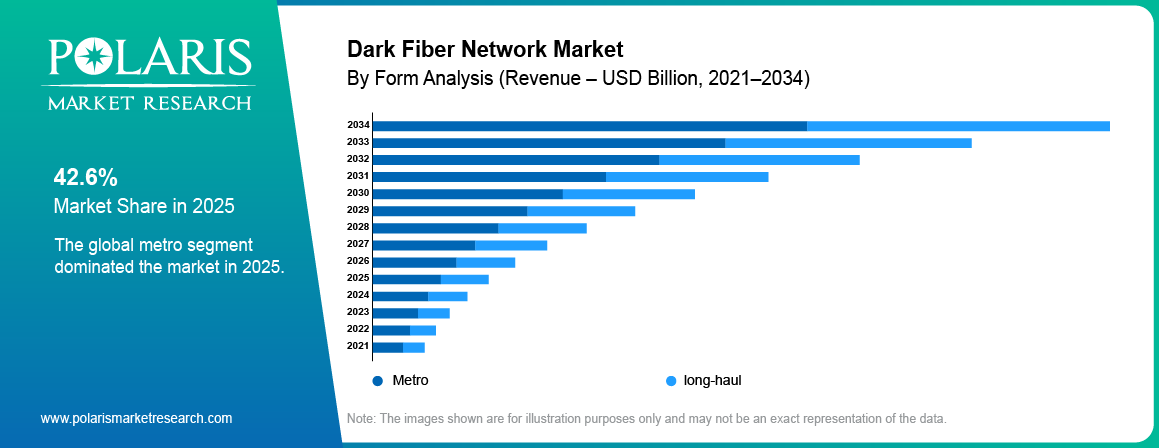
The dark fiber network market is segmented across North America, Europe, Asia Pacific, Latin America, and the Middle East & Africa. Regional growth depends on fiber infrastructure and data center expansion. Regional market development is also shaped by demand for high-capacity connectivity.
Asia Pacific
The dark fiber network market Asia Pacific led with an 29.8% share in 2025. The regional dominance is fueled by the expansion in telecom networks, growth in traffic, and development in data center infrastructure. China remains an important market due to the growing demand for high-capacity data connectivity due to the rising usage of cloud computing and AI applications. India is also increasing its digital infrastructure as cloud computing adoption grows. As per a September 2026 IBEF article, India is expected to see the addition of 3,860 MW through its data center pipeline by 2030 (source: ibef.org). The growth is expected to increase the demand for fiber interconnection from the data centers to telecom networks. Increased investments in digital infrastructure in such economies will have a positive impact on the regional market.
North America
North America is projected to grow at an 17.4% CAGR. The region benefits from established telecom networks and high demand for direct fiber connectivity from data centers and enterprises. Cloud and AI workloads are generating an increased demand for high-bandwidth connectivity between facilities, including connections beyond the usual locations of data centers. In February 2026, US Signal announced plans to build over 1,000 miles of fiber in Ohio and Indiana. The project is intended to build the network between the core and edge data centers as well as increase the middle-mile connectivity (source: ussignal.com). Such investments highlight efforts to increase fiber capabilities in these markets. Telecom companies and infrastructure vendors are also building network routes to cater to increased demand for faster and direct data connections between the areas.
Europe
Europe accounted for a 24.3% dark fiber network market share in 2025. The demand in the region is driven by telecom network infrastructure and the need for fiber connectivity. Markets such as Germany, the United Kingdom, and France are significant because of their data centers and enterprise needs. Dark fibers are used by telecoms to increase capacity in their networks and interconnect their network infrastructure. Data centers require connectivity between them due to the growing volume of traffic. Cloud and digital infrastructure investments also increase the demand for fiber-optic infrastructure in Europe.
Latin America
The Latin America dark fiber network market is projected to grow at an 14.6% CAGR. Expansion is fueled by network infrastructure and data center development. Brazil and Mexico serve as important markets as businesses enhance their capacity within their networks due to increasing amounts of data being transmitted. Dark fiber helps telecom firms interconnect their networks in order to reach urban regions. It is essential for businesses to establish connectivity between their offices and data centers as cloud computing becomes more common. However, uneven fiber network infrastructure and expensive implementation can hinder the use of dark fiber in less connected areas.
Middle East & Africa
The Middle East & Africa dark fiber network market is projected to grow at an 15.1% CAGR. The regional demand is driven by telecom infrastructure growth and investments made into digital products. In the Middle East region, the UAE and Saudi Arabia are expanding data center capacity to offer services to cloud computing and corporate clients. The data centers need to be connected to the telecom infrastructure via high-capacity optical fibers. In Africa, demand for optical fibers is driven by the growth of mobile telecom networks and rising internet penetration.
Key Players and Competitive Landscape
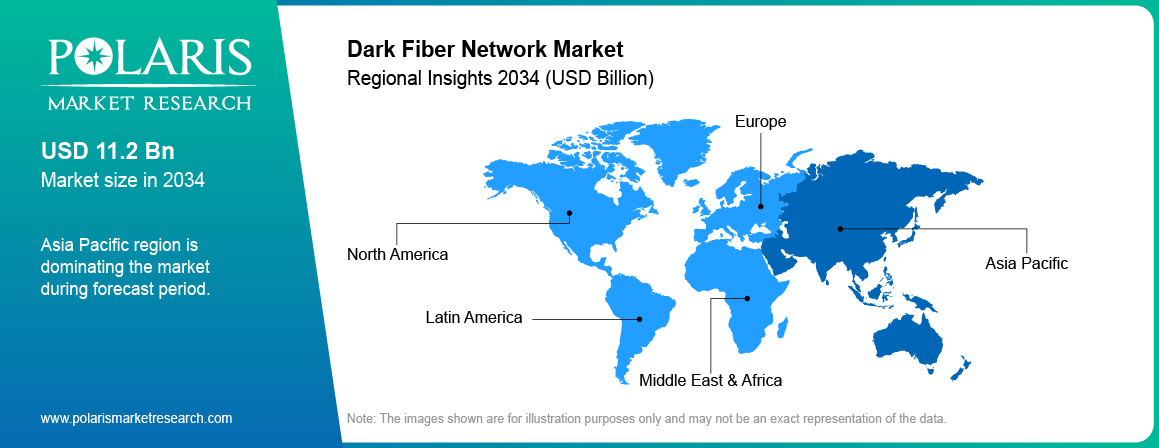
The dark fiber network market is characterized by high competition, whereby providers strive for network coverage and route accessibility through leasing of their facilities. Dark fiber providers offer services to telecom carriers, data center companies, and other large corporations requiring the use of dark fibers for their network infrastructure. Access to the pre-existing fiber optic route may determine the level of competition among the different dark fiber service providers. Metropolitan routes and routes between data centers are among the most common types of routes offered by dark fiber service providers. The top dark fiber companies compete by expanding network coverage and making the pre-existing routes accessible to customers who want greater control over their network operations.
| Company Name | Vendor Positioning |
| AT&T Inc. | Offers dark fiber and wholesale network services across the U.S., serving telecom carriers and large businesses. |
| Lumen Technologies | Owns metro and long-distance fiber routes in North America. Customers can lease dark fiber and operate their own transmission equipment. |
| Verizon Communications Inc. | Uses its U.S. fiber infrastructure to serve enterprise and wholesale customers. Its network supports dedicated fiber connections. |
| Zayo Group | A major dark fiber provider with routes across North America. Its customers include data centers, telecom operators, and large enterprises. |
| Colt Technology Services | Provides fiber connectivity across European business hubs, with links to international markets. Its network serves enterprises and data center operators. |
| Comcast Corporation | Its U.S. network supports business connectivity and private networking services, alongside its consumer communications business. |
| GTT Communications | Serves multinational companies and telecom carriers through its global network services business. |
| NTT DATA | Provides IT and network services to businesses across international markets. Connectivity is part of its broader enterprise service portfolio. |
| Orange S.A. | Operates fiber and telecommunications networks in France and other markets. Its business services include enterprise and wholesale connectivity. |
| Uniti Group Inc. | Owns fiber infrastructure in the U.S. and supplies wholesale network connections to telecom and broadband providers. |
| GlobalConnect Group | Runs fiber infrastructure in Northern Europe, connecting businesses and data centers across the region. |
| FirstLight Fiber | Provides fiber services to businesses, carriers, and public-sector customers in the northeastern U.S. |
| UFINET | Operates wholesale fiber networks in Latin America, with a focus on connections for telecom operators and service providers. |
| NexGen Networks | Provides fiber connectivity for financial firms, enterprises, carriers, and data centers in major business markets. |
| Dark Fibre Africa | Owns and operates open-access fiber infrastructure in South Africa. Other service providers lease capacity on its network. |
Source: Polaris Market Research Analysis
List of Key Companies
- AT&T Inc.
- Colt Technology Services
- Comcast Corporation
- Dark Fibre Africa
- FirstLight Fiber
- GlobalConnect Group
- GTT Communications
- Lumen Technologies
- NexGen Networks
- NTT DATA
- Orange S.A.
- UFINET
- Uniti Group Inc.
- Verizon Communications Inc.
- Zayo Group
Recent Industry Developments
- October 2026: AT&T announced plans to form a fiber joint venture with Global Infrastructure Partners and the Canada Pension Plan Investment Board. The partnership is intended to accelerate fiber network expansion across the U.S. It will also focus on extending connectivity to more communities. (source: att.com)
- September 2026: Verizon and Corning announced a multibillion-dollar deal. As stated by Verizon, the deal relates to the supply of more than 80 million miles of high-density optical fibers from 2027 to 2032. The deal will support the expansion of Verizon’s broadband network. It will also facilitate the construction of long-distance fiber networks for data-intensive operations. (source: verizon.com)
Future Outlook
The dark fiber network market forecast 2026-2034 is expected to be influenced by the need for private fiber connections and the availability of existing network infrastructure. It can be more advantageous for some businesses to lease dark fibers as opposed to installing them on their own, especially if such facilities exist. The upgrading of the equipment in the data centers can lead to the creation of the demand for corresponding fiber optics and optical transceivers. However, growth will vary by region, since providers who already have routes will be able to provide service to new customers much faster than those with limited fiber network presence.
Research Methodology
Research Approach: Polaris Market Research uses both top-down and bottom-up methods to estimate the dark fiber network market. The two estimates are compared to check for gaps and improve consistency. The base year is 2025, and the forecast period is 2026–2034.
Secondary Research: The report uses annual reports, investor presentations, regulatory documents, industry association publications, trade publications, and company announcements. These sources assist in monitoring developments in fiber network deployment, leasing activity, and demand changes.
Primary Research: Interviewing dark fiber service providers, telecommunications companies, data centers, and enterprise network customers helps to support the findings. Interviews include discussion of customer demands, leasing agreements, pricing structures, and market segments.
Market Definition: The market includes revenues generated by the sale and leasing of unlit optical fibers with long-term usage rights of the fiber route. The market is analyzed by fiber type, network type, material, end-user, and geography. Lit fiber and managed connectivity services are not included in the market scope.
Market Data Verification and Forecasting: Market data is verified using indicators of supply and demand. Forecasting considers expansion of data centers, increase in bandwidth requirements, and evolution of the 5G networks. The market values are given in USD billion.
Dark Fiber Network Market Report Scope
| Report Attributes | Details |
| Market Size Value in 2025 | USD 6.81 billion |
| Market Size Value in 2026 | USD 7.88 billion |
| Dark Fiber Network Market Forecast 2034 | USD 25.55 billion |
| CAGR | 15.8% from 2026 to 2034 |
| Base Year | 2025 |
| Historical Data | 2021–2024 |
| Forecast Period | 2026–2034 |
| Quantitative Units | Revenue in USD billion and CAGR from 2026 to 2034 |
| Report Coverage | Revenue Forecast, Market Competitive Landscape, Growth Factors, and Industry Trends |
| Segments Covered |
|
| Regional Scope |
|
| Competitive Landscape |
|
| Report Format |
|
| Customization | Report customization as per your requirements with respect to countries, regions, and segmentation. |
Source: Polaris Market Research Analysis
Dark Fiber Network Market FAQ's
A dark fiber network consists of optical fiber cables that are already installed but are currently not being used for transmitting data. The network remains inactive until transmission devices are connected to it. Telecom companies, data centers, and major corporations can either rent or purchase the fibers.
The global dark fiber network market size was valued at USD 6.81 billion in 2025. The market is projected to grow at a CAGR of 15.8% from 2026 to 2034. It is projected to reach USD 25.55 billion by 2034.
Dark fiber refers to fiber optic cables that have been installed but not activated. It is up to the customer to provide the necessary equipment in order to utilize it. On the other hand, lit fiber means that the fiber optic cables are already in use and have the necessary transmission equipment provided by the company.
Dark fiber is used by large companies to link different offices and data centers. The hyperscalers require high bandwidth for moving information between data centers. Through dark fiber networks, hyperscalers can have control over their network bandwidth, as they can choose their networking hardware.
Asia Pacific held the largest market share of 29.8% in 2025. Construction of data centers and growth in telecommunications networks in China and India contribute to regional dominance. The North America region is expected to witness a CAGR of 17.4%. This is owing to its established fiber networks. Data center clustering also supports demand.
Major companies include AT&T Inc.; Colt Technology Services; Comcast Corporation; Dark Fibre Africa; FirstLight Fiber; GlobalConnect Group; GTT Communications; Lumen Technologies; NexGen Networks; NTT DATA; Orange S.A.; UFINET; Uniti Group Inc.; Verizon Communications Inc.; and Zayo Group.
Fiber links are required for 5G networks to transfer traffic from the cell site to the entire telecommunications network. Dark fiber provides operators with an alternative solution for this type of connection. The use of dark fiber by data center firms allows them to connect facilities and move large volumes of data.

Download Sample Report of Dark Fiber Network Market
Please fill out the form to request a customized copy of the research report.


