
Digital Circular Economy Market Size, Growth Report, 2024-2032
REPORT DETAILS
Digital Circular Economy Market Summary
The global digital circular economy market was valued at USD 2.22 billion in 2023 and is expected to grow at a CAGR of 24.4% during the forecast period.
Market Statistics
A circular economy is an economic system in which resource use is minimized (refuse and reduce) while material value is maximized (reuse and recycle). The growing technological advancements in the marketplace, such as AI, blockchain, data analytics, and the Internet of Things, are creating new ways to follow the circular economy theme. The digital circular economy ensures optimized resource utilisation and lower waste and enhances the tracking and management of raw materials and their life cycle throughout the production, consumption, and distribution phases. The increasing familiarity of digital circular economy tools and growing research studies are expected to conserve natural resources and our planet.
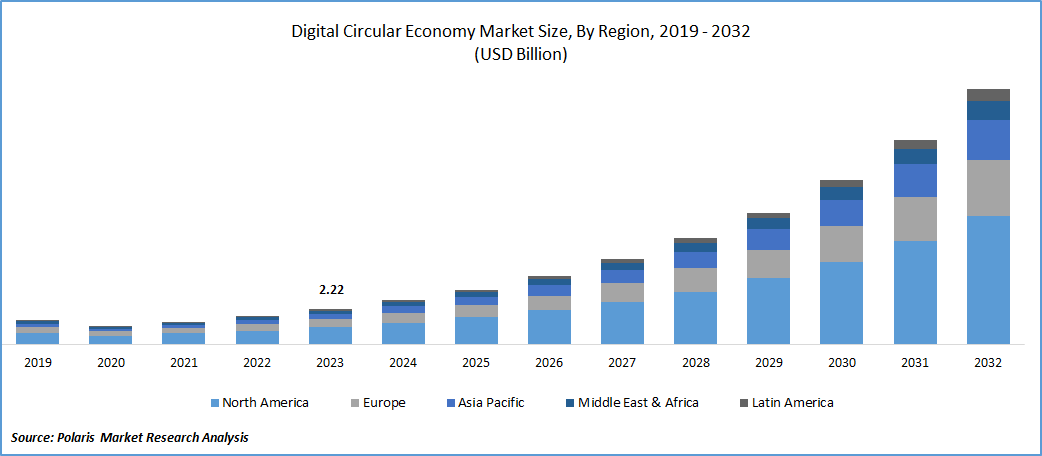
Source: Polaris Market Research Analysis
\
To Understand More About this Research:Download Sample Report
For instance, in April 2023, a study published in Science Direct focused on reviewing the role of digital technologies in driving the adoption of circular strategies.
Moreover, the development of green transition bonds in the marketplace is emphasizing the need to establish economic-friendly projects by companies. The recently introduced climate bonds are a way to access funds for companies’ environmental sustainability projects, which can be waste management initiatives, resource or power efficiency, and others.
However, the limited knowledge of the benefits associated with the circular economy models and the higher initial costs and investments for the protection of the planet are impeding the growth of the digital circular economy market. The ingrained perception of people about considering recycled products as low-quality products is one of the major factors hampering the circular economy.
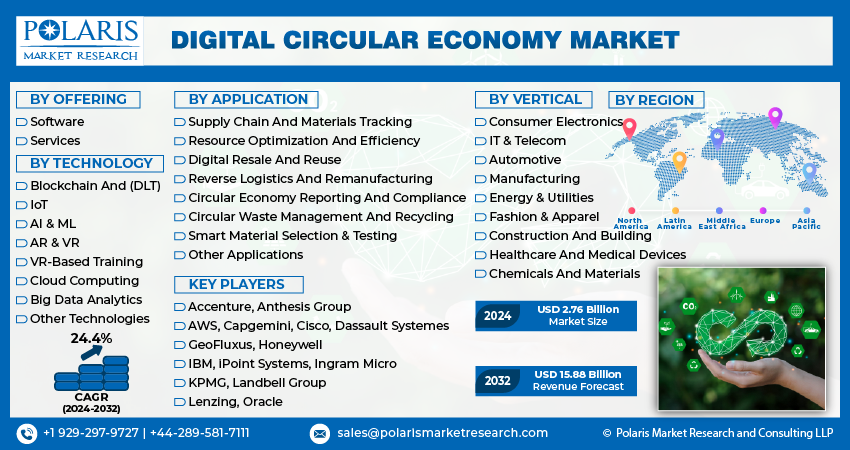
Source: Polaris Market Research Analysis
Growth Drivers
The need to reach sustainable development goals and rising e-waste
The formulation of sustainable development goals is boosting the adoption of digital circular economy tools. The rising concerns on global climate change issues, environmental pollution, and loss of biodiversity are highlighting the importance of opting for strategic environment assessment and impact assessment among nations. The countries efforts to fuel the implementation of sustainable development goals, primarily 7 and 13, which signifies energy and climate action, are in the theme of following a circular economy.
The rising e-waste can be attributable to the increased accessibility of consumer electronics. The advancements in technology are enabling companies to track their products at the various stages of production and distribution processes, ensuring proper disposal or recycling of the item. Furthermore, the adoption of the reverse logistics concept in the market assists in the collection of electronic items at the door steps for refurbishment, disposal, or recycling.
A 2022 study explored the development of blockchain enabled e-waste tracking & tracing systems, specifically for the smart cities, while another 2023 study developed an incentive scheme based on blockchain for the collection of e-waste.
Report Segmentation
The market is primarily segmented based on offering, technology, application, vertical, and region.
| By Offering | By Technology | By Application | By Vertical | By Region |
|
|
|
|
|
Source: Polaris Market Research Analysis
To Understand the Scope of this Report:Request Customization
By Offering Analysis
Product Lifecycle Management (PLM) Software segment is expected to witness the highest growth during the forecast period
The product lifecycle management software segment will grow significantly, mainly driven by its ability to enable manufacturers to monitor products throughout their lifecycle, from initial raw material procurement to production, distribution, and final consumption of products. This assists the companies in designing, manufacturing, and managing products in a sustainable manner, with resource efficiency as a primary motive. The circular economy model not only protects natural resources but also allows companies to minimize their costs with recycling, refurbishment, and waste management.
By Technology Analysis
IoT segment accounted for the largest market share in 2023
The IoT segment accounted for the largest market share. This is highly influenced by its ability to provide transparent, optimized, and traceable management of resources. This technology is expected to have significant potential in supporting green manufacturing and circular design practices, which, in a way, drive the production of goods and services with an environmentally friendly approach.
By Application Analysis
Digital resale and reuse segment held the significant market revenue share in 2023
The digital resale & reuse segment held a significant share, which is highly accelerated due to the continuous rise in digital e-commerce platforms for the resale of used items. One example is OLX. The establishment of digital resale and reuse platforms promotes circular supply chain networks, contributing to the reduction of waste and supporting sustainability. As this enables the value creation of used products, it is providing a new way of reducing waste and driving efficient utilisation of limited resources by controlling the extraction of natural resources from the planet.
By Vertical Analysis
Manufacturing segment held the significant growth share in 2023
The manufacturing segment saw significant growth, which is highly accelerated due to the continuous rise in the focus on resource optimization, reducing waste, and conserving natural resources. The circular economy can be achieved only with the optimal use of resources in an efficient manner, which can reduce natural resource extraction and lead to the conservation of the planet. The evolution of digital technologies is positively assisting manufacturing companies to achieve their cost-minimization strategies.
Source: Polaris Market Research Analysis
Regional Insights
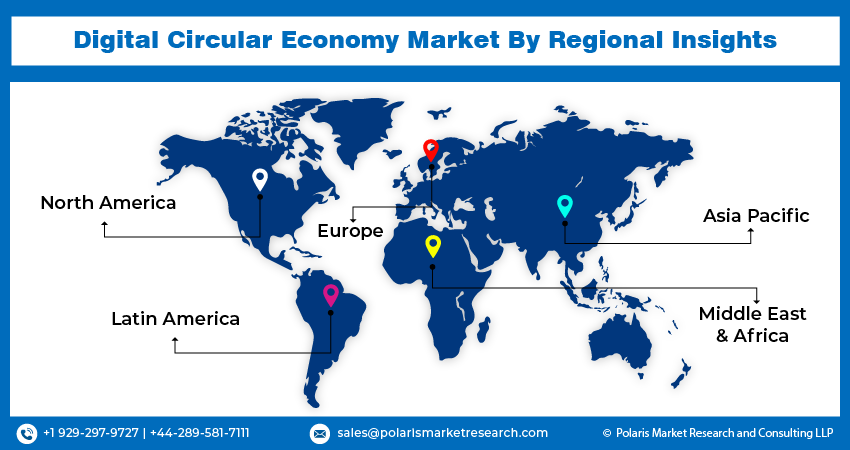
Europe region registered the largest share of global market in 2023
Europe dominated the global market. The growth of the segment market can be largely attributed to the presence of government initiatives to promote the digital circular economy. For instance, the UK government started a research and development project, National Interdisciplinary Circular Economy Research on Circular Economy, with an investment of EUR 30 million during the project period of 2021–2025. These ongoing investments are playing a vital role in rebuilding a resilient circular economy.
The Asia Pacific region is expected to be the fastest growing region with a healthy CAGR during the projected period, owing to the growing government initiatives to move out of the take-make-disposal model. The countries in this region, including China and India, are showing enormous interest in meeting resource efficiency and circular economy strategies.
As a part of the G-20 presidency, India showed concerns about promoting circularity in the steel sector and extended producer responsibility, industry-led resource efficiency, and a circular economy industry coalition. According to a 2023 study, China may achieve a circular economy in electric vehicle batteries by 2059. This ongoing country's strategies to promote the green economy, along with increased technology adoption, are expected to promote the digital circular economy in the region.
Source: Polaris Market Research Analysis
Key Market Players & Competitive Insights
The digital circular economy market is slightly fragmented and slightly consolidated with the rising mergers and acquisitions among the key market players and the increased focus on promoting their market presence. For instance, in June 2023, Amazon and the Ellen MacArthur Foundation announced their collaboration to launch circular economy solutions.
Some of the major players operating in the global market include:
- Accenture
- Anthesis Group
- AWS
- Capgemini
- Cisco
- Dassault Systemes
- GeoFluxus
- Honeywell
- IBM
- iPoint Systems
- Ingram Micro
- KPMG
- Landbell Group
- Lenzing
- Oracle
Recent Developments
- In February 2025, Dassault Systèmes introduced 3D UNIV+RSES, combining generative AI with virtual-twin technology to accelerate design cycles and integrate recyclability insights early in development.
- In May 2024, Flex, a global supply chain solutions company, announced its acquisition of FreeFlow, a leader in global secondary market asset disposition and digital circular economy solutions. The acquisition strengthens Flex’s ability to support circular economy initiatives by improving product lifecycle management and end-of-life asset recovery.
Digital Circular Economy Market Report Scope
| Report Attributes | Details |
| Market size value in 2024 | USD 2.76 billion |
| Revenue forecast in 2032 | USD 15.88 billion |
| CAGR | 24.4% from 2024 – 2032 |
| Base year | 2023 |
| Historical data | 2019 – 2022 |
| Forecast period | 2024 – 2032 |
| Quantitative units | Revenue in USD billion and CAGR from 2024 to 2032 |
| Segments covered | By Offering, By Technology, By Application, By Vertical, By Region |
| Regional scope | North America, Europe, Asia Pacific, Latin America, Middle East & Africa |
| Customization | Report customization as per your requirements with respect to countries, region and segmentation. |
Source: Polaris Market Research Analysis
digital circular economy market FAQ's
The global digital circular economy market is projected to reach USD 15.88 billion by 2032, up from USD 2.22 billion in 2023 at a CAGR of 24.4%.
The digital circular economy market is forecast to grow at a CAGR of 24.4% from 2024 to 2032, driven by sustainability mandates and growing e-waste awareness.
Key technologies include IoT for material tracking, AI & machine learning for resource optimization, blockchain for transparency, and cloud computing for scalability.
The automotive sector dominates the market, leveraging digital circular economy principles for parts recycling, refurbishment, and sustainable supply chain practices.
Europe leads the global digital circular economy market with over 35% share, driven by stringent sustainability regulations and EU circular economy action plans.
Supply chain and material tracking, digital resale and reuse, reverse logistics and re-manufacturing, and circular waste management are the leading application segments.
Key players include SAP, Oracle, IBM, Landbell Group, Anthesis Group, iPoint-systems GmbH, Rheaply, One Click LCA Ltd., LENZING AG, and KPMG International.
Download Sample Report of digital circular economy market
Please fill out the form to request a customized copy of the research report.


