
Digital Payment Market Share, Size, Trends, Industry Analysis Report, 2026- 2034
REPORT DETAILS
Digital Payment Market Summary
The global digital payment market was valued at USD 130.49 billion in 2025 and is expected to grow at a CAGR of 21.5% during the forecast period. Over the projected period, it is anticipated that the prevalence of cashless transactions will increase, and increasing government initiatives and funding will be provided to address the need for liquidity and the cash crisis.
Market Statistics
Key Takeaways
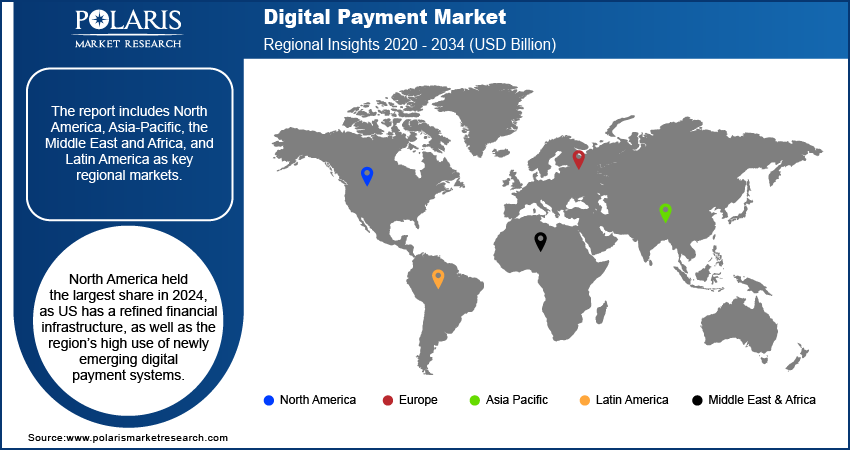
- North America held largest share of 36.2% in 2025, as the US has a refined financial infrastructure, as well as the region’s high use of newly emerging digital payment systems.
- Payment processing subsegment held largest share of 45.2% in 2025. Rapid adoption of electronic commerce is fueling this segment because secure and rapid online transactions are increasingly in demand.
- Contactless transactions held largest share of 55.6% in 2025. The adoption of smartphones and the increase in touchless payment technology are primary factors.
- On-premises held largest share of 45.4% in 2025. This is because on-premises solutions give organizations complete control over their systems and data, which is critical for security and compliance.
- Large enterprises segment held largest share of 60.2% in 2025. These companies allocate more of their budgets for payment technologies and process complex payment transactions.
- Banking, Financial Services, and Insurance (BFSI) held largest share of 24.7% in 2025. The increasing need for domestic and international digital transactions is the core driving force for this segment’s expansion.
Note: Figures and projections outlined in this report are the result of Polaris Market Research’s proprietary analytical processes, grounded in the latest available datasets and market observations.
Industry Dynamics
- Online shopping or e-commerce and mobile commerce or m-commerce have increased tremendously and are a leading factor contributing to this.
- The current digital payment system is mostly reliant on mobile phones and the internet available to most people due to the rapid developments in the tech and telecommunication industries, even in the most remote parts of developing countries.
- Many governments have an economic agenda to achieve a cashless society, which is said to easily boost the economy, while also increasing financial transparency and inhibiting corruption.
Source: Polaris Market Research Analysis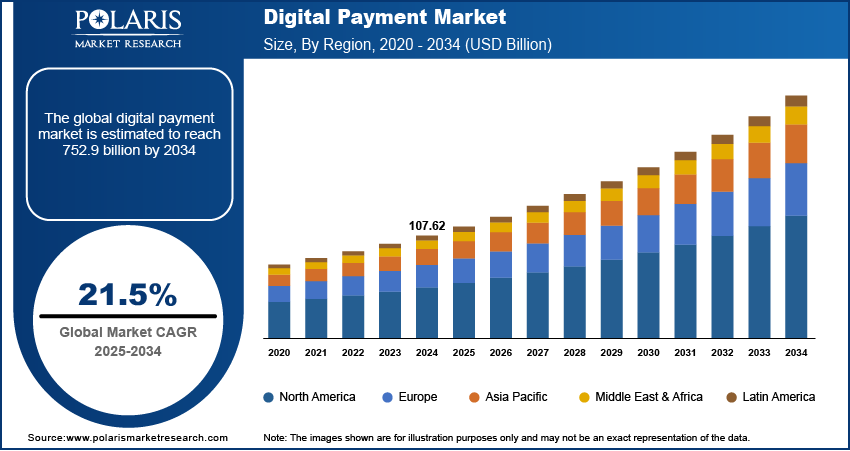
AI Impact on the Market
- The decreased margins of error and oversights in the entire digital payment processing system, along with increased efficiency and speed, are attributed to the incorporation of AI systems coupled with machine learning features.
- AI personalizes and eases payment activities for the users. AI can also power chatbots and virtual assistants and offer customer service concerning billing.
- AI also enhances the precision and the promptness of payments by mechanizing the hitherto hand-operated processes.
What are Digital Payments?
Digital payments refer to cashless financial transactions. They are conducted through electronic platforms such as mobile wallets, debit/credit cards, payment gateways, UPI, and online banking systems. Digital payments enable real-time, secure, and convenient transfer of money between individuals, businesses, and institutions. They offer faster transaction speeds, greater transparency, and greater financial accessibility.
What is the Difference Between Digital Wallets and Banking?
| Parameter | Digital Wallet | Banking |
| Definition | Electronic application used for storing money digitally and making quick payments | Financial institution/service that manages deposits, loans, transfers, and other financial services |
| Accessibility | Accessible mainly through smartphones and internet-enabled devices | Accessible through branches, ATMs, internet banking, and mobile apps |
| Transaction Speed | Instant payments and transfers | Transfers may be instant or take longer, depending on the banking system |
| Service Scope | Primarily focused on payments, bill payments, and small transfers | Includes savings, loans, investments, credit, and payment services |
| Account Requirement | May work with minimal KYC or a linked bank account | Requires a formal bank account with full KYC compliance |
| Security | Protected through OTP, PIN, biometrics, and app authentication | Protected through regulated banking security systems and compliance standards |
| Usage Cost | Usually low or zero transaction fees for users | May involve account maintenance charges and transfer fees |
| Examples | Paytm, Google Pay, PhonePe, Apple Pay | Commercial banks, cooperative banks, digital banks |
Source: Polaris Market Research Analysis
Over the projection period, it is anticipated that demand for digital transactions would rise due to the expanding usage of credit cards, debit cards, digital currencies, mobile wallets, net banking, point of sale, and the rising popularity of mobile apps. These mobile apps offer several promotional schemes for virtual transactions such as online shopping vouchers, cashback, discounts, in-shop offers, and others to attract customers and increase the use of such cards and apps for online transactions.
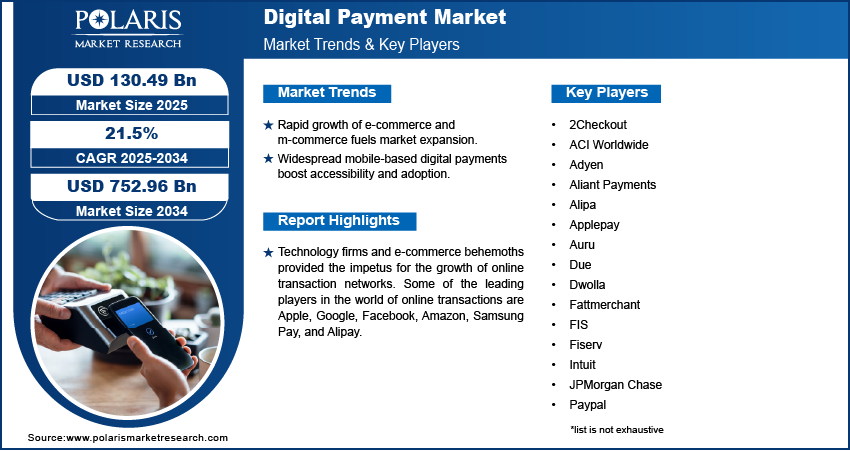
Technology firms and e-commerce behemoths provided the impetus for the growth of online transaction networks. Some of the leading players in the world of online transactions are Apple, Google, Facebook, Amazon, Samsung Pay, and Alipay. To make it simple for consumers and sellers to deal online, Alipay, one of the largest Chinese online transaction platforms, has 900 million domestic users.
In addition, the rising trend for online e-commerce also led to a greater demand for the digital payment market. Worldwide lockdown changed the shopping behavior of the people and had compelled the masses to embrace the online shopping system and buy groceries, medicines, personal care products, and other basic essential commodities online, which led to the increased usage of bank cards and mobile apps which also offers customers some great benefits.
Industry Dynamics
Growth Drivers
Real-time transaction systems are becoming increasingly in demand, and this need is fueled by the usage of smartphones, improved internet access, and non-physical interfaces. This demand is likely to drive growth in the digital compensation industry. Customers now expect a more streamlined and straightforward experience when using digital transactions. The increased global demand for the sector is fueled by a superior, smoother user experience and enhanced customization.
Mobile wallet proliferation is one of the most significant contributors to the growth of the virtual transaction system industry. The popularity of e-wallets has grown over the years owing to easy convenience and several offers provided by online transaction apps. According to the Global Payments Report 2021, the number of consumers that adopted mobile wallets to make transactions online increased from over 900 million to 1.48 billion in fiscal 2020 during the pandemic. Also, 25.7% of all POS (Point of Sale) transactions were made using mobile wallets.
Source: Polaris Market Research Analysis
Report Segmentation
The market is primarily segmented based on solution, mode of payment, deployment, enterprise size, end-use, and region.
| By Solution | By Mode of Payment | By Deployment | By Enterprise Size | By End-Use | By Region |
|
|
|
|
· |
|
Source: Polaris Market Research Analysis
Insight by Mode of Payment
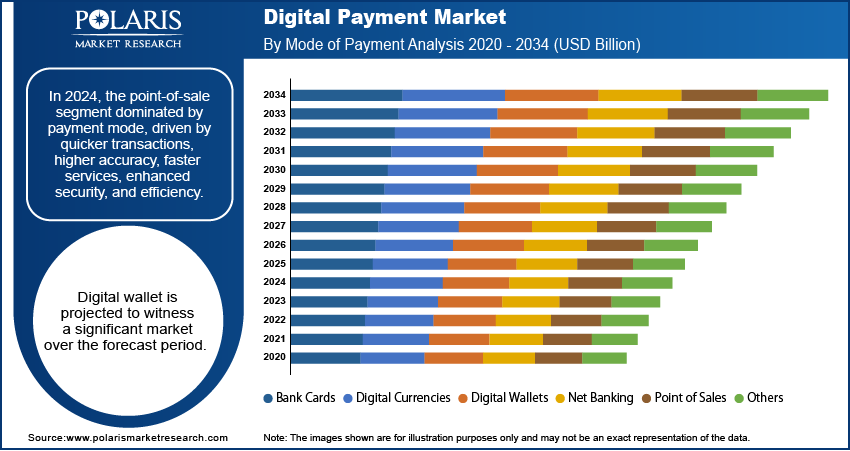
Based on mode of payment, the point-of-sale segment dominated the industry in 2025 due to its several benefits, such as quicker transactions, greater accuracy, expanded disbursement capabilities, faster services, better security, and many others.
Digital wallet is projected to witness a significant market over the forecast period. The increased usage of mobile phones, along with the ease of use and convenience, has led to the more considerable popularity of digital wallets among people, especially millennials, which is likely to boost the demand for the industry.
Source: Polaris Market Research Analysis
Insight by End-Use
Based on end-use, the market is further segmented into BFSI, healthcare, IT & telecom, media & entertainment, retail & e-commerce, transportation, and others. The Banking, Financial Services, and Insurance (BFSI) segment dominated the global digital transaction system market with 24.7% in 2025 and accounted for the largest revenue share.
With the introduction of digitization, banks have adopted the virtual transaction system owing to the several advantages it offers, such as increased efficiency of the delivery of products and services, wider reach of customers, improved quality of services, and reduced operational and transactional costs, increased financial inclusion, etc.
Media & entertainment will likely witness lucrative growth in the global market over the forecast period. The emergence and expansion of the OTT (Over the Top) platform among masses across the globe are driving the market demand primarily due to the convenience of use. OTT platforms have witnessed huge traffic over the past few years, wherein the Covid pandemic has played a crucial role in the rapid surge of online users.
Geographic Overview
North America dominated the global digital payment market 36.2% in 2025 and witnessed the largest revenue share. The demand for the market in the area is anticipated to be driven by the proliferation of swift technology developments and investments in virtual transaction services and capabilities.
The region's fast emergence of digitization over the years has increased market demand. One of the biggest digital streaming platforms, Netflix is a production business and subscription streaming service based in the United States that gives clients worldwide a vast selection of movies and TV shows as well as tempting membership deals.
How is India’s UPI System Impacting the Global Digital Payment Market?
Unified payment interface (UPI) is a unique payment system introduced by India. It is used to transfer money to an individual or a merchant. It is also used to make online payments for shopping, credit card payments, and hotels and restaurants. UPI is also used to make online ticket reservations for trains, flights, and buses. UPI is bifurcated into two types—person-to-person (P2P) transactions and person-to-merchant (P2M) transactions. As these systems make transactions safe, instant, and easy, their adoption is rising rapidly. Also, the UPI transactions are increasing in India due to the rising use of smartphones and growing penetration of 4G and 5G networks.
| Number of UPI Transactions from 2017 to 2024 (in Crore) | ||
| FY | P2P | P2M |
| 2017–2018 | 81.1 | 10.4 |
| 2018–2019 | 422.2 | 113.1 |
| 2019–2020 | 806.1 | 445.8 |
| 2020–2021 | 1,303.9 | 929.2 |
| 2021–2022 | 2,656.2 | 1,940.60 |
| 2022–2023 | 4,115 | 4,260.1 |
| 2023–2024 | 5,299.6 | 7,816.8 |
Source: Polaris Market Research Analysis
Source: NPCI
Given its safety and ease of use, UPI payments are widely used across various countries. As of now, UPI is live and functional in seven countries, including the UAE, Bhutan, Sri Lanka, France, Mauritius, Nepal, and Singapore. The Indian government is promoting the system to enable internationalization of UPI. Such initiatives are expected to boost the digital payments industry across the world.
Source: Polaris Market Research Analysis
Competitive Insight
Some of the major market players operating in the global digital payment market include 2Checkout, ACI Worldwide, Adyen, Aliant Payments, Alipa, Applepay, Auru, Due, Dwolla, Fattmerchant, FIS, Fiserv, Global Payments, Intuit, JPMorgan Chase, Paypal, Paysafe, Paytrace, Payu, Spreedly, Square, Stripe, Visa, Wex, and Worldline.
List of Key Players:
- 2Checkout
- ACI Worldwide
- Adyen
- Aliant Payments
- Alipa
- Applepay
- Auru
- Due
- Dwolla
- Fattmerchant
- FIS
- Fiserv
- Global Payments
- Intuit
- JPMorgan Chase
- Paypal
- Paysafe
- Paytrace
- Payu
- Spreedly
- Square
- Stripe
- Visa
- Wex
- Worldline
Industry Dynamics
April 2026: AstreaX announced the availability of AX Wallet. It is a secure, mobile-friendly digital wallet platform. The platform streamlines how citizens access and manage their identification, credentials and government services. (Source: astreax.com)
In December 2024: Visa completed a USD 280 million purchase of Featurespace, adding smart behavioral analytics to real-time payment approvals. (Source: visa.com)
What is the Future of Digital Payment Market?
The market is expected to witness strong growth in the coming years. The growth is attributed to the rising adoption of real-time payment systems and instant transaction platforms. AI-based fraud detection and cybersecurity solutions will enhance trust and transaction safety across digital channels. Embedded finance and seamless payment integration within e-commerce and service platforms would expand market opportunities. The rapid growth of digital wallets, mobile banking, and contactless payments will accelerate consumer adoption globally. Additionally, the rising shift toward a cashless economy and supportive government initiatives will drive long-term market expansion.
Digital Payment Market Report Scope
| Report Attributes | Details |
| Market size value in 2025 | USD 130.49 billion |
| Market size value in 2026 | USD 151.31 billion |
| Revenue forecast in 2034 | USD 752.96 billion |
| CAGR | 21.5% from 2026 - 2034 |
| Base year | 2025 |
| Historical data | 2021 - 2024 |
| Forecast period | 2026 - 2034 |
| Quantitative units | Revenue in USD billion and CAGR from 2026 to 2034 |
| Segments covered | By Solution, By Mode Of Payment, By Deployment, By Enterprise Size, By End-Use, By Region |
| Regional scope | North America, Europe, Asia Pacific, Latin America, Middle East & Africa |
| Key companies | 2Checkout, ACI Worldwide, Adyen, Aliant Payments, Alipa, Applepay, Auru, Due, Dwolla, Fattmerchant, FIS, Fiserv, Intuit, JPMorgan Chase, Paypal, Paysafe, Paytrace, Payu, Spreedly, Square, Stripe, Visa, Wex, and Worldline. |
Source: Polaris Market Research Analysis
Digital Payment Market FAQ's
The global market size was valued at USD 130.49 billion in 2025 and is projected to grow to USD 752.96 billion by 2034.
The global market is projected to register a CAGR of 21.5% during the forecast period.
North America dominated the market with 36.2% share in 2025.
The payment processing segment accounted for the largest share of the 45.2% in 2025.
Download Sample Report of Digital Payment Market
Please fill out the form to request a customized copy of the research report.


