
Electrical Bushings Market Size, Share, Trends and Forecast, 2026–2034
REPORT DETAILS
Electrical Bushings Market Summary
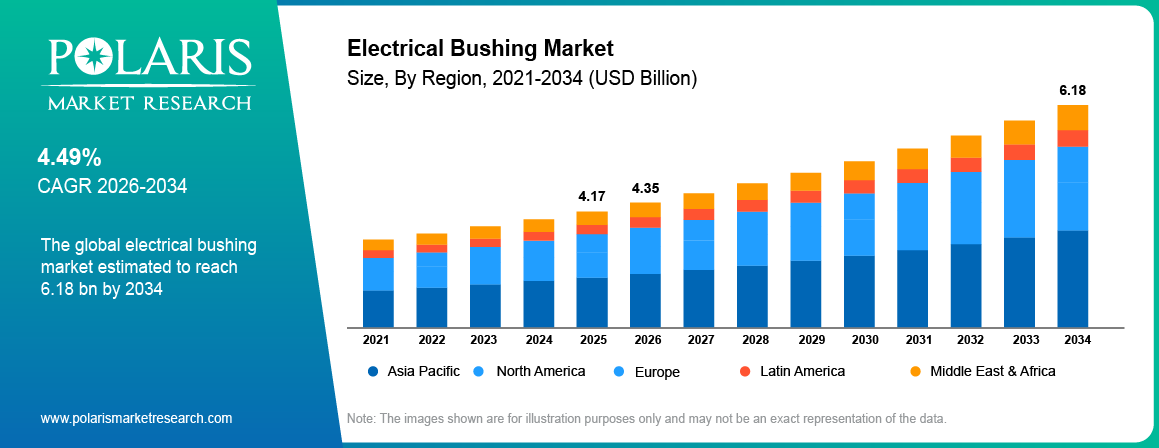
The global electrical bushing market size was valued at USD 4.17 billion in 2025 and is projected to register a CAGR of 4.49% from 2026 to 2034. Market growth is attributed to increasing investments in power transmission and distribution networks and rising demand for power transformers. Also, the expansion of high-voltage infrastructure for renewable energy integration and grid modernization fuel the market expansion.
Market Statistics
Key Takeaways
- Asia Pacific led the global electrical bushing market share with 39.18% in 2025, driven by rising grid modernization and transmission and distribution (T&D) upgrades.
- The North America market will register a 4.58% CAGR from 2026-2034, led by the growth in the substation, renewable energy, and grid markets.
- Oil-impregnated paper (OIP) bushing accounted for 54.82% of the market share in 2025, because of their good dielectric strength and high voltage transformer applications.
- Resin impregnated paper (RIP) bushings are expected to register a 6.18% CAGR during the forecasted period, owing to the growing demand for non-oil insulation systems.
- Transformer applications held 52.18% revenue share in 2025, due to the significance of transformer bushings in the electrical transmission and distribution system.
- The utilities sector is expected to record a 4.18% CAGR from 2026 to 2034, due to increasing activities of grid renovation and substation renovations.
Note: Figures and projections outlined in this report are the result of Polaris Market Research’s proprietary analytical processes, grounded in the latest available datasets and market observations.
What Is an Electrical Bushing?
An electrical bushing is a type of insulator that allows an electric conductor to pass through a grounded insulation. It may be a transformer tank, a switchgear box, or a substation wall. Electrical bushing acts as an insulator between the conductor and the grounded component. Electrical bushings are used in products such as power transformers, switchgear, substations and high-voltage electrical systems. Grid modernization, replacement of aging equipment, and investments in transmission and distribution (T&D) infrastructure impact the electrical bushing market size, share, and forecast 2034.
The market report emphasizes various electrical bushing types such as oil-impregnated paper (OIP) bushings, resin-impregnated paper (RIP) bushings, porcelain bushings, polymer bushings, and composite bushings. A transformer bushing is an insulated connection that connects the windings of a transformer to the external electrical networks. A condenser bushing uses a condenser core and capacitance grading to distribute electrical stress through the insulation system. The main performance parameters are: dielectric strength, partial discharge resistance, creepage distance and basic insulation level (BIL). These features affect bushing selection across different operating voltages and environmental conditions.
Electrical bushings are used in medium-voltage, high-voltage, and extra-high-voltage applications. Extra high voltage/ultra high voltage (EHV/UHV) bushings and high voltage direct current (HVDC) bushings are used to support high-capacity networks, converter transformers, and interconnectors. High voltage bushings are used for electrical connections in transmission equipment. A wall bushing permits insulated conductors to pass through walls and equipment barriers. Insulation options include porcelain, epoxy resin, silicone rubber housing and oil-free designs. These technologies meet the requirements for mechanical strength, environmental resistance, fire safety, and reliable operation in the most demanding electrical installations.
Utilities, industrial facilities, and manufacturers of electrical equipment serve the electrical bushings market. Demand is tied to substation expansion, renewable integration, grid modernization, and transformer replacement programs. Bushing manufacturers are working on better insulation systems and condition monitoring capabilities to assess the performance of the equipment. Partial discharge testing and tan delta (dissipation factor) measurements are used to assess insulation condition. The electrical bushing industry therefore covers a broad product ecosystem spanning insulation materials, voltage ratings, applications, and end users. Moreover, the electrical bushing market forecast 2034 will be shaped by power infrastructure investment and demand for reliable transmission and distribution networks.
Market Dynamics
Driver: T&D Network Expansion and Grid Modernization
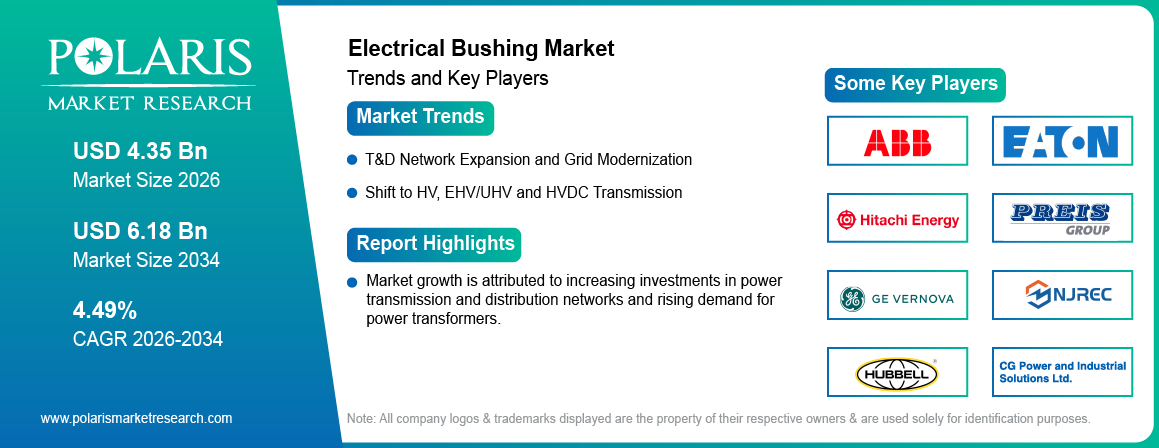
Expansion of transmission and distribution (T&D) networks is driving the electrical bushing market growth. The CEA announced its plans to invest USD 28 billion to integrate over 500 GW of renewable energy by 2030 and increase India’s interregional transmission capacity to 150,000 MW. Utilities are making investments in new substations, transformer installations, and grid modernization projects to enhance electricity supply and network reliability. New transformer and associated switchgear installations require appropriate bushings for electrical insulation and conductor connections. Aging power infrastructures on existing networks are generating demand for transformer bushings. Grid capacity upgrades are being strained by renewable integration and growing electricity demand. The investments are opening opportunities for bushing manufacturers in both medium- and high-voltage applications (Source: thehindu.com).
Driver: Shift to HV, EHV/UHV and HVDC Transmission
The industry is moving toward EHV/UHV and HVDC transmission. As a result, demand for specialized electrical bushings is increasing. In September 2026, POWERGRID acquired Barmer HVDC Power Transmission Limited to construct a 6,000 MW, ±800 kV HVDC corridor to transmit solar power from Rajasthan and augment India’s transmission network. Utilities are constructing larger transmission systems to transmit power over great distances, connecting distant renewable energy projects with centers of consumption. High voltage bushing designs require reliable insulation, effective capacitance grading, and suitable basic insulation level (BIL) performance. HVDC bushings also serve converter transformers, as well as interconnector projects. These applications demand high electrical and mechanical performance. Manufacturers with advanced condenser bushing technologies and high-voltage engineering expertise will expand business as investment in high-capacity transmission infrastructure grows (Source: Litequo LLC).
Restraint: High Cost of RIP, Composite and EHV/UHV Bushings
Advanced electrical bushings, especially resin impregnated paper (RIP), composite and EHV/UHV designs are limited by the high cost of manufacture and purchase. There is a high demand on performance from the devices, which means that there is a need for the use of specific materials as well as manufacturing and electrical test procedures. High voltage bushings may have a need for customization depending on the needs of the equipment used and the operational conditions. If it is feasible, buyers with tight budgets may prefer traditional porcelain or oil-impregnated paper (OIP) bushings. This can be an impediment to the uptake of more sophisticated insulation technology in the market.
Opportunity: Oil-Free RIP/RIS and Smart Bushings
The electrical bushing market offers opportunities for RIP/RIS and smart bushings due to demand for oil-free insulation technologies. For example, Hitachi Energy’s EasyDry RIS bushings have oil-free synthetic insulation, eliminating the risk of oil leakage and fire hazards in AC transformer applications. Resin-based insulation systems can reduce the dependence on insulating oil and the issues of fire safety, leakage, and maintenance in suitable applications. Smart bushing technologies offer opportunities to monitor electrical and insulation conditions by means of sensors and condition monitoring systems. Operators can use measurements of partial discharge and tan delta (dissipation factor) to assess insulation deterioration and plan maintenance. Utilities can use these solutions to upgrade substations and high-voltage equipment, improve asset visibility, reduce unplanned outages, and strengthen grid reliability (Source: Hitachi Energy).
Challenge: Supply Chain, Tariffs, and Lead Times
Electrical bushings makers and users of electrical equipment face constraints in their supply chains along with higher costs due to tariffs. Procurement challenges or price changes could have an effect on the procurement of insulation material, porcelain material, conductive materials, and machinery used in manufacturing electrical bushings. International trade barriers and tariffs could make the cross-border procurement of such items more challenging and expensive. Specialized engineering expertise and testing required in the manufacturing of high-voltage electrical bushings make it difficult to increase the capacity to manufacture quickly. Late delivery of electrical bushings could hamper the manufacturing of transformers, construction of substations, and transmission projects.
Electrical Bushing Market Trends
Increasing use of RIP and oil-free insulation: Manufacturers are developing resin impregnated paper (RIP) bushings and other oil-free designs for fire safety, leakage concerns and maintenance needs. In suitable applications, these technologies offer alternatives to the traditional oil-impregnated paper (OIP) bushings.
Switch to composite and polymer bushings: Silicone rubber-housed bushings enable applications that are lighter weight, environmentally resistant and hydrophobic. These materials are used in place of porcelain bushings in certain outdoor applications.
Smart bushing and condition monitoring integration: Digital monitoring technologies are enhancing the assessment of bushing insulation and operating conditions. Utilities use partial discharge and tan delta (dissipation factor) testing to detect insulation deterioration and schedule preventive maintenance.
Grid modernization & reliability focus: Utilities are upgrading substations, transformers, and transmission and distribution (T&D) networks to enhance power reliability. These investments are supporting demand for transformer bushings, condenser bushings, and wall bushings across modern electrical infrastructure.
Electrical Bushing Market Segmentation Analysis
The electrical bushing market is segmented by type, insulation material, voltage rating, application, and end user. Each segment serves specific electrical insulation and connectivity requirements across power transformers, switchgear, substations, and transmission networks. The segmentation covers OIP and RIP bushings, porcelain and composite insulation, medium- to ultra-high-voltage applications, and demand from utilities and industrial users.
By Type
The electrical bushing market by type includes OIP bushings, RIP and RIS bushings, and other designs. Selection depends on voltage rating, insulation performance, operating conditions, maintenance requirements, and equipment compatibility. Each type serves distinct requirements across transformer and switchgear installations.
The oil-impregnated paper bushing segment accounted for the largest electrical bushing market share of 54.82% in 2025. Oil-Impregnated Paper (OIP) bushings employ oil-impregnated paper insulation for dielectric strength and electrical stress control. These transformer bushings are used in medium- and high-voltage applications in transmission and distribution systems. Their proven application in power transformers supports the demand from utilities and equipment manufacturers. Performance is a function of the condition of the insulation, the oil handling, the sealing integrity, and the maintenance practices. Partial discharge and tan delta (dissipation factor) tests are used to evaluate insulation condition under service.
RIP bushing and RIS bushing segment is expected to register a CAGR of 6.18% during 2026–2034. Resin-impregnated paper (RIP) and RIS bushing designs employ resin-based systems of insulation and provide oil-free options for suitable electrical equipment. RIP bushings are constructed of resin-impregnated paper. RIS bushings are constructed of resin-impregnated synthetic insulation. Applications depend on voltage class, equipment design, fire safety requirements, and environmental conditions. Demand is driven by high-voltage equipment upgrades and a preference for reduced oil-related maintenance risks. Advanced designs also serve selected GIS installations and other applications requiring reliable insulation performance.
| Attribute | OIP (oil-impregnated paper) | RIP (resin-impregnated paper) | RIS (resin-impregnated synthetic) |
| Condenser core | Kraft paper with foil grading layers, soaked in mineral oil | Paper wound with grading layers, vacuum-impregnated with epoxy resin and cured | Synthetic fabric instead of paper, impregnated with resin |
| Oil inside bushing | Yes | No (dry) | No (dry) |
| Fire and leak risk | Higher; oil can leak or ignite on failure | Low; no free oil | Low; no free oil |
| Partial discharge behavior | Good when oil is in condition | Very low; void-free core | Very low |
| Maintenance | Oil level and quality checks | Minimal | Minimal |
| Storage and handling | Robust and well understood | Core must be protected from moisture during storage | Less moisture-sensitive than RIP |
| Relative cost | Lowest | Higher | Highest |
| Typical use | Power transformers, reactors and breakers across most voltage classes | Urban substations, EHV and HVDC, retrofits seeking oil-free designs | Distribution and medium-voltage dry-type applications |
Source: Polaris Market Research Analysis
By Insulation Material
The electrical bushing market by insulation material includes porcelain, polymer/silicone composite, and glass. Material selection depends on dielectric strength, creepage distance, mechanical loading, environmental exposure, and the requirements of the installed equipment. Each material offers distinct operating characteristics.
In 2025, porcelain bushings held 55.46% of the market share. Porcelain provides electrical insulation, mechanical strength, and resistance to outdoor operating conditions. These bushings are used in transformers, switchgear, and substations of various voltage classes. Their performance is dependent on the housing design, surface condition, creepage distance, and exposure to contamination. Utilities still use porcelain bushings where established designs meet technical and maintenance requirements. Selection also depends on installation conditions and applicable electrical standards.
The polymer/silicone segment is projected to record a CAGR of 5.86% during the forecast period. These designs may use silicone rubber housing over an insulating core. Silicone rubber offers hydrophobicity, which can help limit the formation of continuous conductive moisture films on the surface. Composite bushings also offer lower weight than many conventional porcelain designs. Applications include outdoor substations and selected high-voltage installations. Adoption depends on mechanical requirements, environmental exposure, material performance, and long-term reliability.
The glass insulation segment held 10.42% of the market share in 2025. Glass insulation is used in selected electrical applications where its dielectric and environmental properties satisfy the requirements of the equipment. Its application depends on mechanical strength, thermal performance, and design requirements of the installation. Buyers assess glass insulation against porcelain and composite alternatives based on operating conditions, maintenance needs, and applicable technical standards.
| Attribute | Porcelain | Polymer/Silicone Composite | Glass |
| Weight | Heavy | Light | Medium |
| Pollution performance | Moderate; needs washing in polluted areas | Strong; hydrophobic surface | Moderate |
| Seismic and explosion behavior | Brittle; can shatter | Non-shattering; preferred in seismic zones | Can shatter, but failures are easy to see |
| Track record | Longest field history | Growing quickly | Niche use |
| 2025 share / CAGR | 55.46 | 34.12% | 10.42% |
Source: Polaris Market Research Analysis
By Voltage Rating
The electrical bushing market by voltage rating covers medium-voltage, high-voltage, and extra-high-voltage and ultra-high-voltage applications. Voltage classification determines insulation design, testing requirements, conductor configuration, and suitability for transformer and switchgear installations.
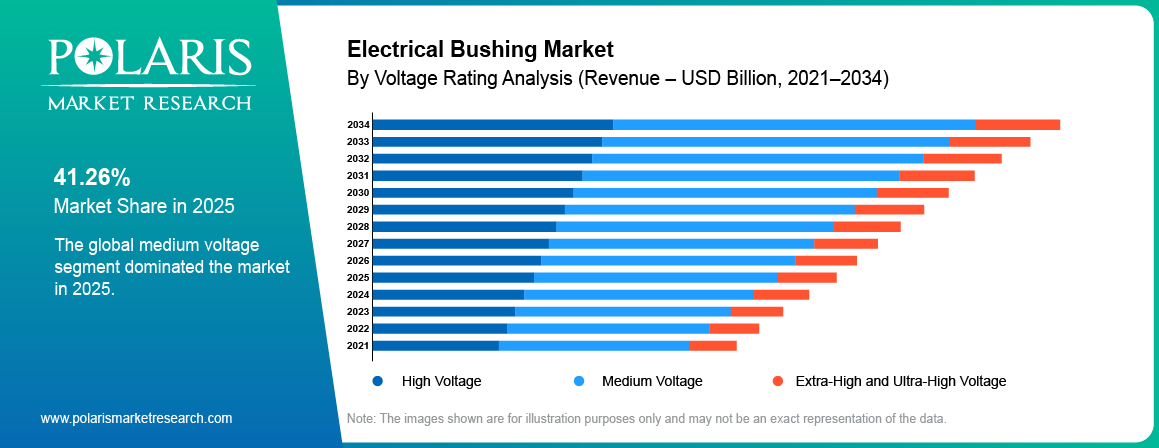
In 2025, the medium voltage segment held 41.26% of the electrical bushing market. Medium-voltage bushings are used on distribution transformers, industrial electrical equipment, and some switchgear installations. Demand is tied to distribution network expansion, industrial power systems, and substation upgrades. When purchasing a bushing insulator, the buyer will consider the insulation performance, the compatibility with the equipment and the operating conditions. The segment includes applications where reliable electrical connections and practical maintenance requirements are key purchasing considerations.
The high voltage bushing segment accounted for 38.74% of the market in 2025. Power transformers, transmission substations and high voltage switchgear use high voltage bushings. Capacitance grading is used in condenser bushings to control the electrical stress in the insulation system. The product selection is based on dielectric strength, partial discharge performance, creepage distance and basic insulation level (BIL). The need for high-performance bushings across utility networks is driven by grid modernization and replacement of aging transmission equipment.
In 2025, the EHV/UHV bushing segment is expected to register the highest CAGR of 5.34% during the forecast period. Extra-high and ultra-high voltage bushings are used in high capacity transmission systems and specialized electrical equipment for very high voltages. HVDC bushing technologies also support converter transformers and interconnectors used for long-distance electricity transmission. Product design needs careful insulation coordination, electrical testing and mechanical qualification. Demand depends on major transmission projects, renewable integration, and investment in high-capacity power networks.
| Segment | Typical assets | Demand driver | 2025 share | CAGR 2026–34 |
| Medium voltage (e.g. 1–72.5 kV) | Distribution transformers, MV switchgear, cable terminations | Urban distribution, industrial and renewable connections | 41.26% | 4.12% |
| High voltage (e.g. 72.5–245 kV) | Sub-transmission transformers, GIS | Substation build-out and replacements | 38.74% | 4.63% |
| EHV / UHV (e.g. >245 kV) | Transmission transformers, reactors, HVDC converter transformers | Long-distance renewable corridors, interconnectors | 20.00% | 5.34% |
Source: Polaris Market Research Analysis
By Application
The electrical bushing market by application includes transformer bushings, switchgear bushings, and other applications such as wall bushings, HVDC equipment, and generators. Demand depends on equipment installations, voltage requirements, insulation design, and investment in power infrastructure.
The transformer segment held the largest share in the electrical bushing market with 52.18% share in 2025. Transformers are vital elements in the infrastructure of power transmission and distribution. They are used to boost or step down voltage levels so that more efficient power transmission is possible and to supply power to consumers. An electrical bushing is an important part of a transformer for electrical insulation and connection. Moreover, developing economies are experiencing substantial investments in grid expansion and electrification programs to provide access to electricity to rural and remote areas. These projects involve the installation of new transformers and electrical bushings to support the growing electrical infrastructure. Participation of many companies in this application is responsible for the dominance of the market.
The switchgear application accounted for 35.46% of the market in 2025. Bushings used in air-insulated switchgear (AIS) and gas-insulated switchgear (GIS) provide insulation and conductor passage through grounded enclosures. Design requirements differ for the voltage class, equipment layout, insulation medium and environmental conditions. As the grid is modernized and substations upgraded, the need for suitable bushing solutions grows. GIS installations require sometimes special interfaces and compact designs to meet the mechanical and electrical performance specifications.
Other applications represented 12.36% of the market in 2025. Other applications include wall, HVDC, and generator. A wall bushing is an insulated conductor that passes through walls of buildings and barriers of substations. HVDC bushings are used in converter stations and converter transformers and generator bushings connect generator conductors to external electrical systems. The demand depends upon project specifications, voltage requirements, and equipment configuration. Interconnectors, renewable power infrastructure, and high-capacity transmission systems all require investment. It would create opportunities for specialist bushing manufacturers.
By End User
The end user segments of the electrical bushing market include utilities, industrial facilities and data centers, renewable energy projects, and commercial installations. Purchasing decisions are influenced by equipment requirements, reliability targets, voltage class, maintenance practices, and capital investment plans.
The utilities segment accounted for 61.34% of the electrical bushing market in 2025. Utilities, including power generation companies and electricity distribution companies, are the primary entities responsible for generating and delivering electricity to consumers. These utilities require a substantial number of transformers and electrical bushings to ensure efficient and reliable power transmission and distribution. Additionally, utilities continuously invest in expanding their power grid infrastructure to meet the increasing electricity demand. This includes installing new substations, transformers, and associated equipment. Electrical bushings are essential components in transformers used by utilities to provide electrical insulation and ensure reliable performance.
Also, utilities are investing in grid modernization projects to enhance the efficiency, reliability, and flexibility of their power networks. These initiatives involve the deployment of advanced technologies, smart grids, and digital monitoring systems. Electrical bushings are integral components in transformers that support these modernization efforts.
Industrial segment is projected to contribute 25.68% share in 2025. Electrical bushings are used in transformers, switchgear, and power distribution systems in manufacturing facilities, processing plants and other industrial locations. Demand is driven by facilities expansion, equipment replacement, production capacity, and electrical reliability needs. When selecting products for industrial installations, factors such as insulation material, voltage rating, operating environment, and maintenance should all be considered.
Data centers, renewable energy projects, and commercial installations were 12.98% of the market in 2025. The power distribution infrastructure (transformers, switchgear, with appropriate bushings) must be reliable. Solar and wind projects employ electrical equipment to connect generation assets to collection networks and substations. Power distribution in commercial buildings requires transformer and switchgear installations too. New construction of facilities, renewable integration, grid connection requirements and investment in reliable electrical infrastructure drive demand.
Electrical Bushing Market Regional Insights
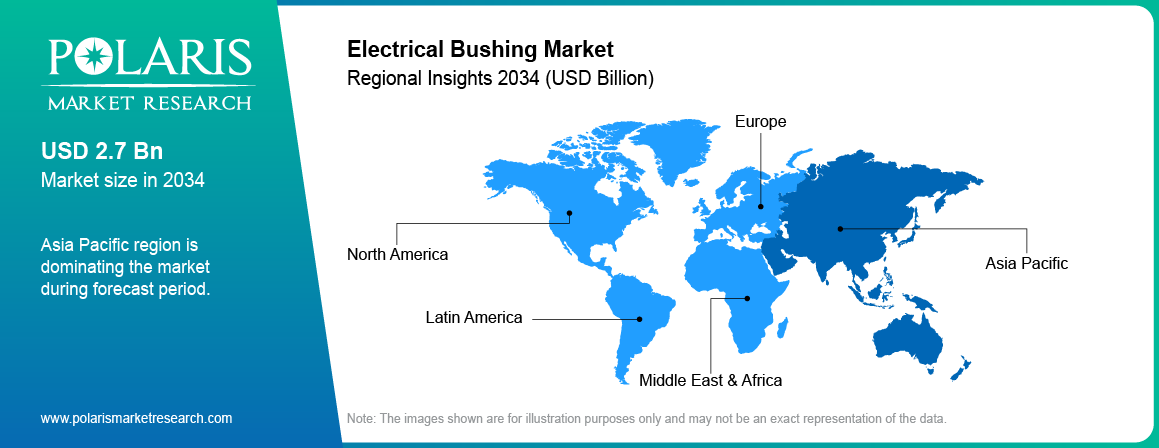
Asia Pacific held the largest electrical bushing market share in 2025. The demand in this region is driven by grid modernization, replacement of aging transformers, substation upgrades, and investments in transmission and distribution (T&D) infrastructure. Opportunities in Asia Pacific, Europe, Latin America and Middle East & Africa tied to power network expansion, renewable integration, and electricity infrastructure development.
| Region | Share | CAGR 2026–34 | Key countries | Demand drivers |
| Asia Pacific | 39.18% | 5.32% | China, India, Japan, South Korea, Malaysia, Indonesia | Grid expansion, UHV corridors, renewables |
| North America | 20.62% | 4.58% | U.S., Canada | Grid hardening, data center load, transformer shortages |
| Europe | 25.84% | 3.71% | Germany, UK, France, Italy, Spain, Netherlands | Offshore wind, interconnectors, oil-free retrofits |
| Latin America | 7.48% | 4.72% | Brazil, Mexico, Argentina | Transmission auctions, hydropower links |
| Middle East & Africa | 6.88% | 4.94% | Saudi Arabia, UAE, Israel, South Africa | Solar build-out, harsh-climate substations |
Source: Polaris Market Research Analysis
North America Electrical Bushing Market Trends
North America is anticipated to register a CAGR of 4.58% during 2026–2034. Regional demand is being driven by grid modernization, replacement of aging transformers, and upgrades to transmission and distribution (T&D) infrastructure. MEAG Power points out that 70% of U.S. power transformers are 25 years or older, 60% of circuit breakers are 30 years or older and 70% of transmission lines are 25 years or older. The need to upgrade the grid and replace equipment is obvious. Utilities are putting substations and high-capacity transmission networks in place to make the grid more reliable and to accommodate renewable integration. These projects create demand for transformer bushing manufacturers, RIP bushings and high voltage bushing technologies. The equipment maintenance strategy is also influenced by the condition monitoring and insulation assessment. Utilities reviewing equipment performance, maintenance needs, and operating conditions across modern power networks may broaden demand for composite bushings and oil-free insulation systems (Source: MEAG Power).
Asia Pacific Electrical Bushing Market Trends
The Asia Pacific market accounted for the largest market share of 39.18% in 2025. China, India and Southeast Asian countries are investing in transmission and distribution (T&D) networks, substations and grid modernization. The Asian Development Bank (ADB) is planning to mobilize USD 50 billion by 2035 to build cross-border power infrastructure in Asia and the Pacific. It is aiming to integrate 22,000 circuit-kilometers of transmission lines and 20 GW of renewable energy across borders. These projects generate demand for transformer bushings, high voltage bushings, and porcelain bushings. The drive to bring in renewables and expand industry is also driving demand for dependable electrical equipment. Power infrastructure investments include opportunities for RIP bushings, composite bushings and advanced insulation systems. Demand for electrical bushings in India and China will depend on transformer installations, voltage requirements, and transmission network expansion (Source: Asian Development Bank).
Europe Electrical Bushing Market Trends
Europe held 25.84% of the electrical bushing market in 2025. Grid modernization, renewable integration, and upgrades to transmission and distribution (T&D) infrastructure support regional demand. The EU needs USD 654 billion of grid investments by 2030. Some 40% of distribution grids are over 40 years old. Also, electricity consumption is expected to increase by 60% by 2030. Utilities are investing in substations, transformers and high-voltage networks to enhance reliability and connect renewable power generation. These projects will drive demand for high-voltage bushings, RIP bushings, and composite bushings. Oil-free insulation technologies also offer opportunities for applications that require enhanced fire safety and reduced maintenance. The future demand will be dependent on grid investment, equipment renewal, and renewable energy connections (Source: European Commission).
Latin America Electrical Bushing Market Trends
The electrical bushing market in 2025 was most represented by Latin America with a share of 7.48%. Demand is related to transmission network expansion, electricity access projects, renewable energy projects and substation development. Investments in transformers and power distribution equipment create demands for transformer bushings and porcelain bushings across utility networks. There are also opportunities for bushing manufacturers in grid modernization and replacement of aging electrical infrastructure. Demand for high-voltage bushings could increase as transmission systems are upgraded and renewable power is connected. Regional market development will depend on infrastructure spending, project execution, equipment procurement, and investment in reliable electricity networks.
Middle East & Africa Electrical Bushing Market Trends
The Middle East & Africa region accounted for 6.88% of the electrical bushing market in 2025. Investments in power generation, transmission networks, substations and industrial infrastructure are driving regional demand. The development of the electricity network and the integration of renewables offer opportunities for transformer bushings, high voltage bushings and composite bushings. Utilities need reliable insulation components to guaranty the performance of power transmission and distribution. Procurement requirements are also supported by new substation and transformer installations. Future market growth will be driven by grid modernization programs, infrastructure investment, project funding, and demand for electrical equipment for utility and industrial applications.
Electrical Bushings in Action: Use Cases
Electrical Bushings Connect insulated conductors through grounded barriers in power equipment. They are used in transformers, switchgear, substations, generators, and high-voltage transmission systems. The choice of a product depends on the voltage rating, the insulation material, the dielectric strength, the operating conditions, and the design of the equipment.
- Power transformers: A transformer bushing provides the interface between the internal windings and the external circuit. Distribution and power transformers use OIP bushings and RIP bushings for different insulation requirements.
- Substations: Electrical bushings connect transformers and other high-voltage equipment. Grid modernization and transmission and distribution (T&D) upgrades are driving demand for reliable insulation system.
- Air-insulated and gas-insulated switchgear: Grounded enclosures provide electrical insulation of switchgear bushings. Designs must be compatible with equipment interfaces and insulation conditions for GIS applications.
- HVDC transmission: HVDC bushings are applied on converter transformers and transmission installations for the transmission of electricity over long distances. EHV/UHV bushing technologies also help to build high-capacity networks and interconnectors.
- Wall and generator applications: A wall bushing is used to carry conductors through building or substation barriers. Generator Bushings connect the generator terminals with external electrical systems.
- Renewables and industrial plants: These electrical bushings are required for transformers and switchgear in wind and solar plants, manufacturing plants and data centers.
Utilities and equipment manufacturers also use condition monitoring to determine insulation health. Partial discharge measurements and testing of tan delta (dissipation factor) help identify potential deterioration and plan maintenance. These use cases relate electrical bushing demand to equipment installation, asset replacement and power network reliability.
Standards & Testing for Electrical Bushings
Electrical Bushing manufacturers test for insulation performance, electrical withstand capability and mechanical suitability against established standards. IEC 60137:2017 specifies the characteristics and test methods for insulated bushings for electrical equipment, transformers and switchgear, for AC voltages above 1 000 V. It also includes RIP and resin-impregnated synthetic (RIS) technology.
IEEE C57.19.00-2023 provides general requirements and test methods for specified power apparatus bushings for use with liquid-immersed transformers and reactors.
Depending upon the bushing design, testing may include power-frequency voltage withstand, lightning impulse withstand, temperature rise, thermal short-time current withstand, and mechanical load tests. Measurements of partial discharge and dimensional checks are also used to evaluate product quality. The requirements are a function of voltage rating, insulation system, AC or DC service, and equipment application. Buyers must confirm the applicable standard and test scope with the manufacturer.
Industry Structure: Porter’s Five Forces, PESTLE and Value Chain Summary
The electrical bushing market combines specialized component manufacturing, insulation materials, electrical testing, and supply to transformer and switchgear manufacturers.
- Porter’s Five Forces: Barriers to entry are technical qualification requirements and manufacturing expertise. There is a lot of competition among the existing bushing manufacturers. Buyer power is a function of order volume, supplier qualification, and product availability. Supplier Power Specialized materials and long production cycles. The substitution depends on the voltage class and equipment compatibility.
- PESTLE analysis: Government investment in the grid, electricity regulations, capital expenditure, prices of materials, environmental requirements, insulation technology, and manufacturing standards influence the market. Demand for advanced electrical bushings is being driven by grid modernization and renewable integration.
- Value chain: The chain starts with paper, porcelain, resin, metals, and composite materials providers. Manufactures emphasize manufacturing insulation cores, housings, conductors, and complete bushings. Testing and quality assurance is performed after the product is manufactured. After passing quality check, the products are being sold to transformer manufacturers, switchgear suppliers, EPC contractors, utilities and industrial buyers. The service chain is rounded off with installation, maintenance, and status monitoring.
Electrical Bushing Market Competitive Insights
The electrical bushing market includes established manufacturers supplying transformer bushings, high-voltage bushings, RIP designs, composite products, and related insulation components. Key players in the electrical bushings market are constantly upgrading their technologies to stay ahead of the competition. They focus on efficiency, integrity, and safety. These players are taking strategic initiatives such as partnership, product upgrades, and collaboration. These activities help them gain a competitive edge over their peers and capture a significant market share.
Electrical Bushing Key Players
- ABB Ltd
- CG Power and Industrial Solutions Limited
- Eaton Corporation plc
- GE Vernova Inc.
- Hitachi Energy Ltd.
- Hubbell Incorporated
- Nanjing Rainbow Electric Co., Ltd.
- NGK Insulators, Ltd.
- PFISTERER Holding SE
- PREIS GmbH
- Reinhausen GmbH (formerly Maschinenfabrik Reinhausen GmbH)
- RHM International, LLC
- Siemens Energy AG
- Transformers and Rectifiers (India) Limited
- Trench Group GmbH
- Yash Highvoltage Limited
Vendor Positioning
| Company | HQ | Core application focus |
| ABB Ltd | Switzerland | Medium-voltage switchgear, connectors and bushings for power distribution; bushing scope after the power-grids divestment to be confirmed |
| CG Power and Industrial Solutions Limited | India | Power and distribution transformers and switchgear with transformer bushings; new Sehore plant for 220–1,200 kV transformers (first unit rolled out 4 Sept 2026) |
| Eaton Corporation plc | Ireland | Power management and medium-voltage/distribution-class bushings for utility and industrial transformers and switchgear |
| GE Vernova Inc. | U.S. | High-voltage transformer, GIS and wall bushings (Grid Solutions); ~USD 30 mn Sesto San Giovanni expansion for dry-type RIP/RIS up to 245 kV (Mar 2026) |
| Hitachi Energy Ltd. | Switzerland | OIP, RIP, dry-type and HVDC transformer bushings up to 800 kV; USD 106 mn Alamo, Tennessee expansion (Aug 2025) |
| Hubbell Incorporated | U.S. | North American utility T&D components including bushings; bushing scope to be confirmed |
| Nanjing Rainbow Electric Co., Ltd. | China | Porcelain and composite insulators, OIP/RIP/RIS condenser bushings and wall bushings; small OEM and export supplier |
| NGK Insulators, Ltd. | Japan | Porcelain and ceramic insulators and high-voltage bushings; Japan and Asia Pacific coverage |
| PFISTERER Holding SE | Germany | Plug-in and cable-connection bushings and connection technology for GIS |
| PREIS GmbH | Austria | Transformer components, tanks and porcelain insulators; bushing scope to be confirmed |
| Reinhausen GmbH (formerly Maschinenfabrik Reinhausen GmbH) | Germany | Tap-changers and transformer components; bushing scope to be confirmed |
| RHM International, LLC | U.S. | Dry-type RIF bushings, wall bushings and instrument transformers for transmission-grade equipment |
| Siemens Energy AG | Germany | High-voltage transmission equipment; bushing portfolio to be confirmed (Trench separated in April 2024) |
| Transformers and Rectifiers (India) Limited | India | 245 kV high-voltage transformer bushings (Changodar, Gujarat; launched Feb 2025) |
| Trench Group GmbH | Germany | High-voltage dry-type RIP/RIS bushings and HVDC wall bushings (HSP); first US plant in Charlotte, 25–765 kV (July 2026) |
| Yash Highvoltage Limited | India | OIP condenser bushings up to 245 kV, RIP/RIS condenser and high-current bushings; greenfield RIP/RIS plant in Vadodara |
Source: Polaris Market Research Analysis
Recent Developments
- July 2026, Trench Group opened its first US HSP manufacturing facility in Charlotte, North Carolina, following an investment exceeding USD 60 million. The facility is designed to manufacture high-voltage transformer bushings rated from 25 kV to 765 kV. (Source: finance.yahoo.com)
- March 2026, GE Vernova approved an investment of approximately USD 30 million at its Sesto San Giovanni facility in Italy to expand bushing production with dry-type RIP and RIS technology up to 245 kV. (Source: GE Vernova)
- August 2025, Hitachi Energy said it will invest $106 million to expand its facility in Alamo, Tennessee, including production capacity for dry bushings for AC and HVDC transmission applications up to 800 kV. (Source: Hitachi Energy)
- May 2025, Trench Group has signed framework agreements with GE Vernova, Hitachi Energy and Siemens Energy for the supply of high voltage components including transformer bushings. (Source: Trench Group)
- February 2025, Transformers & Rectifiers India (TARIL) launched 245 kV air-to-oil and oil-to-oil high-voltage transformer bushings at its Changodar facility in Gujarat. (Source: TND India)
Research Methodology
The electrical bushing market study should combine secondary research, primary interviews, market sizing, and cross-validation to develop estimates for the 2025 base year and the 2026–2034 forecast period.
Secondary research: Review manufacturer annual reports, investor presentations, product catalogs, capacity expansion announcements, utility capital expenditure plans, grid development programs, trade data, technical literature, and applicable standards. Some relevant technical references are IEC 60137 and IEEE C57.19 series. Product portfolios, manufacturing capacity, and developments in OIP, RIP, RIS, composite and high voltage bushing technologies can be identified through company disclosures and industry announcements.
Primary research: Identify bushing manufacturers, transformer manufacturers, utility engineers, EPC contractors, distributors, and industry experts. Procurement trends, average selling prices, lead times, material costs, product preferences, and demand for voltage classes and applications should be part of the discussions.
Market sizing and validation: Bottom-up approach based on transformer and switchgear installations, planned capacity additions, bushing attachment rates, and average selling prices by product and voltage class. Cross verify estimates with manufacturer revenue disclosures and a top down assessment of relevant electrical component markets. Reconcile regional and segment estimates, document assumptions, and test forecast variables.
Electrical Bushing Market Segmentation
By Type Outlook (Revenue, USD Billion, 2021–2034)
- Oil-Impregnated Paper (OIP)
- Resin-Impregnated Paper (RIP) and Resin-Impregnated Synthetic (RIS)
- Others
By Insulation Material Outlook (Revenue, USD Billion, 2021–2034)
- Porcelain
- Polymer/Silicone Composite
- Glass
By Voltage Rating Outlook (Revenue, USD Billion, 2021–2034)
- Medium Voltage
- High Voltage
- Extra-High and Ultra-High Voltage
By Application Outlook (Revenue, USD Billion, 2021–2034)
- Transformer Bushings
- Switchgear Bushings (AIS and GIS)
- Other Applications
By End User Outlook (Revenue, USD Billion, 2021–2034)
- Utilities
- Industrial
- Data Centers, Renewables, and Commercial
By Regional Outlook (Revenue, USD Billion, 2021-2034)
- North America
- U.S.
- Canada
- Europe
- Germany
- France
- UK
- Italy
- Spain
- Netherlands
- Russia
- Rest of Europe
- Asia Pacific
- China
- Japan
- India
- Malaysia
- South Korea
- Indonesia
- Australia
- Vietnam
- Rest of Asia Pacific
- Middle East & Africa
- Saudi Arabia
- UAE
- Israel
- South Africa
- Rest of Middle East & Africa
- Latin America
- Mexico
- Brazil
- Argentina
- Rest of Latin America
Electrical Bushing Market Report Scope
| Report Attributes | Details |
| Market Size in 2025 | USD 4.17 Billion |
| Market Size in 2026 | USD 4.35 Billion |
| Revenue Forecast by 2034 | USD 6.18 Billion |
| CAGR | 4.49% from 2026 to 2034 |
| Base Year | 2025 |
| Historical Data | 2021–2024 |
| Forecast Period | 2026–2034 |
| Quantitative Units | Revenue in USD Billion and CAGR from 2026 to 2034 |
| Report Coverage | Revenue Forecast, Competitive Landscape, Growth Factors, and Industry Trends |
| Segments Covered |
|
| Regional Scope |
|
| Competitive Landscape |
|
| Report Format |
|
| Customization | Report customization as per your requirements with respect to countries, regions, and segmentation. |
Source: Polaris Market Research Analysis
Electrical Bushings Market FAQ's
The electrical bushing market was valued at USD 4.17 billion in 2025, due to expanding high-voltage infrastructure for renewable energy integration and grid modernization.
The electrical bushing market is projected to record a 4.49% CAGR during 2026–2034, owing to the increasing investments in power transmission and distribution networks.
An electrical bushing is an insulated device that allows an electrical conductor to pass through a grounded barrier such as that of a transformer, switchgear, or substation.
The OIP bushing has an oil-impregnated paper bushing, while the RIP bushing has resin-impregnated paper insulation.
In 2025, porcelain bushings accounted for 55.46% market share. Porcelain offers electrical insulation, mechanical strength, and resistance to outdoor operating conditions.
The EHV/UHV bushing segment is projected to record the highest CAGR of 5.34% during the forecast period, driven by major transmission projects, increasing renewable integration, and investment in high-capacity power networks
Asia Pacific led the market share by holding 39.18% share in 2025.
A few key manufacturers of key bushings include Hitachi Energy, Trench Group, GE Vernova, Siemens Energy, PFISTERER, CG Power and TARIL.
The demand for transformer bushings is driven by grid modernization, substation expansion, transformer replacement, and renewable integration.
Smart bushings use sensors and condition monitoring to assess insulation health and enable predictive maintenance.
Transformer bushings are insulators that let an electric conductor pass through a grounded transformer tank while maintaining electrical insulation.
Oil-free bushings have resin-impregnated paper insulation, whereas OIP bushings have oil-impregnated paper insulation.

Download Sample Report of Electrical Bushings Market
Please fill out the form to request a customized copy of the research report.


