
Empty Capsules Market Size, Share, Trends, Industry Analysis Report, 2026 - 2034
REPORT DETAILS
Empty Capsules Market Summary
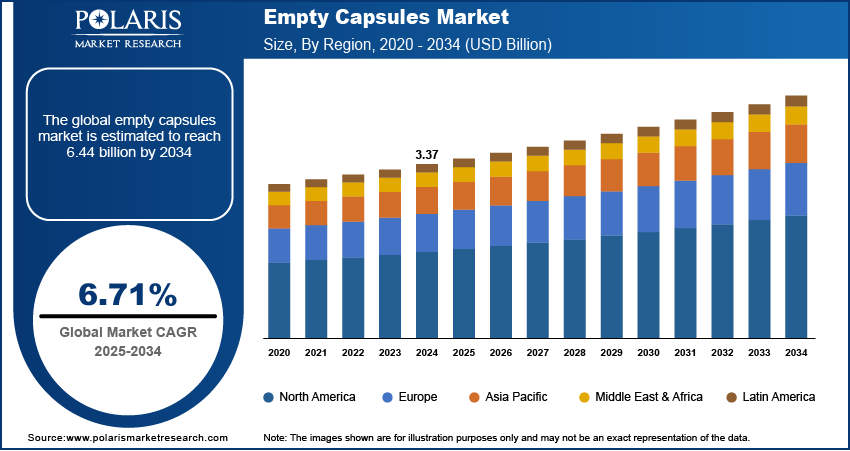
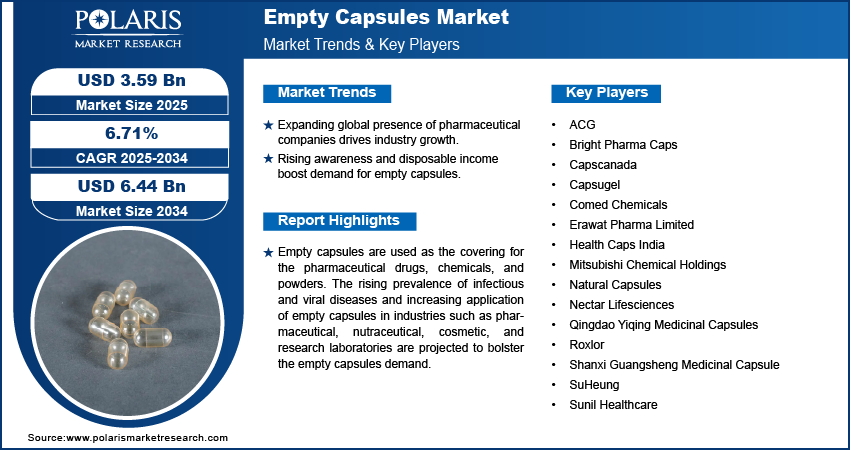
The global empty capsules market size was valued at USD 3.64 billion in 2025. The market is projected to grow at a CAGR of 6.45% during 2026 to 2034. Key factors driving demand for empty capsules include the rising prevalence of chronic diseases, growing aging population, and expanding nutraceutical and dietary supplement.
Market Statistics
Key Takeaways
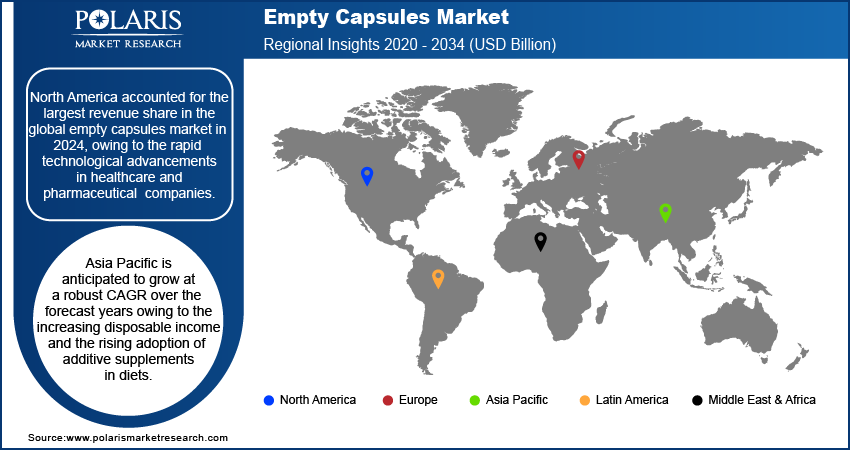
- North America accounted for the largest revenue share of 38.0% in the global empty capsules market in 2025, owing to the rapid technological advancements in healthcare and pharmaceutical companies.
- Asia Pacific is anticipated to grow at a robust 7.95% CAGR over the forecast years owing to the increasing disposable income and the rising adoption of additive supplements in diets.
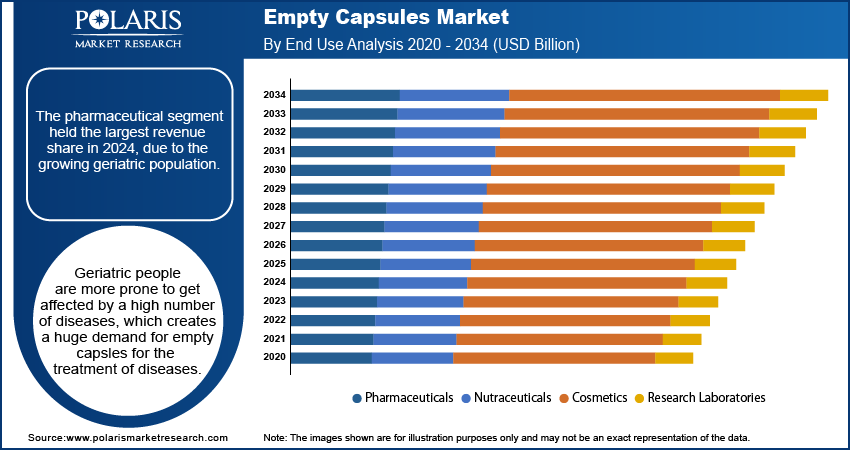
- The pharmaceutical segment accounted for a major revenue share of 58.0% in 2025 due to the growing geriatric population.
- The cosmetic segment is anticipated to grow at a rapid 6.97% CAGR in the coming years. This is due to the changing lifestyles and rising disposable income.
- The gelatin capsules segment held a revenue share of around 69.0% in 2025 due to its low cost and widespread use in pharmaceutical applications.
- The non-gelatin capsules segment is projected to register a CAGR of 8.25% from 2026 to 2034, driven by rising demand for vegan and plant-based supplements.
Note: Figures and projections outlined in this report are the result of Polaris Market Research’s proprietary analytical processes, grounded in the latest available datasets and market observations.
Industry Dynamics
- The rising penetration of pharmaceutical companies across the world fuels the industry growth.
- The growing public awareness, rising disposable income, and development of the pharmaceutical and healthcare sector are also anticipated to increase demand for empty capsules.
- The rising investments by the government in healthcare are creating a lucrative market opportunity.
- Rising prices and lower availability of raw materials may hamper the market growth.
AI Impact on Empty Capsules Market
- AI is improving capsule manufacturing efficiency by optimizing production processes and reducing material waste.
- AI-based inspection systems help detect defects in real time, improving product quality and compliance.
- Predictive analytics supports demand forecasting and inventory optimization across supply chains.
- AI-driven drug development is increasing demand for customized empty capsule solutions.
Source: Polaris Market Research Analysis
To Understand More About this Research: Download Sample Report
What are Empty Capsules?
Empty capsules are used as the covering for the pharmaceutical drugs, chemicals, and powders. The rising prevalence of infectious and viral diseases and increasing application of empty capsules in industries such as pharmaceutical, nutraceutical, cosmetic, and research laboratories are projected to bolster the empty capsules demand. Moreover, the rising number of research & development activities towards the improvement of pharmaceutical industries and increasing government and public spending on healthcare propelled the empty capsules market growth in forthcoming years. The growing public awareness of personal care, coupled with the development of the pharmaceutical industries, contributed to the market growth across the globe.
How Empty Capsules are Manufactured?
- Raw Material Preparation: Gelatin or plant-based materials are selected, processed, and prepared into a uniform solution.
- Shell Molding: The capsule solution is molded into separate cap and body components using specialized pins.
- Drying and Polishing: The capsule shells are dried under controlled conditions and polished to achieve the required finish.
- Inspection and Packaging: Empty capsules are inspected for quality, sorted, and packaged for distribution.
- Capsule Filling: Pharmaceutical or nutraceutical ingredients are filled into the empty capsules before final sealing and packaging.
How Empty Capsules are Manufactured?
- Raw Material Preparation: Gelatin or plant-based materials are selected, processed, and prepared into a uniform solution.
- Shell Molding: The capsule solution is molded into separate cap and body components using specialized pins.
- Drying and Polishing: The capsule shells are dried under controlled conditions and polished to achieve the required finish.
- Inspection and Packaging: Empty capsules are inspected for quality, sorted, and packaged for distribution.
- Capsule Filling: Pharmaceutical or nutraceutical ingredients are filled into the empty capsules before final sealing and packaging.
Gelatin vs Vegetarian Empty Capsules
| Parameters | Gelatin Empty Capsules | Vegetarian Empty Capsules |
| Source Material | Made from animal-derived collagen | Made from HPMC, pullulan, or starch |
| Dissolution | Dissolve quickly in standard conditions | Offer similar dissolution depending on formulation |
| Stability | More sensitive to heat and moisture | Better stability under different storage conditions |
| Consumer Preference | Used in conventional pharmaceutical products | Preferred by vegan and clean-label consumers |
| Halal/Vegan Suitability | Not suitable for vegan use and may require halal certification | Suitable for vegan, vegetarian, and many halal applications |
| Pharmaceutical Applications | Widely used for prescription drugs and supplements | Commonly used for nutraceuticals and herbal products |
| Cost | Lower production cost | Higher production cost |
Market Dynamics
Increasing Demand for Nutraceuticals
Increasing consumer focus on preventive healthcare and general wellness is driving demand for nutraceutical products. Dietary supplements containing vitamins, minerals, herbal extracts, probiotics, and other functional ingredients are commonly formulated in capsule form. Empty capsules offer accurate dosing, convenient consumption, effective taste masking, and compatibility with diverse formulations. The availability of vegetarian and clean-label capsule materials further supports adoption among health-conscious consumers. Nutraceutical companies are also expanding their product portfolios to address immunity, digestion, healthy aging, and sports nutrition. Consequently, rising nutraceutical consumption is strengthening demand for empty capsules.
Expansion of Capsule Production in Emerging Countries
Capsule production in emerging countries is expected to witness significant growth during the forecast period due to the expansion of pharmaceutical and nutraceutical manufacturing capacity. Competitive production costs, an improving skilled workforce, and supportive industrial policies are encouraging companies to establish or expand manufacturing facilities. Growing domestic medicine consumption and contract manufacturing activities are creating additional demand for empty capsules. Local producers are also adopting automated manufacturing systems and advanced quality-control processes to meet international standards. Increasing export opportunities further encourage investments in high-capacity capsule production. These developments are expected to strengthen the role of emerging countries in the global empty capsules supply chain.
How is E-Commerce Impacting the Empty Capsules Market?
E-commerce shifts distribution toward online platforms and enables greater product variety. It fuels innovation in capsule materials and formats. Manufacturers focus on offering their products on e-commerce platforms. E-commerce-driven trends such as brand differentiation, smaller batch flexibility, and clean/vegan materials are better positioned for business growth. The adoption of e-commerce is driving demand for nutraceuticals and dietary supplements. Thus, the sales of gelatin and HPMC capsules are increasing, especially for health supplement applications.
| Aspect | Impact on Market | Implications |
| Distribution Channel Shift | Emergence of online platforms as the fastest-growing sales channel | Rising emphasis of empty capsule suppliers and brands on direct-to-consumer (D2C) and online partnerships. |
| Market Accessibility | E-commerce lowers geographic barriers for capsule suppliers. | Expands access to emerging markets, including India and Southeast Asia |
| Customization & Branding | Online brands provide customization in capsule type, color, and material. | Boosts capsule innovation and enables flexible manufacturing. |
| Supply Chain & Packaging | E-commerce focuses on small-batch production and specialized packaging. | Efficient logistics, traceable supply chains, and quality control are paramount. |
| Regulatory & Quality Concerns | Cross-border online trade increases scrutiny on quality standards. | Industry players must comply with global regulatory standards set by the FDA, EFSA, FSSAI, etc. |
| Challenges | Fragmented online markets and price competition. | The pharma segment is still dominant offline. However, e-commerce impact is mostly indirect but growing rapidly. |
| Strategic Opportunity | Partnerships with online capsule and supplement brands and marketplaces. | Expands industry presence and visibility in rapidly-growing D2C channels. |
Source: Polaris Market Research Analysis
Source: Polaris Market Research Analysis
Report Segmentation
The market is primarily segmented on the basis of type, functionality, application, end use, and region.
| By Type | By Functionality | By Application | By End Use | By Region |
|
|
|
|
|
Source: Polaris Market Research Analysis
Know more about this report: Download Sample Report
Source: Polaris Market Research Analysis
Insight by End Use
The pharmaceutical segment held the largest revenue share in 2025, primarily due to the growing geriatric population and the associated increase in chronic and age-related diseases. Older adults generally require more frequent and long-term pharmaceutical treatment, supporting demand for empty capsules used in prescription and over-the-counter medicines. According to a report published by the U.S. Census Bureau in September 2026, people aged 65 years and above accounted for 10.5% of the global population in 2025, and this share is projected to reach 19.6% by 2060. The report further indicated that growth in this age group is expected to contribute approximately 1.15 billion people to the increase in the global population through 2060. Expansion of healthcare systems and pharmaceutical manufacturing capacity also supports the segment’s dominance. The growing presence of pharmaceutical companies in countries such as India, China, and Brazil is increasing capsule-based drug production. Furthermore, the rising incidence of infectious and chronic diseases encourages pharmaceutical companies to invest in new medicines and oral drug-delivery formulations, thereby strengthening demand for empty gelatin and non-gelatin capsules. (Source: census.gov)
The cosmetics segment is anticipated to exhibit the highest 6.97% CAGR in the forecast years. This is attributed to the changing lifestyles and rising disposable income, which is leading the population towards the adoption of skincare products. The increasing spending on beauty products and cosmetics is another major factor propelling the segment expansion. The growth of e-commerce platform and presence of high young population in emerging countries such as India is driving the segment growth. Younger population in countries like India are ordering cosemetic products and capsules extensively from various e-commerce platforms, which is creating the need for empty capsules. Moreover, the rise in women employment rate across the globe is propelling the segment growth.
Real-World Examples of Empty Capsule Applications
- Vitamin Supplement Capsules: Empty capsules are used for vitamin D, vitamin C, multivitamin, and mineral supplements.
- Herbal Medicine Capsules: Herbal ingredients such as turmeric, ashwagandha, and ginseng are commonly packed in capsules.
- Antibiotic Drug Encapsulation: Empty capsules are used to deliver antibiotics with accurate dosage.
- Sports Nutrition Supplements: Creatine, amino acids, and pre-workout supplements are widely available in capsule form.
- Probiotic Capsules: Probiotics are packed in capsules to support gut health and digestive wellness.
- Cosmetic Nutraceuticals: Collagen, biotin, and beauty supplements are increasingly sold in capsule form.
- Customized Pharmacy Formulations: Compounding pharmacies use empty capsules to prepare patient-specific medicines.
Geographic Overview
North America accounted for the largest revenue share of the global empty capsules market in 2025. Rapid technological advancements by pharmaceutical companies and increasing public healthcare funding are supporting demand for empty capsules across the region. For instance, in April 2026, the U.S. Centers for Medicare & Medicaid Services stated that federal payments to Medicare Advantage plans are expected to increase by 5.06% in 2026 compared with 2025. Rising healthcare funding improves access to pharmaceutical treatments and encourages drug production, thereby increasing the requirement for empty capsules. Furthermore, government initiatives aimed at strengthening healthcare infrastructure, controlling disease transmission, and improving public health awareness support regional market growth. The strong presence of pharmaceutical manufacturers and major empty-capsule suppliers also contributes to North America’s market dominance. (Source: cms.gov)
The Asia Pacific market is anticipated to exhibit the highest 7.95% CAGR over the forecast period. This is owing to the increasing disposable income and rising adoption of additive supplements in diets. The increasing working population is further leading to the demand for empty capsules as working people are more conscious of skincare which propels them to purchase skincare products, including creams, lotions, and capsules. The expansion of e-commerce platforms in the region and high young population in countries like India is leading to an increase in market revenue.
Source: Polaris Market Research Analysis
Competitive Insight
The pharmaceutical capsule market is highly fragmented, with competition spanning global giants, regional specialists, and low-cost Asian manufacturers. Lonza (Capsugel) and Roquette (Qualicaps) lead through scale, R&D, and premium nutraceutical partnerships, while Suheung and ACG dominate Asia-Pacific with integrated manufacturing and cost efficiency. Indian players like Natural Capsules, Nectar Lifesciences, and Sunil Healthcare compete on price and domestic regulatory compliance, though they face margin pressure. Chinese entrants such as Qingdao Yiqing and Shanxi Guangsheng aggressively target export markets with lower pricing, intensifying commoditization. Smaller firms (Bright Pharma, Comed, Erawat, HealthCaps, Lyfe) differentiate via niche offerings, customization, or regional distribution. Key success factors include GMP certification, capsule innovation (HPMC, vegetarian), supply chain reliability, and client stickiness. Consolidation and demand for clean-label capsules will likely favor larger, vertically integrated players.
Some of the major players operating in the global market include ACG; Bright Pharma Caps Inc.; Comed Chemicals Limited; Erawat Pharma Limited; HealthCaps India Limited; Lonza Group AG – Capsugel; Lyfe Group – CapsCanada; Natural Capsules Limited; Nectar Lifesciences Limited; Qingdao Yiqing Biotechnology Co., Ltd.; Roquette Frères – Qualicaps; Roxlor LLC; Shanxi Guangsheng Medicinal Capsule Co., Ltd. – GS Capsule; Suheung Co., Ltd.; Sunil Healthcare Limited.
Key Companies
- ACG
- Bright Pharma Caps Inc.
- Comed Chemicals Limited
- Erawat Pharma Limited
- HealthCaps India Limited
- Lonza Group AG – Capsugel
- Lyfe Group – CapsCanada
- Natural Capsules Limited
- Nectar Lifesciences Limited
- Qingdao Yiqing Biotechnology Co., Ltd.
- Roquette Frères – Qualicaps
- Roxlor LLC
- Shanxi Guangsheng Medicinal Capsule Co., Ltd. – GS Capsule
- Suheung Co., Ltd.
- Sunil Healthcare Limited
Recent Developments
- March 2026: Lonza agreed to sell its Capsules & Health Ingredients business to Lone Star Funds. The deal reflects strong demand for hard empty capsules in pharmaceutical and nutraceutical applications. (Source: lonza.com)
Challenges in Empty Capsules Market
- Raw Material Price Fluctuations: Changes in the prices of gelatin and plant-based materials increase production costs.
- Gelatin Sourcing Concerns: Religious, ethical, and dietary preferences limit the use of animal-derived gelatin capsules.
- Strict Regulatory Compliance: Manufacturers need to meet different quality and safety regulations across countries.
- Manufacturing Complexity: Maintaining capsule quality, stability, and uniformity requires advanced production processes.
- High Production Costs for Vegetarian Capsules: Plant-based capsules cost more to produce than conventional gelatin capsules.
Future Outlook
The empty capsules market is expected to witness steady growth due to increasing pharmaceutical production and rising consumption of nutraceutical products worldwide. Growing demand for vegetarian and clean-label dosage forms is creating new opportunities for capsule manufacturers. Advancements in capsule delivery technologies and plant-based formulations are supporting product innovation. The expansion of personalized medicine and high-bioavailability drug delivery systems will continue to increase the use of empty capsules across pharmaceutical and wellness industries.
Empty Capsules Market Report Scope
| Report Attributes | Details |
| Market size value in 2025 | USD 3.64 Billion |
| Market size value in 2026 | USD 3.86 Billion |
| Revenue forecast in 2034 | USD 6.38 Billion |
| CAGR | 6.45% from 2026 - 2034 |
| Base year | 2025 |
| Historical data | 2021 - 2024 |
| Forecast period | 2026 - 2034 |
| Quantitative units | Revenue in USD Billion and CAGR from 2026 to 2034 |
| Segments covered |
|
| Regional scope |
|
| Key companies | ACG; Bright Pharma Caps Inc.; Comed Chemicals Limited; Erawat Pharma Limited; HealthCaps India Limited; Lonza Group AG – Capsugel; Lyfe Group – CapsCanada; Natural Capsules Limited; Nectar Lifesciences Limited; Qingdao Yiqing Biotechnology Co., Ltd.; Roquette Frères – Qualicaps; Roxlor LLC; Shanxi Guangsheng Medicinal Capsule Co., Ltd. – GS Capsule; Suheung Co., Ltd.; Sunil Healthcare Limited |
Source: Polaris Market Research Analysis
empty capsules market FAQ's
• The global market size was valued at USD 3.64 billion in 2025 and is projected to grow to USD 6.38 billion by 2034.
• The global market is projected to register a CAGR of 6.45% during the forecast period.
• North America dominated the market with 38.0% share in 2025.
• A few of the key players in the market include ACG; Bright Pharma Caps Inc.; Comed Chemicals Limited; Erawat Pharma Limited; HealthCaps India Limited; Lonza Group AG – Capsugel; Lyfe Group – CapsCanada; Natural Capsules Limited; Nectar Lifesciences Limited; Qingdao Yiqing Biotechnology Co., Ltd.; Roquette Frères – Qualicaps; Roxlor LLC; Shanxi Guangsheng Medicinal Capsule Co., Ltd. – GS Capsule; Suheung Co., Ltd.; Sunil Healthcare Limited.
• The pharmaceutical segment dominated the market revenue share of 58.0% in 2025.
Download Sample Report of empty capsules market
Please fill out the form to request a customized copy of the research report.


