
External Counterpulsation Devices Market Size, Share, and Forecast 2027 to 2035
REPORT DETAILS
External Counterpulsation Devices Market Summary
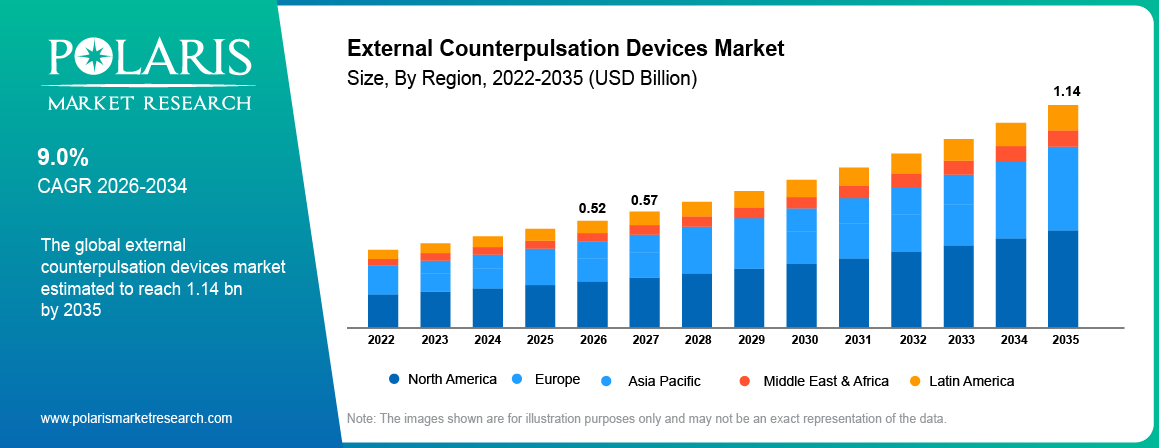
According to Polaris Market Research analysis, the external counterpulsation devices market was valued at USD 0.52 Billion in 2026. It is projected to reach USD 1.14 Billion by 2035, growing at a CAGR of 9.0% from 2027 to 2035. Demand comes from hospitals, cardiology clinics, rehabilitation centers, and home programs that treat refractory angina and heart failure with leg cuff therapy, sold as systems, cuff sets, and service contracts. Pneumatic Air Cuff Systems hold the largest product share, while Portable and Compact Systems expand quickest. The market tracks external devices that compress the legs in time with the heartbeat, and it leaves out intra aortic balloon pumps, ventricular assist devices, and implanted therapies. North America is the leading market. Asia Pacific is the fastest growing region.
Market Statistics
Key Takeaways
- In 2027 North America produced 35.3% of revenue, since hospitals and cardiology offices there own the biggest pool of treatment beds and coverage rules for severe angina are plainer.
- Asia Pacific rises fastest among regions, at 11.9% annually through 2035, as new hospital capacity in China and private cardiology demand in India add beds.
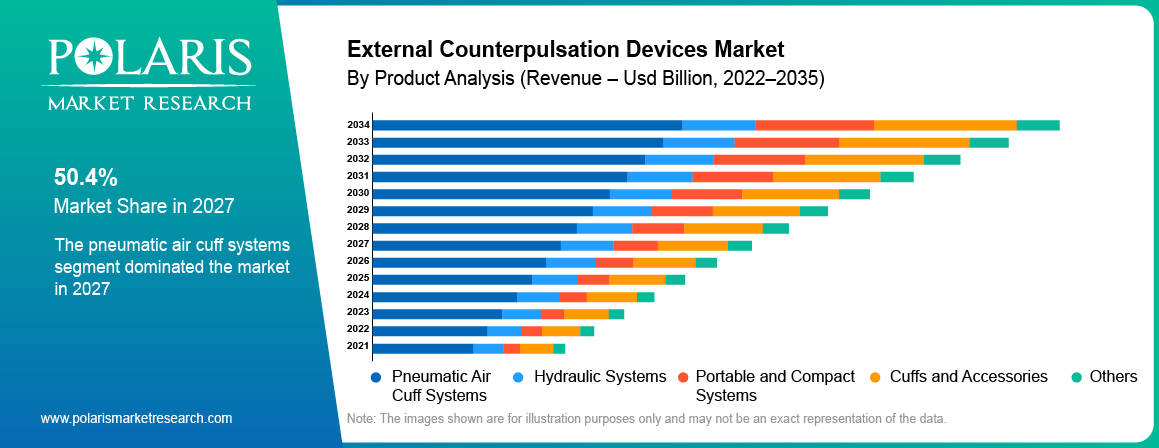
- Product value in 2027 is led by Pneumatic Air Cuff Systems at 50.4%, since most current treatment beds inflate air filled cuffs in sequence.
- Portable and Compact Systems post the highest product CAGR, at 15.4% through 2035, due to smaller units that fit clinics and home programs without a dedicated treatment room.
- Chronic Stable Angina commands 44.6% of 2027 application revenue, as it is the indication that regulators and payers recognize most clearly.
- Peripheral and Cerebrovascular Disorders lead application growth at 11.6% yearly, starting from a modest base.
- ECG Gated Systems account for 72.5% of 2027 technology value, due to decades of use of electrode based timing in existing beds.
- Photoplethysmography Gated Systems grow 15.1% a year to 2035, the fastest technology rate, owing to fingertip sensors that simplify setup in smaller units.
- Home Care Settings show the highest end use growth, 18.1% annually to 2035, and Hospitals lead on size with 39.1% of 2027 value.
Note: Figures and projections outlined in this report are the result of Polaris Market Research’s proprietary analytical processes, grounded in the latest available datasets and market observations.
External Counterpulsation Devices Market Definition
The external counterpulsation devices market covers noninvasive systems that inflate and deflate cuffs around the legs in time with the heartbeat, sold with cuffs, accessories, and service to providers who treat angina, heart failure, and related conditions. It excludes intra aortic balloon pumps, ventricular assist devices, implanted cardiac devices, and ordinary compression garments.
Reported totals for this field differ since every study sets its own limits. Some count only complete treatment beds, others add cuffs and service contracts, and a few mix in compression pumps used for swelling or clot prevention. Polaris counts revenue that system makers and distributors earn from counterpulsation beds, cuff sets, accessories, and service, so the total follows equipment and consumable sales and leaves out the fees that providers charge patients.
Implanted and bedside circulatory support belongs elsewhere. Intra aortic balloon pumps and ventricular assist devices sit in the heart pump device market, while the wider field of catheters, implants, and monitors is covered in the cardiovascular device market. An external system counted here pushes blood flow from outside the body, so no catheter, implant, or surgery is involved.
Revenue comes from four product families. Pneumatic systems use compressed air in cuffs that fill one after another up each leg. Hydraulic systems use liquid filled cuffs and appear mainly in older installations, portable units shrink the console and bed, and cuff sets and accessories are replaced as they wear.
The usual treatment course is long. Anthem describes one course as 35 hours, delivered in sessions of one to two hours on five days a week, so a single patient occupies a bed for roughly seven weeks at one hour a day. That schedule shapes how many beds a provider needs and how often cuffs need replacing.
Revenue reaches system makers through four routes: sales of complete beds, sales of replacement cuffs and sensors, service and software contracts, and, in some regions, rental or placement deals with clinics. Providers then bill payers or patients for each session, and that downstream income decides whether they buy another bed.
External Counterpulsation vs Internal Counterpulsation: Key Differences
| Attribute | External Counterpulsation | Internal Counterpulsation |
| Access to the body | Cuffs wrapped around the legs, with no incision | A balloon catheter placed in the aorta through an artery |
| Care setting | Outpatient rooms, clinics, rehabilitation centers, and some homes | Intensive care and catheterization units |
| Typical course | Daily sessions across several weeks | Continuous support for hours or days |
| Typical patient | Stable patients with chronic angina or heart failure | Critically ill patients with acute cardiac failure |
| Growth outlook | 9.0% CAGR from 2027 to 2035 | Tracked within the heart pump device report |
Source: Polaris Market Research Analysis
The two approaches share a physical idea, the timing of added pressure to the heart cycle, yet their patients and buyers differ. Polaris therefore keeps balloon pumps outside this scope and counts only systems that work from outside the body.
Porter's Five Forces Analysis
| Force | Intensity | Rationale |
| Bargaining power of suppliers | Low | Compressors, valves, textiles, and electronics come from many general suppliers, and no single input controls a treatment bed. |
| Bargaining power of customers | Moderate | Hospitals and clinic chains negotiate on bed prices, yet each purchase depends on a payer pathway and referring cardiologists. |
| Threat of new entrants | Moderate | A new maker needs regulatory clearance and clinical evidence, while the hardware itself is simple to copy. |
| Threat of substitutes | Moderate | Revascularization, new drugs, and cardiac rehabilitation compete for the same patients, although many refractory patients have no surgical option. |
| Competitive rivalry | Moderate | A small group of makers competes on price, portability, and the strength of clinical data. |
Source: Polaris Market Research Analysis
Evidence and reimbursement matter more than hardware in this field. A system that is easy to buy still fails to sell if payers restrict coverage or if cardiologists doubt the data, so makers invest in registries and trials as much as in engineering.
Market Dynamics
Driver Impact Analysis
| Driver | Impact on Market Growth | Time Horizon |
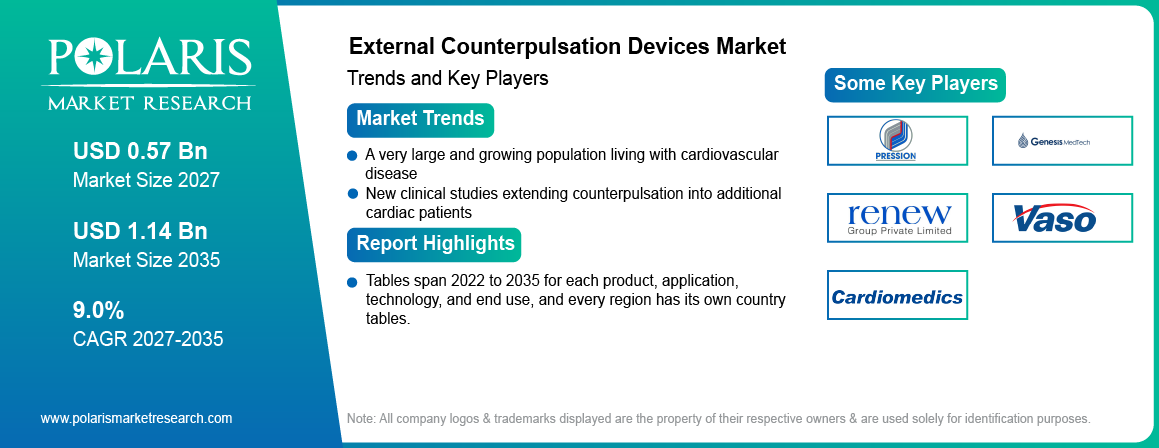
| A very large and growing population living with cardiovascular disease | High | Medium to Long Term |
| New clinical studies extending counterpulsation into additional cardiac patients | Moderate | Short to Medium Term |
Source: Polaris Market Research Analysis
Driver: A Large Population Living With Cardiovascular Disease Is Creating Market Demand
Cardiovascular disease is the main source of demand for any cardiac device. As more adults live with angina and heart failure after earlier treatment, the group of patients who still have symptoms and few procedural options grows, and that group is the core audience for leg cuff therapy.
For example, in March 2026, the American Heart Association published its 2026 Heart Disease and Stroke Statistics in Circulation and reported that 130.6 million US adults live with cardiovascular disease (Source: American Heart Association). A pool of that size produces a steady flow of patients with symptoms that persist after stents, bypass surgery, and drugs, and that keeps referrals for noninvasive options rising.
Revenue from Pneumatic Air Cuff Systems equals 50.4% of the 2027 product total, and hospitals spend USD 224.6 Million in the same year. Heart Failure adds USD 128.6 Million, since some providers now include selected heart failure patients in their angina programs.
Demographics point the same way. Older adults carry most of the disease burden, and many of them cannot undergo repeated procedures, so clinics that already treat chronic cardiac patients see a natural fit for a course of outpatient sessions.
Driver: New Clinical Studies Are Widening the Patient Groups Treated With Counterpulsation
Clinical evidence decides how widely a therapy is used. Each new study that measures exercise capacity, symptoms, or quality of life in a defined group gives cardiologists and payers a reason to consider the therapy for more patients, and it gives makers material for training and marketing.
For example, in July 2026, Advances in Clinical Medicine published a study of 90 patients with myocardial bridge (Source: Advances in Clinical Medicine). Enhanced external counterpulsation (EECP) added to drug therapy improved exercise measures and anxiety and depression scores, with no serious adverse events. A positive result in a new patient group invites larger trials, and it gives clinics in China a documented use beyond classic angina.
Cardiac Rehabilitation and Wellness reaches USD 81.7 Million in 2027 and grows at 11.4% a year to 2035. Rehabilitation Centers hold 16.1% of 2027 end use revenue, owing to programs that combine exercise training with counterpulsation sessions.
Study design is also improving. Smaller trials now report anxiety, depression, and exercise measures beside chest pain, and that wider set of outcomes matches how rehabilitation teams judge success.
Restraint: Strict Payer Criteria Are Limiting Treatment Volumes
Coverage rules limit the number of patients who can receive treatment. Payers write narrow criteria that tie therapy to a severe angina class, require that drugs have failed, and exclude patients with conditions that make cuff pressure risky, so many referred patients never qualify.
For example, in January 2026, Anthem published clinical guideline CG MED 86 (Source: Anthem). It allows one 35 hour course for refractory angina in patients who are not candidates for surgery, and it excludes conditions such as aortic insufficiency, arrhythmias, bleeding disorders, severe heart failure, and stroke. A single covered course caps the sessions per patient, and exclusions shrink the eligible pool.
Others, covering experimental and wellness uses, reaches only USD 34.3 Million in 2027, owing to few payers covering them. Chronic Stable Angina still grows only 6.6% a year, the slowest application rate, since the eligible group changes slowly.
Providers respond by documenting failed drug therapy, measuring symptom change, and asking payers to approve a repeat course when patients respond. Each of those steps adds administrative work, and smaller practices often decline to start a program.
Opportunity: Newly Cleared Portable Systems Are Opening Smaller Sites to Counterpulsation Programs
Size and room needs have limited where counterpulsation could be offered. A conventional system occupies a dedicated room and a heavy bed, so a lighter console with a smaller footprint lets rural hospitals, cardiology offices, and rehabilitation centers add a program with little construction.
For example, in January 2026, Pression announced FDA 510(k) clearance for its Wave PRO system (Source: Pression). The portable unit has calf sleeves with five sequentially inflating bladders and a fingertip photoplethysmography (PPG) sensor, and it is indicated for refractory chronic stable angina in adults who weigh more than 40 kg. A cleared compact design lowers the entry cost for a new site, and it gives buyers a second supplier to compare.
In 2027, Portable and Compact Systems generate USD 62.7 Million. Photoplethysmography Gated Systems account for 19.4% of technology value, and compact units with fingertip sensors add to that total.
The commercial prize is a larger number of sites. A provider that never had space for a bed can start with one unit and a few referring cardiologists, and each added site brings recurring orders for cuffs and sensors.
Opportunity: Day Care Programs Are Creating Demand Beyond Large Hospitals
Day care delivery moves therapy out of the hospital ward. Patients attend a one hour session and go home, so clinics with modest space can run several patients a day and spread a bed cost over many visits.
For example, in March 2026, Spandan Heart Care Clinic in New Delhi described EECP as a day care procedure delivered in one hour sessions over 35 to 40 days (Source: Lokmat Times). Private clinics in large Indian cities can fill beds from a big population of cardiac patients, and that raises demand for systems and cuff sets.
Cardiology and Specialty Clinics hold 37.9% of 2027 end use revenue and grow 8.3% annually until 2035. Procedural cardiology and surgery sit in separate Polaris reports and fall outside this scope.
Quality of claims sets the limit. Clinic marketing sometimes describes the therapy as a replacement for bypass surgery, and regulators and cardiologists push back on that wording, so providers that describe the therapy accurately will keep the trust of referring doctors.
Trend: Counterpulsation Research Is Moving Toward Combined Therapy and Rehabilitation
Researchers are pairing counterpulsation with other treatments and placing it inside structured rehabilitation. Combined designs ask whether added blood flow helps drugs, exercise training, or cell therapy work better, and they give the field new reasons to run trials.
For example, in July 2026, Medical Research Archives published a review that links EECP with CD34+ cell therapy in refractory angina (Source: Medical Research Archives). Combination ideas of this kind give the therapy a role beside newer treatments, and they could attract research funding.
Rehabilitation programs follow the same logic. Community health centers and rehabilitation units are testing counterpulsation as a phase of recovery after a cardiac event, since it adds a passive form of exercise for older patients who tire quickly.
The shift favors makers with documented protocols and data capture. A bed that records session pressure, heart rhythm, and patient response can feed registries and trials, while a basic bed offers no such record.
Value Chain Analysis
| Stage | Activities | Representative Participants |
| Components | Supplying compressors, valves, cuff fabrics, sensors, and control electronics | General industrial and medical component suppliers |
| System manufacturing | Assembling treatment beds, consoles, and software, and obtaining regulatory clearance | Vaso Corporation, Pression, Cardiomedics, Renew Group, and Genesis Meditech |
| Distribution and service | Selling, installing, training, and maintaining systems in each country | Medical equipment distributors and manufacturer service teams |
| Providers | Delivering courses of sessions in hospitals, clinics, and rehabilitation centers | Health systems, cardiology practices, and rehabilitation centers |
| Patients and payers | Referring, qualifying, and paying for each treatment course | Private insurers, public programs, and self paying patients |
Source: Polaris Market Research Analysis
Value gathers at two points. System makers earn the largest margin on beds that carry regulatory clearance and clinical data, and providers earn a recurring fee from each session, whereas components and distribution add the narrowest margins.
Cost sits mostly in manufacturing and service. Cuffs wear out with repeated inflation, sensors fail, and software needs updates, so makers that sell cuff sets and service contracts build a steady income beyond the first bed sale.
Channel partners matter more than their low profile suggests. Local distributors train staff, arrange installation, and keep spare cuffs in stock, and their reach decides whether a clinic in a mid sized city can run a program at all.
Pricing differs along the chain. Components are bought on volume, and beds are priced by feature and clearance status. Sessions are billed under payer codes such as the one Aetna lists for each treatment session, so a lower bed price reaches patients only when providers choose to pass it on.
External Counterpulsation Devices Market Segmentation Analysis
Segmentation follows the equipment a provider buys, the condition it treats, the way heartbeat timing is captured, and the site where sessions take place. Each split changes pricing, replacement cycles, and the evidence a maker needs to win an order.
Product Insights
In 2027, 50.4% of product value sat with Pneumatic Air Cuff Systems, the biggest slice, owing to treatment beds that fill air cuffs in sequence from the calves toward the thighs and are now the usual design. Providers prefer them since they are quieter and easier to maintain than liquid filled designs.
Cuffs and Accessories reached USD 104.6 Million in 2027, supported by cuff sets, hoses, sensors, and electrodes that wear out under repeated inflation. A clinic that runs several sessions a day replaces these parts often, so revenue from the product is steadier than sales of complete beds.
Hydraulic Systems are forecast to post a CAGR of 5.1% through 2035, the slowest product rate, since liquid filled cuffs are heavier and harder to service and few new buyers choose them. Demand now depends mainly on spare parts for installed units.
Portable and Compact Systems record the quickest product CAGR, 15.4% across 2027 to 2035, as smaller consoles and lighter beds let rural hospitals, offices, and home programs add therapy. Others, covering combined and custom designs, reached USD 35.5 Million in 2027.
For example, in August 2026, Vaso Corporation reported net income of USD 542 thousand on revenue of USD 20.9 million for its second quarter (Source: Vaso Corporation). The figures cover the whole company and not counterpulsation alone, yet profitable operation at a long standing system supplier supports continued supply of beds and cuff sets to providers.
Product choice also decides how buyers compare offers. Beds are judged on cuff comfort, noise, footprint, and software, whereas cuff sets are judged on durability and price per session, and service plans are judged on response time.
Boundaries between products are shifting. A compact unit can match the cuff count of a full bed, and a full bed can add lighter parts, so Polaris assigns revenue to the product family named on the invoice.
Application Insights
Chronic Stable Angina accounted for 44.6% of 2027 application revenue, making it the dominant indication, owing to a clear regulatory indication for patients whose symptoms persist despite drugs and who lack surgical options. Patients with earlier stents or bypass operations often return with symptoms, and that group supplies most referrals. Procedural alternatives for the same patients are tracked in the Percutaneous Coronary Intervention (PCI) Devices Market and the coronary stent market.
Heart Failure reached USD 128.6 Million in 2027, supported by programs that admit stable heart failure patients alongside angina cases. Payers set narrower rules here, and Anthem excludes severe heart failure from its angina policy, so growth depends on stable patients with moderate symptoms. Implanted devices for the same patients sit in the Cardiac Rhythm Management (CRM) Devices Market.
Cardiac Rehabilitation and Wellness advances at a CAGR of 11.4% through 2035, driven by programs that pair exercise training with counterpulsation sessions for older patients who tire quickly. Peripheral and Cerebrovascular Disorders climb 11.6% a year, the steepest application path, from a small base that relies on fresh studies and new indications, and Others, covering experimental and wellness uses, grows 6.8% a year.
Aetna states that it considers EECP medically necessary for members with chronic stable angina when its criteria are met, and its clinical policy bulletin 0262 lists a billing code for each treatment session (Source: Aetna). The page carries no date, yet it shows that large payers cover the angina use and reimburse by session, which keeps that application the largest.
Application mix shapes equipment needs. Angina programs value long courses with steady throughput, heart failure programs need closer monitoring, and rehabilitation programs prefer comfortable cuffs and flexible scheduling, so system makers tailor software and training for each.
Applications overlap in daily practice. One patient may have angina, mild heart failure, and a rehabilitation plan at the same time, so providers often buy one system and assign the session to whichever indication a payer accepts.
Technology Insights
In 2027, 72.5% of technology value sat with ECG Gated Systems, the top position, owing to the long installed record of electrode based heartbeat timing. Electrodes give a direct reading of each cardiac cycle, and clinicians trust them for timing inflation to the start of the filling phase.
Photoplethysmography Gated Systems record the fastest technology CAGR, 15.1% across 2027 to 2035, since fingertip sensors are quick to place and suit smaller units used outside large hospitals. Others, covering combined sensing methods, add timing flexibility for patients with irregular rhythms.
ECG Gated Systems reached USD 415.9 Million in 2027, supported by hospitals and clinics that already own electrode based beds and add cuffs and software. The technology advances more slowly than its peers due to a mature installed base and few new buyers.
Timing accuracy is the central technical problem. Cuffs must inflate at the start of the filling phase and release as the heart contracts, and an error of a fraction of a second weakens the effect, so makers invest in signal filtering and in handling of irregular rhythms.
Pression describes its Wave PRO system as timed by a fingertip photoplethysmography sensor (Source: Pression). Sensor choice changes setup time and staff training, and it shapes which sites find a program practical.
Gating methods may converge. A future bed could read both an electrode signal and a fingertip signal and switch when one degrades, and that would reduce failed sessions and make therapy easier to deliver in busy clinics.
End Use Insights
Hospitals captured 39.1% of end use revenue in 2027, since cardiology departments there combine referral flow, imaging labs, and emergency cover. Large systems also run rehabilitation units, so they can offer sessions as part of a wider cardiac pathway.
Cardiology and Specialty Clinics reached USD 217.3 Million in 2027, supported by practices that run therapy as an outpatient service with modest staffing. Independent clinics buy compact beds and bill by session, so their equipment orders follow local referral volume.
Rehabilitation and Wellness Centers are forecast to expand at a CAGR of 10.4% through 2035, owing to programs that add counterpulsation to exercise and education for recovering cardiac patients. Home Care Settings record the quickest end use CAGR, 18.1% across 2027 to 2035, from a very small base and with limited payer support.
For example, in September 2026, Advances in Clinical Medicine reported a Shanghai community health center study of 40 older patients with coronary heart disease (Source: Advances in Clinical Medicine). They were enrolled between June and October 2025 in a 12 week EECP assisted phase III rehabilitation program. Community centers can offer sessions close to patients, since older adults struggle with long trips, and that supports demand for compact beds.
Buying routines vary across sites. Hospitals buy through committees and capital budgets, clinics decide in the practice office, rehabilitation centers weigh bed price against membership revenue, and home programs depend on a manufacturer or distributor that offers support.
Safety supervision shapes every site. Staff must screen patients for conditions that make cuff pressure risky and watch each session, so a home program needs training, remote contact, and a clear rule on when to stop.
External Counterpulsation Devices Market Regional Analysis
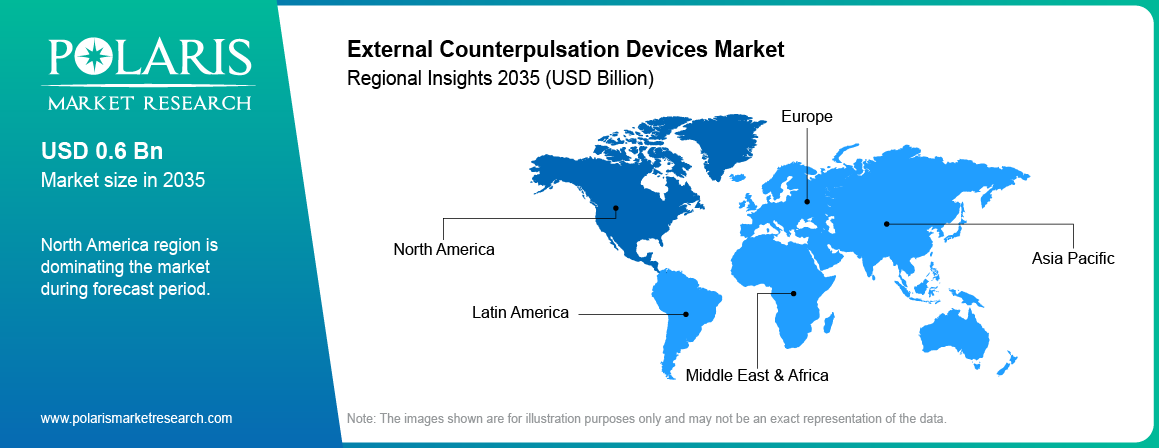
Demand by region follows patient numbers, session coverage, hospital budgets, and available trained staff. North America holds the biggest pool, while Asia Pacific adds revenue fastest.
North America Market
North America contributed 35.3% of 2027 revenue, due to a deep base of treatment beds and an established payer route for refractory angina. Growth of 6.7% a year across 2027 to 2035 is the lowest among regions, since the installed base is already mature.
Annual growth is higher in Canada, 7.4%, than in the United States, 6.5%, as provincial programs and academic centers widen access, while United States sales totaled USD 171.9 Million in 2027.
For example, in April 2026, ThedaCare in Wisconsin introduced EECP for patients with angina or heart failure who are not candidates for stents or bypass, with sessions offered since March 2026 (Source: ThedaCare). Regional health systems add programs to keep referred patients close to home, and each new site buys a bed and replacement cuffs.
ThedaCare cardiology leader Ameer Kabour said the therapy is primarily for patients who are not candidates for invasive procedures (Source: The Business News). Program leaders describe a course of about seven weeks with sessions five days a week, and a foundation funded the equipment.
Competition among suppliers is modest, since the field has few specialist makers, and purchase decisions turn on payer coverage, service coverage, and the comfort of the cuffs.
Europe Market
Europe represented 22.6% of 2027 revenue and is forecast to expand at a CAGR of 7.0%, the second slowest regional rate, due to varied national reimbursement and fewer dedicated programs. Germany is the largest national market, at USD 32.3 Million in 2027.
Spain posts the quickest national pace in Europe, 8.4% yearly, owing to growth in outpatient cardiology services. Values for 2027 were USD 19.5 Million for the United Kingdom, USD 18.2 Million for France, USD 16.9 Million for Italy, and USD 32.4 Million for Rest of Europe.
For example, in November 2025, a review of device based therapies for refractory angina by authors in Rome listed EECP among approved or investigational device approaches (Source: MDPI). Inclusion in a broad European review keeps the therapy visible to cardiologists who treat patients with no surgical option, and it supports referrals to centers that own a bed.
Evidence quality is a constraint. The therapy suits selected patients with few alternatives, so public hospitals often wait for stronger trials before funding a program.
Procurement rules shape sales. Public tenders ask for clinical evidence, service commitments, and local language training, and suppliers with local distributors tend to win the larger regional contracts.
Asia Pacific Market
Second in size at 29.9% of 2027 revenue, Asia Pacific nonetheless records the steepest regional path, 11.9% a year across 2027 to 2035. The pace is due to hospital expansion in China, growing private cardiology in India, and large older populations in Japan and South Korea.
In 2027 China sold USD 78.5 Million of equipment, the biggest national total, and India expands fastest, 16.3% yearly, as private clinics add day care programs. Japan generated USD 18.5 Million, South Korea USD 15.4 Million, and Australia USD 8.6 Million.
For example, in May 2026, Vaso Corporation reported that equipment segment revenue rose USD 118 thousand, or 26.7%, in the first quarter, mainly on higher deliveries in China (Source: Vaso Corporation). A supplier that books growth from Chinese deliveries shows that hospital demand for beds is active, and it lends weight to regional expansion plans.
Clinical research is active in the region. Chinese hospitals and community centers feature in two of the 2026 studies on counterpulsation, and that local evidence supports adoption among cardiologists who trust data from their own patients.
The remaining Asia Pacific economies add USD 29.0 Million in 2027, with private hospitals in Southeast Asia introducing noninvasive cardiac services.
Latin America Market
Latin America generated 5.6% of 2027 revenue and should add 10.4% annually until 2035, due to a heavy cardiovascular burden and growing private cardiology networks. Brazil is the largest market, with USD 14.7 Million, and Mexico is the fastest, at 10.9%.
For example, in December 2025, the Pan American Health Organization launched a quality framework for blood pressure control and stated that cardiovascular diseases cause more than 2.2 million deaths a year in the Americas (Source: PAHO). A burden of that scale raises demand for every form of cardiac care, and private centers that offer noninvasive options can attract patients who are not surgical candidates.
Argentina contributed USD 3.2 Million in 2027 and the other Latin American countries USD 6.4 Million. Local currency pricing and volatile exchange rates encourage distributor stocking, leasing, and charges per session.
Private providers lead adoption. Public systems focus on prevention and emergency care, so counterpulsation programs appear first in urban private hospitals and cardiology practices that serve insured and self paying patients.
Import costs are high. Beds arrive through distributors who carry currency and customs risk, and that raises prices and slows replacement of older units.
Middle East & Africa Market
Middle East & Africa brought in 6.6% of revenue in 2027 and should rise 10.9% annually, owing to Gulf hospital investment and a growing heart disease burden. Saudi Arabia leads the region on size and pace alike, with USD 10.0 Million in 2027 and 11.8% annual growth.
For example, in June 2026, King Faisal Specialist Hospital and Research Centre opened an emergency department cardiac catheterization laboratory in Riyadh and reported a 50% shorter door to reopening time (Source: King Faisal Specialist Hospital). The project concerns emergency catheterization, not counterpulsation, yet it shows capital moving into cardiac services, and that raises the chance that outpatient programs follow.
Values for 2027 were USD 7.6 Million in South Africa, USD 7.6 Million in the United Arab Emirates, and USD 12.9 Million across the other countries. Private hospital groups lead purchases in the Gulf.
Governments take part as buyers and sponsors. Health ministries fund cardiac centers and ask suppliers for training and service, so vendors with regional offices gain an advantage.
Markets south of the Sahara begin from a small base. Few hospitals have the space or staff for daily sessions, and portable systems with simple training offer the most realistic route.
External Counterpulsation Devices Market Competitive Landscape
Suppliers fall into two groups. Established makers such as Vaso Corporation and Cardiomedics have long records of sales and regulatory filings in the United States. Newer or regional makers such as Pression, Renew Group, and Genesis Meditech compete with portable designs, regional distribution, and lower prices.
Vaso Corporation reported equipment segment revenue growth of 26.7% in its first quarter of 2026, mainly on higher deliveries in China, and net income of USD 542 thousand in the second quarter. Pression announced FDA clearance for Wave PRO in January 2026, a portable unit with calf sleeves and a fingertip sensor.
Cardiomedics holds FDA records for its CardiAssist counterpulsation systems dated 2002 and 2005 (Source: US Food and Drug Administration). Renew Group markets the NCP 5 system, cleared by the FDA in December 2015 (Source: US Food and Drug Administration), and Genesis Meditech lists its VarioPulse ECP Therapy System, made in Himachal Pradesh, India (Source: Genesis Meditech).
The records for some suppliers are older than 24 months, so Polaris treats them as evidence of presence in the market and not as evidence of current sales. Companies seldom break out counterpulsation sales, so any ranking of suppliers is approximate.
Contests turn on evidence and reimbursement, so market share goes to suppliers with regulatory clearance, payer coverage, and service reach. Winners pair cleared systems with registries, training, and prompt service, and buyers expect clear data on symptom relief before committing to a bed.
Vendor Landscape Snapshot
| Company | Vendor Positioning | Role |
| Vaso Corporation | Leader | Supplier of EECP therapy systems, with equipment segment revenue up 26.7% in the first quarter of 2026 on higher China deliveries |
| Pression | Challenger | Received FDA 510(k) clearance for the Wave PRO portable system in January 2026, with calf sleeves and a fingertip sensor |
| Cardiomedics | Niche Player | Maker of the CardiAssist counterpulsation systems, with FDA records dated 2002 and 2005 |
| Renew Group | Niche Player | Maker of the NCP 5 external counterpulsation system, cleared by the FDA in December 2015 |
| Genesis Meditech | Niche Player | Manufacturer in India that lists the VarioPulse ECP Therapy System |
Source: Polaris Market Research Analysis
External Counterpulsation Devices Market Technology and Innovation Landscape
Technical work follows three aims: reliable timing of cuff pressure to each heartbeat, smaller and lighter hardware, and data records that clinicians and payers can review. Most gains come from better sensors, lighter compressors, and software that logs every session.
Cuff design matters more than it seems. Sequential inflation from the calves upward pushes blood toward the heart, and cuffs that fit different body sizes, deliver even pressure, and resist wear lower complaints and replacement cost.
Sensing is changing. Electrode timing remains the reference method, while fingertip sensors remove the need for chest electrodes and shorten setup, so makers now offer both choices or combine them in one console.
Size and weight are falling. Calf only sleeves and lighter compressors allow carts instead of heavy beds, and that opens smaller sites, a gap Pression targets with the Wave PRO system.
Data capture is the next step. A bed that stores pressure curves, session length, and symptom scores can feed registries and prove response to payers, and that helps providers seek approval for a repeat course.
Safety checks are built into software. Systems stop on pressure faults, alert staff to rhythm problems, and record screening answers, so providers can show that each session followed protocol.
Remote supervision is a possibility for home programs. A nurse could watch pressure and rhythm during a session from a clinic, and that would extend therapy to patients who live far from a center.
Technology and Innovation Landscape Snapshot
| Area | Role | Status and Representative Developers |
| Portable calf sleeve systems | Deliver counterpulsation from a compact cart with fewer cuffs | Pression received FDA clearance for Wave PRO in January 2026 |
| Fingertip sensor gating | Time inflation to the pulse without chest electrodes | Used in the Pression Wave PRO design |
| Electrode gated beds | Time inflation to the ECG signal in full size beds | Offered by long standing makers including Vaso Corporation, Cardiomedics, and Renew Group |
| Combination research | Test counterpulsation beside cell therapy, drugs, and rehabilitation | A Medical Research Archives review of EECP with CD34+ cell therapy appeared in July 2026 |
| Community rehabilitation protocols | Use counterpulsation as a phase of recovery for older patients | A Shanghai community health center study enrolled patients in 2025 |
Source: Polaris Market Research Analysis
Use Case Analysis
Refractory Angina Programs
Patients with chronic angina who still have symptoms despite drugs and have no surgical option are the core group. Programs screen patients, deliver a course of about 35 sessions, and measure walking distance and symptom change at the end.
Heart Failure Support
Selected patients with stable heart failure receive courses to improve exercise capacity and symptoms. Payers set narrower rules here, and Anthem lists severe heart failure among its exclusions, so programs choose patients with care.
Cardiac Rehabilitation Phases
Rehabilitation teams add sessions to exercise training for older patients who tire quickly. The Shanghai community study followed this pattern, and rehabilitation units value the passive form of exercise that cuffs provide.
Day Care Clinic Sessions
Outpatient clinics fill beds with one hour visits and send patients home the same day. The model suits private practices that want steady recurring visits, yet it needs referral flow and clear patient education.
Research and Combination Therapy
Academic centers test counterpulsation in new patient groups and beside other treatments. Studies on myocardial bridge and on cell therapy show where new indications may emerge.
Every use case carries supervision duties. Staff should screen for conditions that make cuff pressure risky, patients should report chest discomfort at once, and providers should record each session so problems can be traced.
Evidence quality matters most in marketing. Some clinics call the therapy a natural bypass, and cardiologists reject that phrase, so buyers prefer suppliers and providers that describe results with care and cite their data.
Buyer Needs and Decision Criteria
| Buyer Need | Decision Criteria | Why It Matters |
| Regulatory standing | FDA clearance or the local equivalent for the intended use | Payers and hospital committees ask for it first |
| Clinical evidence | Published studies and registry data for the target patient group | Cardiologists refer only when they trust the results |
| Reimbursement fit | Coverage criteria, session codes, and repeat course rules | Income per session decides whether a bed pays back |
| Footprint and comfort | Room size, cuff fit, noise, and session comfort | Smaller sites need compact units that patients accept |
| Service and training | Installation, staff training, spare cuffs, and response time | A bed that is down earns nothing |
Source: Polaris Market Research Analysis
Barriers to entry are regulatory clearance, clinical evidence, payer acceptance, and service reach. Hardware is simple, so a new maker can build a bed, yet it cannot sell widely without data and a distributor network.
Approval often hinges on payer criteria, referral volume, room availability, and the delivered price tag. Evidence on all four points lets a supplier take months off its sales cycle.
Proposals are getting larger. A first order used to cover a single bed, and current offers add cuff plans, training, and data tools, raising account value for suppliers with a complete range.
Premium Insights and Forward Outlook
Portable Systems Will Widen the Site Base
Lighter systems reduce the room and staff needed to start a program, so more cardiology offices and community hospitals will try therapy. Large hospitals will keep full beds for volume while smaller sites choose compact units.
Commercial terms will evolve with the site base. Smaller buyers will ask for leasing, per session pricing, and bundled cuff plans, and suppliers that offer such terms will win orders that a plain purchase price would lose.
Evidence Will Decide Coverage
Payers extend coverage when studies show lasting symptom relief. Makers that fund registries and trials in angina, heart failure, and rehabilitation will gain broader criteria, while makers that rely on marketing claims will face tighter rules.
Rehabilitation Will Become a Larger Channel
Early pilots in community settings use counterpulsation as one phase of recovery. If results hold, programs will buy compact beds in volume and bundle sessions with exercise plans.
Asian Hospital Growth Will Bring Local Rivals
Hospital building in China and private cardiology in India will add many beds, and regional makers will compete on price. Global suppliers must differentiate on evidence, service, and design to defend premium accounts.
Consolidation looks likely. Distributors, clinic chains, and rehabilitation operators may bundle beds, staff training, and referral programs, and small makers could be absorbed by larger ones, leaving fewer independent brands by 2035.
Growth will come from more sites, wider coverage, and a gradual shift to home and community delivery. Makers with cleared products, documented data, and dependable service should take most of the increase.
Key Players in the External Counterpulsation Devices Market
- Vaso Corporation
- Pression
- Cardiomedics
- Renew Group
- Genesis Meditech
Industry Developments
- September 2026: A study in Advances in Clinical Medicine followed 40 older coronary heart disease patients through a 12 week EECP assisted rehabilitation course at a Shanghai community health center (Source: Advances in Clinical Medicine).
- August 2026: Vaso Corporation closed its second quarter with a profit of USD 542 thousand, on sales of USD 20.9 million for the whole company (Source: Vaso Corporation).
- July 2026: A review in Medical Research Archives connected EECP to CD34+ cell therapy in patients with refractory angina (Source: Medical Research Archives).
- May 2026: First quarter equipment sales at Vaso Corporation grew 26.7%, with China deliveries named as the main driver (Source: Vaso Corporation).
- April 2026: ThedaCare reported that its EECP service for angina and heart failure patients had started in March (Source: ThedaCare).
- March 2026: A New Delhi cardiac clinic marketed EECP as a day care option, with a course spread across 35 to 40 days (Source: Lokmat Times).
- January 2026: Pression obtained a 510(k) clearance from the FDA covering its Wave PRO counterpulsation system (Source: Pression).
- January 2026: Anthem issued its CG MED 86 guideline for EECP, capping covered treatment at one 35 hour course (Source: Anthem).
External Counterpulsation Devices Market Report Segmentation
- North America
- United States
- Canada
- Europe
- United Kingdom
- Germany
- France
- Italy
- Spain
- Rest of Europe
- Asia Pacific
- China
- Japan
- India
- South Korea
- Australia
- Rest of Asia Pacific
- Latin America
- Brazil
- Mexico
- Argentina
- Rest of Latin America
- Middle East & Africa
- Saudi Arabia
- United Arab Emirates
- South Africa
- Rest of Middle East & Africa
External Counterpulsation Devices Market Report Scope
| Report Attribute | Details |
| Market Size in 2026 | USD 0.52 Billion |
| Market Size in 2027 | USD 0.57 Billion |
| Revenue Forecast by 2035 | USD 1.14 Billion |
| CAGR | 9.0% (2027 to 2035) |
| Base Year | 2026 |
| Historical Data | 2022 to 2025 |
| Forecast Period | 2027 to 2035 |
| Quantitative Units | Revenue in USD Billion for the market, USD Million for segments, and CAGR in percent |
| Report Coverage | Revenue Forecast, Growth Factors, Competitive Landscape, Industry Trends, and Strategic Analysis of the external counterpulsation devices market |
| Segments Covered | By Product, By Application, By Technology, By End Use, and By Region |
| Regional Scope | North America, Europe, Asia Pacific, Latin America, Middle East & Africa |
| Competitive Landscape | Company Profiling, Product Benchmarking, Financial Analysis, Market Developments, and Strategic Initiatives |
| Report Format | PDF and Excel |
| Customization | Available by Country, Region, and Segment |
| Research Team | Polaris Market Research & Consulting, Inc. research team |
| Last Updated | 24 November 2026 |
Source: Polaris Market Research Analysis
Why Choose Polaris Market Research
Twenty two countries and sub regions are modeled, and a few are residual groups. Every entry has its own estimate, regional values are totals of country values, and segment splits are tuned to match them.
The boundary counts external counterpulsation beds, cuff sets, accessories, and service that makers and distributors sell. A reader comparing published figures needs to know whether balloon pumps, compression pumps for swelling, or provider fees sit inside them.
Every outside fact carries the name of its publisher and the date shown on the page. Regulators, journals, insurers, companies, and news outlets are grouped apart, letting a reviewer follow each claim to its page.
Polaris Market Research & Consulting, Inc. produced this report and also runs bespoke studies focused on one country, product, application, technology, or end use.
Research Methodology
Research Approach
Scope covers cuff based systems that match leg pressure to cardiac timing, plus the cuffs, accessories, and service that providers purchase. Balloon pumps, ventricular assist devices, implanted devices, compression garments, and provider fees sit outside the boundary.
Secondary Research
Dated facts come from 19 sources: 8 company or insurer pages, 4 journal articles, 5 pages from regulators, associations, or intergovernmental bodies, and 2 press reports. Each date is recorded, three records predate the 24 month window and carry a year in the text, and two pages show no date.
Primary Research
Polaris follows its standard process of primary interviews. These interviews cover manufacturers, distributors and channel partners, and industry experts and consultants. They are used to validate secondary estimates, segment shares, regional trends, and growth drivers.
Data Structuring
Amounts are shown in US currency for each calendar year. The boundary was settled before any numbers were collected, each sale was entered once whoever reported it, and revenue from balloon pumps, assist devices, and compression equipment stayed out of the totals.
Market Size Estimation
Bottom up: Polaris built estimates country by country, added the countries into regions, and added the five regions into the global value.
Top down: Polaris tested a base of USD 0.52 Billion for 2026 against other published sizes. The published sizes spread widely because publishers define the market in different ways, so the check guides the estimate without fixing it.
Forecasting
The growth rate declines gradually over the years, and compounding the whole path matches the stated CAGR. Factors weighed were treatment bed installations, cuff replacement cycles, payer criteria, new regulatory clearances, and regional hospital investment.
Data Triangulation and Validation
Each forecast year, segment shares were totaled and checked against 100%. Country figures were reconciled with their regions, regions with the world total, and the opening forecast years were reviewed for a gradual step away from the 2026 base.
Limitations
Market figures in this report are Polaris estimates. Makers rarely report counterpulsation revenue on its own line, so Polaris builds segment and regional values through modeling instead of taking them from filings. Clinical evidence and payer rules continue to change, so published figures could be updated when new studies and coverage decisions emerge.
Research Methodology Phases
| Phase | Focus | Evidence / Output |
| Scope and Setup | Market boundary, segments, and regions | Fixed scope and segment list |
| Secondary Data Collection | Journals, insurers, regulators, companies, and news | 19 sourced facts with dates |
| Primary Research | Interviews with manufacturers, channel partners, and industry experts | Validated segment shares, regional trends, and growth drivers |
| Data Structuring | One currency and one calendar basis | Each sale entered once |
| Bottom Up Estimate | Country and segment estimates | Regional and global totals |
| Top Down Estimate | Global base for 2026 and its segment mix | Base set beside published estimates |
| Forecasting | Annual growth path to 2035 | Stated CAGR |
| Triangulation and Validation | Sum checks and a path review | Checks that passed |
| Output | Report tables and text | One dataset feeding all tables |
Source: Polaris Market Research Analysis
Data Sources by Type
| Type of Source | Named Examples | Used For |
| Company and insurer pages (8) | Anthem; Aetna; Pression; Vaso Corporation; ThedaCare; King Faisal Specialist Hospital; Genesis Meditech | Coverage rules, product clearances, and company results |
| Journal articles (4) | Advances in Clinical Medicine; Medical Research Archives; Journal of Clinical Medicine | Clinical studies and reviews |
| Regulator, association, and intergovernmental pages (5) | American Heart Association; Pan American Health Organization; US Food and Drug Administration | Disease burden and device records |
| News reports (2) | Lokmat Times; The Business News | Program launches and clinic offers |
Source: Polaris Market Research Analysis
External Counterpulsation Devices Market FAQ's
The market covers cuff based therapy that times leg compression to each heartbeat, together with cuffs, accessories, and service. Providers use it for refractory angina, selected heart failure, and related conditions.
The Polaris estimate for the 2026 external counterpulsation devices market is USD 0.52 Billion, counted as revenue from beds, cuff sets, accessories, and service. Sales are forecast to climb to USD 1.14 Billion by 2035.
Polaris projects USD 1.14 Billion for the external counterpulsation devices market by 2035, a CAGR of 9.0% over 2027 to 2035, supported by new portable systems, wider rehabilitation use, and hospital investment in Asia Pacific.
North America is the leading market, with 35.3% of spending in 2027. The lead reflects the biggest installed base of beds and clearer coverage rules for patients with severe angina.
Among regions, Asia Pacific posts the highest CAGR, 11.9% across 2027 to 2035, since new hospitals in China and private day care clinics in India add beds from a smaller base.
In 2027, Pneumatic Air Cuff Systems hold the top product position with 50.4%, and Portable and Compact Systems grow fastest, with a CAGR of 15.4%, as smaller units suit clinics and home programs.
Major names include Vaso Corporation, Pression, and Cardiomedics. Renew Group and Genesis Meditech complete the list, and some of them hold regulatory records that are older than 24 months.
Researchers are pairing counterpulsation with cell therapy and rehabilitation, makers are shrinking hardware into portable carts, and clinics are adding day care programs that send patients home after each session.
Payers set narrow criteria, including one covered course and a list of excluded conditions, so many referred patients do not qualify. Limited evidence outside angina also slows adoption among cardiologists.
Chronic Stable Angina leads with 44.6% of 2027 application value, while Peripheral and Cerebrovascular Disorders grow fastest at 11.6% annually to 2035, from a modest base that relies on new studies.
ECG Gated Systems lead with 72.5% of 2027 technology value, while Photoplethysmography Gated Systems grow fastest, at 15.1% a year to 2035, owing to quick fingertip sensor setup.
Hospitals are the largest, with 39.1% of 2027 value, and Home Care Settings grow fastest, with a CAGR of 18.1% through 2035, from a very small base and limited payer support.
External systems use cuffs on the legs and need no incision, while internal counterpulsation uses a balloon pump in the aorta for critically ill patients. Polaris tracks balloon pumps in a separate report.
The United States holds the biggest national total, USD 171.9 Million in 2027, with China next at USD 78.5 Million, and India posts the fastest national rate at 16.3% annually.
Many adults live with cardiovascular disease, studies keep widening the patient groups, new portable systems cut entry costs, and day care programs add providers able to offer a course of sessions.

Download Sample Report of External Counterpulsation Devices Market
Please fill out the form to request a customized copy of the research report.


