
Global Filters Market Share, Size, Trends, Industry Analysis Report, 2022 - 2030
REPORT DETAILS
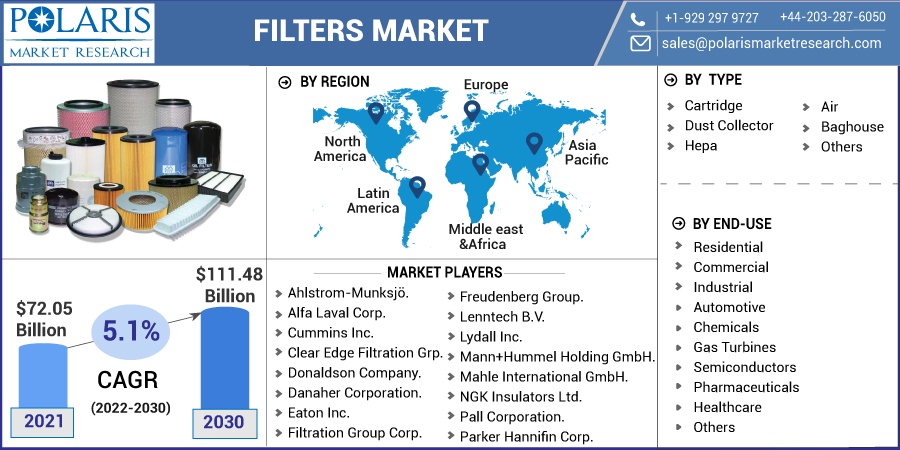
The global filters market was valued at USD 72.05 billion in 2021 and is expected to grow at a CAGR of 5.1% during the forecast period. The market is growing due to the rising concerns that clean air would promote the expansion of the filtration market. People are investing a lot in in-home air purifier systems as a result of rising disposable income levels, increased urbanization, and growing health concerns are boosting the growth of the industry.
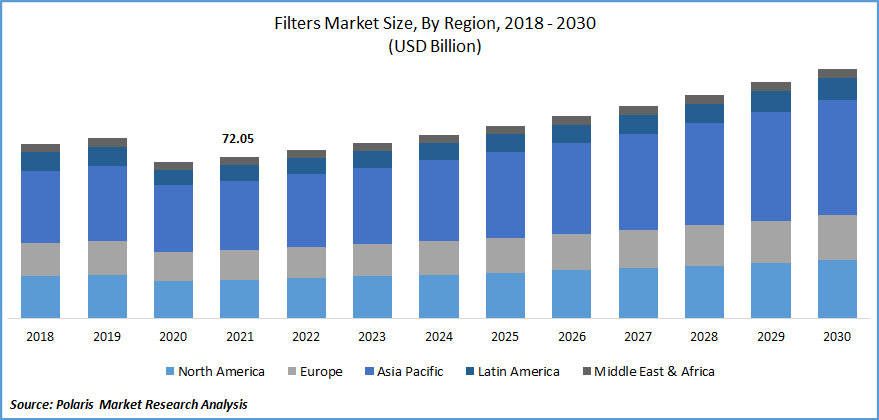
Source: Polaris Market Research Analysis
Know more about this report: Download Sample Report
A filter is a method for reducing the number of possibilities available within a particular universe of safety measures. In this case, the phrases filter and screen can be used interchangeably because this process is also known as screening securities. The growing focus on reducing emissions from industrial and automotive applications is anticipated to drive industry growth.
Growing product application in a variety of consumer goods, such as air and water purifiers, is anticipated to positively affect market growth. It is anticipated that the rapidly growing use of air purifiers to eliminate dangerous germs including viruses and bacteria, in homes, cars, trains, and other public spaces would create new market development prospects.
The filters market is boosted by the rising need for air purification and the use of cost-saving, energy-efficient filtration systems. The need for heating equipment is being driven by the effects of climate change, rising demand for renewable energy sources, and considerable government support in the form of subsidies and financial incentives.
The probability of people being admitted to hospitals is significant because COVID-19 is becoming more commonplace globally. Because COVID-19 is so contagious, there is an increase in the need for critical care units in hospitals, which drives up the demand for HEPA filters because these specialized filters prevent the spread of microorganisms from one compartment to another.
Installation of HEPA in hospitals is in high demand due to the increased need for hospital beds and intensive care units. Samples must be tested in a lab since there are so many contaminated patients. HEPA must be installed following standards because they preserve airflow patterns and stop cross-contamination.
Source: Polaris Market Research Analysis
Know more about this report: Download Sample Report
Industry Dynamics
Growth Drivers
The filters market is anticipated to be driven by an increase in demand from the automotive industry for the reduction of emission levels as a result of regulations by several organizations, including the Department of Energy and the U.S. Environmental Protection Agency (EPA). In February 2021, Beijing promised to significantly reduce smog levels in 2020 by increasing the number of new energy vehicles (NEVs) on the road, cutting the number of diesel-fueled trucks, and tightening regulations on vehicle emissions.
In August 2021, EPA issued proposed greenhouse gas vehicle emission standards for the model year 2023–2026 light-duty vehicles) and NHTSA issued proposed fuel economy standards for the model year 2024–2026 light-duty vehicles.
As per the Swedish government plan for sustainable development, the government has targeted to reduce the use of petrol and diesel cars by 2030 and to cut emissions from transport by 70%. Besides, Japan's government plans to have a zero-emission country by 2050 and wants to tighten the emission target for vehicles by 2030.
In January 2021, according to the Transport and Environment (T&E), the EU announced its aim to achieve zero-emission by 2050. In October 2020, South Korean President Moon Jae-in announced a program, the "New Green Deal" that aims to achieve low carbon emissions by 2050. South Korea will be spending around $37 billion on electric vehicles, green infrastructure, and clean energy. However, the government regulations regarding reducing emissions from automobiles are to drive the market growth during the forecast period.
Report Segmentation
The market is primarily segmented based on type, end-use, and region.
| By Type | By End-Use | By Region |
|
|
|
Source: Polaris Market Research Analysis
Know more about this report: Download Sample Report
HEPA Filters is expected to witness the fastest growth
HEPA is a combination of the mechanical air filter with pleats that are designed to capture around 99.97% of dust, germs, pollen, and other airborne particles which are smaller than 0.3 microns (m). The use of HEPA filters aids in reducing the release of dangerous gases into public or private settings. The global emphasis on infrastructure development and industrialization is favorably affecting consumer demand for these filters market and propelling the sector for HEPA filters.
A favorable regulatory environment and strong usage in the pharmaceutical business will likely support the segment's significant growth during the forecast period. The upgrading of filtration systems for their many uses and the installation of HEPA filters in commercial and residential spaces both help to drive up demand.
Automotive Industry accounted for a significant market share in 2021
The expansion of the market is supported by the rising automotive manufacturing, particularly in nations. Additionally, it is anticipated that stricter restrictions for the reduction of automobile pollution levels by organizations like the U.S. EPA and the Department of Energy will lead to an increase in the utilization of filters, driving up product demand in applications for motor vehicles. The use of filtration equipment in a variety of consumer goods, including air purifiers, air conditioners, and water filters, is anticipated to fuel market expansion in the ensuing years.
In addition, the market is anticipated to be driven by the rising industrialization of developing nations like India, South Africa, Brazil, Thailand, and Indonesia. Pharmaceutical and wine production are two additional significant application areas. To enhance the quality of wine and provide stabilization, microfiltration equipment is commonly employed in the wine industry to remove impurities such as bacteria, particles, crystals, and yeasts.
Pharmaceuticals segment is expected to hold the largest revenue share
For the pharmaceutical sector, air filtration and good indoor air quality (IAQ) standards are essential. High energy expenditures are a direct result of inadequate filtering rates in the pharmaceutical sector. In terms of cost and maintenance, HEPA installation is crucial.
Filters are among the best filtering solutions for keeping pharmaceutical workstations since they save time and money. The American Air Filter (AAF) conducts a complete audit of HEPA filters as a first step before providing expert advice and analyzing cost-saving and risk-reduction opportunities.
The demand in North America is expected to witness significant growth
The market in North America is anticipated to have considerable growth due to factors including increased product demand from the automotive industry and environmental laws established by the Environmental Protection Agency (EPA) for air emission control solutions.
The government's increased focus on water treatment plans for the construction of water treatment facilities is also credited with driving the growth of the global market. This is because of issues like the lack of clean drinking water, the rising population, and contaminated ground and surface water bodies.
Due to its rapid modernization and strict local government laws to safeguard ecological integrity, Asia Pacific holds a significant share in the market. Growing environmental concerns and elevated atmospheric pollution levels are predicted to encourage the use of air filtration and water filtration technologies, driving market expansion.
The European region's market demand is also expected to increase as a result of technical developments like the application of nanotechnology to the filtration process. This is because more wastewater treatment facilities in the area are being built, which is increasing construction activity. Additionally, it is anticipated that the regional market would be driven by the use of filters in Brazil's expanding mining sector to reduce emission levels.
Competitive Insight
Some of the major players operating in the global filters market include Ahlstrom-Munksjö., Alfa Laval Corp., Cummins Inc., Clear Edge Filtration Group., Donaldson Company., Danaher Corporation., Eaton Inc., Filtration Group Corporation., Freudenberg Group., Lenntech B.V., Lydall Inc., Mann+Hummel Holding GmbH., Mahle International GmbH., NGK Insulators Ltd., Pall Corporation., Parker Hannifin Corp., Sidco Filter Corporation., and Valmet Corporation.
Recent Developments
In May 2023, 3M partnered with Svante Technologies to develop materials that trap and permanently remove CO₂. 3M also invested in Svante’s Series E round to scale its carbon capture technology using coated solid sorbents in high-performance filters for direct air and industrial capture.
In February 2023, Camfil launched CamPure 8 media in the U.S., a molecular filtration solution for removing gaseous contaminants and odors in industries like pulp & paper, oil & gas, wastewater treatment, and food preservation.
In January 2022, AVVIR, a leading supplier of innovative filtration solutions and the innovation arm of A.L. Group, introduces IN-EX, a medical-grade and thoroughly tested remedy for indoor air safety. The IN-EX solution uses special sonochemical-coating technology to transform any air filter into a device for eradicating viruses and bacteria.
In June 2021, Nanomatrix Materials released G1 AC Filters for Air Conditioners that utilize graphene-silver nanotechnology to purify indoor air, sterilize 99.9% of airborne germs, and filter out dust particles. Additionally, dangerous volatile organic compounds (VOCs) or gases can be reduced using G1 AC Filters.
Filters Market Report Scope
| Report Attributes | Details |
| Market size value in 2021 | USD 72.05 billion |
| Revenue forecast in 2030 | USD 111.48 billion |
| CAGR | 5.1% from 2022 - 2030 |
| Base year | 2021 |
| Historical data | 2018 - 2020 |
| Forecast period | 2022 - 2030 |
| Quantitative units | Revenue in USD million/billion and CAGR from 2022 to 2030 |
| Segments covered | By Type, By End-Use, By Region |
| Regional scope | North America, Europe, Asia Pacific, Latin America; Middle East & Africa |
| Key companies | Ahlstrom-Munksjö., Alfa Laval Corp., Cummins Inc., Clear Edge Filtration Group., Donaldson Company., Danaher Corporation., Eaton Inc., Filtration Group Corporation., Freudenberg Group., Lenntech B.V., Lydall Inc., Mann+Hummel Holding GmbH., Mahle International GmbH., NGK Insulators Ltd., Pall Corporation., Parker Hannifin Corp., Sidco Filter Corporation., and Valmet Corporation. |
Source: Polaris Market Research Analysis
Download Sample Report of Filters Market
Please fill out the form to request a customized copy of the research report.


