
Forklift Market Size & Share Global Analysis Report, 2026-2034
REPORT DETAILS
What is Forklift Market Size?
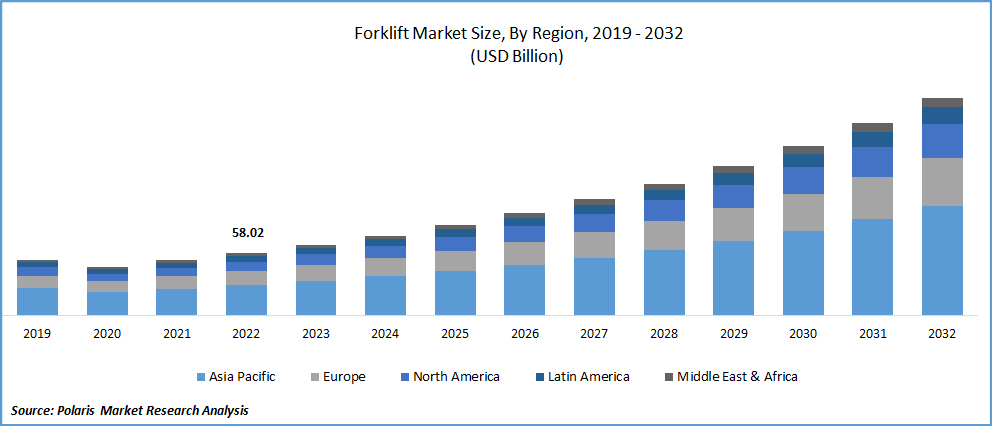
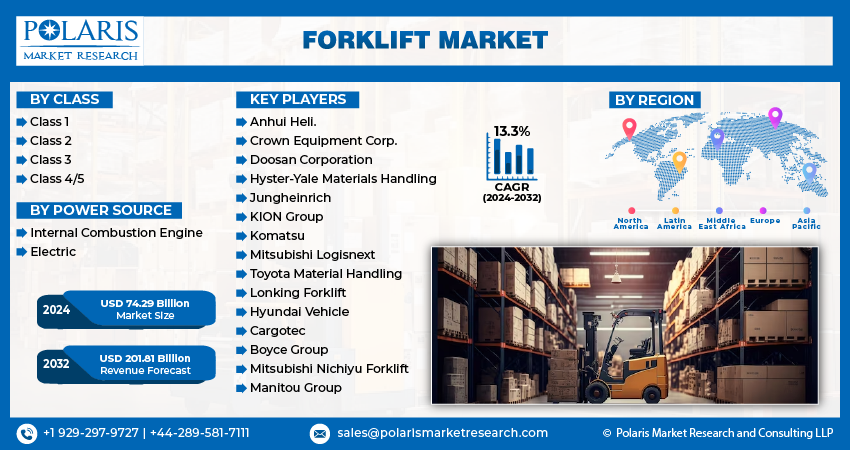
The global forklift market was valued at USD 84.10 billion in 2025 and is expected to grow at a CAGR of 13.4% from 2026 to 2034. The driving factors in the market include rising demand from the e-commerce industry, warehouse automation, and industrialization. The demand for optimized material handling solutions is increasing across the logistics, industrial, and retail sectors.
Market Statistics
Key Takeaways
- Class 3 forklifts are in high demand because they are cost-effective, easy to operate, and well-suited for short-distance transport in warehouses and retail settings.
- The class 1 electric forklift market is projected to grow the most due to their eco-friendly nature, lower operating costs, and noiseless operation compared to other forklifts.
- The electric forklift market is expected to grow most rapidly due to increased demand for zero-emission forklift trucks and advances in lithium-ion batteries.
- Asia Pacific held the largest forklift market share due to increased production in India and China, as well as a surge in online shopping and modern construction projects.
- The market in North America is also growing as a result of increasing investment in electric and automated forklift trucks, driven by demands for efficiency and sustainability in the e-commerce and logistics industries.
Industry Dynamics
- E-commerce expansion is fueling the forklift market forecast, driving demand for more efficient material-handling systems in warehouses. Online retail in the US saw a 8.9% increase in 2023.
- Rising industrial production is driving a higher forklift market growth rate, as factories need more forklifts to move materials. The US industrial production index grew 1.49% in April 2025.
- Infrastructure Expenditures in construction projects are driving the demand for forklift trucks. The construction spending in the US increased to $2.19 trillion in 2024.
- Automation of logistics and modernization of warehouses have driven demand for more advanced forklifts, especially autonomous ones.
- The industry is transforming automation and sustainability, with many establishments adopting electric forklift trucks and self-driving technology.
- The high cost of investment and maintenance for modern forklifts could pose a barrier for smaller businesses.
Source: Polaris Market Research Analysis
Forklift: Overview
A forklift is an industrial truck used to lift and move heavy goods over short distances. A forklift operates in a warehouse or factory setting and is part of the material handling equipment. A forklift can be classified into distinct models, including an electric forklift for indoor usage, and among the most contemporary models are those with automation and Industry 4.0 technology incorporated. The most suitable forklift model can be determined using simple parameters, including warehouse, yard, or cold storage application, aisle width, usage hours, floor surface, and emissions.
Which Forklift Type to Choose: Warehouse vs Yard vs Cold Storage
| Decision Factor | Warehouse Operations | Yard Operations | Cold Storage Operations |
| Typical Forklift Type Used | Electric forklift, reach truck | Diesel or LPG forklift | Cold storage electric forklift |
| Aisle Width | Narrow to very narrow aisles | Wide open spaces | Narrow to standard aisles |
| Duty Cycle | Medium to high, multi-shift | High, heavy, continuous use | Medium, controlled shifts |
| Floor Type | Smooth concrete floors | Rough, uneven outdoor surfaces | Smooth but low-temperature floors |
| Emission Constraints | Very strict indoor limits | Low or none | Very strict indoor limits |
| Power Source Preference | Electric (battery powered) | Diesel or LPG | Electric with a cold-rated battery |
| Environmental Conditions | Clean, dry, controlled | Dust, rain, temperature changes | Sub-zero temperatures |
| Automation Readiness | High, suitable for automated forklifts | Low to medium | Medium, selective automation |
| Primary Business Goal | Space efficiency and speed | Load capacity and durability | Product safety and reliability |
Source: Polaris Market Research Analysis
Industry Dynamics
Which Factors are Driving Forklift Market?
E-commerce Expansion and Logistics Growth
The global boom in e-commerce is a major driver of forklift demand from e-commerce. As e-commerce grows, demand for warehousing space is rising. For example, in the US, e-commerce growth has driven sales to $1.19 trillion in 2023, a 8.9% increase. In the same industry, employment in warehousing also increased, boosting demand for forklifts. In April 2025, there were 1.85 million people employed in warehousing in the US.
Rising Industrial Production and Manufacturing Activity
The global industrial production and manufacturing are major factors influencing the forklift industry. The use of forklift trucks is critical for the movement of raw materials, in-process production, and final goods within a factory. As production in the manufacturing sector rises, the demand for improved material handling increases to maintain the efficiency of the production lines. The US industrial production index, for instance, rose 1.49% in April 2025. Furthermore, organizations are working to enhance supply chains, contributing to rising demand for forklift trucks.
Infrastructure Development and Construction Activities
Global investment in infrastructure and construction is also contributing to the growth of the forklift market. Any construction work, whether government or privately initiated, requires the use of heavy machinery to lift and transport construction equipment. The application of a machine with such diverse uses will only be fulfilled by the versatility and lifting power of the forklift truck. By December 2024, construction spending in the US alone totaled $2.19 trillion, a 4.3% increase from the previous year.
What are Key Opportunities, Emerging Trends, and Major Restraints Shaping Market?
Opportunity: Logistics Automation and Warehouse Modernization
The increasing adoption of logistics automation and warehouse renovations is fueling rapid demand for high-tech forklift trucks. Electric and self-driving trucks are being effectively implemented in organizations to enhance efficiency. The latest trends in this field will create more applications for companies offering forklift solutions in the future.
Trend: Automation and Sustainability in Forklifts
The forklift market is seeing a strong movement toward automation and sustainable operations. More companies are now deploying autonomous and electric forklifts to improve efficiency and reduce their carbon footprint, reflecting a broader push for green, smart warehouse solutions.
Restraint: High Costs and Maintenance
The price factor can be a consideration when using advanced forklift models, especially for small and medium-sized businesses. High-end models with electric and autonomous technology will entail high operating and maintenance costs.
Source: Polaris Market Research Analysis
Impact of Forklift Safety Regulations
- Improved Design of Forklift: Enhanced safety features are now available on forklifts, such as collision-avoidance capabilities, seatbelt alerts, and load sensors.
- Safer Operations with Electric Forklifts: Electric models reduce emissions and noise, making them safe for indoor environments.
- Automation and Safety Compliance: Autonomous forklifts need to be designed with collision detection and the ability to be manually overridden.
- Operator Training & Certification: Operators must undergo certified training and undergo periodic recertification to meet minimum safety standards.
- Challenges & Opportunities: Even with high costs of compliance, innovation in safety systems presents manufacturers with opportunities.
Segmental Overview
By Class Insights
Based on class outlook, the market is classified into Class 1, Class 2, Class 3, and Class 4/5. Class 3 forklifts with electric motors, hand trucks, and rider trucks currently lead the market share. They have another name: Warehouse Pallet Jacks. They are used in warehouses, retail outlets, and other industries to move products over short distances. They are widely used because they are simple to operate and cost-effective. Businesses acquire them because they are efficient in handling functions such as loading, unloading, and material handling. The forklift market by class recognizes the important role of Class 3 Pallet Trucks in material handling solutions.
Among these, the market growth of Class 1 electric forklifts, especially electric counterbalance forklifts, would be higher because of the focus on eco-friendly solutions. Class 1 Electric Forklifts are non-polluting, less expensive, and quieter than conventional forklifts. With advances in lithium-ion batteries, these forklift models have become very efficient, with charging times reduced. The widespread use of these forklifts in warehouses and production facilities, fueled by regulatory needs, has been another accelerating factor in market growth.
By Power Source Insights
Based on power source type, the market is divided into internal combustion engine and electric. The electric sector is expected to account for the largest share during the forecast period. This is attributed to the growing need to make operations more environmentally friendly and reduce carbon emissions across industries. Electric forklifts are widely accepted because they offer zero-emission forklifts and are far quieter than other forklift options. In addition, advancements in lithium-ion batteries used in forklifts have improved their efficiency, allowing them to charge faster and run longer.
The electric forklift market growth is also projected to be the highest among all other types during the forecast period. Stringent environmental policies and sustainability requirements are encouraging companies to switch from fuel-powered devices to electric alternatives. Electric forklift trucks require lower operating expenses, including reduced fuel consumption and lower maintenance costs. Progress in battery technology is, therefore, encouraging companies to transition to electric forklift trucks.
By Battery Type
Based on battery type, the market is analyzed into Li-ion batteries and Lead Acid batteries. Li-ion batteries will lead this market because they charge quickly, offer longer runtime, and do not produce emissions. Li-ion batteries have reduced maintenance expenses and less downtime; therefore, they are more efficient. Due to advances in battery technology, Li-ion forklift batteries are becoming more economical, with longer lifespans and higher residual values.
Lead acid batteries remain widely used, but they require more maintenance, including watering and extended charging. As a consequence, they have higher downtime costs and lower efficiency. Although they are less expensive to purchase, Li-ion batteries are more efficient and are becoming increasingly popular among companies dedicated to sustainability and cost-effectiveness.
Comparison of Lead-Acid vs. Li-ion Batteries for Forklifts
| Metric | Lead-Acid Batteries | Li-ion Batteries |
| Initial Cost | Lower upfront cost | Higher initial cost |
| Charging Time | Longer charging time (8-12 hours) | Faster charging (2-4 hours) |
| Maintenance | Requires regular maintenance (water refills, equalization) | Minimal maintenance (no water refills needed) |
| Lifespan | 1,000 - 1,500 cycles | 3,000 - 5,000 cycles |
| Downtime Costs | Higher due to longer charging and maintenance | Lower due to faster charging and less maintenance |
| Energy Efficiency | Lower efficiency, higher energy losses | Higher efficiency, minimal energy losses |
| Residual Value | Lower residual value due to shorter lifespan | Higher residual value due to longer lifespan |
| Emissions | Emits gases (hydrogen) during charging | Zero emissions, more eco-friendly |
| Suitability | Best for budget-conscious operations | Best for high-demand, eco-conscious operations |
| Total Cost of Ownership | Higher over time due to maintenance & replacement costs | Lower over time due to reduced maintenance and longer lifespan |
Source: Polaris Market Research Analysis
Source: Polaris Market Research Analysis
Regional Analysis
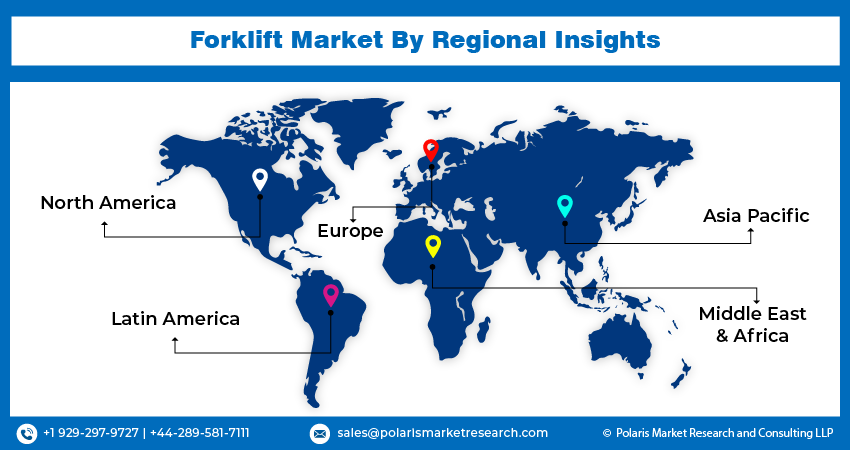
Asia Pacific forklift market has the largest market share among all regions considered in this study. The major factor driving this is the presence of a robust manufacturing base in countries such as India and China. Many of these countries require substantial amounts of material-handling equipment. The increasing e-commerce in Asia Pacific is driving the construction of storage facilities, thereby increasing forklift demand.
Furthermore, the Asia Pacific market is fueled by constant industrial and urban expansion in emerging nations. Nations are transforming their supply chains with modern technology and utilizing advanced material handling systems. The increased demand for electric forklift trucks and warehouse automation in Asia Pacific, driven by government environmental policies, is another factor accelerating market expansion. Due to its massive size, rapid expansion, and technological orientation, Asia Pacific will remain a hub for forklift market growth.
North America forklift market is emerging due to e-commerce infrastructure and a well-established logistics system. Nowadays, it is a common practice for firms to invest in electric forklifts in North America and automatic forklift trucks due to a heavy focus on efficiency, sustainability, and safety. Spending on improving existing warehouses and building new ones is increasing demand in this market.
Region-Wise Forklift Safety Regulations
| Region | Regulations | Key Compliance Focus |
| North America | OSHA (Occupational Safety and Health Administration) regulations | Operator training, maintenance, safety equipment, and inspections |
| Europe | EN 1570 (European Standard for Industrial Trucks) | Safety systems, ergonomic design, and operator visibility |
| Asia-Pacific | ISO 3691 (International Standards for Forklifts) | Operator certification, safety features, and environmental impact |
| Middle East & Africa | Local standards (vary by country) | Workplace safety protocols, load capacity regulations |
| Latin America | National safety codes (varies by country) | Equipment maintenance, safety gear, and training requirements |
Source: Polaris Market Research Analysis
Source: Polaris Market Research Analysis
Key Players and Competitive Insights
The competitiveness in the forklift industry is driven by innovation, collaboration, and a focus on efficiency and sustainability. With an increased focus on smart logistics and green solutions, forklift manufacturers are investing heavily in research and development to develop smart forklift solutions. As a result of increased competition, companies are advancing rapidly through technological developments, enhancing their product offerings, and focusing on digitalization. They are developing forklift telematics systems to control their forklift operations better. With a shift in global demand for forklifts, forklift market players are seeking opportunities to grow their market share.
List of Key Companies:
- Anhui Heli Co., Ltd.
- CLARK Material Handling Company
- Crown Equipment Corporation
- Hangcha Group Co., Ltd.
- Hyster-Yale Materials Handling, Inc. (Hyster and Yale brands)
- Jungheinrich AG
- KION Group (Linde Material Handling, STILL, Baoli)
- Komatsu Ltd.
- Mitsubishi Logisnext (Mitsubishi Heavy Industries)
- Toyota Material Handling (Toyota Industries Corporation)
Industry Developments
May 2025: Mitsubishi Logisnext Americas announced the completion of a major expansion at its Houston manufacturing campus, with the inauguration of a new 73,500-square-foot electrification fabrication facility.
January 2025: Toyota Material Handling unveiled two new high-performance, eco-friendly forklift offerings: the Integrated Mid & Large Electric Pneumatic Forklifts and a refreshed Core Electric Forklift series.
November 2024: Seegrid Corporation terminated its product and distribution agreements with Raymond Corporation, a Toyota division, enabling direct sales of its complete product portfolio to customers across multiple industries.
Forklift Market Segmentation
By Class Outlook (Revenue – USD Billion, 2020–2034)
- Class 1
- Class 2
- Class 3
- Class 4/5
By Power Source Outlook (Revenue – USD Billion, 2020–2034)
- Internal Combustion Engine
- Electric
By Operation (Revenue-USD Billion, 2020–2034)
- Manual
- Autonomous
By Application (Revenue-USD Billion, 2020–2034)
- Outdoor
- Indoor
- Indoor & Outdoor
By Battery Type (Revenue-USD Billion, 2020–2034)
- Li‑ion
- Lead Acid
By Lifting Capacity (Revenue-USD Billion, 2020–2034)
- Below 2 Tons
- 2–5 Tons
- Above 5 Tons
By Tire Type (Revenue-USD Billion, 2020–2034)
- Cushion
- Pneumatics
By Product Type (Revenue-USD Billion, 2020–2034)
- Warehouse Forklifts
- Counterbalance Forklifts
By End-User Industry (Revenue-USD Billion, 2020–2034)
- Manufacturing
- Logistics
- Warehousing and More
By Regional Outlook (Revenue-USD Billion, 2020–2034)
- North America
- US
- Canada
- Mexico
- Europe
- Germany
- France
- UK
- Italy
- Spain
- Netherlands
- Russia
- Rest of Europe
- Asia Pacific
- China
- Japan
- India
- Malaysia
- South Korea
- Indonesia
- Australia
- Vietnam
- Rest of Asia Pacific
- Middle East & Africa
- Saudi Arabia
- UAE
- Israel
- South Africa
- Rest of Middle East & Africa
- Latin America
- Brazil
- Argentina
- Rest of Latin America
Forklift Market Report Scope
| Report Attributes | Details |
| Market Size in 2025 | USD 84.10 Billion |
| Market Size in 2026 | USD 95.23 Billion |
| Revenue Forecast by 2034 | USD 259.77 Billion |
| CAGR | 13.4% from 2026 to 2034 |
| Base Year | 2025 |
| Historical Data | 2021–2024 |
| Forecast Period | 2026–2034 |
| Quantitative Units | Revenue in USD billion, 2021–2034, and CAGR from 2026 to 2034 |
| Report Coverage | Revenue Forecast, Market Competitive Landscape, Growth Factors, and Trends |
| Segments Covered |
|
| Regional Scope |
|
| Competitive Landscape |
|
| Report Format |
|
| Customization | Report customization as per your requirements with respect to countries, regions, and segmentation. |
Source: Polaris Market Research Analysis
Forklift Market FAQ's
The global forklift market is anticipated to expand from USD 84.10 billion in 2025 to USD 259.77 billion in 2034, with a CAGR of 13.4% over the forecast period of 2026-2034.
Electric forklifts are experiencing the fastest growth due to a zero-emission mandate and improvements in lithium-ion battery technology that enable fast charging, greater efficiency, and simpler maintenance.
E-commerce, retail, third-party logistics, and warehousing are the major drivers, driven by rising e-commerce adoption, automation in distribution hubs, and the need for effective material handling systems.
The Asia Pacific market has the highest market share, estimated at around 48-50%, largely due to industrialization in China and India, the growing e-commerce market, and government initiatives to promote electrification.
The key innovations that are currently transforming the forklift industry are Autonomous Guided Vehicles (AGVs), Artificial Intelligence-based fleet management solutions, Internet of Things technology-based predictive maintenance solutions, and hydrogen fuel cell technology.
The following are some of the market trends: ? Automation and Robotics Integration: This involves the increasing adoption and integration of autonomous forklifts and AGVs with cobots and other forms of automation into various manufacturing and warehousing processes for enhanced productivity and improved safety. ? IoT and Connected Systems: IoT devices and telematics integration for monitoring forklift performance in real-time, fleet maintenance, fleet optimization, and data-driven decision-making analysis.
A piece of industrial power equipment commonly known as a forklift truck is used for lifting and transporting materials over short distances. It has a set of steel forks mounted on a hydraulic lift that can be raised or lowered to stack heavy loads that are placed on pallets. This type of machine is widely used worldwide for material handling in a variety of industries, including warehousing and manufacturing, alongside distribution centers and construction sites. Moreover, forklifts enhance logistical and supply chain processes by permitting the fast and safe movement of goods.
Download Sample Report of Forklift Market
Please fill out the form to request a customized copy of the research report.


