
Lead-acid Battery Market Share, Size, Trends, Industry Analysis Report, 2026 - 2034
REPORT DETAILS
Lead-acid Battery Market Summery
The global lead-acid battery market was valued at USD 44.71 billion in 2025 and is expected to grow at a CAGR of 3.9% during the forecast period. Growing SLI applications in the automobile sector is the factor driving up demand for lead-acid batteries. SLI batteries have a stronghold in the traditional automobile industry, as well as additional applications such as mini hybrid systems and vehicles with start-stop capabilities, which will promote product adoption.
Market Statistics
Key Takeaways
- The flooded segment dominated with largest share of 64.21% in 2025 due to its large manufacturing base and cost sensitivity
- VRLA segment is expected to witness significant growth of CAGR 4.0% during the forecast period. This is driven by low maintenance and strong demand in telecom and backup power applications.
- Asia Pacific had the largest revenue share of 56.32% in 2025. This is driven by industrial growth, rising vehicle production, and expanding renewable energy initiatives.
- North America is expected to witness growth of CAGR 4.3% during the forecast period due to high investment, and expanding automotive industry
- The U.S. held regional share of 67.21% in 2025 due to expansion of electric vehicle and large manufacturing base
What is Lead Acid Battery
A lead-acid battery is a secondary cell that stores electrical energy in the form of chemical energy by using lead plates and sulfuric acid as a medium. This battery consists of a positive plate, a negative plate, and an electrolytic solution. The positive plate is made of lead dioxide, and the negative plate is made of sponge lead. A diluted sulfuric acid solution is used as an electrolyte for a lead-acid battery. These batteries are used in automobiles, inverters, ups systems, and backup sources of energy. It has advantages such as low cost, reliable power source, and high current output, but they are heavy, and maintenance is required.
How Lead Acid Battery Works?
A lead-acid battery works on the working principle that two plates partially immersed in an electrolytic solution make a closed circuit. In a lead-acid battery, the chemical reaction that takes place between the lead plate and sulfuric acid generates electricity. The chemical energy stored in the electrolytes is changed to electrical energy when a load is attached to the battery and allows the current to flow from the battery to the circuit. The lead plates and the sulfuric acid solution that is altered and converted into lead sulfate and water, respectively. The chemical activity of the battery has to be restored by using another power source.
To Understand More About this Research: Download Sample Report
AI Impact on Lead-acid Battery Market
- AI helps to accelerate battery development by analyzing performance data, usage patterns, and material behaviors.
- AI helps to enhance supply chain operations by predicting demand, optimizing raw material sourcing, and improving inventory and distribution logistics.
- AI helps to improve quality control by monitoring manufacturing processes in real time to detect defects and ensure safety and compliance standards.
- AI helps to enable predictive maintenance by analyzing battery health data to forecast failures and extend battery life in automotive and industrial applications.
Due to superior cranking power and skyrocketing demand for sophisticated automotive technology, the SLI category is seeing a cyclical demand increase. In the winter, major regions such as North America and Europe are subjected to extreme weather conditions, necessitating the use of a power supply system with high cranking performance. Low cost and operational reliability are two of the most important characteristics that encourage people to use SLI batteries over other options.
Furthermore, as the telecom industry expands in nations like the US, Brazil, India, and the UK, there is a growing demand for UPS systems as a backup power source, resulting in higher usage of lead-acid batteries as a cost-effective energy source.
Growing demand for e-bikes and electric vehicles, cheaper repair and repair costs and a reduction in reliance on traditional fuel technologies are some of the primary factors recognized as drivers of the worldwide lead-acid battery market. However, stringent lead emission laws and the migration to lithium-ion batteries are two major roadblocks to the batteries industry's growth.
Industry Dynamics
Growth Drivers
Rapid technological advancements and innovation in the manufacturing facilities for lead-acid batteries are the factors that are boosting the industry growth during the forecast period. In April 2022, Off-grid Energy Labs announced the launch of their unique ZincGel Battery, which would provide India's EV battery switching industry with long-lasting batteries. In comparison to other batteries, this technology is non-flammable with a lower environmental impact. ZincGel Battery Technology is a cost-effective replacement for the expensive foreign batteries now available in India.
Also, in May 2021, After receiving High Court decisions suspending the Andhra Pradesh Pollution Prevention Board's (APPCB) orders to shut its factories, Amara Raja Batteries (ARBL) resumed production at its manufacturing sites in Andhra Pradesh.
Investors focused on Brookfield-backed ARBL when the APPCB compelled the business to close its facilities in Nunegundlapalli and Karkambadi, both in Andhra Pradesh's Chittoor district. Thus, the technological advancements in the lead-acid battery market by the major players and the innovation in the manufacturing industry in the emerging countries are the factors that are boosting the industry growth during the forecast period.
Report Segmentation
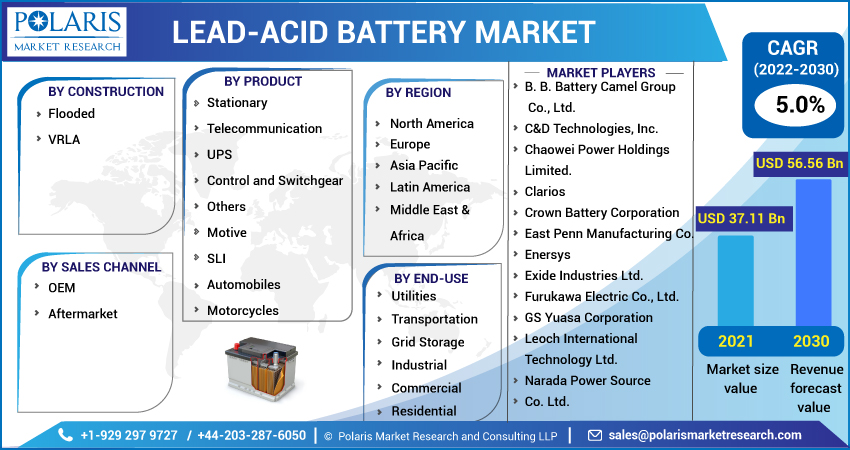
The market is primarily segmented based on product, construction, end-use, sales channel, and region.
| By Product | By Construction | By Sales Channel | By End-Use | By Region |
|
|
|
|
|
Source: Polaris Market Research Analysis
Know more about this report: Download Sample Report
Insight by Construction
VRLA segment is expected to is expected to witness growth of CAGR 4.0% during the forecast period. VRLA batteries are more technically advanced, have a longer life span, and provide outstanding performance. They are much more cost-effective than lithium-ion and nickel-cadmium lead-acid battery packs, and they are likely to be the lead-acid battery of choice among end-users.
Because of its rapid rate of discharge combined with a stable and high-power supply, VRLA batteries have seen a significant increase in recent years when compared to flooded batteries. Furthermore, huge power reserves along with ease of operation are two essential benefits supplied by these units across a variety of industries, including automotive and telecommunications, bolstering the industry dominance of lead-acid batteries.

Moreover, based on the sales channel, the aftermarket segment dominates the market growth. Because of the growing lead-acid battery replacement rates after its service, aftermarket services account for the majority of the sales channel market share. Lead-acid battery manufacturers and suppliers would have more potential as a result of this.
The application for which the lead-acid battery is installed, however, has a significant impact on sales channel trends. For instance, aftermarket sales services are quite popular in the automotive industry, and they provide lucrative opportunities for certified automotive spare parts dealers and other vendors.
Geographic Overview
Asia Pacific had the largest revenue share of 56.32% in 2025. The installation of such units across the region will be fueled by increasing consumer demand for individual transportation and a soaring desire for high-energy-density lead-acid battery units. Increasing demand for efficient and cost-effective power storage units in a variety of industries and applications, such as telecommunications, residential, vehicles, and backup energy systems, will boost product demand in the area.
Further, restricted access to power, a well-established service sector, and growing urbanization are all features of the region. Increased investment in commercial infrastructure development will feed demand for efficient energy storage devices such as UPS and inverters, resulting in increased product adoption across the area. The adoption of new technologies in the Japanese automotive industry aims to reduce maintenance costs, energy usage, and overall costs.
This has opened up new potential for lead-acid battery market sales in the country. As a result of increased demand from businesses such as electric utilities and other sectors, Japan will continue to expand during the predicted period. Moreover, North America is expected to witness a high CAGR in the global market. In terms of both manufacturing and consumption, the US has developed as a lucrative market for lead-acid batteries.
The US is a key region with 67.21% regional share driven by the electrical and automotive industries, and consumption of lead-acid batteries is likely to remain strong during the projection period. Furthermore, technical improvements in the twenty-first century have enhanced the manufacturing capability of American firms. Lead-acid battery sales in the country are becoming more appealing as a result of research and development activities, the existence of numerous large players, and expanding production capacity.

Competitive Insight
Players operating in the global market include:
- B. B. Battery Camel Group Co., Ltd.,
- C&D Technologies, Inc.,
- Chaowei Power Holdings Limited.,
- Clarios,
- Crown Battery Corporation,
- East Penn Manufacturing Co.,
- Enersys,
- Exide Industries Ltd.,
- Furukawa Electric Co., Ltd.,
- GS Yuasa Corporation,
- Leoch International Technology Ltd.,
- Narada Power Source Co. Ltd.,
- Shandong Sacred Sun Power Sources Co. Ltd.,
- Yokohama Batteries Sdn. Bhd.
Industry Developments
October 2026, New Zealand energy storage company ArcActive launched a lead-acid battery pilot at Deakin University in Geelong, Australia, with support from Origin Energy. The project tested redesigned battery technology to extend cycling life and make commercial energy storage more affordable, reliable, and accessible for businesses (Source: australianmanufacturing.com.au)
August 2025, India’s Solance Industries launched its Solance Plus range of lead-acid batteries for industrial and automotive applications. The new batteries offered longer cycle life, faster recharging, and consistent performance in demanding environments. The Gujarat-based manufacturer operated across domestic and international markets. (Source: batteriesinternational.com)
July 2025, Varroc launched eight new Valve Regulated Lead Acid (VRLA) batteries for two-wheelers, with capacities ranging from 2.5 Ah to 9 Ah. The batteries featured a 48-month pro-rata warranty and were designed for over four years of service life. (Source: ackodrive.com).
Lead-acid Battery Market Report Scope
| Report Attributes | Details |
| Market size value in 2025 | USD 44.71 billion |
| Market size value in 2026 | USD 46.44 billion |
| Revenue forecast in 2034 | USD 63.16 billion |
| CAGR | 3.9% from 2026 - 2034 |
| Base year | 2025 |
| Historical data | 2021 - 2024 |
| Forecast period | 2026 - 2034 |
| Quantitative units | Revenue in USD billion and CAGR from 2026 to 2034 |
| Segments covered | By Product, By Construction, By End-Use, By Sales Channel, By Region |
| Regional scope | North America, Europe, Asia Pacific, Latin America, Middle East & Africa |
| Key companies | B. B. Battery Camel Group Co., Ltd., C&D Technologies, Inc., Chaowei Power Holdings Limited., Clarios, Crown Battery Corporation, East Penn Manufacturing Co., Enersys, Exide Industries Ltd., Furukawa Electric Co., Ltd., GS Yuasa Corporation, Leoch International Technology Ltd., Narada Power Source Co. Ltd., Shandong Sacred Sun Power Sources Co. Ltd., and Yokohama Batteries Sdn. Bhd. |
Source: Polaris Market Research Analysis
Lead Acid Battery Market FAQ's
The global lead-acid battery market was valued at USD 44.71 billion in 2025 and is projected to grow steadily.
The market is expected to reach USD 63.16 billion by 2034, driven by automotive demand and increasing backup power requirements
The global lead-acid battery market is projected to grow at a compound annual growth rate (CAGR) of 3.9% from 2026 to 2034.
Growing automotive production, rising telecommunications infrastructure, expanding data centers, and increasing demand for reliable backup power are driving market growth.
Lead-acid batteries serve automotive starting systems, uninterruptible power supplies, telecommunications, industrial equipment, grid storage, and residential and commercial backup power applications.
The market primarily includes flooded and valve-regulated lead-acid (VRLA) batteries, which serve different automotive, industrial, and stationary energy storage requirements
The report covers North America, Europe, Asia Pacific, Latin America, and the Middle East and Africa, highlighting regional market opportunities and trends.
Key companies include Clarios, Exide Industries, EnerSys, GS Yuasa, East Penn Manufacturing, C&D Technologies, and Leoch International Technology.
Download Sample Report of Lead-acid Battery Market
Please fill out the form to request a customized copy of the research report.


