
Green Steel Market Size, Share, and Forecast 2027 to 2035
REPORT DETAILS
Green Steel Market Summary
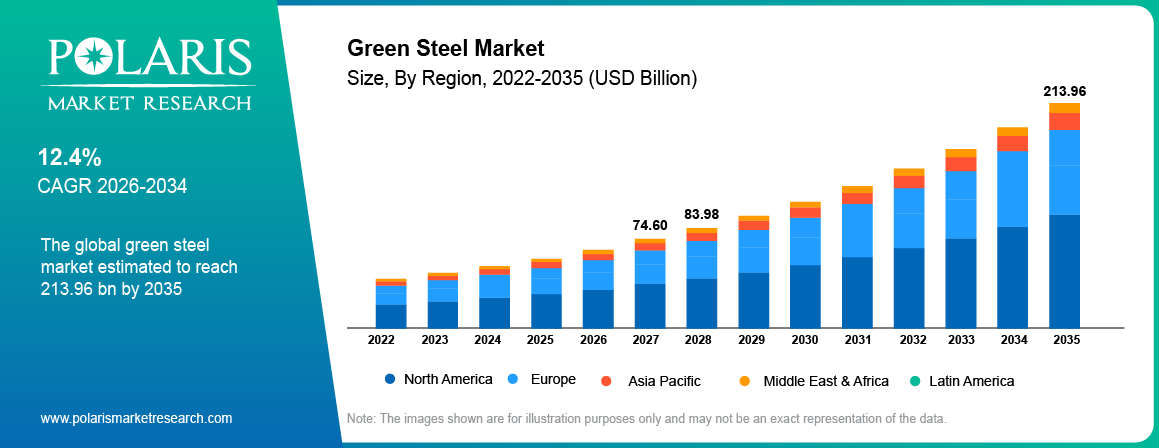
According to Polaris Market Research analysis, the green steel market was valued at USD 74.60 Billion in 2026. It is projected to reach USD 213.96 Billion by 2035, growing at a CAGR of 12.4% from 2027 to 2035. Demand is supported by carbon border regulations, automaker and appliance maker pledges to buy low emission steel, and new electric arc furnace capacity fed by scrap. Scrap based electric arc furnaces bring in the most technology revenue, while electrolysis and other new routes grow quickest. The market covers crude steel made through routes with a documented cut in carbon dioxide, and it excludes conventional blast furnace steel sold with offsets alone. Europe is the leading market. Asia Pacific is the fastest growing region.
Market Statistics
Key Takeaways
- 35.5% of 2027 revenue sits in Europe, where carbon border regulations, strong policy support, and early facility investment give purchasers a wide choice of certified low emission steel.
- Asia Pacific posts the quickest regional pace, at 14.5% annually to 2035, owing to new electric arc furnace capacity in China and fast steel demand growth in India.
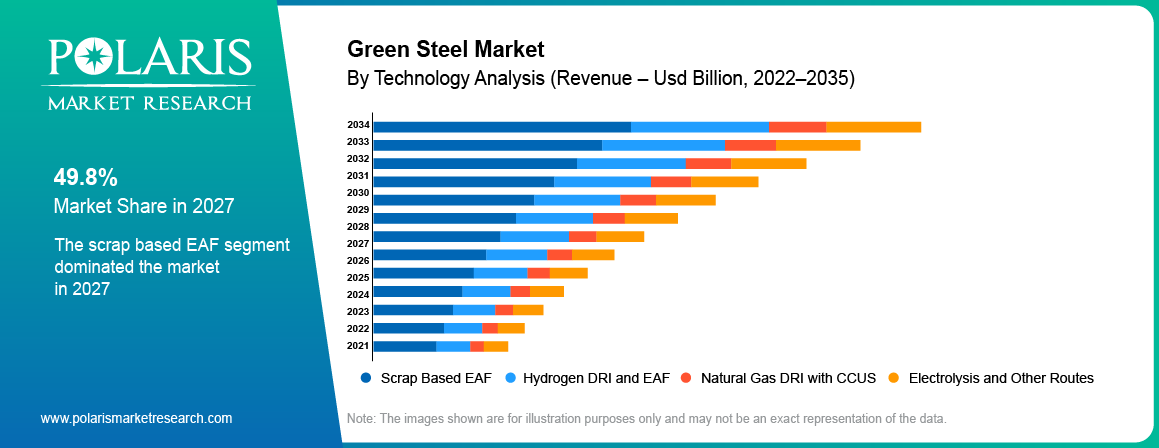
- Scrap Based EAF holds a 49.8% share of 2027 revenue, as recycled metal and clean power cut emissions at a lower cost than hydrogen routes.
- The highest technology CAGR sits with Electrolysis and Other Routes, at 21.0% through 2035, as pilot facilities move toward commercial scale from a very small base.
- Flat Products led the product split with USD 45,462.1 Million of 2027 revenue, since automakers and appliance manufacturers buy sheet and coil in large volumes.
- Recycled content and low emission melting lift Stainless and Specialty Steel by 14.8% a year to 2035 in premium grades.
- Automotive and Transportation accounts for 40.2% of 2027 revenue, supported by vehicle manufacturers that publish emission targets for steel and sign supply agreements early.
- Building and Construction sets the end use growth pace at 14.1% a year to 2035, as public projects and green building codes ask for lower embodied carbon.
- Revenue from Machinery and Industrial Equipment reached USD 15,930.1 Million in 2027, driven by equipment manufacturers that match customer carbon reporting needs.
Note: Figures and projections outlined in this report are the result of Polaris Market Research’s proprietary analytical processes, grounded in the latest available datasets and market observations.
Green Steel Market Definition
The green steel market covers crude and finished steel made through routes that cut carbon dioxide in a documented way, including scrap based electric arc furnaces, hydrogen based direct reduced iron, and natural gas direct reduced iron with carbon capture. It excludes conventional blast furnace steel that relies only on offsets.
The count includes producer revenue from low emission steel sold as semi finished or finished products to automotive, construction, and machinery purchasers. Conventional output sits in the wider iron and steel market, and steel made with a certificate or credit alone, without a process change, falls outside the count. Direct reduced iron sold as a raw material to third parties is not counted separately.
Green steel depends on clean energy and low emission inputs. Electrolytic hydrogen, covered in the green hydrogen market, replaces coal as the reducing agent in one route, while renewable electricity melts scrap in another. Facilities that keep natural gas as the reducing agent add capture of the exhaust stream to qualify.
Four technology groups share the market. A scrap based electric arc furnace (EAF) melts recycled steel with low carbon electricity. A hydrogen route reduces iron ore with hydrogen into direct reduced iron (DRI) that an EAF then melts. A natural gas DRI facility adds carbon capture, utilization, and storage (CCUS), and electrolysis routes such as molten oxide electrolysis split iron ore with electric current.
Product form adds a second cut. Flat products such as sheet and coil serve vehicles and appliances, long products such as rebar and sections serve buildings and infrastructure, and stainless and specialty grades serve process equipment and premium goods. Each form has its own customers, and certified supply is thinnest in the grades that need the purest inputs.
Green Steel vs Conventional Blast Furnace Steel: Key Differences
| Attribute | Green Steel | Conventional Blast Furnace Steel |
| Main reducing input | Hydrogen, electricity, scrap, or gas with carbon capture | Coke made from coal |
| Common formats | Flat, long, and stainless grades with a stated emission level | Flat, long, and stainless grades without an emission claim |
| Market scale | A small but fast growing share of world steel sales | The bulk of current global steel output |
| Growth outlook | 12.4% CAGR from 2027 to 2035 | Flat to slow growth in most regions |
| Typical purchasing argument | Customer carbon targets, border regulations, and a price premium | Lowest cost per tonne and long established supply |
Source: Polaris Market Research Analysis
Purchasers cannot tell the two metals apart by strength, so the premium for green steel rests on proof of emissions and on regulations that reward lower carbon content. Mills can sell both types from one site during the transition, and customers decide how fast the mix moves.
Porter's Five Forces Analysis
| Force | Intensity | Rationale |
| Bargaining power of suppliers | High | Clean power, hydrogen, high grade iron ore, and quality scrap come from a few providers, and a facility cannot run without them. |
| Bargaining power of purchasers | Moderate | Automakers and large construction groups can sign long agreements, yet few sellers can supply certified volumes at scale. |
| Threat of new entrants | Moderate | Facilities cost billions and need financing, but startups with strong backers and public grants can enter. |
| Threat of substitutes | Moderate | Aluminum, composites, and wood compete in vehicles and buildings, and conventional steel with offsets competes on price. |
| Competitive rivalry | High | Incumbent steelmakers and new green specialists compete for the same early customers and public support. |
Source: Polaris Market Research Analysis
Input suppliers hold the strongest position. Hydrogen is scarce and costly, and clean electricity is not available everywhere, so a producer without secured inputs cannot offer volume at a fixed price. Facility owners sign long supply deals and build near cheap power for that reason.
Market Dynamics
Driver Impact Analysis
| Driver | Impact on Market Growth | Time Horizon |
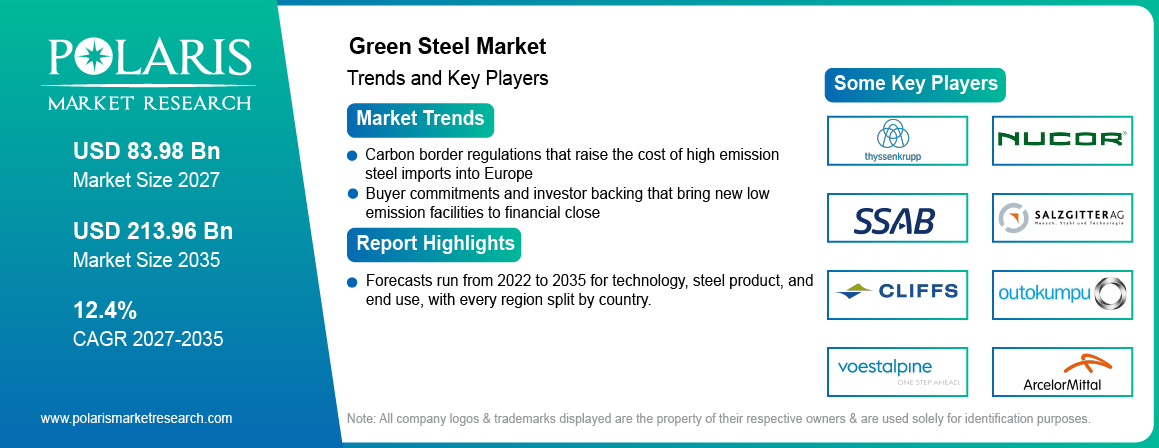
| Carbon border regulations that raise the cost of high emission steel imports into Europe | High | Short to Medium Term |
| Buyer commitments and investor backing that bring new low emission facilities to financial close | High | Medium to Long Term |
Source: Polaris Market Research Analysis
Driver: Carbon Border Regulations Are Raising the Cost of High Emission Steel, Creating Market Demand
The European Union is phasing in a carbon border mechanism for iron and steel, and the definitive period began in 2026. Importers must report the emissions embedded in their goods and, over time, pay for the gap between foreign and European carbon prices. That rule makes high emission steel more expensive and gives lower emission suppliers a price edge.
For example, in August 2026, the European Commission published sector guidance for iron and steel that sets out how embedded emissions are calculated for six product categories, from sintered ore to finished steel products. Post consumer scrap is assigned zero embedded emissions, and for electric arc furnace crude steel the electricity emissions are excluded from the definitive period calculation (Source: Eurometal). These calculation regulations reward scrap based production.
Scrap Based EAF should hold the largest technology share, at 49.8% of 2027 revenue, partly because border regulations treat scrap favorably. Hydrogen based producers gain from the same regulations over a longer horizon, as the gap between their emissions and those of blast furnace imports widens.
Driver: Customer Commitments and Investor Backing Are Funding New Low Emission Facilities, Creating Market Demand
A green steel facility needs billions of euros before the first tonne is sold, so financing depends on purchasers willing to commit. Vehicle manufacturers, parts manufacturers, and appliance brands have signed early supply agreements, and some have taken equity stakes. Those commitments give lenders the revenue visibility they need.
For example, in April 2026, Stegra announced EUR 1.4 billion of new financing for its Boden facility in northern Sweden, led by a consortium around Wallenberg Investments, and the round closed in June 2026. Investors included Scania, Schaeffler, and Kobe Steel, and the company said the overall project timeline remains under review (Source: SteelOrbis). The round shows that purchasers and strategic investors can keep a costly project alive.
Hydrogen DRI and EAF is the technology that benefits most from such backing, with a projected CAGR of 19.9% from 2027 to 2035. The route can produce the cleanest flat steel for premium vehicles, and customers that hold a stake can lock in early volume.
Cost of capital still separates projects. Facilities backed by strategic customers and public lenders reach financial close, while others wait for lower rates or clearer subsidy terms, so the pace of new supply stays uneven by region.
Restraint: High Green Hydrogen Costs and Project Delays Are Slowing Hydrogen Based Steelmaking
Hydrogen steelmaking needs large volumes of cheap clean hydrogen, and the supply chain is still small. Electrolyzers, covered in the electrolyzer market, remain costly, and renewable power is not available near every facility, so producers delay hydrogen use or start with natural gas.
For example, in November 2026, thyssenkrupp Steel received a final decision on revised funding terms for its Duisburg direct reduction facility, with a capacity of 2.5 million tonnes a year. The company said the hydrogen market has not developed as expected and green hydrogen costs more than first projected. The facility can therefore raise its hydrogen share in steps and may start on natural gas, and gas alone already cuts carbon dioxide by more than 50% against the blast furnace route (Source: GMK Center).
Delays carry a market cost. Purchasers that planned to receive certified hydrogen steel in the late 2020s must source from other routes, and lenders look harder at projects that depend on hydrogen prices. Scrap based and gas based producers fill the gap while hydrogen supply matures.
Natural Gas DRI with CCUS brought in USD 26,230.6 Million in 2027, partly because gas based facilities can start before hydrogen is available. Capture and storage add cost, as discussed in the carbon capture and storage market, yet a facility can lower emissions at the outset and shift toward hydrogen later.
Opportunity: New Scrap Based Electric Arc Furnaces Are Widening Low Emission Supply
Electric arc furnaces melt scrap with electricity, so a facility that buys clean power can cut emissions without waiting for hydrogen. European and North American producers are replacing blast furnaces with these furnaces, and scrap supply grows as old vehicles and buildings reach end of life.
For example, in October 2026, voestalpine reported that it had largely completed installation of its electric arc furnace at Donawitz. First production is targeted for the first half of 2027, with capacity of roughly 850,000 tonnes a year of carbon reduced steel. The group also plans first steel melts at Linz in the same half year, and a further expansion of about EUR 100 million at Donawitz depends on funding.
Recycled content has its clearest premium in Stainless and Specialty Steel, with a projected CAGR of 14.8% from 2027 to 2035. Stainless grades already contain a high share of scrap, so adding clean power gives producers a ready claim for customers in food, chemical, and energy equipment.
Opportunity: Public Standards and Funding Are Opening Support for Certified Low Emission Steel
Public standards and funding give purchasers assurance that a green label means a measured emission level. Governments are writing definitions, labeling schemes, and grants that tie support to emissions per tonne of steel, and these regulations shape where facilities are built.
For example, in December 2024, India launched a green steel taxonomy that sets a threshold of 2.2 tonnes of carbon dioxide per tonne of finished steel, with the National Institute of Secondary Steel Technology issuing green certificates and star ratings. The taxonomy covers scope 1, 2, and 3 emissions within defined limits, and it supports the national goal of net zero by 2070.
Building and Construction should gain as public procurement adopts such labels, with a projected CAGR of 14.1% from 2027 to 2035. Public agencies buy long products in large volumes, and a clear label lets them write low carbon requirements into tenders.
Overall, the opportunity depends on proof. Producers that report facility level emissions in a standard way can sell at a premium, while those that rely on general claims face doubt from purchasers and regulators.
Trend: Trade Measures and Carbon Costs Are Reshaping Steel Investment Choices
Trade measures and carbon costs are changing where steelmakers invest. When imports face tariffs or carbon charges, local producers can raise prices and plan lower emission capacity with more certainty, and that supports the case for rebuilding furnaces at home.
For example, in November 2026, ArcelorMittal reported third quarter EBITDA of USD 2.02 billion and a net loss of USD 391 million, after impairment charges of USD 852 million and costs linked to idling its Kryvyi Rih facility. The company said European flat steel earnings fell partly because selling prices adjusted slowly to higher energy and carbon costs, and it pointed to enhanced EU trade measures and a tariff rate quota framework (Source: SteelOrbis).
Flat Products, the largest product group, are most exposed to the shift, as sheet and coil are the grades that European blast furnaces make in volume. Higher carbon costs raise the value of low emission flat steel, and customers in cars and appliances are the first to pay for it.
Value Chain Analysis
| Stage | Activities | Representative Participants |
| Inputs | Supplying iron ore, scrap, natural gas, hydrogen, and clean electricity | Mining groups, scrap processors, and power and hydrogen producers |
| Ironmaking and steelmaking | Reducing ore with hydrogen or gas, melting scrap, and casting steel | ArcelorMittal, SSAB AB, Salzgitter AG, and Stegra |
| Certification and standards | Measuring facility emissions and issuing green labels | Government agencies, standards bodies, and independent verifiers |
| Processing and distribution | Rolling, coating, cutting, and delivery to customers | Service centers, rolling mills, and traders |
| End use | Manufacturing vehicles, appliances, buildings, and machinery | Automakers, builders, and equipment manufacturers |
Source: Polaris Market Research Analysis
Value concentrates in ironmaking and in the supply of clean inputs. A facility that secures hydrogen, power, and scrap at stable prices holds the lowest cost of green output, and a producer that can certify emissions per batch earns the premium that purchasers agree to pay.
Regulation touches several stages. Border regulations apply to imports, grants and taxonomies shape facility investment, and customers add their own carbon reporting needs. Each added rule raises the value of facilities that can prove emissions at the product level.
Green Steel Market Segmentation Analysis
Three choices frame the segmentation: the production route that sets the emission level, the product form that the customer needs, and the industry that uses the steel.
Technology Insights
Scrap Based EAF generated 49.8% of technology revenue in 2027, making it the largest group, as recycled metal and clean electricity cut emissions without waiting for hydrogen. Scrap melting also needs far less capital per tonne than a new ironmaking facility, so producers can add capacity in smaller steps.
For example, in October 2026, SSAB reported that its electric arc furnace at Oxelösund remains on schedule for start up in the second quarter of 2027. Preparatory work for a mini mill at Luleå is under way, with production planned at the end of 2029. Both projects replace blast furnace capacity with melting based on electricity, and a SEK 3.3 billion hardening line at Oxelösund is under construction for 2030.
Hydrogen DRI and EAF is forecast to post a CAGR of 19.9% through 2035, as announced facilities in Sweden, Germany, and elsewhere move from construction toward start up. Hydrogen routes can make the cleanest primary steel, but output depends on electrolyzer supply and on hydrogen prices.
Natural Gas DRI with CCUS earned USD 26,230.6 Million in 2027, driven by facilities in gas rich regions that can lower emissions before hydrogen is available. Operators plan to capture and store the exhaust stream, and some designs allow a later switch to hydrogen.
Electrolysis and Other Routes are projected to grow at a CAGR of 21.0% over the forecast period, the quickest in the dimension, since pilot facilities for molten oxide electrolysis and related processes are scaling up from a very small base. Commercial output will remain limited early in the period.
Purchasers rarely choose a technology directly. They ask for a stated emission level per tonne, and producers pick the route that meets it at the lowest cost for their location, so the technology mix shifts with local power, scrap, and gas prices.
Route choice also follows the product mix. Scrap melting suits long products and many flat grades, whereas premium automotive sheet often needs the purity that primary iron gives. Producers therefore combine routes, using hydrogen iron for demanding grades and scrap for the rest.
Steel Product Insights
Flat Products held 54.1% of steel product revenue in 2027, owing to the high volumes bought by vehicle and appliance manufacturers and to the large rolling capacity that already exists in Europe and Asia. Sheet and coil are also the grades where early customer commitments for low emission supply have been signed.
For example, in June 2026, EWE and Salzgitter Flachstahl, a flat steel maker, agreed a seven year supply of 10,000 tonnes of green hydrogen a year, starting in 2030. The deal gives the SALCOS program a defined hydrogen source for later years, and it shows that flat steel manufacturers are signing supply for hydrogen well before facilities reach full output.
Long Products earned USD 25,936.9 Million in 2027, supported by rebar and sections made in scrap based mills close to construction demand. Mills that use recycled metal and low carbon power have a natural advantage, since the route already dominates long product output in many countries.
Stainless and Specialty Steel shows the highest CAGR in this dimension, at 14.8% from 2027 to 2035, as producers add recycled content and cleaner melting to grades for food, chemical, and energy equipment. Customers in these sectors pay for traceability, so certified supply earns a premium.
Product form shapes how green steel is sold. Flat steel moves under annual contracts with a few large purchasers, whereas long products move through distributors and tenders, so the proof of emissions has to travel differently in each channel.
Service centers add a further layer. They cut and coat steel for smaller customers, and each step must keep the emission record attached, and this pushes suppliers to adopt digital certificates that follow a batch from melt to delivery.
End Use Insights
Automotive and Transportation held 40.2% of the 2027 end use total, driven by vehicle manufacturers that have set emission targets for steel and signed early supply agreements. Body panels and structural parts use large volumes of flat steel, and a carbon claim helps manufacturers meet customer and regulator reporting needs.
For example, in January 2026, thyssenkrupp Materials Processing Europe signed a multi year agreement to buy non prime steel from Stegra, with deliveries expected from 2027 and a total in the high six digit tonnes. The steel is not sold as CO2 reduced, since Stegra plans to sell its green value as certificates, and thyssenkrupp serves automotive suppliers, construction firms, and equipment manufacturers with the metal.
Building and Construction posts the fastest end use CAGR, at 14.1% through 2035, as public projects, green building codes, and developer targets ask for lower embodied carbon. Rebar and structural sections made from scrap are the easiest products for this market to adopt.
Machinery and Industrial Equipment generated USD 15,930.1 Million in 2027, supported by equipment manufacturers that report supply chain emissions to their own customers. Heavy machinery, rail, and wind tower manufacturers buy thick plate and special grades, and their orders favor suppliers with documented content.
Energy equipment and appliances form a smaller but visible group. Wind tower manufacturers and household brands use green steel in marketing, and a few have bought small lots to test customer response before they commit to larger volumes.
Customers in each end use ask for different proof because their own purchasers and regulators check different records. Carmakers want facility level data and audit rights, builders want a recognized label for tenders, and machinery manufacturers want a certificate that passes through to their own reports.
Green Steel Market Regional Analysis
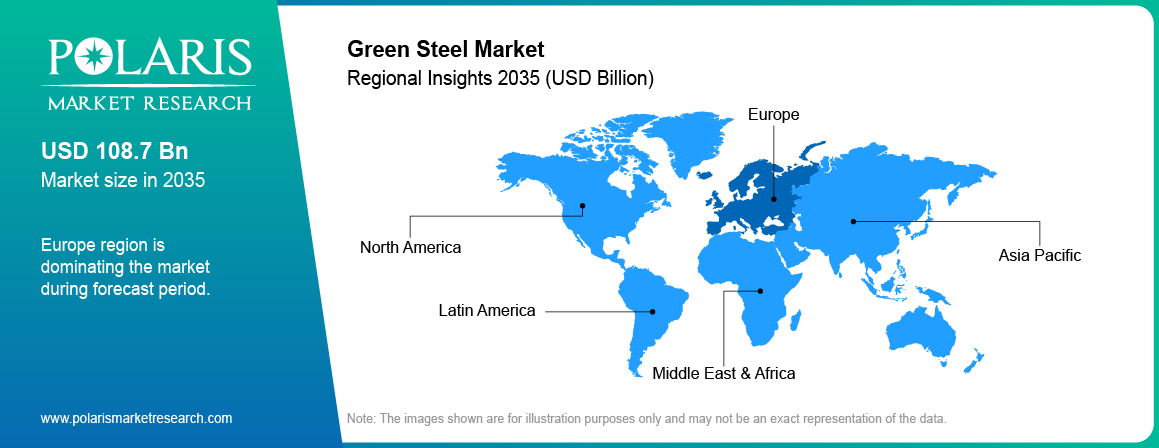
Regional demand rests on carbon regulations, access to clean power and scrap, the size of steel using industries, and public funding for new facilities. Europe holds the largest revenue base today, and Asia Pacific is catching up from a lower starting point.
North America Market
North America held 22.2% of global revenue in 2027, driven by a large scrap supply, abundant natural gas, and an established fleet of electric arc furnaces. Its CAGR of 11.5% from 2027 to 2035 trails the global pace, since policy support has been less steady than in Europe.
Canada outpaces the United States, with 12.3% versus 11.3% from 2027 to 2035, as clean grid power and public support favor new low emission capacity. The United States begins 2027 at USD 16,029.7 Million.
For example, in August 2026, Cleveland-Cliffs and the US Department of Energy confirmed a USD 500 million federal grant, matched by the company, for a USD 1 billion upgrade of Middletown Works in Ohio. The reworked plan swaps the blast furnace for a hydrogen ready direct reduced iron facility and two electric melting furnaces, and completion is planned for January to March 2030 (Source: Kitco).
US demand is led by automakers, appliance manufacturers, and builders. Purchasers favor suppliers with scale, domestic supply, and lower emission claims backed by data, and the use of electric arc furnaces gives many US mills a head start.
Europe Market
Europe held 35.5% of 2027 revenue and advances at 10.6% a year to 2035, owing to early facility investment and carbon border regulations that favor lower emission supply. Germany is the largest named country at USD 8,307.1 Million in 2027, with the United Kingdom next at USD 2,382.9 Million.
For example, in July 2026, Salzgitter completed its acquisition of HKM, lifting crude steel output by 11.3% to 4.90 million tonnes in the first nine months of the year. The group reported a nine month net profit of EUR 177.2 million in November. It said the first SALCOS stage, with direct reduction, a 100 MW electrolysis facility, and an electric arc furnace, should deliver first steel in the second half of 2027 (Source: SteelOrbis).
European purchasers include carmakers and machinery manufacturers that publish emission targets, and they pay close attention to the carbon border regulations. Public support, long power contracts, and strong customer demand help projects reach financial close.
Several projects have slipped because hydrogen is costly, and producers are adding natural gas and scrap stages as a bridge. Europe therefore leads on size and on facility activity, yet its growth rate is the slowest among regions, as a larger base grows more slowly.
Asia Pacific Market
Asia Pacific grows fastest of the five regions, at 14.5% a year to 2035, as China adds electric arc furnace capacity and India expands steel output, owing to government attention to emissions and to growing exports. India has the highest country CAGR, at 21.0%, and China has the largest base, at USD 9,692.1 Million in 2027.
For example, in September 2026, POSCO and BHP signed a HyREX collaboration agreement to prove and commercialize POSCO hydrogen based steelmaking technology, using BHP iron ore to test performance under different raw material conditions. The agreement builds on an October 2025 memorandum, and the companies also plan to explore cuts in emissions from the raw material supply chain.
Japan recorded USD 3,660.8 Million and South Korea USD 2,400.5 Million in 2027, mostly through integrated producers testing hydrogen and electric routes. Australia contributed USD 1,110.2 Million, helped by ore and renewable energy projects.
Producers in the region face a large installed blast furnace fleet, so retrofit and replacement decisions will stretch across many years. Government targets and export customers in Europe are the main pushes toward lower emission output.
Latin America Market
Latin America ranks third on growth, with a CAGR of 12.8% from 2027 to 2035, from a 3.5% share of 2027 revenue, owing to high grade iron ore, renewable power, and plans for direct reduction at the port. Brazil is the largest country, with USD 1,530.1 Million in 2027, and Mexico is the fastest, at 13.9%.
Producers in the region hold an advantage in ore and in clean electricity, and some plan to export reduced iron to steelmakers elsewhere. Financing and policy certainty will decide how many of these plans reach construction.
Domestic steel purchasers pay little premium today, driven by cost focus in construction and light manufacturing. Export customers in Europe and Asia are the likelier first purchasers of certified material.
Middle East & Africa Market
Middle East & Africa represented 6.6% of revenue in 2027 and grows at a CAGR of 13.1% from 2027 to 2035. Saudi Arabia grows fastest among its countries, at 16.1%, driven by cheap solar power, gas supply, and national plans to build steel and hydrogen capacity.
The United Arab Emirates recorded USD 1,891.1 Million in 2027, and South Africa recorded USD 657.2 Million. Gulf producers already run direct reduction facilities on gas, so a move to capture and to hydrogen builds on assets that exist today.
Africa has smaller steel output and few green projects, and ore and renewable resources offer a long term opening for exports. Power supply and financing remain the main limits on near term growth.
Green Steel Market Competitive Landscape
Producers fall into three groups. Integrated and electric arc furnace incumbents add low emission capacity inside existing networks. European green specialists build new facilities around hydrogen and customer partnerships. Asian and Gulf producers pair state support with low cost ore, gas, and power.
ArcelorMittal reported third quarter 2026 EBITDA of USD 2.02 billion and shipments of 13.0 million tonnes on November 5, 2026, and it remains the largest steel group in the table. Its European flat steel earnings were hit partly by slow price adjustment to higher energy and carbon costs, and the company faces the task of funding conversion while earnings swing.
SSAB and Salzgitter lead the European conversion among incumbents. SSAB posted third quarter operating profit of SEK 2.157 billion on October 29, 2026, and Salzgitter expects first steel from its new route in the second half of 2027. Thyssenkrupp Steel is building a 2.5 million tonne direct reduction facility at Duisburg, though its hydrogen schedule has been loosened.
Nucor and Cleveland-Cliffs shape the United States. Nucor posted net earnings of USD 1.32 billion in the third quarter of 2026, and Cleveland-Cliffs plans a hydrogen ready facility at Middletown with a USD 500 million federal grant. Asian groups such as POSCO, Nippon Steel, Tata Steel, and JSW Steel run hydrogen pilots and electric furnace projects.
Newer names add focus. Stegra builds a large hydrogen facility at Boden and has signed supply agreements and raised EUR 1.4 billion, but it has said its overall timeline remains under review. Outokumpu leads in recycled stainless, and Emirates Steel Arkan is working on gas based reduced iron in the Gulf.
Market share is hard to pin down here, as few firms report green steel sales alone. Facility starts, customer agreements, subsidies, and emission certificates stand in for sales data, and they favor producers with secured power, strong balance sheets, and loyal automotive customers.
Customer relationships are the other lever: a producer that signs long agreements with carmakers and appliance brands gains financing support and stable volume. Specialists without such customers depend on investors and public grants until output begins.
Vendor Landscape Snapshot
| Company | Vendor Positioning | Role |
| ArcelorMittal | Leader | Global steel group with European flat steel, reporting third quarter 2026 EBITDA of USD 2.02 billion |
| SSAB AB | Leader | Nordic steelmaker converting blast furnaces to electric arc furnaces, with Oxelösund start up planned for the second quarter of 2027 |
| Salzgitter AG | Challenger | German producer building the SALCOS direct reduction and electrolysis route, with first steel expected in the second half of 2027 |
| Thyssenkrupp Steel Europe AG | Challenger | German producer building a 2.5 million tonne direct reduction facility at Duisburg with revised funding terms |
| voestalpine AG | Challenger | Austrian group installing electric arc furnaces at Donawitz and Linz, with first production in the first half of 2027 |
| Outokumpu Oyj | Challenger | Finnish stainless leader with third quarter 2026 sales of EUR 1.555 billion |
| Nucor Corporation | Leader | Largest US electric arc furnace steelmaker, with third quarter 2026 net earnings of USD 1.32 billion |
| Cleveland-Cliffs Inc. | Challenger | US flat steel group planning a hydrogen ready direct reduction facility at Middletown with a federal grant |
| POSCO Holdings Inc. | Challenger | Korean group developing HyREX hydrogen steelmaking, with a BHP agreement signed in September 2026 |
| Tata Steel Limited | Challenger | Indian group with a decarbonization program in India and the Netherlands |
| Nippon Steel Corporation | Niche Player | Japanese steel group |
| JSW Steel Limited | Niche Player | Indian steel producer |
| Emirates Steel Arkan | Niche Player | Gulf producer working on gas based direct reduction projects |
| Stegra | Emerging Player | Swedish developer of a hydrogen based facility at Boden, which closed EUR 1.4 billion in financing in June 2026 |
Source: Polaris Market Research Analysis
Green Steel Market Technology and Innovation Landscape
Innovation centers on three goals: lower emissions per tonne, lower cost of clean inputs, and proof of the emission level. New furnaces, hydrogen reduction, carbon capture, and digital certificates each change the cost and risk profile of a facility.
Scrap based electric arc furnaces are the most mature route. Modern furnaces can run on renewable power, and better scrap sorting raises the share of high quality steel a mill can make from recycled metal. Quality limits still apply to the thinnest sheet and the cleanest grades.
Hydrogen direct reduction replaces coal with hydrogen as the reducing agent, and an electric arc furnace then melts the iron. The route can make steel with very low emissions, but a facility needs large volumes of clean hydrogen, and thyssenkrupp has shown how cost can push a project to begin on natural gas.
Natural gas direct reduction with carbon capture is a bridge. Gas based facilities already operate in the Gulf and in the Americas, and capture equipment can lower emissions while hydrogen supply grows. Storage sites and transport pipes are the main limits for this route.
Electrolysis routes are earlier in development. Molten oxide electrolysis and related processes split iron ore with electricity and could cut the need for a separate ironmaking step, but facilities remain at pilot or demonstration scale, and cost data are limited.
Measurement is the quiet technology. Facility sensors, batch tracking, and independent verification give each tonne a stated emission level, and regulations such as the European border mechanism and India taxonomy depend on that data to set prices and labels.
Raw material quality links all routes. POSCO and BHP are testing ore under real conditions, since the iron content and impurities in ore decide how a hydrogen process runs. Ore suppliers are therefore becoming partners in facility design.
Cost curves differ sharply between routes. A scrap fed furnace needs mainly power and metal, so its cost follows local electricity prices and scrap supply. A hydrogen facility adds electrolyzer capital, renewable power, and storage, and its final cost depends on how many hours a year the equipment runs. Facilities planned near cheap wind, solar, or hydropower have the strongest case, while sites far from clean power rely on subsidies or long term purchase agreements to reach an acceptable return.
Process heat and finishing also matter. Reheating furnaces, rolling mills, and coating lines still burn gas in many facilities, and a switch to electric or hydrogen heat can remove emissions that the melting step does not count. A producer that reports only ironmaking emissions can therefore look cleaner than one that covers the full route, and purchasers are starting to ask for the wider boundary.
Technology and Innovation Landscape Snapshot
| Area | Role | Status and Representative Developers |
| Scrap based electric arc furnace | Melts recycled steel with low carbon electricity | Production and construction, with Nucor, SSAB AB, and voestalpine AG |
| Hydrogen direct reduction | Replaces coal with hydrogen in ironmaking | Construction and pilots, with Stegra, Salzgitter AG, and POSCO Holdings Inc. |
| Natural gas direct reduction with capture | Lowers emissions of gas based ironmaking | Production and planning, with Emirates Steel Arkan and Cleveland-Cliffs Inc. |
| Electrolysis of iron ore | Splits ore with electric current | Pilot and demonstration scale, with specialist developers |
| Emission measurement and certificates | Verifies emissions per tonne for labels and border regulations | Rolling out, with regulators, standards bodies, and producers |
| Ore and scrap quality control | Matches raw material to the process | Testing, including the POSCO and BHP agreement |
Source: Polaris Market Research Analysis
Use Case Analysis
Automotive Body and Structural Parts
Vehicle manufacturers use flat steel for body panels, frames, and safety parts. Low emission steel lets them cut the carbon footprint of the vehicle without changing design, and early agreements with producers secure volume for models that launch in the late 2020s.
Construction and Infrastructure
Builders use rebar, sections, and plates for buildings, bridges, and rail. Scrap based mills already supply much of this steel, so labels and procurement regulations can move quickly, and public clients are the first to write embodied carbon limits into tenders.
Machinery and Heavy Equipment
Equipment manufacturers buy plate and special grades for cranes, mining machines, and rail vehicles. Their purchasers ask for supply chain emission data, so a certified source helps them keep contracts and meet customer reports.
Energy Equipment and Appliances
Wind tower manufacturers and appliance brands use green steel to support product claims. Volumes are modest today, yet the products carry brand value, and a few companies have signed supply agreements to test how much customers will pay.
Stainless Equipment for Food and Chemical Facilities
Process facilities buy stainless steel for tanks, pipes, and vessels. Stainless grades already hold a high share of recycled metal, and customers value traceability, so certified low emission stainless is among the easiest premium products to sell.
Buyer Needs and Decision Criteria
| Buyer Need | Decision Criteria | Why It Matters |
| Proof of emissions | Facility level data, third party verification, and a recognized label | Purchasers need numbers that pass audit before they pay a premium |
| Supply volume and timing | Start dates, capacity, and contract terms | Project delays can leave carmakers and builders without promised steel |
| Quality and grade range | Strength, surface, and purity for each product | Premium sheet and special grades need consistent inputs |
| Price premium | Cost gap against conventional steel | Customers compare the premium with carbon price and brand value |
| Regulatory fit | Border regulations, taxonomies, and procurement standards | A product must count as low emission in each market where it is sold |
Source: Polaris Market Research Analysis
Capital cost, clean input supply, customer trust, and regulatory approval form the entry barriers. Comparing suppliers is difficult, since emission claims follow different methods, and purchasers ask which boundary and which year each number covers.
Purchasers screen a new supplier on four points: the verified emission level, the start date of supply, the quality of each grade, and the price premium. A producer that answers all four with data can shorten a negotiation that would otherwise take months.
Procurement contracts are changing shape. Early deals fixed a volume and a price premium, while newer agreements tie the premium to a verified emission level and let the buyer receive certificates apart from the physical steel. This split helps a buyer far from a green facility claim credit, and it lets a producer with limited capacity reach more customers, although each buyer must check how a certificate is issued and retired.
Offtake terms shape project financing. Lenders prefer buyers that sign multi year contracts at agreed price premiums, since those contracts reduce the risk that new capacity sits idle. Producers with early customer agreements in automotive and construction therefore find it easier to raise funds, and they set the pace for the rest of the market.
Premium Insights and Forward Outlook
Proven Emission Data Will Split Leaders From the Rest
Purchasers and regulators will favor producers that publish facility level data using a recognized method. Today claims mix company targets, certificates, and measured results, and a maker that adds third party checks gains trust before rivals do. Delivery against stated start dates will also weigh on contract awards.
Scrap Based Capacity Will Deliver Volume Before Hydrogen
Electric arc furnaces under construction in Europe and North America will add low emission supply in 2027 and 2028, ahead of most hydrogen facilities. Producers that secure clean power and good scrap can serve customers early and earn cash to fund later routes.
Gas Bridges Will Shape Hydrogen Timing
Facilities that can run on natural gas first and move to hydrogen later reduce financing risk. Duisburg shows the pattern, and others will copy it, so hydrogen demand will arrive in steps tied to price rather than in a single wave.
Public Funding and Border Regulations Will Steer Facility Location
Funding programs, taxonomies, and border measures will decide where capital goes. Regions with clear regulations and cheap clean power will attract the next projects, while uncertain policy will push investors toward other sites.
Consolidation is possible. Producers with strong customers but weak balance sheets may seek partners, and ore, power, and hydrogen suppliers could take stakes in facilities to secure demand for their own products.
Key Players in the Green Steel Market
- ArcelorMittal
- SSAB AB
- Salzgitter AG
- Thyssenkrupp Steel Europe AG
- voestalpine AG
- Outokumpu Oyj
- Nucor Corporation
- Cleveland-Cliffs Inc.
- POSCO Holdings Inc.
- Tata Steel Limited
- Nippon Steel Corporation
- JSW Steel Limited
- Emirates Steel Arkan
- Stegra
Industry Developments
- November 2026: Salzgitter reported EUR 177.2 million of net profit for nine months and expects first SALCOS steel in the second half of 2027.
- November 2026: Funding terms for the Duisburg direct reduction facility were finalized for thyssenkrupp Steel, and a new hydrogen supply tender was prepared.
- October 2026: Voestalpine largely completed installation of its Donawitz electric arc furnace and targeted first production in the first half of 2027.
- September 2026: POSCO and BHP agreed a HyREX collaboration to test hydrogen steelmaking with real iron ore.
- August 2026: The US Department of Energy and Cleveland-Cliffs announced a USD 500 million grant with matching funds for the Middletown Works upgrade.
- June 2026: Stegra closed EUR 1.4 billion of financing for its Boden facility, with investors including Scania, Schaeffler, and Kobe Steel.
- December 2024: India introduced a green steel taxonomy, setting 2.2 tonnes as the carbon dioxide threshold for each tonne of finished steel.
Green Steel Market Report Segmentation
By Technology Outlook (Revenue, USD Million, 2022 to 2035)
- Scrap Based EAF
- Hydrogen DRI and EAF
- Natural Gas DRI with CCUS
- Electrolysis and Other Routes
By Steel Product Outlook (Revenue, USD Million, 2022 to 2035)
- Flat Products
- Long Products
- Stainless and Specialty Steel
By End Use Outlook (Revenue, USD Million, 2022 to 2035)
- Automotive and Transportation
- Building and Construction
- Machinery and Industrial Equipment
- Energy, Appliances, and Others
By Regional Outlook (Revenue, USD Million, 2022 to 2035)
- North America
- United States
- Canada
- Europe
- United Kingdom
- Germany
- France
- Italy
- Spain
- Rest of Europe
- Asia Pacific
- China
- Japan
- India
- South Korea
- Australia
- Rest of Asia Pacific
- Latin America
- Brazil
- Mexico
- Argentina
- Rest of Latin America
- Middle East & Africa
- Saudi Arabia
- United Arab Emirates
- South Africa
- Rest of Middle East & Africa
Green Steel Market Report Scope
| Report Attribute | Details |
| Market Size in 2026 | USD 74.60 Billion |
| Market Size in 2027 | USD 83.98 Billion |
| Revenue Forecast by 2035 | USD 213.96 Billion |
| CAGR | 12.4% (2027 to 2035) |
| Base Year | 2026 |
| Historical Data | 2022 to 2025 |
| Forecast Period | 2027 to 2035 |
| Quantitative Units | Revenue in USD Billion and USD Million, and CAGR in percent |
| Report Coverage | Revenue Forecast, Growth Factors, Competitive Landscape, Industry Trends, and Strategic Analysis of the green steel market |
| Segments Covered | By Technology, By Steel Product, By End Use, and By Region |
| Regional Scope | North America, Europe, Asia Pacific, Latin America, Middle East & Africa |
| Competitive Landscape | Company Profiling, Product Benchmarking, Financial Analysis, Market Developments, and Strategic Initiatives |
| Report Format | PDF and Excel |
| Customization | Available by Country, Region, and Segment |
| Research Team | Polaris Market Research & Consulting, Inc. research team |
| Last Updated | 20 November 2026 |
Source: Polaris Market Research Analysis
Why Choose Polaris Market Research
Each figure begins in a country model. Twenty two named countries, plus remainder lines, are sized on their own and the results feed five regional totals that link back to technology, steel product, and end use inputs.
Revenue is cut by production route and by product form. Purchasers can see where money flows between scrap furnaces, hydrogen or gas based direct reduction, and electrolysis, and between flat, long, and stainless grades.
Every external fact is tied to its publisher and its date when the page shows one. That lets a reader tell company statements, regulator notices, and trade press reports apart, keeping the evidence trail short and easy to audit.
Polaris can refocus the study on one country, a single production route, or a selected set of producers. To buy this report or request customization, contact Polaris Market Research & Consulting, Inc.
Research Methodology
Research Approach
Revenue counted here is crude and finished steel produced by routes with a documented carbon cut: scrap fed electric arc furnaces, hydrogen or gas based direct reduction with capture, and electrolysis. Blast furnace steel and offset only products are out of scope. Year 2026 is the base, 2022 to 2025 is history, and 2027 to 2035 is the forecast window, with segment values in USD Million and headline sizes in USD Billion. Three segment cuts and 22 country lines feed five regions.
Secondary Research
The desk phase produced 13 dated facts. Agencies and public bodies gave 3, and company announcements and results gave 10. Each source is listed with its name and with a date wherever one is published, with older items marked as such.
Primary Research
Polaris follows its standard process of primary interviews. These interviews cover manufacturers, distributors and channel partners, and industry experts and consultants. They are used to validate secondary estimates, segment shares, regional trends, and growth drivers.
Data Structuring
All values were converted to USD year by year, and each segment was defined ahead of any sizing work. A product fitting two routes was placed under its main route alone, while steel sold only with offsets was left out of every total.
Market Size Estimation
Bottom up: each dimension was built country by country, added up to regions, and then to the world figure.
Top down: the 2026 base of USD 74.60 Billion was set from the market boundary and then placed beside outside estimates that anyone can read. The Polaris base lands inside their range, though estimates run from well under to far above it because each draws its own boundary, so the comparison carries uncertainty.
Forecasting
The forecast follows a curve that loses a little speed every year and lands on the stated CAGR. Inputs include carbon border regulations, facility financing, hydrogen cost, scrap supply, public funding, buyer commitments, and capacity by region. Segment and regional weights drift slowly from 2026 to 2035.
Data Triangulation and Validation
Three checks closed the model. Segment sets close at 100% for every year, countries reconcile with their regions and the world figure, and growth steps near 2026 form one smooth path. The 2026 starting point and the 2034 level were set against outside estimates, as described under Market Size Estimation.
Limitations
Market figures in this report are Polaris estimates. Companies seldom disclose green steel sales on their own, so segment and regional splits come from modeled shares and not from filings. Category boundaries differ between outside estimates, and that explains most of the gap among them.
Research Methodology Phases
| Phase | Focus | Evidence / Output |
| Scope and Setup | Market boundary, segments, and regions | Fixed scope and segment list |
| Secondary Data Collection | Agency records, company announcements, and trade press articles | 13 sourced facts with dates |
| Primary Research | Interviews with manufacturers, channel partners, and industry experts | Validated segment shares, regional trends, and growth drivers |
| Data Structuring | Annual currency conversion, with segment boundaries set before sizing | Inputs counted once |
| Bottom Up Estimate | Country and segment estimates | Regional and global totals |
| Top Down Estimate | Global base for 2026 and its segment mix | Base set against outside estimates |
| Forecasting | Annual growth path to 2035 | Stated CAGR |
| Triangulation and Validation | Share sums, total reconciliation, and growth path review | Checks that passed |
| Output | Report tables and text | One shared dataset feeding all tables |
Source: Polaris Market Research Analysis
Data Sources by Type
| Type of Source | Named Examples | Used For |
| Agencies and associations (3) | European Commission guidance; US Department of Energy; India Ministry of Steel | Carbon border regulations, public funding, and green steel standards |
| Company announcements and results (10) | ArcelorMittal; SSAB; Salzgitter; Nucor; Outokumpu; voestalpine; Stegra; POSCO | Facility timelines, financing, quarterly results, and partnerships |
Source: Polaris Market Research Analysis
Green Steel Market FAQ's
The market covers steel made by routes that carry a documented carbon cut, including scrap fed furnaces, hydrogen or gas fed direct reduction, and electrolysis. Producers sell it to carmakers, builders, and machinery manufacturers.
Polaris Market Research analysis puts the 2026 size of the green steel market at USD 74.60 Billion. Revenue is projected to climb to USD 213.96 Billion by 2035.
Polaris Market Research analysis points to USD 213.96 Billion for the green steel market by 2035, a CAGR of 12.4% over 2027 to 2035.
Europe is the leading market, with 35.5% of revenue in 2027. Carbon border regulations, early facility investment, and customer demand support the lead.
Asia Pacific grows fastest among regions, at 14.5%, driven by rising steel demand in India and new furnace capacity in China.
Scrap Based EAF leads, with 49.8% of 2027 revenue, and Natural Gas DRI with CCUS follows at 31.2%. Electrolysis and Other Routes grow quickest, at 21.0% a year.
The key players include ArcelorMittal, SSAB AB, Salzgitter AG, Thyssenkrupp Steel Europe AG, voestalpine AG, and Nucor Corporation. POSCO, Tata Steel, Outokumpu, and Stegra complete the list.
Producers are building scrap based furnaces first, starting direct reduction facilities on natural gas, and signing supply agreements with carmakers. Border regulations and public labels are also shaping facility choices.
Green hydrogen costs more than planned, and projects such as Duisburg and Boden have changed schedules. Producers also need large amounts of clean power, scrap, and financing before output begins.
Green steel uses hydrogen, clean electricity, scrap, or captured gas emissions instead of coal fired blast furnaces. The metal is similar, but the emission level and proof of it set the price premium.
Flat Products earn the most, at USD 45,462.1 Million in 2027, since carmakers and appliance manufacturers buy sheet in volume. Stainless and Specialty Steel expands fastest, at 14.8% a year.
Building and Construction leads on growth, adding 14.1% a year through 2035 because public clients want steel with less embodied carbon. Automotive is still the largest end use, holding 40.2% of 2027 revenue.
High hydrogen prices delay facilities and push producers to start on natural gas, so certified hydrogen steel arrives later than planned. Purchasers then source scrap based or gas based supply to meet near term targets.
The United States earns the highest revenue, at USD 16,029.7 Million in 2027, leading China and Germany thanks to a large electric arc furnace fleet and deep scrap supply.
Carbon border regulations, vehicle maker targets, green building codes, and public funding lift demand. The European guidance of August 2026 favors scrap based output, and early supply agreements help projects reach financial close.

Download Sample Report of Green Steel Market
Please fill out the form to request a customized copy of the research report.


