
Electrolyzer Market Size, Industry Share, Growth Analysis Report, 2026-2034
REPORT DETAILS
Electrolyzer Market Overview and Growth Forecast, 2026–2034
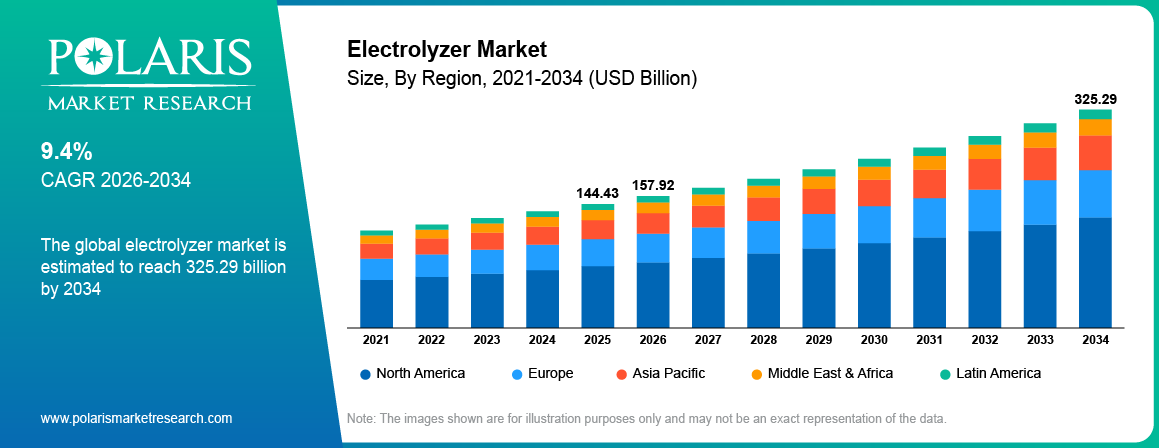
The global electrolyzer market size was valued at USD 144.43 billion in 2025. The market is expected to grow from USD 157.92 billion in 2026 to USD 325.29 billion by 2034, exhibiting a CAGR of 9.4% from 2026 to 2034.
Market Statistics
Key Electrolyzer Market Takeaways by Region, Technology, and Application
- In 2025, Europe accounted for the largest market share of 34.2%. The dominance is attributed to its robust policy framework and substantial investments in green hydrogen infrastructure.
- Germany dominated the regional market with 26.9% share in 2025. This is driven by the country’s emphasis on achieving carbon neutrality.
- The Asia Pacific electrolyzer market is expected to record the highest CAGR of 10.62% during the forecast period. This is due to rising investments in renewable energy infrastructure and strong government policies promoting hydrogen adoption.
- Based on technology, the proton exchange membrane (PEM) electrolyzers segment held the largest share of 38.2% in 2025. The dominance is driven by their ability to deliver high-purity hydrogen and operate efficiently at varying scales.
- By application, in 2025, the industrial segment accounted for the largest market share of 45.0%. This is attributed to the rising adoption of green hydrogen for industrial decarbonization and sustainable manufacturing processes.
Note: Figures and projections outlined in this report are the result of Polaris Market Research’s proprietary analytical processes, grounded in the latest available datasets and market observations.
Industry Dynamics
- Increasing investments in green hydrogen projects propel demand for electrolyzers across industrial and energy sectors.
- Rising government policies, subsidies, and decarbonization targets accelerate the adoption of electrolyzer technologies across the world.
- High capital costs and expensive renewable electricity requirements hinder large-scale electrolyzer deployment.
- Growing adoption of green hydrogen in steelmaking, refining, and transportation is expected to create opportunities for the market.
- High focus on PEM and solid oxide electrolyzer technologies enhances efficiency, flexibility, and operational performance.
Impact of AI and Smart Energy Management Systems
- AI-enabled control systems optimize electrolyzer efficiency. They adjust operating parameters in real time.
- Smart energy management platforms are used to enhance load balancing between renewable energy sources and hydrogen production systems.
- Predictive maintenance tools use AI analytics to reduce unplanned downtime.
- Machine learning (ML) algorithms help improve energy consumption efficiency and lower operational costs.
- Digital monitoring systems are adopted to improve performance tracking, operational reliability, and system lifespan.
What are Electrolyzer?
An electrolyzer is a device that uses electricity to split water into hydrogen and oxygen via electrolysis. Electrolyzer is widely used in green hydrogen production and energy storage. It is widely adopted in industrial processing and renewable energy integration. It supports decarbonization efforts across industries, such as transportation, chemicals, refining, and power generation.
The global electrolyzer market is a cornerstone of the hydrogen economy, facilitating the production of green hydrogen through water electrolysis powered by renewable energy sources. Electrolyzers are critical for decarbonizing industries such as power generation, transportation, and chemicals, as they enable the transition from fossil fuels to sustainable energy systems.
The rising adoption of green hydrogen in efforts to achieve net-zero carbon emissions is one of the key drivers of the electrolyzer market growth. Governments worldwide are supporting this transition with policies and subsidies. Additionally, the rising demand for clean energy solutions across industries, along with advancements in electrolyzer technologies that enhance efficiency and scalability, is driving market demand. The rapid growth in renewable energy installations, such as solar and wind power, is further contributing to the electrolyzer market expansion.
Source: Polaris Market Research Analysis
To Understand More About this Research: Download Sample Report
The development of hydrogen refueling infrastructure is driving market growth, with increased investments in building supply chains to support hydrogen-powered vehicles. Moreover, the rise of industrial decarbonization efforts, particularly in heavy industries like steel and ammonia production, has created substantial electrolyzer market opportunities. By replacing fossil-based feedstocks with green hydrogen, these industries are driving demand for large-scale electrolyzers.
Market Dynamics
Increasing Demand for Green Hydrogen
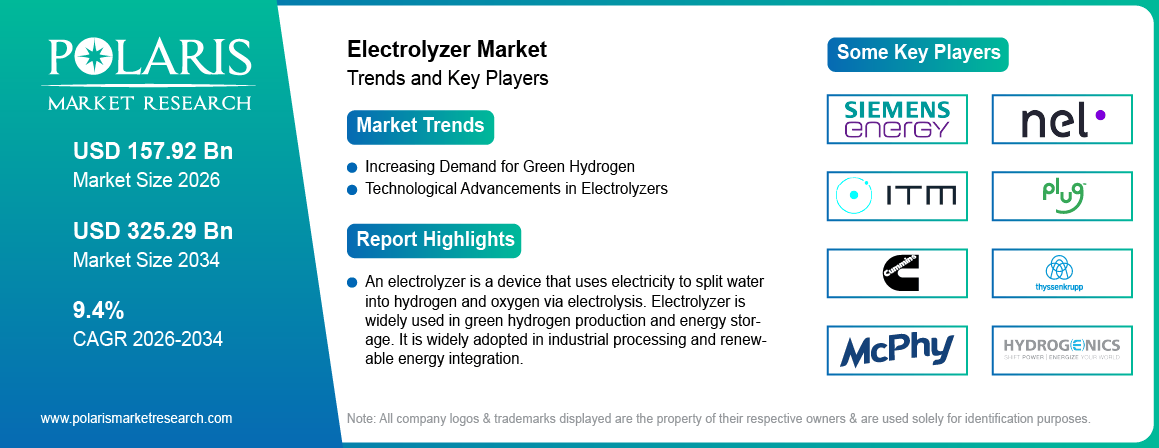
With hydrogen being a critical element in reducing global emissions, industries are increasingly adopting electrolyzers for sustainable hydrogen production. Market analysis indicates significant growth in the use of electrolyzers for industrial applications, particularly in chemical manufacturing, fuel cell vehicles, and energy storage. The scalability and modularity of electrolyzers are crucial for meeting the rising demand for green hydrogen. Governments are also introducing initiatives to promote green hydrogen, offering subsidies, tax incentives, and direct investments. For example, the European Union’s Hydrogen Strategy aims to install substantial electrolyzer capacities. Thus, the growing demand for green hydrogen is boosting the electrolyzer market development.
Technological Advancements in Electrolyzers
The rapid advancement in technology, particularly in proton exchange membrane (PEM) and solid oxide electrolyzers, is driving improvements in energy efficiency, reduced operational costs, and scalability of electrolyzer systems. PEM electrolyzers, in particular, are gaining traction due to their ability to operate under high pressure, making them ideal for compact and high-demand applications such as hydrogen fueling stations. Additionally, the integration of digital monitoring solutions for optimizing electrolyzer performance has revolutionized operational efficiency. As a result, technological advancements have boosted the demand for electrolyzers, with electrolyzer market analysis indicating increased adoption across diverse applications.
Challenges in Electrolyzer Market
- High capital investment requirements for electrolyzer systems and supporting infrastructure hinder widespread market adoption.
- Increased electricity consumption and high dependence on affordable renewable energy sources raise operational costs.
- Challenges related to technology scalability, particularly for advanced electrolyzer systems, adversely affect mass deployment and manufacturing expansion.
- Supply chain constraints for critical materials and components negatively impact production capacity and project timelines.
Source: Polaris Market Research Analysis
Segment Insights
Assessment by Technology Outlook
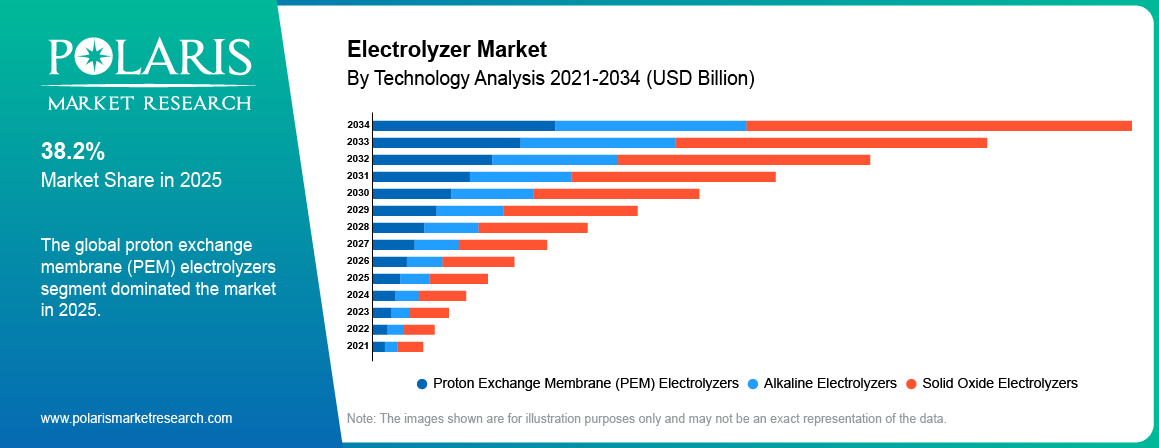
The global electrolyzer market segmentation, based on technology, includes proton exchange membrane (PEM) electrolyzers, alkaline electrolyzers, and solid oxide electrolyzers. In 2025, the proton exchange membrane (PEM) electrolyzers segment held the largest market share of 38.2% due to their ability to deliver high-purity hydrogen and operate efficiently at varying scales. These electrolyzers are highly suitable for integration with renewable energy sources, driving their adoption in green hydrogen projects. Moreover, advancements in materials, such as platinum-group metals, have enhanced the efficiency and durability of PEM electrolyzers, supporting the segment’s growth in the global market.
Comparison Matrix: Alkaline vs PEM vs Solid Oxide Electrolyzers
| Parameter | Alkaline Electrolyzers | PEM Electrolyzers | Solid Oxide Electrolyzers (SOEC) |
| Technology | Uses liquid alkaline electrolyte such as potassium hydroxide | Uses solid polymer electrolyte membrane | Uses solid ceramic electrolyte operating at high temperature |
| Efficiency | Moderate to high efficiency | High efficiency with fast response time | Very high electrical efficiency due to heat utilization |
| Capital Cost | Lower cost and mature technology | Higher cost due to precious metal catalysts | High cost because of advanced materials and limited commercialization |
| Operating Temperature | Low temperature (60–90°C) | Low temperature (50–80°C) | High temperature (600–1,000°C) |
| Operating Pressure | Typically low to medium pressure | Can operate at high pressure without additional compressors | Usually operates at atmospheric or moderate pressure |
| Scalability | Suitable for large-scale industrial hydrogen production | Highly scalable for renewable energy integration and distributed systems | Emerging scalability mainly for industrial and power-to-X applications |
| Dynamic Response | Slower response to fluctuating renewable power | Rapid response and flexible operation | Less flexible due to high-temperature operation |
| Durability | Long operational life with established reliability | Good durability but membrane degradation can occur | Durability challenges due to thermal stress and material degradation |
| Renewable Energy Compatibility | Moderate compatibility with intermittent renewable energy | Excellent compatibility with solar and wind energy | Best suited for continuous industrial heat integration |
| Main Applications | Industrial hydrogen production, ammonia, and chemical processing | Green hydrogen, mobility, energy storage, and renewable integration | Industrial waste heat recovery, synthetic fuels, and high-efficiency hydrogen production |
Source: Polaris Market Research Analysis
Evaluation by Application Outlook
The global electrolyzer market segmentation, based on application, includes power generation, transportation, and industrial. In 2025, the industrial segment accounted for the largest market share of 45.0% due to the increasing adoption of green hydrogen for industrial decarbonization and sustainable manufacturing processes. Key industries such as chemicals, steel, and ammonia production are transitioning to green hydrogen to reduce their reliance on fossil fuels and meet stringent global emission regulations. The chemical industry is driving the demand for electrolyzers, as hydrogen is a critical feedstock for processes like ammonia synthesis and methanol production. Furthermore, the steel industry is leveraging electrolyzers to produce green hydrogen for direct reduction of iron (DRI), a cleaner alternative to conventional coal-based methods. The scalability and efficiency of modern electrolyzer technologies, such as proton exchange membrane (PEM) and alkaline systems, have also enabled large-scale adoption in industrial applications.
Source: Polaris Market Research Analysis
Regional Analysis
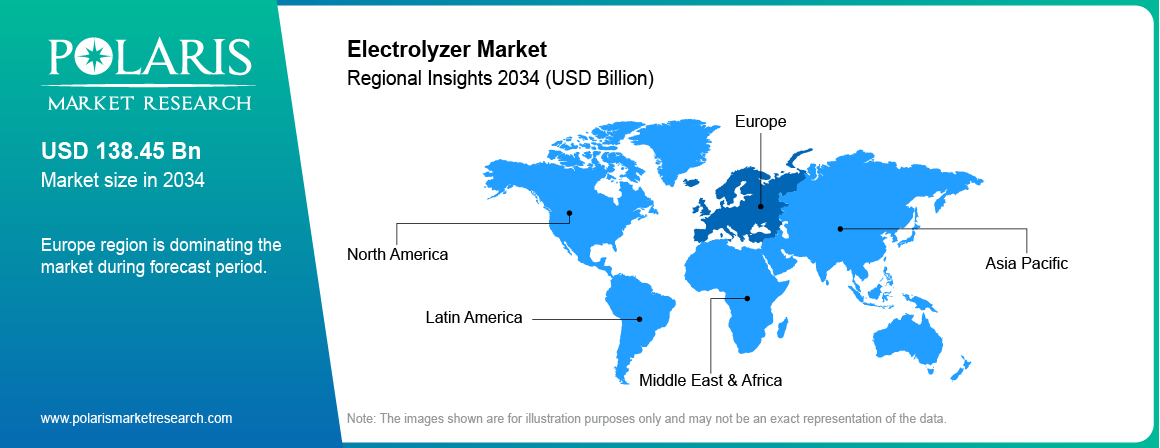
By region, the study provides market insights into North America, Europe, Asia Pacific, Latin America, and the Middle East & Africa. In 2025, Europe accounted for the largest market share of 34.2% due to its robust policy framework, substantial investments in green hydrogen infrastructure, and a strong commitment to achieving carbon neutrality. For instance, in 2022, hydrogen made up less than 2% of Europe’s energy use, mainly for chemical production like plastics and fertilizers, with 96% sourced from natural gas, causing high CO2 emissions. The EU's REPowerEU Strategy targets 10 million tonnes of renewable hydrogen production and imports by 2030, aiming for hydrogen to meet 10% of energy needs by 2050. Renewable hydrogen is central to the EU's plans for decarbonizing industries, transportation, and achieving net-zero goals. This plan has been instrumental in driving electrolyzer market growth, with aggressive targets for installing large-scale electrolyzer capacities to support renewable hydrogen production. The region benefits from a well-established renewable energy base, particularly wind and solar, which is essential for powering electrolyzers sustainably. Additionally, Europe is home to several leading electrolyzer manufacturers, such as Siemens Energy and Nel ASA, which leverage advanced technologies to cater to the growing demand for green hydrogen. Significant investments in hydrogen valleys and cross-border hydrogen networks have further strengthened Europe’s position as a leader in the global market.
The Asia Pacific electrolyzer market is expected to witness the fastest growth at a CAGR of 10.62% during the forecast period due to increasing investments in renewable energy infrastructure, strong government policies promoting hydrogen adoption, and the rising demand for green hydrogen in industrial applications. For instance, Australia’s September 2024 Hydrogen Strategy targets a production capacity of at least 15 million tonnes of green hydrogen annually by mid-century, with the potential to export 1.2 million tonnes each year beginning in 2030. Countries such as China, Japan, South Korea, and India are leading the transition to hydrogen-based economies, driven by decarbonization goals and energy security concerns. Significant projects, such as hydrogen production facilities integrated with solar and wind power, are under development, further boosting regional market expansion. Additionally, the region’s rapidly growing industrial sectors, including chemicals and steel, are adopting green hydrogen to reduce carbon emissions, reinforcing the demand for advanced electrolyzer technologies.
Source: Polaris Market Research Analysis
Key Players and Competitive Insights
The competitive landscape of the electrolyzer market is characterized by intense competition among key players focusing on innovation, strategic collaborations, and capacity expansions to meet the surging demand for green hydrogen. Leading companies such as Nel ASA, Siemens Energy, ITM Power, and Plug Power dominate the market by leveraging advanced technologies like proton exchange membrane (PEM), alkaline, and solid oxide electrolyzers. These players are heavily investing in research and development to enhance efficiency, scalability, and cost-effectiveness, which are critical to driving electrolyzer market growth. Strategic partnerships with energy companies, governments, and industrial end-users further strengthen their market position. Additionally, the entry of new players and the expansion of existing ones into emerging markets contribute to increased competition. Government emphasis on hydrogen infrastructure development and supportive policies also create opportunities for both established companies and startups. This competitive environment is fostering rapid technological advancements, ensuring the market for electrolyzers remains dynamic and progressive.
Siemens Energy is engaged in the electrolyzer market, leveraging its advanced PEM electrolyzer technology to deliver efficient and scalable solutions for green hydrogen production. The company has been instrumental in large-scale projects such as the Westküste 100 in Germany, where renewable energy integration is at the forefront. Siemens Energy partners with global energy players to expand hydrogen infrastructure, strengthening its market presence.
Nel ASA is engaged in the electrolyzer market, known for its innovative alkaline and PEM electrolyzers. The company’s focus on large-scale green hydrogen projects has solidified its market position. Nel ASA’s fully automated electrolyzer production line aims to reduce costs and increase scalability, aligning with the growing global demand for electrolyzers.
List of Key Companies
- Siemens Energy
- Nel ASA
- ITM Power
- Plug Power Inc.
- Cummins Inc.
- Thyssenkrupp AG
- McPhy Energy
- Hydrogenics Corporation (acquired by Cummins)
- Enapter
- H2B2 Electrolysis Technologies
- Bloom Energy
- Sunfire GmbH
- Ballard Power Systems
- Toshiba Energy Systems & Solutions
- Green Hydrogen Systems
Electrolyzer Industry Developments
- April 2026: Sunfire announced the launch of HyLink Alkaline 23, an outdoor pressurized alkaline electrolyzer system. The 50-megawatt electrolyzer module can be used in the implementation of triple‑digit megawatt projects. It is expected to reduce total installed costs (TIC) by up to 50% on the customer side. (Source: sunfire.de)
- September 2025: thyssenkrupp nucera finalized the acquisition of critical technology assets, including IP and a testing facility, from Green Hydrogen Systems, enhancing its pressurized alkaline water electrolysis capabilities (up to ~35 bar). (Source: thyssenkrupp-nucera.com)
- April 2025: John Cockerill inked an agreement with The Green Solutions Group (TGS) in Vietnam to supply pressurized alkaline electrolyzers and jointly develop green hydrogen and ammonia projects, bolstering its presence in the Asian market. (Source: johncockerill.com)
Electrolyzer Market Segmentation
By Technology Outlook (Revenue – USD Billion, 2021–2034)
- Proton Exchange Membrane (PEM) Electrolyzers
- Alkaline Electrolyzers
- Solid Oxide Electrolyzers
By Application Outlook (Revenue – USD Billion, 2021–2034)
- Power Generation
- Transportation
- Industrial
By Capacity Outlook (Revenue – USD Billion, 2021–2034)
- <500 kW
- 500 kW–2 MW
- 2 MW
By Regional Outlook (Revenue – USD Billion, 2021–2034)
- North America
- US
- Canada
- Europe
- Germany
- France
- UK
- Italy
- Spain
- Netherlands
- Russia
- Rest of Europe
- Asia Pacific
- China
- Japan
- India
- Malaysia
- South Korea
- Indonesia
- Australia
- Vietnam
- Rest of Asia Pacific
- Middle East & Africa
- Saudi Arabia
- UAE
- Israel
- South Africa
- Rest of Middle East & Africa
- Latin America
- Mexico
- Brazil
- Argentina
- Rest of Latin America
Electrolyzer Market Report Scope and Segmentation
| Report Attributes | Details |
| Market Size Value in 2025 | USD 144.43 billion |
| Market Size Value in 2026 | USD 157.92 billion |
| Revenue Forecast by 2034 | USD 325.29 billion |
| CAGR | 9.4% from 2026 to 2034 |
| Base Year | 2025 |
| Historical Data | 2021–2024 |
| Forecast Period | 2026–2034 |
| Quantitative Units | Revenue in USD billion and CAGR from 2026 to 2034 |
| Report Coverage | Revenue Forecast, Market Competitive Landscape, Growth Factors, and Trends |
| Segments Covered |
|
| Regional Scope |
|
| Competitive Landscape |
|
| Report Format |
|
| Customization | Report customization as per your requirements with respect to countries, regions, and segmentation. |
Source: Polaris Market Research Analysis
Electrolyzer Market FAQ's
• The market was valued at USD 144.43 billion in 2025 and is projected to grow to USD 325.29 billion by 2034.
• The global market is projected to register a CAGR of 9.4% during the forecast period.
• In 2025, Europe accounted for the largest market share of 34.2%.
• Some of the key players in the market are Siemens Energy, Nel ASA, ITM Power, Plug Power Inc., Cummins Inc., Thyssenkrupp AG, McPhy Energy, Hydrogenics Corporation (acquired by Cummins), Enapter, H2B2 Electrolysis Technologies, Bloom Energy, Sunfire GmbH, Ballard Power Systems, Toshiba Energy Systems & Solutions, and Green Hydrogen Systems.
• The proton exchange membrane (PEM) electrolyzers segment held the largest share of 38.2% in 2025.
• In 2025, the industrial segment accounted for the largest market share of 45.0%.
An electrolyzer is a device that uses electricity from renewable sources to split water into hydrogen and oxygen, enabling clean green hydrogen production.
Key trends include rising green hydrogen adoption, advancements in PEM technology, industrial decarbonization, growing government subsidies, and expanding renewable energy-powered hydrogen infrastructure globally.
Download Sample Report of Electrolyzer Market
Please fill out the form to request a customized copy of the research report.


