
Homogeneous Precious Metal Catalyst Market Size, Report 2026-2034
REPORT DETAILS
What is Homogeneous Precious Metal Catalyst Market Size?
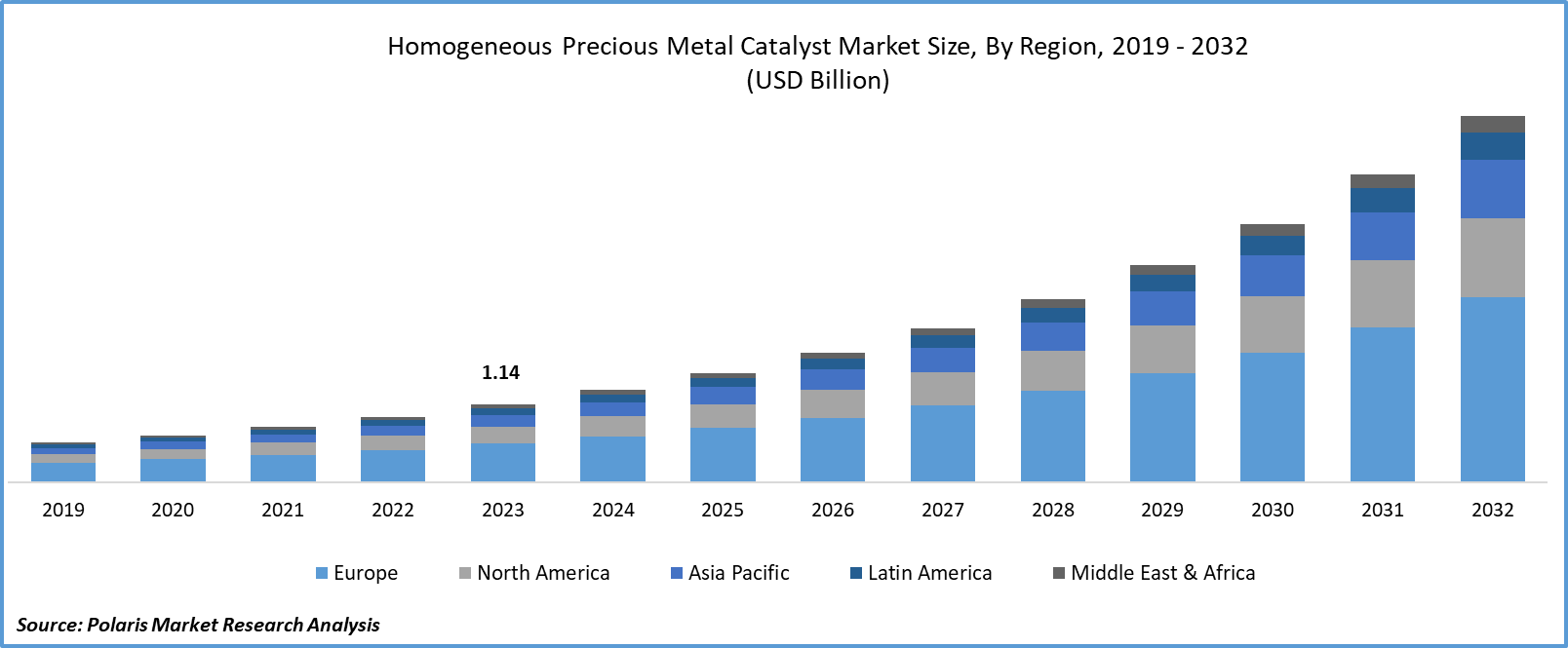
Homogeneous precious metal catalyst market size was valued at USD 2.63 billion in 2025 and is anticipated to exhibit the CAGR of 11.9% during the forecast period. The growth is driven by rise in demand from chemical industry, expansion of the automotive sector, and technological advancement in the production process.
Market Statistics
Key Takeaways
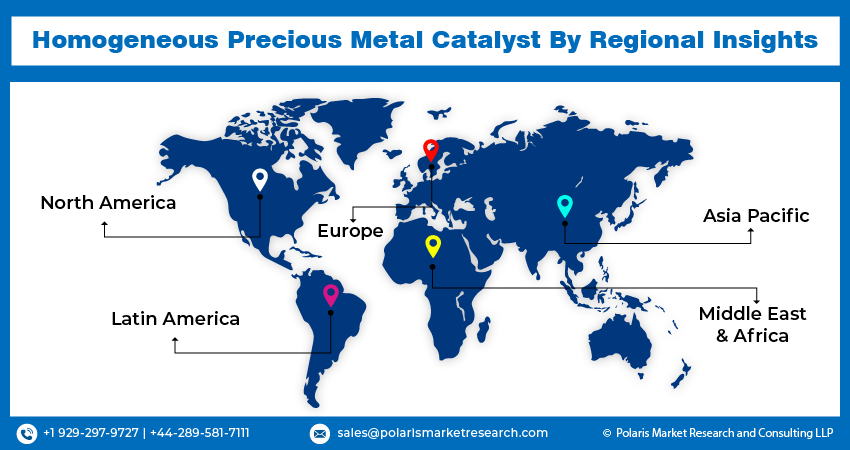
- Europe dominated the largest market and contributed to more than 40% of the share in 2025
- Asia Pacific is expected to grow at the fastest CAGR during the forecast period
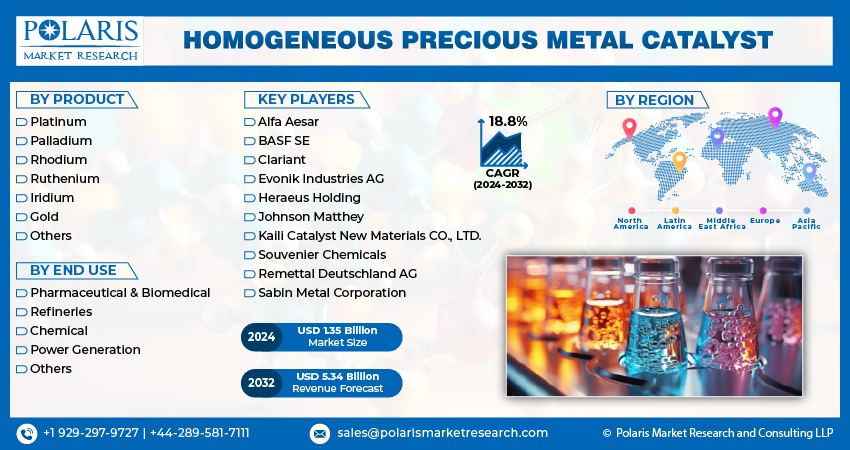
- By type category, platinum segment accounted for the largest market share in 2025
- By End Use category, refinery segment expected to grow at the fastest CAGR during the forecast period
Industry Trends
Catalysts are compounds employed in significant amounts to accelerate chemical reactions without undergoing any physical or chemical alterations. Homogeneous precious metal catalysts are a type of catalyst in which the catalyst and the reactants are in the same phase, typically in a solution. Precious metals such as platinum, palladium, rhodium, and ruthenium are often used as catalysts due to their unique catalytic properties. These catalysts find applications in various chemical processes, including organic synthesis, petrochemical refining, and pharmaceutical manufacturing. Homogeneous precious metal catalysts are valued for their high catalytic efficiency and selectivity, making them suitable for complex chemical reactions.
Moreover, Homogeneous precious metal catalysts are known for their high catalytic efficiency and selectivity. Industries seek catalysts that can enhance reaction rates, improve yields, and minimize the formation of unwanted by-products. Increased demand for specialty and fine chemicals, often used in high-value applications such as pharmaceuticals, agrochemicals, and electronic materials, drives the need for efficient catalysts, including those with precious metals.
Growing awareness and emphasis on green chemistry practices create homogeneous precious metal catalysts market opportunities. These catalysts can facilitate cleaner and more sustainable chemical processes, aligning with environmentally friendly principles. Market opportunities arise in the development of advanced materials for various applications, such as electronics, nanotechnology, and specialty materials. Homogeneous precious metal catalysts contribute to the production of high-performance materials. The increasing demand for specialty chemicals in various industries, including pharmaceuticals, agrochemicals, and electronics, offers opportunities for catalysts that enable efficient and selective chemical transformations. This rising demand expected the market to grow during the forecast period.
Source: Polaris Market Research Analysis
To Understand More About this Research: Download Sample Report
The organization has proactively strengthened its market position by extending its distribution network through strategic partnerships with exclusive distributors. This proactive strategy underscores the company's dedication to maximizing its reach and availability. Through collaborations with key partners, the company not only expands its distribution channels but also leverages the expertise and networks of established distributors. Anticipated outcomes include heightened market penetration, enhanced product availability, and strengthened ties within the distribution ecosystem. In essence, the decision to broaden the distribution network reflects the company's adapting to market dynamics and ensuring effective and widespread delivery of its products.
For instance, In October 2023, Evonik officially announced a formal agreement to participate in the development, scale-up, and production of specialized fixed-bed catalysts tailored for the implementation of Hydrogenous LOHC Technologies' unique liquid organic hydrogen carrier (LOHC) technology. This technology is based on benzyl toluene.
What are the market drivers driving the demand for Homogeneous Precious Metal Catalyst Market?
Expanding Chemical and Pharmaceutical Industries are projected to spur product demand.
The growth of the chemical and pharmaceutical industries, which heavily rely on catalysts for various synthesis processes, contributes to the demand for homogeneous precious metal catalysts. However, It plays a role in electrochemical applications, such as fuel cells and electrolysis. As interest in clean energy technologies increases, opportunities emerge in developing catalysts for electrochemical processes.
The increasing utilization of homogeneous precious metal catalysts in manufacturing organic molecules such as solvents, polymers, and specialty chemicals is poised to fuel significant growth in the chemical synthesis market. These catalysts enhance the activity, selectivity, and efficiency of chemical synthesis reactions, leading to reduced energy consumption and waste generation. Additionally, the growing demand for homogeneous precious metal catalysts in chemical synthesis applications is expected to be driven by the expanding market for high-performance materials across various industries, including automotive, electronics, and construction.
Anticipated substantial market growth in the petrochemical segment is foreseen, driven by the rising use of homogeneous precious metal catalysts in the production of petrochemical intermediates such as olefins, aromatics, and alcohols. This expansion is closely tied to the increasing demand in the plastics and rubber industries, which play crucial roles in applications like packaging, construction, and automotive.
Source: Polaris Market Research Analysis
Which factor is restraining the demand for the Homogeneous Precious Metal Catalyst?
High cost of homogeneous precious metal catalysts are likely to impede the market growth.
The utilization of these metals, such as platinum, palladium, rhodium, and ruthenium, in catalyst formulations can contribute to elevated production costs. This cost factor can potentially limit widespread adoption, especially in applications where cost-effectiveness is a crucial consideration.
Additionally, the scarcity and geopolitical factors associated with precious metals can introduce volatility in their prices, further impacting the cost dynamics for homogeneous precious metal catalysts. The reliance on these finite resources may pose challenges for market players in ensuring a stable and predictable supply chain.
Furthermore, the environmental and ethical considerations associated with the extraction and use of precious metals could present challenges. As sustainability becomes a more significant concern for industries, there may be increased scrutiny and pressure to explore alternative, more environmentally friendly catalyst materials.
Key Trends in Homogeneous Precious Metal Catalyst
| Trend | Description | Technical / application focus | Examples from Practice |
| Electrochemical catalyst recycling | Polymer supports with charge transfer interactions selectively bind anionic metal complexes for reversible electrochemical recovery. | Recycling intact Pd/Rh/Ru complexes from hydrosilylation, etherification, Suzuki reactions, preserving ligands. | New process recovers >90% catalyst via low‑voltage adsorption/desorption; feasible for industrial hydrosilylation. |
| Flow chemistry integration | Precious metal complexes used in continuous flow reactors for hydrogenation and coupling. | High‑pressure H2 reactions, rapid optimization, production scale‑up with safety. | Flow systems accelerate homogeneous catalysis from lab to plant. |
| AI/ML‑accelerated design | Machine learning screens ligands/conditions for Pd/Rh catalyst discovery. | Selective catalysts for pharma intermediates, reducing development time. | Computational tools speed novel precious metal catalyst discovery. |
| Base metal alternatives | Fe/Mn/Co/Ni/Cu for transfer hydrogenation, competing with Rh/Ru. | Cost‑effective reductions with similar activity/selectivity. | Reviews cover base‑metal transfer hydrogenation advances. |
Source: Polaris Market Research Analysis
Report Segmentation
The market is primarily segmented based on product, end use, and region.
| By Product | By End Use | By Region |
|
|
|
Source: Polaris Market Research Analysis
To Understand the Scope of this Report: Request Customization
Category Wise Insights
By Product Insights
Based on a product analysis, the market is segmented on the basis of Platinum, Palladium, Rhodium, Ruthenium, Iridium, Gold, and Others. The platinum segment held the largest homogeneous precious metal catalyst market share in 2025, various platinum compounds, such as Karstedt's catalyst, hexachloroplatinic acid (H2[PtCl6]), and cisplatin ([PtCl2(NH3)2]), serve as catalysts across diverse applications. In Europe, platinum-based catalysts are notably applied in hydrosilylation reactions. Specifically, Karstedt's catalyst is employed in paper coating for packaging and bottling applications and is particularly favored in hydrosilylation reactions. Its presence in trace amounts, measured in parts per million (ppm), presents challenges for the economically viable recovery of platinum from used catalysts. Additionally, Karstedt's catalyst is utilized in complexes featuring vinyl siloxane ligands.
Homogeneous palladium catalysts play a significant role in applications involving hydroesterification reactions. An illustrative example is Lucite International, which employs the catalyst in the production of MMA from ethylene, carbon monoxide, and methanol.
By End Use Insights
Based on end-use analysis, the market has been segmented based on pharmaceutical & biomedical, refineries, chemical, power generation, and other industries. The refinery segment is expected to grow at the fastest CAGR during the homogeneous precious metal catalyst market forecast period. Refineries play a crucial role in the production of petrochemicals. The growing demand for petrochemical products, such as olefins, aromatics, and alcohols, is driving expansion in refinery activities. Homogeneous precious metal catalysts are often utilized in various refinery processes to enhance efficiency and selectivity. Homogeneous precious metal catalysts are essential in hydrocarbon conversion processes within refineries. These catalysts facilitate reactions that lead to the production of valuable intermediates and end-products. The increasing emphasis on optimizing these processes to meet market demands is propelling the use of homogeneous precious metal catalysts.
Moreover, the increasing global demand for refined products, including fuels and specialty chemicals, is a key driver for refinery growth. To meet this demand, refineries are investing in advanced catalyst technologies, including homogeneous precious metal catalysts, to enhance production efficiency. Hence, the market is estimated to grow at the fastest GAGR in the upcoming years.
Source: Polaris Market Research Analysis
Regional Insights
Europe
The Europe region dominated the market with the largest market share in 2025 and is likely to maintain its dominance over the study period due to increasing environmental concerns that have prompted a resurgence in the automotive industry, marked by a heightened production focus on hydrogen fuel cell vehicles. This trend is a significant driver of market growth. The European Union, in response to environmental imperatives, has established a target of 95 grams per kilometer for emissions from new passenger cars, effective from 2021. The expanding healthcare sector, coupled with a steady rise in healthcare expenditure, is further fueling the demand for homogeneous precious metal catalysts.
Asia Pacific
The Asia Pacific region is expected to be the fastest-growing region, with a healthy CAGR during the projected period. The Asia Pacific region, particularly countries like China and India, is undergoing substantial industrialization. This industrial growth leads to increased demand for catalysts in various manufacturing processes, including those utilizing homogeneous precious metal catalysts. The automotive sector in the Asia Pacific region is expanding, driven by rising disposable income, urbanization, and increasing demand for vehicles. The adoption of homogeneous precious metal catalysts in the production of automotive components aligns with the growth of this industry. Growing investments in research and development activities contribute to the development of new and efficient catalyst technologies. This focus on innovation supports the adoption of homogeneous precious metal catalysts in various industrial processes.
Source: Polaris Market Research Analysis
Competitive Landscape
The homogeneous precious metal catalyst Market is fragmented and is anticipated to witness competition due to several players' presence. The market in petrol and refining and pharmaceutical company is expected to grow even more as a result of major players in the industry making significant R&D investments to extend their product lines. Important market developments include the introduction of new products, larger-scale mergers and acquisitions, contractual agreements, and cooperation with other companies. Market participants participate in these events to strengthen their positions.
Some of the major players operating in the global market include:
- Alfa Aesar
- BASF SE
- Clariant
- Evonik Industries AG
- Heraeus Holding
- Johnson Matthey
- Kaili Catalyst New Materials CO., LTD.
- Souvenier Chemicals
- Remettal Deutschland AG
- Sabin Metal Corporation
Recent Developments
In May 2025, Umicore revealed plans to establish a new homogeneous catalyst manufacturing facility in Catoosa, United States. Construction is scheduled to begin in 2025, with multi-ton production of Grubbs catalysts expected to commence by early 2027.
In December 2024, Johnson Matthey finalized the USD 2.3 billion sale of its Catalyst Technologies business to Honeywell, marking a significant step in its strategic shift toward battery materials and hydrogen-related technologies.
Report Coverage
The homogeneous precious metal catalyst market report emphasizes key regions across the globe to provide a better understanding of the product to the users. Also, the report provides market insights into recent developments, and trends and analyzes the technologies that are gaining traction around the globe. Furthermore, the report covers an in-depth qualitative analysis of various paradigm shifts associated with the transformation of this technology
The report provides a detailed analysis of the market while focusing on various key aspects such as competitive analysis, type, end use, and futuristic growth opportunities.
Homogeneous Precious Metal Catalyst Market Report Scope
| Report Attributes | Details |
| Market size in 2025 | USD 2.63 billion |
| Market size in 2026 | USD 2.94 billion |
| Revenue forecast in 2034 | USD 7.25 billion |
| CAGR | 11.9% from 2026 – 2034 |
| Base year | 2025 |
| Historical data | 2021 – 2024 |
| Forecast period | 2026 – 2034 |
| Quantitative units | Revenue in USD billion and CAGR from 2026 to 2034 |
| Segments covered | By Product, By End Use, By Region |
| Regional scope | North America, Europe, Asia Pacific, Latin America; Middle East & Africa |
| Customization | Report customization as per your requirements with respect to countries, region and segmentation. |
Source: Polaris Market Research Analysis
Homogeneous Precious Metal Catalyst Market FAQ's
The Homogeneous Precious Metal Catalyst Market report covering key segments are product, end use, and region.
Homogeneous Precious Metal Catalyst Market Size Worth $7.25 Billion By 2034
Homogeneous precious metal catalyst market exhibiting the CAGR of 11.9% during the forecast period.
Europe is leading the global market
key driving factors in Homogeneous Precious Metal Catalyst Market are rising Demand In Petrol And Chemicals
Download Sample Report of Homogeneous Precious Metal Catalyst Market
Please fill out the form to request a customized copy of the research report.


