
Influenza Diagnostics Market Size, Share, Trends & Forecast, 2026-2034
REPORT DETAILS
Influenza Diagnostics Market Size & Forecast, 2025-2034
The influenza diagnostics market size was valued at USD 1.79 billion in 2025. The market is anticipated to grow at a CAGR of 5.35% from 2026 to 2034. Seasonal flu outbreaks and the need for rapid patient triage are driving market growth. Advancements in molecular and point-of-care (POC) testing are also contributing to market development.
Market Statistics
Influenza Diagnostics Market Key Takeaways: Size, Share, Tests & Regions
- North America led with a 41.9% share in 2025. Advanced healthcare infrastructure contributes to the regional market dominance.
- Asia Pacific is expected to experience significant growth at a 9.8% CAGR. High prevalence of the influenza virus drives the regional market growth.
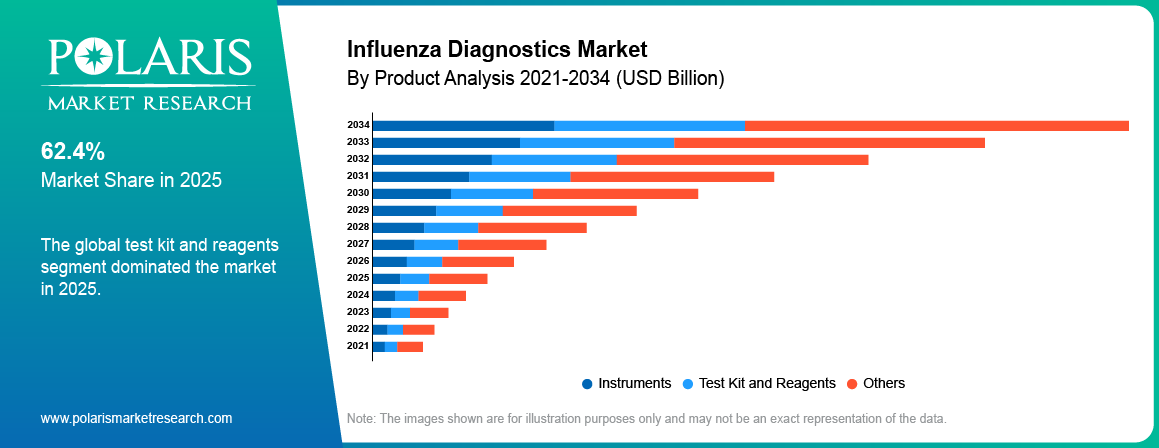
- The test kit and reagents segment held a 62.4% market share in 2025. This is owing to its vital role in diagnosing influenza infections.
- The RIDT segment held significant share of 36.8% in 2025. The quick results and easy to administer nature of RIDT make it highly essential for hospitals.
- The hospitals segment held a 57.3% share in 2025. There is an influx of patients in hospitals due to respiratory diseases such as influenza.
Note: Figures and projections outlined in this report are the result of Polaris Market Research’s proprietary analytical processes, grounded in the latest available datasets and market observations.
What Are Influenza Diagnostic Tests? Methods, Specimens & Uses
Influenza diagnostics are tests that assist physicians in confirming the presence of influenza. They identify the influenza virus using specimens from the patient’s nose and throat and help differentiate influenza from other respiratory diseases that have the same symptoms. Timely and correct diagnosis enables healthcare specialists to administer appropriate treatment earlier and prevent the spread of infection. Flu diagnostics are common in hospitals, clinical centers, labs, and even in point-of-care settings during flu seasons and outbreaks.
How Influenza Testing Works: Sample Collection, RIDTs, Molecular Tests & Results
Sample Collection – A sample is collected from the nostril or the throat of the patient with the help of a swab.
Sample Testing – The collected sample is tested to identify the presence of influenza virus proteins or genetic material.
Initial Test – Rapid antigen test is done to determine the result in a short period.
Further Confirmation Test – RT-PCR or any other molecular test may be done if further confirmation is required.
Interpretation of Results – The test identifies the presence of Influenza A, Influenza B, or the absence of influenza virus in the sample.
Treatment Plan – Doctors determine the treatment plan and prescribe medication for preventing further spread of the infection.

Source: Polaris Market Research Analysis
To Understand More About this Research:Download Sample Report
Influenza Diagnostics Market Dynamics: Drivers, Opportunities & Challenges
- The influenza diagnostics market is growing due to the rising incidence of influenza across the globe.
- Increasing adoption of point-of-care testing is another factor driving the development of the market.
- The development of multiplex assays is expected to create several opportunities for flu diagnostics market participants.
- High costs of advanced equipment may present market challenges.
Influenza Diagnostics Market Growth Drivers
Seasonal Influenza Burden Sustains Demand for Rapid and Molecular Testing
The influenza diagnostics market is expanding due to the rising incidence of influenza globally. Influenza, caused by influenza viruses, experiences seasonal outbreaks influenced by viral strain variations, increased travel, and urbanization. Healthcare providers prioritize early diagnosis for prompt patient management and infection control, fueling demand for influenza diagnostic tools like rapid antigen tests and molecular assays. Ongoing research focuses on enhancing diagnostic accuracy and speed, with advancements such as nucleic acid amplification techniques driving innovation. Public health initiatives promoting vaccination and influenza prevention also contribute to market growth.
Point-of-Care Molecular and Antigen Testing Expands Near-Patient Diagnosis
The influenza diagnostics market is on the rise due to increasing adoption of point-of-care testing (POCT). POCT offers rapid and accurate results, aiding prompt treatment decisions and outbreak containment. Healthcare facilities, including clinics and pharmacies, are integrating POCT devices to streamline diagnostics and improve patient care, especially in remote areas. The COVID-19 pandemic has further accelerated POCT adoption for influenza testing. Technological advancements in POCT devices, such as improved sensitivity, are also driving market growth.
Telehealth Integration Is Expanding Decentralized Influenza Testing
Telemedicine is increasingly becoming a critical aspect of diagnosing and treating patients with influenza. Telemedicine allows patients to seek consultation from a physician without having to visit a hospital or clinic for their initial assessment. Physicians can assess the symptoms and recommend influenza screening for further action to take. Combining telemedicine with diagnostic tools and digitized medical records makes it possible to make clinical decisions in a shorter time. It also eliminates unnecessary hospital visits for patients during influenza seasons, thereby reducing cases of infection. Remote follow-ups are made convenient by using telemedicine. As more services of digital healthcare become common, telemedicine is enhancing accessibility of influenza diagnosis and treatment.
FDA-Authorized At-Home Flu/COVID Tests Expand Consumer Access
The demand for at-home influenza testing has been growing as individuals look for quick and convenient methods of detecting flu infection. Self-testing kits provide an opportunity for users to take a sample and get results without going to healthcare facilities. Early detection helps patients seek advice from a specialist and get treated if necessary. Moreover, home testing can help avoid overcrowding in hospitals and clinics during periods of increased activity of influenza infection. The increase in accuracy of tests and user-friendly design has been contributing to the popularity of such products. Increasing interest in infectious diseases is encouraging individuals to perform home-based testing.
Influenza Diagnostics Market Restraints & Regulatory Challenges
FDA, CLIA and Regional Regulatory Requirements Increase Validation Costs
Regulatory challenges and compliance requirements pose hurdles for the influenza diagnostics market. Stringent guidelines ensure the safety and efficacy of diagnostic tests, necessitating extensive testing and documentation for regulatory approval. Adapting to evolving regulatory standards adds complexity and demands continual updates by manufacturers. Additionally, navigating diverse regulatory frameworks across regions complicates market entry and expansion efforts.
Influenza Diagnostics Market Overview & Technology Evolution
Government initiatives and funding for influenza surveillance are catalysts for the influenza diagnostics market growth. Globally, governments invest in surveillance programs to monitor outbreaks, track virus strains, and implement public health measures. These initiatives aim to detect and respond to influenza epidemics promptly, reducing healthcare burdens and mitigating public health impacts. Additionally, governments allocate funds for innovative diagnostic technologies and vaccines. Collaborations between government agencies, research institutions, and diagnostic companies drive innovation in advanced diagnostic solutions, like rapid point-of-care testing (POCT) devices. Government-sponsored vaccination programs and awareness campaigns further promote influenza prevention, boosting demand for diagnostics.
In addition, companies operating in the market are introducing new products to expand market reach and strengthen their presence.
- For instance, in January 2023, 2San introduced a combined kit for detecting SARS-CoV-2 and Influenza A+B. This single-use test kit provides results in just ten minutes, identifying the viruses responsible for COVID-19 and Influenza A and B. It offers individuals the convenience of testing at home and receiving prompt and precise diagnoses.
Technological advancements in diagnostic techniques are transforming the influenza diagnostics market. Traditional methods like viral culture and serological assays are being replaced by molecular techniques such as PCR and NAATs, offering enhanced sensitivity and rapidity. Point-of-care testing devices allow swift on-site detection, expediting patient management. Biosensor technology and microfluidics offer further miniaturization and automation, improving portability. Integration of AI and machine learning enhances data analysis, boosting diagnostic accuracy. These advancements enhance influenza diagnostics, offering more effective, precise, and accessible testing methods that advance patient care and public health responses.
Influenza Surveillance & Outbreak Monitoring: Role of Diagnostic Testing
Influenza surveillance is essential in monitoring the spread of seasonal flu and the emergence of new flu strains. Testing data is obtained from hospitals, diagnostic laboratories, and public health organizations that monitor infection and outbreaks. The testing data assists governments in planning the implementation of vaccination programs, as well as preparing health facilities for the increased demand during flu seasons. In addition, the surveillance programs play an important role in research on the nature of changes occurring in the influenza viruses. With continued advancements in surveillance systems, it is expected that they will help in preventing and managing influenza outbreaks.

Source: Polaris Market Research Analysis
AI in Influenza Diagnostics: Test Interpretation, Workflow & Surveillance
- Advances in artificial intelligence have made influenza diagnosis easier and more precise through analysis of clinical information and diagnostic testing results.
- Machine learning can identify the signs that differentiate influenza infection from other types of respiratory infection through the identification of symptom and lab results patterns.
- These technologies improve the workflow of the diagnostic process in hospitals and labs, making it faster and more efficient.
- Artificial intelligence also assists in tracking disease trends, contributing to better resource planning.
Influenza Diagnostics Market Trends: AI, Multiplex Panels, Home Tests & Microfluidics
| Trend | Impact on Diagnosis of Influenza |
| AI-Driven Diagnostics | Makes diagnosis of test outcomes easier and facilitates quick decision-making in clinical settings. |
| Portable Molecular Testing Devices | Provides a way for influenza testing even beyond standard laboratory facilities. |
| Multiplex Respiratory Panels | Able to detect influenza, RSV, COVID-19, and other respiratory viruses in one single test. |
| Influenza At-Home Testing Kits | Broadens the scope for conducting influenza testing market tests and helps to diagnose it earlier. |
| Digital Connected Diagnostic Devices | Facilitates test result sharing and tracking among healthcare providers. |
| Microfluidics and Biosensors | Helps in developing better and faster diagnostic technologies. |
Source: Polaris Market Research Analysis
Influenza Diagnostics Market Segmentation
The influenza diagnostics market analysis is primarily segmented based on product, test type, end use, and region.
| By Product | By Test Type | By End Use | By Region |
|
|
|
|
Source: Polaris Market Research Analysis
Influenza Diagnostics Market by Product: Test Kits & Reagents, Instruments & Others
Test kit and reagents segment held a significant market revenue share in 2025
The test kit and reagents segment held a significant revenue share in 2025 owing to its vital role in diagnosing influenza infections. During flu seasons, these kits experience consistent demand across healthcare settings due to their accuracy and ease of use. Technological advancements enhance their sensitivity and specificity, while government initiatives and pandemic preparedness efforts drive investment. The global disease burden of influenza underscores the continual need for effective diagnostic solutions.
Influenza Diagnostics Market by Test Type: RIDT, RT-PCR, Cell Culture & Others
Rapid influenza diagnostics test (RIDT) segment held a significant market revenue share in 2025
The RIDT segment held significant a revenue share in 2025. Rapid results, accessibility, and ease of administration make RIDT invaluable in healthcare settings requiring immediate diagnosis. Its cost-effectiveness compared to molecular methods also contributes to its popularity, particularly in resource-limited settings. Additionally, the established trust among healthcare professionals and regulatory approval further drive its adoption.
RIDTs vs RT-PCR for Influenza: Sensitivity, Speed, Setting & Use
| Factor | Rapid Antigen Tests (RIDTs) | RT-PCR Tests |
| Detection Method | Detection of influenza virus proteins | Detection of influenza virus genetic information (RNA) |
| Speed | Gives results in about 15-30 minutes | Takes a few hours or more, based on the lab |
| Accuracy | Adequate level of accuracy, particularly for preliminary screenings | Highly accurate; sensitive and specific test |
| Best Suited For | Pre-screening influenza infections at hospitals and other care facilities | Confirming the infection and determining the strain of the virus |
| Cost | Lower | Higher |
| Usage | General flu screening and diagnostics | In hospital settings, public health surveillance and lab diagnostics |
Source: Polaris Market Research Analysis
Influenza Diagnostics Market by End Use: Hospitals, Diagnostic Laboratories & Others
Influenza Diagnostic Test Use Cases: Seasonal Care, POC Testing, Home Testing & Surveillance
The hospitals segment held a significant revenue share in 2025. They attract a large influx of patients seeking treatment for respiratory illnesses like influenza, driving the demand for diagnostic tests. Hospitals offer comprehensive healthcare services, including diagnostic testing, making them a convenient choice for patients. Equipped with advanced laboratory facilities and diagnostic equipment, hospitals can perform various tests accurately and efficiently. Moreover, in critical care settings such as intensive care units (ICUs), rapid and accurate influenza diagnosis is crucial for timely patient management. Furthermore, hospitals adhere to regulatory standards for diagnostic testing, ensuring the quality and accuracy of influenza diagnostic procedures.
Use Cases of Influenza Diagnostics
| Use Case | How Influenza Diagnostics Helps |
| Seasonal Influenza Testing | Used for the early diagnosis of flu infection in case of seasonal outbreak for prompt treatment. |
| Hospital and Emergency Care | Assists physicians in diagnosing flu in patients who show symptoms of flu and start their treatment. |
| Pandemic Readiness | Enables health authorities to detect and track influenza outbreaks. |
| Point-of-Care Testing | Tests that are a part of the rapid influenza diagnostic tests market are performed at clinics, pharmacies, and other urgent care facilities. |
| Public Health Monitoring | Influenza diagnostics allow monitoring of influenza outbreaks and tracking the activity of various strains of viruses. |
| At-home Flu Test | An individual can conduct a rapid influenza test from home. |
Source: Polaris Market Research Analysis
Source: Polaris Market Research Analysis
Influenza Diagnostics Market Regional Analysis: North America, Europe, Asia Pacific, Latin America & MEA
North America Led the Influenza Diagnostics Market with 41.9% Share in 2025
In 2025, the North America region dominated the global market due to its advanced healthcare infrastructure, stringent regulatory standards, and high disease burden. The region's healthcare facilities and research institutions drive innovation in diagnostic technologies, meeting the demand for rapid and accurate influenza detection. With significant investments in healthcare, North America maintains a robust market for diagnostic solutions. Government initiatives and funding support bolster influenza surveillance efforts, while the presence of key market players ensures widespread adoption and distribution of diagnostic products.
Asia Pacific Influenza Diagnostics Market to Grow at 9.8% CAGR
Asia-Pacific is expected to experience significant growth during the forecast period. With its dense population and high incidence of influenza, there's a pressing need for effective diagnostic solutions. Improved healthcare infrastructure and rising awareness further boost demand, while urbanization and increased travel facilitate virus spread, necessitating robust diagnostic capabilities. Government initiatives and investments in healthcare bolster market expansion. Advancements in diagnostic technologies, such as NAATs and POCTs, offer rapid and accurate testing options. Additionally, the aging population's susceptibility to influenza fuels the demand for better monitoring and management solutions.

Source: Polaris Market Research Analysis
Influenza Diagnostics Market Competitive Landscape & Company Positioning
The influenza diagnostics market includes various players, with the expected arrival of new contenders intensifying competition. Leading companies continuously enhance their technologies to maintain a competitive advantage, emphasizing efficiency, reliability, and safety. They prioritize strategic actions such as forging partnerships, improving product portfolios, and participating in collaborative ventures to outperform rivals. Their ultimate goal is to secure a significant influenza diagnostics market share.
Leading Influenza Diagnostics Companies & Platforms
- Abbott Laboratories
- Becton, Dickinson and Company (BD)
- bioMérieux SA
- Bio-Rad Laboratories, Inc.
- CorisBioConcept
- DiaSorin S.p.A.
- F. Hoffmann-La Roche Ltd.
- GenMark Diagnostics, Inc.
- Hologic, Inc.
- Luminex Corporation
- Meridian Bioscience, Inc.
- Quidel Corporation
- SA Scientific, Ltd.
- Sekisui Diagnostics
- Thermo Fisher Scientific Inc.
Influenza Diagnostics Market Future Outlook to 2034
The market for influenza diagnostics is forecasted to experience steady growth due to the increasing demand for rapid and accurate testing. The advances in molecular diagnostics, point-of-care diagnostics, and diagnostics through artificial intelligence are likely to contribute to faster and more accurate detection of influenza infections. Increased use of multiplex tests, home diagnostics, and digital health services is also forecasted to contribute to the growth of the market. Public health readiness for future respiratory outbreaks is another factor expected to contribute to market development in the long run.
Recent Influenza Diagnostic Product Launches, Clearances & M&A, 2025-2026
- March 2026: Roche announced the launch of the cobas eplex respiratory pathogen panel 3 in CE markets. The company stated that it’s a fast and comprehensive test intended to help clinicians treat patients with respiratory infections. The new test can detect up to 25 viruses and bacteria in a single patient sample.(source: prnewswire.com)
- September 2025: QuidelOrtho Corporation expanded its QUICKVUE portfolio with the introduction of the QUICKVUE Influenza + SARS Test. The company stated that the QUICKVUE Influenza + SARS Test is a CLIA-waived, 510(k)–cleared rapid, easy-to-use immunoassay. It is designed for professional use in pharmacies, physician office laboratories, emergency departments, urgent care centers, and decentralized hospital labs.(source: prnewswire.com)
- In June 2025, Thermo Fisher Scientific revealed plans to divest select segments of its diagnostics business for approximately USD 4 billion, including its microbiology division, which generates around USD 1.4 billion in annual revenue.
Influenza Diagnostics Market Report Coverage & Research Scope
The influenza diagnostics market report emphasizes on key regions across the globe to provide better understanding of the product to the users. Also, the report provides market insights into recent developments, trends and analyzes the technologies that are gaining traction around the globe. Furthermore, the report covers in-depth qualitative analysis pertaining to various paradigm shifts associated with the transformation of these solutions.
The report provides detailed analysis of the market while focusing on various key aspects such as competitive analysis, products, test types, end uses, and their futuristic growth opportunities.
Influenza Diagnostics Market Scope, Segmentation & Forecast Period
| Report Attributes | Details |
| Market size value in 2025 | USD 1.79 billion |
| Market size value in 2026 | USD 1.88 billion |
| Revenue forecast in 2034 | USD 2.86 billion |
| CAGR | 5.35% from 2026 – 2034 |
| Base year | 2025 |
| Historical data | 2021 – 2024 |
| Forecast period | 2026 – 2034 |
| Quantitative units | Revenue in USD billion and CAGR from 2026 to 2034 |
| Segments covered |
|
| Regional scope |
|
| Competitive Landscape |
|
| Report Format |
|
| Customization | Report customization as per your requirements with respect to countries, region and segmentation. |
Source: Polaris Market Research Analysis
Influenza Diagnostics Market FAQ's
The global Influenza Diagnostics market size is expected to reach USD 2.86 billion by 2034
Key players in the market are Abbott Laboratories, Becton, Dickinson and Company (BD), bioMérieux SA
North America contribute notably towards the global Influenza Diagnostics Market
Influenza Diagnostics Market exhibiting the CAGR of 5.35% during the forecast period.
The Influenza Diagnostics Market report covering key segments are product, test type, end use, and region.
Influenza diagnostics include medical tests that detect influenza viruses such as Influenza A and Influenza B viruses. Such tests assist healthcare practitioners in diagnosing the presence of influenza viruses among patients with flu symptoms. This process helps determine whether it is influenza causing the disease.
Rapid influenza tests, or RIDTs, deliver fast results and are often used in the diagnosis of influenza. RT-PCR influenza diagnostics market tests are not as fast as RIDTs; however, they are more sensitive and accurate as they detect genetic material of the influenza viruses.
The influenza diagnostics market is growing because more people are getting infected with influenza every season, and there is increasing interest in respiratory infections and diagnostics for such infections. Expansion of point-of-care and at-home testing is also contributing to this growth.
Download Sample Report of Influenza Diagnostics Market
Please fill out the form to request a customized copy of the research report.


