
Internet of Things Analytics Market Size, Share, Trends & Forecast, 2026–2034
REPORT DETAILS
Internet of Things Analytics Market Summary
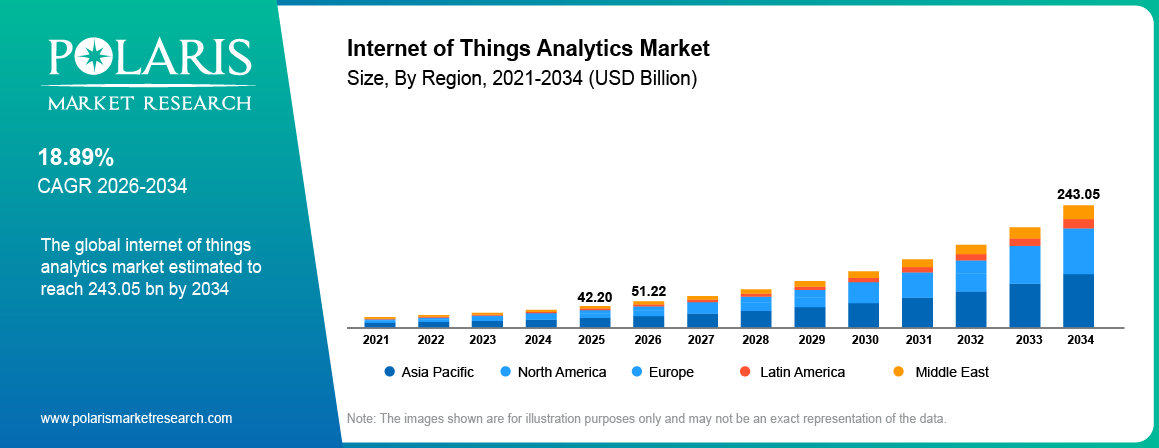
The global internet of things analytics market size was valued at USD 42.20 billion in 2025 and is expected to exhibit a CAGR of 18.89% from 2026 to 2034. The growth is driven by the expansion of smart cities, growing demand for advanced analytics, and technological advancement.
Market Statistics
Internet of Things Analytics Market Key Takeaways
- In 2025, North America accounted for the largest share of 38.9% due to the region's strong technological infrastructure, widespread adoption of IoT devices, and the presence of key industry players.
- The Asia Pacific Internet of Things (IoT) analytics market is expected to witness the fastest growth at a CAGR of 21.6% during the forecast period. It is due to the rapid adoption of IoT technologies across industries such as manufacturing, retail, and healthcare.
- The Europe market is expected to witness growth at a CAGR of 17.8% during the forecast period. This is driven by the adoption of connected technologies in manufacturing, automotive, energy, healthcare, and other sectors.
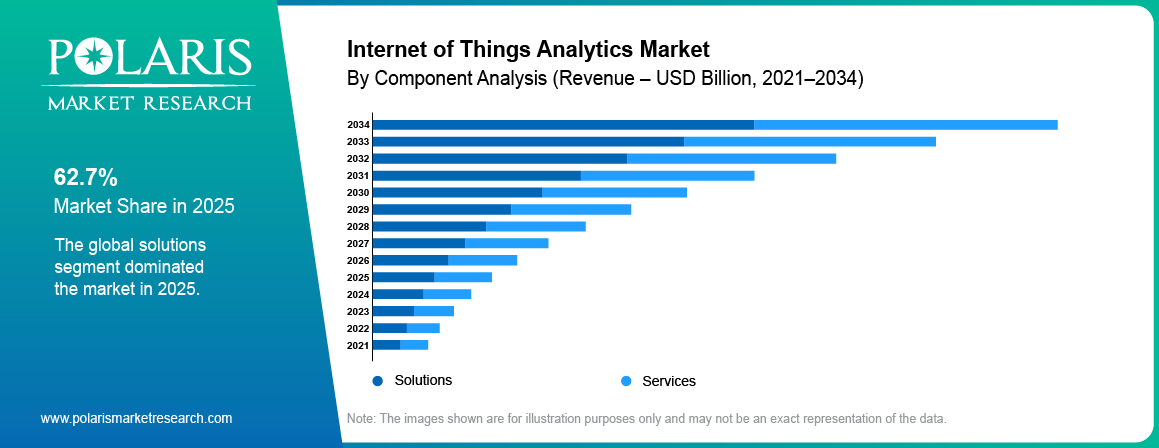
- In 2025, the solutions segment accounted for a larger Internet of Things analytics market share of 62.7%. The growth is attributed to the increasing demand for advanced analytics tools that process and derive actionable insights.
- In 2025, the manufacturing segment accounted for the largest market share of 28.4%. This is fueled by the widespread adoption of IoT technologies to enhance operational efficiency, reduce costs, and enable predictive maintenance
Note: Figures and projections outlined in this report are the result of Polaris Market Research’s proprietary analytical processes, grounded in the latest available datasets and market observations
What is IoT Analytics?
The Internet of Things analytics market focuses on the tools, platforms, and solutions used to analyze data generated by IoT devices. This market enables businesses to derive actionable insights, optimize operations, and enhance decision-making. It helps predict trends using advanced analytics, machine learning, and big data technologies.
The increasing deployment of IoT technology across industries generates vast amounts of data. It is driving the need for advanced analytics solutions to extract actionable insights, which is significantly propelling the IoT analytics market development. Integration of AI and machine learning technologies enhances the efficiency and accuracy of IoT analytics. It enables predictive maintenance, anomaly detection, and real-time decision-making, which is further driving the market growth.
Businesses are prioritizing real-time data processing to optimize operations, reduce downtime, and respond swiftly to changing conditions, which is fueling the IoT analytics market growth. Furthermore, organizations across sectors are leveraging IoT analytics to enhance operational efficiency, improve customer experiences, and stay competitive. This factor is further propelling the demand for IoT analytics.
How Does IoT Analytics Work?
IoT Analytics gathers data from various sources of connected devices such as sensors, machinery, and other equipment. It relays this data to a central database, where it is processed and analyzed. IoT analytics systems read and interpret this information. Information such as patterns, trends, and irregularities in data helps companies make informed business decisions. IoT Analytics helps companies turn data from connected devices into valuable information. Businesses can make their processes more efficient by making informed business decisions.
IoT Analytics vs IoT Platform and IoT Analytics vs BI
| Attribute | IoT Analytics | Traditional Business Intelligence (BI) | IoT Platform |
| Primary Data Source | Sensors, connected devices, and machines | Enterprise transactional and operational systems | Device connectivity, provisioning, and management layer |
| Processing Style | Real-time and streaming, often at the edge | Batch, periodic reporting | Connectivity and device orchestration, not analysis |
| Core Output | Predictive/prescriptive insights, anomaly alerts | Historical dashboards and reports | Device status, connectivity health |
| Typical Buyer Use | Predictive maintenance, asset tracking, automation | Financial and operational reporting | Device fleet management |
Source: Polaris Market Research Analysis
Source: Polaris Market Research Analysis
Role of AI in IoT Analytics Market
- Artificial intelligence is improving IoT Analytics by helping businesses analyze large amounts of device data faster.
- AI and machine learning platforms helps identify unusual machine behavior and supports early problem detection.
- AI-powered IoT analytics can improve predictive maintenance and reduce unexpected equipment failures.
- Businesses can use AI to find patterns and make faster operational decisions.
- Generative AI allows users to interact with IoT data using simple language.
- Growing AI adoption is expected to create new opportunities for IoT Analytics providers
Market Dynamics
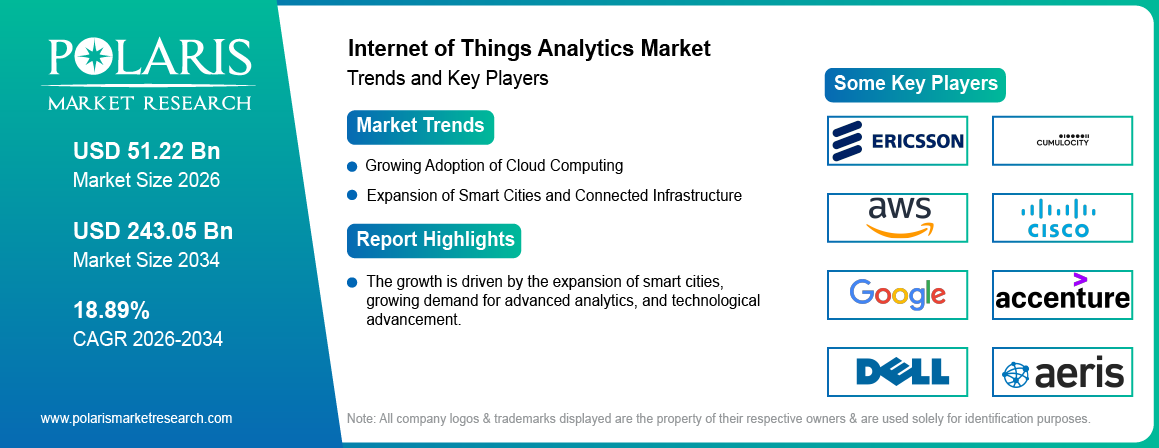
Driver: Growing Adoption of Cloud Computing
Cloud-based IoT analytics platforms provide scalable, cost-efficient, and remotely accessible solutions for managing and analyzing vast amounts of IoT-generated data. Unlike on-premises systems, cloud-based platforms allow businesses to process and store data dynamically, scaling resources up or down based on demand without significant capital investments. This flexibility is particularly beneficial for industries with fluctuating data volumes, such as manufacturing or retail, as it reduces infrastructure costs and operational complexity. Additionally, the remote accessibility of cloud platforms enables organizations to monitor and analyze IoT data in real time from anywhere. It improves decision-making and operational efficiency. For instance, Amazon Web Services (AWS) IoT Analytics offers a fully managed service for analyzing IoT data. Companies in the logistics sector use AWS IoT Analytics to process sensor data from fleets. It helps them optimize routes and reduce fuel consumption. Hence, the rising adoption of cloud computing boosts the market development.
Driver: Expansion of Smart Cities and Connected Infrastructure
The expansion of smart city projects and connected infrastructure is driving substantial growth opportunities for the IoT analytics market players. It enables efficient, data-driven management of urban systems. Cities adopt advanced technologies to enhance operational efficiency and sustainability; IoT analytics serves as a critical tool for processing and analyzing the vast amounts of data generated by connected device analytics and sensors. This data provides actionable insights that empower authorities to address urban challenges more effectively. Moreover, in traffic management, IoT analytics is utilized to monitor and analyze real-time data from road sensors, connected vehicles, and smart traffic systems. This enhances the ability to predict congestion patterns, optimize traffic flow, and reduce commute times. Moreover, IoT analytics significantly improves energy optimization by monitoring and managing energy use across smart grids, reducing waste and enabling more efficient distribution. Furthermore, as smart city initiatives continue to expand globally, IoT analytics is becoming an integral component of managing interconnected systems. It is driving innovation and improving the quality of urban living. The connected infrastructure propels the demand for sophisticated analytics solutions, contributing to the Internet of Things (IoT) analytics market growth.
Restraint: High Cost of Implementation
IoT analytics requires high investments in sensors, software, cloud platforms, and data storage. For cost-conscious organizations, especially small and medium-sized enterprises, analytics technologies’ implementation may be expensive. Moreover, there is often a need to invest in upgrading the existing infrastructure before integrating innovative solutions. Thus, businesses may find analytics applications unaffordable due to high initial costs and the necessity to update IoT analytics software and systems. Thus, the high cost of IoT analytics implementation restrains the growth.
Restraint: Risks of Data Insecurity and Privacy Breach
IoT Analytics involves collecting and storing clients’ information and analyzes the data. It allows businesses to gain insight into their preferences and behaviors. However, customers may worry about the potential data breaches and unauthorized access to their personal information. Thus, businesses need to ensure IoT analytics’ reliability and compliance with data security standards to prevent financial losses due to privacy breaches. Additionally, organizations need to consider legal regulations related to data security and privacy in different countries to avoid extra costs of legal issues.
Opportunity: Rising Demand for Predictive Analytic Tools
Businesses are focusing on implementing predictive analytics tools to ensure operational continuity and gain a competitive advantage. IoT Analytics support operations in various sectors, including manufacturing, electrical appliances, transport, and healthcare. The technologies can help companies identify and address potential issues before they occur, reduce maintenance costs, and optimize operations. Rising demand for predictive analytics and tools that help businesses ensure operational continuity and reduce costs is creating lucrative market opportunities.
Segment Insights
By Component Outlook
The market segmentation, based on component, includes solutions and services. In 2025, the solutions segment accounted for a larger market share of 62.7%. This is attributed to the increasing demand for advanced analytics tools that process and derive actionable insights from the massive volumes of data generated by IoT devices. These solutions, including real-time analytics platforms, data visualization tools, and machine learning algorithms, offer scalability, accuracy, and efficiency. Thus, businesses adopt IoT analytics solutions to optimize operations and improve decision-making. The growing adoption of IoT analytics solutions across various industries such as manufacturing, healthcare, and transportation further drives the segment growth. Organizations prioritize integrating data-driven technologies to enhance performance. Moreover, the availability of customizable and industry-specific IoT analytics solutions adds to their widespread adoption, solidifying their dominant position in the market.
By Deployment Outlook
Segmentation of the market by deployment includes cloud and on-premise. The cloud segment dominated the IoT analytics market share of 67.3% in 2025. IoT Analytics is adopted in the cloud due to its rising need. The software offers a scalable and cost-effective solution to organizations that look to optimize their processes. IoT analytics can be utilized in the cloud to offer a better storage system, especially for large-scale data. Businesses easily store their IoT data in the cloud since it provides remote access to data. These advantages are attracting many organizations as they migrate their IoT analytics workloads to the cloud, thereby driving the segment growth.
By Organization Size Outlook
The segmentation, based on organization size, includes large enterprises and SMEs. The SMEs segment is expected to witness significant growth CAGR of 17.95% during the forecast period. IoT analytics is adopted widely by small and medium-sized enterprises (SMEs) as it helps in improving processes and reducing costs. Cloud-based analytics is projected to gain significant adoption with the rising need for analytics in this specific segment. IoT Analytics is projected to support these organizations as they seek to transform their business data into insights. Some SMEs are adopting IoT analytics due to the readily available IoT devices. Moreover, SMEs need to leverage analytics to remain competitive against large enterprises, thereby driving the segment adoption.
By Type Outlook
The segmentation, based on type, includes descriptive analytics, diagnostic analytics, predictive analytics, and prescriptive analytics. The descriptive analytics market dominated with 42.6% share in 2025. Businesses are adopting this approach to gain insights into their current state and historical data. For example, descriptive analytics can help firms analyze their IoT data to understand their processes and how they can be improved. Furthermore, descriptive analytics is more informative than other analytical types, such as predictive and prescriptive analytics. Therefore, it can be used to gather insights on processes that utilize IoT data, thereby driving the segment growth.
By End Use Outlook
The segmentation, based on end use, includes manufacturing, energy & utilities, retail & e-commerce, healthcare & life sciences, transportation & logistics, IT & Telecom, and others. In 2025, the manufacturing segment accounted for the largest share of 28.7%. This is due to the widespread adoption of IoT technologies to enhance operational efficiency, reduce costs, and enable predictive maintenance. Manufacturers are increasingly leveraging IoT analytics to monitor production processes, optimize supply chain operations, and minimize downtime through real-time data insights. The integration of IoT analytics in smart factories, combined with the rising demand for automation and Industry 4.0 initiatives, has further driven adoption. Additionally, the ability of IoT analytics to provide actionable intelligence for quality control, resource management, and energy efficiency has made it a critical component in modern manufacturing, contributing to its dominant market position.
By Application Outlook
The market segmentation, based on application, includes energy management, predictive maintenance, asset management, inventory management, remote monitoring, others. In 2025, the predictive maintenance segment accounted for a 31.8% share, driven by the growing need to reduce equipment failures and unplanned downtimes. IoT analytics helps businesses monitor machine data and identify early signs of possible problems. This results in less expensive repairs and extended equipment life cycles. Industries such as manufacturing, energy, transportation, and healthcare are rapidly adopting connected equipment. The need for more productive and cost-effective operations has led to the high adoption rates of this predictive maintenance, thereby driving the segment growth.
Segment Breakdown
| Segment Facet | Leading Category in 2025 | Fastest-Growing Category/Highest CAGR During 2026–2034 |
| Component | Solutions (62.7% Share) | Services |
| Deployment | Cloud (67.3% Share) | On-Premises (regulated industries) |
| Analytics Type | Descriptive Analytics (42.6% Share) | Prescriptive Analytics |
| Organization Size | Large Enterprises | SMEs (17.95% CAGR) |
| Application | Predictive Maintenance (31.8% Share) | Asset Management |
| Industry / End Use | Manufacturing (28.7% share) | Healthcare |
Source: Polaris Market Research Analysis
Internet of Things (IoT) Analytics Market Regional Analysis
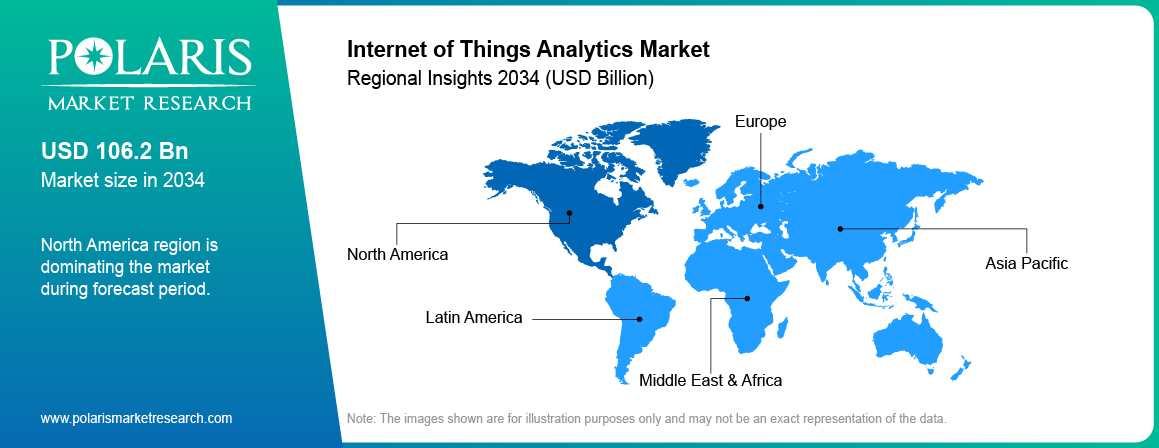
IoT analytics market by region is segmented into North America, Europe, Asia Pacific, Latin America, and the Middle East & Africa. In 2025, North America accounted for the largest share of 38.9%. The dominance is attributed to the region's strong technological infrastructure, widespread adoption of IoT devices, and the presence of key industry players. Rapid digital transformation across industries such as manufacturing, healthcare, and smart retail has driven significant investment in advanced analytics solutions to harness the vast data generated by IoT technologies. Additionally, supportive government initiatives and funding for smart city projects, along with increasing demand for real-time IoT data analytics and data-driven decision-making, have fueled the North America IoT analytics market growth.
The Asia Pacific IoT analytics market is expected to witness the fastest CAGR of 21.6% during the forecast period. This is due to the rapid adoption of IoT technologies across many industries such as manufacturing, retail, and healthcare. The growing investments in smart city projects, rising adoption of industrial automation and control systems, and increasing deployment of connected devices are driving demand for advanced analytics solutions. For instance, the National Industrial Corridor Development Programme is India's strategic initiative to develop advanced “Smart Cities” by integrating advanced technologies across infrastructure sectors. Additionally, the expanding IT infrastructure, a large consumer base, and supportive government initiatives promoting digital transformation contribute significantly to the region's accelerated market growth.
The Europe IoT analytics market is expected to witness a CAGR of 17.8% during the forecast period. The growth is fueled by the adoption of connected technologies in manufacturing, automotive, energy, healthcare, and other sectors. IoT Analytics is increasingly used in various businesses to optimize operations and cut costs. The growing need for smart manufacturing and favorable government policies promoting industrial automation and digital transformation increase the demand for analytics solutions. Additionally, the increasing emphasis on data-powered decision-making and the rising need for predictive maintenance drive the regional IoT analytics market trends.
The Middle East and Africa IoT analytics market is expected to record a CAGR of 16.2% during the forecast period. The growth is supported by the rising need for IoT Analytics in smart cities, energy, transportation, and industrial sectors. The growing need for digital transformation across the Middle East region boosts the need for analytics solutions. Adoption of connected technologies in smart buildings is on the rise across the regions, thereby fueling the demand for IoT data analytics platforms. Similarly, smart energy is experiencing rise in demand in the Middle East, which is fueling the need for analytics solutions providers. Applications such as industrial IoT analytics are increasingly used to optimize operations and monitor equipment performance in real-time. In Africa, the rising digitization and adoption of connected devices are driving the growth.
The Latin America IoT analytics market is expected to witness a CAGR of 17.1% during the projected period. The growth is attributed to the growing digital transformation trends in manufacturing, agricultural, transportation, energy, and other retail sectors. Businesses are increasingly adopting connected devices and analytics solutions to track their operations. Additionally, the rising need for predictive maintenance across industries and improved cloud-based technologies makes analytics solutions more accessible to small and medium-sized enterprises in the region. Moreover, the rising demand for smarter infrastructure and improved cloud connectivity promote the need for IoT Analytics in Latin America.
IoT Analytics Use Cases
| Use Case | How IoT Analytics Is Applied | Example |
| Predictive maintenance analytics in Manufacturing | Vibration, temperature, and power-consumption sensors feed ML models that flag early signs of motor, pump, or compressor failure—enabling maintenance before breakdowns. | Siemens uses IoT analytics across plants to cut unplanned downtime by up to 20%; BMW runs a “Virtual Factory” digital twin with real-time equipment monitoring to predict breakdowns. |
| Smart Logistics & Fleet Optimization | GPS, telematics, fuel, and driver-behavior data are analyzed to optimize routes, monitor vehicle health, and reduce fuel use and idle time. | DHL leverages IoT analytics to monitor global fleet health and optimize delivery routes; logistics firms report 15–20% fuel-cost reductions using such analytics. |
| Remote Patient Monitoring (Healthcare) | Wearables and bedside sensors stream vitals (e.g., respiratory rate, SpO₂) to analytics platforms that detect anomalies and trigger clinical alerts. | Philips’ HealthSuite IoT platform supports hospital-at-home and remote monitoring programs; RespiraSense continuous respiratory monitoring is deployed with measurable impact in hospitals. |
| Smart Energy & Grid Management | Smart meters, substation sensors, and generation assets feed analytics that balance loads, integrate renewables, and improve generation efficiency. | GE Digital applies IoT analytics to optimize power generation efficiency; utilities use similar stacks for smart-grid load balancing and loss reduction. |
| Precision Agriculture | Soil-moisture, nutrient, weather, and equipment telemetry are analyzed to optimize irrigation, fertilization, and harvest timing—boosting yield per acre. | John Deere connects farm equipment to IoT analytics for precision farming; vineyards like Deep Sky (US) have built IoT platforms with cloud partners to manage harvest operations. |
| Smart Cities:Traffic & Infrastructure | Cameras, road sensors, parking sensors, and utility meters feed analytics that optimize traffic signals, manage parking, and monitor infrastructure health. | Barcelona’s citywide IoT initiatives have cut energy costs by ~30% via smart lighting and infrastructure monitoring; AI-powered traffic-signal optimization is deployed using edge IoT analytics. |
Source: Polaris Market Research Analysis
Competitive Analysis
The competitive landscape is characterized by the presence of numerous key players, ranging from established technology companies to emerging startups. All leaders are striving to capture a significant market share through innovative solutions. Companies are focusing on enhancing their IoT analytics platforms with advanced features such as artificial intelligence (AI), machine learning (ML), and real-time data processing capabilities to meet the growing demand for actionable insights from IoT-generated data. Strategic collaborations, and mergers and acquisitions are common as firms seek to expand their market presence and improve service offerings. Additionally, market players are increasingly targeting industry-specific solutions to meet the unique needs of sectors such as manufacturing, healthcare, retail, and transportation. Subscription-based and cloud-driven models are also gaining traction as companies offer cost-effective and scalable analytics platforms. The competitive dynamics are further influenced by regional players, particularly in Asia Pacific and Europe, where growing IoT technology adoption is creating growth opportunities for localized solutions.
List of Key IoT Analytics Companies
- Accenture
- Aeris
- Amazon Web Services, Inc.
- Cisco Systems, Inc.
- Cumulocity GmbH
- Dell Inc.
- Ericsson
- Google (Alphabet Inc.)
- Hewlett Packard Enterprise Development LP
- Hitachi Ltd
- IBM Corporation
- Microsoft
- OpenText Corporation
- Oracle
- PTC
- Salesforce, Inc.
- SAP SE
- SAS Institute Inc.
- Siemens AG
Positioning of IoT Analytics Vendors
| Company | Vendor Category | Primary Offering | Analytics Focus Area | Headquarters |
| Amazon Web Services, Inc. | Hyperscale Cloud | AWS IoT Analytics, IoT Core | Cloud-native, fully managed IoT analytics | United States |
| Google (Alphabet Inc.) | Hyperscale Cloud | Google Cloud IoT Core, BigQuery | Scalable, real-time cloud analytics | United States |
| Microsoft | Hyperscale Cloud | Azure IoT, Azure Digital Twins | Digital twin modeling, real-time streaming | United States |
| IBM Corporation | Enterprise Software & Services | IBM Maximo, Watson IoT | Predictive maintenance, asset management | United States |
| Siemens AG | Industrial Automation | Siemens Insights Hub (MindSphere) | Industrial IoT and manufacturing analytics | Germany |
| PTC Inc. | Industrial Software | ThingWorx | Industrial IoT application platform and analytics | United States |
| SAP SE | Enterprise Software | SAP IoT, SAP Analytics Cloud | Enterprise-integrated IoT analytics | Germany |
| Software AG / Cumulocity GmbH | IoT Platform Specialist | Cumulocity IoT | Device management and edge analytics | Germany |
| Accenture | Consulting & Integration | Industry X, Applied Intelligence (IoT and digital twin services) | Consulting-led IoT analytics and systems integration | Ireland |
| Aeris | Connectivity & IoT Services | Aeris IoT Services, Mobility Intelligence | Connectivity, device lifecycle and connected-vehicle analytics | United States |
| Cisco Systems, Inc. | Networking & Edge | Cisco IoT Operations Dashboard, Edge Intelligence | Network-centric edge data orchestration and IoT connectivity analytics | United States |
| Dell Inc. | Edge Infrastructure | Dell NativeEdge, PowerEdge XR, Streaming Data Platform | Edge compute and real-time streaming analytics | United States |
| Ericsson | Telecom Infrastructure | Ericsson IoT Accelerator, Device Connection Platform | Cellular IoT connectivity and network data analytics | Sweden |
| Hewlett Packard Enterprise Development LP | Edge Infrastructure | HPE GreenLake for edge, Aruba edge networking | Hybrid edge-to-cloud analytics infrastructure | United States |
| Hitachi Ltd | Industrial Conglomerate | Lumada, Pentaho | OT/IT industrial data integration and analytics | Japan |
| OpenText Corporation | Information Management | OpenText IoT Platform, Magellan analytics | IoT data integration and information-management analytics | Canada |
| Oracle | Enterprise Software & Cloud | Oracle Cloud Infrastructure IoT, Oracle Analytics | ERP-integrated IoT and supply chain analytics | United States |
| Salesforce, Inc. | CRM & Data Cloud | Salesforce Data Cloud, Tableau | Customer-centric IoT event and service analytics | United States |
| SAS Institute Inc. | Advanced Analytics | SAS Viya, SAS Event Stream Processing | Streaming, AI and machine-learning analytics at the edge | United States |
Source: Polaris Market Research Analysis
Industry Developments
- January 2026, AT&T debuted a service that gives enterprises visibility into how their connected devices perform. The first offering, IoT Network Intelligence Standard, provides 4G and 5G network performance KPIs and a visualization dashboard (Source: about.att.com)
- January 2026, AT&T launched Connected AI for Manufacturing with MicroAI, NVIDIA, and Microsoft. The platform combined 5G, IoT, and generative AI to deliver real-time insights, support predictive maintenance, reduce downtime, improve efficiency, and strengthen security across manufacturing operations. (Source: about.att.com)
- In October 2025, Wiliot announced a partnership with Walmart to deploy ambient IoT sensors across its supply chain, feeding AI and analytics systems for better inventory and cold chain management. (Source: wiliot.com)
Future Outlook
The IoT Analytics market is expected to grow as businesses increasingly connect machines, equipment, and systems. Demand for real-time data and predictive maintenance will support market growth. Cloud adoption will make analytics solutions more accessible, especially for SMEs. The growing use of AI will also improve data analysis and decision-making. Industries such as manufacturing, healthcare, energy, transportation, and retail are likely to increase adoption. Rising investments in smart factories and connected infrastructure will further create growth opportunities for IoT Analytics providers.
Research Methodology
- Market estimates are derived using a blend of primary and secondary research, validated through weighted-average and combined top-down/bottom-up modeling approaches.
- Secondary research covers vendor filings, IoT device deployment and connectivity data, cloud and edge computing investment trends, industry journals, and paid third-party databases to build baseline estimates.
- Primary research includes interviews with key industry participants such as IoT analytics solution providers, cloud platform vendors, industrial automation specialists, and enterprise IT decision-makers, to validate accuracy and capture forward-looking insights.
- Base year considered is 2025, with a forecast provided through 2034; revenues are expressed in USD Billion.
- Parent market is identified as the global big data and business analytics market; the addressable segment is narrowed using IoT-generated data analytics adoption rates across industrial and enterprise applications.
- Bottom-up model aggregates regional IoT analytics demand across component, organization size, deployment, type, application, and end use, validated against vendor revenue disclosures from IBM, Microsoft, AWS, SAP, Cisco Systems, and others.
- Regional coverage spans North America, Europe, Asia Pacific, Middle East & Africa, and Latin America, further segmented by major countries.
- Projected 18.89% CAGR (2026–2034) reflects weighted analysis of proliferating connected devices and sensor networks, growing demand for predictive maintenance and real-time monitoring, expanding adoption of AI-driven prescriptive analytics, and increasing industrial digitalization initiatives.
- Findings are cross-validated across multiple estimation methods to ensure consistency, accuracy, and reliability of the final market sizing
Internet of Things Analytics Market Segmentation
By Component Outlook (Revenue, USD Billion, 2021–2034)
- Solutions
- Services
By Organization Size Outlook (Revenue, USD Billion, 2021–2034)
- SMEs
- Large Enterprises
By Deployment Outlook (Revenue, USD Billion, 2021–2034)
- On-Premises
- Cloud
By Type Outlook (Revenue, USD Billion, 2021–2034)
- Descriptive Analytics
- Diagnostic Analytics
- Predictive Analytics
- Prescriptive Analytics
By Application Outlook (Revenue, USD Billion, 2021–2034)
- Energy Management
- Predictive Maintenance
- Asset Management
- Inventory Management
- Remote Monitoring
- Others
By End Use Outlook (Revenue, USD Billion, 2021–2034)
- Manufacturing
- Energy & Utilities
- Retail & E-commerce
- Healthcare & Life Sciences
- Transportation & Logistics
- IT & Telecom
- Others
By Regional Outlook (Revenue, USD Billion, 2021–2034)
- North America
- US
- Canada
- Europe
- Germany
- France
- UK
- Italy
- Spain
- Netherlands
- Russia
- Rest of Europe
- Asia Pacific
- China
- Japan
- India
- Malaysia
- South Korea
- Indonesia
- Australia
- Vietnam
- Rest of Asia Pacific
- Middle East & Africa
- Saudi Arabia
- UAE
- Israel
- South Africa
- Rest of Middle East & Africa
- Latin America
- Mexico
- Brazil
- Argentina
- Rest of Latin America
Internet of Things Analytics Market Report Scope
| Report Attributes | Details |
| Market Size in 2025 | USD 42.20 billion |
| Market Size in 2026 | USD 51.22 billion |
| Revenue Forecast by 2034 | USD 243.05 billion |
| CAGR | 18.89% from 2026 to 2034 |
| Base Year | 2025 |
| Historical Data | 2021–2024 |
| Forecast Period | 2026–2034 |
| Quantitative Units | Revenue in USD Billion, and CAGR from 2026 to 2034 |
| Report Coverage | Revenue Forecast, Market Competitive Landscape, Growth Factors, and Trends |
| Segments Covered |
|
| Regional Scope |
|
| Competitive Landscape |
|
| Report Format |
|
| Customization | Report customization as per your requirements with respect to countries, regions, and segmentation. |
Source: Polaris Market Research Analysis
Internet of Things Analytics Market FAQ's
The global IoT analytics market size was valued at USD 33.91 billion in 2024 and is projected to grow to USD 243.05 billion by 2034.
The global market is projected to register a CAGR of 18.89% during the forecast period.
In 2025, North America accounted for the largest market share due to the region's strong technological infrastructure, widespread adoption of IoT devices, and the presence of key industry players.
A few of the key players in the market are Accenture; Aeris; Amazon Web Services, Inc.; Cisco Systems, Inc.; Dell Inc.; Google (Alphabet Inc.); Hewlett Packard Enterprise Development LP; Microsoft; OpenText Web; Oracle; PTC; Salesforce, Inc.; SAP SE; SAS Institute Inc.; and Software AG.
In 2025, the solutions segment accounted for a larger market share due to the increasing demand for advanced analytics tools that process and derive actionable insights from the massive volumes of data generated by IoT devices
In 2025, the manufacturing segment accounted for the largest market share due to the widespread adoption of IoT technologies to enhance operational efficiency, reduce costs, and enable predictive maintenance.
IoT Analytics analyzes data from connected devices to identify patterns, improve operations, reduce costs, and support better business decisions.
IoT Analytics uses real-time data from connected devices, while traditional analytics mainly relies on historical data from existing business systems.
IoT connects devices and collects data, while IoT Analytics processes that data to generate useful insights and support business decisions.

Download Sample Report of Internet of Things Analytics Market
Please fill out the form to request a customized copy of the research report.


