
Mass Timber Fasteners Market Demand, Share & Growth Analysis Report, 2026-2034
REPORT DETAILS
Mass Timber Fasteners Market Summary
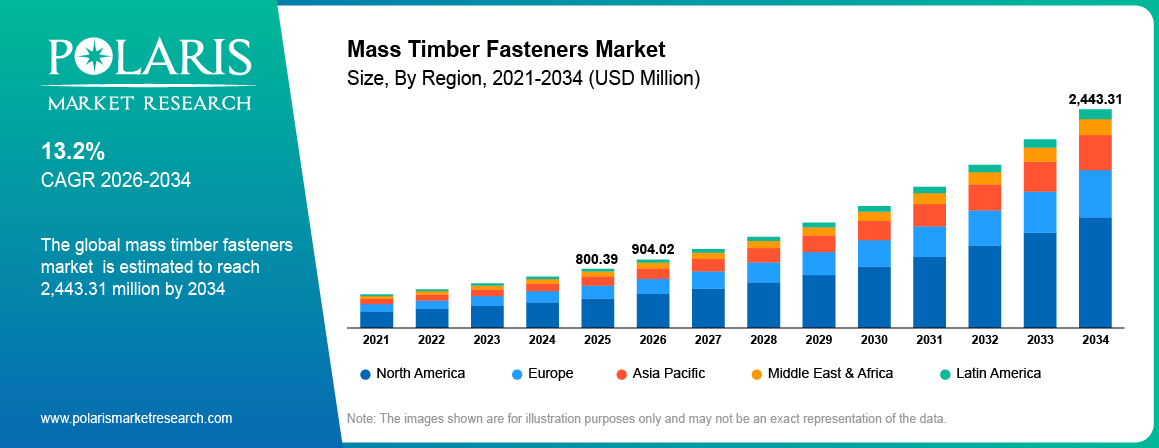
The global mass timber fasteners market is estimated around USD 800.39 million in 2025,?with consistent growth anticipated during 2026–2034. Expansion is driven by increasing adoption of engineered wood construction, rising focus on low-carbon building materials, and growing demand for modular and prefabricated structures. The market is projected to grow at a CAGR of 13.2% during the forecast period.
Market Statistics
Key Takeaways
- Structural screws (Self-Tapping Screws in CLT) captured the highest market share among fasteners used in mass timber, accounting for nearly 41.60% share in 2025.
- The proprietary connector system is projected to grow at the fastest rate, registering a CAGR of around 12.40% during the forecast period.
- The commercial segment holds a prominent position within the market, contributing approximately 38.90% market share in 2025.
- The modular segment is growing at the fastest rate, with a CAGR of nearly 13.10% during the forecast period.
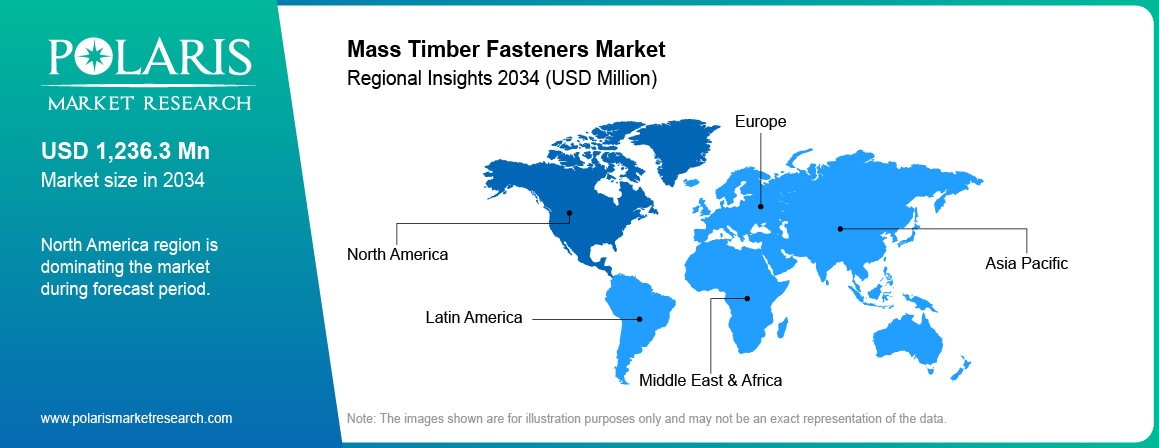
- North America mass timber fasteners led the market in 2025, accounting for nearly 36.70% market share.
Note: Figures and projections outlined in this report are the result of Polaris Market Research’s proprietary analytical processes, grounded in the latest available datasets and market observations.
Industry Dynamics
- Carbon emission reduction targets and the ESG trend have led to more mass timber constructions, driving the demand for specialized fasteners.
- Government intervention has increased demand for high-performance wood connection fasteners due to code changes.
- The prohibitive cost of specialty fasteners is acting as a deterrent in penetrating the low-cost construction segment.
- Growth in modular and prefabricated construction is opening new opportunities for standardized and efficient fastening solutions.
What is the Mass Timber Fasteners Market?
Mass timber fasteners comprise a niche sub-segment in the broader construction hardware category, which specializes in connectors employed in engineered wood structures, including cross-laminated timber (CLT), glue-laminated timber (glulam), and laminated veneer lumber (LVL). The fasteners include screws, rods, dowels, plates, and specialty connectors that ensure load transfer and performance in timber structures.
Mass timber fasteners play an essential role in assembling modular houses and timber structures. The CLT fastener market has witnessed significant growth due to the increasing usage of cross-laminated timber in the housing and non-residential building segments. The rise is attributed to stricter building regulations that mandate the use of low-carbon materials and advances in engineered wood construction technology. Rising demand for high-quality, corrosion-resistant fasteners also boosts the market for mass timber fasteners.
Source: Polaris Market Research Analysis
To Understand More About this Research:Download Sample Report
Drivers & Opportunities
Carbon Reduction Goals and ESG Mandates: Increasingly stringent decarbonization goals worldwide are propelling the demand for sustainable building materials like mass timber. Timber construction structures are advantageous since they provide carbon sequestration and reduced material emissions compared to steel and concrete. Thus, the rise in the demand for fasteners for transferring loads in timber structures is increasing. According to the Climate Action Tracker report, there were about 145 countries that had set net-zero carbon emissions goals or plans to do so by October 2025.Such policies are boosting the use of mass timber in mid- and high-rise buildings, thus fueling the fastener market.
Government Support for Sustainable Construction: Timber-related regulations and building codes are updated to accommodate timber building technologies. The target set by the European Union to achieve zero carbon emission status by 2050 has led to decreased emissions through the buildings industry, hence the acceptance of more building projects utilizing mass timber structures. Modifications to IBC have made it possible for wood to be used in tall buildings in urban environments. This phenomenon will lead to increased demand for fasteners to fix timber in tall buildings.
Restraints & Challenges
High Upfront Cost of Specialized Fasteners: The mass timber industry needs highly engineered fasteners that are strong, corrosion-resistant, and capable of meeting fire-performance requirements. Fasteners of such qualities are relatively expensive to manufacture and certify than ordinary fasteners. The cost incurred is relatively high hence limiting mass timber application in price-sensitive markets.
Opportunity
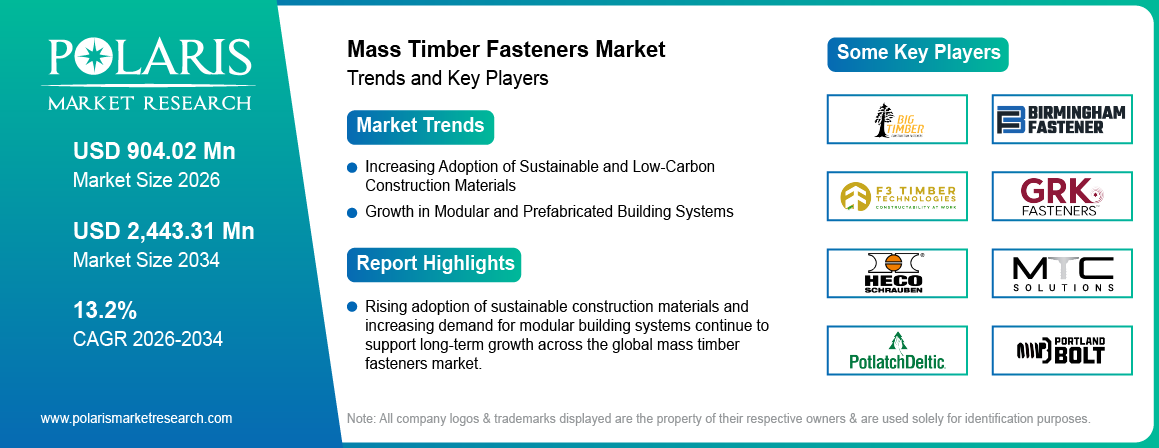
Growth in Modular and Prefabricated Panels: With increased utilization of off-site fabrication techniques, the need for more standardized and efficient fasteners systems has grown. Timber panels and modules, when used in the prefabrication process, would require fasteners that provide for accuracy, stability, and efficiency of installation on site. In August 2025, the Triumph Group introduced a new subsidiary company called PrimeFab, providing services related to prefabrication. The rise in the use of modular building systems would increase the need for fasteners.
Source: Polaris Market Research Analysis
Segmental Insights
In this report, the market for mass timber fasteners has been analyzed in detail based on the product type and application to help readers identify the fastest expanding and most attractive demand segments.
By Product Type
-
Structural screws
Structural screws (Self-Tapping Screws in CLT) captured the highest market share among fasteners used in mass timber due to its flexible load transfer mechanism and easy installation process. Structural screws mass timber systems have found extensive use in cross-laminated timber (CLT) and glulam constructions to make connections for shear and axial loads.
-
Proprietary connector
The proprietary connector system is projected to grow at the fastest rate owing to growing demand for highly-engineered and efficient connector systems. The market for timber connectors is shifting towards concealed fastener timber structures that provide enhanced seismic and fire resistance properties.
Comparison (Fastener Type vs Engineering Performance)
| Fastener Type | Load Transfer Capability | Key Advantage | Best Use Case |
| Structural screws | High (axial + shear) | Fast installation, versatile | CLT panels, beams, general connections |
| Threaded rod systems | Very high (tension systems) | Long-span reinforcement | Timber frames, hybrid structures |
| Bolts & dowel fasteners | Moderate to high | Proven, cost-effective | Traditional timber joints |
| Proprietary connectors | Engineered, optimized load | Seismic/fire performance, hidden | High-rise timber, premium buildings |
Source: Polaris Market Research Analysis
By Application
-
Commercial
The commercial segment holds a prominent position within the market as commercial timber construction fasteners find widespread application in offices and institutions, as well as multi-level structures. Growth will be witnessed owing to the growing use of mass timber in mid-rise and high-rise buildings, which require fasteners capable of bearing heavy weight along with earthquake-resistant and meeting regulatory requirements.
-
Modular construction
The modular segment is growing at the fastest rate owing to the increased trend in prefabricated buildings. The modular timber fastening systems have been created for ease of assembly and disassembly purposes. There is increased demand for these systems as developers are increasingly concerned about cost effectiveness and sustainability.
Source: Polaris Market Research Analysis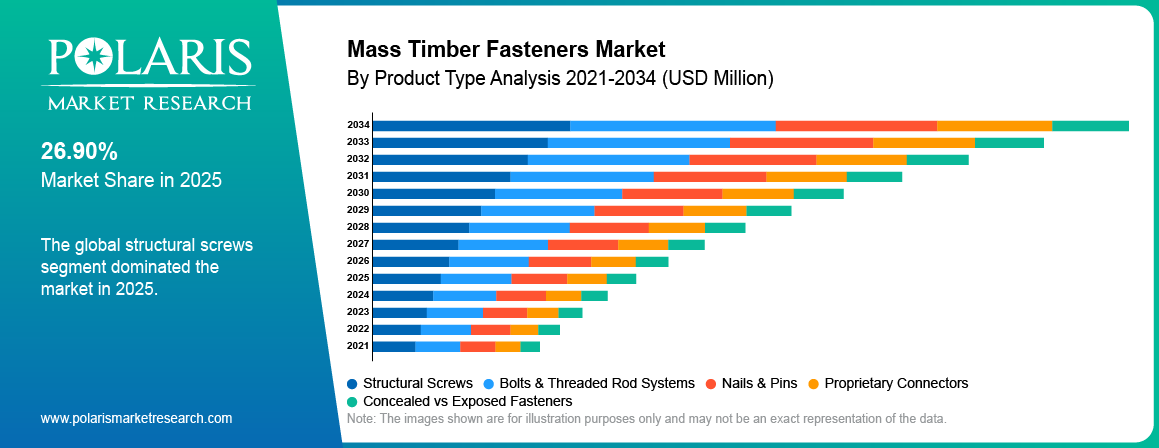
Regional Analysis
North America Mass Timber Fasteners Market Assessment
North America mass timber fasteners led the market in 2025, driven by a strong construction industry and increasing adoption of engineered wood structures in the US and Canada. The US timber fasteners market benefits from a large base of commercial and residential construction projects, along with rising use of cross-laminated timber (CLT). According to the Associated General Contractors of America, there were over 919,000 construction establishments in the US in Q1 2023. Such a large construction network, along with increased focus on sustainable building materials, ensures continued demand for fasteners made for mass timber products.
Europe Mass Timber Fasteners Market Overview
Europe held the second largest market share, owing to stringent environmental laws and a growing emphasis on sustainability in construction. The Regulation on Deforestation-free Products for the European Union has been introduced by the EU to regulate wood and timber value chains, supplanting previous frameworks like EUTR. Current laws such as EUTR and FLEGT will continue to be enforced until the end of December 2029. Such initiatives are driving up the adoption of certified timber and engineered wood, creating demand for timber fasteners.
Asia Pacific Mass Timber Fasteners Market Insight
The Asia Pacific timber construction market is experiencing rapid growth owing to increasing urbanization and infrastructure developments in countries like China and India. Increasing demand for sustainable construction material is driving the use of mass timber buildings. According to the Office of the Economic Adviser, the Index of Eight Core Industries of India increased by 2.3% in February 2026 compared to February in 2025. This is an indication that there is high-level activity in the construction sector and it is indirectly impacting the timber market.
Rest of the World Mass Timber Fasteners Market Assessment
Growth of global timber fasteners in Latin America, the Middle East, and Africa is still an emerging trend but gradually growing owing to the increasing awareness and sustainable advantages. Although the adoption of mass timber constructions is not very common, it is slowly making its way owing to sustainability reasons. Infrastructure developments and gradually favorable policies encourage engineered wood adhesive in selected construction works.
Source: Polaris Market Research Analysis
Competitive Landscape
Key Players & Strategic Developments
Competitive rivalry of the global mass timber fasteners market features a significant level of involvement of structural fastening companies, engineered wood connections providers, and construction hardware providers with a focus on high-load-bearing and code-compliant fasteners. Major players in the global mass timber fasteners industry differentiate themselves by specializing in their products such as self-tapping screws, fully threaded fasteners, and concealed connections for CLT and glulam.
Key players operating in the market include Big Timber Construction Fasteners, Birmingham Fastener and Supply Inc., F3 Timber Technologies, GRK Fasteners (Illinois Tool Works Inc.), Heco-Schrauben GmbH & Co. KG, Mass Timber Connections (MTC) Solutions, PotlatchDeltic Corporation, Portland Bolt Manufacturing Company, ROTHO BLAAS SRL, SFS Group AG, Simpson Strong-Tie Company, Inc., SPAX (ABC Umformtechnik GmbH & Co. KG), Würth Group, MiTek Industries Inc., and FastenMaster.
Standards, Codes & Technical Considerations
Building Codes (IBC 2021 & 2024 Impact)
Building code revisions for fastening mass timber are an important factor driving demand within the mass timber ecosystem. The modification in the International Building Code in 2021 and 2024 makes it possible for taller and more populated mass timber buildings, hence increasing demand for fasteners.
The codes focus on the structural integrity and fire resistance of mass timber buildings, which makes mass timber fasteners under the IBC code an important element within engineered wood products like cross-laminated timber and glued laminated timber.
Fire & Structural Performance Requirements
The fire-resistant timber fasteners are necessary in mass timber building as there are stringent performance requirements related to fires. The fasteners have to be able to withstand the load at high temperatures and meet fire-resistive classifications for different structural assemblies.
With respect to structure, fasteners have to withstand shear, withdrawal, and lateral forces and ensure longevity of the structure. With respect to fasteners for CLT, the requirements are shifting from prescriptive to focusing on connection performance as connections are the weak links in timber buildings.
Certification & Compliance
Compliance with ASTM timber fasteners standards and regional certification frameworks is Conformity to ASTM standards for timber fasteners and regional certification systems is crucial for market access. Testing procedures confirm effectiveness during loading, fire resistance, and climatic exposure, providing reliable performance in building structures.
The certification process is focused on meeting the standards set internationally for construction specifications, particularly in North America and Europe. Certification ensures that safety and appropriateness for architectural and engineering specifications are achieved, thus promoting their application in large timber buildings.
Future Outlook & Opportunities
Market Forecast & Investment Opportunities
The future outlook for mass timber fasteners is expected to see significant growth owing to increased usage of sustainable construction material. Increased funding for mass timber constructions would enable opportunities for fasteners, particularly those designed for high-load applications and specialized connections.
Emerging Technologies
Development of innovative solutions in mass timber fasteners is focusing on smart fasteners for timber, which includes load sensing and monitoring functionalities for structural health evaluations. The research and development of alloys with enhanced resistance and corrosion-resistant coatings are contributing positively to its performance.
Digitalization & Automation
Automated fasteners have gained widespread adoption due to the increasing use of prefabrication and modular construction techniques. The use of advanced technology makes it possible to install fasteners accurately and integrate them with building information modeling (BIM).
The growth of the market will be aided by sustainability considerations, government regulation, and innovations, making mass timber fasteners an essential part of new construction systems.
Key Players
- Big Timber Construction Fasteners
- Birmingham Fastener and Supply Inc.
- F3 Timber Technologies
- GRK Fasteners (Illinois Tool Works Inc.)
- Heco-Schrauben GmbH & Co. KG
- Mass Timber Connections (MTC) Solutions
- PotlatchDeltic Corporation
- Portland Bolt Manufacturing Company
- ROTHO BLAAS SRL
- SFS Group AG
- Simpson Strong-Tie Company, Inc.
- SPAX (ABC Umformtechnik GmbH & Co. KG)
- Würth Group
- MiTek Industries Inc.
- FastenMaster
Industry Developments
- April 2026: Simpson Strong-Tie introduced Timber-SET epoxy adhesive, the first ICC-ES evaluated solution for anchoring threaded rods in glulam mass timber structures. The adhesive provides high bond strength, concealed connections, and reliable load transfer across structural joints. [source: strongtie.com]
Mass Timber Fasteners Market Segmentation
By Product Type Outlook (Revenue, USD Million, 2021-2034)
- Structural Screws
- Bolts & Threaded Rod Systems
- Nails & Pins
- Proprietary Connectors
- Concealed vs Exposed Fasteners
By Application Outlook (Revenue, USD Million, 2021-2034)
- Residential
- Commercial
- Industrial
- Infrastructure
- Modular Construction
By Regional Outlook (Revenue, USD Million, 2021-2034)
- North America
- US
- Canada
- Europe
- Germany
- France
- UK
- Italy
- Spain
- Netherlands
- Russia
- Rest of Europe
- Asia Pacific
- China
- Japan
- India
- Malaysia
- South Korea
- Indonesia
- Australia
- Vietnam
- Rest of Asia Pacific
- Middle East & Africa
- Saudi Arabia
- UAE
- Israel
- South Africa
- Rest of Middle East & Africa
- Latin America
- Mexico
- Brazil
- Argentina
- Rest of Latin America
Mass Timber Fasteners Market Report Scope
| Report Attributes | Details |
| Market Size in 2025 | USD 800.39 Million |
| Market Size in 2026 | USD 904.02 Million |
| Revenue Forecast by 2034 | USD 2,443.31 Million |
| CAGR | 13.2% from 2026 to 2034 |
| Base Year | 2025 |
| Historical Data | 2021–2024 |
| Forecast Period | 2026–2034 |
| Quantitative Units | Revenue in USD Million and CAGR from 2026 to 2034 |
| Report Coverage | Revenue Forecast, Competitive Landscape, Growth Factors, and Industry Trends |
| Segments Covered |
|
| Regional Scope |
|
| Competitive Landscape |
|
| Report Format |
|
| Customization | Report customization as per your requirements with respect to countries, regions, and segmentation. |
Source: Polaris Market Research Analysis
Mass Timber Fasteners Market FAQ's
The global market size was valued at USD 800.39 million in 2025 and is projected to grow to USD 2,443.31 million by 2034.
North America dominated the market due to strong construction activity and increasing adoption of engineered wood structures.
Commercial construction accounts for the largest share, while modular construction is the fastest-growing segment driven by prefabrication trends.
A few of the key players in the market are Big Timber Construction Fasteners, Birmingham Fastener and Supply Inc., F3 Timber Technologies, GRK Fasteners (Illinois Tool Works Inc.), Heco-Schrauben GmbH & Co. KG, and others.
Growth is driven by the use of sustainable construction techniques, greater use of engineered wood, and modular construction methods.
Popular trends include concealed fastener systems, advanced connectors, and compatibility with prefabrication techniques.
Common fastening components include screws, rods, dowels, and connectors, which are specially designed for load transfer.
Structural screw transfers loads through compressive and shear forces making the joint very secure and stable.
Fasteners include individual parts such as screws and bolts, whereas connectors comprise designed structures made up of many parts to form joints.
Download Sample Report of Mass Timber Fasteners Market
Please fill out the form to request a customized copy of the research report.


