
Patient Engagement Solutions Market Share, Size, Trends, Industry Analysis Report, 2026 - 2034
REPORT DETAILS
Patient Engagement Solutions Market Summary
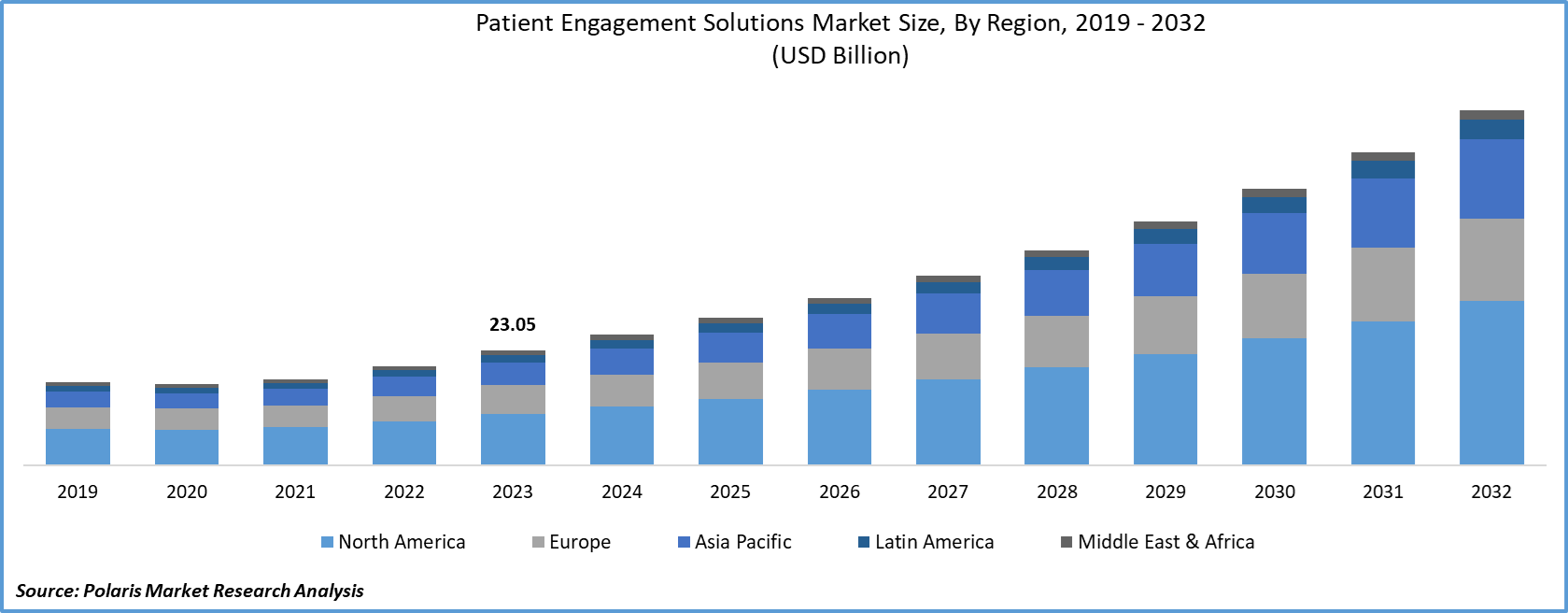
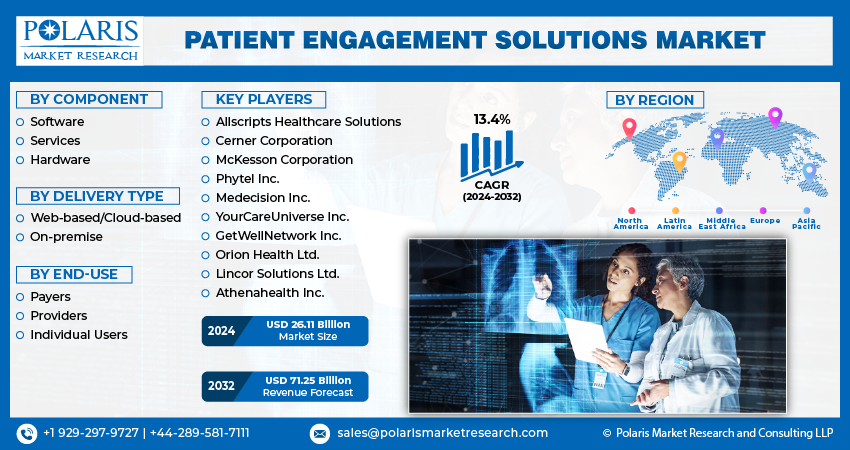
The global patient engagement solutions market size was valued at USD 24.0 billion in 2025, exhibiting the CAGR of 13.4% during the forecast period. Increasing utilization of electronic health records, rising burden of chronic diseases, a surge in usage of smartphones, and adoption of telehealth services, particularly by the old age population are the key factors responsible for market growth. This is illustrated by the survey conducted by National Health Service, in the UK, it is being observed that more than 91.5% of the patients felt assured while using technology-based medical care.
Market Statistics
Key Takeaways
- By component, the software segment dominated the market in 2025, accounting for approximately 62% of the total revenue share. Softwares are the most important part and it enables smother communication, data management, and patient interaction.
- Web-based/cloud-based solutions segment held the largest share in 2025, contributing around 70% of the market. Benefits including flexibility, cost efficiency, and less need for maintenance than traditional on-premise systems drivers this segment growth.
- By end use, the providers segment led the market with an estimated share of 60% in 2025. Hospitals and clinics are the main customers for these tools and they use them to make their services better and their workflows more efficient.
- By application, health management appear as the leading segment, making up about 45% of the market. This includes programs for wellness, ways to manage long-term illnesses, and remote patient monitoring.
- By region, North America accounted for the largest share at 45% of global revenue in 2025. This is because North America has developed healthcare infrastructure, strong investments across the U.S. and Canada, and considerable government funding initiatives.
Industry Dynamics
- The rise in patient care drives the patient engagement solutions, which aims to engage the patient actively in their health and wellness to lower health expenditures.
- Another important driver is the increase in number of chronic diseases, as people suffering from chronic ailments like diabetes or arthritis require constant medical support.
- The growing use of tools, such as mobile applications and simple wearables, targeting the use of digital health technology, is another major driver.
Source: Polaris Market Research Analysis
AI Impact on the Market
- AI implemented in healthcare is offering new solutions, such as automated assistants that can interface with users. Automation allows patients to acquire answers to routine inquiries that assist in their medical appointment scheduling.
- AI improves self-care facilitation and provides customized health plans and reminders for specific goals.
- AI also streamlines operations directly and indirectly by automating repetitive processes such as billing and scheduling or patient record management.
Increasing usage of smartphones had expedited the adoption of digital health services for both consumers and service providers. Moreover, a surge in healthcare apps and the emergence of wearable devices enabled better patient care through proper health management solutions. This has augmented the more dependence of patients on mHealth apps. Hence, the situation of COVID-19 is bound to play a substantial role in healthcare digital transformation.
Moreover, favorable government initiatives in the coming years are likely to foster market growth. In line with this, FDA previously established the “Patient and Caregiver Connection” to promote solutions and services to adopt innovative patient engagements. The program was designed to foster effective engagement with caregivers, patients, and service providers for proper evaluation and surveillance of concerning treatment or surgeries.
Such connection programs are widely accepted in emerging markets. For instance, in March 2019, Columbia Asia Hospital collaborated with MphRx to introduce a patient engagement application to digitally transform medical care and services to invigorate patient engagement.
What are Patient Engagement Solutions?
Patient engagement solutions are digital tools and platforms that help healthcare providers interact with patients more effectively during treatment. The solutions include patient portals, mobile health apps, appointment reminders, telehealth systems, and remote monitoring tools. Patient engagement solutions help improve communication and encourage active participation. They are used to enhance patient satisfaction and outcomes.
How Do Patient Engagement Solutions Work?
Patient engagement solutions work by connecting patients with healthcare providers through secure digital channels. They enable patients to access medical records and schedule appointments. The solutions send reminders to patients regarding appointments. Patients use these solutions to communicate with doctors, track treatment progress, and manage prescriptions. By integrating with electronic health records (EHR) and hospital systems, these platforms provide real-time information and personalized healthcare support.
Benefits of Patient Engagement Solutions in Healthcare
- Enhance communication between healthcare providers and patients through secure digital channels
- Enhance patient satisfaction by providing easy access to medical records, appointments, and care plans
- Improves treatment adherence with medication reminders. Provides follow-up notifications and personalized guidance
- Lowers missed appointments with automated scheduling and reminder systems
- Supports chronic disease management through remote patient monitoring and regular health tracking
- Reduces administrative burden. Streamlines patient communication and workflow processes
- Promotes preventive care and early intervention for better long-term health outcomes
- Strengthens patient loyalty and retention by improving the overall healthcare experience
- Supports value-based healthcare by improving quality of care and patient outcomes
What is the impact of gamification on the patient engagement solutions market?
Gamification is positively influencing the patient engagement solutions industry. Gamified elements such as progress tracking and rewards encourage patients to follow prescribed treatment processes. Interactive features in these platforms enable a better understanding of health conditions and facilitate effective self-care practices. Gamification makes health management more enjoyable. It boosts patient satisfaction and participation. Healthcare providers, pharmaceutical companies, technology developers, and insurers collaborate to foster innovation in these solutions. With the industry expansion, these stakeholders focus on addressing challenges related to engagement and data privacy to realize the potential of gamified patient engagement. The following table comprises key players, the impact of gamification on Patient Engagement Solutions (PES), and use cases.
| Market Player | Impact of Gamification | Key Benefits | Use Cases |
| Healthcare Providers | Integration of points, badges, leaderboards, and other gamified elements into digital health platforms |
| For chronic disease management such as diabetes, cardiovascular diseases, and obesity |
| Technology Developers | Development of gamified healthcare apps and platforms |
| Platforms track patient behavior and tailor engagement strategies |
| Pharmaceutical Companies | Gamification for patient awareness and clinical trials |
| Progress tracking and rewards encourage effective medication use and engagement in clinical studies |
| Payers/Insurers | Gamified programs and challenges for policyholders |
| Incentivizes healthy behaviors through challenges, rewards, and community leaderboards |
Source: Polaris Market Research Analysis
The introduction of gamification facilitates better clinical outcomes and enhances user engagement. This prompts patients to adopt engagement solutions. Hence, integrating gamification into these solutions is expected to offer lucrative opportunities in the market during the forecast period.
Source: Polaris Market Research Analysis
Patient Engagement Solutions Market Report Scope
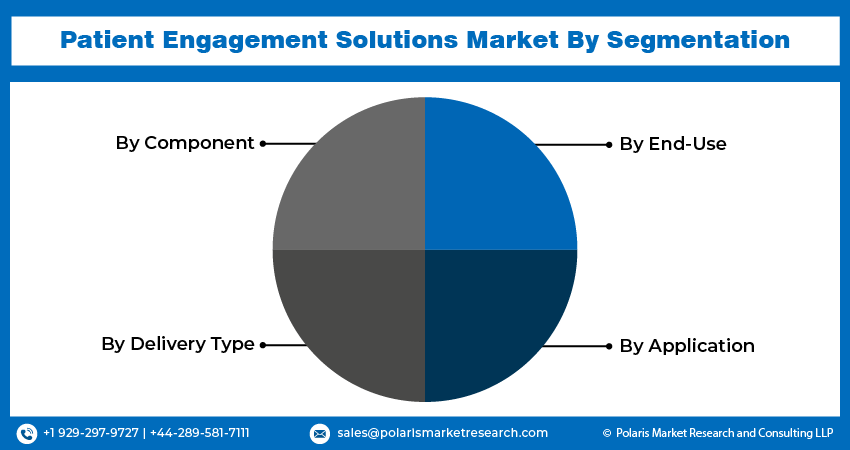
The market is primarily segmented on the basis of product, by function, by application, and geographic region.
| By Component | By Delivery Type | By End-Use | By Application | By Region |
|
|
|
|
|
Source: Polaris Market Research Analysis
Insight by Component
The software patient engagement solutions market segment accounted for the largest market revenue share, in 2025. Softwares are easy to install, use, and drug information can also be available on time and helps in the efficient real-time digital transfer of physician’s prescription. This software is primarily used in home healthcare and remotely monitoring of health in the market. One of the popular suites is the NextGen Office, a cloud-based HER, developed by Kareo. This is web-based billing and medical practice solutions.
The service patient engagement solutions segment is projected to witness the highest market growth over the study period. Service is one of the crucial parts of the effective operation of engagement solutions. It helps in leveraging analytics solutions on-premise or cloud, which enables prediction and interventions in the live training method. This also helps in providing personalized education to the patients which increases its adoption rate.
Patient Engagement Solutions Market: Software vs Services vs Hardware
| Component | Description | Key Uses |
| Software | Digital platforms such as patient portals, mobile health apps, telehealth platforms, CRM systems, and engagement analytics tools | Appointment scheduling, patient communication, remote consultations, health tracking, and data management |
| Services | Professional and support services including implementation, consulting, training, maintenance, and system integration | Platform setup, workflow optimization, staff training, technical support, and compliance management |
| Hardware | Physical devices used to support patient engagement such as tablets, kiosks, wearable devices, and remote monitoring equipment | Self-check-in, remote patient monitoring, vital sign tracking, and in-hospital patient interaction |
Source: Polaris Market Research Analysis
Insight by Delivery Type
In 2025, the web-based patient engagement solutions segment accounted for the largest market revenue share. The adoption of web-based portals is increasing at an alarming rate, owing to its remote access, real-time data tracking, user-friendliness, data back-up, and several others integrated features. In line with this, the companies in the market for patient engagement solutions are investing heavily in cloud-based patient engagement solutions and services.
Source: Polaris Market Research Analysis
For instance, software giant, Microsoft introduced “Microsoft Cloud” catering to healthcare. The platform provides real-time engagement solutions, apart from data analytics and telehealth services. However, the on-premise patient engagement solutions segment is projected to register a lucrative market growth over the study period. It provides patient medical data security, easy accessibility, and easy retrieval. The inclination of on-premise services mostly due to its complete access to information.
Geographic Overview
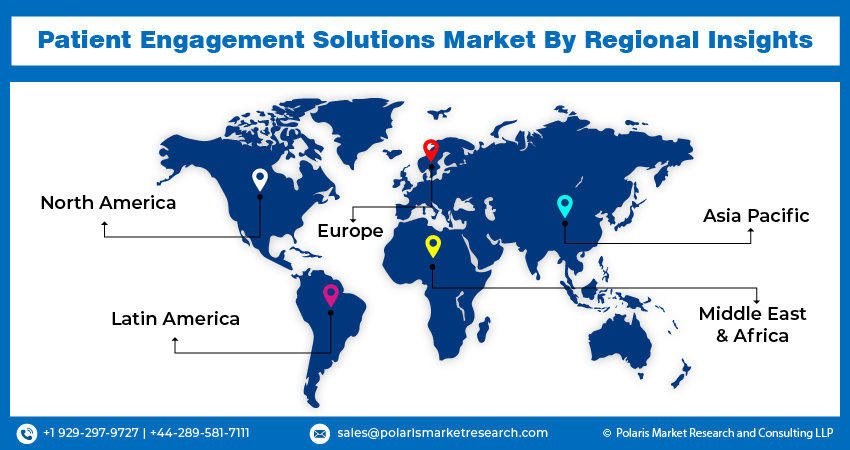
In 2025, the North America patient engagement solutions market accounted for over 35.0% of the global industry. The region’s market dominance is attributed to the rapid adoption of mHealth solutions, significant investments in digital health, and favorable government policies supporting implementation.
Moreover, increasing patient awareness coupled with a rise in intent towards decreasing the cost of healthcare delivery to provide real-time diagnosis and treatment of the disease or any severe condition. Hence, with better implementation of innovative technologies, the region is likely to witness significant market growth for patient engagement solutions.
Asia Pacific patient engagement solutions industry is projected to witness a lucrative market growth over the study period. Advances in medical infrastructure, rising budget allocations to government and municipal hospitals, coupled with a rise in patient’s disposable income are the key factors contributing to the region’s growth. Moreover, economic development and strong government intent, particularly in India and China also supporting the region’s patient engagement solutions market growth.
Source: Polaris Market Research Analysis
Competitive Insight
The prominent players operating in the market for patient engagement solutions are Allscripts Healthcare Solutions, Cerner Corporation, McKesson Corporation, Phytel Inc., Medecision Inc., YourCareUniverse Inc., GetWellNetwork Inc., Orion Health Ltd., Lincor Solutions Ltd., and Athenahealth, Inc.
In today’s hyper-connected world, running a business around the clock is no longer an option. And at Polaris Market Research, we get that. Our sales & analyst team is available 24x5 to assist you. Get all your queries and questions answered about the patient engagement solutions market report with a phone call or email, as and when needed.
List Of Key Companies:
- Allscripts Healthcare Solutions
- Cerner Corporation
- McKesson Corporation
- Phytel Inc.
- Medecision Inc.
- YourCareUniverse Inc.
- GetWellNetwork Inc.
- Orion Health Ltd.
- Lincor Solutions Ltd.
- Athenahealth, Inc.
Recent Development
- April 2026: NiCE Ltd. announced the integration of its CXone platform with Epic Systems to unify patient engagement and clinical data into a single workspace. This would allow healthcare providers to have more personalized, efficient, and AI-driven interactions with patients. (Source: nice.com)
- March 2026: Elsevier entered into a definitive agreement to acquire Mytonomy. Mytonomy offers video-based patient engagement. Its solutions will complement Elsevier’s Clinical Solutions portfolio. (Source: elsevier.com)
- March 2026: Health Union introduced its 2026 DTC product suite, which uses AI and dynamic content to improve patient engagement through personalized education, community-driven experiences, and better patient activation across the pharmaceutical and healthcare ecosystems. (Source:union.com)
-
September 2024: AllazoHealth launched an advanced AI-powered content optimization solution aimed at helping pharmaceutical companies personalize patient communications and improve both medication initiation and adherence. (Source: businesswire.com)
Patient Engagement Solutions Market Report Scope
| Report Attributes | Details |
| Market Size in 2025 | USD 24.0 Billion |
| Market Size in 2026 | USD 27.2 Billion |
| Revenue Forecast by 2034 | USD 74.3 Billion |
| CAGR | 13.4% from 2026 to 2034 |
| Base Year | 2025 |
| Historical Data | 2021–2024 |
| Forecast Period | 2026–2034 |
| Quantitative Units | Revenue in USD Billion and CAGR from 2026 to 2034 |
| Report Coverage | Revenue Forecast, Competitive Landscape, Growth Factors, and Industry Trends |
| Segments Covered |
|
| Regional Scope |
|
| Competitive Landscape |
|
| Report Format |
|
| Customization | Report customization as per your requirements with respect to countries, regions, and segmentation. |
Source: Polaris Market Research Analysis
Patient Engagement Solutions Market FAQ's
The global market was valued at USD 24.0 billion in 2025 and is projected to reach USD 74.3 billion by 2034, growing at a CAGR of 13.4%.
Software dominated the market in 2025 as it's central to modern patient engagement systems, enabling real-time digital prescription transfers, home healthcare, and remote health monitoring.
Web-based/cloud-based systems held the largest share in 2025, offering improved flexibility, scalability, lower implementation costs, easier maintenance, and remote access compared to on-premise solutions.
Healthcare providers (hospitals and clinics) dominated in 2025, as they're primary users of these solutions to enhance patient care, streamline operations, and improve patient outcomes.
Health management held the largest share in 2025, encompassing chronic illness management, wellness programs, and remote monitoring, driven by rising global prevalence of chronic diseases.
North America held over 45% market share in 2025 due to well-established healthcare infrastructure, significant digital health investments, rapid mHealth adoption, and favorable government policies.
Patient medical data privacy is the primary challenge, as handling sensitive health information through digital platforms raises significant concerns around data security, compliance, and unauthorized access.
Download Sample Report of Patient Engagement Solutions Market
Please fill out the form to request a customized copy of the research report.


