
Personal Protective Equipment Market Insights, Size, Share & Industry Report, 2026-2034
REPORT DETAILS
Personal Protective Equipment (PPE) Market Summary
The Personal Protective Equipment (PPE) market was valued at USD 83.83 billion in 2025 and is projected to grow at a CAGR of 6.20% from 2026 to 2034. The personal protective equipment (PPE) market growth is driven by rising awareness of safety and health and the increasing demand for protective gear in high-risk sectors such as healthcare and construction.
Market Statistics
Key Takeaways
- In 2025, the hand protection segment dominated the market with 28.0% share. Increasing awareness of worker safety in mining, construction, and chemical sectors drives the demand for industrial safety gloves.
- The healthcare segment is expected to witness the highest growth rate of 6.15% during the forecast period. The increasing incidence of infectious diseases and rising awareness of self-protection drive the segment growth.
- The respiratory protection segment is expected to grow at a CAGR of 6.27% during 2026–2034. Rising air pollution levels and stricter workplace safety norms are driving demand for respirators.
- North America dominated the personal protective equipment (PPE) market with 32.0% share in 2025. Rising incidents of workplace accidents and increasing government spending on the medical and healthcare sectors contributed to the dominance.
- The Asia Pacific PPE market is expected to register the highest CAGR of 6.95% from 2026 to 2034. It is attributed to increased infrastructure spending and government policies promoting smart and energy-efficient building technologies.
Industry Dynamics
- The rising use of biodegradable and recyclable materials in PPE manufacturing propels the market growth.
- The industry growth is driven by the increasing need for low-cost systems for real-time verification of PPE in industrial facilities using edge computing.
- High production costs hinder the industry expansion.
- The expanding healthcare industry, especially in emerging economies, is expected to create lucrative opportunities for the market during the forecast period.
AI Impact on Personal Protective Equipment (PPE) Market
- Artificial intelligence (AI) tools are used to analyze consumer feedback and environmental data. It helps create PPE according to specific tasks and body types.
- AI-enabled wearables monitor environmental conditions, including temperature and gas levels. Using these observations, these systems issue alerts in hazardous situations.
- The technology streamlines documentation required for regulatory compliance. It minimizes the risk of human errors and improves audit readiness.
- AI predicts equipment maintenance requirements and optimizes resource allocation. This helps enhance manufacturing workflows.
- Various industries such as construction, mining, and healthcare increasingly adopt AI-based PPE.
Source: Polaris Market Research Analysis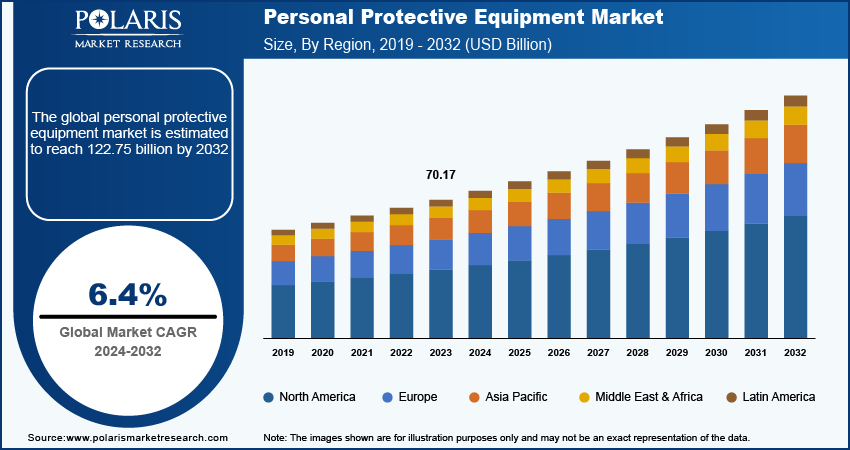
What is Personal Protective Equipment?
Personal protective equipment (PPE) refers to protective gear such as helmets, gloves, masks, goggles, and specialized clothing. These products reduce exposure to workplace hazards. Such equipment protects workers from physical injuries, chemical exposure, and biological risks. PPE is widely used in construction, healthcare, manufacturing, and mining industries.
As industries emphasize employee well-being and adherence to safety regulations, the PPE market is set for sustained expansion, creating avenues for innovation and investments in protective solutions. Furthermore, increasing occupational injuries while working is driving demand for the personal protective equipment (PPE) market. For instance, according to the Employee State Insurance Cooperation Occupational Disease Center (ESICDC) estimates, in 2022, India reports 17 million cases of nonfatal occupational injuries annually, accounting for 17% of the global total, and 45,000 cases of fatal injuries, representing 45% of all work-related deaths worldwide.
The expansion of industrial activities, infrastructure projects, and construction globally is driving demand for various types of PPE to protect workers in hazardous environments. This is significantly contributing to the growth of the personal protective equipment market. Furthermore, innovations in PPE, such as the development of lightweight, durable, and more comfortable materials, are attracting more users and increasing market demand, thereby contributing to market growth.
Market Trends
Rising Use of Biodegradable and Recyclable Materials in PPE Manufacturing
There is an increase in the use of eco-friendly materials to manufacture PPEs. Each year, millions of plastic gloves and other PPE are discarded into landfills, contributing to soil pollution. In response, PPE manufacturers across the globe are working on creating a greener, safer, and cleaner environment. For instance, companies such as Showa and Globus have introduced biodegradable disposable nitrile gloves, promoting the adoption of eco-friendly products. Additionally, in May 2024, Kimberly-Clark introduced “Kimtech Polaris Nitrile Exam Glove,” which has been awarded the Accountability, Consistency, & Transparency (ACT) Environmental Impact Factor Label from the My Green Lab, a nonprofit organization focused on promoting global sustainability in the scientific community. The ACT Label is recognized as the leading ecolabel for laboratory products worldwide.
Rising Need for Low-Cost Systems for Real-Time Verification of PPE in Industrial Facilities Using Edge Computing
Technology plays a crucial role in the personal protective equipment market. Many current safety control systems are expensive and demand significant maintenance. A more affordable solution has been proposed in the form of a computer vision system to monitor safety in industrial settings. This system utilizes object detection and tracking technology on low-cost embedded devices and issue real-time alerts if PPE is not being worn.
In offshore oil and gas operations, viAct's scenario-based AI leverages video analytics to provide precise monitoring of safety conditions, offering instant visibility to safeguard personnel, equipment, and materials. The new comprehensive system designed for safety monitoring in work environments introduces a novel end-to-end model for alarm generation by integrating computer vision systems with deep learning and edge computing devices, primarily focused on detecting PPE and individuals. This innovative approach offers a scalable and secure solution for triggering alarms when workers do not properly use their PPE, greatly improving workplace safety.
Which Technologies are Used in the Personal Protective Equipment (PPE) Market?
The integration of advanced technologies across products is improving protection and user experience. For instance, respirators now have nanofiber filtration and antimicrobial coatings. Protective clothing benefits from high-performance fabrics that enhance comfort and chemical resistance. The convergence of smart systems and sustainability-focused innovations is redefining PPE performance. It also boosts operational efficiency across industries. Market players are adopting advanced technologies to gain a competitive advantage. It also help them expand product portfolio and expand business.
| PPE Product Category | Key Technologies Used | Technology Impact |
| Respirators & Masks (N95, Surgical, and Half/Full Face masks) | Nanofiber filtration, antimicrobial coatings, 3D printing, electrospinning, and self-sterilizing materials | Improved breathability, higher filtration efficiency, pathogen reduction, and custom-fit designs |
| Protective Clothing (Coveralls, Gowns, and Hazmat Suits) | Advanced polymers, chemical-resistant fabrics, breathable membranes, and phase change materials (PCM) | Enhanced chemical and fire resistance, improved user comfort |
| Gloves (Medical, Industrial, Cut-resistant) | Antimicrobial coatings, high-performance fibers (Kevlar, Dyneema), and biodegradable materials | Enhanced cut resistance, pathogen reduction, and eco-friendly disposal |
| Eye & Face Protection (Safety Goggles and Face Shields) | Anti-fog and anti-scratch coatings, 3D printing, UV-resistant materials, and optical-grade polymers | Improved visibility, lightweight design, and high durability |
| Head Protection (Helmets and Hard Hats) | IoT-enabled sensors, impact-resistant composites, and AR integration | Real-time monitoring, digital work instructions, and reduced impact injuries |
| Hearing Protection (Earplugs and Earmuffs) | Active noise-cancellation tech and smart audio filtering | Precise noise monitoring and improved user comfort |
| Foot Protection (Safety Footwear) | Slip-resistant nanocoatings, composite toe materials, and 3D printing | Better traction, enhanced impact resistance, and custom-fit solutions |
| Fall Protection (Harnesses and Lanyards) | High-strength webbing materials and IoT fall-detection sensors | Enhanced safety performance and automated incident alerts |
| Handheld Protection (Shields and Barriers) | Impact-resistant polymers and antimicrobial materials | Higher durability and contamination control |
Source: Polaris Market Research Analysis
Source: Polaris Market Research Analysis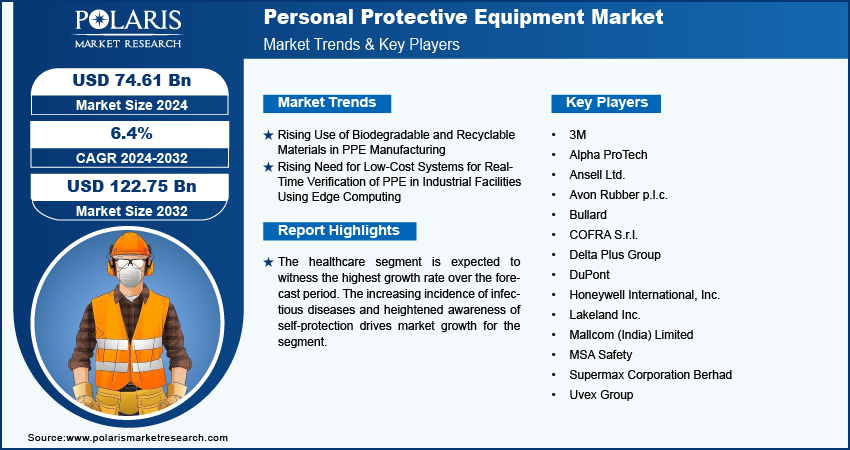
Segment Insights
Product Insights
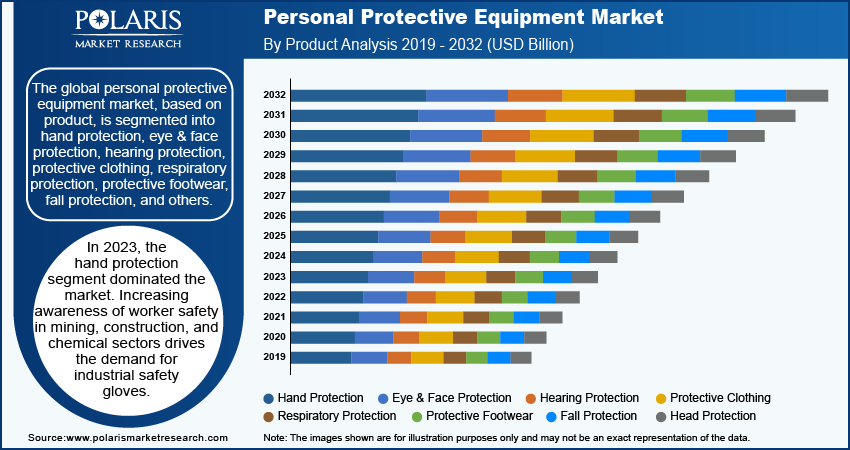
The product segment includes hand protection, eye & face protection, hearing protection, protective clothing, respiratory protection, protective footwear, fall protection, and others.
In 2025, the hand protection segment dominated the market with a revenue share of 28.0%. Increasing awareness of worker safety in mining, construction, and chemical sectors drives the demand for industrial safety gloves. Safety gloves protect workers from chemical burns and metal cuts. Additionally, many safety glove manufacturers are pursuing strategies, including acquisitions, to enhance their product offerings and drive business growth.
Personal Protective Equipment Market – Product Comparison
| Category | Key Products | Protection Type | Key Use Industries | Key Drivers |
| Hand Protection | Safety gloves (cut-resistant, chemical-resistant, disposable) | Protects from cuts, abrasions, burns, chemicals | Construction, mining, chemical, manufacturing | High workplace injury risk, strong demand in industrial sectors |
| Respiratory Protection | Masks, respirators (N95, half/full-face) | Protects from airborne particles, gases, infectious agents | Healthcare, oil & gas, construction, chemical | Rising air pollution, infectious diseases, strict safety norms |
| Protective Clothing | Coveralls, gowns, hazmat suits | Protects from chemicals, heat, biological hazards | Healthcare, oil & gas, manufacturing, firefighting | Need for full-body protection, hazardous work environments |
| Eye Protection | Safety goggles, face shields | Protects from dust, chemicals, radiation, debris | Manufacturing, construction, laboratories | Increasing safety compliance, risk of eye injuries |
Source: Polaris Market Research Analysis
Application Insights
The global personal protective equipment market, by application, is segmented into manufacturing, construction, automotive, oil & gas, healthcare, food, chemical, transportation, and others.
The healthcare segment is expected to witness the highest growth rate of 6.15% over the forecast period. The increasing incidence of infectious diseases and heightened awareness of self-protection drives market growth for the segment. Hospitals are implementing isolation measures for patients and suspected cases to protect others. Health personnel and frontline workers are at the highest risk of exposure. Therefore, the substantial surge in demand for PPE in hospitals is boosting market expansion.
Source: Polaris Market Research Analysis
Regional Insights
By region, the study provides market insights into North America, Europe, Asia Pacific, Latin America, and the Middle East & Africa.
North America dominated the personal protective equipment market with a share of 32.0% in the year 2025. Cases of workplace accidents are increasing across the region. For instance, as per estimates of the Bureau of Labor Statistics (BLS), the US recorded 5,486 cases of fatal workplace injuries in 2022, reflecting a 5.7% increase from the 5,190 cases reported in 2021. On average, a death was recorded every 96 minutes due to a work-related injury that year. Thus, the growing incidence of fatal workplace accidents and heightened awareness among workers and manufacturers about occupational safety fuel the regional market growth. Additionally, increased government spending on the medical and healthcare sectors is expected to maintain the region’s dominance.
Source: Polaris Market Research Analysis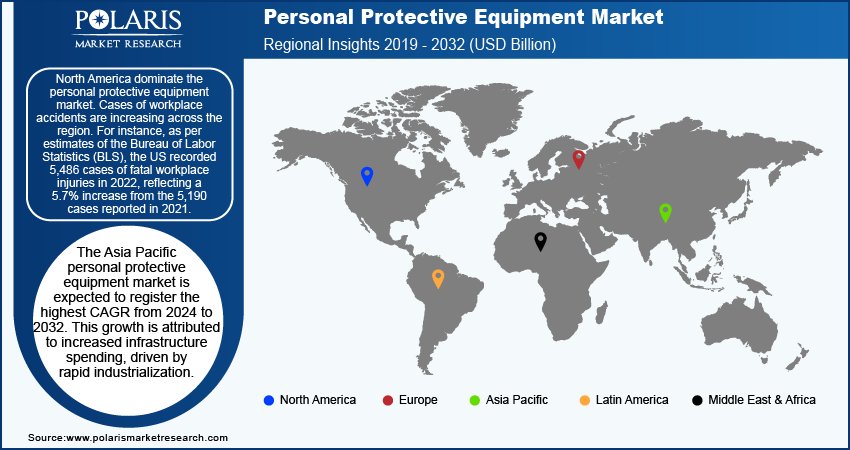
The
In 2021, the Indian Labor Ministry reported to Parliament that over the previous five years, at least 6,500 workers lost their lives while working in factories, mines, and construction sites. To avoid such incidents, the demand for PPE is rising in labor-intensive sectors across Asia Pacific.
The expanding oil & gas industry in the Middle East is projected to boost PPE demand during the forecast period. Significant investments in major Saudi Arabian oilfields, such as Ghawar & Shaybah, are expected to be pivotal for the sector. Additionally, rising domestic demand for natural gas, coupled with the adoption of advanced techniques such as Enhanced Oil Recovery (EOR), is further driving natural gas production in the region.
Key Players and Competitive Insights
The personal protective equipment market is predominantly fragmented, featuring numerous local and regional players. Companies provide customized products such as face protection glasses, night lamp holders, and sensors to enhance worker safety. Many manufacturers are focusing on product and specific technology innovations to establish competitive edge markets.
3M; Alpha ProTech; Ansell Ltd.; Avon Rubber p.l.c.; Bullard; COFRA S.r.l.; Delta Plus Group; DuPont; Honeywell International, Inc.; Lakeland Inc.; Mallcom (India) Limited; MSA Safety; Supermax Corporation Berhad; Uvex Group are among the major players in the PPE market.
Ansell Limited (Ansell) specializes in safety protection solutions, manufacturing & marketing a range of gloves, healthcare safety products, and protective clothing. Its product portfolio includes chemical-resistant, examination, and rubber-insulated gloves. Ansell operates manufacturing facilities in Malaysia, Thailand, Brazil, China, Portugal, Vietnam, and India, with its headquarters located in Richmond, Australia. In February 2024, the company launched the new ultra-textured MICROFLEX Mega Texture 93-256 glove.
MSA Safety Inc. (MSA) specializes in the development, manufacturing, and supply of safety products. Their portfolio includes breathing apparatus, fixed gas and flame detection systems, firefighter helmets, industrial head protection, and fall protection devices. It also provides respirators, eye and face protection equipment, ballistic helmets, and gas masks that enhance their core offerings. MSA operates across the Americas, Europe, the Middle East, Africa, and Asia Pacific, with its headquarters located in Cranberry Township, Pennsylvania, US. In December 2023, the company secured a USD 35 million contract from the US Air Force to supply new respiratory protective equipment for its air base fire brigades.
Key Companies:
- 3M
- Alpha ProTech
- Ansell Ltd.
- Avon Rubber p.l.c.
- Bullard
- COFRA S.r.l.
- Delta Plus Group
- DuPont
- Honeywell International, Inc.
- Lakeland Inc.
- Mallcom (India) Limited
- MSA Safety
- Supermax Corporation Berhad
- Uvex Group
Personal Protective Equipment
- In March 2025, Techtronic Industries launched the MILWAUKEE BOLT Safety Helmet with chip-ready modular mounts, strengthening its cross-platform PPE ecosystem. (Source: milwaukeetool.com)
- In March 2025, airgas launched its new RADNOR women’s PPE line, reinforcing its commitment to safety, comfort, and inclusion. Designed specifically for women, the line features gloves and welding jackets developed in collaboration with leading manufacturers to ensure optimal fit, functionality, and style in industrial work environments. (Source: businesswire.com)
- In February 2025, ASSP released gender-specific fit guidelines, opening targeted PPE opportunities for women, now ~30% of the industrial workforce. (Source: assp.org)
- In January 2025, Kimberly-Clark completed the USD 640m sale of its Kimtech cleanroom business to Ansell, enhancing Ansell’s semiconductor exposure. (Source: ansell.com)
- In April 2024: 3M introduced the 3M Verify app, designed to help companies authenticate their PPE. Leveraging advanced technology, the app scans barcodes on disposable respirator cartons in real time to verify the authenticity of the product packaging. (Source: 3m.com)
Personal Protective Equipment Market Segmentation
By Product Outlook
- Hand Protection
- Disposable by Type
- General Purpose
- Chemical Handling
- Sterile Gloves
- Surgical
- Others
- Disposable by Material
- Natural Rubber
- Nitrile
- Vinyl
- Neoprene
- Polyethylene
- Others
- Durable
- Mechanical Gloves
- Chemical Handling
- Thermal/flame Retardant
- Others
- Disposable by Type
- Eye & Face Protection
- Safety Spectacles
- Safety Goggles
- Welding Shields
- Face Shields
- Headgear
- Hearing Protection
- Ear Plugs
- Cap Mounted Earmuffs
- Hearing Bands
- Protective Clothing
- Chemical Defending Garment
- Flame-Retardant Apparel
- High Visibility Clothing
- Clean Room Clothing
- General Use
- Others
- Respiratory Protection
- Air Purifying Respirators (APR)
- Supplied Air Respirators
- Protective Footwear
- Leather
- Rubber
- Polyvinylchloride (PVC)
- Polyurethane
- Others
- Fall Protection
- Soft Goods
- Hard Goods
- Full Body Harness
- Rescue Kits
- Body Belts
- Head Protection
- Hard Hats
- Bump Caps
- Others
By Application Outlook
- Manufacturing
- Construction
- Automotive
- Oil & Gas
- Healthcare
- Food
- Chemical
- Transportation
- Others
Personal Protective Equipment Regional Outlook
- North America
- US
- Canada
- Europe
- Germany
- France
- UK
- Italy
- Spain
- Netherlands
- Russia
- Rest of Europe
- Asia Pacific
- China
- Japan
- India
- Malaysia
- South Korea
- Indonesia
- Australia
- Vietnam
- Rest of Asia Pacific
- Middle East & Africa
- Saudi Arabia
- UAE
- Israel
- South Africa
- Rest of Middle East & Africa
- Latin America
- Mexico
- Brazil
- Argentina
- Rest of Latin America
Future Outlook
Future of the PPE market is driven by smart PPE integrated with sensors and connected systems. AI-enabled wearables are improving real-time monitoring of worker safety and environmental conditions. Increasing focus on eco-friendly and biodegradable materials is shaping product innovation. Stricter workplace safety regulations across industries are further supporting market growth.
Report Scope
| Report Attributes | Details |
| Market Size Value in 2025 | USD 83.83 billion |
| Market Size Value in 2026 | USD 88.97 billion |
| Revenue Forecast by 2034 | USD 144.10 billion |
| CAGR | 6.20% from 2026 to 2034 |
| Base Year | 2025 |
| Historical Data | 2021–2024 |
| Forecast Period | 2026 to 2034 |
| Quantitative Units | Revenue in USD billion and CAGR from 2026 to 2034 |
| Report Coverage | Revenue Forecast, Market Competitive Landscape, Growth Factors, and Trends |
| Segments Covered |
|
| Regional Scope |
|
| Competitive Landscape |
|
| Report Format |
|
| Customization | Report customization as per your requirements with respect to countries, regions, and segmentation. |
Source: Polaris Market Research Analysis
Personal Protective Equipment Market FAQ's
The global personal protective equipment market size was valued at USD 79.01 billion in 2024 and is projected to grow to USD 154.84 billion by 2034.
The global market is projected to register a CAGR of 6.20% during the forecast period.
North America accounted for the largest market share in 2024 due to the cases of workplace accidents are increasing across the region
3M; Alpha ProTech; Ansell Ltd.; Avon Rubber p.l.c.; Bullard; COFRA S.r.l.; Delta Plus Group; DuPont; Honeywell International, Inc.; Lakeland Inc.; Mallcom (India) Limited; MSA Safety; Supermax Corporation Berhad; Uvex Group are a few key market players.
Personal protective equipment (PPE) includes items like helmets, gloves, masks, goggles, and clothing. These protect workers from workplace hazards.
Cost relies on material quality, level of protection, technology used, durability, and compliance requirements.
Industries such as construction, healthcare, manufacturing, oil & gas, mining, and chemical use PPE widely.
PPE follows standards like OSHA, ANSI, ISO, and EN. These ensure protection and quality.
Replacement depends on usage and exposure conditions. Disposable items are single-use. Durable PPE needs regular inspection.
Download Sample Report of Personal Protective Equipment Market
Please fill out the form to request a customized copy of the research report.


