
Polymer Gel Market Trends, Industry Share & Growth Analysis Report, 2026-2034
REPORT DETAILS
Polymer Gel Market Summary
The polymer gel market size stood at USD 58.81 billion in 2025. The market is projected to account for a CAGR of 5.8% between 2026 and 2034. The growth of the polymer gel industry is mainly driven by the increasing demand for high-performance products in industries such as healthcare, personal care, agriculture, and advanced manufacturing.
Market Statistics
Key Takeaways
- The synthetic segment is expected to experience the fastest growth from 2026 to 2034. This is due to their distinct features such as strength, flexibility, and durability.
- The healthcare segment accounted for a larger market share in 2025. This is because the healthcare industry is a major user of polymer gels.
- North America accounted for a significant share of the global market in 2025 due to the growing incidence of chronic wounds and the increasing aging population in the region.
- The Asia Pacific polymer gel market is expected to witness significant growth from 2026 to 2034, driven by the increasing awareness about wound care and the growing demand for personal care products.
A polymer gel is a three-dimensional network of polymers that can absorb and hold a substantial amount of liquid without dissolving. They provide good swelling ability, stability, and tunability. This makes them useful in many industrial and medical applications. Polymer gels can be made using natural polymers such as alginate, collagen, and gelatin, as well as synthetic polymers such as polyacrylamide, polyvinyl alcohol, and polyacrylates.
Recent advances in the development of hydrogel materials and responsive polymers have increased the scope of polymer gel applications. Polymer gels are also being applied in drug delivery systems, tissue engineering, wound healing, and agricultural water retention. These advancements are likely to fuel the growth of the polymer gel market in the future.
Industry Dynamics
- Polymers gels are increasingly being used across various sectors. These diverse applications are contributing to the market growth.
- The growing usage of polymer gels in delivering growth factors are contributing to the market expansion.
- Increased emphasis on sustainable agriculture is expected to create several market opportunities.
- Stringent environmental regulations regarding disposal may hinder market development.
The increased demand for polymer gels in personal care and hygiene products also adds momentum to the polymer gel market. Polymer gels are used in contact lenses, diapers, and other personal hygiene products, as well as in personal care products. These gels can maintain moisture balance and improve product performance.
In addition, the increasing interest in biodegradable polymer gels and green materials is influencing industry developments. Regulations and consumer interest in green products are prompting polymer gel industry players to develop bio-based and recyclable polymer gels, thereby providing opportunities for the market.
Source: Polaris Market Research Analysis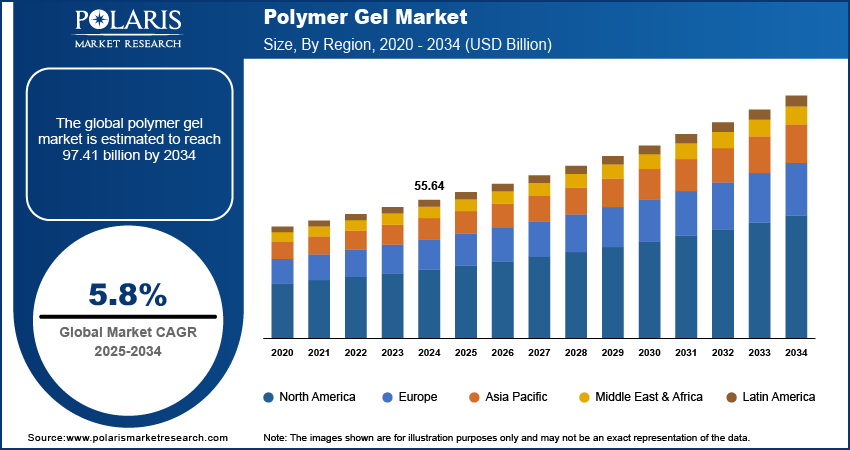
To Understand More About this Research:Download Sample Report
Market Dynamics
Applications Across Diverse Industries
Polymer gels are versatile materials. The various properties of polymer gels include elasticity, moisture retention, and permeability. This makes them useful in different industries. In the medical sector, polymer gels are used in healing wounds, hydrogel drug delivery systems, and tissue engineering scaffolds. The gels assist in keeping the wounds moist and releasing the medication. Outside the medical sector, polymer gels are used in agriculture, water treatment, construction, and cosmetics. In agriculture, the gels are used to maintain moisture levels and improve crop yield. This polymer gel agricultural use is especially seen in dry and arid regions. In cosmetics, the gels improve the texture and hydration of the products.
Rising Usage in Delivering Growth Factors
Growth factors are proteins that have an important role in controlling cell growth and differentiation. These growth factors are necessary in the repair and regeneration of tissues. The controlled release of growth factors has tremendous potential in various fields, including tissue engineering, wound healing, and drug delivery. The release of growth factors is possible by the controlled release of polymer gels. This is necessary so that the growth factors reach the target cells at the correct concentration. This is possible by either incorporating the growth factors into the structure of the polymer gel or by modifying the surface of the polymer gel. The application of polymer gels as growth factor carriers is contributing to the market expansion.
Polymer Gel Manufacturing Process
The process of manufacturing polymer gels generally starts with selecting the appropriate base material, which may include natural and synthetic polymers, water, and other supporting ingredients. The right mixture of these ingredients is made by combining them and creating a solution. This solution then undergoes a process of thickening and gelation, which gives it the right texture and shape. Depending on the end product's requirements, additional ingredients may be added, and the product is then ready for use and application across sectors and industries such as healthcare, personal use, and agriculture.
Emerging Technologies in Polymer Gel Development
Advancements in polymer gel technology have made it more efficient and sustainable. The trends in polymer gel technology include smart gel technology. This technology is sensitive to temperature and humidity. This technology is used in different industries, including health and agriculture. Bio-based gel technology is another trend. Bio-based gels are derived from natural resources and promote sustainable development.
Another area for innovation is enhancing gel strength and durability without compromising flexibility. There is also innovation aimed at enhancing gels' absorption and release capabilities, as these are essential for various medical and personal care treatments. Finally, innovation in production technologies enables firms to manufacture high-quality gels for various purposes.
Source: Polaris Market Research Analysis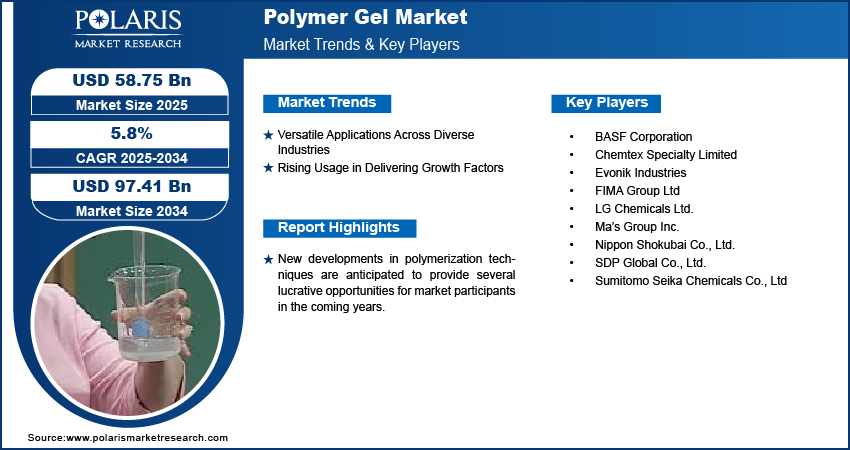
Segment Insights
Market Outlook Based on Material
The polymer gel market, based on material, is segmented into natural, synthetic, and hybrid. The synthetic segment is expected to experience the fastest growth rate from 2026 to 2034. Synthetic polymer gels comprise materials such as composite materials, plastic, and manufactured fibers. These gels are characterized by their distinct features such as strength, flexibility, and durability. They are used in different applications such as construction, automotive, and aerospace. The high demand for synthetic gels is propelling the market segment.
The use of industrial automation technologies, such as control systems, robots, and sensors, has also increased the production of synthetic materials. Automation technologies improve the quality of synthetic materials and reduce production costs. The adoption of automation technologies in the synthetic segment is likely to drive growth in the future.
Natural polymer gels that are derived from biopolymers such as chitosan, gelatin, and alginate are attracting interest due to their biocompatibility and biodegradability, especially in their use in medicine. Hybrid polymer gels are derived from the use of both natural and synthetic polymers. They are important in that they allow manufacturers to achieve better compatibility and strength, which is needed in advanced medical and pharmaceutical applications.
Market Evaluation Based on End-Use Industry
The polymer gel market, based on end-use industry, is segmented into personal care, agriculture, construction, healthcare, and others. The healthcare segment accounted for a larger market share in 2025, as this industry is a major user of polymer gels. Polymer gels are used in wound care products because they create a moist environment that the wound needs to heal. In addition, polymer gels can be used to carry drugs that can be delivered to patients. The increase in demand for polymer gels in wound care products and drug delivery systems contributes to the segment’s larger market share in the global market.
Source: Polaris Market Research Analysis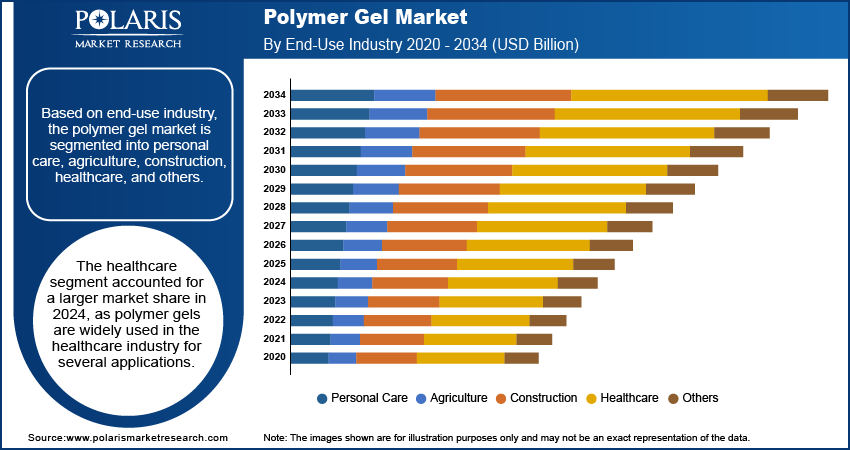
Regional Analysis
By region, the market report offers polymer gel market insights into North America, Europe, Asia Pacific, Latin America, and the Middle East & Africa. North America accounted for a major market share in 2025. The strong market position of the region is due to well-developed healthcare services, high usage of medical technology, and significant investment in research. The rising cases of chronic wounds and diabetic ulcers have created a demand for polymer gel-based wound care. According to the National Institute of Health (NIH), chronic wounds affect over 6 million patients in the United States alone. This number is expected to rise in the near future due to the increasing rates of diabetes and obesity. Polymer gels are also used for the production of wound care products, creating an environment to accelerate the healing process. The aging population is another factor that is affecting the North American region. Polymer gels are often used in anti-aging creams and lotions due to the smooth texture they offer.
The Asia Pacific polymer gel market is expected to witness strong growth from 2026 to 2034, driven by rising awareness of wound care and demand for personal care products. In addition, investment in healthcare and improved standards of living are contributing to the growth of the Asia Pacific polymer gel market. Rapid industrialization, high investment in healthcare, and growing consumption of personal care and hygiene products in countries such as China, India, and South Korea are contributing to the Asia Pacific expansion of the polymer gel market.
Regulatory Landscape for Polymer Gel Materials
The regulations for polymer gels vary depending on their application and usage. In the healthcare and personal care industry, products must comply with stringent regulations on safety and quality before they are put on the market. This involves ensuring the safety of the materials for use on the skin or for any specific application. In agriculture and industry, the emphasis is on their environmental implications and safe handling and disposal.
Each country has its own set of rules and regulations, and the company must comply with them to enter those markets. There is a need for testing, documentation, and labeling. Today, due to the emphasis on sustainable development, eco-friendly materials are in greater demand.
Source: Polaris Market Research Analysis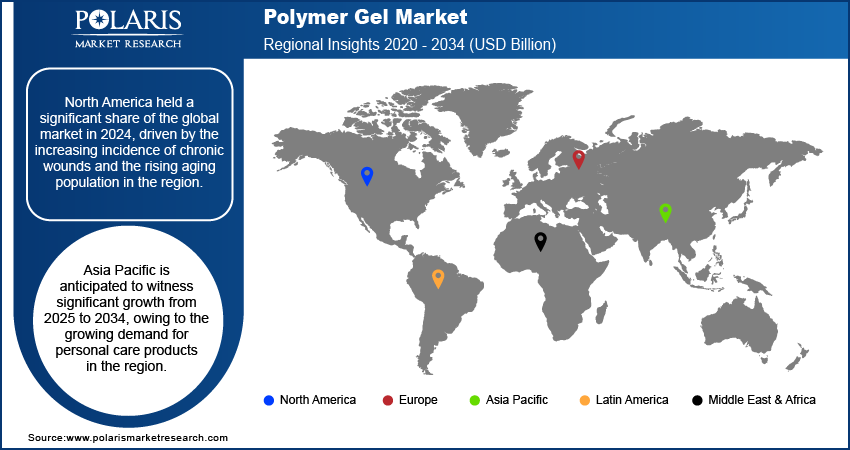
Key Players and Competitive Insights
The research study includes detailed vendor share analysis for all major market players. The market for polymer gels is competitive, with a large number of small- and medium-sized businesses. Top market players are introducing advanced gels to meet customers' increasing needs. In addition, these market players are adopting strategic initiatives, such as collaborations, partnerships, and mergers and acquisitions. These initiatives are aimed at improving their offerings and expanding their regional footprint.
To thrive in the competitive market environment, companies must deliver polymer gels that are both efficient and cost-effective. A few of the key players in the market are LG Chemicals Ltd.; Chemtex Specialty Limited; BASF Corporation; Evonik Industries; FIMA Group Ltd; Nippon Shokubai Co., Ltd.; SDP Global Co., Ltd.; Sumitomo Seika Chemicals Co., Ltd; and Ma’s Group Inc.
List of Key Players
- BASF Corporation
- Chemtex Specialty Limited
- Evonik Industries
- FIMA Group Ltd
- LG Chemicals Ltd.
- Ma’s Group Inc.
- Nippon Shokubai Co., Ltd.
- SDP Global Co., Ltd.
- Sumitomo Seika Chemicals Co., Ltd
Polymer Gel Value Chain Analysis
The value chain for polymer gels begins with raw materials, such as natural and synthetic polymers. It also includes the additives used with them. The raw materials go through processing and development to become gels for specific purposes. The second step is the formulation and customization of gels for use across industries, including health, personal care, agriculture, and industrial applications. Finally, the produced gels are delivered to end users, including hospitals, cosmetic and farming industries, and industrial organizations. All these processes form part of the value chain for polymer gels and are essential for ensuring their quality and prompt delivery to the market.
Polymer Gel Industry Developments
July 2025: Evonik developed a super-absorbent polymer gel for high-end wound care dressings. The super-absorbent polymer gel will help in better moisture and antimicrobial management for effective wound healing.
June 2025: Sumitomo Seika Chemicals expanded its polymer hydrogel production in Southeast Asia. It has increased its polymer hydrogel production in Southeast Asia to meet the growing demand for incontinence and personal hygiene products.
September 2024: Evonik announced the successful sale of its super-absorbents business unit to the International Chemical Investors Group (ICIG). Evonik stated that the sale of its super-absorbents business unit is in line with its strategic intent to focus on high-margin, low-volatility business activities.
June 2024: A group of researchers from various universities, including North Carolina State University, introduced a new class of materials known as "Glassy Gels." This new material comprises over 50% liquid in its composition.
April 2024: A group of researchers from the Indian Institute of Technology (IIT) Mandi developed multifunctional smart microgels using natural polymers. This is a breakthrough in agricultural technology.
March 2024: Linxens collaborated with Clayens to introduce a new medical tracker. The medical tracker is seamlessly integrated into the material.
Polymer Gel Market Segmentation
By Material Outlook (Revenue, USD Billion, 2021–2034)
- Natural
- Synthetic
- Hybrid
By Composition Outlook (Revenue, USD Billion, 2021–2034)
- Polyacrylamide
- Polyacrylate
- Silicone Modified Hydrogels (Si-H)
- Others
By End-Use Industry Outlook (Revenue, USD Billion, 2021–2034)
- Personal Care
- Agriculture
- Construction
- Healthcare
- Others
By Regional Outlook (Revenue, USD Billion, 2021–2034)
- North America
- US
- Canada
- Europe
- Germany
- France
- UK
- Italy
- Spain
- Netherlands
- Russia
- Rest of Europe
- Asia Pacific
- China
- Japan
- India
- Malaysia
- South Korea
- Indonesia
- Australia
- Vietnam
- Rest of Asia Pacific
- Middle East & Africa
- Saudi Arabia
- UAE
- Israel
- South Africa
- Rest of Middle East & Africa
- Latin America
- Mexico
- Brazil
- Argentina
- Rest of Latin America
Polymer Gel Market Report Scope
| Report Attributes | Details |
| Market Size in 2025 | USD 58.81 billion |
| Market Size in 2026 | USD 62.17 billion |
| Revenue Forecast by 2034 | USD 97.42 billion |
| CAGR | 5.8% |
| Base Year | 2025 |
| Historical Data | 2021–2024 |
| Forecast Period | 2026–2034 |
| Quantitative Units | Revenue in USD billion, and CAGR from 2026 to 2034 |
| Report Coverage | Revenue Forecast, Market Competitive Landscape, Growth Factors, and Trends |
| Segments Covered |
|
| Regional Scope |
|
| Competitive Landscape | Polymer Gel Industry Trend Analysis (2025) Company profiles/industry participants profiling include company overview, financial information, product/service benchmarking, and recent developments |
| Report Format | PDF + Excel |
| Customization | Report customization as per your requirements with respect to countries, regions, and segmentation. |
Source: Polaris Market Research Analysis
Polymer Gel Market FAQ's
The polymer gel market stood at USD 58.81 billion in 2025. The market is projected to reach USD 97.42 billion by 2034.
The market for polymer gels is projected to account for a CAGR of 5.8% between 2026 and 2034.
North America led the market in 2025. This is due to the growing incidence of chronic wounds and the increasing aging population in the region.
A few of the key players in the market are LG Chemicals Ltd.; Chemtex Specialty Limited; BASF Corporation; Evonik Industries; FIMA Group Ltd; Nippon Shokubai Co., Ltd.; SDP Global Co., Ltd.; Sumitomo Seika Chemicals Co., Ltd; and Ma’s Group Inc.
The healthcare segment led the market in 2025, as the healthcare industry is a major user of polymer gels.
Download Sample Report of Polymer Gel Market
Please fill out the form to request a customized copy of the research report.


