
Scheduling Apps Market Size, and Global Outlook, 2026-2034
REPORT DETAILS
Scheduling Apps Market Summary
The global scheduling apps market is estimated around USD 673.75 Million in 2025,?with consistent growth anticipated during 2026–2034. Growth is driven by increasing digitalization service coupled with rising adoption of cloud-based SaaS scheduling tools. The market is projected to grow at a CAGR of 13.9% during the forecast period.
Market Statistics
Key Takeawways
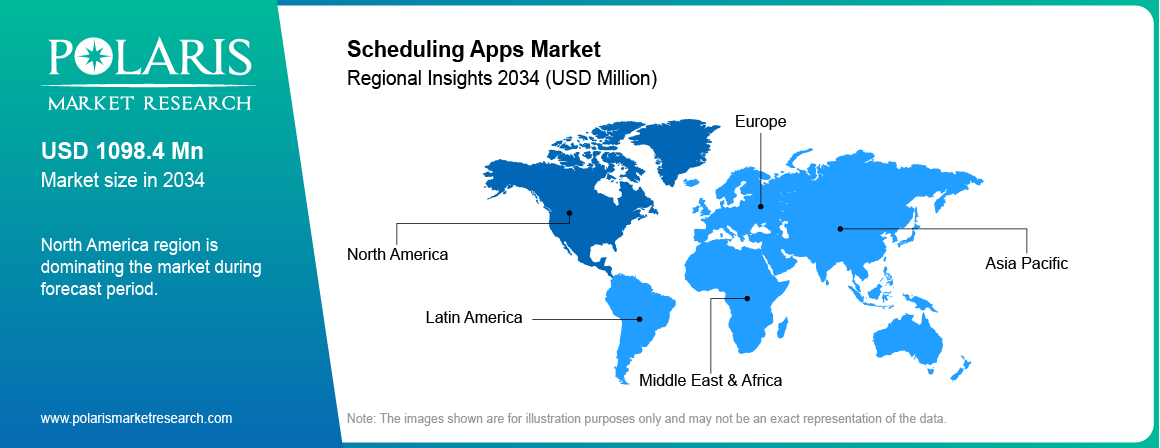
- By Region, North America accounted for the largest market share of around 41% in 2025, driven by strong adoption of cloud-based scheduling solutions across corporate enterprises and healthcare organizations.
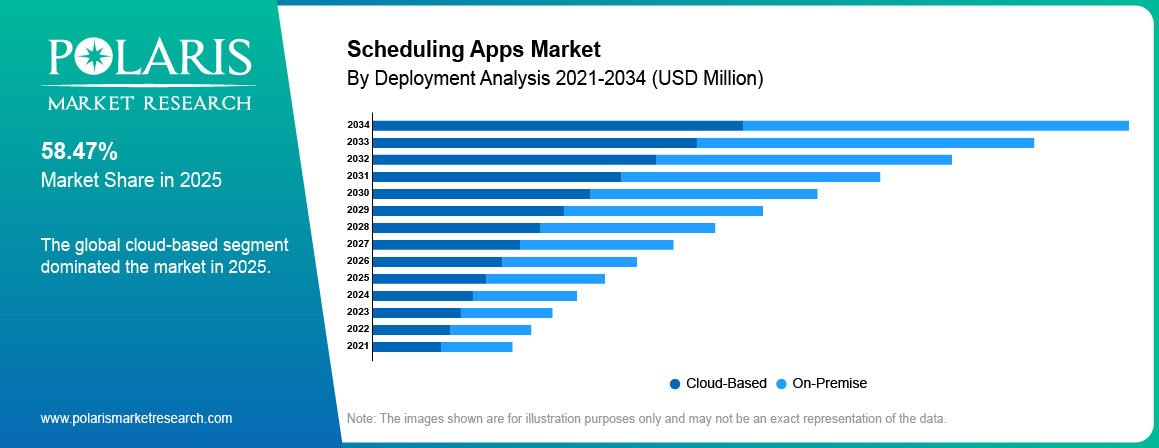
- By Deployment, Cloud-Based segment accounted for the largest market share of around 62% in 2025, driven by increasing adoption of SaaS-based scheduling applications and remote accessibility features.
- By Platform, Web-Based segment accounted for the largest market share of around 57% in 2025, driven by high adoption of centralized scheduling tools with smart calendar integration.
- By Application, Appointment Scheduling segment accounted for the largest market share of around 54% in 2025, driven by widespread use in healthcare, retail, and service industries for managing customer bookings.
- By End User, Corporate segment accounted for the largest market share of around 59% in 2025, driven by increasing implementation of enterprise scheduling tools for meeting coordination and workforce management.
Industry Dynamics
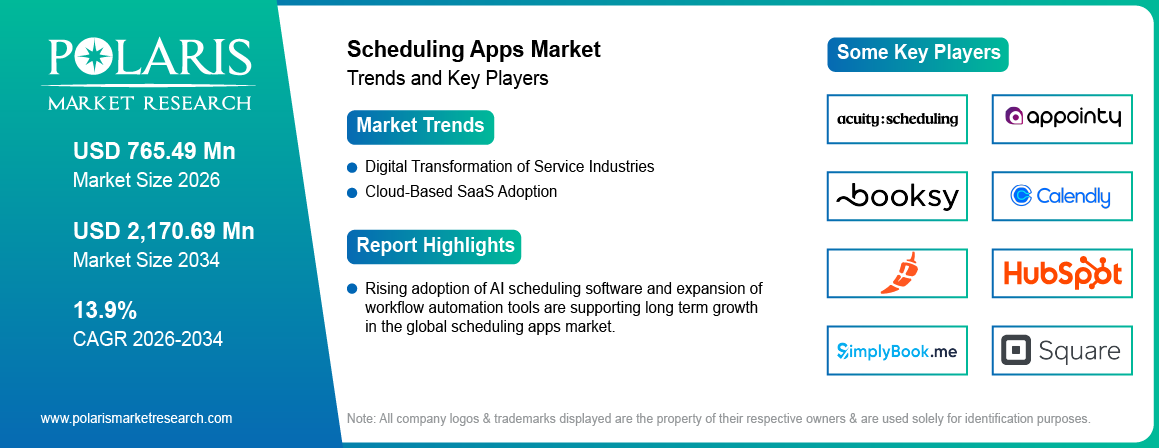
- Digital transformation of service industries is increasing adoption of automated scheduling platforms.
- Rising adoption of SaaS based enterprise tools is expanding the use of cloud scheduling software.
- Data security and privacy concerns create challenges in scheduling software deployment.
- Integration of AI scheduling software and intelligent scheduling technology creates new opportunities in the global scheduling apps market.
What Are Scheduling Apps?
The scheduling apps term is used for digital technology that facilitates the automation of scheduling activities for different organizations or service providers. Scheduling apps assist users in planning different meetings or work shifts by utilizing automated scheduling systems. Scheduling apps usually work by integrating different calendars or communications systems for efficient management of different time-related activities. Organizations utilize cloud scheduling systems for efficient meetings management or workforce scheduling needs.
The scheduling apps market consists of appointment scheduling software, meeting scheduling platforms, workforce scheduling software, and resource scheduling software. Appointment scheduling software primarily deals with scheduling time slots for individuals or resources. Advanced planning and scheduling systems deal with production planning, supply chain management, and operations management. Enterprise scheduling systems deal with daily scheduling activities for organizations. Advanced planning and scheduling systems deal with operational planning and industrial systems management.
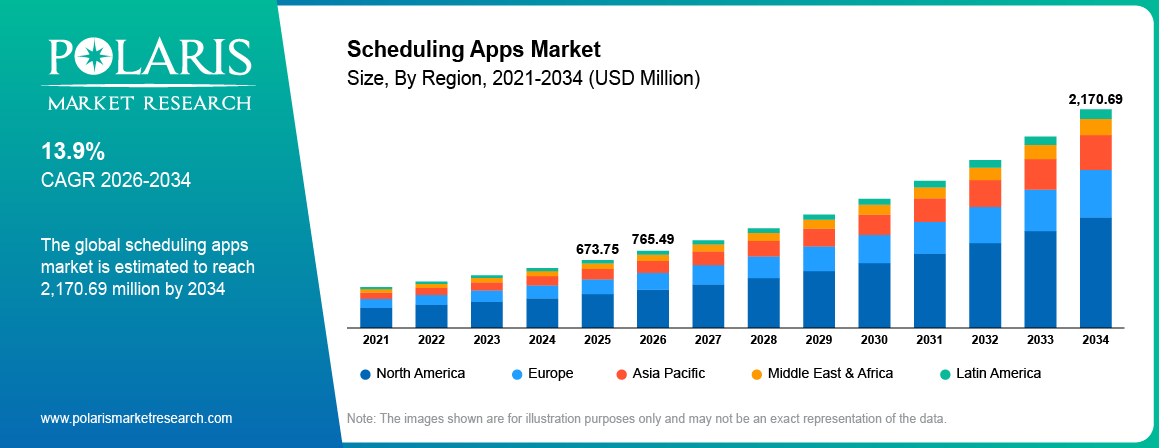
Source: Polaris Market Research Analysis
To Understand More About this RResearch: RequestDownload Sample Report
Scheduling apps differ from advanced planning software used in complex operational planning. Appointment scheduling software focuses on booking time slots and managing availability for people or resources. Advanced Planning and Scheduling (APS) systems support production planning, supply chain coordination, and manufacturing operations. Enterprise scheduling platforms support daily scheduling activities across organizations, while APS systems manage long term operational planning and industrial workflows.
Types of Scheduling Applications
- Appointment Scheduling Software is designed for service providers to handle customer appointments.
- Meeting Scheduling Platforms is required for meeting internal meetings with customers.
- Workforce Scheduling Systems are utilized by enterprises to manage employee shifts, staffing allocation, and labor planning.
- Resource & Facility Scheduling helps to allocate meeting rooms, equipment, and operational facilities.
Difference Between Scheduling Apps and Advanced Planning Software
| Category | Example | Users |
| Scheduling Apps | Appointment scheduling software, meeting scheduling tools | Businesses, service providers, healthcare clinics |
| Workforce Scheduling Software | Employee shift scheduling platforms | Retail, hospitality, logistics companies |
| Resource Scheduling Software | Facility and equipment booking tools | Enterprises, corporate offices |
| Advanced Planning Software (APS) | Manufacturing planning and production scheduling systems | Manufacturing companies, supply chain operators |
Source: Polaris Market Research Analysis
Drivers & Opportunities
Digital Transformation of Service Industries: The digital transformation of consulting services, education, and service businesses is resulting in increased adoption of scheduling apps. For example, in March 2026, Kentroi announced its all-in-one website widget that combines contact forms, AI chatbots, and appointment scheduling. Organizations require automated appointment scheduling to manage customer bookings and internal meetings. Businesses are adopting scheduling platforms to reduce manual coordination and improve operational efficiency. This shift toward digital service management is supporting the growth of the scheduling apps market drivers.
Cloud-Based SaaS Adoption: The increasing trend of adopting cloud scheduling software is resulting in higher adoption of SaaS scheduling tools by various enterprises and small businesses. Cloud deployment allows organizations to manage calendars, bookings, and workforce schedules through centralized platforms. Companies are using SaaS scheduling tools to support remote collaboration and workflow integration. This trend is expanding cloud scheduling software adoption across service industries.
Restraints & Challenges
Data Security and Privacy Concerns: Scheduling software stores data related to customers, employees, and the organization. Security threats and data privacy issues related to scheduling software are becoming barriers to the adoption of scheduling software for some organizations. Many businesses have to comply with data protection regulations for specific regions. Integration challenges for enterprise systems are also becoming barriers to the successful implementation of scheduling software.
Opportunity
Rapid Growing Telehealth Services: The expansion of telehealth services and remote work patterns is generating fresh prospects for scheduling applications. Healthcare organizations are using automated scheduling systems for the management of virtual sessions. In March 2026, Zealthy introduced a telehealth platform that provides virtual sessions for patients by connecting them with licensed professionals for the consumption of GLP-1 weight management therapies like semaglutide and tirzepatide from partner pharmacies. This helps in generating a high demand for scheduling solutions based on the cloud in the healthcare industry.
Technology Trends in the Scheduling Apps Industry
AI and Intelligent Scheduling
The adoption of AI scheduling software is on the rise as it uses scheduling algorithms for predictive scheduling, conflict detection, demand forecasting, and other features such as smart booking links, automated reminders, waitlist, and AI slot optimization.
Integration Ecosystems
Scheduling platforms are expanding through smart calendar integration and scheduling API platforms that connect with CRM systems, HR systems, telehealth platforms, and payment gateways to support automated scheduling and workflow automation tools.
Mobile-First Scheduling Platforms
Growing smartphone adoption is increasing the use of mobile scheduling apps that allow users to manage appointments, bookings, and workforce schedules through cloud connected scheduling platforms.
Source: Polaris Market Research Analysis
Segmental Insights
This report offers detailed coverage of the scheduling apps market by deployment, platform, application, and end user to help readers identify the fastest expanding and most attractive demand segments.
By Deployment
-
Cloud-Based
Cloud-based scheduling apps had the highest market share in 2025, owing to the increasing adoption of service industry and enterprise-level SaaS-based scheduling applications. Cloud-based scheduling solutions allow for the automation of appointment schedules, smart calendar integration, and the ability to access the applications remotely. Cloud-based scheduling applications are used by organizations to manage meetings, work schedules, and service schedules for distributed workforces.
-
On-Premise
On-premise scheduling software segment is expected to grow steadily during the forecast period, owing to the increasing demand from organizations that want more control over their internal systems and data. Large enterprises and government bodies use on-premise scheduling applications for addressing their internal data privacy requirements.
By Platform
-
Web-Based
The web-based scheduling platforms segment held the largest market share in 2025. This is due to the high adoption rate of web-based scheduling tools in organizations and service-based businesses. Web-based scheduling platforms offer smart calendar integration and meeting coordination capabilities via a centralized web platform.
-
Mobile
The segment for mobile scheduling apps is expected to grow at the highest CAGR during the forecast period. The growth in the adoption rate of smartphones and the need for mobile-first scheduling solutions contribute to the growth in the segment. Organizations use mobile scheduling apps for managing meetings and workforce schedules via a cloud-connected platform.
By Application
-
Appointment Scheduling
Appointment scheduling captured the largest market share in 2025. The reason for this is the high adoption rate of automated appointment scheduling in the healthcare, retail, and services sectors. Organizations use appointment scheduling software for managing customer bookings and improving efficiency in serving customers.
-
Workforce Scheduling
The workforce scheduling segment is expected to record the highest CAGR during the forecast period. The reason for this is the growing need for workforce scheduling software in the retail and logistics sectors. Organizations use these software solutions for managing workforce schedules.
By End User
-
Corporate
In 2025, the corporate segment held the largest market share, mainly due to the increasing use of scheduling tools across organizations. These platforms are used to manage meetings and plan employee schedules more efficiently. They also help keep workflows organized and help smoother day-to-day operations.
-
Healthcare
The healthcare segment is expected to grow at the fastest rate during the forecast period, fueled by the growing use of scheduling software in hospitals, clinics, and telehealth settings. These tools are used to handle patient appointments and manage staff availability. They minimize delays and improve service delivery.
Source: Polaris Market Research Analysis
Regional Analysis
North America Market Assessment
North America scheduling apps market dominated in 2025, driven by strong adoption of cloud scheduling software and automated appointment scheduling across healthcare providers and corporate enterprises in the US and Canada. Organizations across these countries are adopting SaaS scheduling tools to manage meetings, workforce schedules, and customer bookings. For instance, in March 2026, Fresha strengthened its appointment booking and scheduling platform presence in North America to accelerate regional expansion and marketplace growth.
Asia Pacific Scheduling Apps Market Insights
Asia Pacific scheduling apps market is projected to grow at the fastest CAGR during the forecast period, owing to rapid digitalization of businesses and increasing adoption of cloud-based software platforms. There are countries like China and India that are increasing the adoption of mobile scheduling applications for industries like healthcare, education, and services. The increasing smartphone market and digital service platform are fueling the need for automated scheduling tools. The Ministry of Electronics and Information Technology (MeitY) reported that India ranks as the world’s second-largest mobile phone manufacturer, with over 330 million units produced annually across more than 300 manufacturing facilities.
Europe Scheduling Apps Market Overview
Europe was the second largest market for scheduling apps, this is attributed to the high adoption rate for enterprise workflow automation solutions in various corporate and government organizations. There is an increasing trend towards the adoption of meeting scheduling solutions and workforce scheduling solutions in countries such as Germany, France, and the UK. The adoption of remote working practices and digital workplace solutions is also contributing to the adoption of enterprise scheduling solutions in the region. According to Indeed, 10% of job postings in France offer remote or hybrid work arrangements, while in the UK and Germany, the figure is 15-16%.
Source: Polaris Market Research Analysis
Key Players & Competitive Analysis Report
The competitive landscape of the scheduling apps market is shaped by continuous development of AI scheduling software and cloud-based enterprise scheduling platforms. Companies are improving their automated scheduling algorithms, smart calendar integration, and workflow automation tools to improve the efficiency of their scheduling process. Partnerships with CRM providers, HR platforms, and telehealth systems are expanding integration capabilities and strengthening platform ecosystems.
Some of the leading companies in the scheduling apps market are Calendly, Acuity Scheduling, Inc., Setmore, Zoho Corporation, SimplyBook.me, Booksy, Square, Chili Piper, Doodle, Appointy, YouCanBookMe, HubSpot, Inc., and many more.
Analyst Perspective
Emerging Market Opportunities
The development in digital transformation in healthcare services, retail services, and professional consulting services is an opportunity for scheduling platforms. Small and medium-sized enterprises are increasingly using cloud-based scheduling software for automating their scheduling processes. The development in SaaS-based enterprise solutions is further strengthening the market trend for scheduling software.
AI-Driven Scheduling Evolution
The future of scheduling applications is likely to be based on intelligent scheduling technology that incorporates AI scheduling software and automated scheduling algorithms. The applications are also likely to incorporate predictive scheduling, automated conflicts, and smart calendar optimization. AI-enabled applications are likely to increase automation of work processes, reducing manual scheduling activities.
Untapped Industry Segments
There are several industries that are yet to be tapped in terms of scheduling software adoption, including education services, telehealth services, field services, and public sector services. These industries need integrated scheduling applications that are used for appointment scheduling, workforce management, and facility scheduling. The need for digital workflow management is likely to increase adoption of scheduling applications in these industries that are yet to be tapped.
Key Players
- Acuity Scheduling, Inc.
- Appointy
- Booksy
- Calendly
- Chili Piper
- Doodle
- HubSpot, Inc.
- Setmore
- SimplyBook.me
- Square
- YouCanBookMe
- Zoho Corporation
Industry Developments
- February 2026: Hardis Supply Chain developed a cloud-based appointment scheduling application for carriers, which allows them to schedule, edit, and manage their dock appointments in real-time via a self-service digital platform.
- April 2025: Zoho launched a new version of its Zoho Bookings scheduling app with a fresh interface and improved appointment scheduling features for businesses.
Scheduling Apps Market Segmentation
By Deployment Outlook (Revenue, USD Million, 2021-2034)
- Cloud-Based
- On-Premise
By Platform Outlook (Revenue, USD Million, 2021-2034)
- Web-Based
- Mobile
- Hybrid Platforms
By Application Outlook (Revenue, USD Million, 2021-2034)
- Appointment Scheduling
- Workforce Scheduling
- Meeting Scheduling
- Resource Scheduling
By End User Outlook (Revenue, USD Million, 2021-2034)
- Healthcare
- Corporate Enterprises
- Education
- Retail and Services
- Government
By Regional Outlook (Revenue, USD Million, 2021-2034)
- North America
- US
- Canada
- Europe
- Germany
- France
- UK
- Italy
- Spain
- Netherlands
- Russia
- Rest of Europe
- Asia Pacific
- China
- Japan
- India
- Malaysia
- South Korea
- Indonesia
- Australia
- Vietnam
- Rest of Asia Pacific
- Middle East & Africa
- Saudi Arabia
- UAE
- Israel
- South Africa
- Rest of Middle East & Africa
- Latin America
- Mexico
- Brazil
- Argentina
- Rest of Latin America
Scheduling Apps Market Report Scope
| Report Attributes | Details |
| Market Size in 2025 | USD 673.75 Million |
| Market Size in 2026 | USD 765.49 Million |
| Revenue Forecast by 2034 | USD 2,170.69 Million |
| CAGR | 13.9% from 2026 to 2034 |
| Base Year | 2025 |
| Historical Data | 2021–2024 |
| Forecast Period | 2026–2034 |
| Quantitative Units | Revenue in USD Million and CAGR from 2026 to 2034 |
| Report Coverage | Revenue Forecast, Competitive Landscape, Growth Factors, and Industry Trends |
| Segments Covered |
|
| Regional Scope |
|
| Competitive Landscape |
|
| Report Format |
|
| Customization | Report customization as per your requirements with respect to countries, regions, and segmentation. |
Source: Polaris Market Research Analysis
Scheduling Apps Market FAQ's
The global market size was valued at USD 673.75 million in 2025 and is projected to grow to USD 2,170.69 million by 2034.
North America dominates due to strong adoption of cloud scheduling software and enterprise workflow automation tools.
Key applications include appointment scheduling, workforce scheduling, meeting scheduling, and resource scheduling.
A few of the key players in the market are Calendly, Acuity Scheduling, Inc., Setmore, Zoho Corporation, SimplyBook.me, Booksy, Square, Chili Piper, Doodle, Appointy, YouCanBookMe, HubSpot, Inc., and others.
Major scheduling apps market drivers include digital transformation of service industries and rising adoption of cloud based SaaS scheduling tools.
Major adoption occurs across healthcare providers, corporate enterprises, educational institutions, retail businesses, and government organizations.
The future of scheduling apps is driven by AI scheduling software, smart calendar integration, and automated scheduling algorithms.
Download Sample Report of Scheduling Apps Market
Please fill out the form to request a customized copy of the research report.


