
Security Paper Market Size, Share Global Analysis Report, 2026-2034
REPORT DETAILS
Security Paper Market Summary
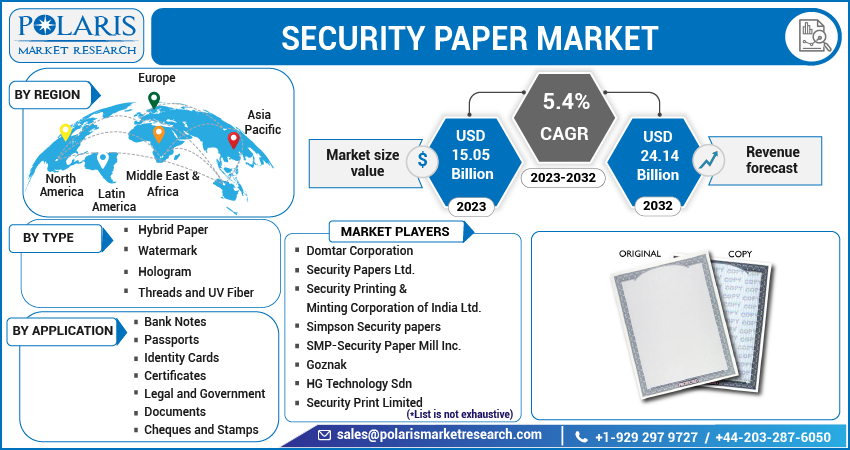
The security paper market size was valued at USD 19.67 billion in 2025, exhibiting a CAGR of 7.1% during 2026–2034. The security paper market is driven by increasing counterfeiting activities, heightened demand for secure documents in banking, government, and education sectors, and advancements in anti-counterfeiting technologies like holograms and watermarks.
Market Statistics
Key Takeaways
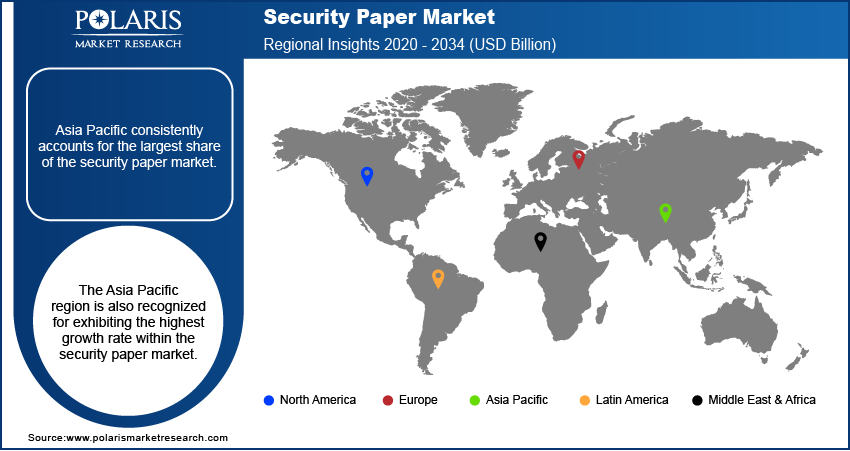
- Asia Pacific dominated the global market with 32.0% revenue share in 2025. The dominance is driven by high volumes of banknote production and circulation.
- China led the Asia Pacific market with 43.0% share in 2025. Furthermore, increasing government initiatives to issue national identification cards, passports, and various other official documents boost the China market expansion.
- The hybrid paper segment held a significant share of 25.0% in 2025. Increasing threat of sophisticated forgery propels the demand for multi-layered, robust security solutions. It is fueling the segment growth.
- The threads & UV fiber segment is projected to register the highest CAGR of 7.40% during the forecast period. The growing demand for basic and effective anti-counterfeiting measures boosts the growth of the segment.
- In 2025, the bank notes segment led the market with 38.0% share. It is attributed to the extensive global circulation of physical currency.
Note: Figures and projections outlined in this report are the result of Polaris Market Research’s proprietary analytical processes, grounded in the latest available datasets and market observations.
Industry Dynamics
- Increasing concerns over counterfeiting and document fraud propel the demand for advanced security paper solutions across governments and financial institutions.
- Rising adoption of secure documents such as certificates, currency, passports, and identity papers supports market growth.
- High production costs associated with specialized fibers, holograms, and authentication technologies hinder the adoption among small organizations.
- Integration of digital authentication features and smart security technologies would create lucrative opportunities for security paper manufacturers.
- Growing use of eco-friendly and recyclable security paper materials will shape sustainable product development trends.
AI Impact on Security Paper Market
- Enhanced Counterfeit Detection: AI-enabled image recognition and machine learning (ML) algorithms enhance the identification of fake documents. They analyze security features, patterns, and printing irregularities.
- Smart Authentication Systems: Integration of AI with mobile scanning and verification platforms facilitates faster real-time authentication of banknotes, passports, certificates, and identity documents.
- Advanced Security Feature Development: Manufacturers use AI-based design tools to create complex security patterns, microtexts, and anti-counterfeiting elements that are difficult to replicate.
- Improved Quality Control: AI-based inspection systems automate defect detection during security paper production. It improves accuracy and reduces manufacturing errors.
What is Security Paper?
Security paper is a specialized paper embedded with advanced anti-counterfeiting and authentication features. The paper is designed to prevent forgery, tampering, and unauthorized duplication. It incorporates various technologies, such as watermarks, holograms, UV fibers, security threads, microprinting, and chemical sensitizers. Security paper is widely used in passports, identity cards, banknotes, legal documents, certificates, and secure government printing applications.
The security paper market pertains to the production and distribution of specialized paper designed with integrated security features. These features are incorporated to prevent counterfeiting, forgery, and unauthorized replication. Security paper and paper bags are employed in the printing of various important documents and instruments that require robust protection against fraud, such as banknotes, passports, certificates, legal documents, and identification cards. The inclusion of security elements helps to verify the authenticity of these documents, safeguarding them from tampering or unauthorized duplication.
A primary driver is the increasing global incidence of counterfeiting activities. The rise in fraud and forgery incidents across various sectors has amplified the demand for secure and tamper-evident document solutions. Furthermore, the growth of the banking and financial sectors, particularly in emerging economies, contributes to the heightened need for security paper in the production of currency, checks, and other financial instruments. The increasing use of security papers has enabled businesses, individuals, and regulatory authorities to limit the abuse of critical documents effectively.
Security Paper vs Regular Paper
Security paper is engineered to protect sensitive documents from counterfeiting and unauthorized duplication. However, regular paper is primarily used for general printing and writing. Security paper incorporates advanced physical and chemical protection features. They make it suitable for currency, certificates, identity documents, and legal records.
| Parameter | Security Paper | Regular Paper |
| Embedded Security Features | Contains features such as watermarks, security threads, fluorescent fibers, holograms, microprinting, and specialized inks. | Typically lacks embedded anti-counterfeiting features and relies only on standard printing. |
| Fraud Prevention Capabilities | Provides strong protection against forgery through multiple authentication layers and tamper-resistant designs. | Offers limited protection and can be easily copied or reproduced. |
| Durability | Manufactured with enhanced fiber composition and treatments for longer lifespan and resistance to wear. | Designed for normal use with lower resistance to aging, damage, and environmental factors. |
| Traceability | Supports tracking through serial numbers, embedded identifiers, and secure document management systems. | Generally does not include tracking or identification mechanisms. |
| Authentication Technologies | Uses advanced verification methods including UV detection, infrared features, optical security elements, and digital scanning. | Authentication is mainly based on printed content and basic visual checks. |
| Applications | Used for banknotes, passports, certificates, stamps, checks, and government documents. | Used for books, packaging, office documents, and everyday printing needs. |
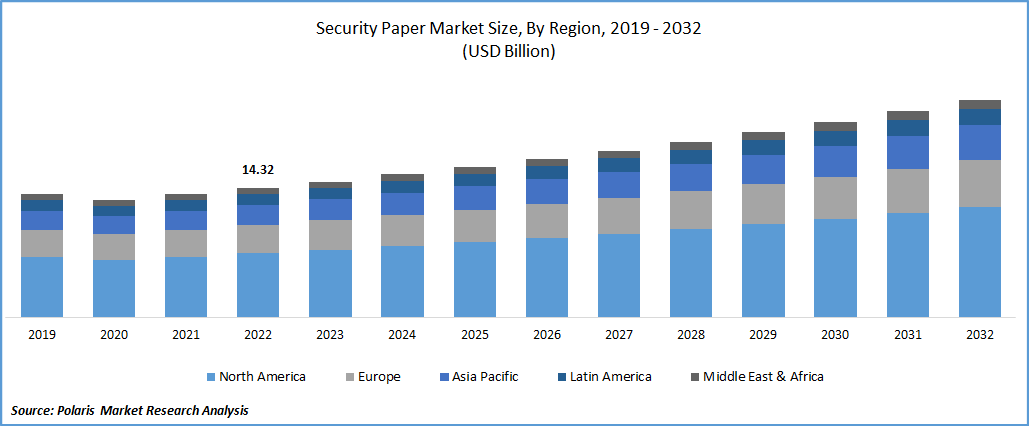
Source: Polaris Market Research Analysis
To Understand More About this Research: Download Sample Report
Industry Dynamics:
Increasing Counterfeiting and Fraud Activities
The persistent global challenge of counterfeiting and fraudulent activities acts as a significant market driver for security paper. As illicit actors become more sophisticated, the demand for highly secure documents with advanced anti-counterfeiting packaging features intensifies. Governments and businesses are compelled to invest in security paper to protect their economic integrity and prevent illicit trade. This escalating threat directly contributes to the increasing demand for security paper.
Growing Demand for Secure Government Documents
The continuous rise in the issuance of secure government documents globally is a core growth factor for the security paper market. Documents such as passports, visas, birth certificates, and national identification cards require specialized paper with embedded security features to ensure their authenticity and prevent identity fraud.
Expansion in Banknote Production
The consistent production and circulation of banknotes worldwide represent a fundamental drive for security paper. Central banks continuously issue new currency and replace worn notes, necessitating a steady supply of highly secure paper embedded with multiple anti-counterfeiting elements like watermarks, security threads, and holographic features.
Source: Polaris Market Research Analysis
Segmental Insights:
Market Assessment By Type
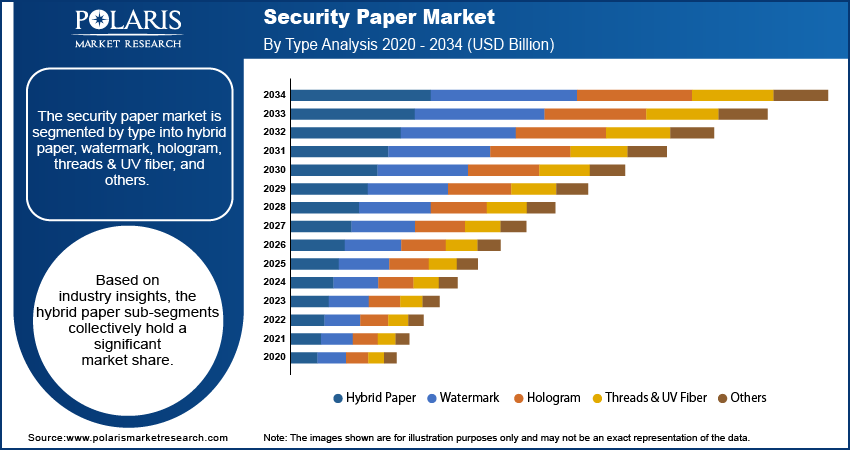
The market is segmented by type into hybrid paper, watermark, hologram, threads & UV fiber, and others. Based on industry insights, the hybrid paper sub-segments collectively hold a significant share of 25.0% in 2025. Hybrid papers integrate multiple security technologies, often combining the tactile feel and printability of traditional paper with the durability and advanced security features typically found in polymer substrates. This convergence allows for the inclusion of highly sophisticated overt and covert security elements, such as advanced holograms, intricate threads, and multi-layered designs, making them extremely challenging to counterfeit. As the threat of sophisticated forgery continues to evolve, the demand for these multi-layered, robust security solutions is rising, significantly driving the development.
The threads & UV fiber sub-segment is demonstrating a notable increase in penetration and growth rate with 7.40% CAGR. These traditional security features have been fundamental to the authenticity of documents for centuries and remain widely adopted across various applications, including banknotes, passports, and legal certificates. Their established efficacy, recognition, and integration into existing printing infrastructures contribute to their pervasive use. The consistent global demand for basic yet effective anti-counterfeiting measures ensures that paper with these embedded features maintains a substantial presence in the market. These classic security elements continue to be a cornerstone driving the demand for security paper.
Market Evaluation By Application
The market is segmented by application into bank notes, passports, identity cards, certificates, legal & government documents, cheques & stamps, and others. The bank notes sub-segment consistently holds the largest share of 38.0% in 2025. This is primarily due to the vast global circulation of physical currency, where every banknote requires specialized security paper to prevent counterfeiting and ensure public trust in monetary systems. The sheer volume of banknotes produced, replaced, and circulated worldwide by central banks and monetary authorities far surpasses other applications. The criticality of currency integrity makes security paper an indispensable component in banknote production, firmly establishing this segment as a dominant force in the dynamics.
The identity cards and passports sub-segments are collectively demonstrating a significant growth rate of 8.20%. This upward trajectory is fueled by increasing international travel, the implementation of stricter identity verification protocols globally, and ongoing initiatives by governments to issue more secure and technologically advanced identification documents. As nations prioritize enhanced security features to combat identity fraud and facilitate more efficient border control, the demand for high-quality security paper for these personal identification documents is steadily rising. This continuous upgrade and expansion of secure identity infrastructure are key growth factors.
Physical Security Paper vs Digital Authentication
Physical security paper and digital authentication technologies are used to prevent fraud and verify document legitimacy. Security paper relies on embedded physical features such as watermarks and security threads. However, digital authentication uses various technologies such as QR codes, blockchain, and online verification systems. The technologies enable secure and traceable document validation.
| Parameter | Physical Security Paper | Digital Authentication |
| Security Approach | Uses physical and chemical security elements embedded within paper to prevent duplication and tampering. | Uses digital systems, encryption, databases, and online verification methods to authenticate information. |
| Fraud Prevention | Protects against counterfeiting through holograms, microprinting, UV fibers, security inks, and unique paper structures. | Prevents fraud through encrypted records, digital signatures, blockchain validation, and secure access controls. |
| Authentication Method | Verified through visual inspection, UV light detection, special scanners, and forensic examination. | Verified using QR codes, mobile applications, biometric checks, blockchain records, and digital platforms. |
| Traceability | Enables tracking through serial numbers, embedded markers, and document identification features. | Provides real-time tracking and record history through digital databases and distributed ledger systems. |
| Durability & Reliability | Remains accessible without internet or electronic devices and provides long-term physical evidence. | Depends on digital infrastructure, cybersecurity systems, and availability of electronic verification tools. |
| Applications | Commonly used for banknotes, passports, certificates, legal documents, and government-issued papers. | Used for e-certificates, digital IDs, online credentials, and electronically verified records. |
| Future Integration | Increasingly combined with digital features such as QR codes and smart authentication layers. | Rising adoption of hybrid models combining blockchain-based verification with physical security documents. |
Source: Polaris Market Research Analysis
Regional Analysis
In 2025, Asia Pacific security paper market consistently accounts for the largest share of 32.0%. This dominance is attributed to several factors, including the vast populations in countries like China and India, leading to high volumes of banknote production and circulation.
Furthermore, significant government initiatives in China to issue national identification cards, passports, and various other official documents contribute substantially to the market size. The China security paper market, in particular, is witnessing strong growth due to the government's emphasis on anti-counterfeiting measures and secure documentation. The region's expanding financial inclusion, coupled with a continued preference for cash-based transactions in many areas, ensures a sustained and robust demand for security paper.
In India, the rising awareness regarding counterfeiting threats, coupled with a proactive approach to implement advanced security solutions in new issuances of identity documents and banknotes, propels this significant growth. The India security paper market is gaining momentum as government and financial institutions increasingly adopt high-security substrates and technologies to safeguard sensitive documents. This robust environment fosters continuous innovation and adoption of security paper technologies, contributing to a strong forecast for the region.
Source: Polaris Market Research Analysis
Key Players and Competitive Insights
In the security paper market, several major players actively contribute to the global supply of secure substrates. Key entities include China Banknote Printing and Minting Corporation – CBPM; Crane Currency – Crane NXT; DREWSEN SPEZIALPAPIERE GmbH & Co. KG; Giesecke+Devrient – G+D / Louisenthal; Goznak; Landqart AG; Portals Paper Ltd.; Real Casa de la Moneda – FNMT-RCM; Security Papers Limited – SPL; Security Printing and Minting Corporation of India Limited – SPMCIL. These organizations specialize in developing and manufacturing advanced paper solutions equipped with various anti-counterfeiting features essential for official documents and financial instruments.
The competitive landscape is characterized by a strong emphasis on innovation, research, and development of new security features. Companies consistently invest in advanced technologies to counter evolving counterfeiting techniques, leading to the introduction of sophisticated watermarks, security threads, holograms, and hybrid substrates. Strategic collaborations with governments and central banks are crucial, as long-term contracts and certifications are vital for penetration and sustained growth. The industry is also shaped by stringent regulatory requirements for document security and the ongoing global demand for authentic and tamper-evident materials, fostering a continuous drive for product enhancement and reliability among participants.
List of Key Companies:
- China Banknote Printing and Minting Corporation – CBPM
- Crane Currency – Crane NXT
- DREWSEN SPEZIALPAPIERE GmbH & Co. KG
- Giesecke+Devrient – G+D / Louisenthal
- Goznak
- Landqart AG
- Portals Paper Ltd.
- Real Casa de la Moneda – FNMT-RCM
- Security Papers Limited – SPL
- Security Printing and Minting Corporation of India Limited – SPMCIL
Industry Developments
June 2025: TOPPAN Security completed the acquisition of dzcard Group, effectively doubling its card manufacturing capacity across Asia and expanding its regional footprint. (Source: holdings.toppan.com)
May 2025: Crane NXT completed the acquisition of De La Rue's Authentication division. This transaction was announced in October 2024 and finalized for £300 million in cash. (Source: investors.cranenxt.com)
Security Paper Market Segmentation
By Type Outlook (Revenue – USD Billion, 2021–2034)
- Hybrid Paper
- Watermark
- Hologram
- Threads & UV Fiber
- Others
By Application Outlook (Revenue – USD Billion, 2021–2034)
- Bank Notes
- Passports
- Identity Cards
- Certificates
- Legal & Government Documents
- Cheques & Stamps
- Others
By Regional Outlook (Revenue-USD Billion, 2021–2034)
- North America
- US
- Canada
- Mexico
- Europe
- Germany
- France
- UK
- Italy
- Spain
- Netherlands
- Russia
- Rest of Europe
- Asia Pacific
- China
- Japan
- India
- Malaysia
- South Korea
- Indonesia
- Australia
- Vietnam
- Rest of Asia Pacific
- Middle East & Africa
- Saudi Arabia
- UAE
- Israel
- South Africa
- Rest of Middle East & Africa
- Latin America
- Brazil
- Argentina
- Rest of Latin America
Security Paper Market Report Scope:
| Report Attributes | Details |
| Market Size Value in 2025 | USD 19.67 billion |
| Market Size Value in 2026 | USD 21.04 billion |
| Revenue Forecast by 2034 | USD 36.41 billion |
| CAGR | 7.1% from 2026 to 2034 |
| Base Year | 2025 |
| Historical Data | 2021–2024 |
| Forecast Period | 2026–2034 |
| Quantitative Units | Revenue in USD billion and CAGR from 2026 to 2034 |
| Report Coverage | Revenue Forecast, Market Competitive Landscape, Growth Factors, and Industry Insights |
| Segments Covered |
|
| Regional Scope |
|
| Competitive Landscape |
|
| Report Format |
|
| Customization | Report customization as per your requirements with respect to countries, regions, and segmentation. |
Source: Polaris Market Research Analysis
How is the report valuable for an organization?
Workflow/Innovation Strategy
The market has been segmented into detailed segments of type and application. Moreover, the study provides the reader with a detailed understanding of the different segments at both the global and regional levels.
Market Entry Strategies
To achieve growth in the market, companies primarily focus on continuous innovation in anti-counterfeiting features, developing more sophisticated watermarks, threads, and holographic elements. Strategic partnerships with governments, central banks, and printing authorities are crucial, as securing long-term contracts for banknotes and official documents is a key marketing strategy. Market players also emphasize the integration of advanced technologies like hybrid substrates and digital transaction management and authentication features, enhancing the robustness and traceability of secure documents.
Security Paper Market FAQ's
The global market size was valued at USD 19.67 billion in 2025 and is projected to grow to USD 36.41 billion by 2034.
The market is projected to register a CAGR of 7.1% during the forecast period, 2026-2034.
Asia Pacific dominated the global market with 32.0% revenue share in 2025.
Key entities include De La Rue plc, Giesecke+Devrient (G+D), Crane Currency (Crane NXT), Louisenthal (G+D), Security Printing and Minting Corporation of India Limited (SPMCIL), Real Casa De La Moneda (FNMT-RCM), Goznak, Drewsen Spezialpapiere GmbH & Co. KG, Fedrigoni Group, Landqart AG (Fortress Paper), and China Banknote Printing and Minting Corporation.
The hybrid paper segment held a significant share of 25.0% in 2025.
Following are some of the market trends: ? Integration of Advanced Security Features: There is a growing focus on incorporating highly sophisticated anti-counterfeiting measures such as multi-layered holograms, advanced watermarks, micro-optics, and specialized security threads and fibers. ? Rise of Hybrid Substrates: The market is seeing an increasing adoption of hybrid papers that combine the properties of traditional paper with the durability and enhanced security of polymer or other advanced materials.
Security paper is a specialized type of paper engineered with embedded features to prevent counterfeiting, forgery, and unauthorized duplication of documents. Unlike regular paper, it incorporates various overt and covert security elements during its manufacturing process. These features can include watermarks, security threads, invisible fibers visible under UV light, chemical sensitizers that react to tampering, holograms, and microprinting. Its primary purpose is to authenticate documents and detect any attempts at alteration, making it essential for items such as banknotes, passports, identity cards, certificates, and other legal or government documents where integrity and trust are paramount.
Download Sample Report of Security Paper Market
Please fill out the form to request a customized copy of the research report.


