
Anti-counterfeit Packaging Market Share, Size, Trends, Industry Analysis Report, 2026 - 2034
REPORT DETAILS
Anti-counterfeit Packaging Market Summary
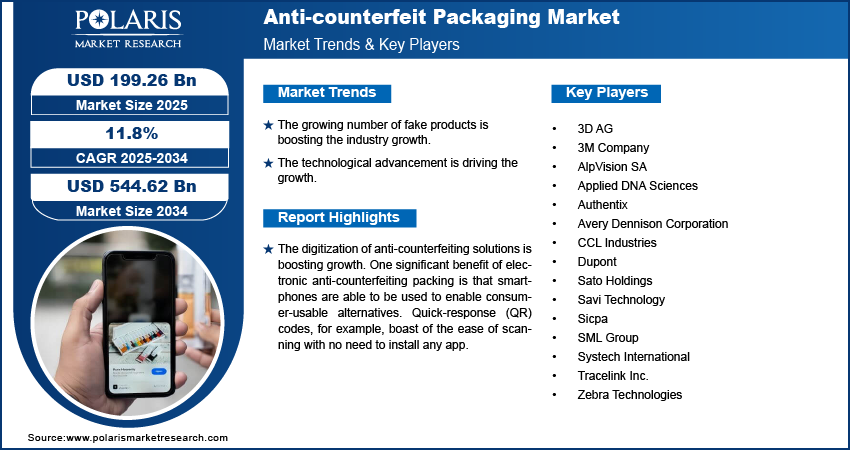
The global anti-counterfeit packaging market size was valued at USD 199.60 billion in 2025 and is expected to register a CAGR of 11.3% during 2026–2034. The digitization of anti-counterfeiting solutions is boosting market growth. Further, rising regulatory pressure across the consumer goods and pharmaceutical industries is contributing to the demand for anti-counterfeit packaging solutions. The rapid adoption of serialization and track-and-trace systems is accelerating the industry growth.
Market Statistics
Key Takeaways
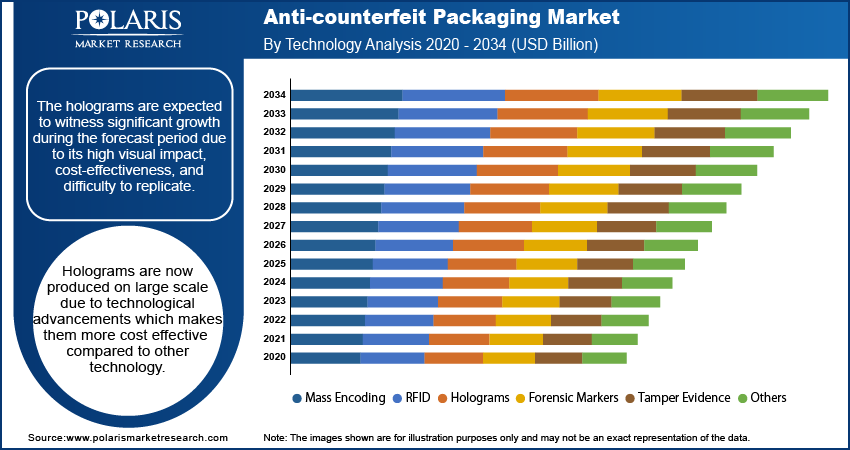
- The holograms segment is expected to witness significant growth during the forecast period due to its high visual impact, cost-effectiveness, and difficulty to replicate.
- The pharmaceutical segment accounted for the largest share in 2025, driven by the rising demand for genuine pharma products.
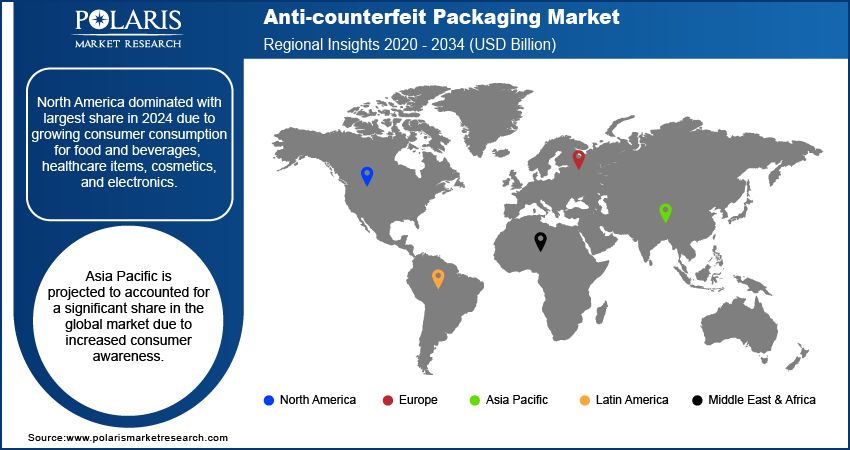
- North America dominated with the largest share in 2025, due to growing consumer consumption for food and beverages, healthcare items, cosmetics, and electronics.
- As per industry outlook 2034, the Asia Pacific market is projected to account for a significant share of the global market due to increased consumer awareness.
Industry Dynamics
- According to our anti counterfeit packaging market analysis, the rising digitalization of anti-counterfeiting solutions is fueling the industry growth.
- The industry growth is driven by the growing number of fake products.
- The technological advancements is contributing to the demand for anti-counterfeiting packaging solutions.
- High implementation costs and complexity of integrating advanced anti-counterfeit technologies restrain widespread adoption.
What is Anti-Counterfeiting Packaging?
Anti-counterfeiting packaging solutions are designed to prevent, detect, and deter counterfeit products. The solutions are used across various industries such as pharmaceuticals, electronics, cosmetics, food & beverage, automotive components, and luxury goods. These solutions integrate traceability technologies, security features, and tamper-evident elements. It helps ensure product authenticity and protect brands and consumers. One significant benefit of electronic anti-counterfeiting packaging is that smartphones can be used to enable consumer-usable alternatives. Quick-response (QR) codes, for example, offer easy scanning with no app required. As the majority of users use smartphones, individuals are familiar with scanning procedures and effectively authenticate particular products. Additionally, digital technology is making a significant impact in marketing and data collection. NeuroTags safe anti-counterfeit QR Codes include a complete integrated loyalty and data gathering solution. It enables the business marketing department to establish a two-way digital connection with top customers and instantly engage them for repeat sales.
Rising global counterfeit incidents, particularly in personal care, luxury goods, FMCG, and cross-border e-commerce, elevate demand for overt and covert security features and digital verification. Overt anti-counterfeiting technologies help consumers and inspectors easily verify authenticity and deter counterfeiters through clear, recognizable security cues. However, covert anti-counterfeiting technologies are hidden elements such as microtext, UV/IR inks, taggants, or forensic markers. They require specialized tools for detection, offering high-security verification without alerting counterfeiters to the presence of the security feature.
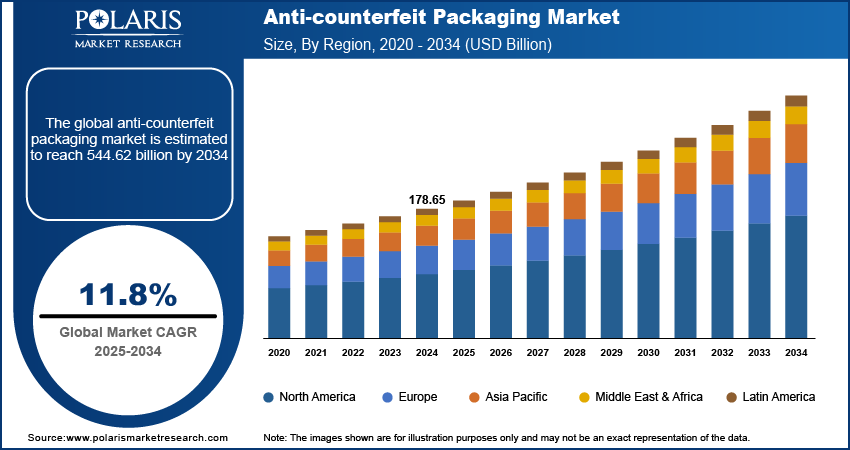
Source: Polaris Market Research Analysis
Comparison Between Overt and Covert Authentication
| Parameter | Overt Technologies | Covert Technologies |
| Visibility | Visible to consumers and inspectors | Hidden; not visible without tools, such as specialized scanners, UV lights, readers, or lab tests |
| Examples | Holograms, tamper-evident seals, color-shifting inks, and security labels | Microtext, taggants, forensic markers, UV/IR inks, and embedded microcodes |
| Primary Purpose | Brand trust, deterrence, and consumer-facing verification | Forensic tracking, high-security verification, and anti-diversion |
| Security Level | Moderate (can be copied by sophisticated attacker) | High (complex to replicate; technology often proprietary) |
| Cost | Generally lower and scalable | Higher due to specialized materials and equipment |
| User Group | End-consumers, retailers, and border and customs staff | Manufacturers, auditors, and investigators |
| Ease of Implementation | Simple integration into packaging lines | Requires controlled processes and secure supply-chain handling |
| Risk of Counterfeiters Identifying the Feature | High (visible) | Low (hidden, unknown to counterfeiters) |
| Use Cases | Consumer goods, apparel, electronics, and FMCG | Pharmaceuticals, high-value components, luxury goods, and government documents |
| Integration with Digital Authentication | Works well with QR/NFC for consumer verification | Often linked to track-and-trace or forensic databases |
Source: Polaris Market Research Analysis
The market growth is driven by expanding track and trace packaging, global demand for secure supply chains, and rapid innovation in the authentication technologies market. Increasing regulatory mandates for serialization in packaging across pharmaceuticals, FMCG, and electronics boost the adoption and enhance product transparency and consumer safety. The rising global counterfeit incidents and regulatory frameworks such as DSCSA and EU FMD boost compliance requirements. Also, serialization in packaging and digital traceability are emerging as core growth drivers.
Industry Dynamics
Growth Drivers
Increasing Counterfeit Risks due to E-Commerce Growth
The rise in online retail platforms across the world propels the counterfeit infiltration across various industries such as electronics, cosmetics, apparel, and FMCG. With the expansion of digital marketplaces, brands face heightened risks. It drives investments in robust e-commerce anti counterfeiting measures, including tamper-evident seals, serialization, and secure digital watermarks. This escalating threat boosts demand for track-and-trace systems, QR code verification packaging, and cloud-linked authentication platforms to protect brand reputation and ensure product integrity. Thus, the rising counterfeit risks due to the rising penetration of e-commerce propel the anti-counterfeiting packaging industry growth.
Pharmaceutical Regulatory Pressure
Pharmaceutical manufacturing and distribution is one of the most heavily regulated segments. Laws such as DSCSA and EU FMD enforce stringent pharmaceutical serialization compliance. These mandates require tamper-evident packaging, unique identifiers, and interoperable track-and-trace infrastructure to detect falsified medicines. As global regulators tighten enforcement, companies are increasingly adopting advanced serialization in packaging. Integrated NFC-enabled secure packaging is used for real-time authentication across the supply chain. Hence, the rising pharmaceutical regulatory pressure is driving the industry growth.
Consumer Adoption of QR/NFC Authentication
Growing consumer awareness of counterfeit risks and widespread smartphone usage fuel the adoption of consumer product authentication tools. Customers increasingly rely on QR code verification packaging and NFC-enabled secure packaging. It assists them in verifying product origin, safety, and brand legitimacy. The increasing shift toward mobile-driven verification enhances transparency, enhances trust, and prompts brands to implement embedded digital identifiers and app-based verification systems. It supports the growth of the anti-counterfeiting packaging market.
Source: Polaris Market Research Analysis
Segmental Insights
By Technology
The holograms are expected to witness significant growth during the forecast period due to its high visual impact, cost-effectiveness, and difficulty to replicate. Holograms are now produced on large scale due to technological advancements which makes them more cost effective compared to other technology. Holograms provide visual verification which enable consumers to identify genuine product more quickly which further fuels the adoption of holograms. Moreover, holograms are difficult to replicate because they required specialized equipment and techniques which further drives the demand. Modern holograms can be combined with QR codes, serial numbers, and blockchain, offering layered security and traceability, thereby diving the segment growth.
By End-Use
The pharmaceuticals segment dominated with largest share in 2024 driven by increased demands for anti-counterfeit packaging and human health and safety, which is increasing recognition of anti-counterfeit packaging and human health and safety. The strict regulations governing counterfeiting operations, the necessity for effective supply chain management, and the availability of cost-effective counterfeiting solutions have prompted packaging firms to invest in anti-counterfeiting technology, which provides cost savings and brand protection, thereby driving the segment growth.
Source: Polaris Market Research Analysis
| End-Use Industry | Use Case |
| Pharmaceuticals | Pharmaceutical anti counterfeit packaging ensures drug authenticity through serialization, tamper-evident seals, and traceability systems. The packaging helps prevent falsified medicines. It also supports regulatory compliance across pharmaceutical supply chains across the world. |
| Food & Beverages | Food and beverage authentication packaging uses tamper-evident features, track-and-trace systems, and QR-based origin verification. It is used to prevent food fraud, protect brand reputation, and ensure consumer trust in product authenticity. |
| Apparel & Footwear | Branded security labels, serialized identifiers, and RFID/NFC tags help authenticate genuine products. It also deters imitation goods and protects supply-chain integrity for fashion and footwear brands. |
| Automotive | RFID tracking, serialized labels, and secure laser markings authenticate genuine automotive components. The authentication packaging combats counterfeit spare parts and ensures safety and performance standards in aftermarket supply chains. |
| Personal Care | Holograms, QR/NFC authentication, and tamper-evident packaging are used to verify genuine cosmetics and skincare products. The packaging prevents counterfeit items and enhances consumer safety and brand protection. |
| Electrical & Electronics | RFID tags, secure barcodes, and tamper-resistant labels verify product authenticity and trace components. Also, electrical and electronics anti counterfeit solutions are used to reduce risks associated with counterfeit electronics entering global manufacturing and retail channels. |
| Luxury Goods | High-security holograms, NFC smart tags, blockchain-enabled IDs, and microtaggants authenticate premium goods and protect brand value. Further, luxury goods authentication technology helps prevent counterfeit infiltration across luxury supply chains. |
| Others | Industries such as tobacco, chemicals, and government documents use tax stamps, forensic markers, and serialization to prevent illicit trade and authenticate products. They also ensure regulatory compliance. Also, the FMCG anti-counterfeit packaging market emphasizes tamper-evident designs, secure labels, and digital authentication technologies. It helps protect high-volume consumer goods from imitation. The packaging enhances brand trust and ensures product integrity. |
Source: Polaris Market Research Analysis
Geographic Overview
Which Region Accounted for the Largest Share of the Anti-Counterfeit Packaging Market in 2025?
North America held the largest revenue share in 2025. Growing consumer consumption for food and beverages, healthcare items, cosmetics, and electronics contributed significantly to the industry growth. Rising consumer demand for transparency is resulting in a huge increase in the traceability of these products. The presence of sophisticated anti-counterfeit rules has supported the market growth. As a result, to meet the expanding demand, manufacturers integrate breakthrough technologies in equipment with particular features for effective production tracking and identification. DSCSA requirements and strengthened CBP enforcement mandate tighter supply-chain traceability, serialization, and proactive authentication measures. It helps prevent counterfeit product entry. Thus, rising emphasis on adhering to these norms boosts the North America anti counterfeit packaging market growth.
Which Regional Market is Expected to Witness the Highest Growth Rate During the Forecast Period?
The Asia Pacific anti-counterfeit packaging market is expected to witness a high CAGR in the global market. Asia Pacific authentication technologies are developing due to the high volume of counterfeit goods and the rapid adoption of advanced technologies. Also, increased consumer awareness has resulted in a greater understanding of the product-related information, raising the demand for counterfeit packaging in the region. China anti-counterfeit regulations focus on strict product serialization, digital traceability, and enforcement measures. They emphasize curbing counterfeit goods across pharmaceuticals, electronics, and consumer sectors. Further, the India secure packaging market is expanding rapidly due to rising counterfeit incidents and government compliance mandates. Also, increased adoption of QR/NFC-enabled authentication and tamper-evident packaging across FMCG, pharma, and consumer goods boosts the India market growth.
Source: Polaris Market Research Analysis
Anti-Counterfeit Packaging Market Key Players and Competitive Analysis
Distinct but overlapping player groups such as large anti counterfeit packaging companies and security label manufacturers shape the competitive landscape for the anti-counterfeit packaging market. These companies dominate physical security features and high-volume deployments. Specialist authentication technology providers supply covert inks, forensic taggants, and optical/digital authentication IP. Track and trace software vendors focus on compliance-led projects in regulated sectors, including pharmaceuticals and food & beverages. Competition is increasingly defined by platform breadth and integration. Industry leaders pursue physical and digital offerings such as labels, RFID/NFC, and cloud verification. However, digital authentication startups compete on speed, consumer engagement and DPP/QR-first solutions. Vendors differentiate through mergers and acquisitions (M&A), partnerships, and AI/blockchain. Track-and-trace firms add AI vision and inspection to serialization stacks. A few major players operating in the global market include 3D AG, 3M Company, AlpVision SA, Applied DNA Sciences, Authentix, Avery Dennison Corporation, CCL Industries, Dupont, Sato Holdings, Savi Technology, Sicpa, SML Group, Systech International, Tracelink Inc., and Zebra Technologies.
List of Key Companies
- 3D AG
- 3M Company
- AlpVision SA
- Applied DNA Sciences
- Authentix
- Avery Dennison Corporation
- CCL Industries
- Dupont
- Sato Holdings
- Savi Technology
- Sicpa
- SML Group
- Systech International
- Tracelink Inc.
- Zebra Technologies
Anti-Counterfeit Packaging Market Developments
In February 2025, Crane NXT finalized its acquisition of OpSec Security, strengthening its capabilities in delivering a fully integrated authentication and brand-protection platform.
In February 2025, 3M joined the US-JOINT semiconductor packaging consortium, aiming to accelerate the development of advanced materials that support next-generation AI computing.
In January 2025, Honeywell provided key technologies for Vioneo’s USD 1.6 billion Antwerp facility, which is designed to produce fossil-free virgin plastics at industrial scale.
What is the Future of Anti Counterfeit Packaging?
The anti counterfeit packaging is expected to witness various future trends such as integration of artificial intelligence (AI), blockchain, and connected smart packaging. Market players are focusing on these trends to gain competitive advantages and expand their product portfolio.
| Future Trend | Description |
| Digital Product Passport Packaging | Digital product passport (DPP) packaging integrates standardized digital product passports. It contains origin, material composition, authenticity data, and lifecycle traceability. EU DPP is driven by sustainability regulations by the EU and global transparency demands. |
| AI in Packaging Security | Artificial intelligence (AI) enhances counterfeit detection through image analytics, anomaly recognition, and automated verification of labels, QR codes, and product patterns. The technology integration enables real-time, high-accuracy authentication. |
| Blockchain Track and Trace | Immutable blockchain networks record product movements across the supply chain. It provides tamper-proof serialization, transparent provenance, and secure verification. It will be adopted across various industries such as pharmaceuticals, luxury goods, electronics, and FMCG. |
| Connected Smart Packaging | NFC, QR, RFID, and IoT-enabled packaging are used to create interactive products. These products, through cloud-linked systems, offer authentication, condition monitoring, consumer engagement, and end-to-end visibility. |
Source: Polaris Market Research Analysis
Analyst Insights
As per our recent study on the anti-counterfeit packaging industry, regulatory milestones, rapid e-commerce penetration, and digitization of supply-chain security will boost the industry growth by 2034. A major inflection point occurs with DSCSA’s full serialization and interoperable traceability enforcement in 2027. It pushes pharmaceutical manufacturers, repackagers, and dispensers in the U.S. to adopt advanced track-and-trace, digital authentication, and tamper-evident solutions. In the EU, Digital Product Passport (DPP) mandates under the Ecodesign for Sustainable Products Regulation. It stimulates investment in interoperable digital identity systems. Brands are shifting toward QR/NFC-enabled consumer authentication, cloud-connected packaging, and blockchain traceability. Thus, the market transitions from traditional security labels to integrated, data-driven security ecosystems.
Market Segmentation
By Technology Outlook (Revenue – USD Billion, 2022–2034)
- Mass Encoding
- RFID
- Holograms
- Forensic Markers
- Tamper Evidence
- Others
By End-Use Outlook (Revenue – USD Billion, 2022–2034)
- Pharmaceuticals
- Food & Beverage
- Apparel & Footwear
- Automotive
- Personal Care
- Electrical & Electronics
- Luxury Goods
- Others
By Regional Outlook (Revenue – USD Billion, 2022–2034)
- North America
- U.S.
- Canada
- Europe
- France
- Germany
- UK
- Italy
- Spain
- Netherlands
- Austria
- Rest of Europe
- Asia Pacific
- China
- India
- Japan
- Malaysia
- South Korea
- Indonesia
- Rest of Asia Pacific
- Latin America
- Mexico
- Brazil
- Argentina
- Rest of Latin America
- Middle East & Africa
- UAE
- Saudi Arabia
- Israel
- South Africa
- Rest of Middle East & Africa
Anti-Counterfeit Packaging Market Report Scope
| Report Attributes | Details |
| Market Size in 2025 | USD 199.60 Billion |
| Market Size in 2026 | USD 221.77 Billion |
| Revenue Forecast by 2034 | USD 522.57 Billion |
| CAGR | 11.3% from 2026 to 2034 |
| Base Year | 2025 |
| Historical Data | 2022–2024 |
| Forecast Period | 2026–2034 |
| Quantitative Units | Revenue in USD billion, 2022–2034 and CAGR from 2026 to 2034 |
| Report Coverage | Revenue Forecast, Market Competitive Landscape, Growth Factors, and Trends |
| Segments Covered |
|
| Regional Scope |
|
| Competitive Landscape |
|
| Report Format |
|
| Customization | Report customization as per your requirements with respect to countries, regions, and segmentation. |
Source: Polaris Market Research Analysis
Anti-counterfeit Packaging Market FAQ's
The anti-counterfeit packaging market is projected to reach by USD 522.57 billion 2034, growing at a CAGR of 11.3% from 2026 to 2034.
The mass encoding segment led the market in 2025, due to mandatory pharmaceutical serialization and regulatory compliance requirements.
The pharmaceuticals segment dominated the revenue share in 2025. Stringent regulations and increasing consumer safety concerns boost the growth of the segment.
Asia Pacific is expected to register the highest CAGR during 2026–2034. It is fueled by China's labeling laws, India's QR-code mandates, and expanding manufacturing capabilities.
A few key technologies are RFID/NFC tags, holographic seals, serialization codes, digital watermarks, forensic markers, and QR codes. These technologies enable product authentication and traceability throughout supply chains.
Technology and End-Use.
Download Sample Report of Anti-counterfeit Packaging Market
Please fill out the form to request a customized copy of the research report.


