
Smart Pills Market Size, Share, Global Analysis Report, 2026-2034
REPORT DETAILS
Smart Pills Market Summary
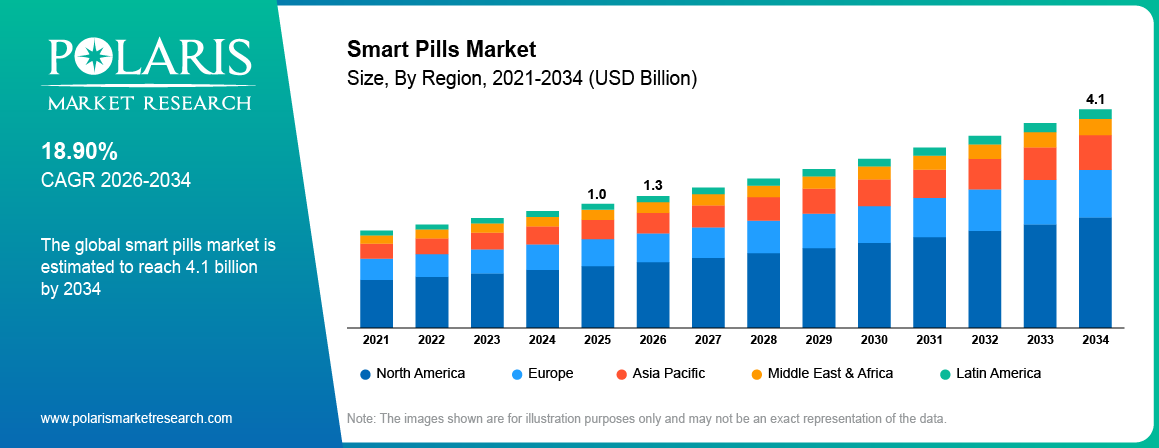
The global Smart Pills Market was valued at USD 1.0 billion in 2025 and is anticipated to grow at a CAGR of 18.90% from 2026 to 2034. Digital health innovations and diagnostics via ingestible sensors are fueling market expansion.
Market Statistics
Smart Pills Market Key Takeaways
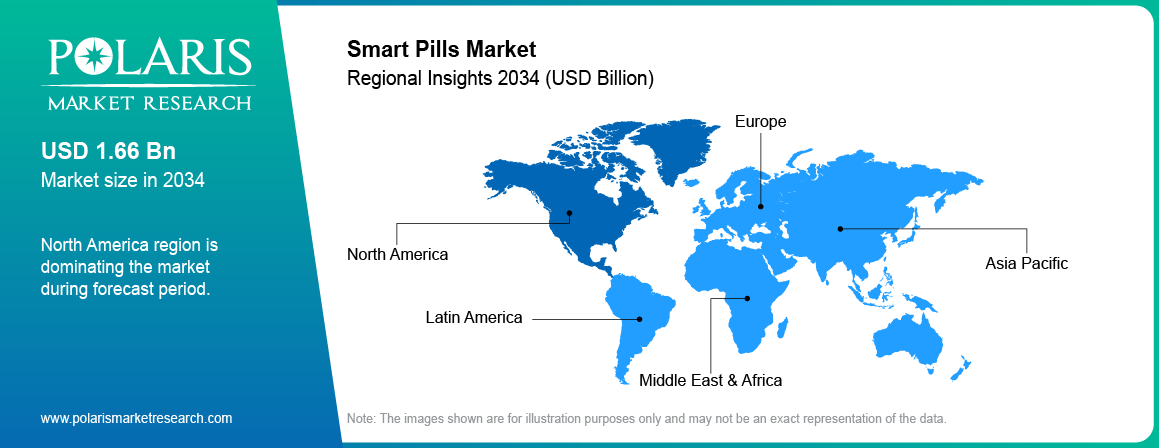
- North America led the global Smart Pills market with 40.7% share in 2025. The dominance is attributed to rapid technological advancements in healthcare, high adoption of minimally invasive diagnostic technologies, and the increasing prevalence of colorectal cancer and gastrointestinal disorders.
- Asia Pacific is projected to register the highest 20.6% CAGR during the forecast period. The regional market growth is fueled by increasing investments in healthcare technologies, expanding healthcare infrastructure, and the surging prevalence of stomach cancer and gastrointestinal diseases.
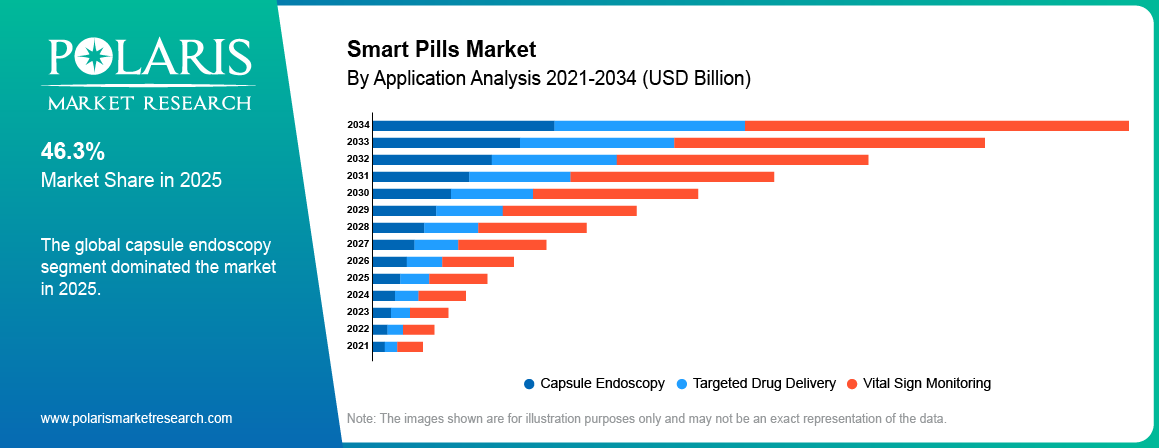
- The capsule endoscopy segment held the largest share of 46.3% in 2025. This leading position is primarily driven by the growing prevalence of gastrointestinal disorders, including colon cancer, Crohn's disease, and ulcerative colitis, along with the increasing preference for non-invasive diagnostic procedures.
- The small intestine segment held the largest market share of 44.1% in 2025. Increasing prevalence of small intestine disorders, including Crohn's disease and celiac disease, bolsters the segment’s growth.
- The hospitals segment is expected to record the highest 19.8% CAGR during the forecast period. The availability of advanced diagnostic technologies, specialized healthcare professionals, and comprehensive treatment facilities will drive the segment’s growth.
Note: Figures and projections outlined in this report are the result of Polaris Market Research’s proprietary analytical processes, grounded in the latest available datasets and market observations.
AI Impact on the Smart Pills Market
- Enhanced Diagnostics: AI enhances smart pill data analysis. The technology enables faster detection of gastrointestinal and internal health conditions.
- Predictive Healthcare: AI-based algorithms help predict disease risks. They also support early intervention through real-time patient data.
- Personalized Treatment: AI helps efficiently analyze patient-specific data collected from smart pills. It assists in making personalized therapy decisions
- Improved Data Management: The technology can be used to process large volumes of sensor-generated data.
- Remote Patient Monitoring: AI integration strengthens remote monitoring by providing continuous health insights and alerts.
- Advanced Product Development: AI supports smart pill innovation through improved sensor design, accuracy, and functionality.
The burgeoning demand for minimally invasive procedures, a heightened focus on enhancing patient convenience, and technological advancements, including the miniaturization of integrated circuits, are anticipated to propel the growth of the market.
To Understand More About this Research: Download Sample Report
As per data from the National Center for Biotechnology Information (NCBI), the United States experienced a substantial 50% surge in the number of minimally invasive procedures conducted over an 18-year period, spanning from 2000 to 2018. In 2018 alone, the country witnessed an impressive total of over 15 million minimally invasive procedures, with laparoscopic cholecystectomy (gallbladder removal), appendectomy, & hernia repair emerging as the most common among them. The increasing popularity of these minimally invasive techniques can be attributed to their manifold advantages over traditional open surgery.
As per the National Center for Biotechnology Information (NCBI), the United States is anticipated to undergo a significant demographic shift in the coming decades. The population of individuals aged 50 & older is expected to witness a substantial increase of 61.1%, rising from 137.2 Mn in 2020 to 221.1 Mn by 2050. This demographic trend is accompanied by a concerning rise in the prevalence of chronic diseases. The number of individuals aged 50 years with at least 1 medical condition will rise to grow by nearly, 99.5%, reaching 142.7 Mn by 2050, compared to 71.5 Mn in 2020
Additionally, the burden of multimorbidity, characterized by having two or more chronic diseases, is also expected to escalate significantly. Individuals with multi-morbidity are estimated to increase by 91.2%, from 7.8 Mn in 2020 to 14.9 Mn in 2050.
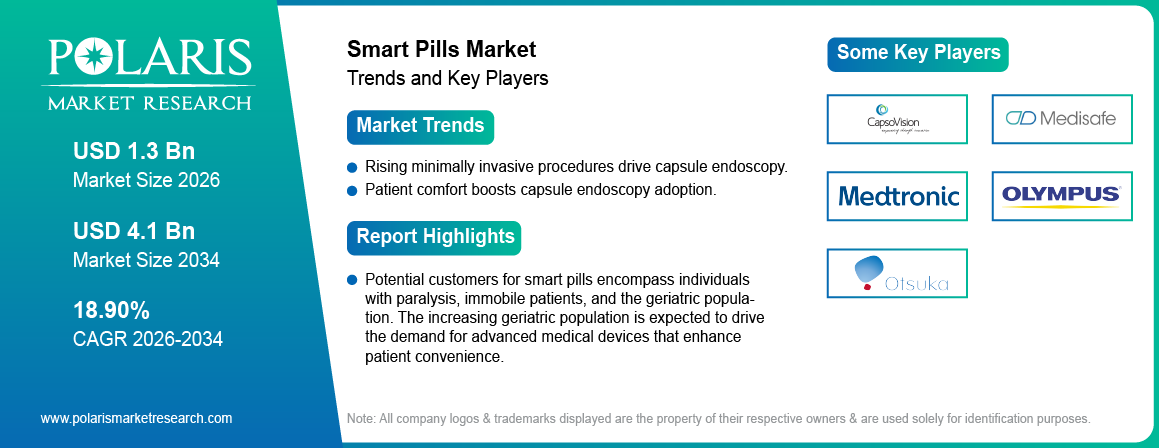
Potential customers for smart pills encompass individuals with paralysis, immobile patients, and the geriatric population. The increasing geriatric population is expected to drive the demand for advanced medical devices that enhance patient convenience. Furthermore, analysts forecast a continuous increase in the global population, anticipating the addition of nearly 2 billion people over the next three decades. This trajectory is expected to elevate the current population of 8 billion to 9.7 billion by 2050, with the potential of reaching a peak of approximately 10.4 billion around the mid-2080s. This growth in population presents both challenges and opportunities for sustainability, resource management, and global development in the years to come.
Difference Between Smart Pills vs Traditional Endoscopy
| Parameter | Smart Pills | Traditional Endoscopy |
| Invasiveness | Non-invasive procedure where patients swallow a capsule with sensors and cameras. | Minimally invasive procedure requiring insertion of an endoscope through the body. |
| Patient Comfort | Provides higher comfort with no need for sedation or discomfort during examination. | May cause discomfort and often requires sedation during the procedure. |
| Imaging Capabilities | Captures images throughout the digestive tract but has limited control over viewing areas. | Provides detailed, real-time visualization with controlled movement and targeted examination. |
| Recovery Time | Requires little to no recovery time, allowing patients to resume normal activities quickly. | Requires recovery time after sedation and the procedure. |
| Monitoring Efficiency | Enables continuous data collection and remote monitoring for improved patient insights. | Provides point-in-time diagnosis with limited long-term monitoring capability. |
The market for smart pills is being propelled by the increasing demand for advanced drug delivery systems that offer benefits such as optimal utilization of active pharmaceutical ingredients, reduced dosage frequency, minimal adverse/side effects, targeted drug delivery, and safer carriers. The integration of innovative drugs, medical devices, and advanced technologies is anticipated to be a key factor in driving further smart pills market growth over the forecast period. Advanced drug delivery products are expected to find a substantial customer base among patients with chronic diseases who require precise medication dosing at the targeted site.
For More Details, Request for Report Discount
Market Dynamics
Driver: Increased Demand for Minimally Invasive Surgical Procedures
The increased demand for minimally invasive surgical procedures has paved the way for innovative techniques like capsule endoscopy. Unlike traditional endoscopy methods that involve the use of a flexible tube, capsule endoscopy offers several advantages. One key advantage is the ease of administration, as patients can simply swallow a small capsule containing a tiny camera. This eliminates the need for invasive procedures, such as inserting a tube through the mouth or rectum.
This non-invasive approach enhances patient comfort, reduces the risk of complications, and improves the overall diagnostic process. Consequently, the advancements in capsule endoscopy are anticipated to contribute to the gradual replacement of traditional endoscopy methods in certain clinical scenarios.
Report Segmentation
The market is primarily segmented based on application, target area, end use, and region.
| By Application | By Target Area | By End Use | By Region |
|
|
|
|
Source: Polaris Market Research Analysis
To Understand the Scope of this Report: Request Customization
By Application Analysis
Capsule Endoscopy Segment Held the Largest Share
Capsule endoscopy segment held the largest share. This dominance is primarily due to rising global incidence of gastrointestinal disorders, including colon cancer, Crohn's disease, and ulcerative colitis. This increase in prevalence is fueling the demand for minimally invasive diagnostic procedures, such as capsule endoscopy. According to the Crohn's & Colitis Foundation, in the United States, approximately 1 in 100 individuals is affected by inflammatory bowel disease (IBD), which comprises a group of chronic gastrointestinal disorders.
Crohn's disease, classified under the umbrella of inflammatory bowel disease (IBD), affects both men and women equally and can manifest at any age. However, it is most frequently diagnosed in adolescents and young adults, typically between the ages of 20 and 30. Research indicates a genetic predisposition to the development of IBD, with studies revealing that between 1.5 percent and 28 percent of individuals with IBD have a close family member (parent, child, or sibling) who also suffers from one of these diseases.
As per information from the National Center for Biotechnology Information (NCBI), in 2019, digestive diseases accounted for approximately 2,276.3 million prevalent cases, resulting in 2.5 million deaths and 88.9 million Disability-Adjusted Life Years (DALYs) globally. These figures represented a notable increase of 67.8% in cases, 37.8% in deaths, and 23.47% in DALYs compared to the data from 1990. Furthermore, the instances of digestive diseases saw a rise from 254.2 million in 1990 to 443.5 million in 2019.
Regional Insights
The North America Region Held the Largest Share of the Global Market in 2025
The North America region dominated the market. This dominance is expected to persist throughout the forecast period, driven by factors like technological advancements in healthcare, a rise in colorectal cancer cases, and regulatory approvals for new products. According to the World Health Organization (WHO), colorectal cancer ranks as the third most common cancer globally, constituting approximately 10% of all cancer cases. Furthermore, it stands as the second leading cause of cancer-related deaths on a global scale. The demographic most affected by colorectal cancer is individuals aged 50 and above.
The Asia Pacific region projected to grow at the rapid pace. Region’s growth is due to mandatory healthcare insurance, technological advancements, and a growing prevalence of stomach cancer and gastrointestinal disorders. In 2020, global reported cases of gastric cancer exceeded 1 million, leading to 769,000 deaths. Some Asian countries, including Japan, Mongolia, & China, exhibit higher incidence rates. Despite an overall decline in gastric cancer incidence, there is a troubling increase in cases among young adults over the past few decades.
Key Market Players & Competitive Insights
Market leaders are implementing various growth strategies, including mergers and acquisitions, enhancements to existing devices, promotional initiatives, and technological advancements. For instance, introduction of Semaglutide, an anti-diabetes pill by the Novo Nordisk, in 2022 in India. This launch offers a new treatment option for individuals managing type 2 diabetes.Top of Form
Some of the major players operating in the global market include:
- CapsoVision, Inc.
- Medisafe
- Medtronic
- Olympus Corporation
- Otsuka Holdings Co., Ltd.
Recent Developments
- In April 2025, Centor launched a smart pill organizer that uses LTE connectivity for real-time medication adherence monitoring, enabling pharmacies to offer remote care without requiring patient app setup or configuration. (Source: gerresheimer.com)
Smart Pill Market Report Scope
| Report Attributes | Details |
| Market size value in 2025 | USD 1.0 billion |
| Market size value in 2026 | USD 1.3 billion |
| Revenue forecast in 2034 | USD 4.1 billion |
| CAGR | 18.90% from 2026 – 2034 |
| Base year | 2025 |
| Historical data | 2021 – 2024 |
| Forecast period | 2026 – 2034 |
| Quantitative units | Revenue in USD billion and CAGR from 2026 to 2034 |
| Segments covered | By Material, Product Type, By Straw Length, Diameter, Sales Channel, End Use, By Region |
| Regional scope | North America, Europe, Asia Pacific, Latin America, Middle East & Africa |
| Customization | Report customization as per your requirements with respect to countries, region, and segmentation. |
Source: Polaris Market Research Analysis
Smart Pills Market FAQ's
The smart pills market report covering key segments are application, target area, end use, and region.
Smart Pill Market Size Worth $4.1 Billion By 2034
The global smart pills market is expected to grow at a CAGR of 18.90% during the forecast period.
North America is leading the global market with 40.7% share.
key driving factors in smart pills market are Growing Geriatric Population.
Download Sample Report of Smart Pills Market
Please fill out the form to request a customized copy of the research report.


