
Solar-Plus-Storage Market Size, Share, and Forecast 2026 to 2034
REPORT DETAILS
Solar-Plus-Storage Market Summary
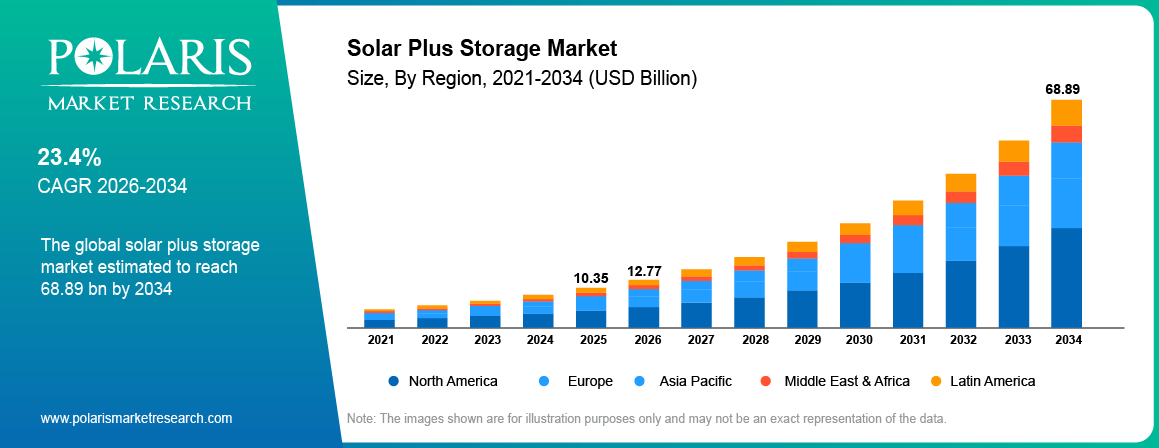
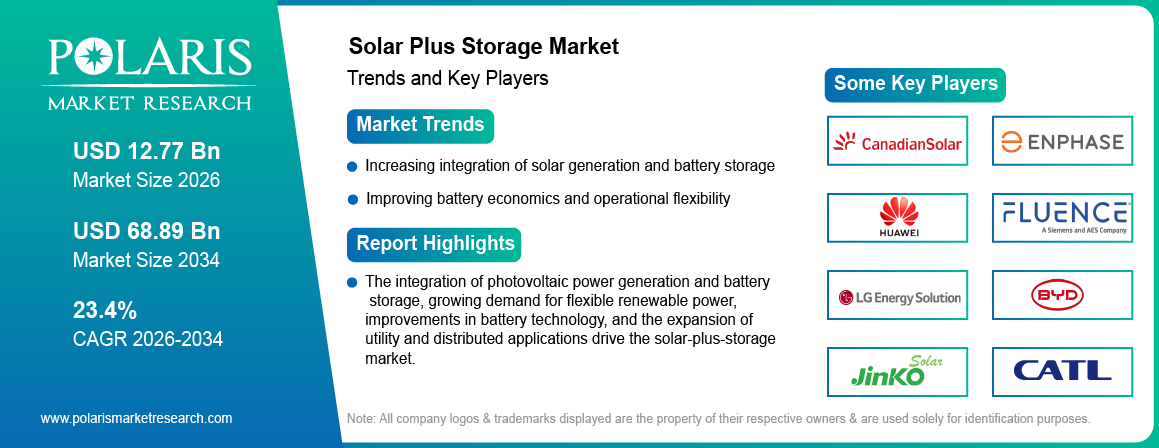
The global Solar-Plus-Storage Market was valued at USD 10.35 Billion in 2025. The market is expected to grow at a CAGR of 23.4% from 2026 to 2034. Growth is driven by increasing integration of battery storage with photovoltaic generation, rising demand for flexible renewable electricity, and the need to shift solar output toward evening peak demand periods.
Market Statistics
Key Takeaways
- Asia Pacific accounted for 64.50% of the market in 2025, driven by large-scale solar development, battery manufacturing capacity and increasing deployment of integrated renewable energy projects.
- North America is expected to grow at 23.64% CAGR, driven by utility-scale solar and storage deployment, residential battery installations, and rising demand for flexible electricity supply.
- The utility-scale segment accounted for 77.00% of the installation type segment in 2025, propelled by demand for dispatchable renewable generation and large-scale energy storage.
- The commercial and industrial installations are expected to grow at a 29.40% CAGR, due to the demand for peak shaving, demand charge management and better control on electricity procurement costs.
- Lithium iron phosphate held 72.80% share of the storage technology segment in 2025, fueled by its wide usage in stationary battery storage systems.
- The DC-coupled systems are anticipated to grow at a 24.24% CAGR owing to their integration capabilities in new solar projects and the coordinated conversion of photovoltaic and battery power.
- Grid-connected systems represented 98.10% of the grid connection segment in 2025, driven by utility-scale deployment, distributed solar installations and participation in electricity markets.
- Systems with 2 to less than 4 hours of usable discharge duration held 44.80% share in 2025, driven by deployment of batteries designed for daily solar shifting and peak-period electricity delivery.
- Residential solar-plus-storage systems are expected to see a 25.58% CAGR, driven by backup power needs, self-consumption, and household electricity tariff optimization.
Note: Figures and projections outlined in this report are the result of Polaris Market Research’s proprietary analytical processes, grounded in the latest available datasets and market observations.
What Is the Solar-Plus-Storage Market?
The Solar-Plus-Storage Market encompasses integrated energy systems that combine photovoltaic solar generation with electrochemical battery storage. These systems store electricity generated by solar panels and release it based on electricity demand, grid conditions, tariff structures, and project operating requirements. Solar-plus-storage installations can be DC-coupled or AC-coupled and can operate as grid-connected, islandable or off-grid systems. The market includes the equipment and integration to provide the combined solar and battery configuration, including photovoltaic modules, battery systems, inverters, controls and related energy management infrastructure.
The market covers utility scale, commercial & industrial and residential installations. Utility-scale projects combine large photovoltaic plants with battery systems to shift generation to times of higher electricity demand, manage renewable output and participate in grid services. Commercial and industrial installations support peak shaving, demand charge management, backup power and self-consumption. Residential systems combine rooftop solar and batteries to make the most use of local solar power, and to provide backup in case of grid outages. Thus, the solar and battery storage market includes integrated installations of different project sizes and client needs.
A solar-plus-storage system interconnects photovoltaic generation and battery storage via DC coupling or AC coupling. DC-coupled storage shares a common DC-side architecture between the solar array and the battery system, while AC-coupled storage uses separate power conversion interfaces. The choice depends on project configuration, inverter design, retrofit requirements, conversion losses, operating flexibility and system economics. Battery energy management systems manage charge and discharge, grid import, solar generation and load requirements to optimize the system operation.
The development of the market is highly dependent on battery chemistry, inverter technology, battery life, energy management software and electricity market structures. Lithium iron phosphate batteries have become a major technology choice for stationary energy storage because of their suitability for repeated cycling and large-scale deployment. Battery systems are also being designed to provide functions such as time of use arbitrage, peak shaving, renewable energy shifting, and grid support. The performance of an integrated installation depends on usable battery capacity, round trip efficiency, degradation, operating temperature, power conversion, and dispatch strategy.
Market Dynamics
Driver and Opportunities Impact Analysis
The table below summarizes the relative influence of the main market drivers and growth opportunities in the solar plus storage market.
| Driver / Opportunity | Impact Level | Geographic Relevance | Impact Timeline |
| Driver: Increasing integration of solar generation and battery storage | High | Global | Medium to long term |
| Driver: Improving battery economics and operational flexibility | High | Global | Short to medium term |
| Opportunity: Expansion of distributed solar storage and retrofit installations | Medium | Europe, North America, Australia | Medium term |
| Opportunity: Development of large hybrid solar projects for flexible renewable electricity | Medium | Middle East, North America, Asia Pacific | Medium to long term |
Source: Polaris Market Research Analysis. Impact levels are indicative estimates based on analyst judgment.
Driver: Increasing Integration of Solar Generation and Battery Storage
The expansion of photovoltaic generation is increasing the requirement for flexible electricity supply across utility networks and distributed energy systems. Solar generation is focused in the daylight hours, while demand for electricity and wholesale prices can increase in the evening periods. Project developers can store part of the solar output in batteries and release it when demand, market prices or grid conditions are higher value. This operating model enables renewable energy shifting, increases dispatch flexibility and enhances the commercial value of solar generation.
The U.S. Energy Information Administration reported that more than 16% of new utility-scale solar capacity added between January and September 2026 was colocated with operable battery storage, compared with 2% in 2017. The agency also reported that planned solar additions scheduled for the final three months of 2026 could raise the annual share to 19%. This indicates that utility-scale solar projects are incorporating battery storage at a faster rate (Source: EIA.gov).
Driver: Improving Battery Economics and Operational Flexibility
Advances in battery manufacturing, energy density, system integration and battery management are enabling the deployment of solar-plus-storage systems across installation categories. Lithium iron phosphate technology is often used for stationary storage, thanks to its cycle performance, thermal characteristics and suitability for large battery installations. The International Energy Agency reported that global additions of battery capacity reached 108 gigawatts in 2025 and that lithium iron phosphate, or LFP, was about 90% of battery installations. This is strengthening the supply chain for integrated solar storage solutions (Source: IEA.org).
Operational flexibility is also provided by battery systems through peak shaving, time of use arbitrage, self-consumption optimization, and scheduled delivery of electricity. Commercial and industrial users can charge batteries when solar generation is available or when electricity prices are lower and then discharge them when prices are higher. For utility-scale operators, battery duration and dispatch controls enable solar output to be matched to evening demand and market requirements. Such capabilities are raising the significance of solar battery hybrid systems in renewable power portfolios.
Restraint: Interconnection, Fire Protection, and Project Financing Requirements
Solar-plus-storage projects involve the integrated engineering of photovoltaic generation, battery systems, inverters, protection equipment, grid interconnection and energy management software. The developer must comply with the grid connection requirements, fire protection requirements, site safety requirements and operating requirements of the combined installation. Project design and commissioning also depend on battery capacity, discharge duration, inverter ratings, thermal management and control systems.
The interconnection studies and grid approval processes can extend project development schedules, particularly when network capacity is limited or hybrid systems require additional operating controls. Fire detection, thermal management, emergency response planning and adequate separation of equipment are also required for battery installations. Whether this project can be financed depends on the capital cost, expected revenues from electricity, degradation of the battery, warranty conditions, grid service opportunities, and the permanence of the applicable market rules. These requirements lead to increased complexity in project development and affect the commercial viability of integrated solar storage projects.
Opportunity: Expansion of Distributed Solar Storage and Retrofit Installations
The rise of rooftop solar and commercial photovoltaic installations provides opportunities for the expansion of battery storage for residential and commercial customers. Existing solar systems are retrofitted with compatible battery systems to increase self-consumption, provide backup power, and help manage electricity purchases during peak tariff periods. AC-coupled systems are well suited to retrofits, as battery storage can be added through a separate inverter without any changes to the existing solar power conversion equipment.
Residential and commercial battery products also expand the capacity options available to customers. Enphase Energy began accepting commercial preorders for the IQ Battery C80 in August 2026, with 80 kWh of usable capacity and 40 kVA of continuous power per enclosure. The product development is a response to the rise of integrated storage solutions for commercial and industrial energy users. The rise of distributed solar storage also opens up opportunities for equipment suppliers, installers, software providers and energy service companies.
Opportunity: Development of Large Hybrid Solar Projects for Flexible Renewable Electricity
Large solar-plus-storage projects can also help developers and equipment suppliers deliver renewable electricity with more control over delivery schedules. Battery systems can store some of the solar generation when it is producing at high output and deliver power when there is demand in the evening, which can help to provide more consistent renewable supply. Furthermore, these projects can participate in the electricity markets via energy arbitrage, capacity services, ancillary services and contracted power delivery.
Sungrow in May 2026 announced a 7.5 GWh PowerTitan battery supply deal for a gigascale renewable energy project in the UAE, developed by Masdar and the Emirates Water and Electricity Company, with 5.2 GW of photovoltaic capacity and 19 GWh of battery storage. The project illustrates the scale of integrated solar and battery deployment in markets seeking large volumes of renewable electricity with scheduled delivery. Large hybrid plants are creating opportunities for battery suppliers, inverter manufacturers, engineering contractors, and project developers.
Market Segmentation Analysis
The Solar-Plus-Storage Market is segmented by installation type, grid connection, storage technology, coupling architecture, usable discharge duration, and region. These categories distinguish project scale, operating configuration, battery chemistry, electrical integration, storage capability, and geographic demand patterns.
Installation Type Insights
The utility-scale segment is leading the market with 77.00% share of the Solar-Plus-Storage Market in 2025. Utility scale projects are large photovoltaic generation assets coupled with battery systems that enable renewable electricity dispatch, grid flexibility and participation in energy markets. These installations often need integrated design of solar capacity, battery power, usable energy, inverter ratings, grid connection and dispatch controls. Developers select battery capacity and discharge duration according to project requirements, electricity market conditions, renewable generation profiles, and contracted delivery schedules. Large hybrid projects also support the integration of solar generation into electricity networks with changing demand patterns.
The commercial and industrial segment is projected to register the fastest growth, with a CAGR of 29.40% during the forecast period. Commercial and industrial facilities are using solar-plus-storage systems to increase on-site solar consumption, reduce electricity demand during peak tariff periods and improve energy supply resilience. Battery systems can charge during solar generation or low-cost electricity periods and discharge during high demand intervals. The system design is based on facility load profiles, demand charge structures, available roof or ground space, battery capacity, and backup power requirements. Such installations can be used in manufacturing plants, warehouses, commercial buildings, logistics centers and other facilities that consume large amounts of electricity.
Grid Connection Insights
The grid-connected segment accounted for 98.10% of the Solar-Plus-Storage Market in 2025 due to the integration of systems in utility-scale, commercial, industrial, and residential applications. Grid-tied installations can exchange electricity with the utility grid, and coordinate solar generation, battery charging and discharging. Their operating strategy is determined by export limits, electricity tariffs, grid service requirements, interconnection rules and the availability of market-based revenue opportunities. These systems can enable peak shaving, renewable energy shifting, and electricity procurement optimization.
The off-grid segment is estimated to grow at a CAGR of 32.10% over the forecast period. Off-grid systems combine solar and storage in areas with limited access to the grid or where an independent source of power generation is required. Battery storage balances solar generation and electricity demand during nighttime hours and periods of low sunlight. These are installed in remote communities, industrial sites, farms, telecommunications infrastructure and commercial sites that are isolated. The project design is driven by the daily energy consumption, solar resource availability, battery duration, backup generation requirements and system reliability targets.
Storage Technology Insights
In 2025, the lithium iron phosphate segment held 72.80% of the storage technology segment, and was the leading battery category in the market. LFP batteries are used commercially as stationary energy storage systems due to their long cycle life, thermal stability and applicability to large battery systems. LFP battery packs are used in utility-scale and distributed solar storage projects and are integrated with battery management systems, thermal management, power conversion equipment and energy management software. Battery selection is influenced by usable capacity, power rating, operating temperature, warranty throughput, degradation profile, and project economics.
The flow battery segment is projected to register a CAGR of 45.80% during the forecast period. Flow battery systems store liquid electrolytes in external tanks and can be designed for longer-duration energy storage applications. Their power and energy capacities can be designed through separate configurations of stack and electrolyte storage. This architecture is useful for solar-plus-storage projects where long discharge durations and frequent cycling are required. The decision to adopt will depend upon the cost of the system, the site requirements, the operating characteristics, the maintenance requirements and the commercial suitability of the technology selected.
Coupling Architecture Insights
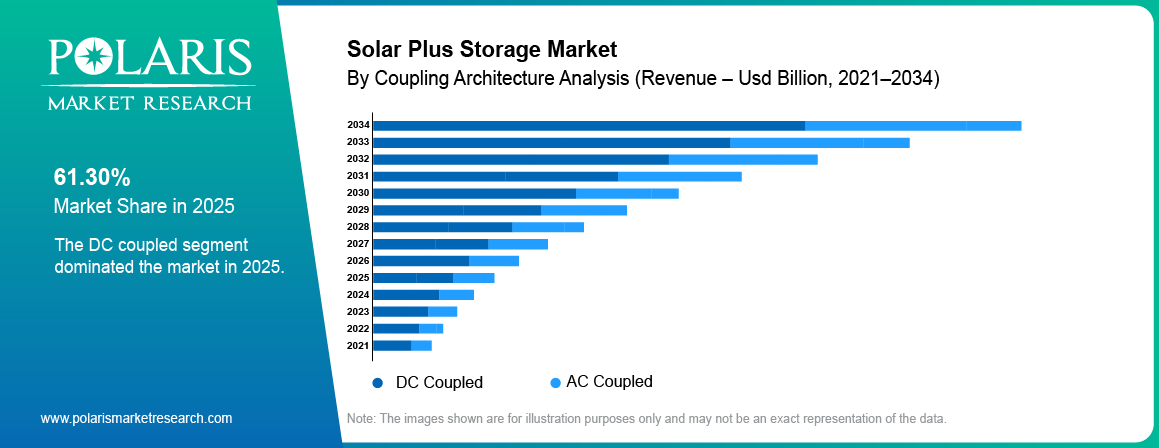
The DC-coupled segment held a share of 61.30% of the coupling architecture segment in 2025. DC-coupled solar-plus-storage systems link solar PV generation and battery storage through a common DC-side connection. Depending on the inverter ratings, battery capacity and system controls, this setup can allow for coordinated power conversion and potentially recover solar energy that would normally be clipped. DC coupling is particularly relevant to new solar-plus-storage projects where photovoltaic and battery components can be designed together. System selection depends on inverter architecture, DC voltage compatibility, conversion efficiency, battery charging requirements, and project operating strategy.
The AC-coupled segment is projected to grow at a CAGR of 22.04% during the forecast period. In AC-coupled systems, the solar generation and battery storage are connected through separate power conversion equipment. This architecture allows the integration of battery storage into existing photovoltaic installations, without the need to replace the existing solar inverter. It is relevant for residential and commercial retrofit projects where operators want to increase solar self-consumption, add backup capability or manage electricity tariffs. The design of an AC-coupled system depends on the compatibility of the inverter, the conversion losses, the power ratings, the control coordination, and the electrical configuration of the existing installation.
Usable Discharge Duration Insights
In 2025, the segment of 2 to under 4 hours represented 44.80% of the usable discharge duration segment. Systems within this category are used for daily solar energy shifting, evening peak supply and short duration grid support. Their battery capacity and discharge power are chosen to suit the project’s generation profile, electricity demand and dispatch requirements. Utility-scale projects can use the duration range to shift solar output to higher-value electricity periods, and commercial and industrial customers can use it to manage demand peaks and tariff exposure.
The 4 to under 8 hours segment is expected to witness the highest growth rate with a CAGR of 28.76% during the forecast period. Systems with longer duration provide electricity for longer periods of time after solar generation tapers off and also provide added flexibility to dispatch renewable energy. Such installations are useful for utility-scale projects that want to match solar generation with demand in the evening and nighttime hours. Project economics depend on battery capacity, power conversion equipment, cycling frequency, electricity market conditions, degradation, and the value of delivered electricity.
Regional Analysis
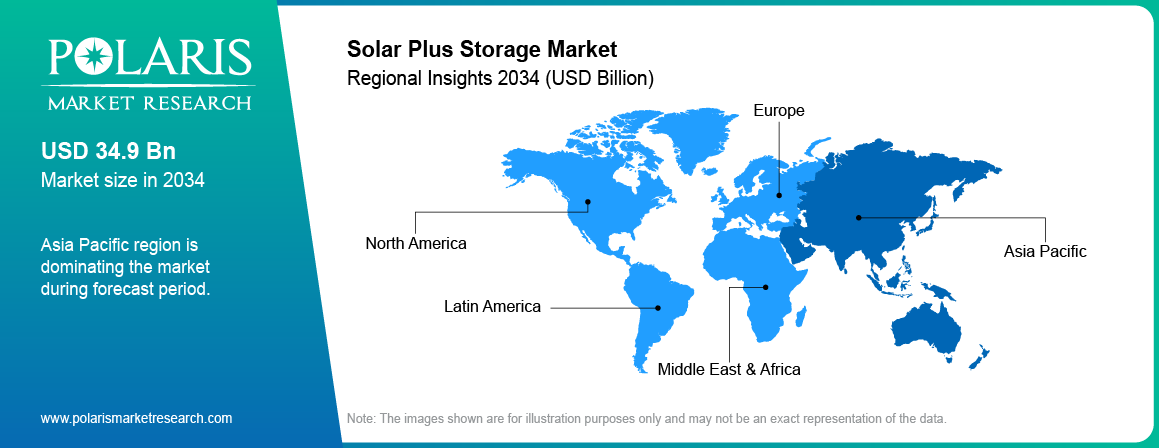
The Solar-Plus-Storage Market spans North America, Europe, Asia Pacific, Latin America, and the Middle East and Africa. Regional demand is driven by solar deployment, battery manufacturing capacity, electricity market structures, grid flexibility requirements, renewable curtailment, distributed energy adoption and government support for energy storage.
North America Solar-Plus-Storage Market Size and Share
North America is projected to grow at 23.64% CAGR during the forecast period. The growth is attributed to the utility-scale hybrid projects, residential battery installations, and the demand for flexible renewable electricity. The US is a large regional market for integrated solar storage systems. Developers have combined PV capacity and batteries to shift solar generation from daytime hours, when electricity prices are lower, to evening hours, when prices are higher. The EIA also reported that more than 30% of planned utility scale solar additions for 2027 and 2028 are expected to be colocated with battery storage. The trend reflects battery storage’s growing role in the planning of utility-scale solar projects.
Additionally, solar self-consumption, backup power, and peak shaving add to regional demand via residential and commercial installations. Battery energy management systems coordinate solar generation, battery charging, grid imports and electricity usage in response to tariff structures and operating requirements. Canada also has other opportunities in provincial electricity markets, renewable energy development and distributed energy needs. Utility procurement, electricity prices, battery incentives, interconnection conditions and project financing all impact the regional deployment. In the US, the One Big Beautiful Bill Act of July 2025 retained investment tax credits for battery storage while setting foreign entity of concern content thresholds, which start at 55% for storage projects that begin construction in 2026.
Asia Pacific Solar-Plus-Storage Market Size and Share
In 2025, the Asia Pacific region held a 64.50% share of the Solar-Plus-Storage Market due to the large-scale deployment of solar, battery manufacturing capacity, industrial electricity demand and investment in renewable energy infrastructure. China is an important hub for battery production and for deployment of stationary storage. The International Energy Agency said that China accounted for around 60% of global battery storage additions in 2025. The regional supply base for integrated solar storage projects is underpinned by China’s dominance in battery manufacturing and deployment.
India, Japan, South Korea and Australia are important markets for solar-plus-storage development. As of September 30, 2026, India’s cumulative solar capacity was 171.05 GW, giving a large photovoltaic generation base for future hybrid project development. Australia is encouraging the deployment of distributed batteries through its small-scale battery discount program, which provides eligible households and businesses with a discount of about 30% on eligible battery systems.
Europe Solar-Plus-Storage Market Size and Share
Europe held 11.10% of the Solar-Plus-Storage Market in 2025, as the region’s renewable energy integration, distributed solar deployment and the need for more flexibility across electricity networks spurred growth. Solar plus storage systems allow self-consumption, energy price optimization and variable renewable generation integration. When solar output is high, battery systems can store electricity and release it when demand or electricity prices are high. Regional deployment is influenced by national energy policies, electricity market structures, grid export rules and incentives for residential and commercial battery installations.
Integrated solar storage systems have opportunities in utility-scale and distributed applications in Germany, Italy, the UK, Spain and other European markets. In March 2026, SolarEdge Technologies launched its integrated residential solar and storage solution Nexis in Germany. This launch follows the development of integrated residential energy systems for European clients. Battery deployment is also supported by balancing services, virtual power plant aggregation, shifting to renewable energy and greater flexibility in electricity distribution networks.
Middle East and Africa Solar-Plus-Storage Market Size and Share
The Middle East and Africa Solar-Plus-Storage Market held a share of 3.10% in 2025. The utility-scale renewable energy development, electricity infrastructure investment, and demand for reliable power supply are the key factors propelling the market growth. Gulf countries are building large solar projects with integrated battery storage to deliver renewable electricity on a scheduled basis. The International Energy Agency noted strong battery storage momentum in parts of the Middle East in 2025, where storage is increasingly seen as a key building block for electricity security and renewables integration.
The wider regional opportunity includes commercial and industrial energy systems, remote power supply, microgrid installations, and solar storage installations designed to reduce reliance on diesel generation. Battery systems can boost the availability of electricity in areas with limited grid infrastructure and allow for better use of locally generated solar power. The choice of project depends on the solar resource, the electricity demand, the reliability of the grid, the operating requirements of the battery and the financing structures. The region’s large solar resource base and investment in renewable generation is underpinning interest in integrated solar storage solutions.
Latin America Solar-Plus-Storage Market Size and Share
Latin America holds 4.10% market share in 2025. The market growth is attributed to the development of the solar energy storage market, investment in electricity infrastructure, and growing interest in battery storage for grid flexibility. Key markets to evaluate regional solar-plus-storage opportunities are Brazil, Chile and Mexico. Batteries are used in utility-scale solar projects to shift electricity delivery, manage variability in renewable generation, and provide electricity system balancing. Commercial and industrial users also have the option of solar battery hybrid systems to control the cost of electricity purchasing and improve energy resilience.
Brazil’s Ministry of Mines and Energy advanced a framework for the procurement of battery capacity through an auction mechanism in June 2026. The development supports the growth of battery storage procurement and provides a policy framework for new storage capacity.
Regional demand is determined by rules of the electricity market, deployment of renewables, requirements for connecting to the grid, financing of battery projects and the commercial value of storage services. Solar-plus-storage opportunities are also shaped by availability of suitable project sites and the cost of integrating battery systems with photovoltaic generation.
Solar-Plus-Storage Market Competitive Landscape
Solar-Plus-Storage Market competition is driven by suppliers’ ability to provide integrated photovoltaic and battery systems, battery energy storage platforms, hybrid inverters, energy management software, and project-level integration services. Battery makers, inverter suppliers, solar equipment companies and developers of integrated residential, commercial and utility-scale energy storage systems are all part of the competitive landscape. Supplier comparisons distinguish complete solar-plus-storage offerings from standalone battery systems, solar-only equipment, and individual power conversion components.
Vendor Landscape Snapshot
The table below classifies the leading vendors by market position based on solar plus storage product breadth, project scale and regional reach.
| Vendor | Market Position | Core Offering |
| Tesla, Inc. | Leader | Megapack and Powerwall storage |
| Sungrow Power Supply Co., Ltd. | Leader | PowerTitan storage and hybrid PV inverters |
| Huawei Technologies Co., Ltd. | Leader | LUNA2000 smart string storage |
| BYD Company Limited | Leader | LFP battery storage systems |
| Contemporary Amperex Technology Co., Limited | Leader | LFP cells and utility storage systems |
| Fluence Energy, Inc. | Challenger | Smartstack storage and EPC services |
| Canadian Solar Inc. | Challenger | SolBank storage and PV modules |
| SMA Solar Technology AG | Challenger | Grid forming hybrid inverters |
| LG Energy Solution, Ltd. | Challenger | Stationary battery cells and modules |
| Enphase Energy, Inc. | Niche Player | IQ Battery and microinverters |
| SolarEdge Technologies, Inc. | Niche Player | Nexis integrated residential system |
| Sunrun Inc. | Niche Player | Solar plus storage subscriptions |
| LONGi Green Energy Technology Co., Ltd. | Emerging Player | LONGi ONE solar plus storage portfolio |
| Trina Solar Co., Ltd. | Emerging Player | PV modules and storage systems |
| JinkoSolar Holding Co., Ltd. | Emerging Player | PV modules and storage systems |
Source: Polaris Market Research Analysis. Market positions are indicative estimates and do not represent ranked market share.
The solar storage competitive landscape is influenced by battery system performance, product integration, inverter compatibility, usable capacity, discharge duration, software controls, warranty conditions, and service capabilities. Utility-scale buyers evaluate battery power and energy ratings, operating duration, thermal management, safety systems, grid compliance, and long-term performance. System compatibility, installation specifications, backup capabilities, energy management, and electricity bill optimization are more important for residential and commercial buyers.
Manufacturers are broadening their range of products to cater to diverse installation types and project demands. Sungrow’s PowerTitan platform is aimed at large-scale battery deployments, while Canadian Solar’s e-STORAGE business offers utility-scale storage solutions. Enphase and SolarEdge are building integrated products for the residential and distributed energy markets. Huawei provides smart string energy storage systems for distributed and larger projects, while Tesla’s Megapack platform is designed for utility-scale battery storage applications. CATL and BYD supply lithium iron phosphate cells and storage systems at scale, while Trina Solar, JinkoSolar and LONGi are extending their module portfolios into storage, and Sunrun and LG Energy Solution address residential and distributed demand.
Value Chain Analysis
The table below outlines the main stages of the solar plus storage value chain and the constraint that most affects each stage.
| Stage | Key Activities | Example Participants | Key Constraint |
| Cells and materials | Cell manufacturing and materials supply | CATL, BYD, LG Energy Solution | Supply concentration |
| PV and power conversion | Modules, inverters and hybrid controls | LONGi, SMA, Sungrow, Huawei | Inverter compatibility |
| System integration | Battery systems, controls and software | Tesla, Fluence, Sungrow | Safety and grid compliance |
| Project development and EPC | Interconnection, engineering and financing | Developers, EPC contractors | Interconnection and financing |
| Distribution and installation | Residential and C&I sales and installation | Sunrun, Enphase, SolarEdge | Installer capacity |
| Operation and services | Dispatch, maintenance and warranty | Integrators, aggregators | Degradation and warranty |
Source: Polaris Market Research Analysis
Solar-Plus-Storage Market Technology and Innovation Landscape
Solar-plus-storage systems combine photovoltaic generation, battery storage, power conversion equipment, and energy management controls. The technical architecture determines how solar electricity flows between the PV array, battery, electrical loads, and grid connection. Key considerations include coupling configuration, inverter capacity, battery chemistry, usable energy, discharge duration, thermal management, protection systems and communication protocols. System performance also depends on coordination of solar generation forecasts, electricity prices, load profiles and battery operation limits.
DC-coupled storage systems link photovoltaic generation and battery storage on the DC side with a coordinated power conversion arrangement. This architecture can support shared conversion equipment and may allow the recovery of clipped PV output, where system ratings and controls permit. DC coupling is relevant to new installations where the solar array, battery capacity, and inverter architecture can be designed as an integrated system. The project design considers compatibility with DC voltage, the sizing of the inverter, the power to charge the batteries and the operating profile of the installation.
In AC-coupled storage systems, solar generation and battery storage are handled by separate power conversion equipment. This configuration enables batteries to be added to existing solar installations without the need to change the installed photovoltaic inverter. AC coupling is important for residential and commercial retrofits, where project developers want to add storage capacity without replacing the existing solar system. AC or DC coupling depends on project configuration, conversion stages, system compatibility, control requirements and installation economics.
Lithium iron phosphate is often used in stationary battery storage systems. LFP battery packs incorporate battery management systems that monitor cell voltage, temperature, current, state of charge and operating limits. Thermal management systems keep the battery within required temperature ranges. Protection equipment meets electrical and safety requirements. Battery degradation, usable capacity, warranty throughput and round trip efficiency are important considerations in evaluating system performance over the life of the project.
Battery energy management systems coordinate photovoltaic generation, battery charging and discharging, grid imports, electricity exports, and connected loads. Dispatch strategies can utilize solar forecasts, electricity tariffs, wholesale prices, export restrictions, reserve requirements and battery operating conditions. Grid-forming inverter technology can provide voltage and frequency support during islanded operation, if enabled through system design, protection configuration and applicable grid approvals. The technology roadmap calls for better battery integration, grid-support functionality, software-based dispatch and longer-duration storage configurations.
Technology and Innovation Landscape Snapshot
The table below summarizes the main technologies shaping integrated solar and battery systems and their current adoption stage.
| Technology | Adoption Stage | Key Development | Market Impact |
| LFP battery chemistry | Mainstream deployment | Lower cost and suited to frequent cycling | Cost reduction |
| DC coupled architecture | Growing deployment | Recovers clipped solar output in new projects | Efficiency gain |
| Grid forming inverters | Early commercial deployment | Voltage and frequency support in hybrid plants | Grid stability |
| AC coupled retrofits | Growing deployment | Adds storage without replacing solar inverters | Retrofit demand |
| Energy management software | Growing deployment | Dispatch guided by forecasts, tariffs and prices | Revenue optimization |
| Long duration storage | Early commercial deployment | 4 to 8 hour systems and flow batteries | Capacity expansion |
Source: Polaris Market Research Analysis
Use Case Analysis
Utility-Scale Projects: Renewable Energy Shifting and Dispatch
Major solar-plus-storage projects pair large photovoltaic generation capacity with battery systems to supply electricity over a wider range of demand periods. Batteries can store part of the solar output during high generation hours and discharge electricity during evening demand peaks. This approach enables renewable energy shifting, time-of-use arbitrage and scheduled delivery of electricity. The operator of the project chooses the battery power and energy capacity according to the solar generation profile, market prices, the needs of the grid and the supply obligations under contract.
The International Energy Agency reported that around 80% of new battery storage capacity added globally in 2025 was utility scale. This reflects the central role of large projects in coupling battery systems with solar generation to provide scheduled delivery of renewable power.
Commercial and Industrial Applications: Demand Charge Management
Solar-plus-storage systems are used at commercial and industrial sites to manage electricity consumption, reduce peak demand and better utilize on-site photovoltaic generation. Batteries can be charged when solar generation is high, and discharged when demand at the facility is high or when electricity prices are high. These systems may be of interest to manufacturing plants, warehouses, logistics centers, office campuses and other facilities that consume substantial electricity. The system size is dependent on load profiles, demand charges, operating hours, solar generation, battery duration and backup requirements.
Residential Applications: Backup Power and Self-Consumption
Residential solar-plus-storage systems enable homeowners to store excess photovoltaic electricity for use in the evenings or during power outages. Battery controls modulate the solar generation, household consumption, battery charging and the grid imports depending on the system configuration and the electricity tariff. Residential buyers look at usable battery capacity, inverter compatibility, backup circuits, installation space, warranty conditions, and the desired amount of energy independence. Integrated residential products are expanding the range of solar storage configurations.
Remote and Off-Grid Applications: Reliable Electricity Supply
Off-grid solar-plus-storage systems provide power to remote communities, industrial operations, agricultural facilities and other locations with limited grid access. Battery storage helps to balance the electricity demand with variable solar generation after sunset when solar generation is low. The system design takes into account the daily consumption, the availability of the solar resource, the battery duration, the backup generation and the reliability requirements. Solar-plus-storage systems can reduce diesel consumption if the battery size and solar generation are sized to meet the site’s operating needs.
Premium Insights and Forward Outlook
Solar and Battery Integration Is Reshaping Renewable Project Design
The coupling of battery storage with photovoltaic generation is changing the design and operating strategy of solar power projects. Developers are able to synchronize solar output and battery discharge so that delivery of electricity matches market prices, grid needs and demand patterns. Utility-scale projects are increasingly incorporating storage in their development plans, while commercial and residential users are installing batteries to enhance self-consumption and manage electricity costs. The increase in the number of integrated projects is fueling the demand for coordinated solutions in batteries, inverters and energy management.
Battery Duration and Dispatch Strategy Influence Project Economics
Battery duration is a critical factor in the operational capacity and market value of a solar plus storage system. Shorter duration systems can assist with peak shaving and daily solar shifting, while longer duration installations can provide power for longer periods in the evening and overnight. In selecting system capacity, project developers consider usable energy, battery power, cycling frequency, round trip efficiency, degradation and market revenue opportunities. Dispatch strategies are also dependent on electricity tariffs, solar generation forecasts, grid export conditions and reserve requirements.
DC and AC Coupling Shape Equipment Selection
The decision between DC-coupled and AC-coupled configuration affects the system design, conversion equipment and the installation requirements. DC coupling is advantageous for new projects where solar and battery systems can be designed together. AC coupling offers flexibility to add batteries to existing photovoltaic systems. Both architectures require coordinated controls, compatible inverter ratings and appropriate protection arrangements. Equipment selection depends on project objectives, system efficiency, retrofit requirements, and total installation costs.
Grid-Forming Capabilities Expand the Role of Battery Storage
Grid-forming inverter technology is increasing the range of potential services that battery systems can provide in suitable configurations. These inverters can support voltage and frequency control during islanded operation and contribute to grid stability when the system design and protection arrangements allow. The integration of grid-forming capabilities, battery management software, and advanced dispatch controls is expanding the technical role of solar-plus-storage installations across utility and distributed energy systems.
Industry Forecast Considerations
The Solar-Plus-Storage Market forecast depends on solar capacity additions, battery manufacturing scale, storage system costs, electricity market structures, renewable energy policies, and the value of flexible electricity supply. The solar PV storage forecast also considers battery chemistry, usable discharge duration, coupling architecture, grid interconnection, project financing, and the development of distributed storage applications. The expansion of utility-scale hybrid projects and residential and commercial battery installations is expected to influence the market's growth across the forecast period.
Cost and Pricing Benchmarking Analysis
Solar-plus-storage pricing varies according to photovoltaic capacity, battery energy capacity, battery power rating, usable discharge duration, coupling architecture, inverter configuration, installation scale, and project location. Utility-scale systems need coordinated solar generation and battery storage equipment; commercial and residential installations have different capacity, installation and backup requirements. Price comparisons should differentiate between modeled system costs and installed project quotes, and should evaluate the equipment and services included in each benchmark.
The U.S. Department of Energy’s Q1 2025 benchmark gives modeled cost estimates for PV plus energy storage systems for utility scale, commercial and residential configurations. The figures are in 2024 U.S. dollars and provide a consistent basis for comparison of modeled system costs across different scales of installation (Source: Energy.gov).
| System Configuration | Minimum Sustainable Price (MSP) | Modeled Market Price | Basis |
| Utility: 100 MWdc PV + 240 MWh storage | USD 1.71/Wdc | USD 1.81/Wdc | 2025 Q1 modeled benchmark, 2024 USD |
| Commercial: 250 kWdc PV + 250 kWh storage | USD 2.96/Wdc | USD 2.98/Wdc | 2025 Q1 modeled benchmark, 2024 USD |
| Residential: 8 kWdc PV + 13.5 kWh storage | USD 4.33/Wdc | USD 4.59/Wdc | 2025 Q1 modeled benchmark, 2024 USD |
Source: U.S. Department of Energy
Costs for battery installation also depend on the scale of the system, the chemistry of the battery, power conversion equipment, thermal management, and project configuration. IRENA reported that the total installed cost of utility scale battery storage fell to USD 192/kWh in 2024. This benchmark provides a reference for battery storage cost trends and should be evaluated separately from PV-plus-storage system costs because the underlying cost boundaries and measurement bases differ (Source: IRENA.org).
Key Players in the Solar-Plus-Storage Market
- BYD Company Limited
- Canadian Solar Inc.
- Contemporary Amperex Technology Co., Limited
- Enphase Energy, Inc.
- Fluence Energy, Inc.
- Huawei Technologies Co., Ltd.
- JinkoSolar Holding Co., Ltd.
- LG Energy Solution, Ltd.
- LONGi Green Energy Technology Co., Ltd.
- SMA Solar Technology AG
- SolarEdge Technologies, Inc.
- Sungrow Power Supply Co., Ltd.
- Sunrun Inc.
- Tesla, Inc.
- Trina Solar Co., Ltd.
Industry Developments
- November 2026: India’s Union Cabinet approved a USD 1.53 billion scheme to boost energy storage projects across the country. The funding is expected to accelerate deployment of grid-scale storage and improve the ability to integrate renewable power sources such as solar.
- November 2026: Contemporary Amperex Technology Co., Limited (CATL) signed an agreement to supply a 313 MW, 1,639.45 MWh battery energy storage system for the La Alegría solar project in Campeche, Mexico, which CATL described as the first battery system above 1 GWh in the country.
- November 2026: Sunrun Inc. reported a storage attachment rate of 75% for the third quarter of 2026, compared with 70% a year earlier, and networked storage capacity of 5.0 GWh as of September 30, 2026.
- October 2026: SMA Australia unveiled a grid-forming, DC-coupled solar-plus-storage solution for Germany, Australia and the UK, following its European introduction in June 2026. The system consists of solar PV and battery energy storage, which stores excess solar energy and provides grid stability with grid-forming inverter technology.
- July 2026: Fluence Energy, Inc. agreed to supply its Smartstack AC battery platform and turnkey engineering, procurement and construction services to Avantus for the 200 MW, 800 MWh Rexford 2 solar plus storage project in Tulare County, California.
- April 2026: LONGi launched LONGi ONE, an integrated solar-plus-storage strategy that combines its back-contact (BC) solar technology with energy storage systems. The portfolio includes utility scale and commercial and industrial applications, with an integrated platform for coordinating power generation, storage and consumption.
Solar-Plus-Storage Market Report Segmentation
By Installation Type Outlook (Revenue, USD Billion, 2021–2034)
- Utility Scale
- Commercial and Industrial
- Residential
By Grid Connection Outlook (Revenue, USD Billion, 2021–2034)
- Grid Connected
- Off Grid
By Storage Technology Outlook (Revenue, USD Billion, 2021–2034)
- Lithium Iron Phosphate
- Other Lithium Ion
- Flow Battery
- Other
By Coupling Architecture Outlook (Revenue, USD Billion, 2021–2034)
- DC Coupled
- AC Coupled
By Usable Discharge Duration Outlook (Revenue, USD Billion, 2021–2034)
- Under 2 Hours
- 2 to Under 4 Hours
- 4 to Under 8 Hours
- 8 Hours or More
By Region Outlook (Revenue, USD Billion, 2021–2034)
- North America
- US
- Canada
- Europe
- Germany
- France
- UK
- Italy
- Spain
- Netherlands
- Rest of Europe
- Asia Pacific
- China
- Japan
- India
- South Korea
- Australia
- Rest of Asia Pacific
- Latin America
- Brazil
- Mexico
- Chile
- Rest of Latin America
- Middle East & Africa
- Saudi Arabia
- UAE
- South Africa
- Rest of Middle East & Africa
Solar-Plus-Storage Market Report Scope
| Report Attributes | Details |
| Market Size in 2025 | USD 10.35 Billion |
| Market Size in 2026 | USD 12.77 Billion |
| Revenue Forecast by 2034 | USD 68.89 Billion |
| CAGR | 23.4% from 2026–2034 |
| Base Year | 2025 |
| Historical Data | 2021–2024 |
| Forecast Period | 2026–2034 |
| Quantitative Units | Revenue in USD Billion and CAGR |
| Report Coverage | Revenue Forecast, Growth Factors, Competitive Landscape, Industry Trends, and Strategic Analysis |
| Segments Covered | By Installation Type, Grid Connection, Storage Technology, Coupling Architecture, Usable Discharge Duration, and Region |
| Regional Scope | North America, Europe, Asia Pacific, Latin America, Middle East & Africa |
| Competitive Landscape | Company Profiling, Product Benchmarking, Financial Analysis, Market Developments, and Strategic Initiatives |
| Report Format | PDF + Excel |
| Customization | Available by Country, Region, and Segment |
Source: Polaris Market Research Analysis
Why Choose Polaris Market Research
Polaris Market Research & Consulting, Inc. provides a structured assessment of the Solar-Plus-Storage Market across installation types, grid connection configurations, storage technologies, coupling architectures, discharge durations, and regional markets. The analysis covers utility-scale, commercial and industrial, and residential systems that combine photovoltaic generation with electrochemical battery storage. Buyers then can assess the market demand for integrated solar storage solutions, and examine how battery technology, inverter architecture, electricity pricing and renewable energy deployment influence buying decisions.
The research can be customized by installation type, battery chemistry, coupling architecture, usable discharge duration, grid connection, or geography. Additional analysis can cover lithium iron phosphate systems, other lithium-ion technologies, flow batteries, DC-coupled storage, AC-coupled storage, grid-forming inverters, battery energy management systems, and distributed energy applications. Buyers can also examine demand across utility-scale developers, commercial and industrial operators, residential customers, and off-grid users to understand how project economics, battery performance, and electricity market structures influence system selection.
A further strength is the assessment of integrated system demand across the solar generation and battery storage value chain. The research evaluates product developments, battery supply agreements, hybrid project announcements, technology launches, and regional energy storage policies within the framework of the report. This provides readers with an understanding of supplier capabilities, project deployment patterns, technology selection, and the commercial factors shaping the solar and battery storage industry analysis.
Research Methodology
Solar-Plus-Storage Market research begins by defining the market at the integrated photovoltaic and battery storage system level. The scope includes newly installed and expanded configurations combining solar generation with electrochemical battery storage across utility-scale, commercial and industrial, residential, grid-connected, and off-grid applications. The analysis evaluates the complete system configuration, including photovoltaic generation, battery storage, power conversion, integration, and associated energy management controls. This boundary keeps the assessment focused on integrated solar storage solutions.
Secondary research draws on energy agency publications, government data, company announcements, product documentation, project disclosures, industry publications, and other sources included in the approved research register. The evidence is assessed for its relevance to solar-plus-storage deployment, including project capacity, battery energy ratings, coupling architecture, battery chemistry, product specifications, regional policies, and technology developments. Announced projects, battery supply agreements, and product launches are evaluated according to their relevance to the integrated solar and storage market. Primary research combines interviews with equipment manufacturers, project developers, installers and utility procurement specialists, and the findings are used to validate and refine the secondary research inputs.
Market estimates break down revenue by installation type, grid connection, storage technology, coupling architecture, usable discharge duration, and region. Each category represents a different market dimension, enabling the analysis to examine differences in system configuration, battery needs, customer demand, and geographic activity. Market trends are read through from solar deployment, battery additions, equipment pricing, project economics and electricity market conditions.
Five-Phase Research Methodology
| Phase | Activity | Output |
| 1. Scope Definition | Define integrated solar-plus-storage systems and market exclusions | Market boundary and segmentation |
| 2. Secondary Research | Review energy agency data, company disclosures, product documentation, project announcements, and industry sources | Source register |
| 3. Market Estimation | Assess revenue across installation type, grid connection, storage technology, coupling architecture, discharge duration, and region | Market model |
| 4. Validation | Cross-check estimates against project deployment, product, pricing, battery supply, technology, and primary interview evidence | Validated market assumptions |
| 5. Quality Review | Check source accuracy, scope consistency, terminology, and formatting | Final report and forecast |
Source: Polaris Market Research Analysis
Forecast construction considers the relationship between photovoltaic capacity additions, battery storage deployment, electricity market structures, energy storage costs, and demand for flexible renewable electricity. Project announcements, product developments, battery supply agreements, and policy frameworks are assessed according to their relevance to integrated solar-plus-storage installations. The forecast also considers the role of battery chemistry, coupling architecture, usable discharge duration, and energy management technology in shaping market demand.
Solar-Plus-Storage Market FAQ's
• The Solar-Plus-Storage Market covers integrated energy systems combining photovoltaic solar generation with battery storage to control electricity supply, increase self-consumption, and deliver grid flexibility.
• The global Solar-Plus-Storage Market was valued at USD 10.35 Billion in 2025 and is projected to reach USD 68.89 Billion by 2034, exhibiting a CAGR of 23.4% over the forecast period.
• Asia Pacific dominated the solar-plus-storage market, supported by large-scale solar deployment, expanding battery manufacturing capacity, rising energy storage installations, and increasing demand for reliable renewable power.
• The utility scale segment is driving the market with 77.00% share in 2025, owing to large hybrid projects and renewable energy shifting.
• Solar panels generate electricity, while battery systems store surplus energy for later use. An energy management system coordinates charging, discharging, and grid imports.
• Project economics depend on battery costs, solar generation, electricity tariffs, system duration, financing, installation costs, and revenue from grid services.
• DC-coupled systems connect solar and batteries on a shared DC bus, while AC-coupled systems use separate inverters. DC coupling suits integrated installations, whereas AC coupling often supports solar retrofits.
• Lithium iron phosphate (LFP) is widely used in solar-plus-storage plants due to its cycle life, thermal stability, and suitability for stationary applications.
• Discharge duration depends on project requirements, load profiles, and economics. Common configurations include under 2 hours, 2 to under 4 hours, 4 to under 8 hours, and 8 hours or more.
• Hybrid projects must meet local grid codes, utility interconnection standards, permitting requirements, protection rules, and applicable electricity export regulations.
• Batteries store surplus solar electricity and discharge during peak consumption periods, helping commercial and industrial users reduce grid demand and associated charges.
• Yes, a solar battery can supply critical loads during a grid outage when the system includes backup circuits and islanding capability, subject to battery capacity and inverter design.
• Yes. Solar batteries can support frequency regulation, voltage management, peak load reduction, energy shifting, and other grid services, subject to system capabilities and market rules.
• Operators use battery management systems to monitor temperature, charging cycles, state of charge, and operating limits to manage degradation and maintain performance.
• Key suppliers include BYD Company Limited, Canadian Solar Inc., Contemporary Amperex Technology Co., Limited, Enphase Energy, Inc., Fluence Energy, Inc., Huawei Technologies Co., Ltd., SolarEdge Technologies, Inc., Sungrow Power Supply Co., Ltd., and Tesla, Inc.

Download Sample Report of Solar-Plus-Storage Market
Please fill out the form to request a customized copy of the research report.


