
Standard Modulus Carbon Fiber Market Trends, Forecast, Analysis Report, 2026-2034
REPORT DETAILS
Standard Modulus Carbon Fiber Market Summary
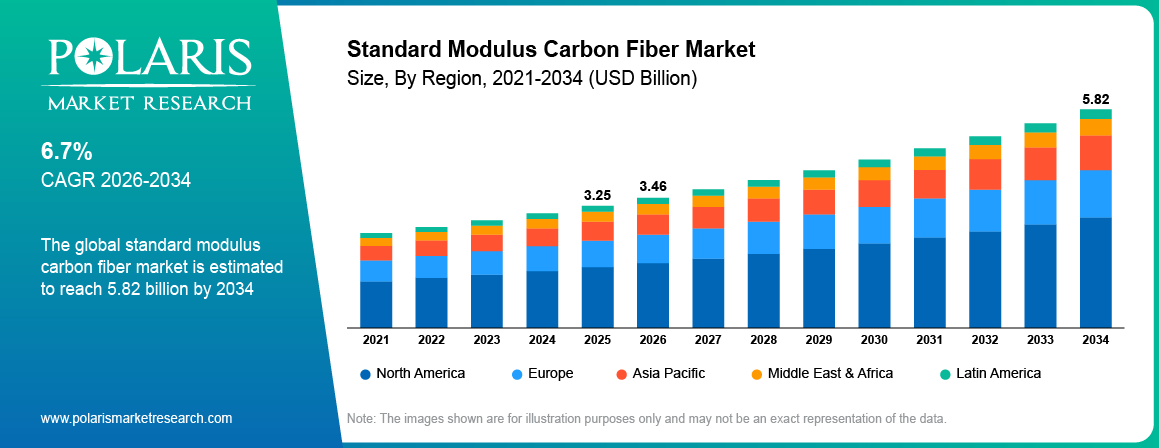
The global standard modulus carbon fiber market is estimated around USD 3.25 Billion in 2025,with consistent growth anticipated during 2026–2034. Expansion is supported by increasing demand for lightweight structural materials across automotive, aerospace, and renewable energy sectors. The market is projected to grow at a CAGR of 6.7% during the forecast period.
Market Statistics
Key Takeaways
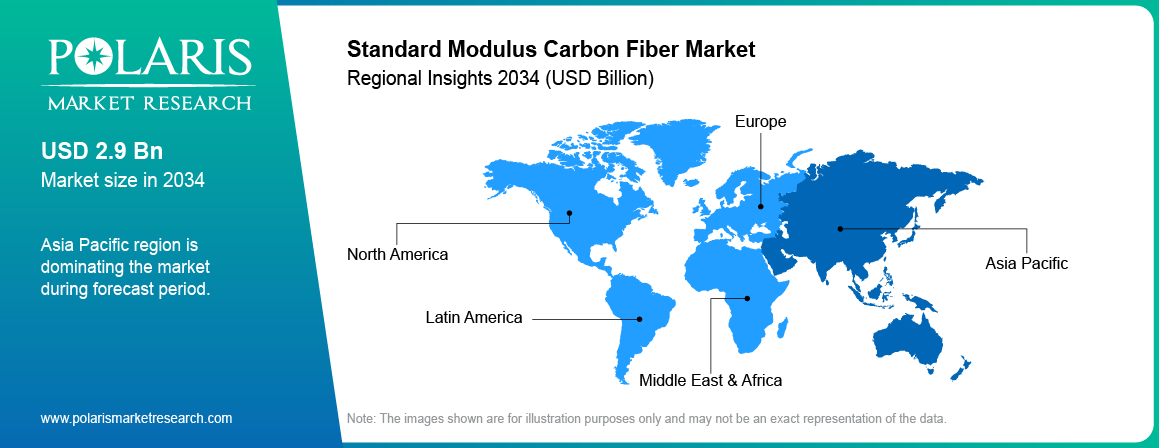
- Asia Pacific accounted for the largest regional share of around 43.2% in 2025, driven by strong composite manufacturing capacity, expanding EV production, and growing renewable energy sector investments.
- By Product Type, Continuous segment accounted for the largest share of approximately 68.5% in 2025, supported by high strength-to-weight ratio and widespread use across aerospace, automotive, and wind turbine applications.
- By Raw Material, PAN-Based segment accounted for the largest share of around 89.4% in 2025, driven by superior stiffness, tensile strength, and cost-effectiveness for large-scale composite manufacturing.
- By Material Type, Carbon Fiber Reinforced Polymer segment accounted for the largest share of nearly 76.1% in 2025, supported by rising demand for lightweight, durable, and corrosion-resistant materials.
- By End Use Industry, Aerospace & Defense segment accounted for the largest share of around 34.8% in 2025, driven by increasing demand for high-strength, lightweight composite structures.
- By End Use Industry, Wind Energy segment is projected to grow at a CAGR of 7.2%, driven by increasing adoption of carbon fiber in turbine blades to enhance efficiency and durability.
Industry Dynamics
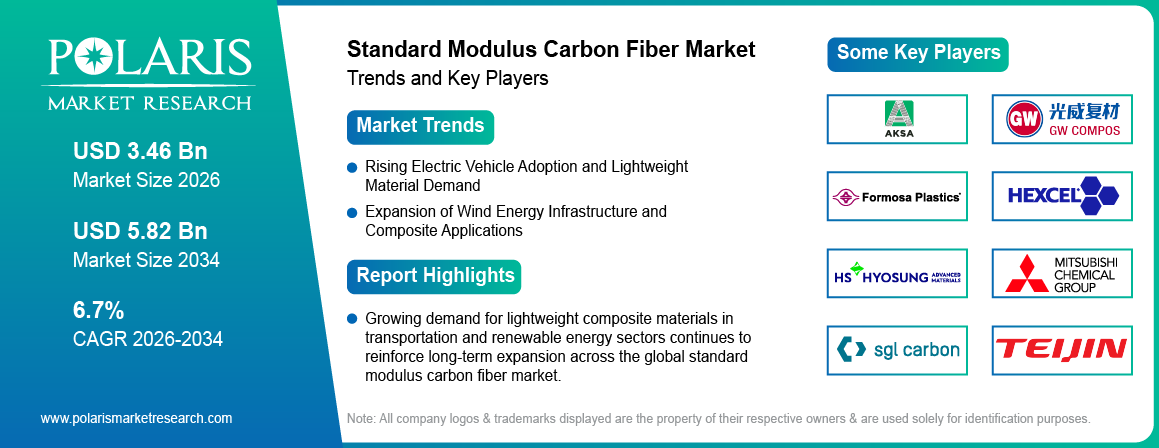
- Rising electric vehicle adoption is increasing demand for lightweight structural composites to improve energy efficiency and driving range.
- Expansion of wind energy infrastructure is strengthening carbon fiber usage in turbine blade manufacturing.
- High production and processing costs remain a constraint compared with conventional materials such as steel and glass fiber composites.
- Automation in composite manufacturing technologies is improving production efficiency and enabling scalable carbon fiber component fabrication.
What is included in the Standard Modulus Carbon Fiber market?
The standard modulus carbon fiber market includes the production and commercial supply of carbon fiber materials engineered with balanced stiffness, strength, and cost efficiency for structural composite applications. Standard modulus carbon fiber typically exhibits an elastic modulus range of standard carbon fiber between ~230–240 GPa, making it suitable for high-volume industrial uses where structural reinforcement and weight reduction are required.
The market offers PAN-based CFs processed via stabilization, carbonization, and surface treatment steps followed by sizing and tow packaging for use in composite materials production. Industry players follow a broad and integrated value chain of raw materials production, CF conversion, fabric or prepreg production, and composite part production for end-use industries.
Source: Polaris Market Research Analysis
To Understand More About this Research:Download Sample Report
| Property | Standard Modulus Carbon Fiber | Intermediate Modulus Carbon Fiber |
| Elastic Modulus | ~230–240 GPa | ~290–320 GPa |
| Tensile Strength | ~3.5–5.5 GPa | ~4.5–6.0 GPa |
| Cost Level | Lower | Higher |
| Typical Applications | Automotive parts, wind blades, pressure vessels | Aerospace structures, high-performance composites |
Source: Polaris Market Research Analysis
Standard modulus materials are more focused on balanced performance and cost efficiency, and intermediate modulus materials are focused on stiffness requirements in aerospace and defense structural applications. This distinction influences material selection across engineering design and composite manufacturing.
Drivers & Opportunities
Rising Electric Vehicle Adoption Driving Lightweight Material Demand: Growing EV penetration is increasing demand for lightweight structural materials that improve energy efficiency and driving range. According to the International Energy Agency, global sales reached about 11 million battery electric vehicles and 6.5 million plug-in hybrid electric vehicles in 2024, representing a 16% increase from the previous year. This increasing demand for lightweight materials within automotive manufacturing is boosting the carbon fiber market growth.
Expansion of Wind Energy Infrastructure Increasing Carbon Fiber Usage: The rapid implementation of wind energy infrastructure is driving carbon fiber demand within wind turbine blades, which are integral components of large-scale renewable energy solutions. In March 2026, International Finance Corporation made an announcement regarding investing USD 275 million in supporting the Olavarría Wind Farm project in Argentina, which includes installing 29 Vestas turbines with a total capacity of 185.6 MW. Such renewable infrastructure expansion increases demand for composite materials, reinforcing the aerospace carbon fiber demand forecast and wind energy applications.
Restraints & Challenges
High Production and Processing Costs: Cost-related issues associated with carbon fiber production act as a major restraint to the use of carbon fiber composite materials. Production of carbon fibers is a complex task that involves expensive precursor materials, advanced machinery, and quality control procedures. Sustainability practices require organizations to use sustainable carbon fiber production technologies. This has raised production costs compared to other materials such as metals and glass fiber composite materials.
Opportunity
Automation in Composite Manufacturing Technologies: Advances in automated fiber placement and automated tape laying technologies is creating opportunities for the market. Greater automation strengthens adoption across aerospace, automotive, and renewable energy sectors, while also supporting emerging recyclable carbon fiber market opportunity initiatives focused on sustainable composite manufacturing.
Source: Polaris Market Research Analysis
Segmental Insights
This report offers detailed coverage of the standard modulus carbon fiber market by product type, application, and end user to help readers identify the fastest expanding and most attractive demand segments.
By Product Type
-
Continuous Carbon Fiber
Continuous carbon fiber has the largest market share due to its high strength and performance properties for composite material manufacturing. Continuous fibers are used for aerospace structures, automotive parts, and wind blades, among other applications, driven by their high load-carrying capacity.
-
Short Carbon Fiber
Short carbon fiber market is projected to grow at a fast pace propelled by the increasing demand for short carbon fibers used for injection molded composite parts. These fibers are also used for automotive light weighting applications as they are more cost-effective than continuous fibers for composite material manufacturing.
By Application
-
Composites
Composites segment dominated the market share in 2025. Composites are used for construction and infrastructure as they are more durable and resistant to corrosion. Carbon fiber composite materials are used for construction for reinforcement and retrofitting structures.
-
Non-Composites
Non-composite is projected to grow at a rapid pace during the forecast period, due to their use in specialized industrial applications. Carbon fiber market for pipes and tanks is growing in industries such as chemical processing and energy production, where corrosion resistance is crucial.
By End-Use Industry
-
Aerospace & Defense
Aerospace standard modulus dominated the market share in 2025. This is driven by the critical performance requirements in aircraft structures. The use of lightweight composite materials helps to improve fuel efficiency in aircraft. The demand for carbon fiber is high in commercial air transport and in aerospace.
-
Wind Energy
Wind energy segment is projected to grow at a fastest pace during the forecast period. Carbon fiber are used in the manufacture of large wind turbine blades to improve their structural efficiency.
Source: Polaris Market Research Analysis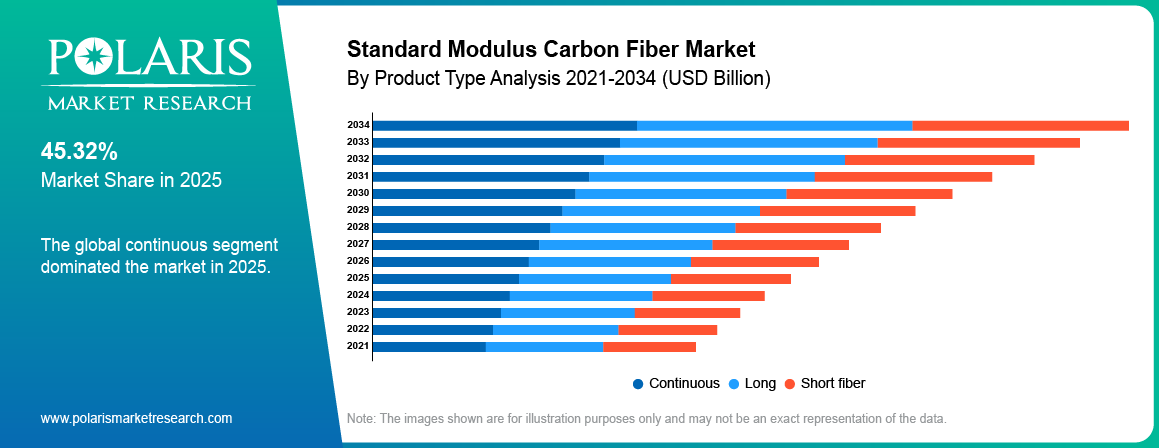
Regional Analysis
Asia Pacific Standard Modulus Carbon Fiber Market Assessment
Asia Pacific held the dominant market share in standard modulus carbon fibers due to huge production capacity in countries like China, Japan, and South Korea. Increasing production of electric vehicles and industrial composites is driving demand for lightweight materials in Asia Pacific. During China’s 14th Five-Year Plan period (2021-2025), China’s manufacturing value was projected to add USD 1.13 trillion to its economy, contributing more than 30% of global manufacturing growth.
North America Standard Modulus Carbon Fiber Market Insight
North America is expected to grow at a rapid pace during the forecast period propelled by consistent demand from the manufacturing sector of aerospace and defense products. It has also grown with a well-established manufacturing base of composite materials. High-performance carbon fiber materials have continued to be critical to various components of aircraft structures, lightweight aircraft parts, and defense products. According to the Aerospace Industries Association, US aerospace and defense exports were recorded at 138.7 billion USD from 2023 to 2024. This is an indication of strong demand globally for products made in the US.
Europe Standard Modulus Carbon Fiber Market Overview
Europe was the second largest market in standard modulus carbon fiber driven by the expansion of renewable energy production and decarbonization of industries. According to Eurostat, renewable energy contributed to 25.2% of total energy consumption in the European Union in 2024, up from 24.6% in 2023. This helped to drive demand for carbon fiber composite materials in Europe, which are used in wind turbine blades and other components of renewable energy production.
Latin America and Middle East & Africa Standard Modulus Carbon Fiber Market Assessment
Latin America and MEA carbon fiber market is growing at a moderate pace propelled by increasing trend in using corrosion-resistant composite materials in pipelines, storage tanks, and processing equipment in European industries. Composite materials are utilized to offer benefits in durability in industrial projects.
Source: Polaris Market Research Analysis
Key Players & Competitive Analysis Report
The competitive scenario of standard modulus carbon fiber is determined by the development of composite material technologies, increasing demand for composite materials in aerospace, automotive, wind power, and industrial sectors, and continuous improvement in efficiency of production processes. Manufacturers are working towards developing stronger, more consistent, and lightweight carbon fibers to cater to the increasing demand for composite material-based high-performance products.
Some of the prominent players in the standard modulus carbon fiber market are Aksa Akrilik Kimya Sanayii A.Ş., China Weihai Guangwei Composites Co., Ltd., Formosa Plastics Corporation, Hexcel Corporation, Hyosung Advanced Materials Corporation, Jiangsu Hengshen Fibre Materials Co., Ltd., Mitsubishi Chemical Corporation, Monte-Belluna S.r.l., SGL Carbon SE, Solvyti International Ltd., Synesqo SA, Teijin Limited, Toray Industries, Inc., Xiamen Tungsten Co., Ltd., and Zhongfu Shenying Carbon Fiber Co., Ltd.
Key Players
- Aksa Akrilik Kimya Sanayii A.Ş.
- China Weihai Guangwei Composites Co., Ltd.
- Formosa Plastics Corporation
- Hexcel Corporation
- Hyosung Advanced Materials Corporation
- Jiangsu Hengshen Fibre Materials Co., Ltd.
- Mitsubishi Chemical Corporation
- Monte-Belluna S.r.l.
- SGL Carbon SE
- Solvyti International Ltd.
- Synesqo SA
- Teijin Limited
- Toray Industries, Inc.
- Xiamen Tungsten Co., Ltd.
- Zhongfu Shenying Carbon Fiber Co., Ltd.
Pricing Trends, Technology & Future Outlook
-
Pricing Trends & Procurement Considerations
The standard modulus of carbon fibers is largely affected by costs related to precursors, energy consumption, and production scale. PAN is the largest component of the overall production cost of carbon fibers. Energy is another key factor in terms of its consumption in the overall process of carbonization.
-
Technology & Innovation
Automated placement of fibers is used for composite materials in aircraft and high-performance automotive structures. AI in the production of carbon fibers is used for optimizing parameters and for quality control. Development of materials is seen in terms of thermoplastic carbon fibers for faster processing and recyclability.
-
Future Market Opportunities
Carbon fibers play an essential role in hydrogen storage pressure vessels containing hydrogen used in fuel cell vehicles and energy storage devices. Sustainable initiatives are driving the recyclable carbon fibers market with emphasis on recycling fibers from composite wastes. Robotics, renewable energy equipment, and advanced manufacturing automation composites contribute to industrial demand for carbon fibers.
Industry Developments
- May 2025: Hexcel Corporation and its subsidiary company, Specialty Materials, have successfully developed a boron-fiber-infused high-modulus carbon fiber composite with the help of its Hy-Bor technology.
- June 2024: Toray Industries expanded its carbon fiber portfolio with the introduction of T720 large-tow carbon fiber, strengthening its range across standard, intermediate, and high-modulus grades.
Standard Modulus Carbon Fiber Market Segmentation
By Product Type Outlook (Revenue, USD Billion, 2021-2034)
- Continuous
- Long
- Short fiber
By Application Outlook (Revenue, USD Billion, 2021-2034)
- Composites
- Non-composites
By End Use Industry Outlook (Revenue, USD Billion, 2021-2034)
- Aerospace & defense
- Automotive
- Wind energy
- Sporting goods
- Construction
- Pipes & tanks
- Others
By Regional Outlook (Revenue, USD Billion, 2021-2034)
- North America
- US
- Canada
- Europe
- Germany
- France
- UK
- Italy
- Spain
- Netherlands
- Russia
- Rest of Europe
- Asia Pacific
- China
- Japan
- India
- Malaysia
- South Korea
- Indonesia
- Australia
- Vietnam
- Rest of Asia Pacific
- Middle East & Africa
- Saudi Arabia
- UAE
- Israel
- South Africa
- Rest of Middle East & Africa
- Latin America
- Mexico
- Brazil
- Argentina
- Rest of Latin America
Standard Modulus Carbon Fiber Market Report Scope
| Report Attributes | Details |
| Market Size in 2025 | USD 3.25 Billion |
| Market Size in 2026 | USD 3.46 Billion |
| Revenue Forecast by 2034 | USD 5.82 Billion |
| CAGR | 6.7% from 2026 to 2034 |
| Base Year | 2025 |
| Historical Data | 2021–2024 |
| Forecast Period | 2026–2034 |
| Quantitative Units | Revenue in USD Billion and CAGR from 2026 to 2034 |
| Report Coverage | Revenue Forecast, Competitive Landscape, Growth Factors, and Industry Trends |
| Segments Covered |
|
| Regional Scope |
|
| Competitive Landscape |
|
| Report Format |
|
| Customization | Report customization as per your requirements with respect to countries, regions, and segmentation. |
Source: Polaris Market Research Analysis
Standard Modulus Carbon Fiber Market FAQ's
• The global market size was valued at USD 3.25 Billion in 2025 and is projected to grow to USD 5.82 Billion by 2034.
• Asia Pacific led the market share in 2025 due to large-scale manufacturing capacity, increasing EV manufacturing, and a growing demand for industrial composite materials in China, Japan, and South Korea.
• Major applications include composite and non-composite.
• Key players in this market include Aksa Akrilik Kimya Sanayii A.?., China Weihai Guangwei Composites Co., Ltd., Formosa Plastics Corporation, Hexcel Corporation, Hyosung Advanced Materials Corporation, Jiangsu Hengshen Fibre Materials Co., Ltd., Mitsubishi Chemical Corporation, SGL Carbon SE, Teijin Limited, and Toray Industries, Inc.
• The growth of the market is fueled by the increasing use of electric vehicles, expansion of wind energy, demand for lightweight composite structures, and automation of carbon fiber manufacturing technology.
Download Sample Report of Standard Modulus Carbon Fiber Market
Please fill out the form to request a customized copy of the research report.


