
Methanol Ships Market Size, & Growth Analysis Report, 2026-2034
REPORT DETAILS
Methanol Ships Market Summary
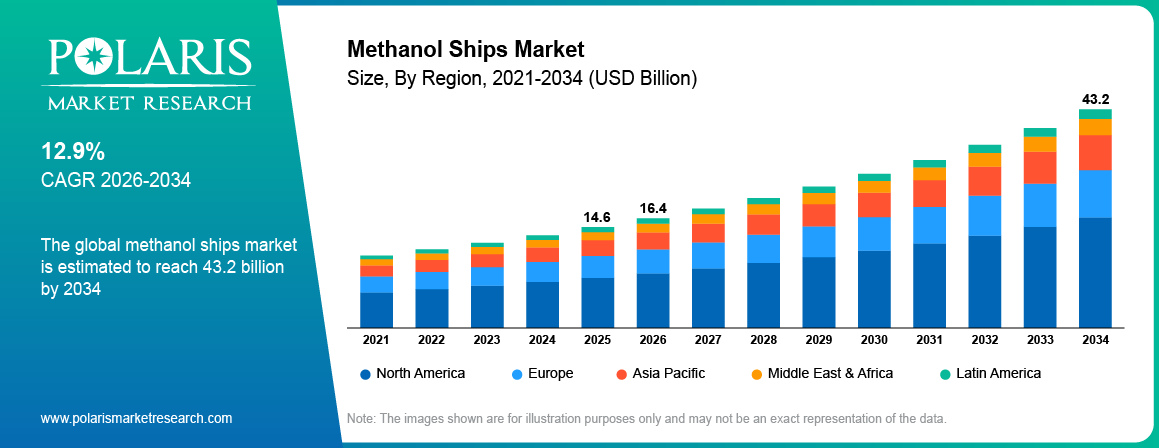
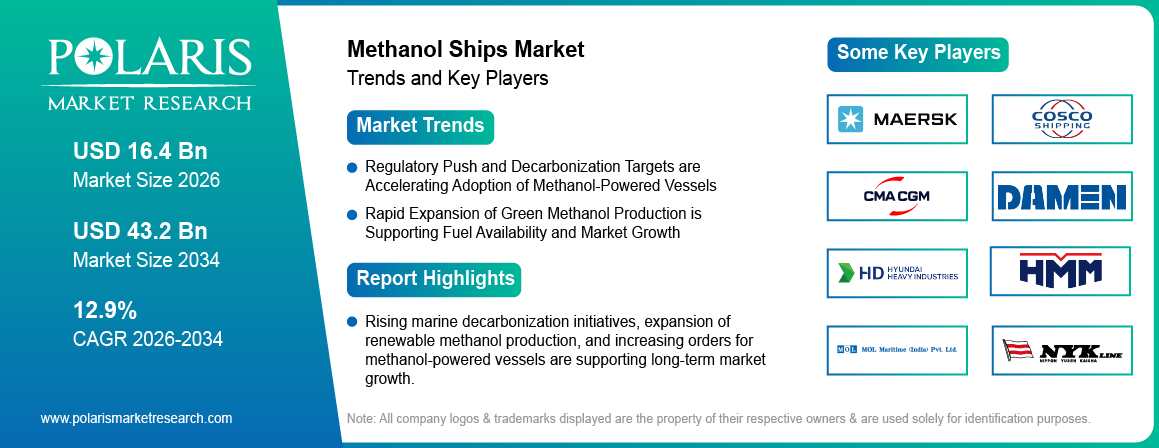
The global methanol ships market is estimated around USD 14.6 Billion in 2025,with consistent growth anticipated during 2026–2034. Growth is supported by rising focus on shipping decarbonization and increasing adoption of alternative marine fuels across the maritime industry. The market is projected to grow at a CAGR of 12.9% during the forecast period.
Market Statistics
Key Takeaways
- Container ships segment dominated the global market by 51.2% in 2025 due to strong adoption of methanol-powered vessels by major shipping operators.
- Ferries and cruise ships segment is expected to grow rapidly at CAGR of 13.5% due to rising focus on sustainable passenger transportation.
- Dual-fuel methanol segment held the largest share of 81.5% due to operational flexibility and lower fuel transition risk.
- Pure methanol segment is projected to grow at a fast pace of 13.4% CAGR due to increasing availability of green methanol fuel.
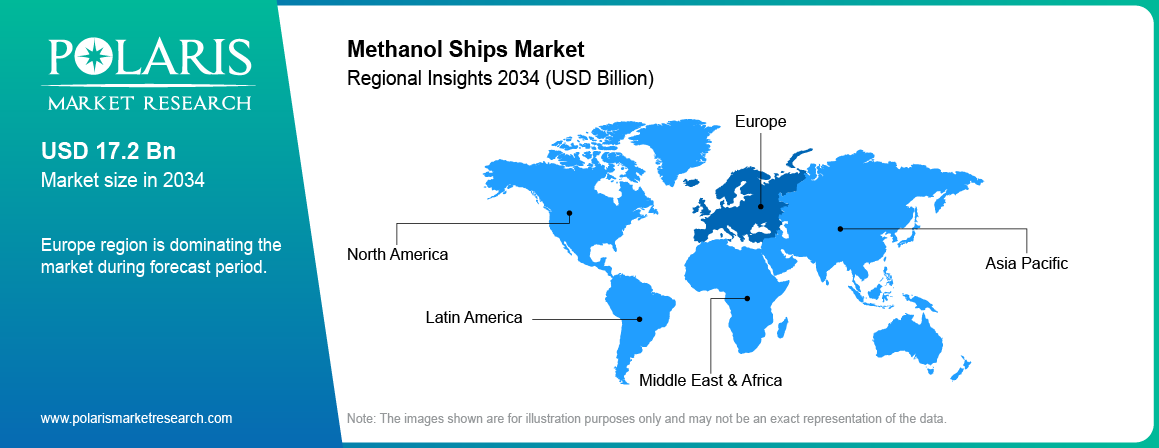
- Europe dominated the market by 38.99% market share due to strong maritime decarbonization policies and clean energy investments.
- North America methanol ships market is growing at CAGR of 13.6% due to expansion of green methanol production capacity across the US and Canada.
Industry Dynamics
- Stringent emission regulations are increasing adoption of low-carbon marine fuel solutions.
- Expansion of green methanol production is improving fuel availability for shipping operators.
- High vessel conversion and infrastructure costs are limiting adoption among smaller fleet owners.
- Development of e-methanol and bio-methanol technologies is creating long-term market opportunities.
What is Methanol Ships?
Methanol ships are built or retrofitted to run on methanol fuel. The vessels comprise containerships, tankers, and bulk carriers with engines and fuel systems that allow the use of methanol fuel. Methanol-powered ships are classified among the broader fuel transition within the industry due to their ability to generate lower levels of sulfur oxide, nitrogen oxide, and particulate emissions compared to conventional marine fuels.
The adoption of methanol as a source of fuel is increasingly common driven by its capacity to facilitate the process of de-carbonization of shipping activities and offer operational flexibility. Green methanol obtained through biomass and carbon capture technology is increasingly regarded as a green alternative to current fuels. Utilizing methanol ships by shipping companies enables them to reduce carbon intensity and achieve emission reduction objectives worldwide.
Source: Polaris Market Research Analysis
Regulatory mechanisms established by the International Maritime Organization, are encouraging the use of green shipping fuels to minimize the environmental footprint. The storage and handling aspects associated with methanol offer some benefits over other alternative fuels, thereby increasing its usage among various vessel designs.
Drivers & Opportunities
Growing Regulatory Pressure and Decarbonization Targets are Boosting Adoption of Methanol Ships: Shipping companies are transitioning into using environmentally friendly fuel options in order to adhere to the global environmental targets and reduce their carbon footprints. According to the International Maritime Organization, there are plans by the shipping sector to achieve a minimum of 40% reduction in carbon intensity in international shipping by the year 2030 with more ambitions toward achieving a 70% reduction by the year 2050.[International Maritime Organization, "shipping sector to achieve a minimum of 40% reduction in carbon intensity in international shipping by the year 2030", www.imo.org] Rising pressures to comply with regulatory emission standards have forced operators to consider methanol-fueled ships for their fleets as part of broader shipping decarbonization strategies.
Rise in the Number of Renewable Methanol Projects Boosts Market Expansion: Increasing number of renewable methanol projects is driving the development of the supply chain for wide-scale adoption of methanol ships. According to the Methanol Institute, as of March 2026, there were 263 renewable methanol projects globally with projected total capacity of 48.5 million tons of renewable methanol until 2031, out of which, 23.8 million tons of e-methanol and 24.7 million tons of bio-methanol projects.[Methanol Institute, "there were 263 renewable methanol projects globally with projected total capacity of 48.5 million tons of renewable methanol until 2031", methanol.org] Fuel availability lowers barriers to entry into the market, encouraging the shift towards alternative fuels for marine applications.
Restraints & Challenges
High Costs for Conversion and Infrastructure for Methanol Ships are Hindering the Market Expansion: Retrofitting existing vessels or building new methanol-powered ships requires significant capital investment. Additional costs related to fuel storage systems, engine modifications, and port infrastructure are creating financial challenges for shipowners. High upfront investment is slowing adoption, particularly among small and mid-sized fleet operators.
Opportunities
E-Methanol and Bio-Methanol Technologies Developments Create Long Term Growth Opportunities: Sustainable fuel technologies development helps in producing green methanol on a larger scale suitable for maritime transportation. In October 2025, European Energy introduced new green methanol technologies with an aim to increase efficiency and help produce methanol in larger quantities utilizing renewable sources of energy. Investments into research in alternative fuels are anticipated to help increase supplies of methanol in the maritime industry.
Source: Polaris Market Research Analysis
Segmental Insights
The report features in-depth analysis of the methanol ships market based on ship type, fuel type, and propulsion technology, focusing on leading and rapidly expanding segments to enable decision-makers to capitalize on lucrative opportunities associated with vessel growth and advancements in marine propulsion technologies.
By Ship Type
-
Container Ships
Container ships segment dominated the global market by 51.2% in 2025 owing to the high deployment of methanol container ships by leading shipping companies with a focus on lowering emissions and adhering to environmental laws. Methanol is widely considered by many container ships as a fuel that enables long haulage of cargo while maintaining low levels of carbon emissions. Rising global trade volumes and ongoing fleet expansion programs are supporting demand for methanol-powered container vessels.
-
Ferries & Cruise Ships
Ferries and cruise ships segment is expected to grow rapidly at CAGR of 13.5% during the forecast period due to increasing focus on sustainable passenger transport and emission reduction in coastal and short-distance routes. Operators are adopting methanol-powered systems to meet strict maritime regulations and improve environmental performance.
By Fuel Type
-
Dual-Fuel Methanol
Dual-fuel methanol segment held the largest share of 81.5% due to its operational flexibility and ability to switch between conventional fuels and methanol. Shipping companies prefer dual fuel methanol ships as they reduce risk associated with fuel availability while ensuring compliance with emission norms.
-
Pure Methanol
Pure methanol segment is projected to grow at a fast pace of 13.4% CAGR during the forecast period driven by increasing availability of green methanol and rising focus on zero-emission shipping solutions. Shipowners are exploring fully methanol-powered vessels to reduce dependency on fossil fuels.
By Propulsion Technology
-
Internal Combustion Engines
Internal combustion engine segment held the largest market share in 2025 owing to their compatibility with current vessel design and easy retrofitting to run on methanol. Internal combustion engines continue to be popular among ship owners due to their reliability, efficiency, and low cost.
-
Fuel Cells
Fuel cells segment is expected to grow at the fastest pace during the forecast period due to increasing interest in clean energy propulsion technologies. Methanol-based fuel cells offer lower emissions and higher efficiency compared to traditional systems.
Source: Polaris Market Research Analysis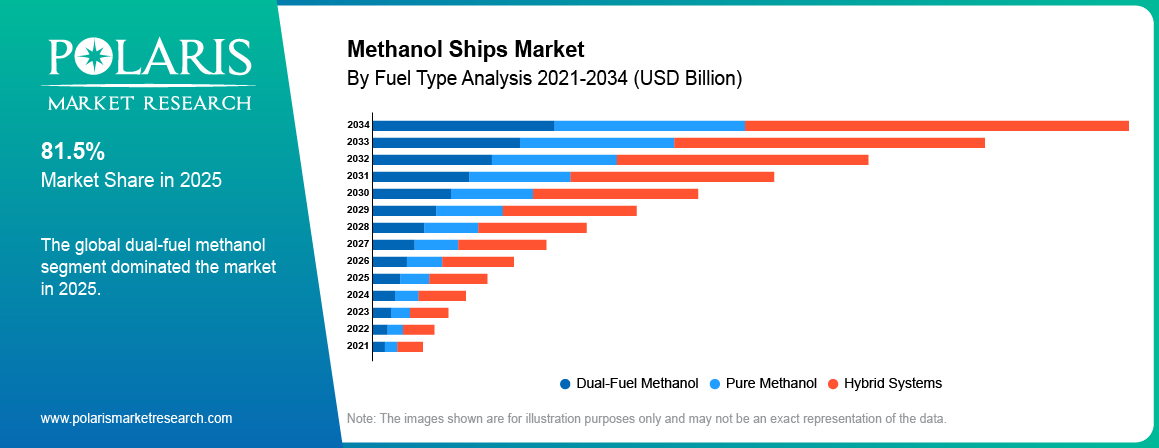
Regional Analysis
Europe Methanol Ships Market Insights
Europe dominated the market by 38.99% in 2025 due to strong regulatory frameworks and high investments in clean energy and green fuel adoption. The policies relating to decarbonization of shipping are boosting the process of transitioning into ships that use methanol for propulsion. The European Investment Bank estimates that EU nations have spent around USD 118 billion on renewable energy production in 2023, indicating that significant fund are invested on clean energy than fossil fuels.[European Investment Bank, "EU nations have spent around USD 118 billion on renewable energy production in 2023", www.eib.org] Positive shipping laws in the EU are encouraging new ship acquisitions.
Asia Pacific Methanol Ships Market Insights
Asia shipbuilding methanol ships market is expanding at the fastest pace due to strong shipbuilding capacity and infrastructure across China and South Korea. Major shipyards are increasing production of methanol-ready vessels to meet global demand. Data from China Association of the National Shipbuilding Industry shows China accounted for 46% of global completed tonnage and 63.5% of new shipbuilding orders in 2023. Output increased by 52% in 2024 to reach 87.11 million DWT.[China Association of the National Shipbuilding, "China accounted for 46% of global completed tonnage and 63.5% of new shipbuilding orders in 2023", www.ijsrtjournal.com] Expansion of shipyards Asia is supporting rapid deployment of methanol-powered fleets.
North America Methanol Ships Market Overview
North America methanol ships market is growing at CAGR of 13.6% due to expansion of green methanol production capacity across the US and Canada. Investments from companies such as OCI N.V. are strengthening fuel availability and reducing supply-side uncertainty for shipping operators. Development of low-carbon fuel infrastructure and supply chains is supporting adoption of methanol vessels in the region.
Middle East & Rest of World Methanol Ships Market Outlook
Emergence of bunkering and fuel production centers is driving growth in the methanol ships market across the Middle East region and other regions globally. While the UAE emerges as a key bunkering point for alternative marine fuels such as methanol, Brazil emerges as a producer of green methanol. The rising emphasis on sustainable shipping operations and global trade lanes continue to contribute to steady market growth.
Source: Polaris Market Research Analysis
Competitive Landscape & Key Players
The methanol ships market competition is relatively intense, with global ship companies, ship manufacturing companies, and marine engine manufacturers playing a significant part. The dynamics of the market include the capacity of the fleet, fuel efficiency, regulatory compliance, and the availability of methanol infrastructures. Firms are investing in developing fleets that use alternative fuels including dual fuels and methanol in order to meet their goals of reducing carbon emission. Innovations in marine engines, methanol fuel, and ships will play a big role in the future market competition.
Major companies operating in the methanol ships market include A.P. Moller - Maersk A/S, CHINA COSCO SHIPPING, CMA CGM Group, Damen Shipyards Group, HD Hyundai Heavy Industries Co., Ltd., Samsung Heavy Industries Co., Ltd., Shanghai Waigaoqiao Shipbuilding Co., Ltd., Yangzijiang Shipbuilding (Holdings) Ltd., MAN Energy Solutions SE, Wärtsilä Corporation, MOL (Mitsui O.S.K. Lines, Ltd.), NYK Line (Nippon Yusen Kabushiki Kaisha), HMM Co., Ltd., OCI N.V., and Waterfront Shipping Ltd.
Premium Insights
The cost effectiveness of methanol-powered vessels is very high compared to LNG-fueled vessels as the price of methanol is lower, storage is less complicated, and compliance with higher emissions is more manageable. Ship owners have begun evaluating methanol as an intermediary fuel, balancing cost and sustainability.
Pricing Benchmarks & Cost Analysis
| Ship Type | Cost Range (USD) |
| Container Ship | 120M – 160M |
| Tanker | 90M – 130M |
| Bulk Carrier | 70M – 110M |
Source: Polaris Market Research Analysis
Fuel Cost Comparison (per ton)
| Fuel | Cost (USD) |
| Methanol | 350 – 600 |
| LNG | 400 – 700 |
| Marine Diesel | 600 – 900 |
Source: Polaris Market Research Analysis
OPEX Savings
- Methanol helps reduce lifecycle emission penalties under global regulations
- Compliance costs remain lower compared to conventional marine fuels
ROI MODEL (10-Year Lifecycle)
| Metric | Methanol | LNG |
| CAPEX | Medium | High |
| Fuel Cost | Moderate | Moderate |
| Compliance Cost | Low | Medium |
| ROI | High | Medium |
Source: Polaris Market Research Analysis
Methanol vs LNG vs Ammonia
| Factor | Methanol | LNG | Ammonia |
| Storage | Easy | Complex | Complex |
| Safety | Moderate | High | Low |
| Infrastructure | Growing | Established | Limited |
| Cost | Moderate | Moderate | High |
Source: Polaris Market Research Analysis
Key Takeaway: Methanol provides a good compromise solution with easier fuel storage and infrastructure development, making it more appealing for immediate application than LNG and ammonia.
Fleet Transition Timeline
- 2025–2027: Pilot projects and early deployment of vessels
- 2028–2032: Vessel orders increasing and infrastructure development
- 2033–2035: Mass adoption supported by regulatory push and fuel availability
Investment Outlook
Methanol carriers are gaining popularity as an ROI-rich proposition for decarbonizing the maritime industry. Strong potential is visible across:
- Container shipping lines implementing fuels switching
- European maritime firms complying with stringent emissions standards
- Pioneers securing methanol green fuel procurement agreements
Global Fleet Transition Model (2025–2035)
| Year | % Methanol Fleet | New Orders Share |
| 2025 | 3% | 12% |
| 2027 | 6% | 20% |
| 2030 | 11% | 35% |
| 2035 | 18% | 50% |
Source: Polaris Market Research Analysis
Key Insight: Methanol tank adoption is poised to become more common, with an explosive growth in new shipping orders as ship owners meet decarbonization goals.
Port-Level Bunkering Intelligence (Global Map Breakdown)
Tier 1 (Fully Operational Methanol Bunkering)
- Rotterdam
- Singapore
- Shanghai
- Antwerp
Tier 2 (Expanding Infrastructure)
- Houston
- Fujairah
- Hamburg
- Busan
Tier 3 (Emerging Readiness)
- Mumbai
- Santos
- Cape Town
Strategic Insight: Early adoption of methanol fuel facilities is laying the groundwork for the emergence of some ports as global fuel centers with sustainable income streams.
Advanced Pricing Benchmarks (Deep Cost Curve)
Vessel Cost Curve (CAPEX)
| Vessel Size | Methanol Premium vs Conventional |
| Small (<10k TEU) | +8–12% |
| Mid-size | +10–15% |
| Large (>20k TEU) | +15–20% |
Source: Polaris Market Research Analysis
Key Players
- A.P. Moller - Maersk A/S
- China COSCO Shipping
- CMA CGM Group
- Damen Shipyards Group
- HD Hyundai Heavy Industries Co., Ltd.
- HMM Co., Ltd.
- MAN Energy Solutions SE
- MOL (Mitsui O.S.K. Lines, Ltd.)
- NYK Line (Nippon Yusen Kabushiki Kaisha)
- OCI N.V.
- Samsung Heavy Industries Co., Ltd.
- Shanghai Waigaoqiao Shipbuilding Co., Ltd.
- Waterfront Shipping Ltd.
- Wärtsilä Corporation
- Yangzijiang Shipbuilding (Holdings) Ltd.
Industry Developments
- January 2026: Cargill delivered its first-ever green methanol dual-fuel vessel, the Brave Pioneer, which will be used to conduct tests on performance, fuel bunkering capacity, and carbon calculations. [source: cargill.com]
- December 2025: Hapag-Lloyd ordered eight methanol-powered container ships, which is projected to be delivered from 2028 to 2029. These ships have been fitted with highly efficient engines that will improve fuel efficiency by up to 30 percent and reduce carbon dioxide emissions using methanol. [source: hapag-lloyd.com]
Methanol Ships Market Segmentation
By Ship Type Outlook (Revenue, USD Billion, 2021-2034)
- Container Ships
- Tankers
- Bulk Carriers
- Ferries & Cruise Ships
By Fuel Type Outlook (Revenue, USD Billion, 2021-2034)
- Dual-Fuel Methanol
- Pure Methanol
- Hybrid Systems
By Propulsion Technology Outlook (Revenue, USD Billion, 2021-2034)
- Internal Combustion Engines
- Fuel Cells
- Hybrid Propulsion
By Regional Outlook (Revenue, USD Billion, 2021-2034)
- North America
- US
- Canada
- Europe
- Germany
- France
- UK
- Italy
- Spain
- Netherlands
- Russia
- Rest of Europe
- Asia Pacific
- China
- Japan
- India
- Malaysia
- South Korea
- Indonesia
- Australia
- Vietnam
- Rest of Asia Pacific
- Middle East & Africa
- Saudi Arabia
- UAE
- Israel
- South Africa
- Rest of Middle East & Africa
- Latin America
- Mexico
- Brazil
- Argentina
- Rest of Latin America
Methanol Ships Market Report Scope
| Report Attributes | Details |
| Market Size in 2025 | USD 14.6 Billion |
| Market Size in 2026 | USD 16.4 Billion |
| Revenue Forecast by 2034 | USD 43.2 Billion |
| CAGR | 12.9% from 2026 to 2034 |
| Base Year | 2025 |
| Historical Data | 2021–2024 |
| Forecast Period | 2026–2034 |
| Quantitative Units | Revenue in USD Billion and CAGR from 2026 to 2034 |
| Report Coverage | Revenue Forecast, Competitive Landscape, Growth Factors, and Industry Trends |
| Segments Covered |
|
| Regional Scope |
|
| Competitive Landscape |
|
| Report Format |
|
| Customization | Report customization as per your requirements with respect to countries, regions, and segmentation. |
Source: Polaris Market Research Analysis
Methanol Ships Market FAQ's
The global market size was valued at USD 14.6 Billion in 2025 and is projected to grow to USD 43.2 Billion by 2034.
Europe dominated the market by 38.99% market share due to strong regulations and development of clean marine fuel infrastructure.
Common applications of methanol ships include container ships, bulk carriers, ferry ships, and cruise ships.
Leading companies operating in the market include A.P. Moller - Maersk A/S, CMA CGM Group, CHINA COSCO SHIPPING, MAN Energy Solutions SE, Wärtsilä Corporation, and others.
Key drivers are shipping industry decarbonization, increase in green methanol production, and stringent emission norms.
Container ships currently account for major adoption due to large-scale fleet transition programs.
At present, methanol is mostly used in container ships due to large scale of fleet conversion programs.
Yes, methanol-fueled container ships are used for long-haul international routes.
The costs differ from one ship to another depending on size, power source, and fuel technology.
Production of green methanol, use of fuel cells, and expansion of infrastructure for low-carbon vessels.
Download Sample Report of Methanol Ships Market
Please fill out the form to request a customized copy of the research report.


