
Green Methanol Market Size, Share, Trends & Forecast, 2026–2034
REPORT DETAILS
Green Methanol Market Summary
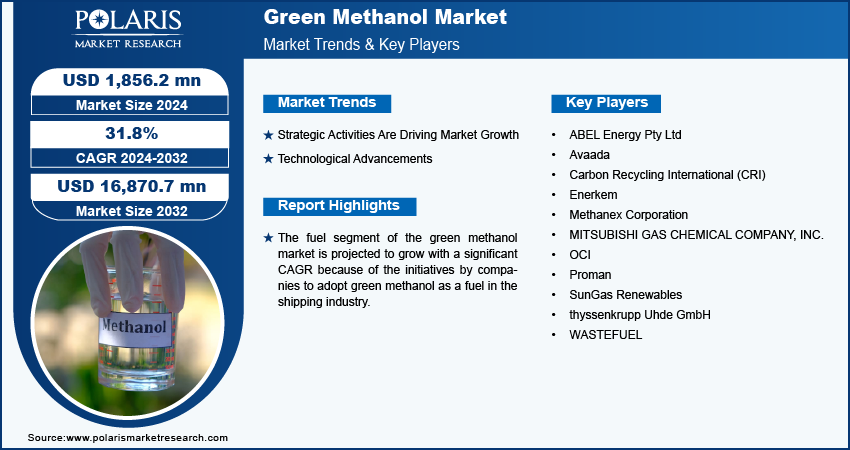
The global green methanol market size was valued at USD 5.42 billion in 2025. The market is projected to grow at an 53.3% CAGR from 2026 to 2034. The rising global focus on decarbonization and the implementation of stringent government regulations are a few of the key factors shaping the market landscape.
Market Statistics
Green Methanol Market Key Takeaways
- Asia Pacific led the global market with an 66.5% green methanol market share in 2025. This is owing to rising infrastructure development to increase the production capacity of green methanol.
- North America is projected to witness the fastest growth at an 58.7% CAGR. The regional green methanol market growth is driven by government initiatives aimed at lowering marine carbon dioxide emissions.
- The biomass segment held the largest market share of 64.2% in 2025. The segment’s leading position is attributed to its easy availability and scalable production.
- The formaldehyde segment accounted for the largest green methanol market share of 34.8% in 2025. This is owing to massive downstream volume requirements.
- The fuel segment is projected to grow at an 55.6% CAGR. The segment’s growth is driven by global blending mandates and government policies supporting renewable energy in transportation.
Note: Figures and projections outlined in this report are the result of Polaris Market Research’s proprietary analytical processes, grounded in the latest available datasets and market observations.
What Is Green Methanol?
Green methanol is methanol that has been produced using renewable energy sources and carbon-free or low-carbon-footprint raw materials instead of regular fossil fuel sources. Green methanol can either be produced by mixing renewable hydrogen with captured carbon dioxide or by using sustainable biomass. Green methanol can be used as an alternative fuel or chemical feedstock, especially in the maritime industry and other applications.
How Green Methanol Is Produced?
Green methanol can be produced either through biomass gasification or through mixing of hydrogen and carbon dioxide.
Biomass gasification: Renewable biomass is heated for the purpose of producing synthesis gas, which contains hydrogen and carbon monoxide. Synthesis gases are processed to produce methanol.
Electrolysis: Renewable energy sources are used for splitting water into hydrogen and oxygen. Hydrogen is used for producing methanol.
Carbon capture and utilization: Carbon dioxide is collected from different industries and is mixed with hydrogen. This mixture is further processed to produce methanol.
Methanol synthesis: Gases are exposed to a catalytic reaction to produce methanol. The methanol thus obtained is purified to produce pure methanol.
Green Methanol Market Dynamics
Market Drivers : Expansion of Green Methanol Production Capacity
Green methanol availability is an increasingly important consideration as companies evolve from pilot to commercial scale operations. Green methanol plants help increase regional green methanol supplies while giving producers more ability to meet demand from chemical, fuel, and other industrial consumers. Expansion is occurring in different production pathways, such as biomass-to-green methanol and e-methanol, which uses renewable hydrogen and carbon dioxide. In 2026, European Energy and Mitsui & Co. added OMV to the list of off-takers at the Kassø e-methanol plant (source: europeanenergy.com). Such offtake agreements give producers better visibility into demand when planning new production capacity. This, in turn, drives the green methanol market development.
Market Drivers : Growing Demand for Low-Carbon Chemical Feedstocks
Methanol is commonly used as a raw material in the manufacturing of various chemicals, including formaldehyde, acetic acid, plastics, and paints. As manufacturers seek to reduce carbon emissions from their products, demand for low-carbon methanol will rise in these well-known chemical industries as well. In doing so, green methanol can replace conventional methanol without altering its function in the process. In this way, the market has a demand base outside the use of methanol in transportation fuels and will expand the uses of renewable methanol as well. In June 2026, Carbon Recycling International supplied the largest e-methanol reactor for the Liaoyuan E-Methanol Project in China as the project prepares itself for commissioning in the latter part of the year (source: carbonrecycling.com). This shows how commercial e-methanol production is expanding to supply both fuel and chemical markets.
Market Challenges : High Production Costs and Supply Constraints
The production of green methanol is significantly more expensive than that of conventional methanol in many markets. Factors such as renewable energy costs, electrolyzer costs, carbon capture technology, and others may affect the viability of these projects. Another problem is the infrastructure issue, including storage infrastructure, transport logistics, and methanol bunkering facilities in ports. In many places, the infrastructure is not enough to accommodate large amounts of alternative fuels. Methanol production from biomass relies on the supply and logistics of the biomass, whereas e-methanol production is based on renewable hydrogen and CO2. The comparatively higher green methanol production cost can pose challenges when increasing production volume.
Market Opportunities : Potential Use of Green Methanol in Sustainable Aviation Fuel
Green methanol can act as an intermediate in the production of sustainable aviation fuel using the methanol-to-jet process. The aviation industry is seeking other ways to manufacture low-carbon fuels in efforts to mitigate emissions from aviation operations. Such processes would utilize renewable hydrogen and carbon dioxide, thus providing a substitute for the traditional feedstock-based processes. This represents another opportunity for green methanol suppliers to penetrate the fuel production value chain and serve other customers in the process. Increased investments in methanol-to-jet technology, aviation fuel plants, and other supporting logistics can help facilitate this opportunity. This can enable green methanol producers to diversify their market beyond the shipping and chemicals industries.
Market Opportunities : Increasing Use in Methanol Fuel Cells
Methanol fuel cells are another potential application for green methanol, especially in portable and backup power systems. Direct methanol fuel cells allow the production of electric current using methanol and do not require charging facilities that would be used with batteries. Therefore, they may find application in remote equipment, communications, power backup, and other facilities that require reliable power supply beyond the electrical grid. Using green methanol in these fuel cells will further reduce fuel-related emissions. With the development of fuel cell technology and the desire to obtain longer-lasting power sources, methanol can become more widely used in distributed energy applications. Thus, demand for green methanol will expand beyond its traditional applications.
Market Trends : Technological Advancements Supporting Green Methanol Production
Innovations in technology are making the process of methanol production more efficient by increasing the options available for producers to obtain their raw materials. Carbon capture and utilization (CCU) can extract carbon dioxide for methanol production purposes, while direct air capture provides an alternative source of carbon dioxide when no concentrated industrial sources are present. Better technologies for green hydrogen electrolysis mean that hydrogen production is more efficient, and less electricity is used. Innovations in electrolyzers can assist with controlling the supply of renewable energy that is changing over time. The concept of modular plants has been widely adopted since it allows beginning with small plants and increasing their capacity slowly. This helps to be flexible, reduces constraints, and assists in developing green methanol plants.
Market Trends : Growing Focus on Carbon Intensity Certification
The suppliers and buyers of green methanol are now giving more importance to proving the fuel’s carbon content and source. The certification process can help differentiate the methanol depending on the feedstock, production process, and associated emissions. This becomes important as companies are setting carbon reduction targets and have to document the carbon content of fuels and feedstock used for the operation. The certification process can be helpful for trading between producers and international buyers to evaluate low-carbon methanol. It enables buyers to analyze the products produced through different routes and to check if the products fulfill the sustainable requirements of the companies. Traceability of feedstock, renewable energy, and carbon capture may become important in the future for the green methanol production process.
Shipping Industry Driving Demand
The shipping industry is becoming an important area for the green methanol market as shipowners add vessels that can operate on methanol alongside conventional marine fuels. Methanol marine fuel is being considered mainly for container shipping, with interest also extending to bulk carriers, car carriers, and other vessel types. Dual-fuel methanol vessels give operators the option to use methanol while retaining fuel flexibility on routes where methanol supply is still developing. This is also increasing the need for methanol bunkering at major ports. The order pipeline shows continued interest in methanol-capable vessels. DNV recorded 61 methanol-fuelled vessel orders in 2025 (source: dnv.com). The company also noted that more than 450 methanol-capable vessels were in operation or on order by the end of 2025 (source: dnv.com). These vessels provide a future customer base for green methanol as production and bunkering infrastructure expands.
| Shipping Use Case | Company | Role of Methanol |
| Marine fuel supply | Proman | Methanol supply for marine fuel applications |
| Methanol-fuelled shipping | Methanex Corporation | Methanol used as a marine fuel in its shipping operations |
| Green methanol production | Cepsa | Green methanol production for maritime fuel applications |
| CO₂-to-methanol production | Carbon Recycling International (CRI) | Methanol production using captured CO₂ for potential marine fuel supply |
Source: Polaris Market Research Analysis
IMO Regulatory Timeline
The IMO Net-Zero Framework was approved at MEPC 83 in April 2025 (source: imo.org). The framework forms part of the draft amendments to MARPOL Annex VI and includes a global marine fuel standard based on GHG fuel intensity, along with a pricing mechanism for GHG emissions. The measures were planned for formal adoption in October 2025. However, the IMO’s extraordinary MEPC session in October 2025 was adjourned for one year, delaying the adoption process.
The framework was still under discussion at MEPC 84 in April 2026 (source: imo.org). The IMO stated that further work would continue before the resumed extraordinary session. The original timetable anticipated entry into force in 2027, following adoption and the required 16-month period. The October 2025 delay means that this timing is no longer fixed. The framework remains relevant to green methanol shipping fuel demand 2030 because its proposed fuel standard would place greater importance on marine fuels' lifecycle emissions.
Green Methanol Market Segment Insights
| Segmentation Axis | Segments |
| By Type | Biomethanol · E-Methanol |
| By Feedstock | Biomass · Carbon Capture & Storage · Green Hydrogen |
| By Production Route | Power to Methanol · Biomethane Reforming · Biomass Gasification · Waste to Methanol |
| By Derivatives | Acetic Acid · Biodiesel · Dimethyl Ether (DME) · Formaldehyde · Gasoline · Methanol-To-Olefins & Methanol-To-Propylene · Methyl Methacrylate · Methyl Tertiary Butyl Ether (MTBE) · Others |
| By Application | Chemical Feedstock · Fuel · Others |
| By Region | North America (U.S., Canada) · Europe (UK, Germany, France, Italy, Spain, Netherlands, Russia, Rest of Europe) · Asia Pacific (China, India, Japan, Malaysia, Indonesia, South Korea, Rest of Asia Pacific) · Latin America (Brazil, Mexico, Argentina, Rest of Latin America) · Middle East & Africa (Saudi Arabia, UAE, Israel, South Africa, Rest of Middle East & Africa) |
Source: Polaris Market Research Analysis
By Type
The biomethanol segment led the global green methanol market with an 59.27% share in 2025. Bio-methanol is derived from bio-feedstocks such as agricultural waste and biomass feedstocks. The production of bio-methanol serves as an alternative to the production of methanol from fossil feedstocks. Demand is driven by its application in chemical synthesis and also as an alternative low-carbon fuel. The availability of biomass feedstock also helps in the development of projects in regions that have agricultural and forestry activity. Chemical manufacturers can make use of biomethanol in the synthesis of formaldehyde and methanol derivative products. Interest from the transportation sector has become another source of demand, as there is demand for low-carbon fuels.
The e-methanol segment is projected to grow at an 51.67% CAGR. The production of e-methanol utilizes renewable hydrogen and CO2 emissions. Thus, it can decrease dependence on fossil feedstocks. This product becomes relevant for industries that look for low-carbon fuel and raw material. One of the spheres where demand arises is the marine sector, as it can operate in methanol-capable ships. Additionally, its production can be combined with renewable energy projects, especially in regions with abundant solar and wind potential. Advancements in electrolyzers are contributing to more effective hydrogen production. An increase in investment in e-methanol projects and infrastructure is projected to drive further growth during the forecast period.
| Attribute | Bio-Methanol | E-Methanol |
| Primary feedstock | Biomass: forestry residue, agricultural waste, municipal solid waste, biogas | Green hydrogen (electrolysis) + captured CO2 |
| Core process | Gasification or biogas/biomethane reforming | Power-to-methanol catalytic synthesis |
| Scalability driver | Feedstock availability and collection logistics | Renewable electricity and electrolyzer capacity |
| 2025 market position | Larger share (established, lower up-front cost) | Smaller base currently; viewed as the faster long-term-scalable route |
| Representative players | Enerkem, WasteFuel, Södra, SunGas Renewables | Carbon Recycling International, European Energy, Ansasol, C1 Green Chemicals |
| Best-fit end use | Chemical feedstock, near-term marine bunkering | Long-horizon shipping decarbonization, e-fuel blending |
Source: Polaris Market Research Analysis
By Feedstock
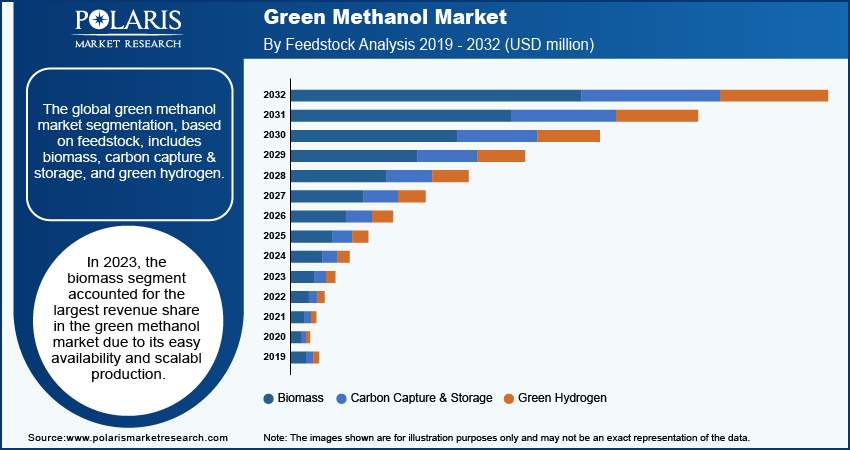
The biomass segment accounted for an 62.4% green methanol market share in 2025. The production of methanol from biomass is based on the use of proven conversion processes as well as the presence of experience in processing at commercial scale. Producers can utilize various types of conversion processes depending on the nature of the feedstock and methanol needs. Economic viability of the route depends on aspects such as cost of feedstocks, need for preprocessing, process efficiency, and distance of transportation. The existing infrastructure for processing biomass can be of help in minimizing the need for new logistics networks. In comparison to feedstocks in new routes, biomass has been utilized for production in industrial processes for a relatively longer time period. These aspects favor the use of biomass as a feedstock and support its dominance in the market.
The carbon capture and storage segment is projected to grow at an 56.8% CAGR. This feedstock route is attracting considerable interest among producers seeking to use captured carbon dioxide for their low-carbon methanol production process. This feedstock route can be used to integrate methanol plants with existing industrial carbon capture facilities, especially where there are concentrated sources of CO2 available. Project development will largely depend on access to carbon capture facilities as well as storage or utilization networks. Availability of renewable hydrogen is also an essential consideration for methanol production from carbon capture processes. With an increasing number of carbon management projects, the availability of captured CO2 may enable more methanol capacity.
By Production Route
The power to methanol segment held an 69.35% market share in 2025. The route involves the use of renewable energy to generate hydrogen through water electrolysis and the combination of carbon dioxide to form methanol. The market position is driven by the ongoing developments in renewable energy projects and developments in electrolyzers. This route can be integrated with solar and wind power production, depending on local sources of energy. Manufacturers are exploring projects that connect renewable electricity, hydrogen production, and methanol synthesis under one chain. Affordability of renewable energy is still a key driver in determining the feasibility of the project. With increasing numbers of commercial renewable hydrogen production projects, power to methanol is becoming a key production route for low-carbon methanol.
The biomethane reforming segment is projected to grow at an 54.9% CAGR. This route allows methanol producers to adapt gas-based production systems to renewable raw materials. This technology can be applicable in regions where biomethane development for energy and transportation purposes is underway. The conversion of biomethane to synthesis gas makes methanol production technology a part of the entire renewable gas value chain. The attractiveness of this route lies in initiatives to increase the role of renewable gases in industrial processes. Implementing this technology will be especially important for companies with experience in conventional reforming technologies. The segment is also expected to benefit from policies that promote renewable gas development and reduce the carbon footprint of industrial fuels and chemicals.
By Derivatives
The formaldehyde segment led the global market with an 43.8% share in 2025. One of the major derivatives of methanol is formaldehyde, which finds application in various fields of industrial manufacturing. Formaldehyde is an ingredient for the production of wood panel resins and adhesives, coatings, and other items. The need for these substances creates additional demand for methanol from the formaldehyde producers. The growing push to reduce carbon content in chemical feedstocks is boosting the popularity of green methanol in this segment. Manufacturers can use green methanol in their formaldehyde production processes, provided all necessary conditions are met. Demand for formaldehyde-based products in the construction and manufacturing industries further contributes to the segment's dominance in the green methanol market.
The methanol-to-olefins & methanol-to-propylene segment is projected to grow at an 52.7% CAGR. Methanol-to-olefins (MTO) and methanol-to-propylene (MTP) processes use methanol as the input and convert it to olefinic products, which act as the raw material for the chemical industry. Propylene made from these processes is used in polypropylene, plastics, and other chemical products. The demand for products from downstream processes will drive the use of methanol in these applications. Green methanol can also provide chemical companies with a low-carbon raw material for certain chemical processes. With increasing demand for renewable sources of chemical raw materials, MTO and MTP could be another application for green methanol other than fuel.
By Application
The chemical feedstock segment accounted for the largest green methanol share of 63.88% in 2025. Methanol is extensively used as the basic raw material for the production of various chemicals and derivatives. It is used for the manufacturing of formaldehyde, acetic acid, dimethyl ether, and others. This extensive use ensures that chemical feedstocks maintain a steady demand for methanol. Green methanol provides manufacturers with the opportunity to substitute some of the conventional methanol used in the chemical industry with green methanol. Growing interest in low-carbon raw materials prompts chemical producers to evaluate the potential of renewable methanol.
The fuel segment is projected to grow at an 55.6% CAGR. Green methanol is currently being considered as an alternative source of fuel for shipping and other forms of transportation that require fuels with lower carbon emissions. The use of green methanol in methanol-compatible ships increases the scope of potential demand, especially for the shipping industry. Green methanol can either be mixed with fuel or used as fuel in selected applications. Development of methanol bunkering helps meet the needs of fuel supply at ports. Increased interest by ship owners and fuel providers also supports investments in the methanol fuel industry. The future growth in the industry will depend on the availability of competitive green methanol fuel and its infrastructure.
Green Methanol Market Regional Insights
Asia Pacific
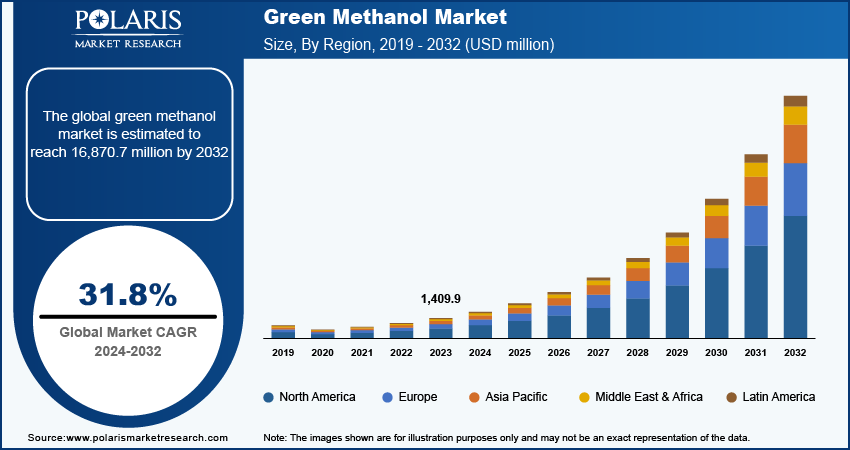
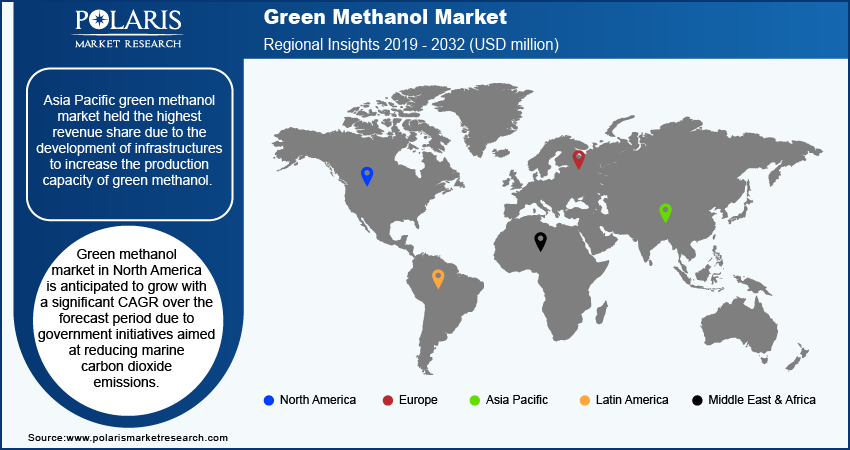
Asia Pacific accounted for the largest green methanol market share of 66.5% in 2025. The presence of an established methanol market, along with considerable consumption in the chemicals and other industrial applications, creates a basis for the introduction of reduced-carbon methanol variants. In addition, there is a shift towards the development of renewable energy in several countries within the region, thus offering a positive environment for projects based on renewable hydrogen. Major ports and maritime transport networks offer another opportunity for the implementation of green methanol as a fuel for ships. At the same time, developments in carbon capture technologies and renewable gas projects expand feedstock opportunities. Industrial decarbonization efforts by governments create additional incentives for companies to consider alternative fuels and chemicals. These factors help ensure the Asia Pacific region's leadership in the market.
North America
North America is projected to witness rapid growth at an 58.7% CAGR. There has been increasing interest in the use of low-carbon fuels in the region as industries try to cut back emissions in energy and chemicals production. Investments in renewable energy and green hydrogen have increased the potential to build the foundation for e-methanol projects. The region also has existing capabilities for producing chemicals, which can be used to increase the potential for using green methanol as a lower-carbon feedstock. Another area of demand that is likely to increase in the future is that of the maritime industry as the ports and shipping firms evaluate methanol as a marine fuel. Carbon capture programs will help enhance the production process by supplying carbon dioxide for methanol production. Policies and firms' decarbonization goals are also boosting investment in new fuel technologies.
Europe
Europe held an 19.6% share of the global green methanol market in 2025. There is high demand for low-carbon fuels as there is a push in the region to reduce transport and industrial emissions. The shipping industry is one of the sectors that has been receiving attention as methanol is explored as an alternative fuel option for new and old vessels. Europe also has existing renewable energy projects that can supply the green hydrogen needed for e-methanol. Another potential demand generator for methanol is the chemical industry. There have been investments in carbon capture and renewable fuel projects in order to produce additional capacity. The regulatory push for reducing emissions from transport and industry has also been contributing to the demand for cleaner fuel options. These factors are contributing to the growth of the green methanol market in Europe.
Latin America
Latin America is projected to grow at an 50.8% CAGR. The region has significant potential for green methanol production due to the availability of renewable energy sources and feedstocks for biomass methanol production. Further investment in renewable energy projects, such as solar or wind energy projects, can contribute to green hydrogen production for e-methanol production. Agricultural and forest sector activities within the region can contribute to biomass methanol feedstocks. Additional demand for green methanol can come from the chemical sector as a less carbon-intensive feedstock alternative. In addition, various ports across the region can provide a market opportunity for methanol to be used for marine transportation purposes by shipping companies considering alternatives to fossil fuels. Growing attention to industrial decarbonization and renewable fuels can help expand market demand in Latin America.
Middle East & Africa
The Middle East & Africa green methanol market is anticipated to account for an 48.9% CAGR. Interest in green methanol is driven by the strong potential of solar and wind power to produce hydrogen from renewable sources. Infrastructure and industrial capacity can also assist in implementing new fuel projects that have a low carbon footprint. Some countries are investigating hydrogen and renewable fuel projects as a way to diversify their energy sectors. Green methanol is also a good raw material for chemical companies. Major ports in the region provide possibilities for using methanol in the maritime industry. Carbon capture and renewable energy projects can also be used to produce local methanol. This creates opportunities to develop green methanol projects in the Middle East & Africa.
Competitive Insights
The green methanol market is fragmented, with competition shaped by project size, technology licensing, production efficiency, and customer relationships. Traditional energy and chemicals companies have begun competing in this area, together with specialist developers of low-carbon methanol facilities. Companies are leveraging partnerships to increase their influence within different phases of the value chain. Technology firms are partnering with project developers to enhance methanol synthesis technologies and minimize production costs.
Collaboration with fuel producers and consumers can help secure long-term supply agreements. Some green methanol market players are exploring new business opportunities by investing in hydrogen, carbon management, and renewable energy sectors. Intellectual property rights, experience in executing projects, and sources of finance will become increasingly important criteria during the progression of projects from development to production.
| Company | Primary feedstock focus | Positioning |
| Biomass · Green hydrogen · CO₂ | Green methanol project developer, biomass and e-methanol | |
| ANDRITZ | Biomass | Technology provider, biomass-to-methanol |
| Avaada | Green hydrogen · CO₂ | Renewable energy developer, green hydrogen and e-methanol |
| C1 Green Chemicals AG | Biomass · Green hydrogen | Technology developer, renewable methanol production |
| Carbon Recycling International (CRI) | CO₂ · Green hydrogen | Technology licensor, CO₂-to-methanol |
| Cepsa | Green hydrogen · CO₂ | Integrated energy company, green methanol and hydrogen |
| China Tianying (CNTY) | Waste biomass | Waste-to-methanol developer |
| Element 1 Corp. | Methanol | Technology provider, methanol-to-hydrogen |
| Enerkem | Municipal solid waste | Waste-to-methanol specialist |
| Biomass · CO₂ · Green hydrogen | Integrated methanol producer, low-carbon methanol | |
| Mitsubishi Gas Chemical Company, Inc. | Biomass · CO₂ | Integrated chemical producer, low-carbon methanol |
| Proman | Biomass · Green hydrogen · CO₂ | Integrated methanol producer, renewable methanol |
| Shenergy Group | Green hydrogen · CO₂ | Energy company, e-methanol project development |
| Södra | Biomass | Forest industry producer, biomass-based methanol |
| SunGas Renewables | Biomass | Technology provider, biomass gasification |
| thyssenkrupp Uhde GmbH | Green hydrogen · CO₂ | Technology licensor, power-to-methanol |
| Veolia | Municipal solid waste · Biomass | Waste-to-fuel developer, waste-derived methanol |
| WasteFuel
| Municipal solid waste
| Developer of waste-to-methanol projects using non-recyclable municipal solid waste |
Source: Polaris Market Research Analysis
Green Methanol Industry Developments
- August 2026: HyOrc received approval for a €6.7 million grant to support its waste-to-methanol project in Portugal. The project is developing a waste-based methanol production unit, with delivery of the first European unit targeted for September 2026. (source: globenewswire.com)
- July 2026: ETFuels selected the Port of Immingham in the UK for its e-SAF project. The planned facility will use green methanol produced in Texas as feedstock for methanol-to-jet production, linking green methanol with the sustainable aviation fuel value chain. (source: et-fuels.com)
Research Methodology
The green methanol research report follows a top-down and bottom-up sizing approach, cross-validated through data triangulation. Secondary research draws on company annual reports and investor presentations, regulatory filings (IMO/MEPC documentation, MARPOL Annex VI amendments), trade association publications (Methanol Institute), and verified industry news on plant announcements, offtake agreements, and newbuild ship orders (Clarksons, DNV). Primary research includes structured interviews with supply-side stakeholders, including feedstock suppliers, methanol producers, and EPC/technology licensors. Demand-side stakeholders interviewed include shipping lines, chemical manufacturers, and fuel distributors. These research approaches help validate capacity, pricing, and adoption assumptions.
Market sizing is built by feedstock (biomass, green hydrogen, carbon capture & storage), derivative, application, and region, with country-level detail for markets showing material policy or capacity activity. Forecast assumptions explicitly account for policy-timeline sensitivity (in particular, the IMO Net-Zero Framework's delayed adoption path) given its direct bearing on shipping-sector demand projections for green methanol as a marine fuel. Data triangulation reconciles top-down macro estimates with bottom-up capacity and offtake data; material divergences between sources are disclosed rather than silently averaged. All figures are dated to a stated base year and revisited at each scheduled content refresh.
Green Methanol Market Report Scope
| Report Attributes | Details |
| Market Size Value in 2025 | USD 5.42 billion |
| Market Size Value in 2026 | USD 8.74 billion |
| Market Forecast 2034 | USD 409.38 billion |
| CAGR | 53.3% from 2026 to 2034 |
| Base Year | 2025 |
| Historical Data | 2021–2024 |
| Forecast Period | 2026–2034 |
| Quantitative Units | Revenue in USD billion and CAGR from 2026 to 2034 |
| Report Coverage | Revenue Forecast, Market Competitive Landscape, Growth Factors, and Industry Trends |
| Segments Covered |
|
| Regional Scope |
|
| Competitive Landscape |
|
| Report Format |
|
| Customization | Report customization as per your requirements with respect to countries, regions, and segmentation. |
Source: Polaris Market Research Analysis
Green Methanol Market FAQ's
The green methanol market size was valued at USD 5.42 billion in 2025. The market is anticipated to reach USD 409.38 billion by 2034.
The market is projected to account for a CAGR of 53.3% from 2026 to 2034.
Asia Pacific accounted for the largest green methanol market share of xx% in 2025. This is due to rising infrastructure development to increase the production capacity of green methanol.
The fuel segment is projected to witness the fastest growth at an 55.6% CAGR. This is due to government policies supporting renewable energy in transportation.
A few of the key market players include ABEL Energy Pty Ltd; ANDRITZ; Avaada; C1 Green Chemicals AG; Carbon Recycling International (CRI); Cepsa; China Tianying (CNTY); Element 1 Corp.; Enerkem; Methanex Corporation; Mitsubishi Gas Chemical Company, Inc.; Proman; Shenergy Group; Södra; SunGas Renewables; thyssenkrupp Uhde GmbH; Veolia; and WasteFuel.
Green methanol is made from renewable or low-carbon inputs. On the other hand, grey methanol is mainly produced from fossil-based feedstocks such as natural gas or coal. This difference affects production emissions. Green methanol can have a much lower carbon footprint when it uses renewable energy and suitable feedstocks.
Not necessarily. Green methanol can have low lifecycle emissions. But it is not automatically carbon neutral. The result depends on how the methanol is produced and where its carbon and energy inputs come from.
Download Sample Report of Green Methanol Market
Please fill out the form to request a customized copy of the research report.


