
Long Fiber Thermoplastics Market Size, Share, Trends | Report 2034
REPORT DETAILS
Long Fiber Thermoplastics Market Summary
The global long fiber thermoplastics market is estimated around USD 6.4 Billion in 2025,with consistent growth anticipated during 2026–2034. Growth is supported by rising demand for lightweight and high-strength materials across automotive, aerospace, and industrial sectors. The market is projected to grow at a CAGR of 9.6% during the forecast period.
Market Statistics
Key Takeaways
- Glass fiber LFT segment dominated in 2025 with 80.9% revenue due to strong demand for lightweight and cost-effective reinforced polymers.
- Carbon fiber LFT segment is expected to grow rapidly at CAGR of 10.2% due to increasing use in high-performance automotive and aerospace applications.
- LFT-D segment is witnessing steady growth rate of 10.3% due to higher manufacturing efficiency and lower production cost.
- LFT-G segment held the largest share of 61.5% market due to due to improved fiber retention and consistent material quality.
- Asia Pacific dominated the market by holding 43.78% revenue share due to strong manufacturing base and increasing EV production.
- North America thermoplastics market holds approximately 22% revenue share due to advanced automotive and aerospace industries.
Industry Dynamics
- Rising electric vehicle production is increasing demand for lightweight thermoplastic materials.
- Growing focus on sustainable and recyclable polymers is supporting market adoption.
- High cost of carbon fiber materials is limiting penetration in price-sensitive applications.
- Advancements in direct long-fiber thermoplastic processing technologies are creating new manufacturing opportunities.
What is Long Fiber Thermoplastics?
Long fiber thermoplastics are advanced composite materials made by reinforcing thermoplastic resins with long glass or carbon fibers to improve mechanical strength, stiffness, and impact resistance. The materials has great utility in applications such as car plastics, aircraft parts, heavy machinery, and other consumer items, especially those requiring lightweight but extremely strong materials. The advantages of using long fiber thermoplastics includes properties like corrosion resistance, versatility, and recyclability, making them perfect replacements for conventional metals and short fiber plastics.
The market has recorded tremendous growth driven by increased use of lightweight materials in sectors such as manufacturing and transportation. The market is experiencing rising demand from the automobile OEMs as manufacturers replace conventional metals with long fiber thermoplastics in order to improve fuel efficiency and reduce vehicle weight.
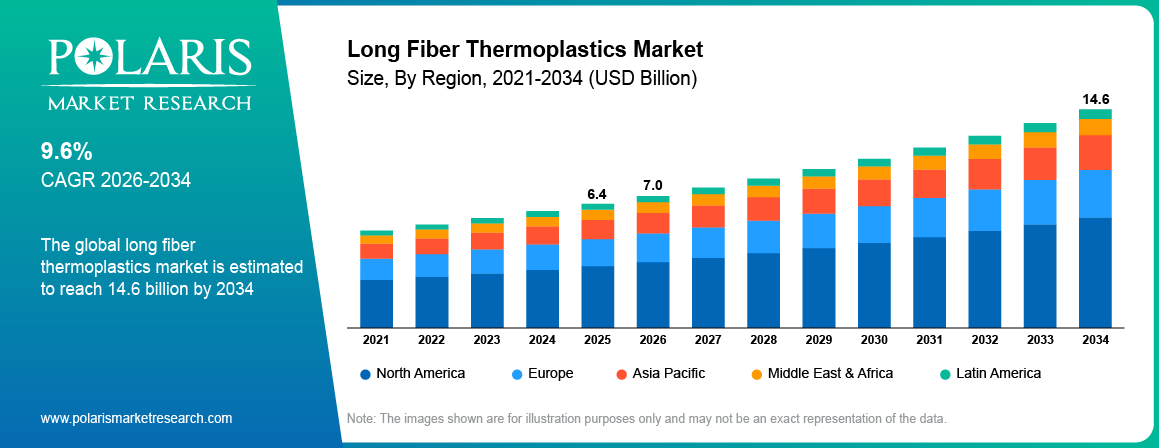
Source: Polaris Market Research Analysis
This sustainability movement is propelling companies to rely on recyclable materials which provide efficiency in terms of energy while manufacturing products. With technological advancement in the processing of polymers and fiber reinforced composites, they have become very efficient in performance and commercial application. The industry is expected to grow steadily during the forecast period owing to the growing demands for OEM goods, industrial automation, and sustainability manufacturing practices.
Drivers & Opportunities
Growing Number of Electric Cars Driving Increase in Thermoplastics Demand: Long fiber thermoplastic is used by automobile manufacturers to reduce the weight of vehicles and enhance their fuel efficiency and battery efficiency. According to the International Energy Agency report, in 2024, over 17 million electric cars have been produced around the world and that represents a more than 25% increase from the previous year. Within a single year, additional 3.5 million electric cars have been produced than the total number of electric vehicles that were sold in the year 2020.[International Energy Agency, "over 17 million electric cars have been produced around the world in 2024", www.iea.org] The production of lightweight electric cars is driving the use of advanced composite material like long fiber thermoplastics.
Rise in Demand for Eco-Friendly Polymers is Fueling the Use of Recyclable Composites: Organizations operating in the automobile manufacturing industry and packaging industry have been utilizing eco-friendly materials with high recyclability. In January 2026, INEOS launched the Recycl-IN hybrid polymer grade made of 70% recycled content for high-quality cosmetic packaging applications.[INEOS, "launched the Recycl-IN hybrid polymer grade made of 70% recycled content", www.ineos.com] The polypropylene composite material provides mechanical properties equivalent to virgin grades of polymers but cuts down the carbon emissions by almost 35%. Increasing sustainability targets and carbon reduction initiatives are encouraging wider use of advanced thermoplastic composites.
Restraints & Challenges
Higher Price of Carbon Fiber Reinforcement Material is Hinder Market Growth on a Large Scale: The advantages of carbon fiber reinforced thermoplastics are high strength and light weight. However, the cost of production is much higher when compared to conventional material. Higher raw materials prices along with complicated manufacturing processes lead to increased costs of components and limit usage in cost-sensitive applications and small manufacturing facilities.
Opportunities
Developments in D-LFT Processing Techniques Provide New Manufacturing Options: New developments are made constantly in molding techniques in order to increase efficiency of production process. For instance, SABIC launched its MEGAMOLDING platform back in August 2025 that allows improving large thermoplastic molding through advanced molding technology.[SABIC, "launched its MEGAMOLDING platform”, www.sabic.com] Next generation D-LFT manufacturing equipment is helping the usage of lightweight composite material in various industries such as automobile sector.
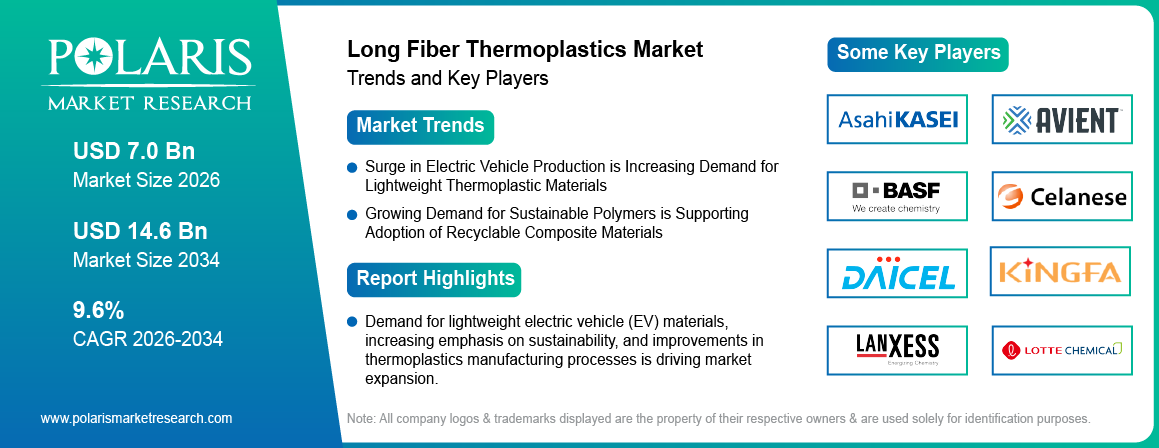
Source: Polaris Market Research Analysis
Segmental Insights
The present report offers a comprehensive analysis of the long fiber thermoplastics market segmented on the basis of material type, manufacturing process, and application, which help stakeholders comprehend material segments and identify lucrative growth prospects within polymers applications.
By Material Type
-
Glass Fiber LFT
Glass fiber LFT segment dominated in 2025 with 80.9% revenue owing to the increasing requirement of lightweight and economic reinforced polymers in automotive and industrial applications. The high impact resistance and durability along with excellent mechanical strength make glass fiber thermoplastics ideal for structural applications.
-
Carbon Fiber LFT
Carbon fiber LFT segment is expected to grow rapidly at CAGR of 10.2% during the forecast period owing to the increasing need for lightweight and high-performance materials. The unique attributes of carbon fiber LFT make it apt for aerospace, automotive, and industrial applications.
By Manufacturing Process
-
LFT-D
LFT-D segment is witnessing steady growth rate of 10.3% owing to the combination capability of the compounding and molding process within the same production line. LFT-D manufacturing process is favored by manufacturers over LFT-G manufacturing process owing to the large-scale production of automotive and industrial products.
-
LFT-G
LFT-G segment held the largest share of 61.5% market due to the rising demands for long fiber thermoplastics with consistent material qualities. The LFT-G manufacturing process allows better fiber length and higher mechanical properties. The use in the manufacture of industrial thermoplastics and strong components is aiding the segment’s growth.
By Application
-
Automotive
Automotive segment dominated the market in 2025 due to rising automotive LFT demand for lightweight, durable, and recyclable vehicle components. Long fiber thermoplastics are increasingly used in front-end modules, underbody shields, battery housings, and structural EV components.
-
Industrial Applications
Industrial applications segment is expected to register the fastest growth during the forecast period due to increasing use of long fiber thermoplastics in machinery materials, construction equipment, and industrial tools. Manufacturers are adopting reinforced polymers to improve durability, corrosion resistance, and operational efficiency.
Source: Polaris Market Research Analysis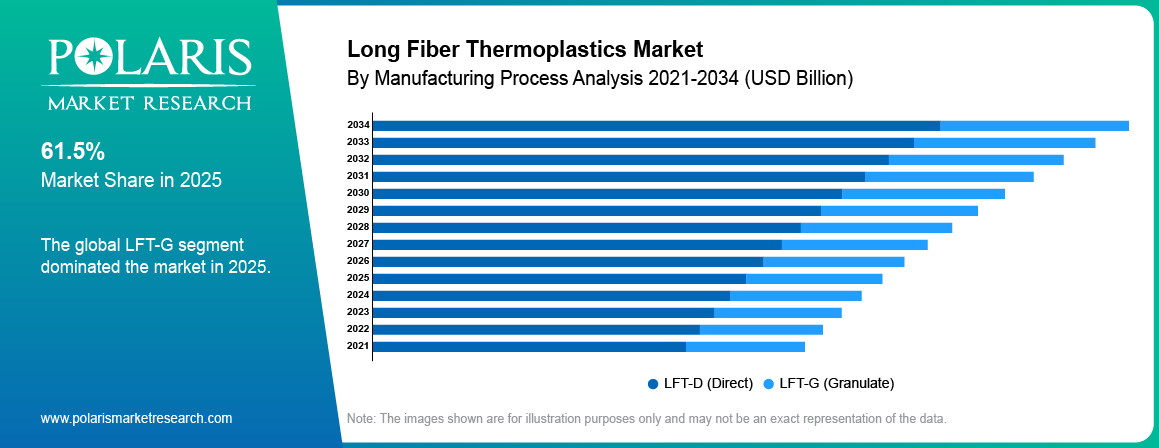
Regional Analysis
Asia Pacific Long Fiber Thermoplastics Market Insights
Asia Pacific dominated the market by holding 43.78% revenue share due to its strong manufacturing base and government initiatives promoting electric vehicle adoption. China continues to be an important player with its high manufacturing volumes of electric vehicles and lightweight automotive components. In 2024, electric cars comprised nearly 50 percent of the overall car sales in China, with over 11 million cars sold in that period according to International Energy Agency.[International Energy Agency, "electric cars comprised nearly 50 percent of the overall car sales in China", www.iea.org] Rising China thermoplastics demand and manufacturing growth are supporting wider use of long fiber thermoplastics across automotive and industrial applications.
North America Long Fiber Thermoplastics Market Overview
North America thermoplastics market holds approximately 22% revenue due to advanced automotive and aerospace industries. Demand for lightweight and high-strength materials is increasing across EV production and aircraft manufacturing. Data from Aerospace Industries Association shows that the aerospace and defense industry generated USD 955 billion in total business output in 2023.[Aerospace Industries Association, "the aerospace and defense industry generated USD 955 billion in total business output in 2023", www.aia-aerospace.org] Increasing focus on aerospace materials and EV adoption is driving the use of long fiber thermoplastics in the region.
Europe Long Fiber Thermoplastics Market Insights
Europe LFT market is expanding due to stringent sustainability regulations and emissions reduction targets introduced by bodies such as the European Commission. Increasing use of eco-friendly materials by automakers enhances vehicle fuel economy and reduces emissions. The use of recyclable and lightweight composites continues to propel industry growth in the transportation and industrial segments.
Rest of the World Long Fiber Thermoplastics Market Outlook
Long fiber thermoplastics industry in Latin America and Middle East region is experiencing steady growth owing to industrialization and infrastructure development. Growing manufacturing operations and transportation projects are creating rising demand for durable composites.
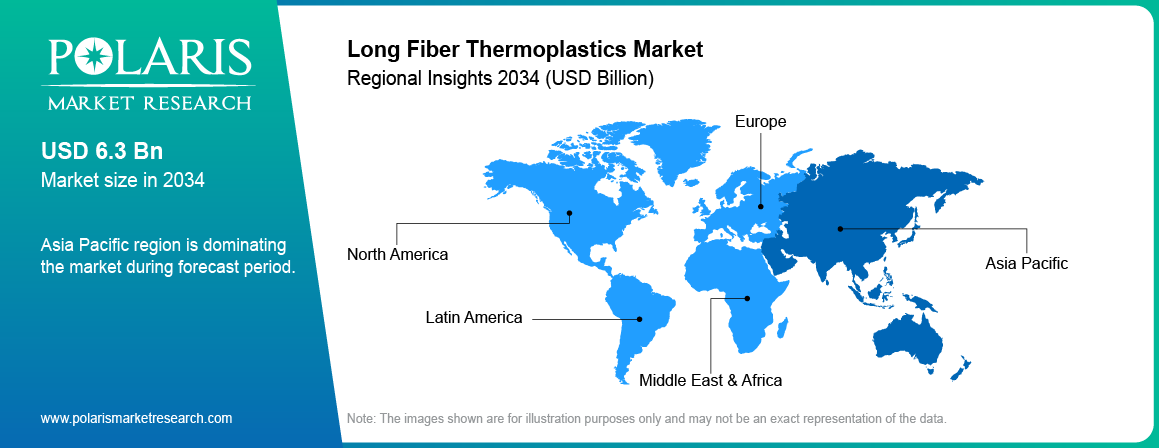
Source: Polaris Market Research Analysis
Competitive Landscape & Key Players
The long fiber thermoplastics industry is slightly concentrated, with competition characterized by global chemical firms, reinforced plastic producers, and composite materials providers. Competition in the market revolves around product performance, innovation in materials, production capabilities, and efficiency. Market players are focusing more on the development of light and strong thermoplastics owing to the rising demand in the automotive, aerospace, and industrial industries. The growing preference for recyclable composites and technological advancements are affecting competition dynamics in the market. Strategic alliances, capacity augmentation, and R&D are aiding the growth of the long fiber thermoplastics industry.
Leading firms in the long fiber thermoplastics industry are Asahi Kasei Corporation, Avient Corporation, BASF SE, Celanese Corporation, Daicel Corporation, Kingfa Science & Technology Co., Ltd., LANXESS AG, Lotte Chemical Corporation, Mitsubishi Chemical Group Corporation, RTP Company, SABIC, SGL Carbon SE, Solvay SA (Syensqo), Toray Industries, Inc., and Xiamen LFT Composite Plastic Co., Ltd.
Strategic Trends
- Increasing investments made in sustainable and recyclable composite materials are driving innovation in the market
- Product manufacturers are investing heavily in establishing their production and distribution systems in developing countries to capitalize on the increasing demand from such regions
- Collaboration between composite materials companies and OEMs is improving product design and increasing usage of materials in specific applications
Premium Insights
Increasing demands are witnessed from sectors such as automotive, aerospace, and industrial for lightweight LFTs, owing to their lightweight construction and corrosion resistance properties. The use of LFT materials to replace metals in automotive is gaining more importance due to its lightweight and strength.
Electric vehicles are witnessing a rise in production, and this factor is also increasing the demand for advanced LFT composites. Advancements in D-LFT processing technology and collaborations among thermoplastics manufacturers and OEMs are making progress in the market.
Development of technologies in D-LFT manufacturing along with collaboration between thermoplastics producers and automobile manufacturers is enhancing productivity.
Key Players
- Asahi Kasei Corporation
- Avient Corporation
- BASF SE
- Celanese Corporation
- Daicel Corporation
- Kingfa Science & Technology Co., Ltd.
- LANXESS AG
- Lotte Chemical Corporation
- Mitsubishi Chemical Group Corporation
- RTP Company
- SABIC
- SGL Carbon SE
- Solvay SA (Syensqo)
- Toray Industries, Inc.
- Xiamen LFT Composite Plastic Co., Ltd.
Industry Developments
- July 2021: Avient Corporation launched moisture-resistant nylon 6 and 6/6 Complēt long fiber thermoplastic composites designed to improve structural stability and surface aesthetics in humid and water-exposed environments. [source: avient.com]
Long Fiber Thermoplastics Market Segmentation
By Material Type Outlook (Revenue, USD Billion, 2021-2034)
- Glass fiber LFT
- Carbon fiber LFT
- Hybrid fiber systems
By Manufacturing Process Outlook (Revenue, USD Billion, 2021-2034)
- LFT-D (Direct)
- LFT-G (Granulate)
By Application Outlook (Revenue, USD Billion, 2021-2034)
- Automotive
- Industrial
- Electrical & Electronics
- Other
By Regional Outlook (Revenue, USD Billion, 2021-2034)
- North America
- US
- Canada
- Europe
- Germany
- France
- UK
- Italy
- Spain
- Netherlands
- Russia
- Rest of Europe
- Asia Pacific
- China
- Japan
- India
- Malaysia
- South Korea
- Indonesia
- Australia
- Vietnam
- Rest of Asia Pacific
- Middle East & Africa
- Saudi Arabia
- UAE
- Israel
- South Africa
- Rest of Middle East & Africa
- Latin America
- Mexico
- Brazil
- Argentina
- Rest of Latin America
Long Fiber Thermoplastics Market Report Scope
| Report Attributes | Details |
| Market Size in 2025 | USD 6.4 Billion |
| Market Size in 2026 | USD 7.0 Billion |
| Revenue Forecast by 2034 | USD 14.6 Billion |
| CAGR | 9.6% from 2026 to 2034 |
| Base Year | 2025 |
| Historical Data | 2021–2024 |
| Forecast Period | 2026–2034 |
| Quantitative Units | Revenue in USD Billion and CAGR from 2026 to 2034 |
| Report Coverage | Revenue Forecast, Competitive Landscape, Growth Factors, and Industry Trends |
| Segments Covered |
|
| Regional Scope |
|
| Competitive Landscape |
|
| Report Format |
|
| Customization | Report customization as per your requirements with respect to countries, regions, and segmentation. |
Source: Polaris Market Research Analysis
Long Fiber Thermoplastics Market FAQ's
The global market size was valued at USD 6.4 Billion in 2025 and is projected to grow to USD 14.6 Billion by 2034.
Asia Pacific dominated the market by holding 43.78% revenue share due to strong automotive manufacturing and increasing EV production.
Major applications include automotive components, aerospace structures, industrial machinery, and consumer goods.
Key players include BASF SE, SABIC, Celanese Corporation, LANXESS AG, Mitsubishi Chemical Group Corporation, and others.
Key drivers include rising EV production, lightweight material demand, and increasing focus on sustainable composites.
Major demand comes from automotive, aerospace, industrial equipment, and construction sectors.
LFT-D stands for long fiber thermoplastic direct process, whereas LFT-G denotes long fiber thermoplastic granulate process.
The utilization of thermoplastics ensures less vehicle weight, energy-efficient batteries, and light design.
The cost of long fiber thermoplastics is around USD 3–15 per kilogram depending on fiber and resin composition.
Yes, there are many long fiber thermoplastics which can be recycled.
Download Sample Report of Long Fiber Thermoplastics Market
Please fill out the form to request a customized copy of the research report.


