
Thermal Printer Market Share, Size, Trends, Industry Analysis Report, 2026 - 2034
REPORT DETAILS
Thermal Printer Market Summary
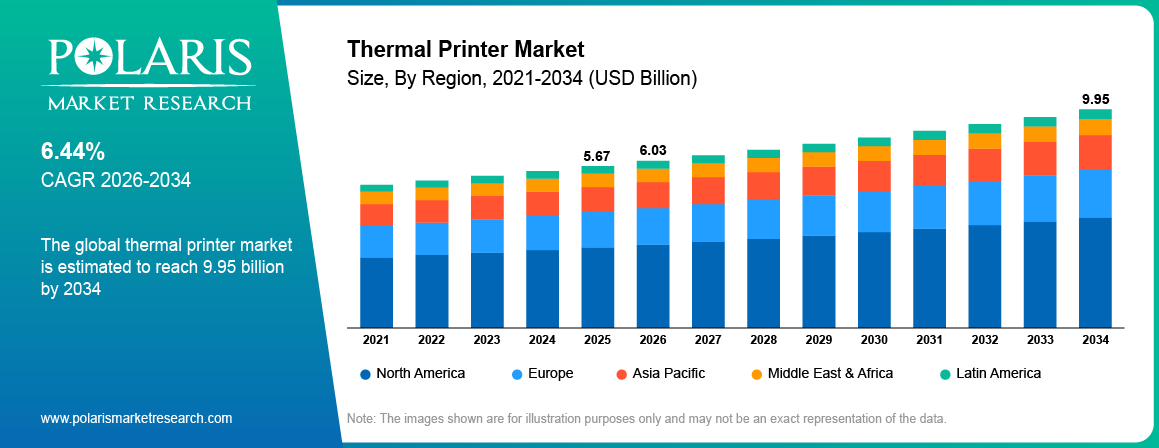
The global thermal printer market is estimated around USD 5.67 Billion in 2025,with consistent growth anticipated during 2026–2034. This growth is driven by rising e-commerce shipments and expanding retail chains that are increasing demand for efficient thermal printing solutions across global markets. The market is projected to grow at a CAGR of 6.44% during the forecast period.
Market Statistics
Key Insights
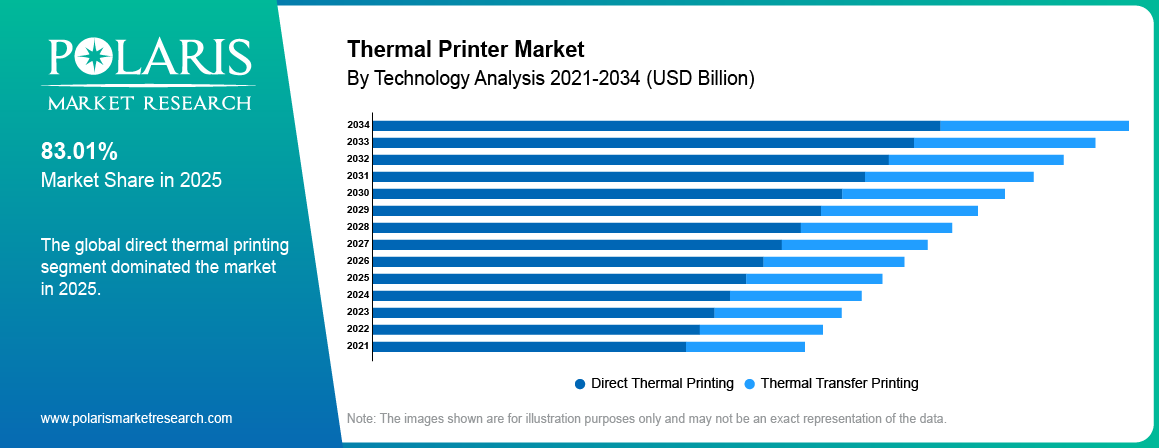
- Direct thermal printing segment dominated in 2025, accounting for nearly 49.20% market share due to strong use in receipts and shipping labels.
- Retail segment led in 2025, contributing approximately 44.80% market share owing to high demand for POS billing and receipt printing.
- Thermal transfer printing segment is projected to grow at a CAGR of around 9.60% due to rising demand for durable labels.
- Logistics & transportation segment is projected to grow at the fastest pace, registering a CAGR of nearly 10.80% during the forecast period.
- European market held the second-largest market share, accounting for approximately 27.40% share in 2025 due to the rising popularity of sustainable printing methods and the advancement of retail technology.
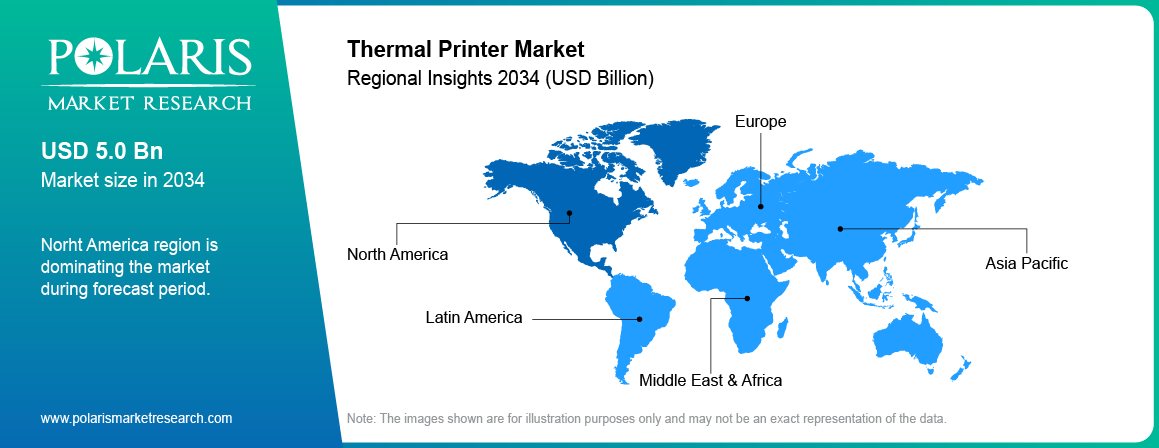
- North America dominated the market, accounting for nearly 36.90% market share in 2025 due to strong retail networks and early adoption of automation technologies.
Industry Dynamics
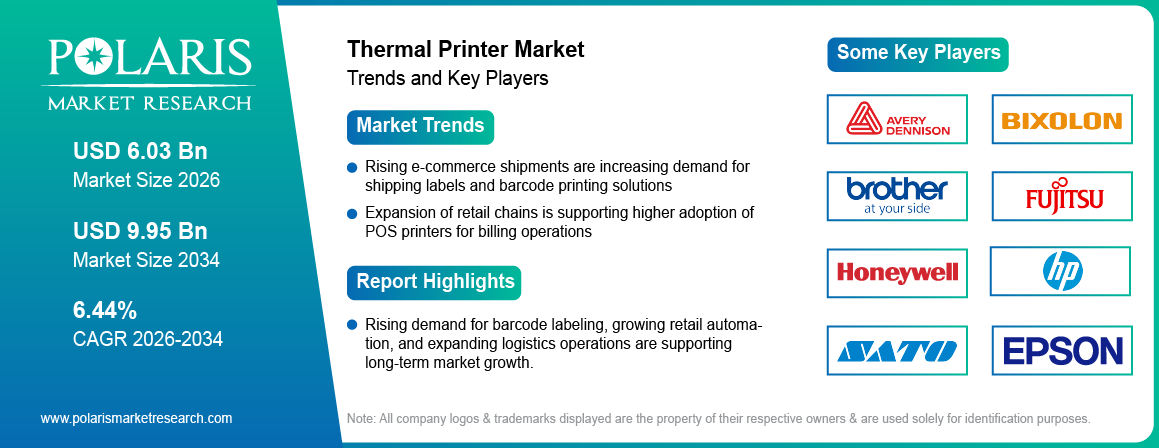
- Rising e-commerce shipments are driving demand for shipping labels and barcode printing solutions.
- Expansion of retail chains is supporting higher adoption of POS printers for billing operations.
- The increasing shift toward digital receipts and paperless transactions hinders market adoption in some use cases.
- IoT and automation integration is driving force behind significant market growth for smart thermal printers.
What are Thermal Printer?
Thermal printers are printing systems that are capable of printing text, barcodes, and even images using thermal sensitive paper or thermal transfer ribbon without ink or toner. Such printing machines are commonly employed in a wide range of retail stores, hospitals, logistics companies, hospitality businesses, and even in manufacturing facilities. They support receipt printing, barcode labeling, ticketing, and packaging identification. Rising demand for cost-efficient and low-maintenance printing systems is supporting adoption of thermal printers across commercial operations.
The supply chain of the thermal printer industry involves the process of acquiring components, manufacture of printhead, assembling of printers, installation of software, and then distribution using the channel partners or the direct sales force. The goal of this industry is to ensure increased printing speeds, prolonged printhead life, development of wireless technology, and miniaturization of devices. Different kinds of printers such as mobile printers, POS printers, and industrial printers are discussed to meet different organizational needs. Retail and logistics digitalization drives innovations in this area.
Source: Polaris Market Research Analysis
To Understand More About this Research:Download Sample Report
Market development began with early adoption in billing counters and barcode printers, where speed and accuracy were essential factors. The early demands arose from retailers and warehouse companies that required more efficiency in their transactions and stock management systems. The adoption of these systems progressed even further as the increase in e-commerce activities generated more shipping labels and improved store management systems. The industry is now heading towards widespread commercialization with increasing automation capabilities, intelligent networking capabilities, and reliable printing needs.
Drivers & Opportunities
Rising e-commerce shipments are increasing demand for shipping labels and barcode printing solutions: There have been rapid developments in e-commerce due to large volume of parcels on a daily basis. According to International Trade Administration, global B2C e-commerce revenue is projected to reach USD 5.5 trillion by 2027, supporting demand for thermal printers in labeling and fulfillment.[Source: www.trade.gov] Since the thermal printer is increasingly used for shipping labels, tagging for orders, and barcodes owing to its speed and low operational cost, logistics firms are now adding more printing capabilities to handle increasing dispatches.
Expansion of retail chains is supporting higher adoption of POS printers for billing operations: The emergence of supermarket and convenience stores as well as branding of outlet chains means that there are increasing demand for good billing systems. The thermal printer is popular due to its speed, small size, and maintenance requirements. In February 2026, LaunderPay integrated Epson thermal receipt printers into its POS solution to improve payment and receipt processing for laundromats. Retailers are upgrading checkout counters to improve customer service speed. This expansion is supporting higher sales of POS thermal printers.
Restraints & Challenges
The increasing shift toward digital receipts and paperless transactions hinders market adoption: Many retailers and service providers are promoting digital receipts through SMS, email, and mobile apps. Paperless billing helps in reducing the consumption of paper. The change in the billing method reduce the printing of receipts. Thus, the demand for POS thermal printers hinders the long term adoption among the businesses.
Opportunity
Integration with IoT and automation systems presents significant growth opportunities: Connected devices are adopted by organizations to increase efficiency in warehouses, retail spaces, and manufacturing processes. Thermal printers with Internet of Things (IoT) capabilities aid in automation of labeling, asset management, and tracking activities. For example, in December 2025, Weidmuller USA introduced the THM MultiMark Plus R thermal transfer printer and MultiMark R-Fix applicator, which allow for automated cable marking within three seconds with up to a 60% improvement in marking performance for industrial printing tasks.
Source: Polaris Market Research Analysis
Segmental Insights
This report offers detailed coverage of the thermal printer market technology and application to help readers identify the fastest expanding and most attractive demand segments.
By Technology
-
Direct Thermal Printing
Direct thermal printing segment dominated in 2025, accounting for nearly 49.20% market share due to strong use in receipts, tickets, and short-life shipping labels. Retail stores and courier networks prefer this technology for low operating cost and simple maintenance. Rising demand for fast transaction printing is supporting growth of this segment.
-
Thermal Transfer Printing
Thermal transfer printing segment is projected to grow at a CAGR of around 9.60% due to rising demand for durable and long-lasting labels. Manufacturing, healthcare, and warehouse users prefer this technology for asset tags, product identification, and compliance labeling. Higher need for print durability is supporting expansion of this segment.
By Application
-
Retail
Retail segment led in 2025, contributing approximately 44.80% market share due to wide use of POS printers for billing, receipts, and promotional labels. Expansion of supermarkets, restaurants, and convenience stores is increasing printer installations. Demand for faster checkout operations is supporting this segment.
-
Logistics & Transportation
Logistics & transportation segment is projected to grow at the fastest pace, registering a CAGR of nearly 10.80% due to rising parcel volumes and warehouse automation. As per the China Federation of Logistics and Purchasing, the total value of logistics in China rose by 5.8% from the previous year to an estimated USD 50.28 trillion in 2024.[Source: english.scio.gov.cn]This is driving growth in the demand for thermal printers, which are used for labeling and other warehouse-related activities. Growing in e-commerce delivery networks is supporting rapid expansion of this segment.
Source: Polaris Market Research Analysis
Regional Analysis
North America Market Assessment
North America dominated the market, accounting for nearly 36.90% market share in 2025, driven by advanced retail infrastructure and high adoption of automation technologies. The US remains the key market due to strong presence of organized retail chains, warehouse modernization, and demand for efficient billing systems. In December 2025, Phomemo introduced a portable thermal printer G100 Pro that has the facility of direct Wi-Fi connection to Apple products without any application requirement and offers 300 DPI fast print speeds. In addition, rising replacement demand for connected POS printers is supporting regional growth.
Asia Pacific Thermal Printer Market Insights
Asia Pacific projected to register the fastest CAGR during the forecast period, fueled by rapid industrialization, expanding retail sectors, and strong e-commerce growth in China and India. According to India Brand Equity Foundation, India’s e-commerce market is projected to reach USD 211.6 billion in 2025 and USD 326.7 billion by 2029, increasing demand for thermal printers in labeling and logistics.[Source: www.ibef.org] Moreover, Japan and South Korea are other significant markets due to advanced manufacturing processes. The increasing use of digital technologies by SMEs is boosting growth.
Europe Thermal Printer Market Overview
European market held the second-largest market share, accounting for approximately 27.40% share in 2025 due to the rising popularity of sustainable printing methods and the advancement of retail technology. Countries such as Germany, France, and the UK are investing in efficient receipt printing and warehouse labeling systems. Strong regulatory frameworks are encouraging energy-efficient and low-waste printing devices. Demand for durable printers in healthcare and manufacturing is supporting long-term growth.
Rest of the World Market Insights
Latin America and the Middle East are emerging markets for thermal printers due to rising digitalization and retail expansion. Countries in these regions are upgrading billing systems and logistics operations to improve efficiency. In October 2025, HOIN demonstrated portable, label, and receipt thermal printers at GITEX GLOBAL 2025, given the increasing demand in the Middle East region for thermal printer technology among different industries. Additionally, the growth of malls, supermarket businesses, and delivery companies creates a new demand for point-of-sale and label printers.
Source: Polaris Market Research Analysis
Competitive Landscape & Key Players
Thermal printers industry shows moderate fragmentation, with competitors including global printer companies, POS software companies, and industrial printing firms. Critical success factors for success in this market include fast printing, durable products, features, and cost-effectiveness. Innovations in products, channels, and strategies are important ways that firms seek competitive advantage. Mobile printing and intelligent automation technologies also provide growth opportunities for achieving competitive advantage.
Some firms in this industry include Zebra Technologies, Seiko Epson Corporation, Brother Industries Ltd., TSC Auto ID Technology Co., Ltd., SATO Holdings Corporation, BIXOLON Co., Ltd., Honeywell International Inc., Toshiba Tec Corporation, Star Micronics Co., Ltd., FUJITSU Limited, Avery Dennison Corporation, HP Inc., and others.
Premium Insights
The future of the thermal printer market will be shaped by:
- AI-based print management, predictive maintenance, and process optimization to minimize downtime.
- Compatibility with Cloud ERP, point of sale (POS), warehouse management systems, and logistics systems for smooth operation.
- Rise in mobile printers, portable printers, and wearable printers for mobile billing and labeling requirements.
- Movement towards recyclable labels, linerless media, and environmentally friendly thermal paper.
- Increasing use of IoT-based printers with the ability to conduct real-time diagnosis and tracking of devices.
- Increasing requirement for small-sized printers with rising speeds, higher connectivity, and reduced cost of operations.
Automation, connectivity, and smart printing together is expected to change the way organizations deal with processes such as billing, logistics, inventory management, asset management, and compliance.
Key Players
- Avery Dennison Corporation
- BIXOLON Co., Ltd.
- Brother Industries Ltd.
- FUJITSU Limited
- Honeywell International Inc.
- HP Inc.
- SATO Holdings Corporation
- Seiko Epson Corporation
- Star Micronics Co., Ltd.
- Toshiba Tec Corporation
- TSC Auto ID Technology Co., Ltd.
- Zebra Technologies
Industry Developments
- April 2026: BIXOLON introduced the SRP-G300, which is a 3-inch thermal printer that are used for printing lottery tickets and point-of-sale transactions in bulk quantities, with print speed of 255 mm/sec, intelligent media sensors, and large paper rolls. [source: bixolonusa.com]
- January 2026: AM Labels released the M2 thermal inkjet printer for use in industries where there is a requirement for fast coding with print resolution of up to 1200 dpi. [source: amlabels.co.uk]
Thermal Printer Market Segmentation
By Technology Outlook (Revenue, USD Billion, 2021-2034)
- Direct Thermal Printing
- Thermal Transfer Printing
By Application Outlook (Revenue, USD Billion, 2021-2034)
- Retail
- Healthcare
- Logistics & Transportation
- Manufacturing
By Regional Outlook (Revenue, USD Billion, 2021-2034)
- North America
- US
- Canada
- Europe
- Germany
- France
- UK
- Italy
- Spain
- Netherlands
- Russia
- Rest of Europe
- Asia Pacific
- China
- Japan
- India
- Malaysia
- South Korea
- Indonesia
- Australia
- Vietnam
- Rest of Asia Pacific
- Middle East & Africa
- Saudi Arabia
- UAE
- Israel
- South Africa
- Rest of Middle East & Africa
- Latin America
- Mexico
- Brazil
- Argentina
- Rest of Latin America
Thermal Printer Market Report Scope
| Report Attributes | Details |
| Market Size in 2025 | USD 5.67 Billion |
| Market Size in 2026 | USD 6.03 Billion |
| Revenue Forecast by 2034 | USD 9.95 Billion |
| CAGR | 6.44% from 2026 to 2034 |
| Base Year | 2025 |
| Historical Data | 2021–2024 |
| Forecast Period | 2026–2034 |
| Quantitative Units | Revenue in USD Billion and CAGR from 2026 to 2034 |
| Report Coverage | Revenue Forecast, Competitive Landscape, Growth Factors, and Industry Trends |
| Segments Covered |
|
| Regional Scope |
|
| Competitive Landscape |
|
| Report Format |
|
| Customization | Report customization as per your requirements with respect to countries, regions, and segmentation. |
Source: Polaris Market Research Analysis
Thermal Printer Market FAQ's
The global market size was valued at USD 5.67 Billion in 2025 and is projected to grow to USD 9.95 Billion by 2034.
North America dominates the market due to advanced retail infrastructure and high adoption of automation technologies.
Major applications include receipt printing, barcode labeling, shipping labels, ticketing, and inventory tracking.
A few of the key players in the market are Zebra Technologies, Seiko Epson Corporation, Brother Industries Ltd., TSC Auto ID Technology Co., Ltd., SATO Holdings Corporation, BIXOLON Co., Ltd., Honeywell International Inc., Toshiba Tec Corporation, Star Micronics Co., Ltd., FUJITSU Limited, Avery Dennison Corporation, HP Inc., and others.
Key drivers include rising e-commerce shipments, retail expansion, warehouse automation, and demand for low-maintenance printing systems.
Major demand comes from retail, logistics, healthcare, hospitality, and manufacturing sectors.
The market outlook remains positive due to growth in smart printing, mobile devices, and connected automation systems.
Download Sample Report of Thermal Printer Market
Please fill out the form to request a customized copy of the research report.


