
U.S. Metaverse Market Size, Share, Trends & Forecast, 2026–2034
REPORT DETAILS
U.S. Metaverse Market Summary
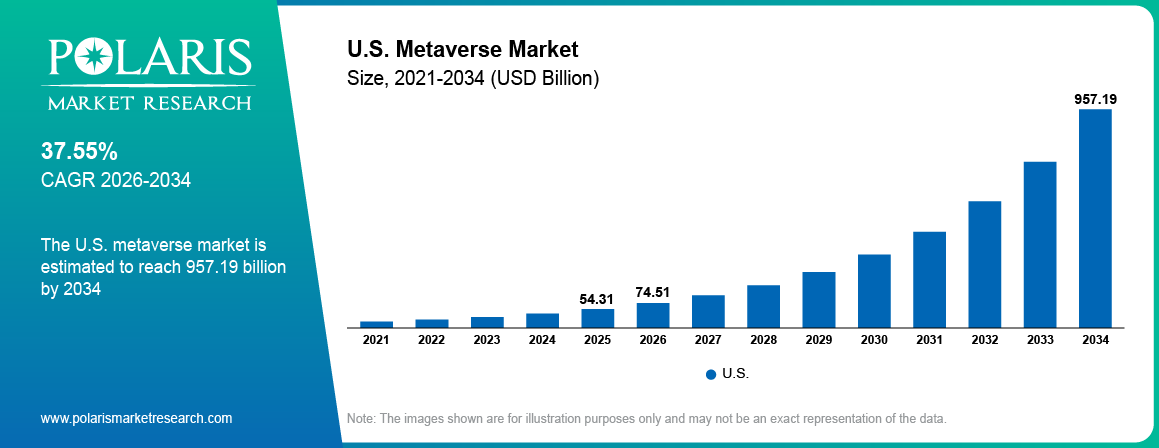
The U.S. metaverse market size was valued at USD 54.31 billion in 2025. The market is anticipated to exhibit a CAGR of 37.55% from 2026 to 2034. Increasing adoption of VR/AR technologies drives the market expansion. Also, rising investments in immersive digital experiences propel the market growth.
Market Statistics
U.S. Metaverse Market Key Takeaways
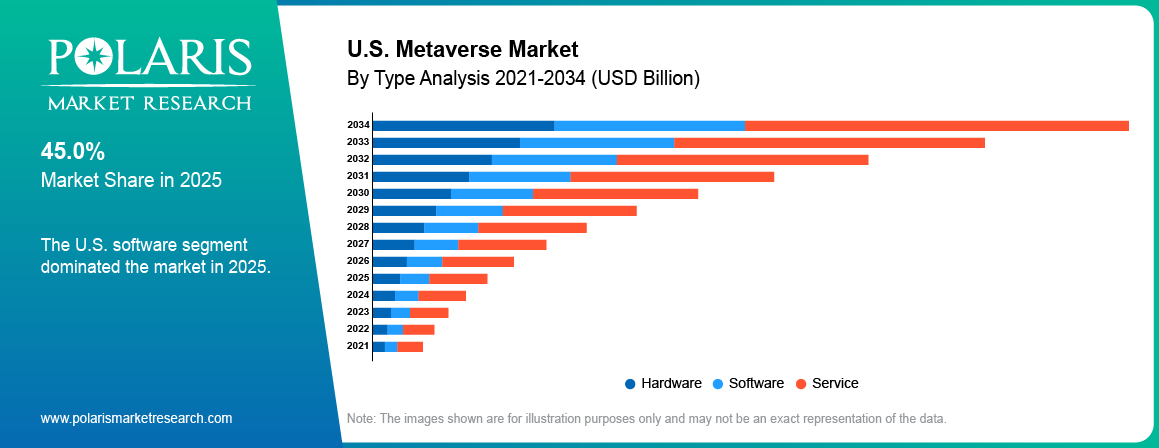
- The software segment accounted for the largest share of 40.8% in 2025. Development of complex algorithms and simulation technologies boosts the dominance.
- Virtual reality and augmented reality led the market with 34.3% share in 2025. This is due to their rising adoption in various industries.
- The gaming segment dominated with 25.3% share in 2025. The expansion of immersive technologies such as AR and VR in gaming fuels the dominance.
- The digital marketing segment is expected to record the highest CAGR of 38.6% during the forecast period. Rising adoption of e-commerce and social media market drives the segment growth.
Note: Figures and projections outlined in this report are the result of Polaris Market Research’s proprietary analytical processes, grounded in the latest available datasets and market observations.
How AI Is Shaping the Metaverse?
- Modeling motions and GenAI help in the creation of realistic and interactive avatars.
- AI-enabled virtual assistants provide assistance in business-oriented activities and navigation in virtual environments.
- AI applications can be helpful in recommending content based on behavior analysis.
- Navigation based on voice and natural language is becoming a substitute for manual navigation.
- AI platforms use behavioral analysis to make sure of maximum engagement and retention.
Introduction to U.S. Metaverse Market
The metaverse is a term used to describe a future vision of the internet that is more immersive, interactive, and interconnected. It would allow users to access a shared virtual space where they could interact with each other and digital objects in real-time. The metaverse has been described as a kind of "virtual reality internet" and is seen by many as the internet's next evolution.
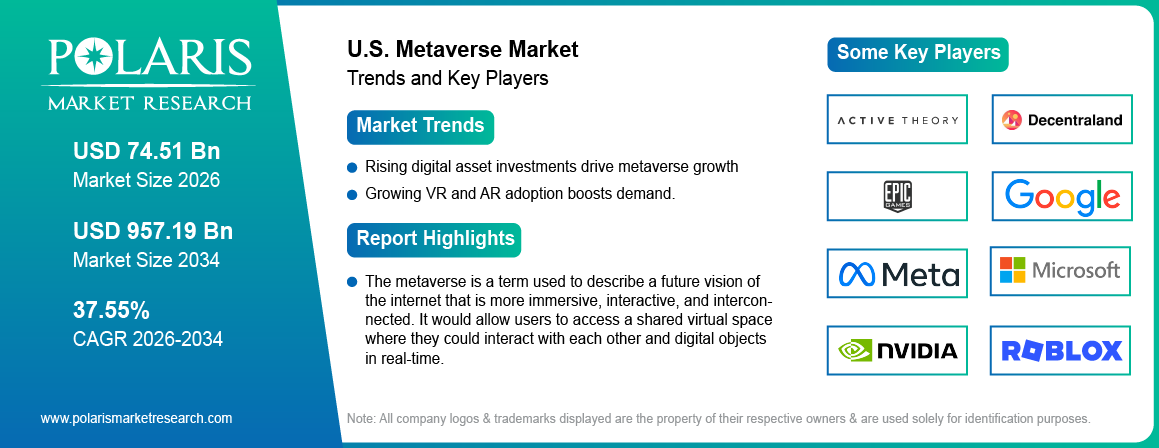
The U.S. metaverse market is an emerging and rapidly growing industry that has gained significant attention in recent years due to advancements in technologies such as virtual and augmented reality (VR/AR), blockchain, and cloud computing. Advances in VR/AR technology have made it possible to create more realistic and engaging virtual environments, which are crucial for the metaverse. Companies like Meta Platforms, Inc., Google, and Microsoft are investing heavily in VR/AR research and development, leading to improvements in hardware and software capabilities. As consumers are seeking more interactive and immersive experiences in gaming, entertainment, and social media, the metaverse offers a unique opportunity to provide these experiences, attracting a growing number of users and driving market growth.
For instance, in May 2022, WPP, a leading advertising and marketing services company, partnered with Epic Games, the creator of popular games such as Fortnite and Unreal Engine, to enable WPP agencies to offer cutting-edge digital experiences for brands in the metaverse. This collaboration will allow WPP to leverage Epic Games' expertise in creating immersive digital environments to help brands create engaging experiences for their customers in the virtual world.
Source: Polaris Market Research Analysis
To Understand More About this Research: Download Sample Report
How the Metaverse Works?
One can use a virtual reality headset, mobile phones, or computers to gain access into the virtual world. The virtual avatars are used to present a user in the virtual world. Blockchain is used to determine the ownership of the digital property and NFTs. Cloud computing services help in scaling and synchronization of virtual worlds for millions of users. Virtual economy helps make transactions using NFTs and cryptocurrencies.
Further, changing market trends toward cloud computing have made it possible to deliver high-quality content and applications seamlessly across devices, supporting the growth of the metaverse. Leading cloud providers such as Amazon Web Services (AWS), Microsoft Azure, and Google Cloud Platform are expanding their offerings to meet the demands of this emerging market.
However, the U.S. metaverse market growth is hampered by several technical challenges, including latency issues, data privacy concerns, and interoperability between different platforms. Also, the metaverse operates in a legal gray area, with unclear regulations regarding data ownership, intellectual property rights, and user safety. All these factors affect the market growth, causing a reduced adoption rate by consumers.
Metaverse vs Traditional Internet
| Feature | Traditional Internet | Metaverse |
| User Experience | Web browsing and content consumption | Immersive 3D virtual experiences |
| Interaction | Clicks, text, and video | Real-time avatar-based interaction |
| Environment | Two-dimensional websites | Persistent three-dimensional virtual worlds |
| Accessibility | Browsers and mobile applications | VR headsets, AR devices, smartphones, and PCs |
| Digital Ownership | Limited ownership of digital assets | Blockchain-based ownership of NFTs and virtual assets |
| Commerce | Conventional e-commerce | Virtual marketplaces and digital economies |
| Collaboration | Video conferencing and messaging | Interactive virtual workplaces and shared environments |
Source: Polaris Market Research Analysis
Market Dynamics
The U.S Metaverse Market Growth is Driven by the Shift in Market Trends Toward Digital Asset Investments and Virtual Experiences
The U.S. Metaverse market is experiencing significant growth, driven by a shift in market trends towards digital asset investments and virtual experiences. As more people become familiar with blockchain technology and cryptocurrencies, they are looking for new ways to invest and engage with digital assets. At the same time, there is growing interest in immersive technologies such as virtual reality (VR) and augmented reality (AR), which enable users to interact with virtual environments that mimic real-world experiences or entirely new worlds. This has led to an increase in demand for metaverse platforms that allow users to create, buy, sell, and trade digital assets, as well as participate in various virtual experiences such as gaming, socializing, and entertainment.
Along with this, businesses are also exploring how they can leverage the metaverse to enhance their customer experience, improve collaboration, and streamline processes. All these factors combined have created a perfect storm of demand for the metaverse, leading to rapid growth in the market.
Which Factor Is Restraining the Demand for the U.S. Metaverse?
The Lack of Regulations or Regulatory Bodies in Open-Source and Decentralized Metaverse Models Is Hampering the U.S. Metaverse Market Growth
The lack of regulations or a regulatory body in open-source and decentralized metaverse models is a significant challenge hindering the growth of the U.S. There is unclarity on issues such as data privacy, security, and intellectual property rights, which deters investors and stakeholders from fully embracing these models. Moreover, a central authority to enforce rules and standards is needed to ensure interaction between different platforms and services, further complicating the development of a thriving metaverse ecosystem. In addition, the lack of regulation creates uncertainty around liability and accountability, making it challenging for businesses to navigate the legal landscape and potentially exposing users to risks such as fraudulent activities or unethical behavior. Establishing a robust regulatory framework would help address these concerns, provide stability and confidence to stakeholders, and ultimately foster the growth of the U.S. Metaverse market.
Key Challenges in the Market
- Data privacy and cybersecurity concerns associated with virtual identity persistence
- Lack of interoperability among rival metaverse platforms and systems
- Expensive VR and AR devices that are not affordable for large consumer population.
- Uncertainty about digital asset and virtual property rights regulations
- Latency problems due to inadequate infrastructure. They adversely affect real-time immersive experiences
Source: Polaris Market Research Analysis
Report Segmentation
The market is primarily segmented based on type, technology, application, and industry vertical.
| By Type | By Technology | By Application | By Industry Vertical |
|
|
|
|
Source: Polaris Market Research Analysis
By Type Insights
Based on type analysis, the market is segmented on the basis of hardware, software, and service. The software segment accounted for the largest share of the U.S. Metaverse market since the metaverse is fundamentally a virtual world that requires advanced software solutions to create an immersive and interactive environment for users. This has led to a high demand for sophisticated software platforms that can facilitate the creation, management, and interaction within these virtual spaces. Also, the development of complex algorithms, 3D modeling, and simulation technologies has further driven the growth of the software segment. The increasing adoption of cloud computing and artificial intelligence (AI) technologies has also contributed to the expansion of the software segment, as they enable seamless accessibility and enhanced user experiences within the metaverse.
By Technology Insights
Based on technology analysis, the market has been segmented on the basis of blockchain, virtual reality and augmented reality, mixed reality, and others. The virtual reality and augmented reality segment dominated the U.S. metaverse market size in 2025 since VR and AR technologies have been gaining significant traction in recent years, with advancements in hardware and software leading to more immersive and realistic experiences. In addition, these technologies have been increasingly adopted across various industries, such as gaming, education, healthcare, and entertainment, which has driven their growth in the metaverse market.
VR and AR are critical components of the metaverse ecosystem, enabling users to interact with virtual environments and objects in a seamless manner. As the metaverse continues to evolve, it is expected that VR and AR will play an even more crucial role in shaping its future, further solidifying its position in the market.
Blockchain-Powered Virtual Economies
Blockchain technology underpins secure ownership and exchange within metaverse ecosystems, enabling verifiable digital transactions outside traditional financial rails.
- Secure ownership data of virtual properties and NFTs
- Payment through cryptocurrency for transactions within virtual worlds
- Digital identification linked with wallet addresses
- Transactions data of virtual real estate and collectibles
With the development of decentralized platforms, blockchain technology would likely become increasingly important in the formation and transfer of value in the metaverse environment.
By Application Insights
Based on application analysis, the market has been segmented on the basis of content creation and social media, digital marketing, events and conferences, gaming, online shopping, and testing and inspection. The gaming applications segment dominated the U.S. metaverse market share since gaming has been a popular form of entertainment in the country for decades, and the rise of immersive technologies such as virtual and augmented reality has only increased its attraction.
Also, the metaverse offers a unique opportunity for gamers to engage in shared, interactive experiences that were previously not possible with traditional gaming platforms. This has led to a surge in the popularity of massively multiplayer online games (MMOs) and other social gaming experiences that leverage the metaverse's ability to create vast, interconnected virtual worlds. The metaverse allows for new monetization models, such as virtual goods and services, which have become a significant revenue stream for game developers. Further, the pandemic has accelerated the adoption of virtual environments for both work and play, boosting the demand for metaverse-based gaming applications.
Emerging Industry Applications: Education & Healthcare
Apart from the gaming and business sectors, education and health care are emerging to be significant fields in which the metaverse may be used.
- Remote teaching through virtual classrooms and immersive learning platforms.
- Clinical practice for students and doctors through surgical simulations
- Skill development through virtual hands-on practical training environments
- Educational partnerships for accessibility to immersive educational content
Such partnerships are already evident in the market. For instance, in October 2025, Meta partnered with educational institutions to develop virtual learning spaces. Such deals support rising momentum for education-focused metaverse applications. Healthcare sector is also expected to follow a similar trajectory.
Enterprise & Workplace Applications of the Metaverse
Metaverse technology is being used by companies in addition to gaming and social applications to resolve issues related to operations and collaborations.
- Online collaboration and meetings spaces for virtual teams
- Immersion-based employee training and onboarding
- Digital twins for products for their designing, testing, and manufacturing process
- Product demonstrations and customer interaction experience virtually
- Virtual technical assistance through augmented reality-based guidance
Adoption of enterprise-level metaverses is bound to grow in future because companies like Microsoft are embedding AI-based collaboration tools within metaverses.
Major Metaverse Use Cases
| Use Case | Product | Company | Real-World Application |
| Virtual Gaming Ecosystems | Fortnite | Epic Games | Hosts immersive multiplayer experiences and virtual events. |
| Digital Concerts & Live Entertainment | Roblox | Roblox Corporation | Enables virtual concerts and live music events |
| Enterprise Collaboration & Virtual Workplaces | Microsoft Mesh | Microsoft | Immersive events, meetings, collaboration, and hybrid workplace experiences using mixed reality. |
| Online Education & Training Simulations | ENGAGE | ENGAGE XR Holdings | Provides virtual classrooms, training solutions, and simulation-based learning. |
Source: Polaris Market Research Analysis
Source: Polaris Market Research Analysis
Competitive Landscape
The U.S. Metaverse market is witnessing significant activity from various key players, including technology giants, startups, and investors. Companies like Meta, Google, Microsoft, and NVIDIA are investing heavily in virtual and augmented reality technologies to create immersive experiences for their users. Several startups are building virtual worlds and platforms that allow users to interact, collaborate, and participate in various activities.
Some of the major players operating in the U.S. market include:
- Active Theory
- Decentraland
- Epic Games, Inc.
- Futureverse
- Google LLC
- Maticz Technologies Private Limited
- Meta Platforms, Inc.
- Microsoft Corporation
- NVIDIA Corporation
- Roblox Corporation
- Tencent
- Unity Technologies, Inc.
Future Outlook of the U.S. Metaverse Market
The U.S. metaverse industry is expected to witness strong growth during the forecast period. Developments in VR/AR technology, AI, blockchain, and cloud computing technology will drive the growth. Enterprise collaboration and virtual economies would provide great potential in the coming years. Digital experience driven by AI and virtual commerce will be among the major trends. Also, interoperable metaverse ecosystems will transform entertainment, work, education, and social interaction.
Recent Developments
- January 2026: Siemens announced Digital Twin Composer. It is a software solution that builds Industrial Metaverse environments at scale. The solution will enable organizations to apply industrial AI, simulation, and real-time physical data. It will help them make decisions virtually at speed and at scale. (Source: PRNewswire)
- In October 2025, Meta Platforms (US) announced a major collaboration with multiple educational institutions to create virtual learning spaces within its metaverse. The goal of this initiative is to improve access to education and increase user engagement, reflecting Meta’s growing focus on educational content. This step helps expand its user base and strengthens its position in the education-focused segment of the metaverse, which could support long-term user retention and loyalty.
- In September 2025, Microsoft (US) introduced a new set of virtual collaboration tools enhanced with AI features to improve interactions within its metaverse platforms. This move highlights Microsoft’s strategy to use artificial intelligence to boost productivity and user experience. These tools are expected to attract enterprises looking for advanced remote work solutions, further strengthening Microsoft’s presence in the business-focused metaverse market.
- In August 2025, Epic Games (US) launched a new program to support independent developers by providing funding and resources for metaverse-related projects. This initiative encourages innovation while expanding Epic’s ecosystem with diverse applications and experiences. By supporting the developer community, Epic Games (US) is likely to increase platform appeal and ensure a steady flow of new and engaging content for users.
Report Coverage
The Metaverse market research report emphasizes key regions across the globe to provide a better understanding of the product to the users. Also, the report provides market insights into recent developments and trends and analyzes the technologies that are gaining traction around the globe. Furthermore, the report covers an in-depth qualitative analysis pertaining to various paradigm shifts associated with the transformation of these solutions.
The report provides a detailed analysis of the market while focusing on various key aspects such as competitive analysis, type, technology, application, industry vertical, and futuristic growth opportunities.
U.S. Metaverse Market Report Scope
| Report Attributes | Details |
| Market size value in 2025 | USD 54.31 billion |
| Market size value in 2026 | USD 74.51 billion |
| Revenue Forecast in 2034 | USD 957.19 billion |
| CAGR | 37.55% from 2026 – 2034 |
| Base year | 2025 |
| Historical data | 2021 – 2024 |
| Forecast period | 2026 – 2034 |
| Quantitative units | Revenue in USD billion and CAGR from 2026 to 2034 |
| Segments Covered | By Type, By Technology, By Application, By Industry Vertical |
| Customization | Report customization as per your requirements with respect to countries, regions, and segmentation. |
Source: Polaris Market Research Analysis
U.S. Metaverse Market FAQ's
key companies in U.S. Metaverse Market are Active Theory, Decentraland, Epic Games, Inc., Futureverse, Google LLC, Maticz Technologies Private Limited
U.S. Metaverse Market exhibiting a CAGR of 37.55% during the forecast period
The U.S. Metaverse Market report covering key segments are type, technology, application, and industry vertical.
key driving factors in U.S. Metaverse Market are Advances in VR/AR technology drive market growth
The global Metaverse market size is expected to reach USD 957.19 Billion by 2034
The metaverse is an ecosystem of virtual worlds connected to each other. In this environment, users socialize, interact, play, work, and perform tasks using immersive technology .
The metaverse uses VR, AR, AI, blockchain technology. It also uses cloud computing and fast connectivity. These technologies help develop persistent virtual worlds where the users take part in via digital avatars.
VR technology gives complete immersion experience in virtual worlds. However, AR is the overlaying of virtual objects in real environments. It enables interactive training, healthcare, gaming, meeting, and other activities.
Download Sample Report of U.S. Metaverse Market
Please fill out the form to request a customized copy of the research report.


