
Waterborne Coatings Market Size, Industry Demand, Global Analysis, 2026-2034
REPORT DETAILS
Waterborne Coatings Market Summary
The global waterborne coatings market was valued at USD 98.97 billion in 2025 and is forecasted to grow at a CAGR of 6.1%from 2026 to 2034. Growth is supported by increasing environmental regulations and demand for low-VOC coatings.
Market Statistics
Key Takeaways
- In 2025, the alkyd segment led the market due to the increasing use of alkyd-based coatings in architectural, residential, and commercial buildings.
- The architectural segment accounted for a major market share in 2025. The demand for waterborne coatings in this segment is fueled by the increasing focus on remodeling and renovation activities related to residential and commercial spaces.
- North America leads the global waterborne coatings market. This is due to the rising adoption of EVs and the increasing number of construction activities.
- Asia Pacific is projected to have the highest CAGR from 2026 to 2034. This is mainly due to the rising demand for waterborne coatings in architectural and home decor applications.
Waterborne coatings are coatings in which water is used as the principal carrier instead of solvents. Waterborne coatings include water-reducible coatings and polymer dispersion (latex) coatings. They are developed to reduce the use of solvents and, at the same time, offer protection to the surface, which may be metal, wood, or concrete.
The waterborne coatings market includes eco-friendly paint and coating solutions that primarily use water as a solvent. These coating solutions are preferred for their low levels of volatile organic compounds (VOCs), which are safer for the environment and human health.
The rising demand for coatings in the automotive sector, especially in the electric vehicle (EV) market, is boosting the waterborne coating market. Government environmental protection efforts, such as encouraging EV purchases and adopting eco-friendly manufacturing processes, are also fueling this growth. The automotive OEMs are adopting low-emission coatings more rapidly due to VOC compliance regulations, sustainability, and stricter supplier requirements. This shift is expected to make waterborne automotive OEM coatings a significant market growth driver in the coming years.
Apart from sustainability, the adoption rate is increasing because many formulations now meet stringent requirements for durability, adhesion, corrosion resistance, and abrasion resistance. This is improving competitiveness with traditional solvent-based systems in architectural and industrial use.
Industry Dynamics
- The introduction of stringent regulations by governments worldwide to reduce VOC emissions is a major factor fueling market expansion.
- The market is benefiting from rising investments in advanced manufacturing technology and innovative formulations.
- The development of specialized additives is projected to provide several market opportunities in the coming years.
- High cost of end product may hinder market growth.
Source: Polaris Market Research Analysis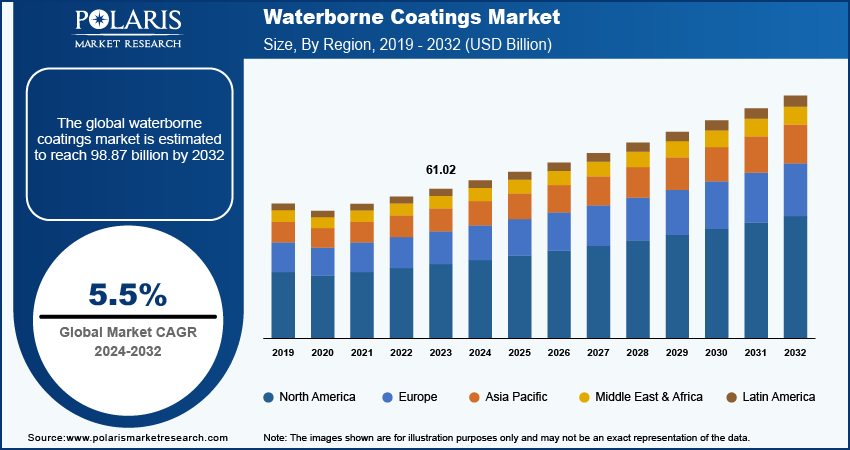
The rising demand for waterborne coatings in the metal industry is a major factor that is contributing to the growth of the market. Waterborne coatings possess some special properties, such as high durability, strength, and resistance to chemicals, corrosion, and abrasion. In the case of metal substrates, improved corrosion resistance of waterborne coatings is driving increased use of these coatings in fabricated metal products, machinery, and equipment, as consumers prefer coatings with longer life, greater appearance consistency, and easier maintenance.
Major players are also adopting advanced waterborne manufacturing techniques to develop new waterproof and fire-resistant coatings, further increasing the applications of waterborne coatings in the future. However, the use of metal may be affected by problems such as flash rust and water sensitivity. The management of these challenges through proper surface treatment, formulation, and curing processes supports wider industrial adoption.
Market Dynamics
Stringent Environmental Regulations
Stringent environmental regulations are a major driver of the market. The increasing trend among manufacturers to adopt waterborne coatings is driven by governments worldwide introducing stricter guidelines to minimize volatile organic compounds (VOCs). These coatings meet the required standards and provide improved safety and environmental friendliness.
This trend is most apparent in market segments where waterborne vs solvent-based coating choices are impacted by VOC thresholds, emissions reporting, and customer sustainability requirements, especially in architectural and OEM supply chains.
Increase in Investment in Manufacturing
The increase in investment in the manufacturing sector is expected to drive the number of players in the waterborne coating market. As the companies strive to enhance their offerings and keep pace with the rising demand for environmentally friendly products, they are investing in advanced manufacturing technology and innovative formulations. Manufacturing investment is increasingly being made in polymer dispersions, new resin materials, and advanced additives that enhance film formation, drying rates, and resistance to outdoor light. All these are essential for their adoption in high-performance applications.
Source: Polaris Market Research Analysis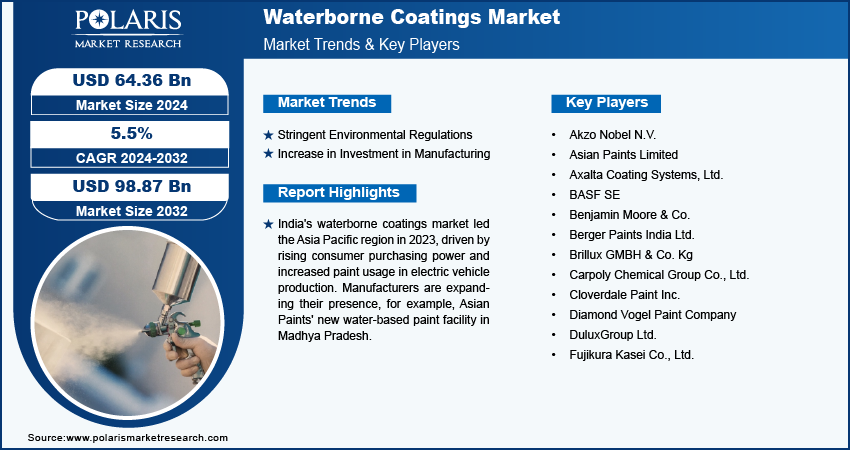
Market Segment Insights
Market Breakdown by Resin Type Outlook
The global waterborne coatings market segmentation, based on resin type, includes acrylic, polyester, alkyd, epoxy, polyurethane, PTFE, PVDF, PVDC, and others. In 2025, the alkyd segment led the market due to the increasing use of alkyd-based coatings in architectural, residential, and commercial buildings. Furthermore, the alkyd-based coatings are manufactured using emulsion technology, which allows it to replace traditional solvents with water, ensuring sustainability and safety related to the final painting. In November 2023, a study published in the Journal of Coatings Technology and Research highlighted the synthesis of the potential of the organosilane monomer, such as its corrosion resistance and the adhesive properties related to the acrylic-modified water-reducible alkyd resin. Waterborne alkyd systems are widely used in building applications because they provide a good appearance and a smooth finish, along with reliable protection, while meeting low-VOC requirements for architectural coatings.
In addition to alkyds, waterborne acrylic and polyurethane coatings are finding increasing use in applications where faster drying times, improved weather resistance, and scratch and wear resistance are desired.
Market Breakdown by Application Industry Insights
The global waterborne coatings market, based on application industry, is bifurcated into architectural and industrial. The architectural segment had a higher revenue share in 2025. The demand for waterborne coatings in this segment is fueled by the increasing focus on remodeling and renovation activities related to residential and commercial spaces. As per the National Association of Home Builders (NAHB) Remodelers survey in 2024, the demand for overall house remodeling was 50%, and window or door replacement was 22%. Additionally, the increasing focus on lowering energy consumption is anticipated to boost the use of these coatings, which are driven by their benefits, such as faster drying and improved air quality. Demand in the architectural segment is also being fueled by consumer preference for improved indoor air quality, low odor, and faster drying times. These features make interior water-based paints extremely popular in residential and occupied spaces, leading to strong volume growth.
In industrial applications, demand is increasing in the areas of automotive OEM coatings and wood and furniture finishes. Improvements in waterborne technology have made them more comparable to solvent-based alternatives.
Source: Polaris Market Research Analysis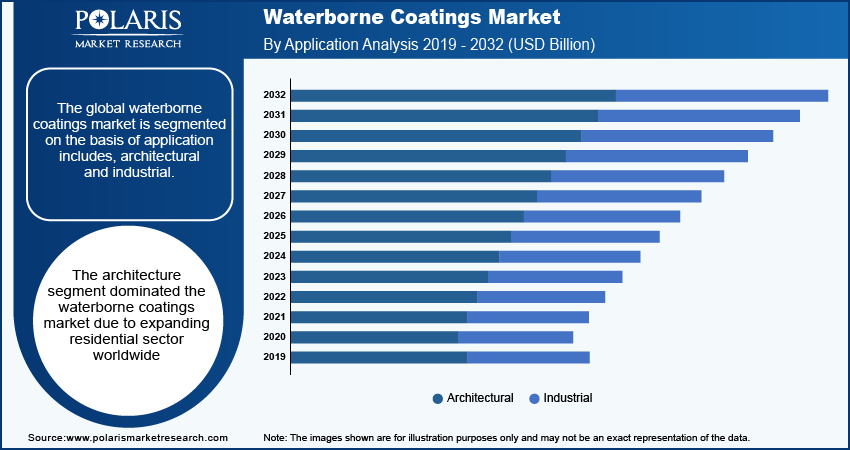
Regional Insights
By region, the study provides insights into North America, Europe, Asia Pacific, Latin America, and the Middle East & Africa. North America leads the global waterborne coatings market due to the rising adoption of EVs and the increasing number of construction activities. Growth is also supported by continued innovation in low-emission formulations and steady demand from renovation activity and automotive supply chains.
The presence of major players such as Axalta Coating Systems, Benjamin Moore, and Diamond Vogel Paint, which focus on delivering advanced waterborne coatings, strengthens the market landscape in North America. The major players are also concentrating on various strategic approaches, such as acquisition, merger, and collaboration, to enhance their position and deliver better services in the North America waterborne coatings market.
The Europe waterborne coatings market accounted for the second-largest market share. This is because of the stringent environmental regulations in the region. The increasing levels of air pollution and the rising production of hazardous waste are further propelling the demand for waterborne coatings. In addition, the requirement for sustainable practices to comply with environmental regulations is also propelling the demand for waterborne coatings.
The Asia Pacific waterborne coatings market is projected to have the highest CAGR from 2026 to 2034. This is mainly due to the rising demand for waterborne coatings in architectural and home decor applications, driven by a growing middle-class population and higher disposable incomes. The demand for eco-friendly, attractive coatings is also rising as people spend more on home improvement and renovation. The rising disposable income is also driving more architectural projects, thereby fueling demand for waterborne coatings. The Asia Pacific region is also fueled by the growth of manufacturing capacity, urban housing demand, and the increasing acceptance of water-based coatings.
The India waterborne coatings market accounted for the largest share in the Asia Pacific market in 2025. The growth in the Indian market is driven by rising consumer purchasing power, greater use of paint in electric vehicle production, and manufacturers' expanding industrial presence in India. In January 2024, Asian Paints made an announcement about its plan to establish the production of waterborne paints in the state of Madhya Pradesh with a capacity of 400,000 kiloliters per annum. The future prospects in the India market are also fueled by the rising construction activities. Additionally, the adoption of compliant coatings is on the rise in the automotive and manufacturing industries.
Source: Polaris Market Research Analysis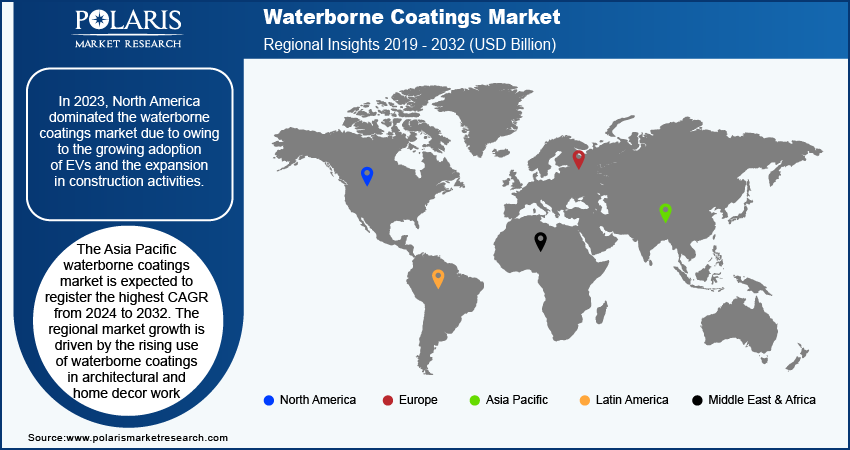
Key Players and Competitive Insights
The key players are investing heavily in R&D to innovate new products and increase their product offerings, which will help them acquire a competitive share by improving accessibility to their products. The key players in the waterborne coatings market are adopting intensive strategies to improve their footprint in the global market. Some of the key developments include mergers and acquisitions, collaborations, and partnership agreements. Market players are also working to develop affordable waterborne coatings to gain a larger share of the consumer base.
Competitive themes include the expansion of waterborne resin and dispersion product lines, the enhancement of local manufacturing capabilities to improve cost competitiveness, and the development of low-VOC coating systems for architectural, wood, and OEM markets.
In the global waterborne coatings market, local production is one of the most important business strategies that is being used by the key players in order to reduce production costs and increase profits. The industry is witnessing advancements in technologies with the changing global conditions.
BASF SE is a global chemical corporation with seven distinct business segments: chemicals, industrial solutions, materials, surface technologies, nutrition & care, agricultural solutions, and others. The chemical segment supplies petrochemicals and their intermediates. Advanced materials and their precursors for applications such as polyamides and isocyanates are available through the Materials section, inorganic basic products, and specialties for the plastic and plastic processing industries. The industrial solutions sector deals with the development and sale of various ingredients and additives such as polymer dispersions, resins, electronic materials, pigments, light stabilizers, antioxidants, mineral processing, oilfield chemicals, and hydrometallurgical chemicals. On the other hand, Surface Technologies provides chemical solutions and automotive OEM services to the automotive and chemical sectors. This includes surface treatment, battery materials, refinishing coatings, catalysts, and base metal services. The Nutrition and Care sector provides ingredients for food and feed producers, pharmaceutical, detergent, cosmetics, and cleaner industries. Lastly, the Agricultural Solutions segment offers seeds and crop protection products, such as herbicides, fungicides, insecticides, seed treatment products, and biological crop protection products.
Arkema SA is a chemical company engaged in offering coating solutions, adhesives, and advanced materials. It provides coating resins, additives, adhesives, and polymers to aeronautics, sporting products, cosmetics, electronics, and the automobile industries across the globe. In April 2024, Arkema widened its sustainable offering by introducing a range of products focused on circularity, decarbonization, and others at the American Coatings Show 2024 in Indiana to meet changing consumer interests.
List of Key Companies
- Akzo Nobel N.V.
- Asian Paints Limited
- Axalta Coating Systems, Ltd.
- BASF SE
- Benjamin Moore & Co.
- Berger Paints India Ltd.
- Brillux GMBH & Co. Kg
- Carpoly Chemical Group Co., Ltd.
- Cloverdale Paint Inc.
- Diamond Vogel Paint Company
- DuluxGroup Ltd.
- Fujikura Kasei Co., Ltd.
Waterborne Coatings Industry Developments
- February 2025: AkzoNobel announced the launch of RUBBOL WF 3350, a waterborne wood coating with 20% bio-based content. The coating has been developed by the Sikkens Wood Coatings business. Its combination of sustainability with high performance supports a circular economy and eco-friendly design.
- August 2024: AkzoNobel launched its new line of wood coating solutions at the International Woodworking Fair (IWF) 2024 in Atlanta. The new products included Chemcraft’s acrylic lines and Selva Pro 2K polyurethane.
- August 2023: Covestro finished building its new manufacturing facility in Shanghai, China. According to Covestro, the new facility will focus on the development of polyurethane solutions. The new initiative by Covestro will help the company cater to the growing need for sustainable coatings and adhesives in the Asia Pacific region.
Waterborne Coatings Market Segmentation
By Resin Type Outlook (Revenue, USD Billion, 2021–2034)
- Acrylic
- Polyester
- Alkyd
- Epoxy
- Polyurethane
- PTFE
- PVDF
- PVDC
- Others
By Application Industry Outlook (Revenue, USD Billion, 2021–2034)
- Architectural
- Industrial
By Regional Outlook (Revenue, USD Billion, 2021–2034)
- North America
- US
- Canada
- Europe
- Germany
- France
- UK
- Italy
- Spain
- Netherlands
- Russia
- Rest of Europe
- Asia Pacific
- China
- Japan
- India
- Malaysia
- South Korea
- Indonesia
- Australia
- Vietnam
- Rest of Asia Pacific
- Middle East & Africa
- Saudi Arabia
- UAE
- Israel
- South Africa
- Rest of Middle East & Africa
- Latin America
- Mexico
- Brazil
- Argentina
- Rest of Latin America
Waterborne Coatings Market Report Scope
| Report Attributes | Details |
| Market Size in 2025 | USD 98.97 billion |
| Market Size in 2026 | USD 104.62 billion |
| Revenue Forecast by 2034 | USD 168.19 billion |
| CAGR | 6.1% |
| Base Year | 2025 |
| Historical Data | 2021–2024 |
| Forecast Period | 2026–2034 |
| Quantitative Units | Revenue in USD billion, and CAGR from 2026 to 2034 |
| Report Coverage | Revenue Forecast, Market Competitive Landscape, Growth Factors, and Trends |
| Segments Covered |
|
| Regional Scope |
|
| Competitive Landscape | Waterbone Coatings Industry Trend Analysis (2025) Company profiles/industry participants profiling include company overview, financial information, product/service benchmarking, and recent developments |
| Report Format | PDF + Excel |
| Customization | Report customization as per your requirements with respect to countries, regions, and segmentation. |
Source: Polaris Market Research Analysis
Waterborne Coatings Market FAQ's
The global waterborne coatings market stood at USD 98.97 billion in 2025. The market is projected to reach USD 168.19 billion by 2034.
Waterborne coatings are eco-friendly surface treatments. They use water as a solvent for architectural, automotive, and industrial applications that need corrosion protection and aesthetic enhancement with low VOC emissions.
The waterborne coatings market is driven by stringent environmental regulations and low VOC emission requirements. The market is also benefiting from increasing demand across the construction and automotive sectors.
Alkyd-based waterborne coatings dominate the market. This is due to widespread application in architectural, residential, and commercial buildings.
North America leads the global waterborne coatings market due to the rising adoption of EVs and the increasing number of construction activities.
Download Sample Report of Waterborne Coatings Market
Please fill out the form to request a customized copy of the research report.


