
5G Services Market Size, Share, Trends, Industry Analysis Report, 2026 - 2034
REPORT DETAILS
5G Services Market Summary
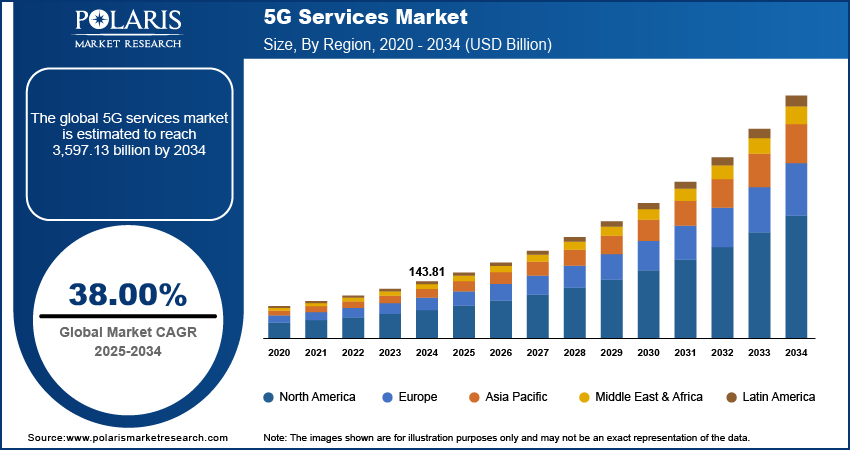
The global 5G services market size was valued at USD 198.18 billion in 2025. The market is projected to grow at a CAGR of 38.14% during 2026 to 2034. Key factors driving demand for 5G services include the proliferation of Internet of Things (IoT) devices, growing adoption of autonomous vehicles, industrial automation, and remote surgery, and increasing enterprise digital transformation and smart city initiatives.
Market Statistics
Key Takeaways
- Asia Pacific dominated the global 5G services market with 38.0% share in 2025 and is anticipated to maintain its dominance throughout the forecast period. Rapid infrastructural development in countries such as India, China, Japan, and others has contributed to regional dominance.
- North America is expected to witness a CAGR of 36.5% in the global 5G services market throughout the forecast period due to the presence of large 5G services providers such as AT&T and Verizon.
- The IT & telecom segment held the largest revenue share of 21.0% share in 2025 and is anticipated to lead the market over the forecast period. This is due to the rising need for faster speeds, lower latency, and massive connectivity to support new applications such as the Internet of Things (IoT) and artificial intelligence (AI).
- The manufacturing segment is anticipated to grow at a CAGR of 39.5% in the coming years, due to the rising adoption of IoT and other related technologies in order to increase productivity and efficiency.
- The smart cities segment held 21.0% revenue share in 2025 due to rising investments in smart infrastructure and IoT networks.
- The connected factories segment is projected to grow at a CAGR of 39.0% during 2026–2034, driven by increasing Industry 4.0 adoption.
*Note: Figures and projections outlined in this report are the result of Polaris Market Research’s proprietary analytical processes, grounded in the latest available datasets and market observations.
Industry Dynamics
- The global 5G services market is fueled by the rising consumer expectations for faster downloads, smoother streaming, and minimal lag in online gaming.
- The growing number of connected devices and sensors in smart homes, manufacturing, healthcare, and logistics is also anticipated to increase demand for 5G services.
- Urban development initiatives, including intelligent transportation systems and smart grids, are creating a lucrative market opportunity.
- The high cybersecurity risks may hamper the market growth.
AI Impact on 5G Services Market
- Enhances 5G network performance by predicting traffic patterns and optimizing resource allocation.
- Detects potential network failures, reducing downtime and improving reliability.
- Helps in automated network management, lowering operational costs and human intervention.
Source: Polaris Market Research Analysis
To Understand More About this Research: Download Sample Report
What are 5G Services?
5G services are advanced wireless communication services that offer faster internet speeds, lower latency, and stronger network connectivity. They support smartphones, IoT devices, smart cities, autonomous vehicles, industrial automation, cloud gaming, and digital transformation across industries.
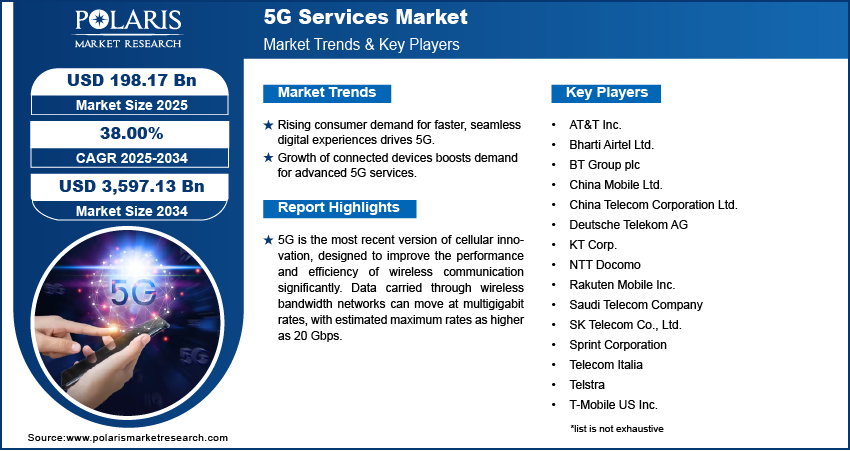
5G is the most recent version of cellular innovation, designed to improve the performance and efficiency of wireless communication significantly. Data carried through wireless bandwidth networks can move at multigigabit rates, with estimated maximum rates as higher as 20 Gbps. Bandwidth speeds are faster than landline network connections and have a latency of fewer than five milliseconds (ms), which is beneficial for businesses that demand real-time input. Increasing demand for low network latency rate, high-speed transmission along with increasing connected devices trends are among several factors expected to increase demand for the 5G services market throughout the projected period.
5G vs 4G Network Services
| Parameters | 4G Network Services | 5G Network Services |
| Speed | Up to 100 Mbps | Up to 10 Gbps |
| Latency | Around 30–50 ms | Less than 10 ms |
| Bandwidth | Limited bandwidth capacity | Higher bandwidth capacity |
| Device Connectivity | Supports fewer connected devices | Supports massive IoT device connectivity |
| Industrial Applications | Limited industrial automation support | Supports smart factories and Industry 4.0 |
| Streaming Quality | Good HD streaming | Smooth 4K/8K and cloud gaming |
| IoT Support | Basic IoT connectivity | Advanced IoT and real-time communication support |
Source: Polaris Market Research Analysis
Industry Dynamics
Growth Drivers
The global 5G services market is fueled by the rising consumer expectations for faster downloads, smoother streaming, and minimal lag in online gaming. Collaboration among smartphone makers, semiconductor vendors, and telecom operators is further projected to aid in developing operational 5G networks, which is increasing the demand for 5G services. Innovative infrastructure such as smart power networks, smart cities, intelligent buildings, and others need reliable internet connections, whcih is increasing the deployment and usgae of 5G netowrks. This is increasing the demand for advanced 5G services. Moreover, the government's significant expenditures and digital transformation intiatives in many parts of the world are fueling the expansion of the 5G cellular services market. The growing number of connected devices and sensors in smart homes, manufacturing, healthcare, and logistics is also anticipated to increase demand for 5G services.
Expansion of 5G Infrastructure & Small Cell Networks
Telecom providers are increasing investments in 5G infrastructure to improve network coverage and capacity. Companies are deploying small cells, macro cells, and advanced radio access networks across urban and industrial areas. These deployments help deliver faster connectivity, lower latency, and better network performance. Growing demand for IoT devices and high-speed data services is further supporting infrastructure expansion.
Source: Polaris Market Research Analysis
Report Segmentation
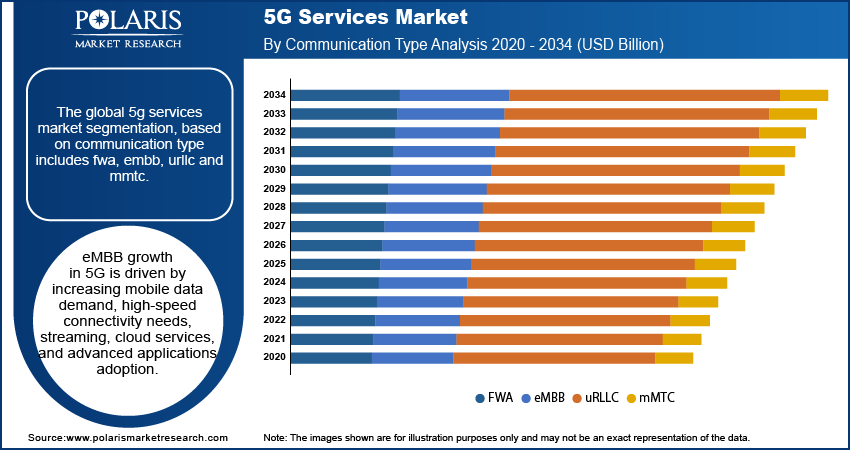
The market is primarily segmented based on communication type, end use, industry vertical, and region.
| By Communication Type | By End Use | By Industry Vertical | By Region |
|
|
|
|
Source: Polaris Market Research Analysis
Insight by Industry Vertical
The IT & telecom segment held the largest revenue share of 21.0% in 2025 and is anticipated to lead the market over the forecast period. This is due to the rising need for faster speeds, lower latency, and massive connectivity to support new applications such as the Internet of Things (IoT) and artificial intelligence (AI). 5G also hepls in creating new revenue streams for telecom operators, which contributed to the high adoption of 5G services in IT & telecom.
The manufacturing segment is anticipated to grow at a CAGR of 39.5% in the coming years, due to the rising adoption of IoT and other related technologies in the manufacturing sector in order to increase productivity and efficiency. Furthermore, cyber-physical technologies and IoT are projected to power Industry 4.0 in manufacturing which is projected to increase need of 5G services connections.
Source: Polaris Market Research Analysis
Insight by End Use
The smart cities segment held the largest revenue share of 21.0% in 2025. Smart cities need 5G services to support massive numbers of IoT devices and enhance public safety, smart energy grids, and improve waste management. The growing investment in smart cities acorss the globe, particualry in emerging countries such as India further contributed to the segment's dominance. The Government of India launched Smart Cities Mission (SCM) to enhance the quality of life in India's cities through smart, sustainable solutions, with an investment of ₹1,47,704 crore.
B2B Use Cases of 5G Services by End User Segment
| End Users | Core 5G B2B Use Cases | Value Proposition for Enterprises | Key Opportunities |
| Smart Cities | IoT connectivity across smart cities, video analytics, and smart infrastructure management | Enables integrators and governments to deliver connected urban services with enhanced efficiency and safety. | Public-private partnerships (PPPs) between telecoms, municipal bodies, and infrastructure firms. |
| Connected Workers | AR/VR-based remote training, real-time collaboration tools, and the use of wearables for safety monitoring | Increased workforce productivity, reduced risks, and enhanced field operations. | Partnerships among industrial OEMs, 5G providers, and workforce management SaaS vendors. |
| Connected Vehicles | Vehicle-to-everything (V2X) communication, fleet telematics, and real-time navigation | Enhanced fleet safety, autonomous driving readiness, and logistics efficiency. | OEM–telecom form alliance for connected platforms; insurance and data-sharing agreements. |
| Connected Factories | Smart automation, digital twins, machine vision, and predictive maintenance. | Increases production uptime, lower operational cost, and enables Industry 4.0 transformation. | Collaboration among manufacturing enterprises, telcos, cloud providers, and robotics firms |
| Smart Buildings | IoT-based energy management, smart maintenance systems, and security analytics. | Reduces energy consumption, lowers operating costs, and improves occupant experience. | System integrator and telecom collaborations offering managed 5G building services. |
| Smart Utilities | Remote asset management, grid intelligence, automated metering, and outage prediction. | Improves reliability, efficiency, and operational safety in water and energy networks. | Utility companies are partnering with telecoms and analytics firms for real-time control. |
| Connected Healthcare | Remote diagnostics, robotic surgery, smart ambulances, and telemedicine. | Improves healthcare delivery, patient outcomes, and operational efficiency. | Partnerships among hospitals, MedTech, telecom operators, and cloud AI vendors. |
Source: Polaris Market Research Analysis
Geographic Overview
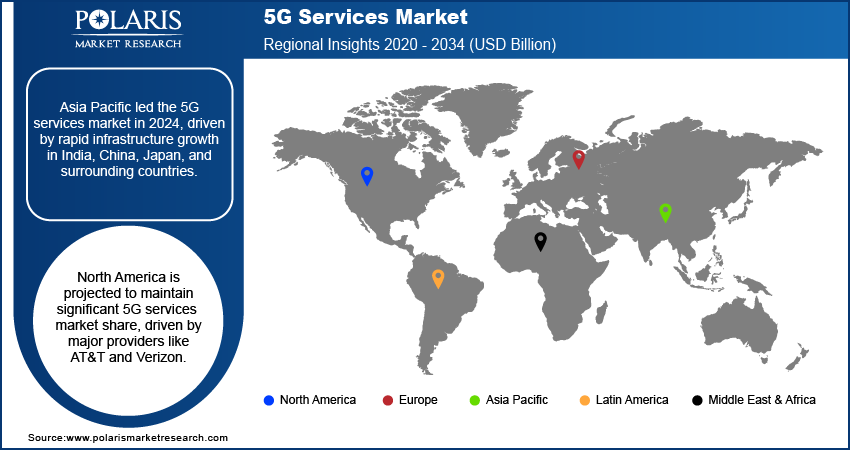
Asia Pacific dominated the global 5G services market in 2025 with revenue share of 38.0% and is anticipated to maintain its dominance throughout the forecast period. Rapid infrastructural development in countries such as India, China, Japan, and others has increased the demand for these services in order to improve connectivity. Moreover, the massive internet userbase and rising demand for smartphones with higher internet speeds have contributed to a consistent supply of 5G-enabled devices across the region, which increased the demand for 5G services.
Europe is expected to grow at a significant pace of 36.9% due to the increasing adoption of fifth generation services across the region. For instance, by the end of March 2021, 24 EU-27 nations had implemented 5G commercial services, including Austria, France, Belgium, Germany, and Greece.
North America is expected to hold a significant market share of 28.0% in 2025 of the global 5G services market throughout the forecast period due to the presence of large 5G services provider such as AT&T and Verizon. Furthermore, increasing investments made by these players in order to provide 5G services across major countries, including the U.S. and Canada, are expected to propel market growth. For instance, in January 2021, AT&T began 5G services in several parts of Tampa, U.S., including the Tampa Airport and the Channel District.
Source: Polaris Market Research Analysis
Competitive Insight
Major market players operating in the global 5G services market include AT&T, Inc., Bharti Airtel Ltd., BT Group plc, China Mobile Ltd., China Telecom Corporation Ltd., Deutsche Telekom AG, KT Corp., NTT Docomo, Rakuten Mobile Inc., Saudi Telecom Company, SK Telecom Co., Ltd., Sprint Corporation, Telecom Italia, Telstra, T-Mobile USA Inc., Verizon Communications Inc., and Vodafone Group.
These market players are investing in research & development and securing the required spectrum. Furthermore, marketing strategies adopted by these players such as mergers & acquisitions and partnerships & collaboration in order to capture more consumers and enlarge their footprints. For instance, In January 2021, AT&T introduced its 5G+ services in prominent Tampa regions and venues such as Channel District, Raymond James Stadium, and Tampa International Airport in the United States.
Key Companies in 5G Services Market
- AT&T, Inc.
- Bharti Airtel Ltd.
- BT Group plc
- China Mobile Ltd.
- China Telecom Corporation Ltd.
- Deutsche Telekom AG
- KT Corp.
- NTT Docomo
- Rakuten Mobile Inc.
- Saudi Telecom Company
- SK Telecom Co., Ltd.
- Sprint Corporation
- Telecom Italia
- Telstra
- T-Mobile USA Inc.
- Verizon Communications Inc.
- Vodafone Group
Challenges in 5G Services Market
- High infrastructure deployment and network upgrade costs
- Spectrum allocation and availability issues in several countries
- Rising cybersecurity and data privacy concerns
- Complex government regulations and compliance requirements
- Limited 5G coverage in rural and remote areas
- High energy consumption of advanced 5G network infrastructure
Future Outlook
The 5G services market is expected to grow steadily in the coming years due to rising demand for ultra-fast connectivity and low-latency networks. Growth in smart city and Industry 4.0 projects will further support market expansion. Increasing adoption of private 5G networks, AI-enabled telecom infrastructure, and edge computing is also creating new opportunities. Rising deployment of IoT-connected devices across consumer and enterprise sectors will continue to drive demand worldwide.
5G Services Market Developments
- April 2026: Deutsche Telekom is extending its already available 5G+ range, which was limited to gaming applications, to introduce an option of latency-optimised video calling over its mobile network. Customers can now enjoy an ultra-stable experience for gaming and video calling with the new 5G+ Ultra tier option, even on an overcrowded mobile network. (Source: telekom.com)
- March 2025: ZTE collaborated with China Mobile to introduce two major innovations—‘Communication-Sensing-Computing-Intelligence’ and ‘Ambient IoT’—as part of the latest advancements in 5G-A technology. (Source: zte.com)
- February 2025: Bharti Airtel teamed up with Ericsson to roll out advanced 5G Core technology, marking a major milestone in its shift to a full-scale 5G Standalone (SA) network in India. This collaboration leverages their 25-year partnership and aims to boost Airtel’s network capacity, enabling the delivery of innovative and differentiated services to millions of customers and enterprises. Ericsson’s dual-mode 5G Core solutions will help Airtel monetize its network through features like network slicing and API exposure, unlocking new opportunities for both consumers and businesses. (Source: airtel.com)
5G Services Market Report Scope
| Report Attributes | Details |
| Market size value in 2025 | USD 198.18 billion |
| Market size value in 2026 | USD 272.65 billion |
| Revenue forecast in 2034 | USD 3,629.44 billion |
| CAGR | 38.14% from 2026 - 2034 |
| Base year | 2025 |
| Historical data | 2021 - 2024 |
| Forecast period | 2026 - 2034 |
| Quantitative units | Revenue in USD Billion and CAGR from 2026 to 2034 |
| Segments covered |
|
| Regional scope |
|
| Key Companies | AT&T, Inc., Bharti Airtel Ltd., BT Group plc, China Mobile Ltd., China Telecom Corporation Ltd., Deutsche Telekom AG, KT Corp., NTT Docomo, Rakuten Mobile Inc., Saudi Telecom Company, SK Telecom Co., Ltd., Sprint Corporation, Telecom Italia, Telstra, T-Mobile USA Inc., Verizon Communications Inc., and Vodafone Group. |
Source: Polaris Market Research Analysis
5G Services Market FAQ's
• The global market size was valued at USD 198.18 billion in 2025 and is projected to grow to USD 3,629.44 billion by 2034.
• The global market is projected to register a CAGR of 38.14% during the forecast period.
• Asia Pacific dominated the global 5G services market with 38.0% share in 2025.
• A few of the key players in the market include AT&T, Inc., Bharti Airtel Ltd., BT Group plc, China Mobile Ltd., China Telecom Corporation Ltd., Deutsche Telekom AG, KT Corp., NTT Docomo, Rakuten Mobile Inc., Saudi Telecom Company, SK Telecom Co., Ltd., Sprint Corporation, Telecom Italia, Telstra, T-Mobile USA Inc., Verizon Communications Inc., and Vodafone Group.
• The IT & telecom segment held the largest revenue share of 21.0% share in 2025.
Download Sample Report of 5G Services Market
Please fill out the form to request a customized copy of the research report.


