
Automotive Aftermarket Industry Share, Growth Analysis Report, 2026-2034
REPORT DETAILS
Automotive Aftermarket Summary
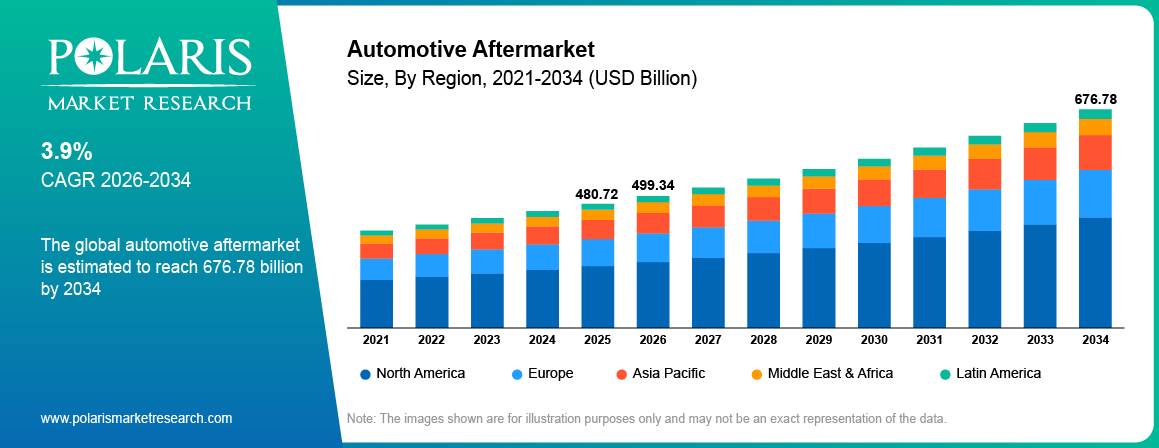
The global automotive aftermarket industry was valued at USD 480.72 billion in 2025. The market is expected to register a CAGR of 3.9% from 2026 to 2034. The rising number of aged vehicles and the increasing adoption of electric vehicles drive the market growth. The high penetration of e-commerce platforms enhances product accessibility, which is expected to fuel industry expansion during the forecast period.
Market Statistics
Key Takeaways
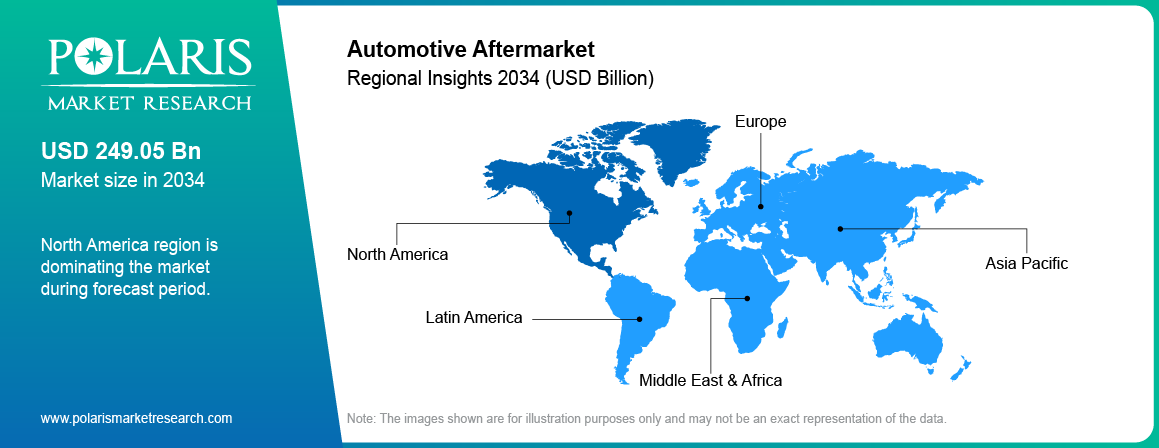
- North America dominated with a revenue share of 36.8% in 2025. The regional market expansion is attributed to its aging vehicle population and robust service infrastructure.
- The Asia Pacific automotive aftermarket industry is anticipated to experience the fastest growth at a 4.5% CAGR. The growth is fueled by increased vehicle ownership in emerging economies.
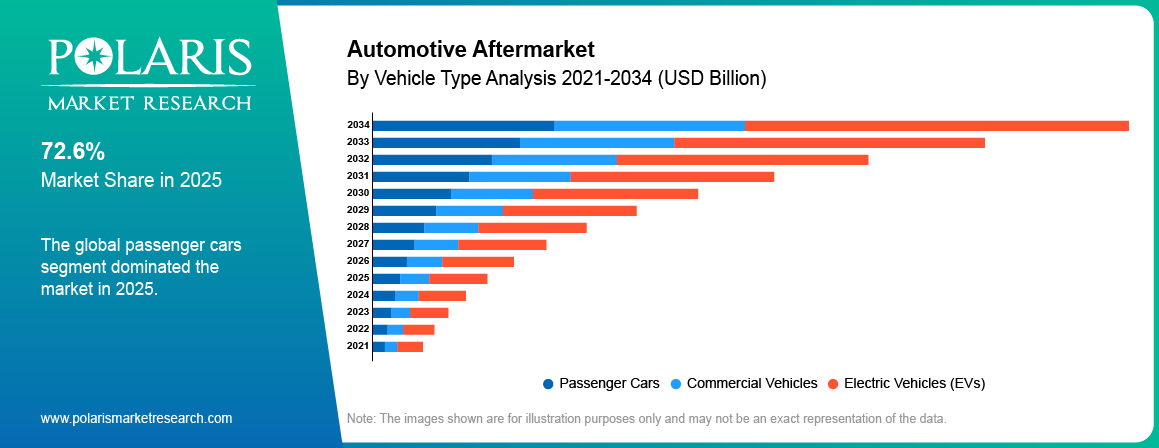
- The passenger cars segment dominated with a 72.6% share in 2025. The larger global fleet of passenger cars has contributed to the segment dominance.
- The replacement parts segment is expected to experience the fastest growth at a 4.3% CAGR. The regular replacement cycle of replacement parts, especially in older vehicles, is projected to boost the segment growth.
- The independent service providers segment led with a 56.4% revenue share in 2025. This is owing to their cost-effective pricing and broad vehicle coverage.
Note: Figures and projections outlined in this report are the result of Polaris Market Research’s proprietary analytical processes, grounded in the latest available datasets and market observations.
AI Impact on Automotive Aftermarket Industry
- Artificial Intelligence (AI) technology plays a key role in various automotive aftermarket services, including predictive maintenance and insurance.
- AI systems predict issues related to engine performance that may occur in the future.
- Insurance providers utilize AI-enabled models to deliver efficient and quick services to customers, such as claims processing.
- Players in the automotive aftermarket adopt AI tools to gain insights for surging sales through retailers and distributors.
To Understand More About this Research: Download Sample Report
The automotive aftermarket industry encompasses the manufacturing, distribution, and sale of vehicle parts, accessories, and services after the original equipment manufacturer (OEM) sale. The market caters to vehicle maintenance, repair, and customization demands, which include parts replacement, performance-improving accessories, and others for passenger and commercial vehicles.
The evolving consumer preferences for personalized vehicles and advanced features have fueled the automotive aftermarket industry growth. The market is expanding rapidly owing to technological innovations, including e-commerce platforms and predictive maintenance solutions, which have improved product accessibility and enhanced service precision.
OEM Parts vs Aftermarket Parts
| Factor | OEM Parts | Aftermarket Parts |
| Manufacture | Made by the vehicle’s original manufacturer or their designated supplier | Produced by outside third parties |
| Cost | More costly due to brand assurance and guarantee | More economical with greater choice of price points |
| Fitment | Engineered for specific models with exact fitment | Variable in terms of fitment due to different manufacturers and varying quality |
| Warranty | Carry manufacturer warranties | Warranties depend on the supplier and can be different from OEM guarantees |
| Modification Possibilities | Not many since parts follow original specifications | Endless modifications based on product features and design |
| Accessibility | May need to be ordered through dealer networks or other authorized sources | Readily available from retailers and distribution centers |
Source: Polaris Market Research Analysis
Market Dynamics
Driver: Rising Automotive Customization
The rising vehicle customization culture, especially among younger drivers, is driving the automotive aftermarket industry growth. According to the US Bureau of Labor Statistics, in the US alone, employment in vehicle customization shops increased by 12% from 2019 to 2023, showcasing the growth of the vehicle customization culture. Social media and automotive influencers have transformed cars from simple transportation into expressions of personal identity, creating viral trends in vehicle modifications and inspiring widespread customization, thereby propelling market demand.
Driver: Expansion of E-Commerce Channels
The surge in e-commerce platforms is reshaping the automotive aftermarket industry, providing consumers with improved accessibility and convenience for the purchase of automotive equipment. Online marketplaces have enabled users to compare prices, review products, and access a wide array of parts from global vendors, contributing to market growth. Furthermore, companies adopting omnichannel strategies, which integrate online and offline sales channels, are capturing significant market share as consumers increasingly favor digital-first purchasing channels.
Trend: Sustainable Automotive Parts and Circular Economy
The concept of sustainability is becoming increasingly significant in the auto aftermarket as more companies in these areas embrace circular economic models. For instance, there is increased adoption of reconditioning, remanufacturing, and recycling strategies for components and parts that extend their lifespans while minimizing waste and energy use. Furthermore, organizations have started adopting sustainable manufacturing techniques, green packaging materials, as well as recycling procedures of tires, batteries, oils, and metal components in order to lessen their ecological impact. Such actions not only help achieve sustainability but also provide customers with economical products.
Segment Insights
Assessment by Product Type Insights
The automotive aftermarket industry, based on product type, is segmented into replacement parts and accessories. The replacement parts segment is expected to experience the fastest growth of CAGR 4.3% during the forecast period, driven by the regular replacement cycle of replacement parts, especially in older vehicles. Additionally, environmental regulations are prompting the replacement of parts to meet emissions standards, while growing concerns over fuel efficiency are leading to the replacement of components that optimize vehicle performance and reduce fuel consumption, thereby driving segmental growth in the global market.
Evaluation by Vehicle Type Insights
The automotive aftermarket industry, based on vehicle type, is segmented into passenger cars, commercial vehicles, and electric vehicles (EVs). The passenger cars segment dominated the market in 2025 with 72.6% due to the larger global fleet of passenger cars and a higher frequency of maintenance as compared to other vehicle types. Additionally, growing interest in vehicle customization and increasing disposable income worldwide contribute to the dominance of the segment.
Which Technologies are Being Used by Service Channels in the Automotive Aftermarket Industry?
Based on service channels, the industry is segmented into OEM-authorized dealers, independent service providers, and online platforms. OEM dealers are adopting Internet of Things (IoT) and predictive analytics. These technologies help them deliver precision maintenance and ensure warranty integrity. Independent service providers leverage connected diagnostics and artificial intelligence (AI). Using these technology, they offer affordable and personalized repairs. There is an increasing adoption of online platforms. They are driving transparency and convenience through e-commerce and digital booking systems. These technologies help industry components create integrated, data-driven aftermarket network. It enhances customer experience and supports the growing complexity of modern and electric vehicles. It also helps reduce downtime.
| Ecosystem Component | Role in Aftermarket | Technologies Used | Use/Application in Aftermarket |
| OEM-Authorized Dealers | Use genuine parts, provide certified repairs, and maintain OEM warranty compliance. | IoT, Digital Twins, Predictive Maintenance, and Blockchain | Real-time vehicle diagnostics, service history digitization, proactive maintenance scheduling, and authenticated parts tracking |
| Independent Service Providers (ISPs) | Cost-effective repair, maintenance using OEM or aftermarket parts, and customization | Connected Diagnostics, AI-enabled Repair Analytics, and AR/VR | Remote fault detection, AI-based maintenance recommendations, and technician assistance through AR |
| Online Platforms | Facilitate online part sales, service booking for consumers and workshops, and price comparison, | E-Commerce Platforms, API Integration, Cloud Computing, and Data Analytics | Real-time parts availability, customer review aggregation, online appointment scheduling, and predictive pricing. |
Source: Polaris Market Research Analysis
Regional Analysis
By region, the report offers automotive aftermarket industry insights into North America, Europe, Asia Pacific, Latin America, and the Middle East & Africa. North America dominated the global market in 2025 with 36.8% share due to its aging vehicle population and robust service infrastructure. Aging vehicles require more frequent maintenance and replacement parts, which increases the demand for aftermarket products and services. The average age of vehicles in North America is now over 12 years, leading to a greater need for repairs and upgrades. Additionally, technological advancements in automotive design and engineering have contributed to the evolution of the automotive aftermarket industry in the region. The rise of e-commerce platforms has further expanded the market, as these platforms have transformed how consumers purchase automotive aftermarket parts and accessories, making it easier for them to find and order products online.
The Asia Pacific automotive aftermarket industry is anticipated to experience the fastest growth of CAGR 4.5% during the forecast period, fueled by increased vehicle ownership in emerging economies like India and China. For instance, according to the Society of Indian Automobile Manufacturers, India has 380 million vehicles, while China boasts 420 million passenger vehicles, showcasing a large volume of vehicle ownership in the region. Additionally, these countries are witnessing rapid urbanization and growing consumer spending on vehicle maintenance, further fueling regional market growth.
Competitive Insights
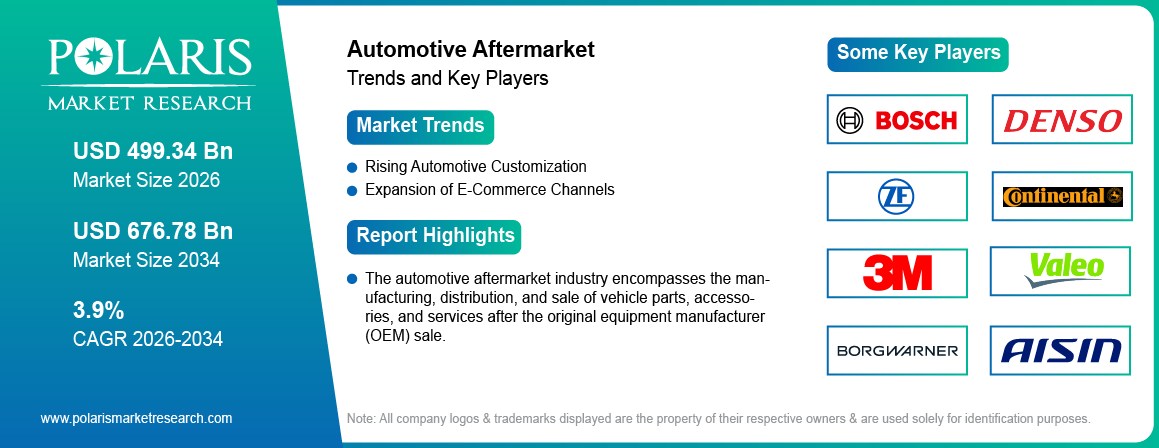
The leading companies dominate the automotive aftermarket industry through global networks, innovative technologies, and diverse portfolios. Bosch and Denso focus on advanced diagnostic tools, while Bridgestone and Goodyear specialize in tires, commanding significant automotive aftermarket industry share. These players employ strategies such as mergers and acquisitions, partnerships, and digitalization to maintain a competitive edge.
Continental AG, is a technology company with a global presence, providing innovative solutions for vehicles, machinery, traffic, and transportation. The company specializes in tires, automotive components, software development, driver assistance systems, automated driving, connectivity, vehicle networking, and autonomous mobility. Continental AG has evolved into a multifaceted entity operating through four key segments: Automotive, ContiTech, Tires, and Contract Manufacturing. The Automotive segment is focused on enhancing vehicle safety and performance through advanced technologies, including safety, chassis, brake, motion, and motion control systems. It also develops solutions for assisted and automated driving, as well as innovative display, operating, and interior systems encompassing audio and camera technologies. Additionally, the segment provides intelligent information and communication technology solutions, integrating the latest advancements in vehicle connectivity and automation. Continental's Tires sector supplies a wide range of tires for cars, buses, trucks, electric two-wheelers, and specialty vehicles, alongside offering digital tire monitoring and management systems. The ContiTech division specializes in producing high-performance products and systems from rubber, metal, plastic, and textiles, catering to industries such as energy, construction, agriculture, automotive, and transportation. Continental leverages its extensive expertise in material science and engineering to support various industrial applications globally through its contract manufacturing services.
3M Company, originally founded in 1902 as Minnesota Mining and Manufacturing Company, is a diversified technology and science corporation headquartered in St. Paul, Minnesota. With operations in over 70 countries and sales in approximately 200 countries, 3M serves a wide range of industries, including industrial, safety, healthcare, and consumer markets. The company’s portfolio features more than 60,000 products categorized into key business segments. The Safety & Industrial segment offers personal protective equipment, adhesives, abrasives, and tapes for industries such as automotive and construction. In the Transportation & Electronics segment, 3M provides solutions for automotive OEMs and electronic components. 3M operates manufacturing facilities across various regions, including North America, and significant operations in Asia Pacific, particularly in India and China. The company also maintains a robust presence throughout Europe.
List of Key Companies
- Robert Bosch GmbH
- Denso Corporation
- ZF Friedrichshafen AG
- Continental AG
- 3M Company
- Valeo SA
- BorgWarner Inc.
- Tenneco Inc.
- Aisin Seiki Co., Ltd.
- Delphi Technologies
- Federal-Mogul Corporation
- Goodyear Tire & Rubber Company
- Bridgestone Corporation
- Magneti Marelli
- Cooper Tire & Rubber Company
Future Outlook
The growth of the automotive aftermarket industry in the future will be influenced by the increase in car ownership, longevity of cars, development in the servicing of EVs, and growth of e-commerce in car spare parts. Diagnostics through artificial intelligence, predictive maintenance technology, connectivity technology, and digitized service centers will contribute to improving efficiency and enhancing the customer experience. With vehicles becoming smarter and more secure as a result of advances in technology, the automotive aftermarket will play an important role in maintaining, repairing, and managing the lifecycle of vehicles, mobility services, and even infrastructure for the vehicles.
Industry Developments
April 2026: Malco Automotive unveiled its partnership with Holley Performance Brands. The collaboration centers on the development of a new car care line called Holley High-Performance Car Care. As per Malco Automotive, the development of the new line is in line with its dedication to deliver professional results. (source: malcoautomotive.com)
March 2026: CLEPA (European Association of Automotive Suppliers) advocated for extending guidelines on the European Commission's Data Act. CLEPA emphasized the critical importance of open access to vehicle data in order to safeguard the competitiveness of the aftermarket suppliers. (source: clepa.eu).
Industry Segmentation
By Product Type Outlook (Revenue – USD Billion, 2021–2034)
- Replacement Parts
- Batteries
- Filters
- Brake Components
- Accessories
- Interior Accessories
- Exterior Accessories
By Vehicle Type Outlook (Revenue – USD Billion, 2021–2034)
- Passenger Cars
- Commercial Vehicles
- Electric Vehicles (EVs)
By Service Channel Outlook (Revenue – USD Billion, 2021–2034)
- OEM-Authorized Dealers
- Independent Service Providers
- Online Platforms
By Regional Outlook (Revenue – USD Billion, 2021–2034)
- North America
- US
- Canada
- Europe
- Germany
- France
- UK
- Italy
- Spain
- Netherlands
- Russia
- Rest of Europe
- Asia Pacific
- China
- Japan
- India
- Malaysia
- South Korea
- Indonesia
- Australia
- Vietnam
- Rest of Asia Pacific
- Middle East & Africa
- Saudi Arabia
- UAE
- Israel
- South Africa
- Rest of Middle East & Africa
- Latin America
- Mexico
- Brazil
- Argentina
- Rest of Latin America
Report Scope
| Report Attributes | Details |
| Market Size Value in 2025 | USD 480.72 billion |
| Market Size Value in 2026 | USD 499.34 billion |
| Revenue Forecast by 2034 | USD 676.78 billion |
| CAGR | 3.9% from 2026 to 2034 |
| Base Year | 2025 |
| Historical Data | 2021–2024 |
| Forecast Period | 2026–2034 |
| Quantitative Units | Revenue in USD billion and CAGR from 2026 to 2034 |
| Report Coverage | Revenue Forecast, Market Competitive Landscape, Growth Factors, and Trends |
| Segments Covered |
|
| Regional Scope |
|
| Competitive Landscape |
|
| Report Format |
|
| Customization | Report customization as per your requirements with respect to countries, regions, and segmentation. |
Source: Polaris Market Research Analysis
Automotive Aftermarket Industry FAQ's
The global automotive aftermarket industry size was valued at USD 480.72 billion in 2025 and is projected to grow to USD 676.78 billion by 2034.
The global market is projected to register a CAGR of 3.9% from 2026 to 2034.
North America had the largest share of 36.8% in 2025.
Some of the key players in the market are Bosch Automotive Aftermarket; Denso Corporation; ZF Friedrichshafen AG; Continental AG; 3M Company; Valeo SA; BorgWarner Inc.; Tenneco Inc.; Aisin Seiki Co., Ltd.; Delphi Technologies; Federal-Mogul Corporation; Goodyear Tire & Rubber Company; Bridgestone Corporation; Magneti Marelli; and Cooper Tire & Rubber Company
The passenger cars segment dominated the market in 2025 with 72.6% due to the presence of a larger global passenger car fleet and a higher frequency of maintenance as compared to other vehicle types.
Download Sample Report of Automotive Aftermarket Industry
Please fill out the form to request a customized copy of the research report.


