
Global Automotive HVAC Market Size & Share Global Analysis Report, 2026-2034
REPORT DETAILS
Automotive HVAC Market Summary
The global Automotive HVAC Market was valued at USD 20.1 billion in 2025 and is expected to grow at a CAGR of 6.30% from 2026 to 2034. Enhanced vehicle comfort features and electrification trends are supporting growth.
Market Statistics
Key Takeaways
- Asia Pacific accounted for the largest market share of 46.7% in 2025. The dominance is attributed to the presence of major automotive manufacturers and extensive vehicle production.
- China held the largest share of 52.8% in Asia Pacific in 2025. This is driven by the increasing demand for vehicles in the country.
- The market in North America is anticipated to register the highest CAGR of 7.1% during the forecast period. It is attributed to enhanced macroeconomic conditions and growing automobile production within the region.
- In 2025, the automatic HVAC segment dominated with 64.3% revenue share. The rising interest in automated automotive HVAC systems is supported by changing consumer preferences and an increasing desire for luxury vehicles.
- The passenger cars segment led with 73.5% market share in 2025. Growing disposable income and the availability of various financing options boost the segment growth.
Note: Figures and projections outlined in this report are the result of Polaris Market Research’s proprietary analytical processes, grounded in the latest available datasets and market observations.
Industry Dynamics
- Increasing vehicle production and sales worldwide propels demand for advanced HVAC systems across passenger and commercial vehicles.
- Rising consumer preference for enhanced cabin comfort and air quality drives the adoption of sophisticated climate control technologies.
- High development and integration costs of energy-efficient HVAC systems hinder the adoption of automotive HVAC systems, particularly in cost-sensitive vehicle segments.
- The rapid expansion of electric vehicles (EVs) is expected to create opportunities for innovative HVAC solutions.
- Increasing integration of smart climate control systems with sensors, connectivity, and automated temperature management will shape market growth.
AI Impact on the Automotive HVAC Market
- AI enables intelligent climate control. It automatically adjusts cabin temperature based on occupant preferences and environmental conditions.
- AI-enabled predictive maintenance helps detect HVAC system issues early. It reduces downtime and repair costs.
- AI enhances energy efficiency. It optimizes HVAC operation and minimizes power consumption, particularly in EVs.
- AI-integrated sensors enhance cabin air quality. It continuously monitors and regulates air circulation and filtration.
- Automakers use AI-powered analytics to improve HVAC system design, performance, and reliability through real-time data insights.
Automotive HVAC systems are the air conditioning systems integrated into vehicles, including passenger cars, pickup trucks, and heavy-duty trucks. Similar to conventional air conditioning setups, automotive HVAC functions by cooling air through the conversion of refrigerant into either liquid or gas. The heating aspect of automotive HVAC is distinctive, utilizing the engine-generated heat for the warming process.
Several factors are driving the growth of the automotive HVAC market. The growing need for improved performance, air quality, and environmental considerations drives the automotive HVAC market. The increasing desire for remote access control systems, which contribute to enhanced air conditioning efficiency and reduced fuel consumption, is a key factor fueling market growth in the forecast period.
- For instance, in October 2022, Polestar launched three electric SUV models in the global market. The SUV has an advanced climate control system to keep passengers comfortable on long journeys.
Source: Polaris Market Research Analysis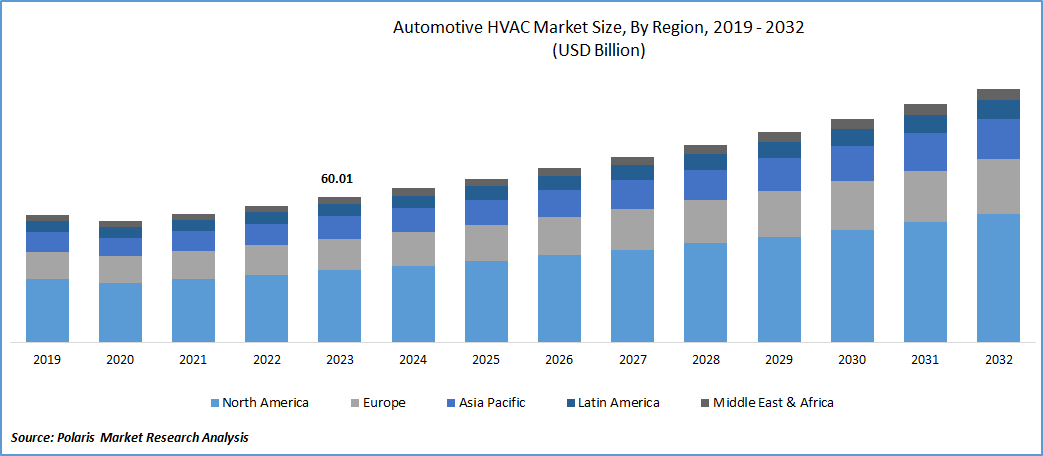
To Understand More About this Research: Download Sample Report
The rise in R&D investments for developing advanced technological components for automobiles, combined with an escalating desire for luxurious vehicles featuring advanced HVAC systems, is a key driver facilitating growth opportunities for the automotive HVAC market. Furthermore, the automotive sector is increasingly embracing technology-centric approaches, introducing innovations in the production of air conditioning compressors and refrigeration systems, which is anticipated to drive the market during the forecast period.
Difference Between Manual vs Automatic Climate Control Systems
| Aspect | Manual Climate Control Systems | Automatic Climate Control Systems |
| Operation | Requires the driver to manually adjust temperature, fan speed, and airflow settings. | Automatically maintains the desired cabin temperature using sensors and electronic controls. |
| User Convenience | Needs frequent adjustments based on changing weather and cabin conditions. | Provides a hands-free experience with minimal driver intervention. |
| Comfort Level | Offers basic climate management with limited precision. | Delivers consistent and precise temperature control for enhanced passenger comfort. |
| Energy Efficiency | May consume more energy due to non-optimized operation. | Optimizes HVAC performance to improve energy efficiency and reduce unnecessary power usage. |
| System Complexity | Simpler design with lower installation and maintenance costs. | More advanced system with additional sensors, controllers, and software integration. |
| Advanced Features | Typically supports single-zone temperature settings. | Can include multi-zone climate control, allowing different cabin temperatures for drivers and passengers. |
| Vehicle Segment | Common in entry-level and budget vehicles. | Widely adopted in premium, luxury, and modern electric vehicles. |
Source: Polaris Market Research Analysis
Source: Polaris Market Research Analysis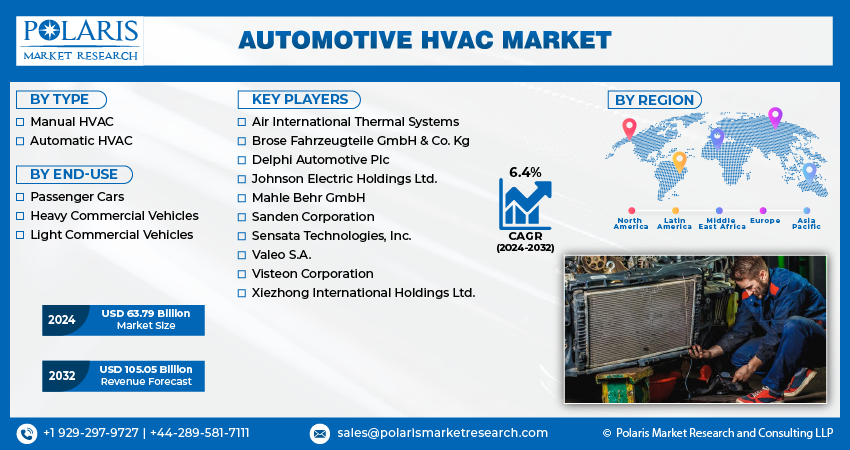
Industry Dynamics
Growth Drivers
-
Rise in the automotive production will drive the growth of the automotive HVAC market
Increase in the automobile production will facilitate the growth of the automotive HVAC market. As global vehicle demand rises, particularly in emerging markets, automotive manufacturers are increasingly incorporating advanced HVAC systems into their vehicles to improve driver and passenger comfort. Enhancing automotive production not only increases the number of vehicles on the road but also increases the demand for advanced climate control solutions.
Consumers are becoming more cautious, seeking enhanced comfort and customized climate settings in their vehicles. This development is driving innovation in the automotive HVAC sector as manufacturers strive to develop energy-efficient and technologically advanced systems, fueling market growth. The surge in automotive production is a driving force behind the automotive HVAC market's robust expansion.
Report Segmentation
The market is primarily segmented based on type, end-user, and region.
| By Type | By End-Use | By Region |
|
|
|
Source: Polaris Market Research Analysis
To Understand the Scope of this Report: Request Customization
By Type Analysis
The automatic HVAC segment accounted for the largest revenue share of 64.3% in 2025
In 2025, the automatic HVAC segment accounted for the largest revenue share. The growing interest in automated automotive HVAC systems is being driven by changing consumer preferences and a growing desire for luxury vehicles, which is fueling the growth of the market. Furthermore, advancements in HVAC technologies, such as fogging sensors, automatic temperature controls, and automatic air recirculation driving the growth of the Automotive HVAC Market.
Manual HVAC systems allow users to adjust temperature settings, fan speeds, and airflow direction based on their personal preferences and comfort levels. This system is for those who prefer direct control over the interior climate of their vehicle, allowing them to fine-tune the thermal comfort inside.
By End-Use Analysis
The passenger cars segment accounted for the highest market share of 73.5% during the forecast period
The passenger cars segment accounted for the highest market share during the forecast period. Because of rising disposable income and the availability of various financing options. Automotive HVAC system demand in Light Commercial Vehicles (LCVs) is increasing significantly, owing to improved financial options and increased demand in rural areas.
These systems play a crucial role in controlling the interior temperature, ensuring proper air circulation, and regulating the humidity in the passenger compartment. Manufacturers in the automotive HVAC market aim to improve the efficiency, energy sustainability, and convenience of these systems to change consumer demands in the passenger car segment.
| Technology | Description | Key Benefits |
| AI-Enabled Climate Control | Uses AI to analyze cabin conditions, occupant preferences, and environmental data for automatic temperature adjustment. | Enhanced comfort, personalized settings, and optimized energy consumption. |
| Heat Pump Systems for EVs | Advanced thermal management systems that transfer heat efficiently instead of generating it through resistance heating. | Improved driving range, reduced battery drain, and greater energy efficiency in electric vehicles. |
| Smart Sensors | Sensors continuously monitor temperature, humidity, air quality, sunlight intensity, and occupant presence. | Precise climate regulation, improved air quality, and enhanced passenger comfort. |
| Connected HVAC Systems | Integrates HVAC controls with vehicle connectivity platforms, mobile applications, and cloud-based services. | Remote climate control, predictive maintenance, and improved user convenience. |
| Energy-Efficient Thermal Technologies | Includes advanced refrigerants, variable-speed compressors, and optimized airflow management systems. | Lower energy consumption, reduced emissions, and improved overall HVAC performance. |
| Multi-Zone Climate Control | Enables independent temperature settings for different cabin zones through advanced control systems. | Customized comfort for passengers and improved user experience. |
| Predictive HVAC Management | Utilizes vehicle data and AI algorithms to anticipate heating and cooling requirements. | Faster climate response, reduced power usage, and enhanced sys |
Source: Polaris Market Research Analysis
Source: Polaris Market Research Analysis
Regional Insights
Asia Pacific is accounted for the largest market share of 46.7% in 2025
Asia Pacific is accounted for the largest market share in the automotive HVAC market. Because of the presence of major automotive manufacturers, extensive vehicle production, and rising demand for vehicles in emerging economies such as India, South Korea, and China, the Asia-Pacific market is poised for significant growth. Government initiatives to revitalize the automotive industry are expected to drive market growth in the forecast period.
North America is anticipated for the fastest growth of CAGR 7.1% in the automotive HVAC market, owing to enhanced macroeconomic conditions and a surge in automobile production within the region. Furthermore, rising disposable income in the United States and rising demand for luxury vehicles are expected to drive the expansion of the market during the forecast period.
Source: Polaris Market Research Analysis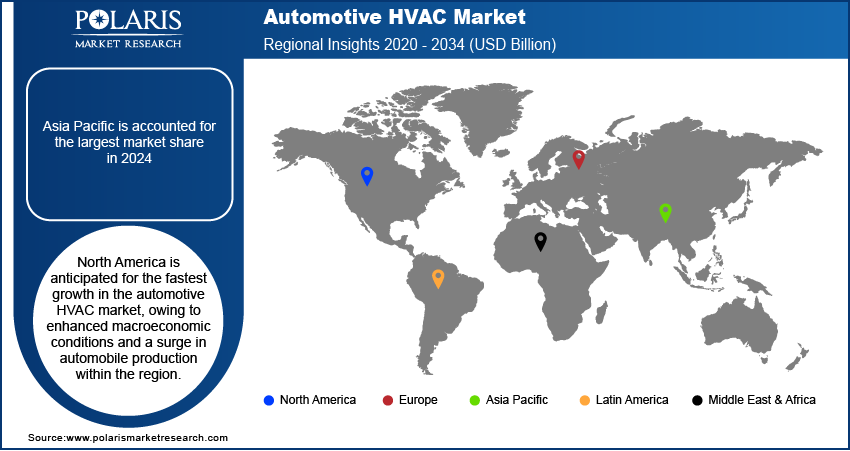
Key Market Players & Competitive Insights
The market is characterized by intense competition, with established players relying on advanced technology, high-quality products, and a strong brand image to drive revenue growth. These companies employ various strategies such as research and development, mergers and acquisitions, and technological innovations to expand their product portfolios and maintain a competitive edge in the market.
Some of the major players operating in the global market include:
- Air International Thermal Systems
- Brose Fahrzeugteile GmbH & Co. Kg
- Delphi Automotive Plc
- Johnson Electric Holdings Ltd.
- Mahle Behr GmbH
- Sanden Corporation
- Sensata Technologies, Inc.
- Valeo S.A.
- Visteon Corporation
- Xiezhong International Holdings Ltd.
Recent Developments
-
February 2026: Trane, by Trane Technologies, collaborated with Garrett Motion to advance ultra high efficiency commercial HVAC solutions. (Source: garrettmotion.com)
.
Automotive HVAC Market Report Scope
| Report Attributes | Details |
| Market size value in 2025 | USD 20.1 billion |
| Market size value in 2026 | USD 22.65 billion |
| Revenue forecast in 2034 | USD 32.7 billion |
| CAGR | 6.30% from 2026 – 2034 |
| Base year | 2025 |
| Historical data | 2021 – 2024 |
| Forecast period | 2026 – 2034 |
| Quantitative units | Revenue in USD billion and CAGR from 2026 to 2034 |
| Segments Covered | By Type, By End-Use, By Region |
| Regional scope | North America, Europe, Asia Pacific, Latin America; Middle East & Africa |
| Customization | Report customization as per your requirements with respect to countries, region and segmentation |
Source: Polaris Market Research Analysis
Quality Assured
We strive to offer our clients the finest in market research with the most reliable and accurate research findings. We use industry-standard methodologies to offer a comprehensive and authentic analysis of the Automotive HVAC Market. Besides, we have stringent data-quality checks in place to enable data-driven decision-making for you.
Browse Our Top Selling Reports
Flexible Electronics Market Size, Share 2024 Research Report
Center Stack Display Market Size, Share 2024 Research Report
Decarbonization Market Size, Share 2024 Research Report
FAQ's
The key companies in Automotive HVAC Market are Air International Thermal Systems, Brose Fahrzeugteile GmbH & Co. Kg, Delphi Automotive Plc
Automotive HVAC Market is expected to grow at a CAGR of 6.30% during the forecast period.
The key segments covered type, end-user, and region.
The key driving factors in Automotive HVAC Market are Rise in the automotive production will drive the growth of the automotive HVAC market
The global coronary stent market size is expected to reach USD 32.7 billion by 2034
Download Sample Report of Automotive HVAC Market
Please fill out the form to request a customized copy of the research report.


