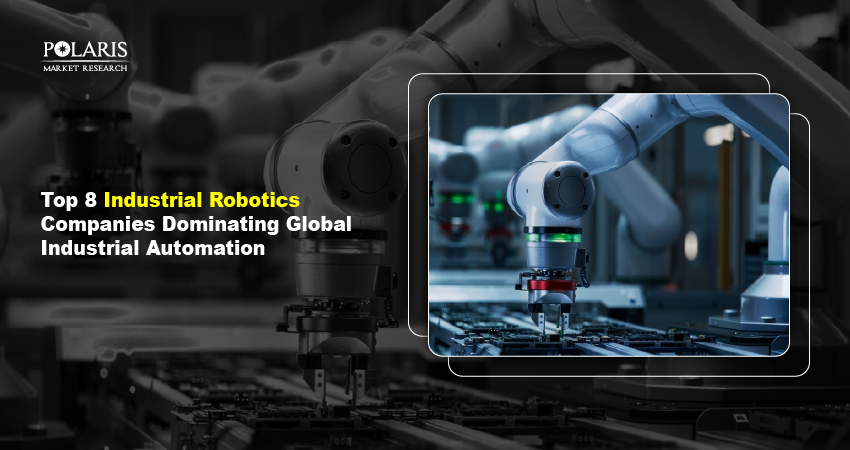
Industrial robotics refers to programmable machines that are used for repetitive and precise tasks. Robotics is used for welding, assembly, packaging, and material handling in many industries. Robotics and automation boost productivity in manufacturing. Robotics automation in manufacturing reduces labor requirement and improves workplace safety. With expansion of smart factories, robots are more frequently combined with AI, IoT, and digital systems. This allows for faster, more flexible, and data-driven production environments.
Industrial Robotics Market Overview
The industrial robotics market focuses on the development, manufacturing, and maintenance of robots used for industrial applications. Selection of industrial robot types relies on manufacturing needs. Articulated robots offer multi-axis flexibility for welding and assembly. However, SCARA robots provide fast horizontal movement for pick-and-place applications. On the other hand, delta robots deliver high-speed precision for packaging. Collaborative robots (cobots) are developed to safely work alongside humans. Cartesian and cylindrical robots support linear and structured motion in automated production lines.
The industrial robotics market size was valued at USD 34.76 billion in 2024 and is expected to register a CAGR of 10.1% during 2025–2034. The shortage of skilled labor in manufacturing and rising demand for cobots across several sectors drive the industrial robotics industry growth. The imposition of stringent regulatory rules on handling hazardous materials and products will boost the industrial robot market trends in the coming years.
Leading Industrial Robotics Market Players
Abb Robotics
ABB Robotics, a division of ABB Group, is one of the leading robotics suppliers across the world. The company employs ~ 11,000 people across 100 locations in 53 countries. It offers industrial and collaborative robots, autonomous mobile robots (AMRs), controllers, equipment, and other products. ABB’s portfolio includes articulated robots, collaborative robots, delta robots, SCARA robots, paint robots, palletizing robots. With the integration of intelligent software, its technologies help businesses across a wide range of industries, from automotive and electronics to logistics, leverage automation in their processes.
Yaskawa Electric Corporation
Yaskawa was founded in 1915 in Kita-Kyushu, Japan. The company produces industrial robots that incorporate its motors. In 1977, Yaskawa announced Japan’s first all-electric industrial robot. Its brand name is MOTOMAN. Since then, the company has shipped around 500,000 units across the world. Yaskawa’s industrial robots are used in numerous industries, including automobiles, biomedical, food, medical products, electric and electronic equipment, semiconductor manufacturing, and logistics.
Kuka AG
KUKA is a global automation corporation headquartered in Augsburg, Germany. The company reported sales worth around € 4 billion. It employs around 15,000 people. KUKA offers a variety of industrial robots that provide flexibility, precision, and efficiency. Its robots are used for various applications such as additive manufacturing/3D printing, applying/painting, arc welding, assembly, diagnosis/surgery/rehab, palletizing, packaging, and others. In February 2025, KUKA and Dassault Systèmes announced partnership to drive robotics and automation efficiency for manufacturers.
Kawasaki Heavy Industries Ltd.
In 1969, Kawasaki Heavy Industries produced Japan's first industrial robots. The company develops and supplies high-quality, high-performance Kawasaki robots. The robots are used for welding, painting, assembly/handling, palletizing, and other industrial applications. It offers robots to a wide range of industries, including automotive and electrical/electronics. On February 16, 2026, Kawasaki announced the launch of high-speed palletizing robot, “CP110L.” The robotic palletizer has a maximum payload capacity of 110kg and a compact body.
Denso Robotics
DENSO Robotics offers 4-axis robots, 5- and 6-axis robots, collaborative robots, pharma/medical robots, integrated robots, and other. Its portfolio includes standard, dust- and waterproof, dust- and mistproof, cleanroom, and aseptic models. The robots are used across different applications such as assembly, dispensing, grinding, insertion, laser welding, machining, material handling, material removal, packaging, finishing, polishing, encapsulating and potting, soldering, and others. These robots are adopted in many industries, including aerospace, automotive, biomedical, alternative energy, general manufacturing, chemicals, consumer products, disk drives, electronics and semiconductors, factory automation, food and beverage, injection molding, machine tools, medical devices, life sciences, pharmaceuticals, and plastics.
Universal Robots
Universal Robots was founded in 2005 with an aim to develop lightweight robot/cobots that are easy to install and program across medium-sized businesses. Its portfolion includes UR Series Robots, e-Series Robots, and software. In November 2025, Universal Robots partnered with Viam to transform automation for the marine sectors. Combination of UR Series robots of Universal Robots and the Viam platform emphasizes transformative automation solutions for the industrial manufacturing and marine sectors.
Omron Corporation
The Industrial Automation business unit of OMRON, headquartered in Kyoto, Japan, provides complete automation solutions for different industrial applications. The company has a sophisticated and wide product range, including smart sensors, panel components, plcs, servos, drives, vision technologies, robots and cobots, and machine safety solutions. It offers parallel robots, SCARA robots, articulated robots, software, robot controllers, and partfeeder. In October 2025, OMRON launched new Automation Center in Bengaluru, India. The center is expected to advance India’s smart manufacturing future. It would support the "Make in India" and Industry 4.0 initiatives in the country.
Comau S.P.A.
Comau, founded in 1973, is a global company that provides automation solutions across various industries. It offers robotics and digital solutions in food and beverage, shipyards, logistics, renewable energy, and pharmaceuticals. In July 2025, Comau acquired Automha, an Italian company that specializes in warehousing and automated intralogistics systems.
How Global Industrial Robotics Market Players Compete?
Top industrial robotics companies are investing in technological innovations using AI, vision systems, IoT, and other technologies. Companies expand their product portfolio such as cobots and autonomous mobile robotics (AMR). They emphasize factory automation solutions. Players also focus on offering services including Robotics-as-a-Service (RaaS) and cloud-based automation. Companies in this market are taking strategic actions like new product launch, partnerships, and mergers and acquisitions. Such strategies help them stay ahead in the competitive industrial robotics market.
To Conclude
The industrial robotics market will be shaped by rising focus on innovation and smart factory automation. Leading players like ABB, Yaskawa, KUKA, and Universal Robots will stay at the forefront. Industrial robot manufacturers focus on AI integration, smart manufacturing, and cobot development. Industries are adopting automation solutions more to improve productivity and cut costs. Therefore, industrial robotics companies will be crucial in shaping the future of robotics.

.webp)