
Agriculture Drones Market Share, Size, Trends, Industry Analysis Report, 2026 - 2034
REPORT DETAILS
Agriculture Drones Market Summary
The global agriculture drones market was valued at USD 3.23 billion in 2025 and is expected to grow at a CAGR of 24.8% during the forecast period. Key factors driving the demand includes pressure on global food supply owing to growing world population, increase in venture funding for development of agriculture drones, rapid technology adoption, and awareness for agriculture drones.
Market Statistics
Key Takeaways
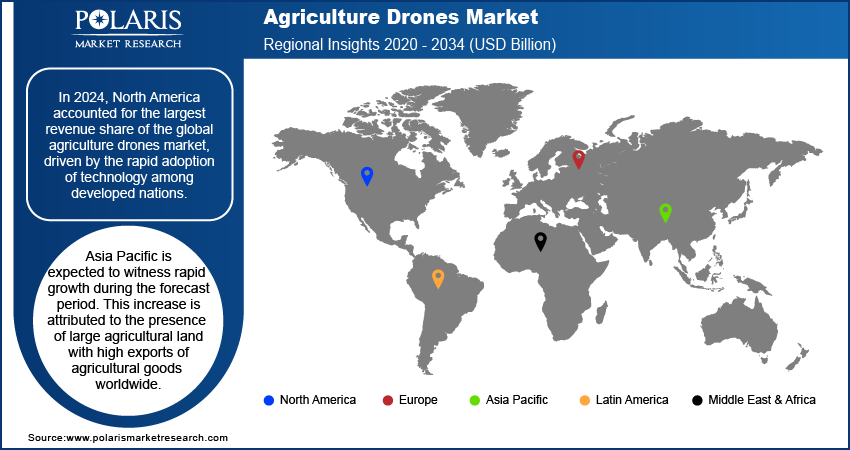
- In 2025, North America accounted for the largest revenue share of 37.05%, driven by the rapid adoption of technology among developed nations.
- Asia Pacific is expected to witness rapid growth at a 25.7% CAGR during the forecast period. This increase is attributed to the presence of large agricultural land with high exports of agricultural goods worldwide.
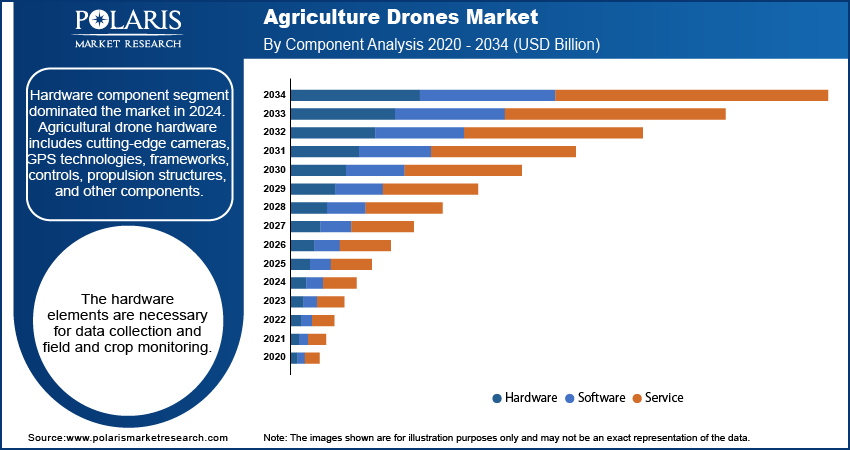
- In 2025, the hardware segment dominated the market with a 63.4% revenue share. This is due to the elements being necessary for data collection and field and crop monitoring.
- The software segment is projected to grow at a 25.5% CAGR. Increasing market demand for managing and analyzing data collected by agriculture drones contributes to the segment’s growth.
- The field mapping segment is expected to witness significant growth at a 25.4% CAGR. This is owing to their detailed area modeling, which allows farmers and other agro experts to identify any irregularities in the land.
Note: Figures and projections outlined in this report are the result of Polaris Market Research’s proprietary analytical processes, grounded in the latest available datasets and market observations.
Industry Dynamics
- Precision agriculture and the use of technology have boosted the market demand, driven by an expanding population and the need for abundant food to meet rising market demands.
- Drones equipped with powerful sensor payloads have expanded opportunities for farmers, who utilize these drones to streamline farm tasks, enhance crop productivity, and reduce labor costs.
- High costs and the need for big data analysis create challenges for the adoption of drones among many farmers who work in smaller areas.
- Agricultural drones help with the targeted use of resources to cut down costs and boost yield production, which is essential for food production, especially in changing weather conditions.
Source: Polaris Market Research Analysis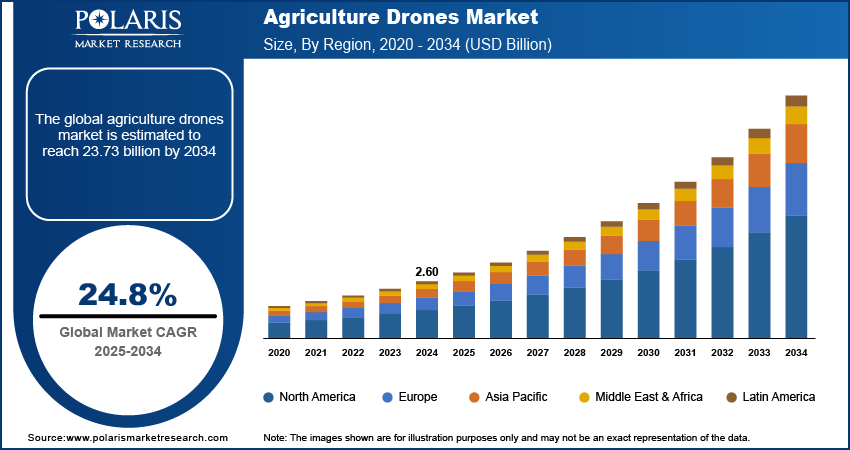
AI Impact on Agriculture Drones Market
- Smart scouting and analysis with drones help find sick plants and soil issues from the air automatically.
- Precision spraying targets weeds and pests to cut chemical and water usage.
- Data analysis for crop forecast size and quality to harvest for better planning and outputs.
- Automation in drones enables them to avoid obstacles and cover large farming areas.
Agricultural drones are used to help farmers manage their crops and land efficiently. The rapid adoption of advanced technology in the agricultural industry, combined with rising awareness of the benefits of adopting drones, is anticipated to boost the agricultural drones market over the forecast period. Unlike commercialized drones, agricultural drones are used in agricultural development for digital photography, multispectral photographs, and near-infrared views of fields. Drone innovation delivers benefits during the planting season, such as monitoring crop development, predicting pre-harvest yields, and preparing drainage systems for the following season.
Moreover, drones are increasingly being utilized in agribusiness as part of an impactful strategy for effective agricultural management that enables agro-based technicians, farmers, and farmworkers to streamline their processes and gain valuable insights into their crops through the use of advanced data analytics.
Source: Polaris Market Research Analysis
Industry Dynamics
Growth Drivers
Precision agriculture and the use of technology, such as drones, are gaining popularity worldwide, driven by an expanding population and the need for abundant food to meet rising market demands. According to a report from UN, the world's population is expected to reach 9.7 billion by 2050, necessitating a 70% increase in agricultural production by 2050.
Weather changes worldwide has created challenges in the agricultural sector, which has boosted demand for innovative technologies to enhance crop production and improve operational efficiency. Furthermore, the aerial view provided by drone agriculture is expected to reveal various challenges, such as soil differences, drainage issues, and fungal infections. Thus, these standards are utilized in agriculture to examine crops and easily identify faults, which drives the growth opportunities.
Moreover, drones equipped with powerful sensor payloads are used in agriculture for regular field surveillance and site-specific data. Farmers can utilize these drones to streamline farm tasks, enhance crop productivity, and reduce labor costs. The rise in use of drones for agricultural condition surveillance, weed identification, adjustable-rate spraying, crop surveying, and livestock control fuels the development of the agricultural drones market.
Which Are the Key Technologies in the Agriculture Drones Market?
The agriculture drone industry is witnessing the adoption of advanced technologies, such as artificial intelligence, the Internet of Things, and multispectral/hyperspectral sensors. The rising penetration of 5G networks and increasing investments in agricultural technologies are driving the integration of technologies. Market players are continually integrating advanced technologies in their agricultural drones to stay ahead in the competition. It also helps them expand business and boost industry growth.
| Technology | Key Features |
| AI & Machine Learning | Automation in crop monitoring, anomaly detection, predictive analytics, and yield prediction |
| Multispectral/Hyperspectral Sensors | Advanced crop and soil health imaging, optimal spectral, and spatial resolution |
| Real-Time Data Analytics | Real-time data processing and farm management insights |
| Autonomous Spraying Drones | Automation in precision fertilizers and pesticide spraying |
| IoT Integration | Integration of drone data with soil and weather sensors |
| Swarm Drone Technology | Coordinated multiple drones for wide area coverage |
| Advanced Drone Design & Battery | Longer flight times, higher payload capacities, and durable materials |
Source: Polaris Market Research Analysis
Fixed-wing vs Rotary vs Hybrid Drones
| Drone Type | Structure | Main Strengths | Main Application |
| Fixed-wing | Airplane-like structure | Long-range flight | Mapping of large farmlands |
| Rotary-wing | Multiple-rotor structure | Good maneuvering abilities | Spraying and monitoring |
| Hybrid | Combination of both types | Balanced range and control | Used in various agricultural activities |
Source: Polaris Market Research Analysis
Report Segmentation
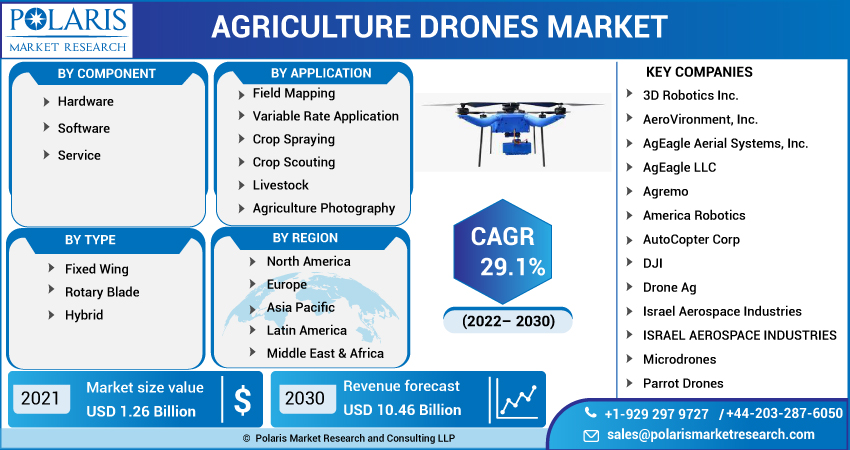
The market is primarily segmented based on component, type, application and region.
| By Component | By Type | By Application | By Region |
|
|
|
|
Source: Polaris Market Research Analysis
Segmental Analysis
Component Analysis
Hardware component segment dominated the market in 2025. Agricultural drone hardware includes cutting-edge cameras, GPS technologies, frameworks, controls, propulsion structures, and other components. The hardware elements are necessary for data collection and field and crop monitoring. Furthermore, the increasing requirement for repair, upgrade, and customization of drone equipment parts in order to extend the lifetime and functionality of drone and obtain a competitive edge is driving the expansion of this industry.
Software segment is anticipated to grow at a considerable pace due to the increasing market demand for managing and analyzing data collected by agriculture drones. Furthermore, the rising implementation of AI and smart machine learning technologies in conventional data analytics technologies is also expected to create opportunities for market growth.
Source: Polaris Market Research Analysis
Application Analysis
Field mapping segment is expected to hold a major share in the global market by 2034, as drone offer detailed area modeling, such as elevation data, allowing farmers as well as other agro experts to identify any anomalies in the land. Further, by analyzing agricultural quality and condition throughout various soil types and administration areas, field mapping exposes crop viability and output capacity.
Regional Analysis
North America Agriculture Drones Market Insights
North America dominated the global agriculture drones market in 2025. This is due to the rapid technology adoption among developed nations such as the U.S. and Canada, along with rising government initiatives on the use of drone for agriculture purposes. Furthermore, increasing market demand for high-quality crops coupled with increasing public awareness of precision farming for field mapping is expected to propel market growth.
Asia Pacific Agriculture Drones Market Assessment
Asia Pacific is expected to witness fastest growth during the forecast period due to the presence of large agricultural land along with high exports of agricultural goods worldwide. Furthermore, increasing technology adoption in major Asian countries such as Indonesia, India, and China is anticipated to create lucrative opportunities for agriculture drones market growth.
Source: Polaris Market Research Analysis
Competitive Insight
The agriculture drone industry is facing stiff competition from the growing number of tech firms and drone companies entering the precision farming market. Key players are innovating in artificial intelligence analysis, self-driving technologies, and precision spraying technology. They are also working with agricultural technology companies and government initiatives to ensure wider acceptance. The competition is getting stiffer on price, battery backup, and user-friendliness, particularly for reaching small- to medium-scale farmers in developing nations.
Major players operating in the global agriculture drones market:
- 3D Robotics Inc.
- AeroVironment Inc.
- AgEagle Aerial Systems Inc.
- AgEagle LLC
- Agremo
- America Robotics
- AutoCopter Corp
- DJI
- Drone Ag
- Israel Aerospace Industries
- ISRAEL AEROSPACE INDUSTRIES
- Microdrones
- Parrot Drones
- Pix4D SA
- senseFly
- Sentera
- Sky-Drones Technologies LTD
- Solvi AB
- THANOS
- Trimble Inc.
- Yamaha Motor Corp.
These market players are investing in research & development in order to launch novel technology advanced products and product up-gradation. Further, these players indulge in marketing strategies such as mergers & acquisitions, and mergers partnerships & collaborations, in order to expand their footprint and boost their sales.
Industry Developments
- April 2026: DroneDash Technologies and GEODNET announced the formation of GEODASH Aerosystems Pte. Ltd. The joint venture will focus on bringing map-free, AI-driven precision spraying to industrial agriculture. The commercial deployment of these precision spraying drones is set for Q3 2026. (source: businesswire.com)
- January 2026: Agri Spray Drones and WinField United announced a co-marketing agreement. According to Agri Spray Drones, the agreement is designed to advance drone-based crop application, training, and research in the U.S. agriculture industry. (source: prnewswire.com)
- August 2025: Terra Drone Corporation, a drone and Urban Air Mobility (UAM) technology company, entered into a sales partnership agreement with Yanmar Holdings Co., Ltd., for the distribution of its in-house developed agricultural drones. (Source: terra-drone.net)
- April 2024: DJI launched the Agras T50 and Agras T25 drones. These drones are compatible with the upgraded SmartFarm app, which offers powerful features for managing and controlling wide aerial applications. (Source: ag.dji.com)
Future of Agricultural Drones Market
The agriculture drone industry is likely to experience growth owing to AI-enabled self-driving drones, 5G connectivity, and its integration with smart farming systems. The growing trend of precision agriculture and data-driven farming will increase efficiencies and productivity. The adoption of drones for large-scale farming operations and sustainable farming will fuel growth over time. Rising investments in smart irrigation and climate-smart agriculture will aid growth. Lower cost and ease of operation are expected to enable small and mid-level farmers to adopt this technology.
Agriculture Drones Market Report Scope
| Report Attributes | Details |
| Market size value in 2025 | USD 3.23 Billion |
| Market size value in 2026 | USD 4.02 Billion |
| Revenue forecast in 2034 | USD 23.66 Billion |
| CAGR | 24.8% from 2026 - 2034 |
| Base year | 2025 |
| Historical data | 2021 - 2024 |
| Forecast period | 2026 - 2034 |
| Quantitative units | Revenue in USD million and CAGR from 2026 to 2034 |
| Segments covered | By Component, Type, By Application By Region |
| Regional scope | North America, Europe, Asia Pacific, Latin America; Middle East & Africa |
| Key Companies | 3D Robotics Inc., AeroVironment, Inc., AgEagle Aerial Systems, Inc., AgEagle LLC, Agremo, America Robotics, AutoCopter Corp, DJI, Drone Ag, Israel Aerospace Industries, ISRAEL AEROSPACE INDUSTRIES, Microdrones, Parrot Drones, Pix4D SA, senseFly, Sentera, Sky-Drones Technologies LTD, Solvi AB, THANOS, Trimble Inc., and Yamaha Motor Corp. |
Source: Polaris Market Research Analysis
Agriculture Drones Market FAQ's
The global market size was valued at USD 3.23 billion in 2025 and is projected to grow to USD 23.66 billion by 2034.
The global market is projected to register a CAGR of 24.8% during the forecast period.
A few of the key players in the market are 3D Robotics Inc., AeroVironment, Inc., AgEagle Aerial Systems, Inc., AgEagle LLC, Agremo, America Robotics, AutoCopter Corp, DJI, Drone Ag, Israel Aerospace Industries, ISRAEL AEROSPACE INDUSTRIES, Microdrones, Parrot Drones, Pix4D SA, PrecisionHawk, senseFly, Sentera, Sky-Drones Technologies LTD, Solvi AB, THANOS, Trimble Inc., and Yamaha Motor Corp.
In 2025, the hardware segment dominated the market.
The field mapping segment is expected to witness significant growth during the forecast period.
North America dominated the global market share in 2025.
Download Sample Report of Agriculture Drones Market
Please fill out the form to request a customized copy of the research report.


