
AI in Chemicals Market Size, Share, Trends and Forecast, 2026-2034
REPORT DETAILS
AI in Chemicals Market Summary
The AI in chemicals market size was valued at USD 952.98 million in 2025. The market is anticipated to grow from USD 1318.33 million in 2026 to USD 18579.41 million by 2034, exhibiting a CAGR of 39.10% during 2026 – 2034.
Market Statistics
Key Takeaways
- In 2025, North America led the global market with 39.8% revenue share. Rising awareness of digitization and increasing investments in research and development boost the leading position.
- The Asia Pacific AI in chemicals market is projected to register a significant CAGR of 28.2% during the forecast period. This growth can be attributed to the ability of the technology to solve issues faced by industries.
- In 2025, the Software segment captured the highest market share of 67.4%. The rising demand for machine learning, deep learning, and analytics drives the market growth.
- In 2025, the R&D segment held the largest market share of 35.9%. Growing funding for research and development projects by governments and players support the segment growth.
- The Basic Chemicals segment dominated the market with 42.6% share in 2025. This is due to rising demand for products such as petrochemicals, fertilizers, and polymers.
Note: Figures and projections outlined in this report are the result of Polaris Market Research’s proprietary analytical processes, grounded in the latest available datasets and market observations.
Industry Dynamics
- Rising demand for process optimization and predictive maintenance drives the market growth.
- Growing emphasis and investments in AI-powered research and development support market expansion.
- High implementation cost of new technologies hinders the growth of the market.
- Surging adoption of digital twins and autonomous manufacturing would creates lucrative market opportunities.
- Integration of generative AI (GenAI) and machine learning (ML) models would become a key trend.
AI in Chemicals in Simple Terms
Artificial Intelligence (AI) in chemicals refers to the use of AI to optimize various processes in the chemical industry. Machine learning, predictive analytics, computer vision, natural language processing, and algorithmic techniques are being used in the industry. These methods are applied in research, production, quality management, logistics, and process automation. Chemical companies use AI to improve efficiency, cut costs, and drive innovation. The use of AI has also been embraced to boost sustainability initiatives.
The chemical industry is increasingly adopting advanced digital techniques which is driving the growing need for enhanced batch production scheduling. As the awareness of the benefits of AI solutions expands, more companies are integrating these technologies to optimize manufacturing processes, resulting in greater demand for reliable and efficient production methods. The chemical sector benefits from AI by enhancing product development, improving demand forecasting, and refining quality testing. AI applications like predictive maintenance, process optimization, virtual screening, and molecular modeling revolutionize chemical production, fostering a supportive environment for AI integration in the industry. Furthermore, the adoption of digital technology, such as Artificial Intelligence, in the chemical industry accelerates innovation and efficiency. Companies use AI for real-time monitoring, predictive maintenance, and process optimization, leading to more accurate forecasting and better decision-making. As the industry embraces these technologies, it becomes more agile, responsive, and capable of meeting the evolving demands of the market.
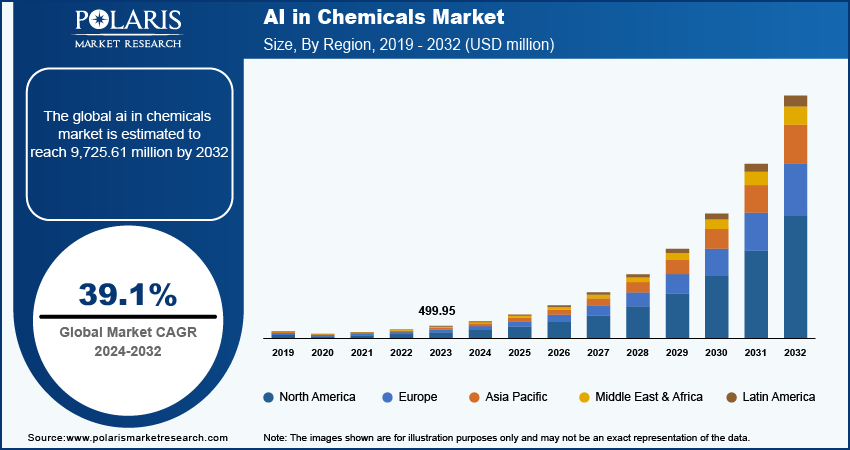
Source: Polaris Market Research Analysis
To Understand More About this Research:Download Sample Report
How AI in Chemicals Works
- Collect data from sensors, production systems, and laboratory processes.
- Train AI models with the use of real-time and historical operational data.
- Detect patterns, trends, anomalies, and process relationships.
- Forecast equipment failures and process results.
- Generate automated suggestions on how to adjust process parameters.
- Improve production efficiency, product quality, and resource use.
- Continue to innovate AI models through new operational data.
Traditional Chemical Manufacturing vs AI-Driven Manufacturing
| Feature | Traditional Chemical Manufacturing | AI-Driven Manufacturing |
| Decision Making | Manual and experience-based | Data-driven and AI-assisted |
| Maintenance | Reactive | Predictive |
| Process Efficiency | Moderate | High |
| Quality Control | Periodic inspections | Real-time monitoring |
| Resource Utilization | Moderate | Optimized |
| Innovation Speed | Slower product development | Faster AI-enabled innovation |
Source: Polaris Market Research Analysis
Additionally, increased government spending on research and development in manufacturing process optimization will drive growth in the AI in chemicals market in the coming years as AI helps streamline operations, reduce costs, and enhance safety by providing advanced analytics and automation solutions. For instance, in 2019, NIST used AI for high-throughput data evaluation, which is critical to the chemical manufacturing enterprise. The project was aimed to improve the chemical manufacturing design process by providing optimal property value recommendations while enhancing transparency around data sources and reliability. Traditionally, engineers relied on handbooks and databases, which often lacked clarity on data trustworthiness, leading to costly errors in plant design. For example, a 10% error in vapor pressure calculations could double the size of distillation columns, significantly increasing capital investment.
The project leveraged artificial intelligence, machine learning, and quantum chemical computations to streamline data curation and improve property predictions. By automating labor-intensive tasks like data extraction from scientific literature and developing transfer learning methodologies has significantly boosted the efficiency of subject matter experts and improved the quality of chemical property data. Therefore, this initiative has ultimately reduced the manufacturing costs and environmental impacts.
Real-World Examples of AI in Chemicals
| AI Application | Real-World Example |
| Chemical Formulation Optimization | BASF uses AI and digital technologies to boost material innovation. AI helps the company optimize chemical formulations. |
| Process Automation in Chemical Plants | Siemens offers process automation and industrial AI for the manufacture of chemicals. |
| Emissions Monitoring & Sustainability Management | Shell uses AI for monitoring the emission levels and increasing the efficiency of operations. |
Source: Polaris Market Research Analysis
Growth Drivers
Improved Research & Development and Innovation are Driving Market Growth
AI improve research and development by simulating chemical reactions, predicting outcomes, and analyzing complex datasets, which boosts the discovery of new materials, products, and processes. AI also analyzes vast amounts of experimental data to identify patterns and correlations, guiding the discovery of promising new materials. For instance, in July 2024, Imperial and BASF spinout SOLVE used AI and innovative experimental methods to transform chemical manufacturing digitally. The companies aimed to improve the production of drugs and fertilizers by gathering data on chemical reactions and using machine learning to predict optimal manufacturing methods. This technology is expected to make chemical production more sustainable, reduce waste, lower costs, and enhance supply chain resilience.
Increasing Demand for Predictive Maintenance are Driving Market Growth
The rising demand for AI in chemical industry enhances predictive maintenance by continuously analyzing equipment data to foresee potential failures before they happen. This proactive approach minimizes downtime, extends the lifespan of equipment, and reduces maintenance costs. For instance, Dow Chemical’s began implementing AI-driven predictive maintenance systems in 2020 to monitor their chemical processing equipment. By analyzing real-time data from sensors embedded in their machinery, AI algorithms can identify early signs of wear and performance irregularities. The technology, therefore, allows Dow to schedule maintenance just before equipment failures are likely to occur, moving away from a reactive, time-based maintenance approach. As a result, the company has reduced unexpected breakdowns, improved operational efficiency, and lowered maintenance costs. The introduced technology thus demonstrates the significant advantages of using AI for maintaining the reliability of critical machinery in the chemical industry.
Rising Adoption of Industry 4.0 Technologies
The rising adoption of Industry 4.0 technologies is a key driver of the AI in chemicals market. Chemical manufacturers are increasingly integrating AI with industrial IoT (IIoT), digital twins, cloud computing, advanced sensors, and automation systems. The integration supports smart manufacturing. These technologies offer real-time monitoring, predictive analysis, and autonomous process control. They improve production efficiency. Also, equipment downtime is reduced. The adoption also improves product quality and lowers operational costs. Companies are accelerating their digital transformation initiatives. Thus, the demand for AI-enabled solutions would grow across the chemical value chain.
Restraining Factors
High Cost of New Technologies
One of the primary challenges in adopting artificial intelligence (AI) in the chemical industry is the high cost associated with implementing new technologies. Integrating AI-driven systems necessitates substantial investments in advanced hardware, software, and infrastructure, including IoT sensors, data storage, and high-performance computing resources. In addition to the costs of technology, training specialized personnel to manage and interpret AI systems further contributes to the overall expense. For many chemical companies, particularly small to mid-sized enterprises, these initial costs can be prohibitively high.
Moreover, there is often uncertainty regarding the return on investment (ROI) during the early stages of AI implementation. Companies may need time to realize significant cost savings or efficiency improvements, lead to reluctance in replacing existing systems with newer, more expensive technologies. As a result, this financial burden can slow the widespread adoption of AI within the industry.
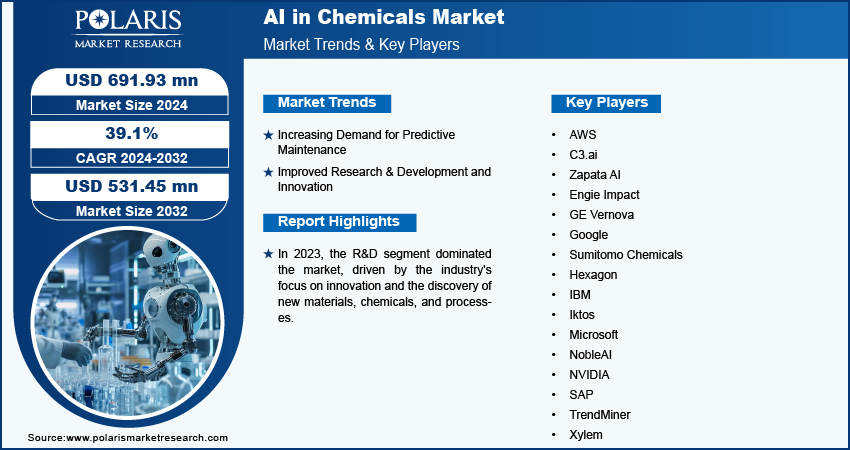
Source: Polaris Market Research Analysis
Segment Insights
AI in Chemicals Market, by Component
The global AI in Chemicals market segmentation, based on components, includes hardware, software, and services. In 2023, the software segment dominated the market due to its critical role in enabling AI-driven innovations across various processes in the industry. Software solutions are essential for optimizing chemical reactions, predicting material properties, and improving laboratory management. Furthermore, AI software enables data-driven decision-making, enhancing operational efficiency, and accelerating research and development efforts. The growing adoption of machine learning, deep learning, and advanced analytics is driving demand for such software. Additionally, cloud-based deployment provides scalability, cost efficiency, and easy access to real-time data. Therefore, the transformative capabilities of AI software position it as a leading component in the market.
AI in Chemicals Market, by Business Application
The global AI in Chemicals market segmentation, based on business application, includes production, R&D, and supply chain management, strategy management. In 2023, the R&D segment dominated the market, driven by the industry's focus on innovation and the discovery of new materials, chemicals, and processes. AI played a crucial role in accelerating R&D by enabling advanced simulations of chemical reactions, predicting material properties, and analyzing vast datasets. Additionally, AI tools such as machine learning, deep learning, and chemical modeling software helped reduce the time and cost of experimentation, leading to faster product development. Companies are continuously investing in AI-driven R&D to bring new products to market more quickly and improve research capabilities, as a result, R&D became the leading business application for AI in the chemicals market.
AI in Chemicals Market, by End-use Industry
The global AI in Chemicals market segmentation, based on end user, includes basic chemicals, active ingredients, green & biochemical, advance materials, paints & coatings, adhesive & sealants, water treatment & services, other end users. In 2023, the basic chemicals segment dominated the market due to growing demand for products such as petrochemicals, fertilizers, and polymers, which form the foundation of numerous industries, making their production highly crucial and large-scale. AI technologies, such as machine learning, predictive analytics, and autonomous systems, are transforming traditional manufacturing processes and operational strategies; by implementing predictive maintenance algorithms, companies have achieved significant benefits. These algorithms continuously analyze real-time data from equipment sensors, including temperature, vibration, and pressure, to detect early signs of potential failures. Moreover, the proactive approach enables refineries to anticipate and address issues before they result in equipment breakdowns or unplanned downtime. Therefore, the end-user segment remained a dominant force in the AI in chemicals market in 2023.
Technology Advancement in AI in Chemicals Market
| Technology Advancement | Description |
| Generative AI for Molecule Design | Accelerates molecular discovery and formulation development. |
| AI-Powered Digital Twins | Simulates production processes for optimization and testing. |
| Autonomous Process Control Systems | Automatically adjusts process parameters for higher efficiency. |
| Industrial IoT Integration | Connects sensors and equipment for real-time data collection. |
| Real-Time Predictive Analytics | Predicts equipment failures and process deviations before they occur. |
| Advanced Machine Learning Algorithms | Identifies complex patterns to improve manufacturing decisions. |
| Computer Vision Quality Inspection | Detects product defects through automated visual inspection. |
| Cloud-Based AI Platforms | Enables scalable AI deployment, remote monitoring, and data analytics. |
Source: Polaris Market Research Analysis
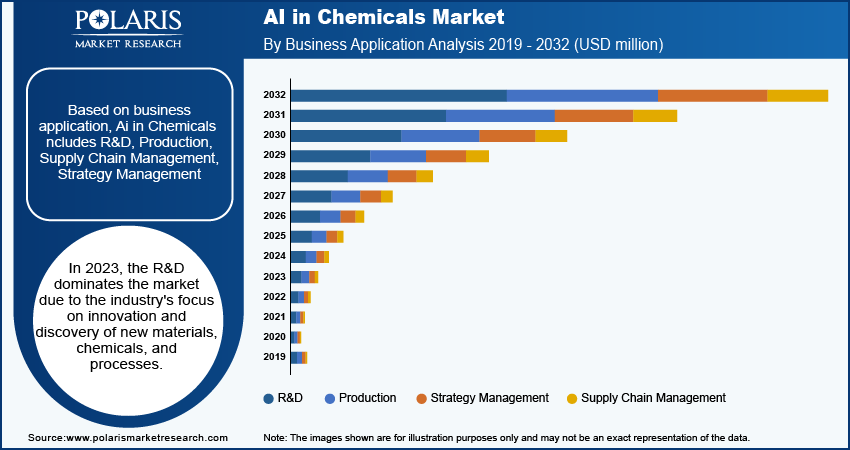
Source: Polaris Market Research Analysis
AI in Chemicals Market Regional Analysis
North America Held Largest Share of Global AI in Chemicals Market in 2023
By region, the study provides market insights into North America, Europe, Asia-Pacific, Latin America, and Middle East & Africa. In 2023, North America dominated the AI in chemicals market, driven by increased awareness of digitization and strong funding for research and development. Government support has promoted confidence in AI-based processes, contributing to this leadership. Despite recent declines in investment levels, the United States remains the global leader in AI financing, holding the top position in transaction share and overall funding within the industry.
A notable development occurred in March 2024 when Standard Industries, a manufacturer of specialty chemicals, launched a $1 million AI Challenge. The initiative aimed to transform the creation of fine chemicals by streamlining and optimizing the labor-intensive process of chemical retrosynthesis, which currently relies heavily on manual analysis and trial and error. Such efforts reflect the ongoing commitment to leveraging AI technologies to enhance efficiency in the chemical sector.
The Asia Pacific AI in chemicals market is projected to register a significant compound annual growth rate (CAGR) during the forecast period, driven by rapid AI adoption in the chemical sector. The growth is expected largely due to the effectiveness of AI technologies in addressing industry challenges, such as optimizing manufacturing processes, predicting equipment failures, and enhancing product quality. Moreover, the rising demand for chemicals in the region further fuels the need for increased efficiency and innovation, prompting companies to embrace AI-driven approaches to stay competitive.
Regional Market Trends
| Region | Market Position | Key Trend |
| North America | Largest Market | Advanced industrial digitalization, strong AI adoption, and significant investments in smart manufacturing. |
| Europe | Second Largest Market | Rising emphasis on sustainable manufacturing, increasing Industry 4.0 initiatives, and AI-enabled smart factories to improve efficiency and reduce emissions. |
| Asia-Pacific | Fastest-Growing Market | Rapid industrial automation, increasing chemical production, and rising AI investments in chemical manufacturing. |
| China, Japan, South Korea & India | Key Growth Countries | Government-backed digital transformation, growing emphasis on AI innovation, and rising chemical production. |
| Middle East | Emerging Market | Increasing AI adoption in petrochemical operations for production optimization, predictive maintenance, and sustainability improvements. |
Source: Polaris Market Research Analysis
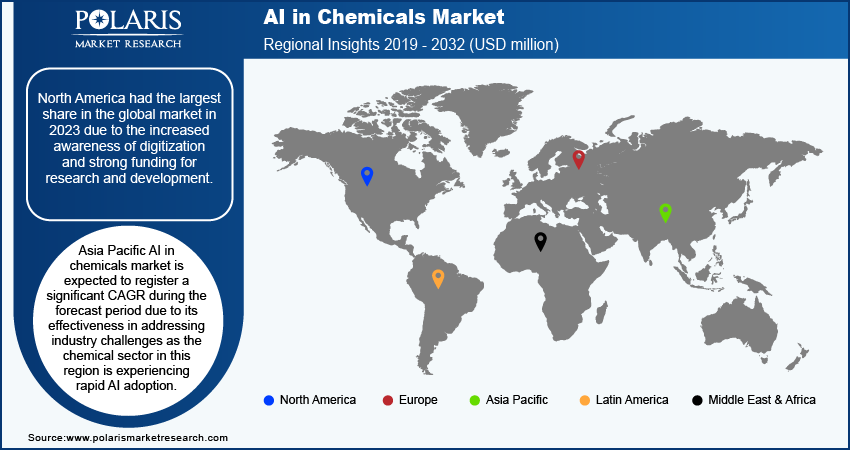
Source: Polaris Market Research Analysis
Key Market Players and Competitive Insights
Strategic Partnerships to Drive Competition
The competitive landscape of the AI in chemical market is characterized by a diverse array of global and regional players striving to capture market share through innovation, strategic partnerships, and geographic expansion. Major players in the industry, such as AWS, C3.ai, Engie Impact, leverage their extensive R&D capabilities and broad distribution networks to offer a wide range of products. These companies are focusing on product innovation, including improvements in safety, functionality, and cost-efficiency, to meet the evolving needs of the industry. These major players utilize AI to enhance operational efficiencies and develop new chemical compounds. Collaborations between chemical companies and AI technology providers drives innovation, accelerating AI adoption specially in chemical industry. Competitive strategies often include mergers and acquisitions, Major players include AWS, C3.ai, Engie Impact, Zapata AI, Sumitomo Chemical Co., GE Vernova, Google, Hexagon, IBM, Iktos, Microsoft, NobleAI, NVIDIA, SAP, Nexocode, Sandbox, Deepmatter, Zapata AI, Chemical.Ai, TrendMiner, Xylem (US). Sumitomo Chemical Co., Ltd. is a major Japanese chemical company, based in Tokyo, Japan has developed an in-house generative AI service called "ChatSCC," available to its 6,500 employees. It aims to boost productivity, enhance competitiveness, and facilitate the effective use of proprietary data. The tool features robust security measures and has shown a 50% improvement in operational efficiency during chemical testing. The company plans to expand its use and link proprietary data to the service in the future to further improve operational efficiency.
Zapata Computing Holdings Inc., also known as Zapata AI, operates as an industrial generative artificial intelligence (AI) software company in the United States. In June 2024, the company joined the KT Consortium to help transform chemical engineering processes using generative AI.
As a member of the consortium, Zapata AI will collaborate directly with leading chemical and biochemical manufacturers. The partnership aims to leverage Zapata AI's expertise in optimization, virtual sensors, predictive modelling, and generative AI capabilities to accelerate the development and manufacturing of chemical compounds at scale.
Major Players
- AWS
- C3.ai
- Zapata AI
- Engie Impact
- GE Vernova
- Sumitomo Chemicals
- Hexagon
- IBM
- Iktos
- Microsoft
- NobleAI
- NVIDIA
- SAP
- TrendMiner
- Xylem
AI and the Future Chemical Workforce
AI is reshaping workforce requirements in the chemical industry. The technology adoption increases demand for data scientists and AI engineers. Automation specialists and digitally skilled chemical engineers are also in demand. AI adoption is increasing across various process in the chemicals industry. Thus, companies invest in workforce upskilling. It helps them manage intelligent production systems and support digital transformation initiatives. This shift is fostering collaboration between chemical expertise and advanced digital technologies.
Recent Developments in Industry
- July 2026: AgPlenus Ltd. announced the launch of Antifungal Potency Predictor (APP), a ML model. APP can be used to predict the antifungal potency of small molecules from their chemical structures. (Source: PRNewswire)
- In April 2025, UTulsa’s chemical engineering program embedded artificial intelligence across all courses. The University of Tulsa’s Russell School of Chemical Engineering updated its curriculum to ensure students gain hands-on exposure to AI technologies shaping the industry.
- In March 2025, a U.K.-based startup revealed plans to apply AI for discovering new chemicals and materials. The company appointed two leading AI pioneers, along with a prominent AI policy specialist and a respected materials science expert, as advisors.
- In April 2025, The Icahn School of Medicine at Mount Sinai launched an AI-driven small molecule drug discovery center. The initiative combines AI with traditional drug discovery approaches to accelerate the identification and design of novel small molecule therapies with greater speed and accuracy.
Future Outlook for AI in Chemicals Market
The AI in chemicals market is expected to expand rapidly during the forecast period. Manufacturers boost digital transformation initiatives and embrace Industry 4.0 technologies. This factor would drive the industry growth in the coming years. AI-driven process optimization, predictive maintenance, generative molecule design, and digital twin applications will reshape chemical production and innovation. There is rising pressure on chemicals industry players to improve efficiency, sustainability, and competitiveness. It will position AI as a foundational technology across the global chemical industry in the coming decade.
Report Segmentation
The AI in chemicals market is primarily segmented on the basis of component (hardware, software (by type, by technology, by deployment), business application, end user, and by region.
By Component (2021-2034 (USD million)
- Hardware
- Accelerators
- Processors
- Memory
- Network
- Software
- By Type
- Dashboard & Analytics Tools
- Process Simulation Software
- Chemical Modeling Software
- Laboratory Management Software
- Virtual Screening Tools
- Chemical Property Prediction Tools
- By Technology
- ML
- Deep Learning
- Generative AI
- NLP
- Computer Vision
- Advanced Analytics
- By Deployment Mode
- Cloud
- On-Premises
- By Type
- Services
- Professional Services
- Consulting Services
- Deployment Services
- Support & Maintenance
- Managed Services
AI in Chemicals Market, By Business Application (2021-2034 (USD million)
- R&D
- Production
- Supply Chain Management
- Strategy Management
AI in Chemicals Market, By End User (2021-2034 (USD million)
- Basic Chemicals
- Advance Materials
- Active Ingredients
- Green & Biochemicals
- Paints & Coatings
- Adhesive & Sealants
- Water Treatment & Services
- Other End Users
AI in Chemicals Market, By Region Outlook (2021-2034 (USD million)
- North America
- US
- Canada
- Europe
- Germany
- France
- UK
- Italy
- Spain
- Netherlands
- Russia
- Rest of Europe
- Asia-Pacific
- China
- Japan
- India
- Malaysia
- South Korea
- Indonesia
- Australia
- Vietnam
- Rest of Asia-Pacific
- Middle East & Africa
- Saudi Arabia
- UAE
- Israel
- South Africa
- Rest of Middle East & Africa
- Latin America
- Mexico
- Brazil
- Argentina
- Rest of Latin America
Report Coverage
The AI in chemicals market report emphasizes key regions across the world to provide better understanding of the product to the users. Also, the report provides market insights into recent developments and trends and analyzes the technologies that are gaining traction around the globe. Furthermore, the report covers in-depth qualitative analysis pertaining to various paradigm shifts associated with the transformation of these solutions.
The report provides a detailed analysis of the market while focusing on various key aspects such as competitive analysis, component, technology, deployment mode, application, end user, and their futuristic growth opportunities.
AI in Chemicals Market Report Scope
| Report Attributes | Details |
| Market size value in 2025 | USD 952.98 million |
| Market size value in 2026 | USD 1318.33 million |
| Revenue forecast in 2034 | USD 18579.41 million |
| CAGR | 39.10% from 2026 to 2034 |
| Base year | 2025 |
| Historical data | 2021–2024 |
| Forecast period | 2026–2034 |
| Quantitative units | Revenue in USD million and CAGR from 2026 to 2034 |
| Segments covered |
|
| Regional scope |
|
| Competitive landscape |
|
| Report format |
|
| Customization | Report customization as per your requirements with respect to countries, regions, and segmentation. |
Source: Polaris Market Research Analysis
AI in Chemicals Market Frequently Asked Questions
The AI in chemicals market size was valued at USD 952.98 million in 2025 and is projected to grow to USD 18579.41 million by 2034.
The global market is projected to grow at a CAGR of 39.10% during the forecast period.
North America held the largest share in the global market in the year 2023 due to the increased awareness of digitization and strong funding for research and development.
The key players in the market include AWS, C3.ai, Engie Impact, Zapata AI, Sumitomo Chemical Co., GE Vernova, Google, Hexagon, IBM, Iktos, Microsoft, NobleAI, NVIDIA, SAP, Nexocode, Sandbox, Deepmatter, Zapata AI, Chemical.Ai, TrendMiner, Xylem (US).
The basic chemicals category dominated the market in 2025 due to growing demand for products like petrochemicals, fertilizers, and polymers that form the foundation of numerous industries which makes their production highly crucial and large-scale.
AI in the chemicals sector uses machine learning, predictive analysis, and automation to streamline the manufacturing process, speed up research activities, improve quality control efforts, and make better decisions.
AI boosts production efficiency, reduces machine downtime, cuts down energy use, improves product quality, lowers costs, and encourages sustainable production.
AI analyzes molecular data, predicts chemical characteristics, and identifies suitable compounds to speed up formulation development and material discovery. This also shortens research and development timelines.
Download Sample Report of AI in Chemicals Market
Please fill out the form to request a customized copy of the research report.


