
AI Integration Platform Market Demand, Industry Share, Global Report, 2026-2034
REPORT DETAILS
AI Integration Platform Market Summary
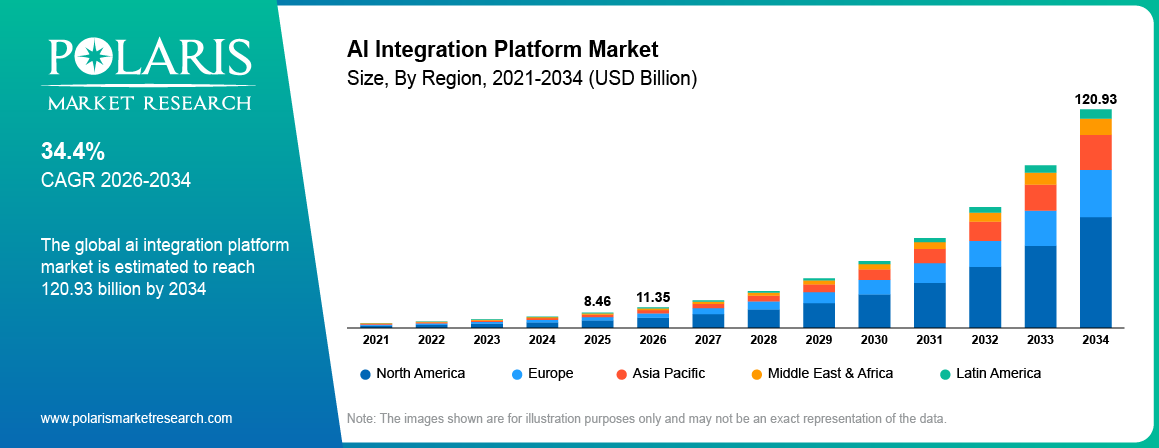
The global AI integration platform market is estimated around USD 8.46 Billion in 2025,?with consistent growth anticipated during 2026–2034. Growth is driven by rising enterprise data volumes and increasing demand for automation across business functions. The market is projected to grow at a CAGR of 34.4% during the forecast period.
Market Statistics
Key Takeaways
- North America dominated the market in 2025, accounting for approx. 38.43% of the total revenue share, driven by strong cloud infrastructure and early AI adoption.
- Cloud-based platforms held the largest market share of nearly 42.26% in 2025, owing to their scalability and faster deployment capabilities.
- AI orchestration platforms are expected to register a CAGR of 24.5% during 2026–2034, as companies increase investments to improve integration efficiency.
- Unified enterprise AI architectures are projected to grow at a CAGR of 22.8%, supported by rising enterprise focus on seamless AI integration across systems.
- Generative AI integration capabilities are witnessing rapid growth with an estimated CAGR of 26.3%, driven by the increasing adoption of generative AI technologies.
- API-based AI integration accounted for a market share of nearly 35.47% in 2025 and is expanding steadily due to the growth of API ecosystems.
Industry Dynamics
- Expansion of enterprise data is increasing demand for AI integration platforms.
- Rising automation across industries is increasing adoption of AI automation platforms.
- High implementation complexity is limiting adoption among small enterprises.
- Integration of generative AI and AI agents is improving platform capabilities.
What is the AI Integration Platform Market?
An AI integration platform refers to a software layer that connects artificial intelligence models with enterprise systems, data sources, and applications. These types of systems serve as AI middleware platforms, facilitating effective data transfer, model creation and execution, and real-time decision-making within a corporate setting. These platforms are used by businesses to integrate AI across different fields such as analyzing customers, automating processes, and forecasting procedures. With the increase in AI adoption across enterprises, the need for good integration arises.
The main distinguishing feature of AI integration platforms from AI platforms, iPaaS, and MLOps is their specific purposes and capabilities. The purpose of AI platforms is model building and training, while iPaaS is responsible for application and data integration but not for AI integration. On the other hand, MLOps deals with models’ lifecycle management. In contrast, AI integration platforms enable enterprise AI integration by combining data pipelines, model execution, and system interoperability within a single framework.
Source: Polaris Market Research Analysis
To Understand More About this Research:Download Sample Report
Rising enterprise demand for real-time insights and automation is supporting adoption of AI integration platforms. Businesses are increasingly implementing unified architecture tools that enable them to simplify the process of implementation while scaling up in other business departments. The increased adoption of API integration, cloud computing, and hybrid integration platforms is enhancing the functionalities of the platform. These trends are helping the global AI integration platform market expand.
Drivers & Opportunities
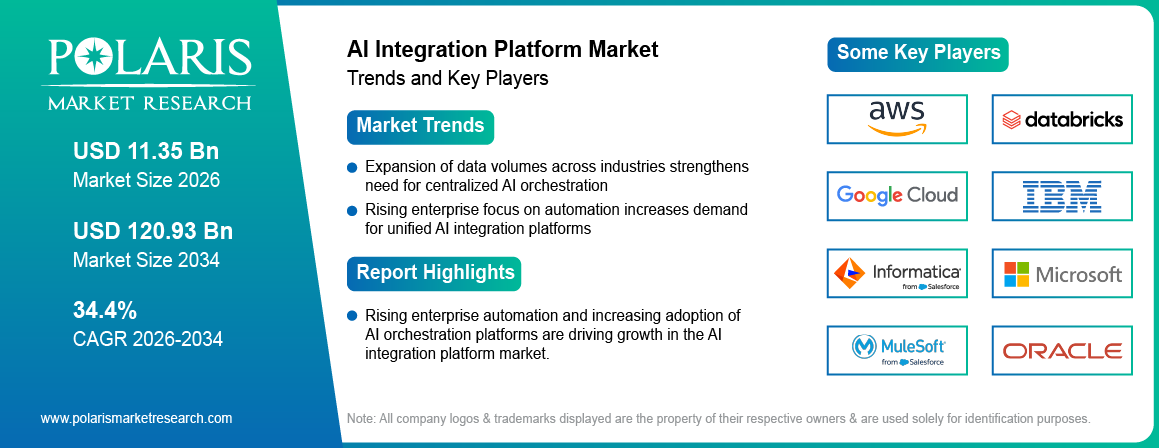
Expansion of data volumes across industries strengthens need for centralized AI orchestration: The rise in enterprise data in cloud, edge, and on-premise architectures makes the integration process more complicated. Companies need AI middleware platforms for facilitating data transfer and model implementation in different environments. Centralized orchestration ensures the consistency of data and helps in building real-time decision systems. As per the International Data Corporation (IDC), 78% of data is unstructured data, expected to increase from 5.5 ZB in 2024 to 10.5 ZB in 2028.
Rising enterprise focus on automation increases demand for unified AI integration platforms: More resources are directed towards automation with AI technologies within business processes, customer service, and analytics. The report from The Linux Foundation reveals that 89% of firms leverage open source in their AI stack, while 63% deploy open AI models. Businesses need to have a platform to link AI models with their enterprise systems and processes. Enterprise AI integration reduces deployment gaps and improves operational efficiency. This factor is increasing adoption of AI integration platforms.
Restraints & Challenges
High implementation complexity limits adoption among small and mid-sized enterprises: Integrating AI into a business requires intricate architecture, multiple system connections, and skilled labor. SMEs have limited resources and budgets when it comes to implementing their AI systems. Integrations between legacy systems result in higher costs and longer implementation times. This is a constraint that prevents companies from adopting AI technology.
Opportunity
Increasing investment in generative AI opens new platform integration requirements: The usage of generative AI is growing, thus increasing the need for integration within enterprises. Companies will need to implement advanced systems to integrate their large language model into their existing information and software programs. Vendors are also improving their offerings in AI orchestration and automation capabilities. According to the Stanford AI Index Report 2025, private investments in generative AI have been recorded at USD 33.9 billion in 2024, up by 18.7% from 2023 and 8.5 times more than in 2022.
Source: Polaris Market Research Analysis
Technology & Architecture Landscape
AI Integration Platform Architecture Explained
The architecture for AI integration integrates enterprise data, AI algorithms, and applications within one platform. AI pipeline integration is made possible through the organizational process architecture. Integration connectors combine data sources and enterprise applications. An orchestration layer manages workflows and automation. Model gateways manage access to AI models and services.
Key Technologies (APIs, RAG, LLMs, orchestration)
Modern AI orchestration platforms use API-based AI integration to connect systems and services. LLMs and ML models run through model gateways for secure inference. RAG improves output accuracy using vector databases for data retrieval. Orchestration layers manage pipelines and automate model execution.
Cloud vs Hybrid vs On-premise Integration
Cloud-based AI integration platforms support scaling and real-time capabilities. Cloud architectures are preferred by organizations for integration and performance considerations. However, organizations deploy on-premise to ensure data security. The hybrid architecture allows organizations to be flexible and secure in their operations.
Segmental Insights
This report offers detailed coverage of the AI integration platform market by deployment, enterprise size, application, and industry vertical to help readers identify the fastest expanding and most attractive demand segments.
By Deployment
-
Cloud
Cloud segment dominated the market in 2025, driven by rising adoption of cloud AI integration platforms across enterprises. Organizations are concentrating on AI deployment that supports scalability and real-time processing. In February 2026, Project DI introduced its next-generation global AI integration platform with cloud deployment one of its top priorities. As faster implementation and lower infrastructure dependency are supporting segment growth.
-
Hybrid
Hybrid segment is projected to grow at the fastest CAGR during the forecast period, due to increasing demand for flexible and secure AI integration architecture. Organizations have been combining cloud scalability with on-premise security in their operations.
By Enterprise Size
-
Large Enterprises
The large enterprises segmentation dominated the market in 2025 owing to increasing investments in AI integration and automation solutions. Large enterprises have complicated data management processes and thus need AI orchestration tools. Good IT infrastructure has helped in this adoption process.
-
SMEs
SMEs segment is projected to grow at the fastest CAGR during the forecast period, due to rising adoption of cost-effective AI middleware platforms. Vendors are offering simplified and scalable solutions. Increasing digital transformation is supporting segment growth.
By Application
-
Data Integration
The data integration segmentation dominated the market owing to the increasing amount of enterprise data and demand for effective data pipelines. Companies are focusing on AI pipeline integration to enable real-time insights. Cross-system connectivity is supporting demand.
-
Workflow Automation
Workflow automation segment is projected to grow at the fastest CAGR during the forecast period, due to rising enterprise focus on process efficiency and automation. The use of AI models in workflow automation in order to increase productivity has increased the deployment of automation solutions.
By Industry Vertical
-
BFSI
BFSI segment dominated the market in 2025 owing to increasing use of APIs for AI integration for fraud detection, risk analysis, and consumer analytics. Financial institutions are focusing on real-time decision systems. High data volumes are supporting platform adoption.
-
Healthcare
Healthcare segment is projected to grow at the fastest CAGR during the forecast period, due to rising adoption of AI pipeline integration in diagnostics and patient data management. Healthcare providers are focusing on data-driven decision systems. Expansion of digital health infrastructure is supporting segment growth.
Source: Polaris Market Research Analysis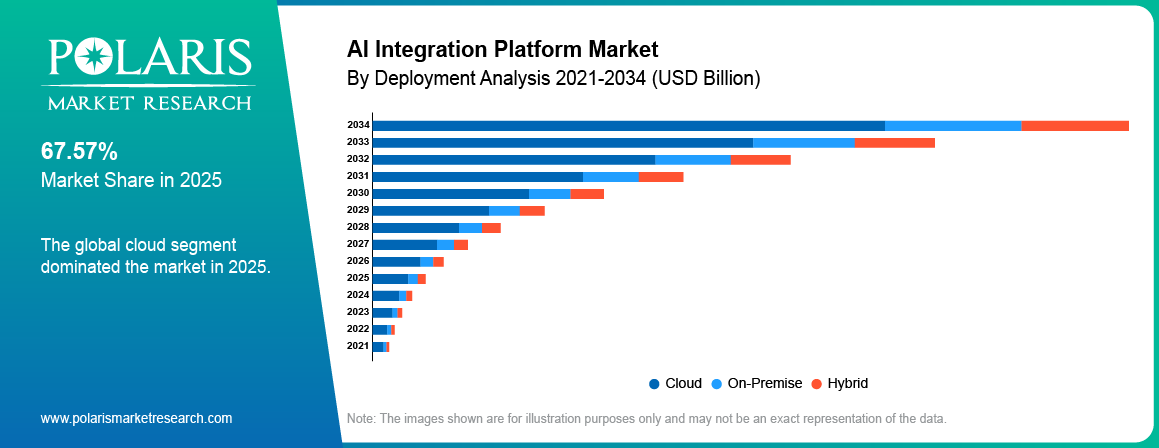
Regional Analysis
North America Market Assessment
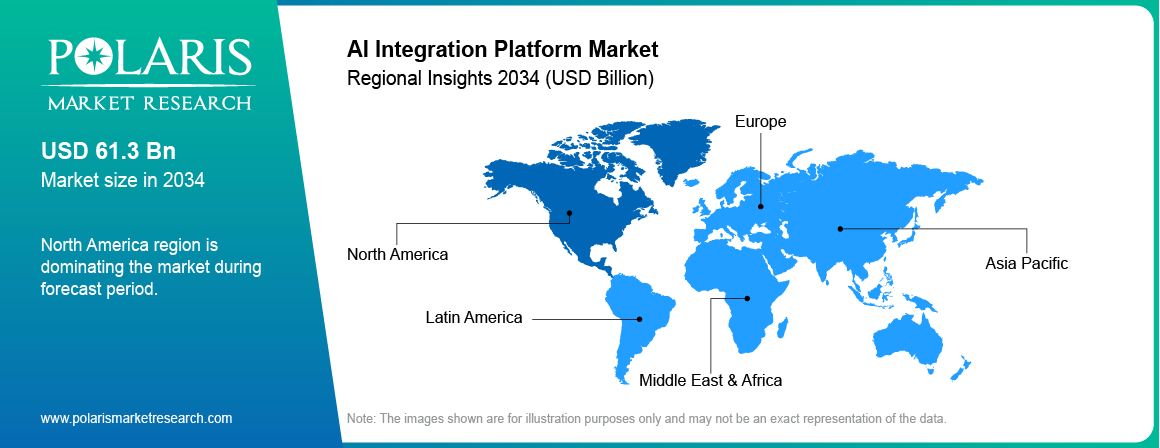
North America AI integration platform market dominated in 2025, driven by high enterprise AI adoption and strong cloud infrastructure. The US leads the region due to early deployment of AI orchestration platforms across industries. For instance, in April 2026, Kyndryl launched an AI-powered Digital Twin for the Workplace to predict and resolve IT issues and improve operations.Also, the presence of major technology providers and advanced IT ecosystems is supporting market growth.
Asia Pacific AI Integration Platform Market Insights
Asia Pacific AI integration platform market is projected to grow at the fastest CAGR during the forecast period, driven by rapid digital transformation and rising enterprise data volumes. According to Digital Realty, about 65% of organizations in APAC have prioritized data management as a key strategy to foster innovations in AI, whereas 50% of them have emphasized investments in infrastructure to cope with increasing amounts of data.Countries such as India and China have been focusing on building infrastructures for AI and deploying cloud services.
Europe AI Integration Platform Market Overview
The Europe AI integration platform market accounted for the second-largest share, mainly due to an increased concentration of efforts in the regulation and governance of data and digitization of enterprises. According to Eurostat, approximately 74% of EU companies had already reached the level of basic digital intensity by 2024, out of which 73% were SMEs and 98% were large enterprises, which was below the set EU 2030 benchmark.Countries like Germany, France, and UK were consistently adopting AI-based integration solutions for enterprises.
LATAM & MEA Emerging Markets
The market for AI integration platforms in Latin America & Middle East & Africa is witnessing consistent growth due to the increasing adoption of cloud computing and digitalization initiatives by companies. Nations such as Brazil and UAE have also started investing heavily in AI and data technologies. The slow increase in the adoption rate of technology and growth in cloud services are driving market growth.
Source: Polaris Market Research Analysis
Competitive Landscape & Key Players
Key Players & Strategic Developments
The AI integration platform market is relatively fragmented, with cloud service providers, software providers, and AI-focused solution providers involved in providing solutions for integration processes within enterprises. Competition lies in offering scalable, interoperable, and real-time orchestration solutions. Key players are emphasizing their focus on AI orchestration, API integrations, and expanding architectures.
Some of the notable players in the market include Microsoft Corporation, Amazon Web Services, Inc, Google Cloud, IBM Corporation, Oracle Corporation, SAP SE, Salesforce, Inc., Snowflake Inc., Databricks, Inc., MuleSoft, LLC, Informatica Inc., TIBCO Software Inc., and others.
Premium Insights & Analyst View
Key Strategic Insights
Enterprises are adopting unified platforms that combine data, models, and workflows. Integration with generative AI is boosting the demand for advanced AI orchestration tools. The emergence of AI agents allows autonomous processes. Such a phenomenon influences the future trends within the AI ecosystem.
Market Evolution (Next 5–10 Years)
The AI platform evolution is shifting toward agent-driven and fully integrated systems. Platforms are moving from middleware to core enterprise infrastructure. Ecosystem consolidation is expected to increase across vendors. These AI integration future trends support long-term market growth.
AI Integration Platform Use Cases
Enterprise Workflow Automation
Organizations leverage AI automation solutions to optimize their internal operations. Copilot AI solutions connect to CRM applications to facilitate automated customer service and sales management operations. AI enterprise workflows enhance efficiency with the help of real-time data processing and decision-making capabilities.
Industry-Specific AI Integration Examples
In the healthcare industry, AI tools can process patients' data together with diagnostic algorithms. In BFSI, AI integration examples help detect fraud using real-time data. AI integration case studies allow retailers to forecast demands and generate product recommendations.
Real-World Case Studies
Companies implement RAG-powered solutions to enhance enterprise search based on internal information sources and vector databases. AI copilots help CRM processes through insight generation and automated actions. These examples of AI integrations show increased usage in various business operations.
Key Players
- Amazon Web Services, Inc
- Databricks, Inc.
- Google Cloud
- IBM Corporation
- Informatica Inc.
- Microsoft Corporation
- MuleSoft, LLC
- Oracle Corporation
- Salesforce, Inc.
- SAP SE
- Snowflake Inc.
- TIBCO Software Inc.
Industry Developments
- April 2026: BetaNXT launched InsightX, an enterprise AI platform that centralizes data and expands access to AI-driven insights. [source: foundationmedicine.com]
- February 2026: BetaNXT launched InsightX, an enterprise AI platform that centralizes data and expands access to AI-driven insights. [source: betanxt.com]
AI Integration Platform Market Segmentation
By Deployment Outlook (Revenue, USD Billion, 2021-2034)
- Cloud
- On-Premise
- Hybrid
By Enterprise Size Outlook (Revenue, USD Billion, 2021-2034)
- SMEs
- Large Enterprises
By Application Outlook (Revenue, USD Billion, 2021-2034)
- Data Integration
- Workflow automation
- API management
- Business process automation
By Industry Vertical Outlook (Revenue, USD Billion, 2021-2034)
- Healthcare
- BFSI
- Retail
- Manufacturing
By Regional Outlook (Revenue, USD Billion, 2021-2034)
- North America
- US
- Canada
- Europe
- Germany
- France
- UK
- Italy
- Spain
- Netherlands
- Russia
- Rest of Europe
- Asia Pacific
- China
- Japan
- India
- Malaysia
- South Korea
- Indonesia
- Australia
- Vietnam
- Rest of Asia Pacific
- Middle East & Africa
- Saudi Arabia
- UAE
- Israel
- South Africa
- Rest of Middle East & Africa
- Latin America
- Mexico
- Brazil
- Argentina
- Rest of Latin America
AI Integration Platform Market Report Scope
| Report Attributes | Details |
| Market Size in 2025 | USD 8.46 Billion |
| Market Size in 2026 | USD 11.35 Billion |
| Revenue Forecast by 2034 | USD 120.93 Billion |
| CAGR | 34.4% from 2026 to 2034 |
| Base Year | 2025 |
| Historical Data | 2021–2024 |
| Forecast Period | 2026–2034 |
| Quantitative Units | Revenue in USD Billion and CAGR from 2026 to 2034 |
| Report Coverage | Revenue Forecast, Competitive Landscape, Growth Factors, and Industry Trends |
| Segments Covered |
|
| Regional Scope |
|
| Competitive Landscape |
|
| Report Format |
|
| Customization | Report customization as per your requirements with respect to countries, regions, and segmentation. |
Source: Polaris Market Research Analysis
AI Integration Platform Market FAQ's
The global market size was valued at USD 8.46 Billion in 2025 and is projected to grow to USD 120.93 Billion by 2034.
North America dominates the market due to strong enterprise AI adoption and advanced cloud infrastructure.
Major applications include data integration, workflow automation, API management, and business process automation.
A few of the key players in the market are Microsoft Corporation, Amazon Web Services, Inc, Google Cloud, IBM, Oracle Corporation, SAP SE, Salesforce, Inc., Snowflake Inc., Databricks, Inc., MuleSoft, LLC, Informatica Inc., TIBCO Software Inc., and others.
Key drivers include rising enterprise data volumes, increasing automation demand, and expansion of AI-driven workflows.
Major demand comes from BFSI, healthcare, retail, and manufacturing industries.
The market outlook remains strong due to growth in generative AI, AI agents, and enterprise-wide integration platforms.
Download Sample Report of AI Integration Platform Market
Please fill out the form to request a customized copy of the research report.


