
AI Toolkit Market Size, Share, Trends and Forecast, 2026-2034
REPORT DETAILS
AI Toolkit Market Summary and Key Insights
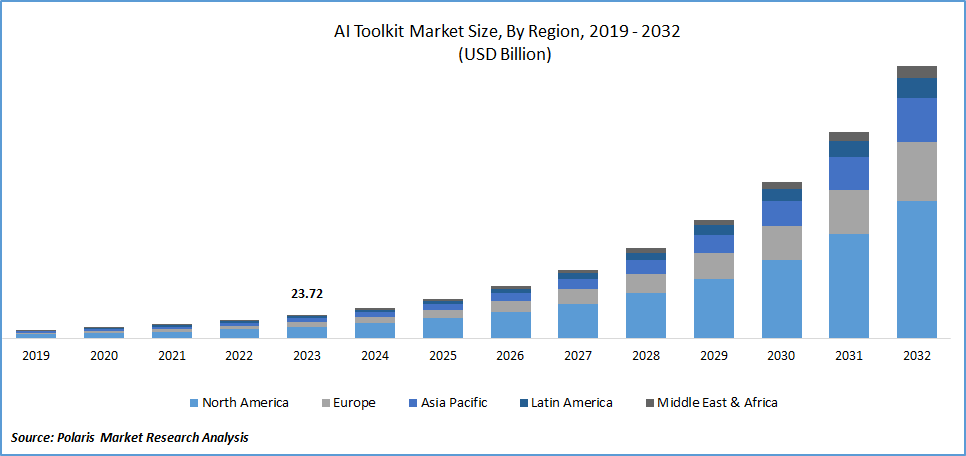
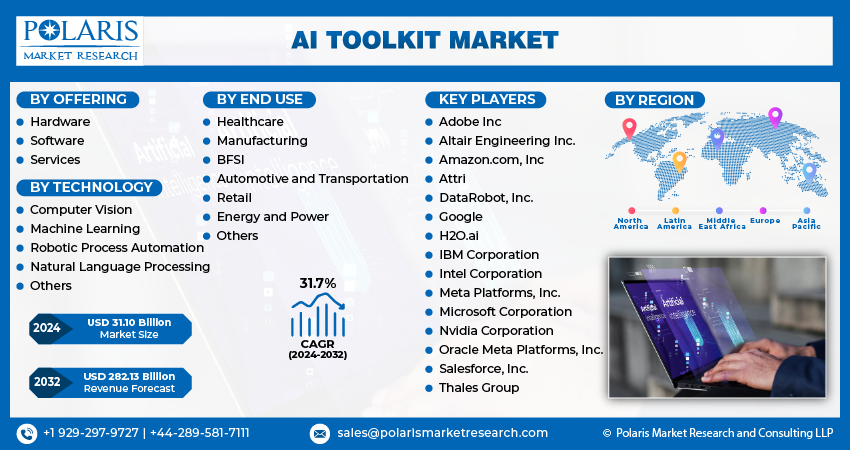
The global AI toolkit market was valued at USD 40.86 billion in 2025 and is expected to grow at a CAGR of 31.98% during the forecast period.
Market Statistics
AI Toolkit Market Key Takeaways
- North America dominated the global market with 39.4% revenue share in 2025. The presence of major players such as Google drives the leading position of the market.
- The Asia Pacific AI toolkit market is expected to exhibit the highest CAGR of 23.2% during the forecast period. Emerging AI players and the existence of global giants such as Google and Microsoft boost the regional market growth.
- The services segment is expected to register a significant CAGR of 24.6% during 2026–2034. Rising demand for cloud-based AI services contributed to the segment dominance.
- The natural language processing segment led with 31.8% share in 2025. NLP is used for text understanding by extracting meaning and discerning sentiment. Thus, NLP witnesses high demand.
- The BFSI segment dominated with 27.6% share in 2025. Increasing emphasis on accurate risk assessments fuels the segment growth.
Note: Figures and projections outlined in this report are the result of Polaris Market Research’s proprietary analytical processes, grounded in the latest available datasets and market observation
Industry Dynamics
- Rising demand for AI solutions across industries drives the growth of the AI toolkit industry.
- Increasing investments by market players to develop innovative solutions fuel the market expansion.
- Lack of skilled professionals restrains the growth of the market.
- Increasing supportive government policies and initiatives to advance AI research and development would create lucrative market opportunities.
AI Toolkit in Simple Terms
AI toolkit refers to a set that comprises different tools, frameworks, libraries, and models. Organizations deploy AI toolkits to build, train, launch, and support their AI solutions. This adoption makes it easier to develop AI. The software toolkit consists of various components. They perform various tasks such as machine learning (ML), NLP, and computer vision. The AI toolkit usage saves time and reduces technical challenges.
Recognizing the diverse needs of industries, AI toolkit developers increasingly specialize their offerings. Customized toolkits for healthcare, finance, manufacturing, and other sectors address specific challenges, ensuring relevance and efficacy in varied applications.
A thriving developer community around popular AI toolkits promotes collaboration, knowledge sharing, and the creation of diverse applications. Forums, online communities, and collaborative projects contribute to the collective expertise of developers worldwide.The influx of investments and funding in AI research and development fortifies the AI toolkit industry. Companies are investing in R&D and market expansion to gain an edge. In addition, companies operating in the market are introducing new solutions to cater to the growing market demand.
How AI Toolkits Work?
- Collect data from multiple sources.
- Clean and prepare data for training.
- Train AI models with the use of different algorithms and datasets.
- Improve model accuracy and efficiency.
- Evaluate model performance and reliability.
- Integrate models into real-world applications.
- Track performance and update models with new data.
Difference Between AI Toolkit vs. AI Platform
| Parameter | AI Toolkit | AI Platform |
| Primary Purpose | Focuses on AI model development and experimentation | Supports the complete AI lifecycle from development to deployment |
| Core Components | Frameworks, libraries, APIs, and pre-built models | Development tools, deployment, monitoring, and governance features |
| Primary Users | AI developers, data scientists, and researchers | Enterprises, IT teams, and business users |
| Customization | Highly flexible and customizable for specific use cases | Standardized workflows with configurable options |
| Deployment | Requires additional tools for production deployment | Includes built-in deployment, scaling, and model management |
| Best Suited For | Building and testing custom AI applications | Managing enterprise-scale AI projects and operations |
Source: Polaris Market Research Analysis
Source: Polaris Market Research Analysis
To Understand More About this Research: Download Sample Report
- For instance, in May 2025, IBM introduced the Watsonx Platform, designed to fuel the development of next-generation foundation models for business applications. This new platform, tailored for foundation models and generative AI, comprises a studio, data store, and governance toolkit, providing a comprehensive suite of tools for enhanced capabilities.
The growing adoption of edge computing architectures prompts the development of AI toolkits optimized for edge deployment. This allows for efficient processing of data on edge devices, reducing latency and supporting real-time applications in diverse environments.
Supportive government policies, grants, and initiatives geared toward advancing AI research and development create an enabling environment. Government backing facilitates increased collaboration, accelerates innovation, and positions the AI toolkit market industry as a key contributor to national technological advancements.
Use Cases on AI Toolkit
| Use Case | How AI Toolkits Are Used |
| Chatbots & Virtual Assistants | Build conversational AI for customer support, automation, and personalized interactions. |
| Fraud Detection Systems | Develop AI models to identify suspicious transactions. Financial fraud detection in real time. |
| Medical Image Analysis | Enable AI-powered analysis of X-rays, MRIs, and CT scans. It supports clinical diagnosis. |
| Predictive Maintenance | Analyze equipment data to predict failures. Optimize maintenance schedules. |
| Recommendation Engines | Deliver personalized product, content, and service recommendations based on user behavior. |
| Autonomous Vehicles | Support computer vision, sensor fusion, and decision-making for self-driving systems. |
| Smart Manufacturing | Power quality inspection, process automation, and production optimization in factories. |
| Customer Analytics Platforms | Analyze customer data to improve segmentation, personalization, and marketing performance. |
Source: Polaris Market Research Analysis
Source: Polaris Market Research Analysis
Key Market Drivers & Restraints
Growth Drivers
Increasing demand for AI solutions and technological advancements
The rising need for solutions driven by artificial intelligence extends across a spectrum of industries, ranging from precision medicine to the optimization of supply chains. To meet the diverse demands, AI toolkits are designed to accommodate a wide array of applications. Customization is a key aspect, addressing specific use cases like fraud detection, recommendation systems, and the development of autonomous vehicles.
The dynamic landscape of AI is marked by ongoing advancements, not limited to algorithmic improvements but also encompassing innovations in model architectures and optimization techniques. Techniques such as federated learning, attention mechanisms, and the continuous refinement of architectures like GPT-4 contribute to the evolution of AI toolkit market.
Impact of Generative AI on the AI Toolkit Market
GenAI is a significant factor in the transformation of the AI development toolkits marketplace. In this regard, the growing popularity of AI development frameworks is driven by rising adoption of LLMs, multimodal AI, and foundation models. In order to keep up with the demands of AI developers, AI toolkits are increasingly offering new capabilities like pre-trained models, prompt engineering capabilities, model fine tuning systems, vector databases, and AI agent development platforms. Such capabilities allow enterprises to develop their generative AI applications faster and with reduced complexity.
Key Impacts of Generative AI
- Growing Demand for LLM Support
- Rise of AI Agents for autonomous AI workflows.
- Faster application development due to reduced coding.
- Greater Focus on AI Governance
Rise of AI Agents and Autonomous Systems
Rapid adoption of autonomous AI agents and systems is bringing transformation in the market. This is attributed to the need for intelligent frameworks to make decisions, automate workflows, and collaborate among multiple agents. Current AI frameworks are not restricted to developing machine learning algorithms only. They offer an infrastructure for autonomous systems. These can plan, reason, and perform actions with minimum human involvement.
Challenges in the AI Toolkit Market
There are some concerns in the marketplace, even though it is growing quickly. The development and implementation of sophisticated AI models need special knowledge. Therefore, the lack of skilled specialists becomes a serious problem for most businesses. High expenses of GPU, cloud services, and big model training are another issue that affects the popularity of AI toolkits.
The incorporation of AI toolkits into existing IT systems and varied data ecosystems makes the process even more difficult to implement. Moreover, the issue of growing concerns around data protection, cyber security, model bias, and AI regulation cannot be ignored.
AI Toolkit Market Segment Analysis
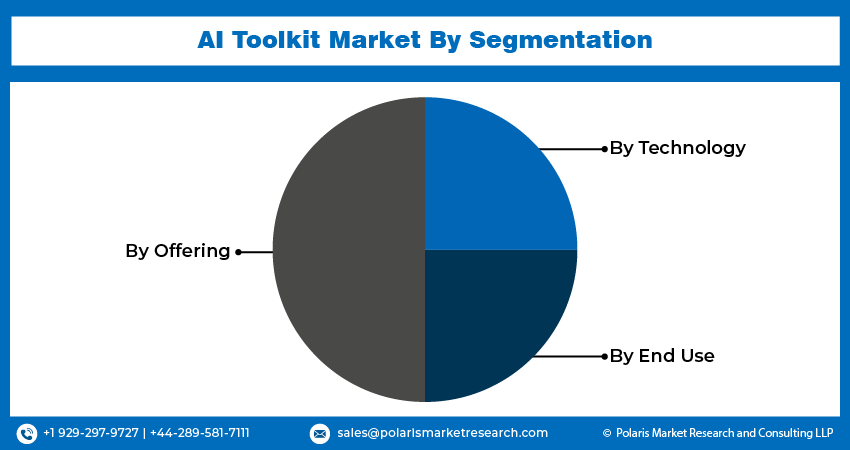
The market is primarily segmented based on offering, technology, end use, and region.
| By Offering | By Technology | By End Use | By Region |
|
|
|
|
Source: Polaris Market Research Analysis
AI Toolkit Market, by Offering
The services segment is expected to experience significant growth during the forecast period
The services segment is expected to experience significant growth during the forecast period. These services include development frameworks, cloud-based AI services, and NLP APIs for language-related tasks. Computer vision services enable applications to interpret visual data, while speech recognition and synthesis enhance voice-based interactions. AutoML simplifies the machine learning development process, and model deployment tools ensure seamless integration into production environments. Data annotation services aid in preparing datasets, while interpretability tools enhance understanding of model predictions. Consulting and training services offer strategic guidance and educational resources, and integration platforms facilitate the seamless inclusion of AI models into existing workflows. Custom AI solutions address specific business needs, collectively making AI more accessible, efficient, and impactful across diverse industries.
AI Toolkit Market, by Technology
The natural language processing segment accounted for the largest market share in 2025
The natural language processing segment accounted for the largest market share. Within these toolkits, NLP facilitates text understanding by extracting meaning, discerning sentiment, and grasping intent from human-written language. It enables speech recognition, converting spoken words to text, a crucial function in virtual assistants and transcription services. Language translation capabilities in AI toolkits leverage NLP, allowing for seamless conversion between languages.
Sentiment analysis gauges opinions and feelings in textual content, while Named Entity Recognition identifies entities like names and locations. NLP-driven question-answering systems and text summarization enhance user interactions and information retrieval. Language generation in AI toolkits produces coherent and contextually relevant text, applied in chatbots and content creation. Coreference resolution addresses word associations, and syntax analysis aids in understanding sentence structure. NLP in AI toolkits enriches language-based applications, fostering more sophisticated interactions between machines and users.
AI Toolkit Market, by End-use Industry
The BFSI segment accounted for the largest market share in 2025
AI toolkits have significantly impacted the BFSI industry, revolutionizing various aspects of operations. In fraud detection and prevention, machine learning algorithms from AI toolkits enhance security by analyzing transaction patterns. These toolkits contribute to advanced risk management, providing more accurate risk assessments and aiding decision-making processes. AI-powered chatbots, built using these toolkits, improve customer service by offering instant responses and streamlining tasks.
Personalized banking experiences are achieved through recommendation engines, analyzing customer behavior and preferences. In credit scoring and underwriting, AI toolkits enhance accuracy by analyzing vast datasets. These toolkits also bolster the automation of routine tasks, algorithmic trading, and cybersecurity measures. They aid in regulatory compliance by monitoring transactions and identifying potential issues. Predictive analytics for customer insights and voice recognition technologies further contribute to the BFSI sector's evolving landscape, emphasizing efficiency, customer experience, and risk management.
Source: Polaris Market Research Analysis
AI Toolkit Market Regional Analysis
North America accounted for the largest revenue share in 2025
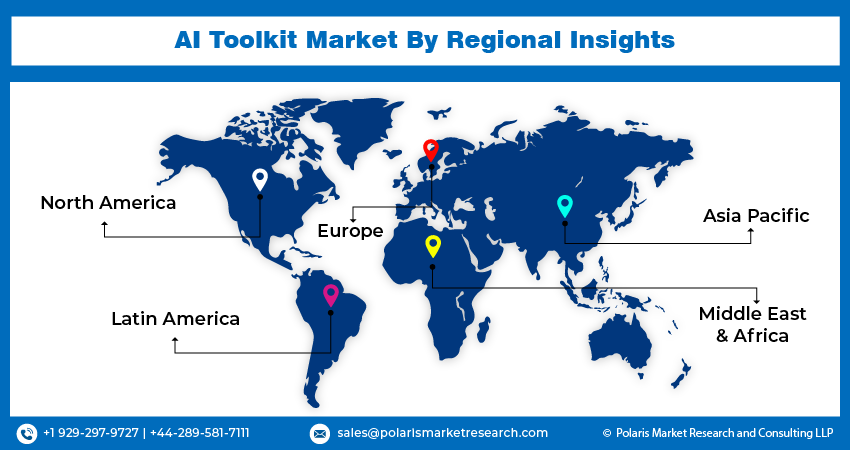
North America accounted for the largest revenue share in 2025. Major players such as Google, with its widely adopted TensorFlow framework, Facebook providing PyTorch, and Microsoft offering Azure Machine Learning and Cognitive Toolkit, continue to set the standard for AI toolkits. These platforms are characterized by extensive developer support and feature-rich capabilities. North America's bustling startup ecosystem contributes to a diverse array of specialized AI toolkits and platforms. These emerging companies offer dynamism to the industry. Major cloud service providers, including Amazon Web Services (AWS), Microsoft Azure, and Google Cloud Platform (GCP), elevate the accessibility of AI toolkits through cloud integration. Their AI services, often built upon popular toolkits, facilitate scalable and on-demand AI capabilities for businesses, reducing infrastructure barriers.
Asia-Pacific is expected to experience significant growth during the forecast period. Asia-Pacific's AI toolkit market is dynamic, marked by emerging players and global giants such as Google and Microsoft extending influence. Governments, particularly in China, invest in AI R&D through initiatives like the 'New Generation AI Development Plan.' Leading institutions, like Tsinghua University and IITs, contribute to research. Industries adopt AI toolkits, with startups innovating in tech hubs across the region. Regulatory approaches vary, with China implementing comprehensive frameworks.
Regional Market Trends
| Region | Key Trend |
| North America | Leads the market. Strong investments in generative AI, cloud AI platforms, and enterprise AI application development. |
| Europe | Witnesses strong Growth. Responsible AI initiatives, stringent AI regulations, and increasing adoption across manufacturing and financial services. |
| Asia Pacific | Fastest-growing region. Expanding AI startups, government-led AI programs, and rapid digital transformation in China, India, Japan, and South Korea. |
| Latin America | Adoption is increasing. Growing investments in AI-powered customer service, fintech solutions, and cloud-based AI development tools. |
| Middle East & Africa | Witnesses substantial market growth. Increasing smart city projects, digital government initiatives, and high investments in AI innovation and cloud infrastructure. |
Source: Polaris Market Research Analysis
Source: Polaris Market Research Analysis
Key Market Players & Competitive Insight
The market faces fierce rivalry, with companies leveraging cutting-edge technology, top-notch product offerings, and a robust brand reputation to propel revenue expansion. Key players employ diverse tactics, including dedicated research and development, strategic mergers and acquisitions, and continuous technological advancements. These strategic maneuvers are aimed at broadening their product ranges and sustaining a competitive advantage. The market dynamic is shaped by constant innovation and a commitment to delivering high-quality solutions, underscoring the importance of strategic initiatives in ensuring sustained competitiveness.
Some of the major players operating in the global market include:
- Adobe Inc
- Altair Engineering Inc.
- Amazon.com, Inc
- Attri
- DataRobot, Inc.
- H2O.ai
- IBM Corporation
- Intel Corporation
- Meta Platforms, Inc.
- Microsoft Corporation
- Nvidia Corporation
- Oracle Meta Platforms, Inc.
- Salesforce, Inc.
- Thales Group
Recent Developments
- July 2026: Google announced the launch of new AI tools at I/O Connect India 2026. The U.S.-based technology giant also revealed educational programs and partnerships to boost AI ecosystem across India. (Source: ommcomnews.com)
- In September 2025, Microsoft announced a partnership with OpenAI to improve its AI toolkit offerings. The collaboration integrates OpenAI’s advanced language models into Microsoft products, enhancing user experience and expanding AI capabilities. This partnership aims to create a stronger ecosystem for developers, making it easier to build sophisticated applications.
- In August 2025, Google launched a new set of AI development tools for small and medium-sized businesses. This move aims to make advanced AI technology more accessible to smaller companies, helping them improve efficiency and innovate. It also positions Google to capture a growing share of the SME market.
- In July 2025, NVIDIA introduced a new AI toolkit to support autonomous systems. The toolkit is designed to simplify AI development for robotics and self-driving vehicles. This launch highlights NVIDIA’s commitment to leading in AI hardware while expanding its software solutions, strengthening its position in the competitive AI market.
Future Outlook of AI Toolkit Market
The AI toolkit industry is expected to experience strong growth in the coming years. The growth would be driven by increasing generative AI adoption and enterprise automation. Also, rising deployment of AI agents across industries will drive the market expansion in the future. Growing cloud-native AI development and increasing demand for machine learning (ML) solutions across industries will fuel growth. There are continued advancements in foundation models, edge AI, multimodal AI, and AI governance frameworks. They will expand commercial adoption. It will also position AI toolkits as a foundational layer of the global AI ecosystem.
AI Toolkit Market Report Scope
| Report Attributes | Details |
| Market size value in 2025 | USD 40.86 billion |
| Market size value in 2026 | USD 53.68 billion |
| Revenue forecast in 2034 | USD 496.51 billion |
| CAGR | 31.98% from 2026 - 2034 |
| Base year | 2025 |
| Historical data | 2021 - 2024 |
| Forecast period | 2026 - 2034 |
| Quantitative units | Revenue in USD million/billion and CAGR from 2026 to 2034 |
| Segments covered | By Offering, By Technology, By End Use, By Region |
| Regional scope | North America, Europe, Asia Pacific, Latin America; Middle East & Africa |
| Customization | Report customization as per your requirements with respect to countries, region and segmentation. |
Source: Polaris Market Research Analysis
AI Toolkit Market Frequently Asked Questions
The global AI toolkit market size is expected to reach USD 496.51 billion by 2034
Amazon.com, Inc., Google, IBM Corporation, Intel Corporation, Meta Platforms, Inc., Microsoft Corporation, Nvidia Corporation are the top market players in the market.
North America region contribute notably towards the global AI Toolkit Market.
The global AI toolkit market is expected to grow at a CAGR of 31.98% during the forecast period.
The AI Toolkit Market report covering key segments are offering, technology, end use, and region
An AI toolkit refers to the set of frameworks, libraries, APIs, and pre-built models. The tools are used to develop, train, deploy, and manage AI applications.
The following are the major parts of an AI toolkit: Machine learning framework, data preprocessing tools, model training libraries, APIs, visualization tools, debugging tools, and deployment capabilities.
The AI toolkits find applications in sectors such as healthcare, finance, manufacturing, retail, automobile, and telecommunications. Moreover, the education and information technology sectors utilize these toolkits for developing AI-based solutions.
AI toolkits speed up the creation of AI models, minimize implementation expenses, and enhance scalability. They help to deploy the models in less time. Furthermore, the toolkits help simply manage AI applications within the organizations.
Download Sample Report of AI Toolkit Market
Please fill out the form to request a customized copy of the research report.


