
Ammunition Market Size, Share, Growth Opportunities, 2026-2034
REPORT DETAILS
Ammunition Market Summary
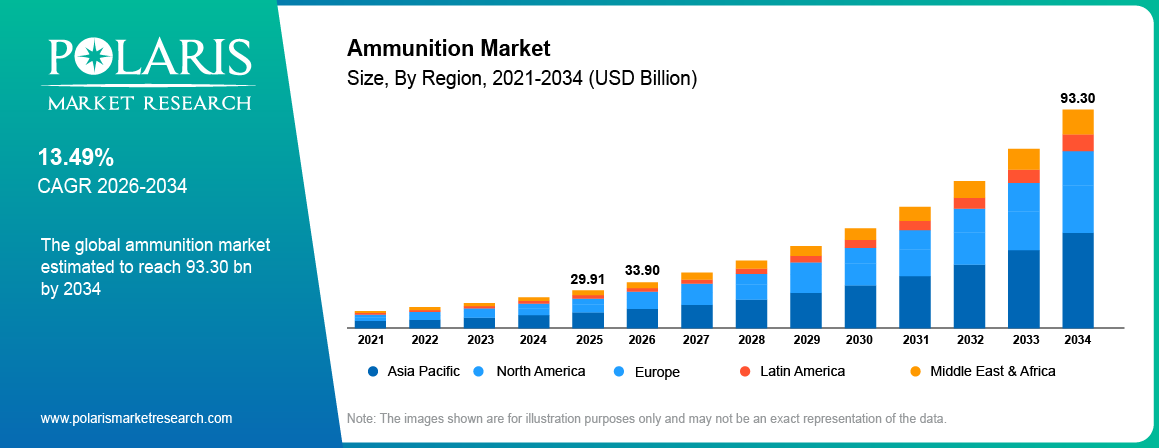
The global ammunition market was valued at USD 29.91 billion in 2025 and is expected to grow at a CAGR of 13.49% from 2026 to 2034. The market growth is driven by rising defense spending and increasing demand for firearms across military and law enforcement sectors. Increasing participation in shooting sports and self-defense training drives demand for ammunition in the civilian segment.
Market Statistics
Key Takeaways
- North America held the largest revenue share in 2025, accounting for 38.42%. Growth was driven by strong defense spending, military modernization, and ammunition stockpile replenishment.
- Europe is projected to register the fastest CAGR of 16.84% during the forecast period. Government initiatives to strengthen defense production are supporting growth.
- Projectiles and warheads held the largest segment share in 2025, accounting for 14.06%. Rising defense demand amid geopolitical tensions supported the segment.
- Bullets segment dominated the market with 55.84% share during the forecast period. Growth is driven by rising security threats and modern defense requirements.
- Small-caliber ammunition accounted for 36.84% of the market in 2025. Demand across military, law enforcement, and sporting applications supports the segment.
Note: Figures and projections outlined in this report are the result of Polaris Market Research’s proprietary analytical processes, grounded in the latest available datasets and market observations.
What is Ammunition
Ammunition refers to the supplies used by firearms and other weapons to engage targets. It includes bullets, cartridges, shells, projectiles, and related components designed for specific weapon systems. The ammunition market covers the production, distribution, and demand for these products across defense, law enforcement, and civilian sporting applications.
The growing global conflicts, especially among neighboring countries, are increasing the need for defense tools such as bullets, grenades, and mortars. Government and non-government organizations are also supporting countries in strengthening their defense capabilities. These factors are creating growth opportunities for the ammunition market.
In July 2026, the NATO Support and Procurement Agency (NSPA) awarded a contract to Diehl Defence for 155-mm VULCANO guided ammunition. Deliveries are expected to begin in 2027. This agreement will help NATO allies strengthen their defense capabilities and replenish ammunition stockpiles (Source: nspa.nato.int).
Furthermore, rising investments in ammunition manufacturing and growing concerns about national security are expected to support industry growth.
For instance, in February 2025, Winchester held a groundbreaking ceremony for a new 6.8-mm ammunition manufacturing facility at Lake City Army Ammunition Plant in the United States. The facility is part of the Next Generation Squad Weapons program. It will support domestic ammunition production (Source: winchester.com).
Moreover, growing bilateral agreements are helping countries develop advanced ammunition. These partnerships are expected to create new growth opportunities in the coming years. Government spending on defense and military modernization is a key industry driver. Countries are investing in stronger defense capabilities to address security threats. This creates a continuous demand for ammunition.
Military modernization programs aim to upgrade weapons, improve combat capabilities, and increase operational effectiveness. These efforts are driving demand for advanced ammunition systems. They include precision-guided munitions, smart ammunition, and next-generation small caliber ammunition.
The civilian market also contributes to ammunition demand. It includes recreational shooters, hunters, sports enthusiasts, and firearms collectors. Growing participation in shooting sports, hunting, and self-defense training supports this demand.
Market Dynamics
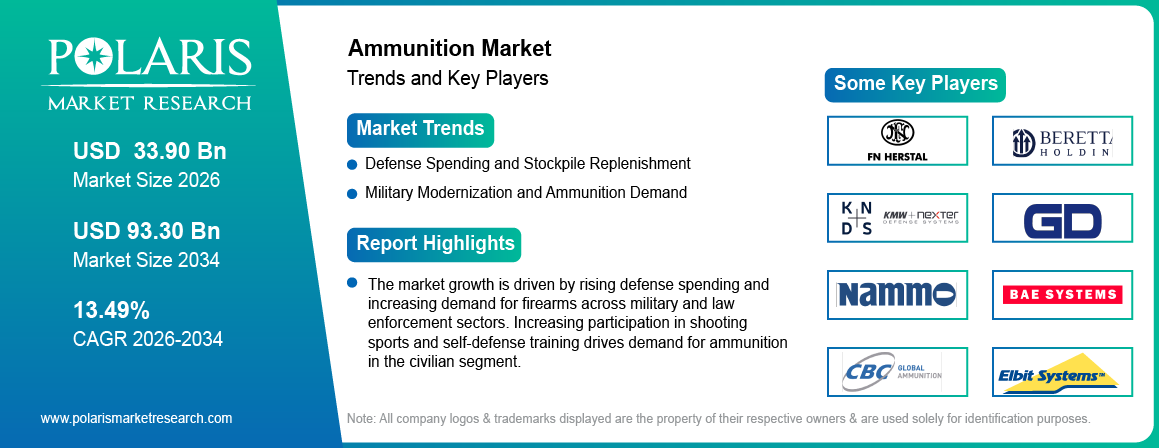
Market Driver- Defense Spending and Stockpile Replenishment
Countries are increasing defense spending to address security threats. They are also replenishing ammunition stockpiles to maintain military readiness. These efforts are increasing demand for ammunition from defense manufacturers. Long-term procurement agreements are also helping suppliers plan production. In February 2026, Rheinmetall reported an initial order worth around €200 million from NATO’s procurement agency for 120-mm tank ammunition. The order followed a framework agreement signed in July 2025 (Source: rheinmetall.com).
Market Driver- Military Modernization and Ammunition Demand
Countries are upgrading military equipment to improve defense capabilities. Modernization programs are creating demand for advanced ammunition systems. Governments are also investing in technologies that support changing military requirements. These efforts are encouraging manufacturers to develop and supply newer ammunition products. In July 2026, NATO’s Support and Procurement Agency awarded Diehl Defence a contract for 155-mm VULCANO guided ammunition. First deliveries are expected in 2027 (Source: thedefensepost.com).
Market Opportunity- Domestic Ammunition Production
Countries are expanding domestic ammunition production to reduce dependence on foreign suppliers. Local manufacturing can improve supply reliability during periods of high demand and support national defense needs. Government investments in new facilities and production capacity are creating opportunities for ammunition manufacturers and component suppliers. These efforts are also supporting the growth of domestic supply chains and strengthening the ammunition industry's ability to meet rising procurement requirements.
Market Opportunity- International Partnerships and Manufacturing Expansion
International partnerships can help countries strengthen ammunition supply chains. Joint projects can support technology sharing and manufacturing expansion. They can also help manufacturers access new markets. These partnerships create opportunities for companies supplying ammunition and related components. In July 2025, Rheinmetall and its Australian partner, NIOA, continued developing their joint ammunition manufacturing capabilities in Australia. Such partnerships support local production and help strengthen regional supply chains (Source: defensenews.com).
Market Restraint- High Costs and Supply Chain Constraints
Advanced ammunition production requires substantial investment in equipment, facilities, and research. Manufacturers must also meet strict safety and regulatory requirements. Supply disruptions involving metals and other raw materials can increase production costs. These challenges can delay capacity expansion and limit the ability of smaller manufacturers to compete.
Traditional vs. Advanced Ammunition: Market Comparison
| Factor | Conventional / Unguided Ammunition | Guided, Programmable, or Advanced Ammunition |
| Market Definition | Includes conventional ammunition used across different weapon systems and applications. | Includes ammunition with guidance systems, programmable functions, specialized fuzing, or other advanced features. |
| Key Benefits | Supports established weapon systems and benefits from standardized designs and large-scale production. | Offers specialized features that may improve precision or mission-specific performance, depending on the system. |
| Cost and Procurement | Established production lines and bulk procurement can support cost efficiency. Costs vary by caliber and contract. | May involve higher unit costs, system integration, testing, and training requirements. |
| Applications | Used in military operations, training, and other applications based on weapon-system requirements. | Used for specialized defense requirements where guidance, programmable functions, or other advanced features are needed. |
Source: Polaris Market Research Analysis
Report Segmentation
The market is primarily segmented based on product, component, caliber, guidance mechanism, application, lethality, and region.
By Product
The global ammunition market segmentation, based on product, includes bullets, aerial bombs, grenades, artillery shells, and mortars. The bullets segment dominated the market in 2025 with 55.84% share. Growth is driven by rising security threats, military modernization, and increasing demand for ammunition across defense and law enforcement applications.
The aerial bombs segment is anticipated to grow with 14.82% CAGR during forecast period. Demand is supported by rising defense spending and the need to strengthen military capabilities. Their use in defense operations also contributes to segment demand.
By Component
The global ammunition market segmentation, based on component, includes fuzes and primers, propellants, bases, projectiles and warheads, and others. The projectiles and warheads segment held the largest revenue share in 2025, accounting for 35.28%. Demand is supported by rising defense spending, military modernization, and the need to strengthen ammunition supplies. These components are essential parts of various ammunition systems used by armed forces.
The fuzes and primers segment is projected to register the highest CAGR of 14.28% during the forecast period of 2026–2034. Growth is driven by advancements in ammunition technology and increasing demand for modern defense equipment. Rising investments in defense manufacturing are also expected to support segment growth.
By Caliber
The global ammunition market segmentation, based on caliber, includes small-caliber, medium-caliber, large-caliber, and other ammunition. The small-caliber segment held the largest revenue share in 2025, accounting for approximately 36.84%. Its demand is supported by widespread use in military operations, law enforcement, training, and civilian sporting activities. The availability of different calibers also supports its use across various applications.
The large-caliber segment is expected to register strong growth of 16.38% during the forecast period of 2026–2034. Rising defense spending and military modernization are increasing demand for artillery shells, tank ammunition, and other large-caliber products. Countries are also investing in defense equipment and ammunition stockpiles to strengthen their military capabilities.
By Guidance Mechanism
The global ammunition market segmentation, based on guidance mechanism, includes guided and non-guided ammunition. The non-guided segment accounted for 86.74% of market revenue in 2025. Its demand is supported by widespread use across conventional ammunition systems, military training, and established defense inventories. These systems continue to serve various defense requirements.
The guided segment is projected to register the highest CAGR of 18.64% during the forecast period of 2026–2034. Growth is driven by rising demand for precision-guided systems, military modernization, and investments in advanced defense technologies. Increasing focus on improving targeting accuracy is also supporting demand for guided ammunition.
By Application
The global ammunition market segmentation, based on application, includes defense and civil & commercial. The defense segment accounted for 84.18% of market revenue in 2025. Demand is supported by rising military spending, ammunition stockpile replenishment, and growing investments in homeland security. Military modernization programs and ongoing efforts to strengthen national security are also supporting demand across defense applications.
The civil & commercial segment is projected to register the significant CAGR of 9.36% during the forecast period of 2026–2034. This segment includes sporting, hunting, self-defense, and other applications. Growth is driven by interest in recreational shooting, hunting activities, and lawful firearm ownership. Demand may also vary based on regulations and participation in these activities across regions.
By Lethality
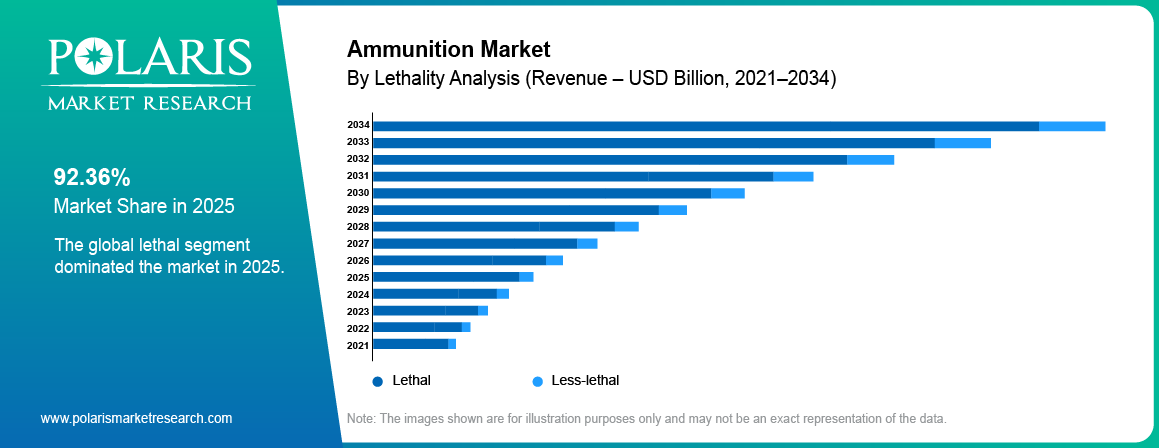
The global ammunition market segmentation, based on lethality, includes lethal and less-lethal ammunition. The lethal segment accounted for 92.36% of market revenue in 2025. Demand is supported by military operations, defense requirements, and the need to maintain ammunition stockpiles. These products are used across various defense applications to support national security and military readiness.
The less-lethal segment is projected to register the highest CAGR of 11.58% during the forecast period of 2026–2034. Growth is driven by demand from law enforcement and homeland security agencies. These products are used in crowd management, public order operations, and situations where reducing the risk of fatal injury is a priority.
Applications and Use Cases
The ammunition market serves defense, law enforcement, and civilian applications. Military forces use ammunition for defense operations and training exercises. Border security agencies use it to support national security and protect sensitive areas. Law enforcement agencies use ammunition for authorized duties and public safety operations.
Ammunition is also used in testing and evaluation to assess performance, reliability, and compatibility with different weapon systems. Naval forces use it for maritime defense, while aerospace-related defense systems may use specialized ammunition where applicable. In the civilian sector, ammunition supports regulated sporting and hunting activities. Demand across these applications depends on defense spending, security needs, government regulations, and the availability of suitable products.
Key Applications of Ammunition
| Application | Common Uses |
| Military and Defense | Defense operations, military readiness, and training |
| Border and Homeland Security | Border protection and national security duties |
| Law Enforcement | Authorized public safety and law enforcement activities |
| Testing and Evaluation | Performance, reliability, and compatibility assessment |
| Naval and Aerospace Defense | Maritime defense and specialized defense systems |
| Sporting and Hunting | Regulated shooting sports and hunting activities |
Source: Polaris Market Research Analysis
Role in Military Modernization
Military modernization is a key driver of the global ammunition market. Countries are upgrading their defense equipment to improve military readiness and respond to changing security needs. This is supporting ammunition demand across different weapon systems. Compatibility with existing equipment also remains important in ammunition procurement.
Stockpile renewal is another key part of military modernization. Governments replace aging supplies and plan procurement to meet long-term defense requirements. Investments in defense ammunition and domestic ammunition manufacturing are also supporting the ammunition industry. These efforts are shaping ammunition market trends as countries strengthen their defense capabilities.
Ammunition Manufacturing and Supply Chain
The ammunition manufacturing process depends on a steady supply of raw materials, reliable production facilities, and quality checks. Manufacturers source metals, propellants, and other components from approved suppliers. Production planning helps companies meet demand from defense agencies and other customers. Quality assurance is also important to maintain product consistency and compliance with safety standards.
The ammunition supply chain includes storage, transportation, procurement, and logistics. Ammunition requires suitable storage conditions and careful handling during transport. Delays in raw material supply or transportation can affect production schedules and deliveries. Governments and defense agencies also plan ammunition procurement to maintain stockpiles and meet future requirements. Investments in domestic production can help reduce reliance on external suppliers and strengthen supply chains. These factors influence global ammunition market growth and the ability of manufacturers to meet changing defense needs.
Technology and Sustainability Trends
Technology is shaping the global ammunition market through developments in guided systems, programmable features, and improved materials. Guided ammunition uses guidance technology, while non-guided ammunition follows its designed trajectory without active guidance. Programmable features and specialized fuzes are also becoming part of modern ammunition systems.
Sustainability is another focus for the ammunition industry. Manufacturers are exploring lead-free projectiles and primers to reduce the use of hazardous materials. Research into alternative materials also aims to reduce environmental impacts while maintaining product quality and reliability. These developments are influencing ammunition manufacturing and supporting changes in defense procurement. Adoption varies by product type, technical requirements, and regulatory standards.
Regional Insights
The global ammunition market is segmented into North America, Europe, Asia Pacific, Latin America, and the Middle East & Africa.
North America
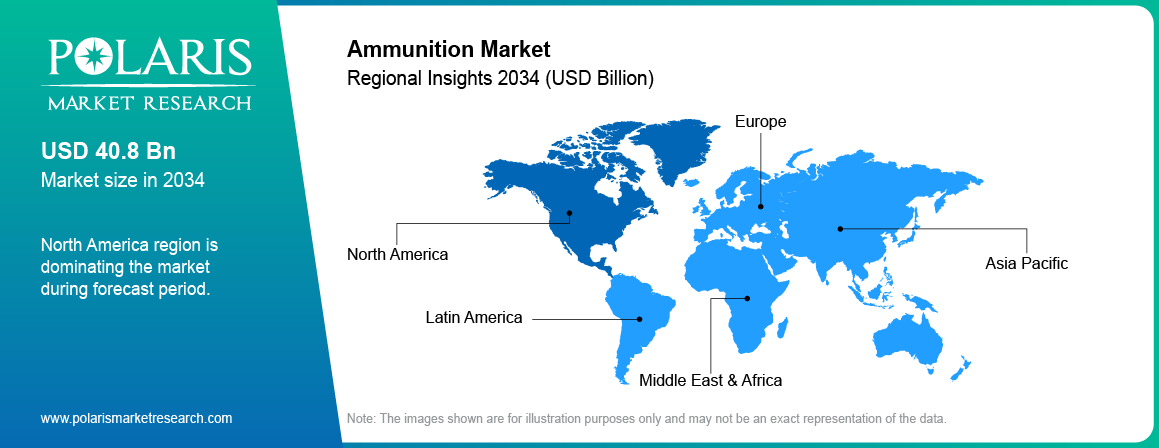
North America held the largest revenue share of the global ammunition market in 2025, accounting for 38.42% of market revenue. Strong defense spending, military modernization, and stockpile replacement are supporting regional demand. The United States and Canada are also investing in domestic ammunition production to strengthen supply chains and meet defense needs.
In March 2026, Canada announced an investment of CAD 1.4 billion to expand domestic ammunition production. The investment aims to increase manufacturing capacity, reduce dependence on foreign suppliers, and improve the security of ammunition supplies (Source: canadianshieldinstitute.ca).
Europe
Europe is expected to record rapid growth of 16.84% in the ammunition market during the forecast period. Government initiatives to expand ammunition manufacturing, replenish stockpiles, and strengthen defense capabilities are supporting regional demand. The region is also increasing investment in defense technology and procurement.
In July 2026, the European Defence Agency reported that EU member states' defense spending reached EUR 418 billion in 2025, up 20% from 2024. Spending is projected to reach EUR 454 billion in 2026. These investments are expected to support ammunition procurement and manufacturing capacity (Source: eda.europa.eu).
Asia Pacific
The Asia Pacific ammunition market is supported by rising defense spending, border tensions, and military modernization. Countries such as India and China are investing in defense capabilities and ammunition supplies. These efforts are increasing demand for ammunition and supporting regional market growth.
In December 2025, the Indian government reported that 78% of the central procurement budget under its emergency procurement program had been used to procure ammunition. This highlights the focus on maintaining stockpiles and strengthening defense readiness in the region (Source: pib.gov.in).
Latin America
Latin America's ammunition market is influenced by defense budgets, public security needs, and military procurement. Demand varies across countries based on modernization plans and local manufacturing capacity. Government procurement and supply availability remain important factors for the regional ammunition industry. Domestic production and partnerships may create further opportunities as countries seek to strengthen their defense supply chains.
Middle East & Africa
The Middle East and Africa ammunition market is shaped by defense spending, security needs, and efforts to expand local manufacturing. In August 2026, Egypt reviewed plans to increase ammunition production and reduce dependence on imports. The initiative includes improving production capacity and adopting modern manufacturing technologies (Soure: sis.gov.eg).
Segment Summary Table
| Category | Segments |
| Product | Bullets; Aerial Bombs; Grenades; Artillery Shells; Mortars; Others |
| Component | Fuzes & Primers; Propellants; Bases; Projectiles and Warheads; Others |
| Caliber | Small-Caliber; Medium-Caliber; Large-Caliber; Others |
| Guidance Mechanism | Guided; Non-Guided |
| Application | Defense (Military; Homeland Security); Civil & Commercial (Sporting; Hunting; Self-Defense; Others) |
| Lethality | Lethal; Less-Lethal |
| Region | North America; Europe; Asia Pacific; Latin America; Middle East & Africa |
Source: Polaris Market Research Analysis
Key Market Players & Competitive Insights
Strategic Partnerships to Drive Competition
Growing investments in defense equipment are increasing competition in the global ammunition market. Strategic partnerships help companies share technology, expand manufacturing capacity, and improve supply chains. They also support local production and help meet rising demand for defense ammunition. These collaborations are becoming important as countries work to strengthen their defense capabilities and replenish ammunition stockpiles.
For instance, in September 2025, BAE Systems and Poland’s Polska Grupa Zbrojeniowa (PGZ) announced a strategic partnership to establish a 155-mm artillery ammunition manufacturing facility in Poland. The partnership involves transferring manufacturing technology and expertise to support local production. This initiative aims to expand ammunition manufacturing capacity and strengthen Europe’s defense supply chain. It also highlights the role of international collaboration in supporting the growth of the ammunition industry (Source: baesystems.com).
Rheinmetall AG is a major defense company involved in ammunition manufacturing, military technology, and weapon systems. The company supplies ammunition for different defense applications and focuses on expanding its production capacity to meet growing demand. Its activities include the development and manufacture of artillery ammunition, tank ammunition, and other defense-related products. Rheinmetall also invests in manufacturing facilities and industrial partnerships to strengthen supply chains and support defense procurement. These efforts contribute to the company’s role in the global ammunition market as countries work to replenish stockpiles and modernize their armed forces.
BAE Systems is a key player in the ammunition industry, supplying ammunition, weapon systems, and defense technologies to military customers. Its product portfolio includes artillery ammunition, naval ammunition, and other military products designed for different operational requirements. The company supports defense forces through manufacturing, engineering, and technology development. BAE Systems also works to strengthen production capabilities and maintain reliable supply chains to meet procurement needs. Its involvement in ammunition production and defense programs supports military readiness and contributes to the growth of the global ammunition market.
Some of the major players operating in the global market include:
- BAE Systems
- Beretta Holding S.A.
- CBC Global Ammunition
- Elbit Systems Ltd.
- FN Herstal
- General Dynamics Corporation
- KNDS N.V.
- Nammo AS
- Northrop Grumman Corporation
- Olin Corporation
- Rheinmetall AG
- ST Engineering
- Thales Group
Vendor Positioning Table
| Company | Primary Focus | Market Positioning |
| BAE Systems | Defense systems and ammunition | Supplies artillery, naval, and other military ammunition |
| Beretta Holding S.A. | Firearms and ammunition | Serves military, law enforcement, hunting, and sporting markets |
| CBC Global Ammunition | Small-caliber ammunition | Manufactures ammunition for defense, law enforcement, and civilian markets |
| Elbit Systems Ltd. | Defense technology and ammunition | Offers artillery ammunition and advanced defense solutions |
| FN Herstal | Firearms and ammunition | Supplies small-caliber ammunition and firearms for military and law enforcement use |
| General Dynamics Corporation | Defense systems and ammunition | Provides small-, medium-, and large-caliber ammunition |
| KNDS N.V. | Land defense systems and ammunition | Focuses on artillery systems, tank ammunition, and land defense solutions |
| Nammo AS | Ammunition and aerospace systems | Manufactures small-caliber ammunition, shoulder-fired systems, and other defense products |
| Northrop Grumman Corporation | Defense technology and ammunition components | Supports ammunition programs through propulsion, energetics, and defense technologies |
| Olin Corporation | Ammunition and small-caliber products | Produces small-caliber ammunition through its Winchester business |
| Rheinmetall AG | Ammunition and weapon systems | Supplies artillery, tank, and other military ammunition |
| ST Engineering | Defense systems and ammunition | Provides ammunition and military equipment through its defense business |
| Thales Group | Defense electronics and ammunition | Offers ammunition and defense solutions for military applications |
Source: Polaris Market Research Analysis
Recent Developments in the Industry
- July 2026: Rheinmetall announced an order from a NATO member state for 155 mm artillery shells and propellant charges for Ukraine. Deliveries are expected before April 2027. (Source: rheinmetall.com)
- June 2026: The Australian Government signed a AUD 72 million contract with Rheinmetall NIOA Munitions to establish a 155 mm projectile forging facility in Queensland. Operations are planned to begin by the end of 2028. (Source: minister.defence.gov.au)
- June 2026: General Dynamics Ordnance and Tactical Systems received a U.S. Army contract for an extended-range 155 mm artillery projectile based on the Vulcano system. The contract supports the development of advanced artillery ammunition. (Source: gdots.com)
- March 2026: Israel’s Ministry of Defense signed a USD 48 million deal with Elbit Systems for tens of thousands of 155 mm artillery shells. The ammunition will be produced at Elbit’s facilities in Israel. (Source: timesofisrael.com)
- February 2026: Poland’s Niewiadow-PGM signed a framework agreement with Northrop Grumman to support 155 mm ammunition production in Poland. The agreement aims to strengthen local manufacturing. (Source: polands-niewiadow-signs-framework-dea)
- In January 2025, a European consortium led by FN Herstal launched the SAAT project, uniting partners from nine countries to standardize small arms ammunition and strengthen Europe’s defence interoperability, innovation, and strategic autonomy. (Source: fnherstal.com)
Future Outlook
The global ammunition market is expected to grow during the forecast period of 2026–2034. Rising defense spending, stockpile replenishment, and military modernization are expected to support market demand. Governments are also investing in domestic ammunition manufacturing to reduce dependence on imports and strengthen supply chains. The growing need to maintain military readiness and replace aging ammunition stocks is likely to create further opportunities for manufacturers. These factors are expected to shape the future of the ammunition industry.
Research Methodology
The ammunition market study covers product types, components, caliber groups, guidance systems, applications, lethality categories, and regions. The research uses company reports, government budgets, defense contract announcements, trade data, and industry reports. It may also include information from manufacturers, suppliers, and industry experts.
Market estimates are prepared using suitable research methods. The study considers product types, regional demand, prices, contract timelines, and production capacity. Historical data, the base year, and the forecast period are kept consistent across the report.
The forecast considers defense spending, military modernization, stockpile replacement, production capacity, and supply chain challenges. Civilian demand is also considered where relevant. Company announcements and government releases are checked to identify awarded contracts, framework agreements, tenders, and planned manufacturing investments. Announced contracts are not treated as completed sales. Market figures are checked for consistency, and differences between research reports are reviewed. The report also states the data cutoff date and the date of the latest major update.
Market Segmentation
Ammunition, Product Outlook (Revenue - USD Billion, 2021 - 2034)
- Bullets
- Aerial Bombs
- Grenades
- Artillery Shells
- Mortars
Ammunition, Component Outlook (Revenue - USD Billion, 2021 - 2034)
-
Fuzes & Primers
- Fuze
- Primer
- Propellants
- Bases
- Projectiles and Warheads
- Others
Ammunition, Caliber Outlook (Revenue - USD Billion, 2021 - 2034)
- Small-Caliber Ammunition
- 9X19 MM Parabellum
- 5.56 MM
- 7.62 MM
- 12.7 MM
- 14.5 MM
- .338 Lapua Magnum
- .338 Norma Magnum
- Others
- Medium-Caliber Ammunition
- 20 MM
- 25 MM
- 30 MM
- 40 MM
- Large-Caliber Ammunition
- 60 MM
- 81 MM
- 120 MM
- 155 MM
- Others
Ammunition, Guidance Mechanism Outlook (Revenue - USD Billion, 2021 - 2034)
- Guided
- Non-guided
Ammunition, Application Outlook (Revenue - USD Billion, 2021 - 2034)
- Defense
- Military
- Homeland Security
- Civil & Commercial
- Sporting
- Hunting
- Self-Defense
- Others
Ammunition, Lethality Outlook (Revenue - USD Billion, 2021 - 2034)
- Lethal
- Less-lethal
Ammunition, Regional Outlook (Revenue - USD Billion, 2021 - 2034)
- North America
- U.S.
- Canada
- Europe
- Germany
- UK
- France
- Italy
- Spain
- Russia
- Netherlands
- Rest of Europe
- Asia Pacific
- China
- India
- Japan
- South Korea
- Indonesia
- Malaysia
- Australia
- Rest of APAC
- Latin America
- Argentina
- Brazil
- Mexico
- Rest of LA
- Middle East & Africa
- UAE
- Saudi Arabia
- Israel
- South Africa
- Rest of MEA
Ammunition Market Report Scope
| Report Attributes | Details |
| Market size value in 2025 | USD 29.91 billion |
| Market size value in 2026 | USD 33.90 billion |
| Revenue forecast in 2034 | USD 93.30 billion |
| CAGR | 13.49% from 2026 – 2034 |
| Base year | 2025 |
| Historical data | 2021 – 2024 |
| Forecast period | 2026 – 2034 |
| Quantitative units | Revenue in USD billion and CAGR from 2026 to 2034 |
| Segments covered |
|
| Regional scope |
|
| Competitive Landscape |
|
| Report Format |
|
| Customization | Report customization as per your requirements with respect to countries, region, and segmentation. |
Source: Polaris Market Research Analysis
Ammunition Market FAQ's
Ammunition includes cartridges, bullets, artillery shells, fuzes, propellants, and other components used by firearms and weapon systems.
The global ammunition market was valued at USD 29.91 billion in 2025 and USD 34.50 billion in 2026. It is projected to reach USD 93.30 billion by 2034.
The ammunition market is expected to grow at a CAGR of 13.49% during the forecast period of 2026–2034.
The market is segmented by product, component, caliber, guidance mechanism, application, lethality, and region.
Defense spending, military modernization, stockpile replacement, domestic manufacturing, and security concerns are supporting market growth.
Smart or advanced ammunition may include guidance systems, programmable features, or specialized fuzes. These features vary by ammunition type.
Recent developments include ammunition procurement by Israel, a U.S. Army contract for an extended-range artillery projectile, and Australia's investment in 155 mm projectile production capacity.
Download Sample Report of Ammunition Market
Please fill out the form to request a customized copy of the research report.


