
Benzene Market Research Report, Trend Analysis & Forecast, 2026 – 2034
REPORT DETAILS
Benzene Market Summary
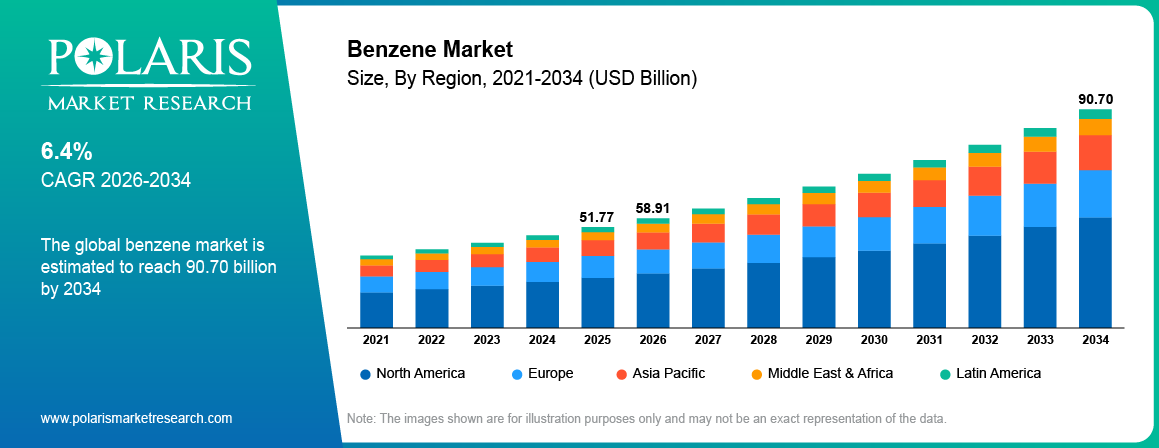
The global benzene market size was valued at USD 51.77 billion in 2025 and is projected to grow at a CAGR of 6.4% from 2026 to 2034. Styrene is made from ethylbenzene, a derivative of benzene, and its growing usage in industries such as packaging, automotive, and electronics is propelling the market forward.
Market Statistics
Benzene Market Key Takeaways
- Asia Pacific dominated with 52.3% revenue share in 2025. The region’s dominance is driven by strong demand from petrochemicals, plastics, and automotive manufacturing industries.
- China led the regional market with 58.7% in 2025. This is attributed to its extensive petrochemical production capacity and robust industrial base.
- North America is projected to register a significant CAGR of 6.8% during the forecast period. Growing demand for styrene, cumene, and other benzene derivatives supports regional market growth.
- In 2025, the ethylbenzene segment held the largest share of 34.5%. The growth is attributed to the increasing production of styrene for plastics and synthetic rubber applications.
- The petrochemicals segment led the market with 47.8% share in 2025. Rising demand for benzene as a key feedstock in the production of various chemical intermediates drives the segment growth.
Note: Figures and projections outlined in this report are the result of Polaris Market Research’s proprietary analytical processes, grounded in the latest available datasets and market observations.
What is Benzene?
Benzene is a colorless or light-yellow colored chemical compound composed of carbon and hydrogen atoms. It is liquid at room temperature, highly flammable, and evaporated quickly in the air. Benzene is used in various industrial and consumer products, including as a solvent in the chemical and pharmaceutical sectors, as well as in gasoline, adhesives, cleaning products, paint thinners, and as a precursor for the production of other chemicals.
Styrene is made from ethylbenzene, a derivative of benzene, and its growing use in industries like packaging, automotive, and electronics is driving up the demand for benzene. The demand for benzene is increasing as the automotive industry expands, especially for electric vehicles; another compound, cumene, which is made from benzene, is also being used across the world in several industries such as chemical, construction, automotive, and aviation industries. Also, the extensive use of benzene in the pharmaceutical industry as a starting material or intermediate in the synthesis of various drugs and as a building block for more complex molecules is driving the market growth.
Benzene is primarily a starting material for producing other chemicals used in various consumer products. The benzene market demand is being driven by the rising need for medications that use intermediates derived from benzene. Additionally, the growing use of polystyrene packaging in culinary and e-commerce applications, an intermediate derived from benzene, is driving market development. Benzene is used to make epoxy resins and phenolic resins, which are used to make durable and safe construction materials, thereby creating several market opportunities.
Source: Polaris Market Research Analysis
To Understand More About this Research: Download Sample Report
Difference Between Benzene vs Other Aromatic Hydrocarbons
Benzene is one of the most important aromatic hydrocarbons. It serves primarily as a chemical feedstock for the production of downstream derivatives, including ethylbenzene, cumene, cyclohexane, and alkylbenzene. These intermediates are widely used in plastics, rubber, synthetic fibers, detergents, and resins manufacturing. However, toluene and xylene are more extensively utilized as industrial solvents, gasoline blending components, and paint or coating additives. All three compounds are derived from petroleum refining and petrochemical processes. Benzene holds greater strategic importance in the chemical industry. This is due to its broad application base in high-volume chemical synthesis and polymer production.
| Parameter | Benzene | Toluene | Xylene |
| Primary Role | Chemical feedstock | Solvent and fuel additive | Solvent and polyester feedstock |
| Major End Uses | Plastics, resins, synthetic fibers, detergents | Paints, coatings, adhesives, gasoline blending | PET production, coatings, printing inks |
| Industrial Importance | High in petrochemical synthesis | Moderate in industrial solvents | High in polyester and packaging industries |
| Key Derivatives | Ethylbenzene, cumene, cyclohexane | TNT, benzene, solvents | Purified terephthalic acid (PTA), dimethyl terephthalate |
| Demand Driver | Chemical manufacturing growth | Construction and automotive coatings | Packaging and textile industries |
| Toxicity Concerns | Higher carcinogenic risk | Lower than benzene | Moderate exposure concerns |
Source: Polaris Market Research Analysis
Benzene Market Dynamics
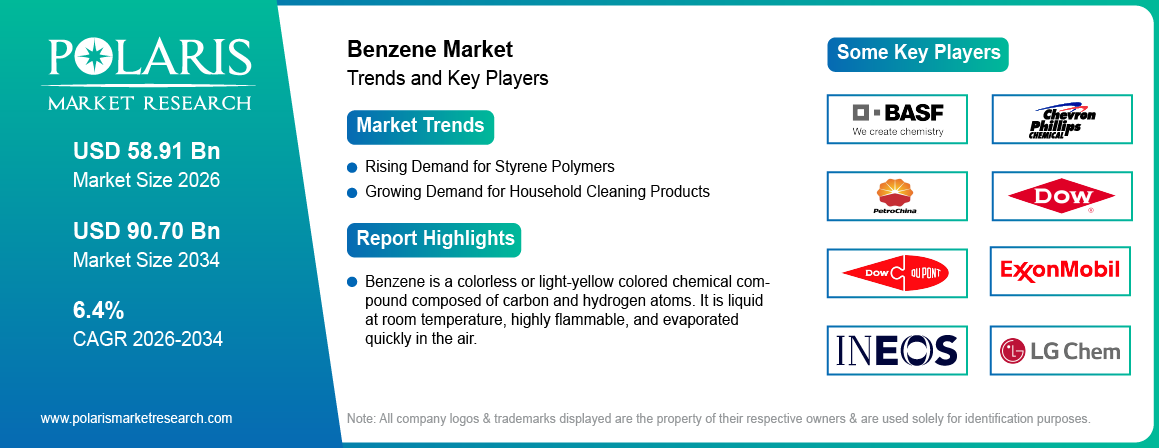
Rising Demand for Styrene Polymers
Industries such as electronics, packaging, automotive, and construction widely use styrene in its polymerized and co-polymerized forms. Most of the styrene produced globally comes in the form of polystyrene, a polymerized version available in solid, foam, and film forms. The packaging industry uses polystyrene due to its exceptional strength, flexibility, low weight, and resistance to moisture. E-commerce is significantly driving the polystyrene demand by increasing the demand for protective packaging materials, as online retailers rely heavily on polystyrene foam peanuts, trays, and other containers to safely ship fragile items across long distances.
Growing Demand for Household Cleaning Products
Linear alkyl benzene is primarily used as a raw material to produce linear alkyl benzene sulfonate (LAS), a widely used surfactant in both powdered and liquid detergents. With growing public awareness of the benefits of cleanliness, the demand for linear alkyl benzene is expanding into the home cleaning sector. The demand for industrial and residential cleaners is expected to increase, which will expand the benzene market. As LAS is fully biodegradable and environmentally safe, it remains one of the key products in the benzene market. Additionally, the increasing need for both industrial and household cleaners is expected to drive market growth over the forecast period.
Challenges in Benzene Market
- Volatility in Raw Material Prices: Prices of naphtha and other petrochemical feedstocks always fluctuate. This influences benzene production costs and profit margins.
- Stringent Environmental Regulations: Governments are imposing strict environmental and emission regulations. They are increasing compliance costs for benzene manufacturers globally.
- Toxicity and Health Concerns: Benzene has a carcinogenic nature. It raises occupational safety concerns and restricts its use in certain applications.
- Shift Toward Sustainable Chemicals: Preference for bio-based and eco-friendly alternatives is rising. It reduces long-term dependence on benzene-derived products.
Source: Polaris Market Research Analysis
Benzene Market Segment Insights
Benzene Market Assessment by Derivative Insights
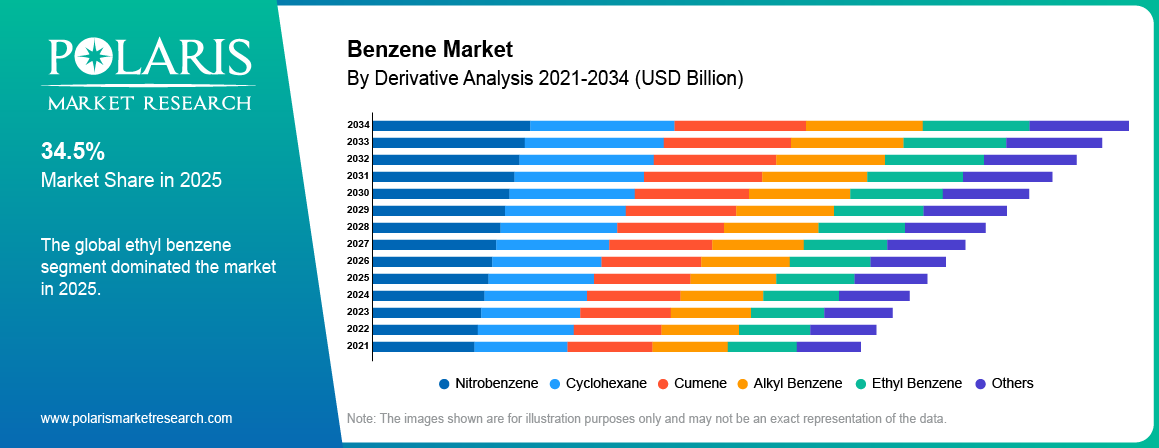
The global market for benzene based on derivative by end-use is segmented as nitrobenzene, cyclohexane, cumene, alkyl benzene, ethyl benzene, and others. The ethyl benzene segment led the market with a 34.5% revenue share in 2025, driven by its expanding applications in end-use industries such as electronics, plastic, rubber, and automobiles. Most of the styrene used in rubber tires, plastic packaging, car components, and electronic devices is derived from ethylbenzene.
The cumene segment accounted for the second-largest revenue share and is projected to witness the fastest growth during the forecast period. This growth is due to its widespread use in end-use industries like paints and coatings, chemicals, automotive, construction, and electronics.
Benzene Market Evaluation by Production Process Insights
The benzene market, based on production process, is segmented into steam cracking, catalytic reforming, and others. The catalytic reforming segment dominated the market with a 52.6% revenue share in 2025. This can be attributed its ability to produce a high yield of aromatic hydrocarbons such as benzene and toluene, making it a key source for the benzene market. Additionally, the process also generates hydrogen as a byproduct, which can be utilized in other refinery operations. All these factors are helping the process to dominate the benezene market developments.
The steam cracking segment accounted for the second-largest revenue share in 2025. This can be attributed to benefits such as flexibility in feedstock options, relatively low capital investment, and high energy efficiency. Additionally, steam cracking can produce valuable byproducts like hydrogen and is able to use renewable feedstocks. It enables a greater variety of products and eliminates the need for the costly distillation process. Due to these factors the process is expected to grow at a significant rate.
Source: Polaris Market Research Analysis
Benzene Market Regional Insights
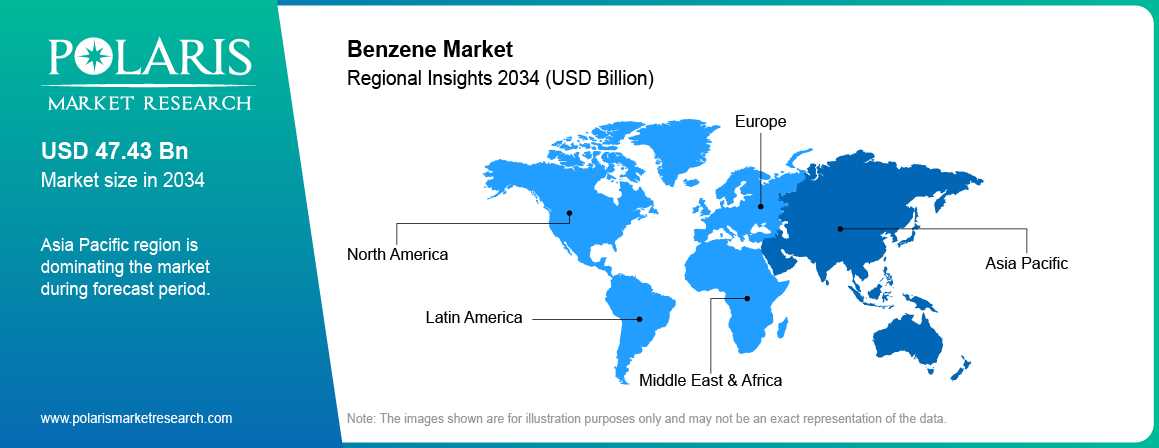
By region, the report provides the benzene market insights into North America, Europe, Asia Pacific, Latin America, and the Middle East and Africa. Asia Pacific led the market with a 52.3% revenue share in 2025, driven by the growing end-use industries such as chemical, packaging, automotive, and pharmaceuticals in the region. South Korea is a major exporter of benzene, while China is one of the largest consumers. The rising demand and imports of benzene in China are due to its growing use in building and automotive products, including paints, flooring, fiberglass, adhesives, and tires.
The benzene market in North America is expected to grow at a significant rate of CAGR 6.8% over the forecast period. This can be attributed to the expanding petrochemical sector in the U.S. and North America, along with the accessibility of crude oil, which is influencing the rising demand for benzene in the region. The rising need for styrene in multiple end-use sectors such as packaging, automotive, electronics, and more is also driving the growth of the benzene market in the region.
Source: Polaris Market Research Analysis
Benzene Market – Competitive Insights
The key players in the market are focusing on research and development to enhance their products and services offerings and drive market demand. Besides, they are adopting various strategic initiatives, including collaborations, mergers and acquisitions, new product launches, and increased investments, to improve their global footprint. To expand and survive in a more competitive environment, market participants must offer innovative solutions.
In recent years, the market for benzene has witnessed several innovations, with key players seeking to provide advanced solutions that help meet sustainability goals. The benzene market research report offers a market assessment of all the key players, including BASF, China National Petroleum Corporation, Sinopec, Dow, Saudi Basic Industries Corporation, ExxonMobil Corporation, DuPont, and Royal Dutch Shell plc.
List of Benzene Market Key Players
- BASF
- Chevron Phillips Chemical Company LLC
- China National Petroleum Corporation
- Dow
- DuPont
- ExxonMobil Corporation
- INEOS Group
- LG Chem
- Reliance Industries Limited
- Royal Dutch Shell plc
- SABIC
- Sinopec
Benzene Industry Developments
In March 2025: India’s Directorate General of Trade Remedies (DGTR) completed its anti-dumping investigation into Linear Alkyl Benzene (LAB) imports from Iran and Qatar, recommending definitive anti-dumping duties for five years. The probe was initiated following a petition from Nirma Limited and Tamilnadu Petroproducts Limited, leading representatives of India’s domestic LAB industry. DGTR found that imports were being dumped at unfairly low prices, causing significant harm to the local market. The recommended duties, varying by exporter and country of origin, range from USD 14 to USD 62 per metric tonne. (Source: alchempro.com).
In June 2024: Encina and BASF signed a long-term supply agreement for chemically recycled circular benzene derived from post-consumer end-of-life plastics. According to BASF, the partnership marks a pivotal movement in sustainable sourcing. (Source: basf.com)
Benzene Market Segmentation
By Derivative Outlook
- Nitrobenzene
- Cyclohexane
- Cumene
- Alkyl Benzene
- Ethyl Benzene
- Others
By End-Use Outlook
- Pharmaceuticals
- Agriculture
- Textile
- Automobile
- Paints & Coatings
- Pharmaceutical
- Personal Care
- Others
By Production Process Outlook
- Steam Cracking
- Catalytic Reforming
- Others
By Regional Outlook
- North America
- US
- Canada
- Europe
- Germany
- France
- UK
- Italy
- Spain
- Netherlands
- Russia
- Rest of Europe
- Asia Pacific
- China
- Japan
- India
- Malaysia
- South Korea
- Indonesia
- Australia
- Rest of Asia Pacific
- Middle East & Africa
- Saudi Arabia
- UAE
- Israel
- South Africa
- Rest of the Middle East & Africa
- Latin America
- Mexico
- Brazil
- Argentina
- Rest of Latin America
Benzene Market Report Scope
| Report Attributes | Details |
| Market Size Value in 2025 | USD 51.77 billion |
| Market Size Value in 2026 | USD 58.91 billion |
| Revenue Forecast by 2034 | USD 90.70 billion |
| CAGR | 6.4% from 2026 to 2034 |
| Base Year | 2025 |
| Historical Data | 2021–2024 |
| Forecast Period | 2026–2034 |
| Quantitative Units | Revenue in USD billion and CAGR from 2026 to 2034 |
| Report Coverage | Revenue Forecast, Market Competitive Landscape, Growth Factors, and Trends |
| Segments Covered |
|
| Regional Scope |
|
| Competitive Landscape |
|
| Report Format |
|
| Customization | Report customization as per your requirements with respect to countries, regions, and segmentation. |
Source: Polaris Market Research Analysis
Benzene Market FAQ's
• The global benzene market was valued at USD 51.77 billion in 2025 and is expected to grow to USD 90.70 billion in 2034.
• The market is projected to register a CAGR of 6.4% from 2026 to 2034.
• Asia Pacific held the largest market share of 52.3% in 2025.
• Sinopec, BASF, China National Petroleum Corporation, Saudi Basic Industries Corporation, Dow DuPont, ExxonMobil Corporation, and Royal Dutch Shell plc. are some of the key players in the market.
• The catalytic reforming segment led the market in 2025.
• The ethyl benzene segment, based on derivative by end-use type, held the largest market share of 34.5% in the benzene market.
Download Sample Report of Benzene Market
Please fill out the form to request a customized copy of the research report.


