
Blockchain Security Market Size, Share, Trends & Forecast, 2026–2034
REPORT DETAILS
Blockchain Security Market Summary
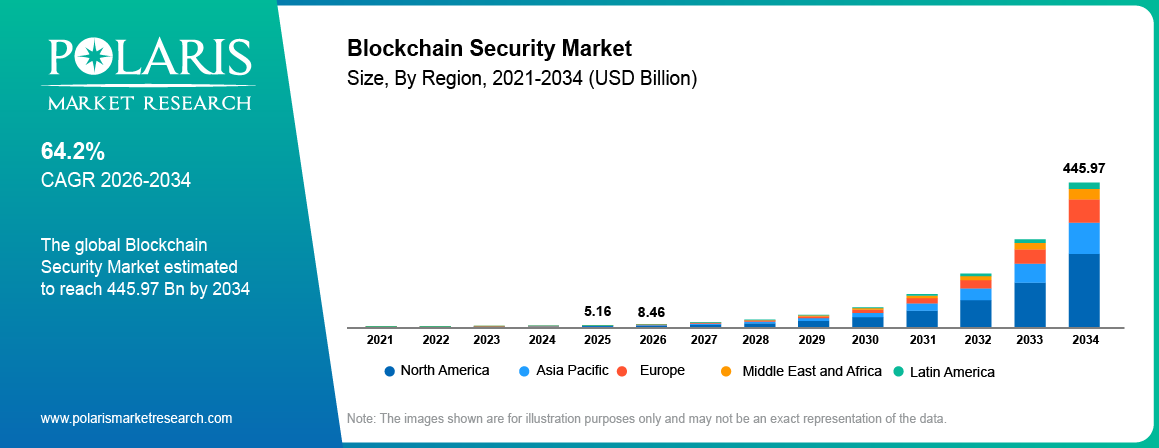
The blockchain security market size was valued at USD 5.16 billion in 2025. The market is projected to grow from USD 8.46 billion in 2026 to USD 445.97 billion by 2034, exhibiting a CAGR of 64.2% during 2026–2034.
Market Statistics
Blockchain Security Market Key Takeaways
- North America held the largest share of 30% in 2025. The regional market is driven by early adoption of blockchain and high demand for cybersecurity.
- Asia Pacific is expected to register a CAGR of 80% during 2026-2034. The growth is driven by growing digitalization and proliferating use of blockchain.
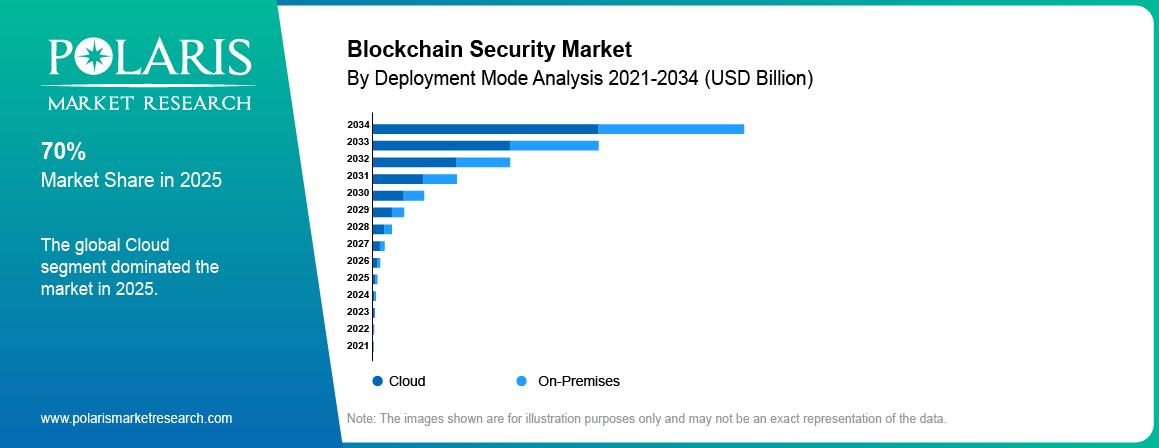
- The cloud segment held a share of 70% in 2025. Growing adoption due to its flexibility and reduced infrastructure costs.
- On-premises segment is expected to register a CAGR of 60.50% over the forecast period 2026-2034. Increasing Demand from industries with strict security and compliance requirements.
- The BFSI segment dominated the market with a 90% share in 2025. The demand for secure financial transactions contributed to the segment’s leading position.
- The media, advertising, and entertainment segment is expected to record a CAGR of 66.80% during 2026–2034. The adoption of blockchain for content protection is driving its growth.
Note: Figures and projections outlined in this report are the result of Polaris Market Research’s proprietary analytical processes, grounded in the latest available datasets and market observations.
What Is Blockchain Security?
The blockchain security market is expanding due to the adoption of blockchain technology by businesses and governments. The blockchain technology is being increasingly used in finance, healthcare, supply chain, retail, and government. This creates a need for solutions to secure blockchain networks, transactions and data against cyber attacks, fraud and unauthorized access.
Blockchain offers decentralized and tamper-resistant records. However, security risks and system vulnerabilities are still a concern. Hence, organizations are investing in advanced security solutions. Industry norms, partnerships and new technologies are also driving the market growth.
Chainalysis reported in June 2026 that at least USD 36.7 million was stolen from protocols with unverified intelligent contracts over the last six months. The report also pointed out the growing use of AI to discover vulnerabilities. Such developments are increasing the need for smart contract audits, real-time monitoring and advanced blockchain security solutions (Source: chainalysis.co).
How Does Blockchain Security Work?
To protect blockchain networks, transactions, data, and digital assets blockchain security uses different methods. The process supports prevent unauthorized access, fraud, and other security problems. It includes user verification, data protection, transaction checks, smart contract testing, and regular system monitoring.
User verification and access control is the first step of process. With this only authorized users can access the blockchain system. Encryption prevents the information from being accessed or changed without permission. Consensus mechanisms check transactions before they are added to the blockchain.
To find errors or weak points smart contracts are tested and audited. Monitoring tools are important to check the network for unusual activity. The security team investigates if any threat is found. These teams have authority to take actions on these threats. Regular security checks and system updates also go a long way in keeping blockchain networks safe.
Source: Polaris Market Research Analysis
Blockchain Security Solutions & Services
Blockchain security solutions assist in protecting blockchain networks, data, transactions and digital property. They help companies to minimize security risks and avoid attacks. The major fields are key management, smart contract security, security testing, identity management and other security services.
Key Management
Key management protects private and cryptographic keys. These keys are used to access blockchain accounts and digital resources. Proper key management helps to avoid key theft and unauthorized transactions.
Smart Contract Security
Smart contract security is used to find the issues in smart contract code. Through audits and testing, errors and security vulnerabilities can be identified. This supports in avoiding the attacks and securing blockchain applications.
Penetration Testing & Security Audits
Penetration testing allows to find weak points in the blockchain network and applications. Security experts test the system for possible vulnerabilities. Security audits help businesses to upgrade their security and meet compliance needs.
Identity & Access Management
User access to blockchain systems is controlled by identity and access management. To manage their permissions it verifies user for safety purposes. This helps stop unauthorized users from accessing important systems.
Security Services: Integration, Consulting & Incident Response
To manage blockchain security of organizations these services are important. Consulting helps with security planning and system design. Integration is about connecting your security tools to your existing systems. Incident response is about helping organizations respond to security incidents and limiting their impact.
Blockchain Security Solution Comparison
| Solution | What It Does | How It Helps | Common Uses |
| Key Management | Keeps private keys safe | Prevents key theft and unauthorized transactions | Digital assets, exchanges, banks |
| Smart Contract Security | Checks smart contracts for problems | Helps prevent attacks and code-related risks | DeFi, Web3, tokenization |
| Penetration Testing | Finds weak points in systems | Helps identify security problems before attackers do | Blockchain platforms, wallets, exchanges |
| Identity & Access Management | Controls who can access the system | Prevents unauthorized access | Enterprise blockchain, healthcare, government |
| Security Audits | Checks the overall security of a system | Helps find risks and improve security controls | Financial services, enterprises, digital assets |
Source: Polaris Market Research Analysis
Blockchain Security Threat Landscape
Blockchain networks are vulnerable to a range of security threats. These threats can be targeted against transactions, digital property, smart contracts or users. Typical threats include coding errors, stolen private keys, network assaults, phishing, fraud and attacks on connected blockchain networks.
Smart Contract Vulnerabilities
Standard contracts can have bugs or security vulnerabilities. These flaws can be exploited by hackers to steal money or crash the application. Regular security testing and scans can help to uncover these issues.
Private Key Theft and Wallet Compromise
To access blockchain accounts and digital resources private keys are the main element. If a key is stolen, attackers can take over the assets. Poor wallet security can also increase this risk.
51% and Sybil Attacks
A 51% attack is when in a blockchain network an attacker acquires more than half of the computational or validation power. A Sybil attack is an attack in which an attacker creates many fake identities on a network. Such attacks are capable of compromising integrity of a network and security of transactions.
Phishing, Fraud and Social Engineering
Attackers may trick users into sharing passwords, private keys, or other sensitive information. Phishing messages and fake websites are common methods. These attacks can lead to stolen assets and unauthorized transactions.
Bridge, Cross-chain, and Interoperability Risks
The systems that connecting different networks together, enabling the exchange of assets or data between them is referred as blockchain bridges. Attacker can exploit weaknesses in these systems. Poor security across connected networks can also increase the risk of asset theft or data loss.
Common Applications of Blockchain Security
| Application | Purpose |
| Cryptocurrency transaction protection | Secures cryptocurrency transfers from fraud and cyberattacks |
| Digital wallet security | Protects digital wallets and private keys |
| Smart contract auditing | Identifies and fixes vulnerabilities in smart contracts |
| Secure financial transactions | Ensures safe and transparent digital payments |
| Supply chain data protection | Secures product and transaction records |
| Healthcare data security | Protects patient records and medical data |
| Identity verification | Confirms user identity and prevents unauthorized access |
| Enterprise blockchain protection | Secures business blockchain networks and applications |
| Decentralized application (dApp) security | Protects decentralized applications from cyber threats |
Source: Polaris Market Research Analysis
Technology Trends in Blockchain Security
As per changing requirements organizations adopt new security tools. With this change blockchain security is also changing. AI and machine learning can help find unusual activity and possible threats. They can also help with fraud detection and network monitoring.
Smart contract code is checked with automated auditing. This helps find errors and security gaps. Zero-trust security is used more often. It checks users and devices before giving access to blockchain systems.
Privacy technologies are used to protect sensitive data when running blockchain networks. Zero-knowledge proofs can prove information without revealing the data itself. Secure enclaves provide a protected environment for sensitive information and cryptographic keys.
Post-quantum security is also being studied. It seeks to protect blockchain systems against possible attacks from future quantum computers. As the use of blockchain keeps growing these technologies can help businesses improve security.
Blockchain Security Market Drivers & Adoption Opportunities
Market Driver- Growing Enterprise Blockchain Adoption
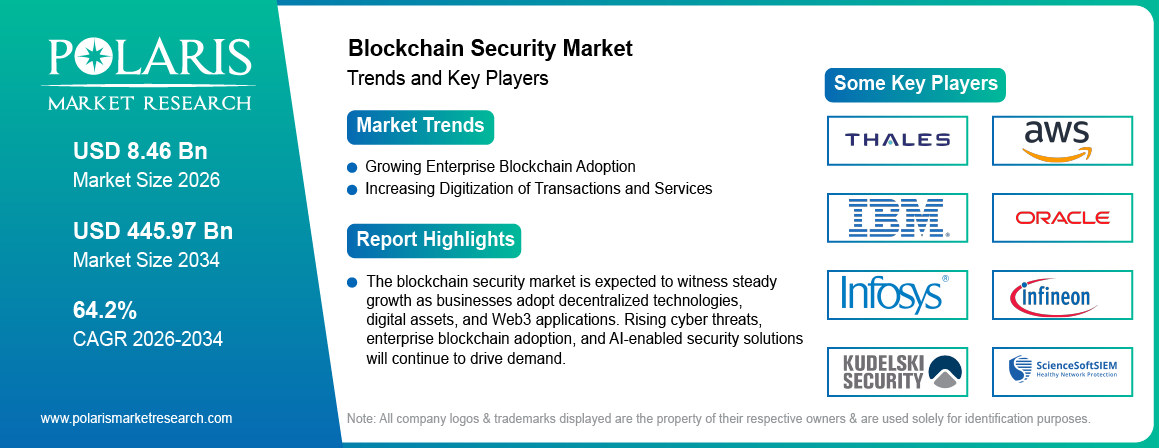
Businesses are using blockchain for payments, records, supply chains, and data sharing. This is increasing the demand for security tools. A 2025 Deloitte survey found 37% of respondents had spoken to their company boards about the use of cryptocurrency. 41% of respondents discussed it with CIOs. The increasing number of companies exploring blockchain and digital currencies also demands better controls for access, transactions and protection of data (Source: deloitte.com).
Market Driver- Increasing Digitization of Transactions and Services
The growth of digital transactions is creating more demand for secure digital systems. India’s digital payments crossed 20 billion in January 2025, amounting to nearly INR 250 trillion. The growing adoption of digital services is also resulting in an increase in the demand for secure transaction systems. Blockchain security can help businesses secure digital records, transactions and user data (Source: pib.gov.in).
Market Opportunity- Digital Asset, Web3 and DeFi Expansion
For blockchain security providers the growth of digital assets and Web3 is creating new opportunities. Deloitte’s 2025 survey found that 23% of North American CFOs expected their treasury departments to use cryptocurrency for investments or payments within two years. Also, 52% expected non-stable cryptocurrency to be used for supply-chain tracking. As these business uses grow, companies will need stronger security for transactions, wallets, and blockchain applications (Source: deloitte.com).
Market Opportunity- Rising Demand for Compliance and Security Assurance
For compliance and security services growing use of digital assets is creating demand. The European Securities and Markets Authority maintains a register of crypto-asset service providers under the EU's MiCA framework. This shows increasing interest in regulated crypto activities. The more companies that operate under these rules, the more potential need for security audits, transaction monitoring, risk assessment, compliance assistance (Source: esma.europa.eu).
Market Restraint- High Implementation Costs and Skills Shortages
For smaller businesses the cost of setting up blockchain security systems can be high. Organizations may need new security tools, trained staff and frequent system updates. The shortage of professionals with both blockchain and cybersecurity skills can also delay implementation. These factors can slow adoption, particularly for businesses with tight technology budgets and internal security teams.
Cloud vs. On-Premise Blockchain Security
| Factor | Cloud-Based | On-Premise |
| Deployment | Security tools are hosted on the cloud. | Security tools are installed on the company’s own systems. |
| Scalability | Easy to increase resources when needed. | Depends on the company’s existing infrastructure. |
| Upfront Cost | Lower need for hardware and infrastructure. | Higher cost for hardware and setup. |
| Control | Some control is shared with the cloud provider. | The company has more direct control over its systems. |
| Best Fit | Suitable for businesses that need quick setup and flexible resources. | Suitable for businesses that need more control over sensitive systems. |
| Key Consideration | Data location, provider security, and system integration. | Maintenance, staff, upgrades, and infrastructure costs. |
Source: Polaris Market Research Analysis
Source: Polaris Market Research Analysis
Market Segment Analysis
Blockchain Security Market Assessment by Deployment Outlook
The blockchain security market, based on deployment, is bifurcated into cloud and on-premises. In 2025, the cloud segment dominated the market with 61.70%. The share is due to its flexibility, scalability, and cost-effectiveness compared to on-premises solutions. Cloud-based options enable businesses to manage blockchain security without extensive physical infrastructure, making it accessible to organizations of all sizes. The cloud model supports enhanced collaboration and secure data sharing across multiple locations and stakeholders. As more enterprises embrace digital transformation, the adoption of cloud-based blockchain security solutions is expected to grow in the coming years.
The blockchain security market for the on-premises segment is expected to record a significant CAGR of 60.50% during the forecast period, owing to its rising use in industries requiring stringent control over data privacy and compliance, such as banking, healthcare, and government. These industries prefer on-premises deployments for better customization, security, and regulatory alignment. Despite higher initial costs and maintenance demands, on-premises solutions offer enterprises full control over their infrastructure. They are preferred for sensitive data management, making them a crucial segment in the blockchain security market.
Blockchain Security Market Evaluation by Vertical Outlook
The blockchain security market segmentation, based on vertical, includes transportation and logistics; agriculture and food; manufacturing; energy and utilities; healthcare and life sciences; media, advertising, and entertainment; banking financial services and insurance; IT and telecom; retail and e-commerce; government: and others. In 2025, the banking, financial services, and insurance (BFSI) segment dominated the market with 31.90%. The share is because of its need for secure, transparent, and efficient transaction management. Financial institutions require robust security to protect sensitive data, comply with regulations, and combat cyber threats such as fraud. Blockchain's decentralized nature ensures secure transactions and streamlined processes. As digital technologies, such as cryptocurrencies and smart contracts, become more widespread, demand for blockchain security solutions rises in the BFSI sector. The adoption of blockchain is further driven by the need to improve operational efficiency, reduce costs, and enhance customer trust, making BFSI the leading market vertical.
The media, advertising, and entertainment segment is expected to witness substantial growth of 66.80% during the forecast period, driven by the rising adoption of blockchain platforms such as Ethereum. These platforms offer benefits such as eliminating intermediaries, reducing IP violations, and enabling direct monetization through peer-to-peer micropayments and smart contracts. Blockchain also facilitates efficient micropayment systems and provides detailed records of media usage, enhancing transparency and revenue collection in the sector.
By Services
In 2025 the Development and Integration segment hold the largest share of 27.80%. This is backed by the growing need to build and connect secure blockchain systems. Support and Maintenance is expected to record of 21.90% share in the forecast period. As businesses need regular updates, system checks, and ongoing security support this segment will show significant share. Competitor research also points to strong growth in blockchain security services, with consulting, integration, and support becoming important as more businesses move blockchain projects into regular use.
By Organization Size
The large enterprises segment hold the largest share of 58.40% in 2025. Large businesses often have larger blockchain deployments and higher security needs. The SME segment is expected to register the fastest growth with 68.70% in the forecast period. Growing use of cloud-based security solutions and affordable security services is making blockchain security more accessible to smaller businesses.
Source: Polaris Market Research Analysis
Blockchain Security Market Regional Outlook
North America
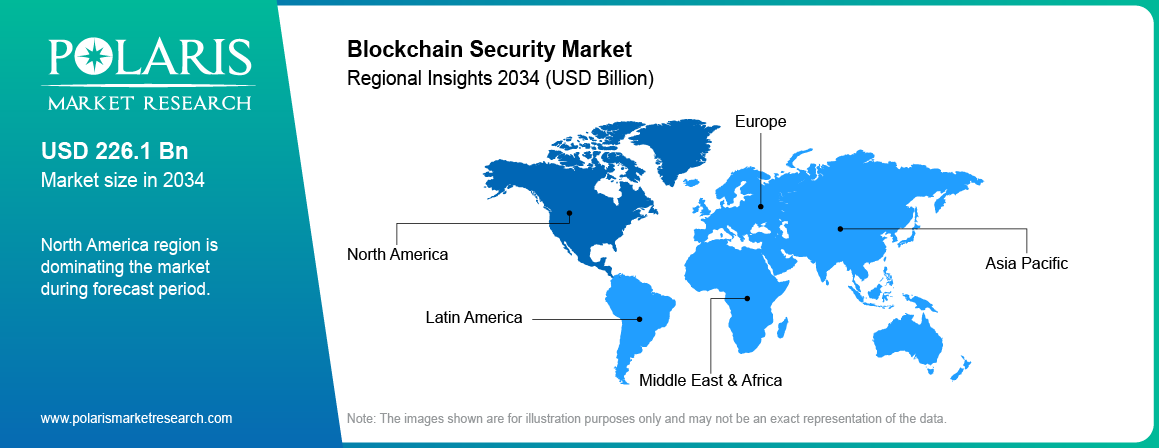
By region, the study provides market insights into North America, Europe, Asia Pacific, Latin America, and the Middle East & Africa. In 2025, North America dominated the blockchain security market of 42.30% due to its early adoption of blockchain technology across multiple industries such as finance, healthcare, and retail. The region benefits from the presence of leading technology companies and a well-established regulatory environment that boosts blockchain innovation and development. Furthermore, as cyber threats continue to increase in sophistication, there is a growing requirement for robust blockchain security solutions to protect sensitive data and transactions. North America's advanced technological infrastructure, coupled with a rising focus on cybersecurity, positions it as the dominant region in the blockchain security market.
Asia Pacific
The Asia Pacific (APAC) blockchain security market is expected to register the highest CAGR of 69.80% during the forecast period due to factors such as rapid digital transformation, increasing demand for secure transaction systems, growing focus on cybersecurity, and the region’s large tech and innovation hubs driving more blockchain applications.
In May 2026, the Asian Development Bank outlined a number of blockchain projects being developed across the Asia Pacific. These included trade finance projects in Thailand and Vietnam. Other projects included land leasing in Fiji and carbon trading in China. All these projects are indicative of the growing use of blockchain across the region (Source: adb.org).
Europe
As businesses adopt digital assets and blockchain-based services Europe is focusing more on blockchain security. New regulations are also increasing the need for stronger security and compliance measures. The region is seeing increasing use of blockchain in financial services while privacy and data protection continue to be major concerns. To protect transactions, user data and blockchain networks demand is increasing for security tools.
Latin America
Blockchain adoption is increasing in fintech and digital services in Latin America. Financial institutions and businesses are using blockchain for digital payments, financial services, and secure data sharing. The increasing adoption is driving the demand for security solutions to safeguard blockchain networks, transactions and digital property.
Middle East & Africa
In financial services and digital government the Middle East and Africa are seeing more use of blockchain. The need for security solutions to protect blockchain networks, transactions and digital data is being driven by countries exploring blockchain for digital payments, identity and public services.
Source: Polaris Market Research Analysis
Blockchain Security vs Traditional Cybersecurity
| Feature | Blockchain Security | Traditional Cybersecurity |
| Data Storage | Decentralized ledger | Centralized systems |
| Data Modification | Highly restricted | More vulnerable to changes |
| Transparency | High | Limited |
| Authentication | Cryptographic methods | Password-based systems |
| Application | Digital assets, Web3, and blockchain networks | General IT systems |
Source: Polaris Market Research Analysis
Key Players and Competitive Analysis Report
The competitive landscape in the blockchain security market is marked by global and regional players aiming to capture market share through innovation, strategic collaborations, and regional expansion. Leading companies in the market focus on enhancing security protocols, ensuring data privacy, and improving scalability to meet the growing demand for secure digital transactions across industries such as finance, healthcare, and government. These companies leverage their strong research and development capabilities, along with global distribution networks, to offer advanced blockchain security solutions.
Smaller regional companies are emerging, offering specialized solutions tailored to local regulatory environments or specific industry requirements. Common competitive strategies in the blockchain security market are mergers and acquisitions, collaborations with industrial partners, and investments in emerging markets, all aimed at strengthening market presence and expanding product offerings. A few major players are IBM; Amazon Web Services, Inc. (AWS); Oracle; Infosys Limited; Infineon Technologies; Kudelski Security; ScienceSoft; Kaspersky Lab; Chainalysis; Consensys; Bitfury Group Limited; Fortanix; Hacken; Arridae Infosec; OVHcloud; and CryptoSec.
Platonic Inc. is a blockchain infrastructure company that focuses on tokenization within financial markets to empower global financial institutions by providing a platform that uses blockchain and smart contracts to increase operational efficiency, reduce risks, and replace outdated processes. In May 2025, Platonic announced a research collaboration with MIT’s Geospatial Data Center to explore generative AI for financial market infrastructure. The work includes AI-driven smart contract creation and asset servicing. The initiative underscores how AI and blockchain can be used to improve automation and security in financial markets. The Platonic approach seeks to improve capital markets by providing a transparent, secure, and decentralized method for asset tokenization (Source: platonic.io).
Kudelski Security, based in the US, is a provider of cybersecurity solutions to help enterprises and clients build, deploy, and manage effective security programs aligned to their business objectives. In January 2019, the company launched the Blockchain Security Center (BSC) to bring its cryptographic expertise to the blockchain development community. The aim was to integrate security into blockchain solutions across enterprises and public/private sectors. As blockchain applications grow, the technology is predicted to generate USD 3.1 trillion in business value by 2030, highlighting its potential for revolutionizing industries.
Key Companies:
- IBM Corporation
- Amazon Web Services, Inc. (AWS)
- Oracle Corporation
- Thales
- Infosys Limited
- Infineon Technologies
- Kudelski Security
- ScienceSoft
- Kaspersky
- Aujas Cybersecurity
- Chainalysis
- CertiK
- ConsenSys
- Bitfury Group Limited
- LeewayHertz
- Fortanix
- Utimaco
- Hacken
- Bit Sentinel
- Astra IT, Inc.
- Kaleido, Inc.
- Microminder Cybersecurity
- Arridae Infosec
- OVHcloud
- CryptoSec
Industry Developments
- July 2026 – CertiK reported more than USD 1.31 billion in Web3 security losses in its H1 2026 Hack3D report. The report covered 344 incidents and identified wallet compromise as a major source of losses. (Source: certik.com)
- February 2026: Guardrail launched a blockchain security solution for stablecoin ecosystems. The platform provides real-time threat detection, automated response, and smart contract protection across blockchain networks. (Source: guardrail.a)
- January 2026: Fireblocks expanded its partnership with Thales to strengthen digital asset security. The integration of Fireblocks' platform with Thales' Luna HSMs helps financial institutions improve blockchain security and regulatory compliance. (Source: prnewswire.com)
- May 2025: Rayls launched Enygma, a privacy framework for Ethereum and EVM-compatible blockchains. The solution improves data privacy and strengthens the security of blockchain transactions. It is designed to help financial institutions securely manage sensitive data while supporting blockchain-based operations. (Source: rayls.com)
Future of the Blockchain Security Market
The blockchain security market is expected to witness steady growth as businesses adopt decentralized technologies, digital assets, and Web3 applications. Rising cyber threats, enterprise blockchain adoption, and AI-enabled security solutions will continue to drive demand. Advances in smart contract security, digital identity management, and real-time blockchain monitoring are expected to strengthen protection and support the future growth of the market.
Market Segmentation
By Solution Outlook (Revenue, USD Billion, 2021–2034)
- Key Management
- Smart Contract Security
- Penetration Testing
- Identity and Access Management
- Audits
By Services Outlook (Revenue, USD Billion, 2021–2034)
- Development and Integration
- Support and Maintenance
- Technology Advisory and Consulting
- Incident and Response Services
By Deployment Mode Outlook (Revenue, USD Billion, 2021–2034)
- Cloud
- On-Premises
By Organization Size Outlook (Revenue, USD Billion, 2021–2034)
- SMEs
- Large Enterprises
By Vertical Outlook (Revenue, USD Billion, 2021–2034)
- Transportation and Logistics
- Agriculture and Food
- Manufacturing
- Energy and Utilities
- Healthcare and Life Sciences
- Media, Advertising, and Entertainment
- Banking Financial Services and Insurance
- IT and Telecom
- Retail and eCommerce
- Government
- Others
By Region Outlook (Revenue, USD Billion, 2021–2034)
- North America
- US
- Canada
- Europe
- Germany
- France
- UK
- Italy
- Spain
- Netherlands
- Russia
- Rest of Europe
- Asia Pacific
- China
- Japan
- India
- Malaysia
- South Korea
- Indonesia
- Australia
- Vietnam
- Rest of Asia Pacific
- Middle East & Africa
- Saudi Arabia
- UAE
- Israel
- South Africa
- Rest of Middle East & Africa
- Latin America
- Mexico
- Brazil
- Argentina
- Rest of Latin America
Report Scope
| Report Attributes | Details |
| Market Size Value in 2025 | USD 5.16 billion |
| Market Size Value in 2026 | USD 8.46 billion |
| Revenue Forecast by 2034 | USD 445.97 billion |
| CAGR | 64.2% from 2026 to 2034 |
| Base Year | 2025 |
| Historical Data | 2021–2024 |
| Forecast Period | 2026–2034 |
| Quantitative Units | Revenue in USD billion and CAGR from 2026 to 2034 |
| Report Coverage | Revenue Forecast, Market Competitive Landscape, Growth Factors, and Trends |
| Segments Covered |
|
| Regional Scope |
|
| Competitive Landscape |
|
| Report Format |
|
| Customization | Report customization as per your requirements with respect to countries, regions, and segmentation. |
Source: Polaris Market Research Analysis
Blockchain Security Market FAQ's
The global blockchain security market size was valued at USD 5.16 billion in 2025 and is projected to grow to USD 445.97 billion by 2034.
The global market is projected to record a CAGR of 64.2% during the forecast period.
North America dominated the Blockchain Security Market with a 42.30% share in 2025, driven by the early adoption of blockchain technology across finance, healthcare, and retail.
Blockchain security protects blockchain networks, digital assets, and transactions from cyber threats. It uses technologies and practices to keep data secure and reliable.
A few key players in the market are IBM; Amazon Web Services, Inc. (AWS); Oracle; Infosys Limited; Infineon Technologies; Kudelski Security; ScienceSoft; Kaspersky Lab; Chainalysis; Consensys; Bitfury Group Limited; Fortanix; Hacken; Arridae Infosec; OVHcloud; and CryptoSec.
The cloud segment accounted for the largest market share of 61.70% in 2025 due to its flexibility, scalability, and cost-effectiveness compared to on-premise solutions.
The banking, financial services, and insurance (BFSI) segment dominated the market in 2024 due to its need for secure, transparent, and efficient transaction management
Blockchain security helps prevent fraud, hacking, and unauthorized access. It keeps digital transactions safe and builds trust among users.
Blockchain security uses encryption, identity verification, and consensus mechanisms to protect data. It also monitors networks and secures smart contracts from attacks.
Blockchain security solutions include encryption tools, identity management, smart contract audits, and threat monitoring systems. They help protect blockchain networks and digital assets.
Download Sample Report of Blockchain Security Market
Please fill out the form to request a customized copy of the research report.


