
Bulb Market Size, Share Global Analysis Report, 2025-2034
REPORT DETAILS
Bulb Market Summary
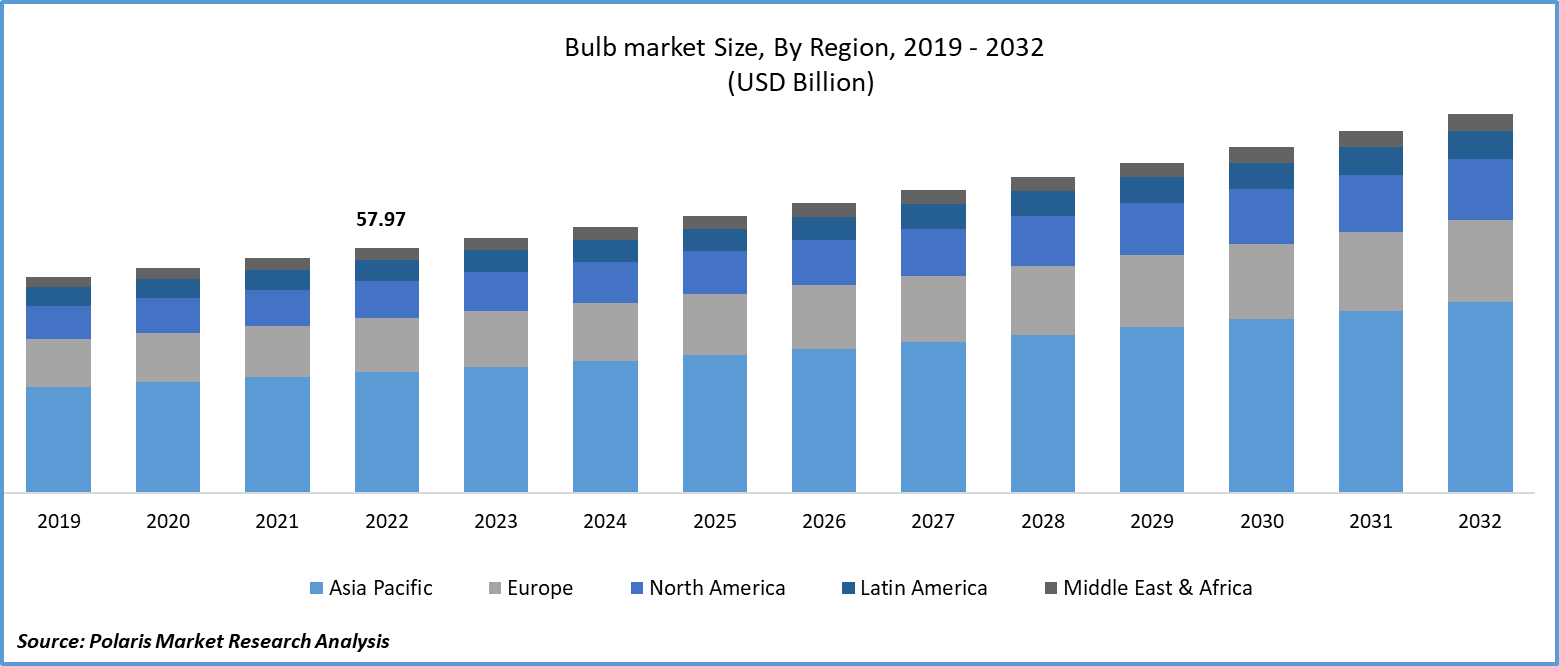
The global bulb market was valued at USD 59.07 billion in 2024 and is expected to grow at a CAGR of 4.4% during the forecast period.
Market Statistics
Key Takeaways
- The automobile headlights segment dominated in 2024 as rising number of road accidents at night is fueling the need for headlights.
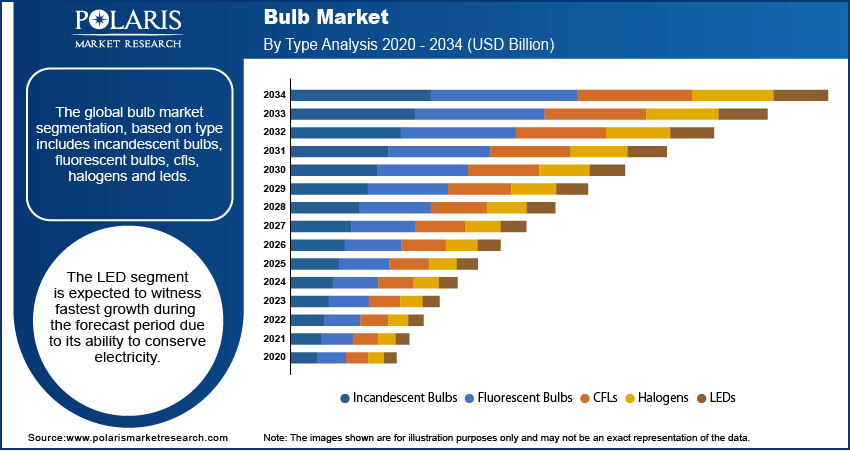
- The LED segment is expected to witness fastest growth during the forecast period due to its ability to conserve electricity.
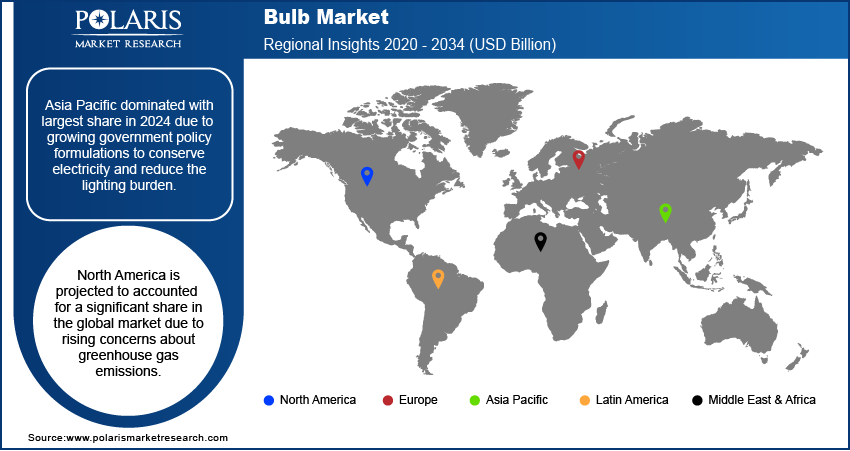
- Asia Pacific dominated with largest share in 2024 due to growing government policy formulations to conserve electricity and reduce the lighting burden.
- North America is projected to account for a significant share in the global market due to rising concerns about greenhouse gas emissions.
Industry Dynamics
- The rising product innovations by major players is fueling the growth.
- The widespread use of wireless technology is driving the growth.
- The technological advancement is boosting the growth.
- High initial cost and consumer hesitation during the transition from traditional incandescent bulbs to energy-efficient LED alternatives restrains the bulb market.
To Understand More About this Research: Download Sample Report
Bulbs have become an integral part of daily life since their invention. It is used in automobile headlights like cars, bikes, and more to increase safety while driving at night for pedestrians and other vehicle drivers. The growing recreational activities are driving the demand for effective lighting, which assists in creating a pleasant mood for humans. The prevalence of bulb adoption in households and commercials to lighten dark places is boosting the expansion of the bulb in the coming years. Furthermore, the growing product launches in the global space are enhancing product availability for a wider audience. Bulbs, sometimes referred to as lamps in the industry, are an electrical light designed for illumination. Invented over a century ago, the early bulbs were expensive to manufacture, had shorter lifespans, and consumed large amounts of energy. But, with technological advances and the commercialization of bulbs, both the efficacy and efficiency of bulbs improved. Today, electric bulbs come in different sizes and provide varied light output. Besides, they commonly operate with a voltage range of 1.5 volts to 300 volts. The most basic form of the bulb consists of three main parts. These are the filament, the glass bulb, and the base of the light bulb. The filament, which is commonly made up of tungsten, is covered in a globe-shape glass mount and is attached to the lead wires connected to the bulb’s base. The tungsten filament illuminates and glows when electric power is passed through it. To cater to the diverse consumer needs, there are several different types of bulbs available in the bulb market, including incandescent lamps, fluorescent lamps, CFLs, Halogens, and LEDs. For instance, in January 2023, GE Lighting introduced new Dynamic Effects Neon-Shape Smart Lights at the CES 2023. They are suitable for bedroom, entertainment, and gaming purposes.
The rising incorporation of smart homes is further boosting the demand for smart bulbs, which can be operated by mobile, facilitating households to switch off or on their lights even out of their rooms, driving convenience when they forget to switch off lights and switch on lights at night before entering the room, making it highly feasible for people with the fear of darkness.
For Specific Research Requirements: Request for Customized Report
Growth Drivers
What Factors are Driving the Industry Growth?
The growing innovations in the marketplace are propelling bulb utilization in various disciplines. The rising global power outage problem is driving the need for efficient bulbs without electricity. To tackle this issue, companies are working on innovating chargeable bulbs for consumers. For instance, Halonix launched the Halonix Prime 12W B22 LED Bulb with a built-in Li+ battery, which charges the bulb efficiently in a few hours. It can work for 4 hours after a power cut. As scientists and companies step forward with the latest technologies to meet ongoing consumer needs, the adoption of bulbs throughout the study period will further increase. In addition, the widespread use of wireless technology is creating new growth potential for the bulb market, as wireless lighting technology is capturing a large consumer base owing to its ability to connect without cable connectivity. Moreover, organic light-emitting diode (OLED) technology is gaining popularity due to its ability to offer flexibility and provide aesthetically pleasing lighting on surfaces. As the new evolution of technology takes place, there will be a rapid shift in consumer electronics, which may create new growth potential for the bulb market soon.
Report Segmentation
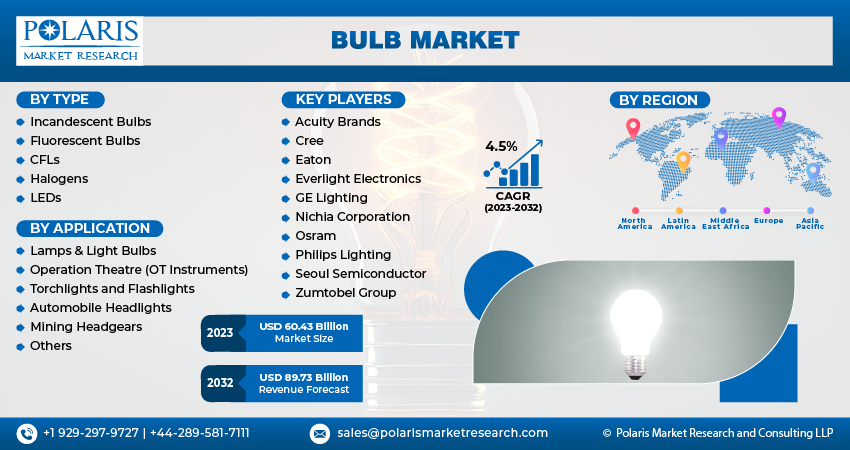
The market is primarily segmented based on type, application, and region.
By Type | By Application | By Region |
|
|
|
Source: Polaris Market Research Analysis
To Understand the Scope of this Report: Request Customization
Which Segment by Type is Expected to Witness the Highest Growth During the Forecast Period?
The LED segment is projected to grow at the highest CAGR during the projected period due to its ability to conserve electricity. These are known to be energy-efficient compared to incandescent, fluorescent, CFL, and halogen bulbs, driving energy-conscious consumers to shift from traditional bulbs. Furthermore, the lower production of heat and environmental sustainability of these bulbs gained traction among a larger consumer base. These bulbs are known to have a longer life, which is up to 50,000 hours, resulting in lower maintenance costs for the users. These factors are contributing to the growth of the bulb market in the coming years.
Why Automobile Headlights Segment Dominated in 2024?
The automobile headlights segment accounted for the largest share. The rising number of road accidents at night is fueling the need for headlights. They play a crucial role in illuminating the roadway and facilitating safe driving. Furthermore, governments are initiating policies to tackle growing accidents in their countries. They are mandating the use of helmets while driving bikes. In the future, there will be a chance of keeping headlights mandatory to save citizens from accidents at night, driving demand for headlights.
Regional Insights
How Asia Pacific Captured Largest Share?
The Asia Pacific region dominated with largest share in 2024. This growth is highly attributable to the growing government policy formulations to conserve electricity and reduce the lighting burden on the population in the region, primarily in China and India. The Government of India initiated the Unnat Jyoti by Affordable LEDs for All program (UJALA) in 2015 with the aim of transforming all household lights into LEDs. This scheme became the largest lighting policy in all of the world. According to Energy Efficiency Services Limited (EESL), by June 2023, the UJALA scheme would have distributed around 368 million LED bulbs and tube lights, avoiding 38 million metric tonnes of carbon dioxide per year and saving INR 192 billion in electricity costs. Furthermore, around 2.4 billion LED units will be sold in India by March 2022, which is seven times higher than the UJALA distribution of lights. This will further create new growth opportunities for the bulb market in the coming years.
What are the Reason for North America's Fastest Growth?
The North American region is expected to be the fastest-growing region with a healthy CAGR during the projected period, owing to rising concerns about greenhouse gas emissions. According to a report, the nationwide reduction of power consumption by 15% for one year in America with efficiency measures can save six lives a day and help to avoid up to $20 billion due to health problems. This demonstrates the need for energy-efficient appliances like bulbs in the region. As the government starts taking measures against higher power consumption in the region, there will be a need for efficient bulbs in the coming years.
Key Market Players & Competitive Insights
The bulb market is witnessing higher competition in the marketplace, driven by the growing number of companies in the manufacturing of bulbs and the rising research and development activities for new product innovations in bulbs. The rising partnerships, collaborations, mergers, and acquisitions among the key market players are expanding the global bulb market.
Some of the major players operating in the global market include:
- Acuity Brands
- Cree
- Eaton
- Everlight Electronics
- GE Lighting
- Nichia Corporation
- Osram
- Philips Lighting
- Seoul Semiconductor
- Zumtobel Group
Recent Developments
- January 2023, LEDVANCE introduced the SYLVANIA Everyday LED Light Bulb portfolio to help families save money, time, and energy. They use less energy and have a 3.5-times longer life than traditional bulbs, which often do not require bulb replacement.
Bulb Market Report Scope
| Report Attributes | Details |
| Market size in 2024 | USD 59.07 billion |
| Market size in 2025 | USD 61.62 billion |
| Revenue forecast in 2034 | USD 90.90 billion |
| CAGR | 4.4% from 2025 – 2034 |
| Base year | 2024 |
| Historical data | 2020 – 2023 |
| Forecast period | 2025 – 2034 |
| Quantitative units | Revenue in USD billion and CAGR from 2025 to 2034 |
| Segments covered | By Type, By Application, By Region |
| Regional scope | North America, Europe, Asia Pacific, Latin America, Middle East & Africa |
| Customization | Report customization as per your requirements with respect to countries, region, and segmentation. |
Source: Polaris Market Research Analysis
Bulb Market FAQ's
• The market size was valued at USD 59.07 Billion in 2024 and is projected to grow to USD 90.90 Billion by 2034.
• The market is projected to register a CAGR of 4.4% during the forecast period.
• A few of the key players in the market are Acuity Brands, Cree, Eaton, Everlight Electronics, GE Lighting, Nichia Corporation, Osram, Philips Lighting, Seoul Semiconductor, and Zumtobel Group.
• The automobile headlight segment accounted for the largest market share in 2024.
• The LED is expected to record significant growth.
Key bulb market trends include rising adoption of LED technology for energy efficiency, growing smart home integration enabling mobile-controlled lighting, increasing wireless lighting solutions, and the emergence of OLED technology offering flexible, aesthetically pleasing illumination across residential and commercial applications.
Download Sample Report of Bulb Market
Please fill out the form to request a customized copy of the research report.


