
Cell Culture Market Share, Trends, Growth Analysis Report, 2026 - 2034
REPORT DETAILS
Cell Culture Market Summary
The global cell culture market size was valued at USD 22.69 billion in 2025. It is projected to exhibit a CAGR of 12.0% between 2026 and 2034. The cell culture industry is growing rapidly, driven by the increasing prevalence of chronic diseases, rising research and development efforts for monoclonal antibodies and gene therapies, expanding vaccine production, and ongoing advancements in culture methods and technologies.
Market Statistics
Key Takeaways
- In 2025, the consumables segment accounted for the largest market share. This is due to expanding use in biopharmaceutical companies, research institutions, and contract research organizations.
- The biopharmaceutical production market is also expected to grow over the forecast period due to increasing applications in medical screening and compound synthesis.
- The North America cell culture market dominated the global market in 2025, driven by the rising incidence of chronic diseases and the growing number of aging people.
- The Asia Pacific market is expected to expand at the highest rate. Rising healthcare expenditure, greater awareness of cell and gene therapies, and expanding opportunities for clinical research are contributing to the Asia Pacific cell culture market growth.
From a commercial and research perspective, the global cell culture market is an essential part of supporting biologics production, precision medicine, and advanced therapies. Market growth is driven not only by the increasing number of research activities but also by the industrial application of cell culture systems.
Cell culture is a laboratory technique used to grow and maintain human, animal, or plant cells. Cell culture is applied in drug discovery, diagnostics, vaccine development, toxicology studies, and cell and gene therapy development. Due to the wide range of cell culture applications, it is a fundamental technology in the life sciences and biopharmaceutical industries.
Industry Dynamics
- The cell culture media market is poised for significant growth. It is driven by increasing vaccine production and investments in biologics manufacturing by leading pharmaceutical manufacturers.
- The cell culture industry is expected to continue growing on a large scale as biotech and pharmaceutical firms advance medical research and innovation.
- Advancements in technology are helping to improve scalability, consistency, and contamination control. The advancements include automated cell culture systems, single-use bioreactors, and serum-free media.
- High equipment costs and complex regulations might hinder market growth.
The demand for the cell culture market is increasing significantly due to the increase in R&D activities for the development of monoclonal antibodies. This is because of the increasing number of cases of chronic diseases such as cardiovascular diseases and autoimmune diseases. As per a report by the World Health Organization, published in June 2021, cardiovascular diseases are one of the major causes of death globally. They account for approximately 17.9 million deaths every year. This is 32% of all deaths. The growing number of people suffering from these diseases is fueling the demand for new treatments. This is boosting the adoption of cell culture techniques for the development of treatments.
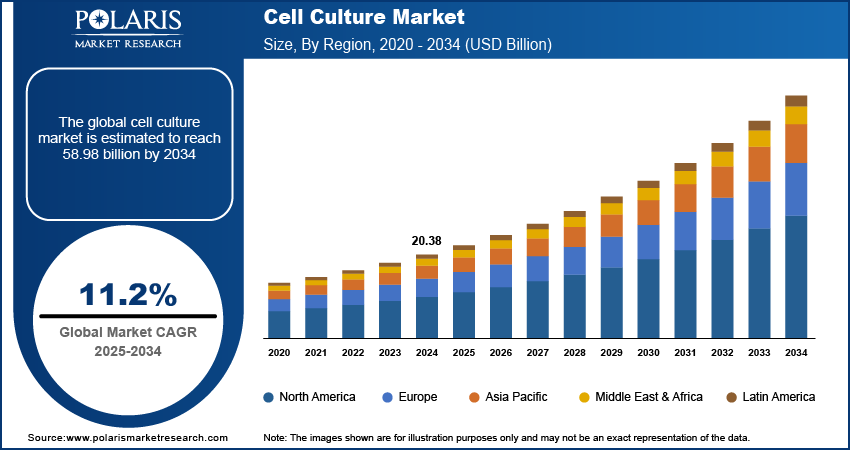
Source: Polaris Market Research Analysis
Major pharmaceutical companies worldwide are expanding their vaccine production facilities, and new companies are also entering the market. This trend of expansion across the major countries is expected to boost the demand for raw materials, such as cultural media. Therefore, the market for cell culture media is expected to grow rapidly over the forecast period due to rising demand for vaccine production. For example, in January 2024, AbbVie announced an investment of USD 223 million to enhance its biologics manufacturing capacity at its Singapore facility. The expansion will boost the facility's biologics drug-substance capacity by 24,000 liters, thus improving AbbVie's ability to support its existing products and new products in its pipeline, including its immunology and oncology therapies.
Market Drivers
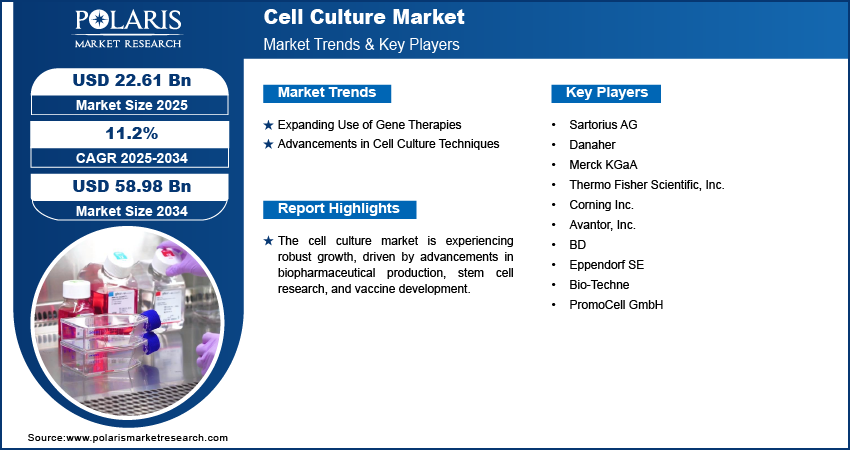
Expanding Use of Gene Therapies
Gene therapy has been employed to treat numerous acquired and inherited neurological disorders and is recognized for its potential to reduce cellular dysfunction. Scientists are actively exploring new applications of gene therapy, which uses viral vectors to deliver genetic material to target cells. Cell culture media, when effective and supplemented with recombinant proteins, reduce the risk of contamination with viral RNA, DNA, and other pathogens.
Thus, the increasing demand for cell culture technologies, driven by advancements in gene therapies and the rising incidence of chronic diseases such as cancer, is expected to drive the growth of the cell culture market. This is further aided by the rising number of collaborations and innovations in the area of CAR-T and CAR-M therapies, which have great potential in revolutionizing the treatment of cancer and other therapeutic areas. As the biotech and pharma industry continues to move ahead in the area of research and development, the cell culture market is expected to witness significant growth.
Advancements in Cell Culture Techniques
The cell culture industry is experiencing continuous development, including the application of nanofibers in cell culture media. These fibers are transparent and enable live cell imaging, monitoring of cell migration in real time, and recreation of the three-dimensional surface topography that is present in living organisms. They can also be modified with extracellular matrix proteins, which is especially important in cancer studies. Companies such as Merck KGaA are offering nanofiber cell culture plates with randomly oriented nanofibers, which have the potential to include epidermal and fibroblast growth factors. In addition, new technologies that allow easier analysis of drug products and cell culture media are driving the growth of the cell culture industry. For instance, in September 2023, Waters Corporation introduced innovative walk-up solutions that aim to improve the efficiency of sample preparation and analysis. The technology enables easier analysis of drug products and cell culture media by integrating the BioAccord LC-MS system with the Andrew + robot. These developments have led to more efficient and effective research processes. They have created a demand for innovative cell culture solutions.
Source: Polaris Market Research Analysis
Segment Analysis
Market Assessment by Product Outlook
Based on product, the global cell culture market is segmented into consumables and instruments. In 2025, the consumables segment held a larger market share. This is due to its rising application in biopharmaceutical companies, academic research, and contract research institutes. The rising cases of infectious and chronic diseases like tuberculosis, malaria, HIV/AIDS, influenza, rabies, and cancer have led to the adoption of personalized medicine, thereby fueling the growth of the market. According to the World Health Organization report published in June 2024, rabies is a fatal viral disease that is transmitted to humans through the bite of infected animals, mainly dogs, resulting in tens of thousands of deaths every year, with more than 95% cases reported in Asia and Africa.
In consumables, the media segment is expected to grow during the forecast period by eliminating contamination between samples and by ensuring accurate cell culture, thereby meeting the high demand in the life sciences, chemistry, and other end-use industries.
The instruments segment is expected to grow rapidly due to increased R&D spending and the growth of the life sciences industry, especially in the biopharmaceutical sector. In addition, the development of the biotechnology industry, along with interest in stem cell research and its applications, helps drive the segment.
Market Evaluation by Application Outlook
The global cell culture market, based on application, is segmented into biopharmaceutical production, diagnostics, drug development, tissue culture & engineering, cell & gene therapy, toxicity testing, and other applications. The biopharmaceutical production segment is also expected to grow during the forecast period due to increased applications in medical screening and compound synthesis. In June 2024, BD (Becton, Dickinson and Company) launched the BD Rhapsody ATAC-Seq Assay, which improves diagnostics, drug discovery, tissue culture, regenerative medicine, and cell and gene therapy by advancing precision medicine through a better understanding of disease mechanisms.
Government support for the development of cell culture vaccines, driven by the increasing incidence of monoclonal disorders and the efficiency of these vaccines in treating this disease, is expected to boost the development of the cell culture market.
The diagnostics segment is expected to have the highest CAGR because of the application of cell culture in metabolomics to detect biomarkers for pathologically significant diseases. Metabolites play a crucial role in cancer diagnosis and recurrence, thereby expanding the application scope of cell culture media products in disease diagnostics.
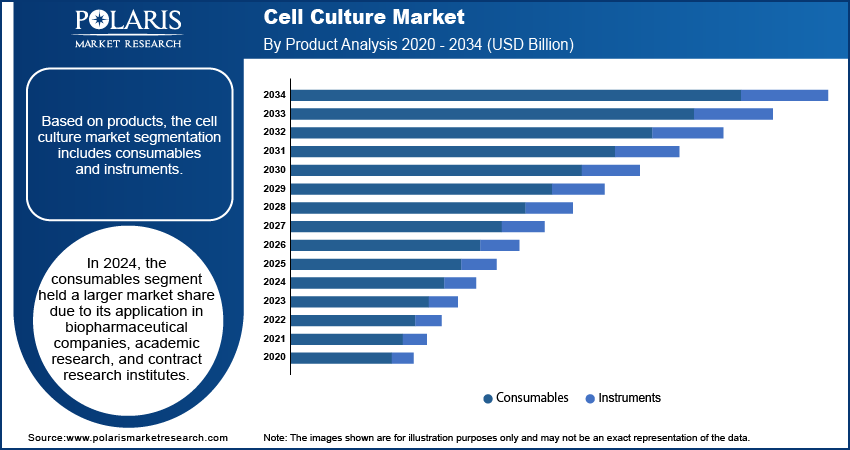
Source: Polaris Market Research Analysis
Regional Insights
By region, the study provides the cell culture market insights into North America, Europe, Asia Pacific, Latin America, and the Middle East & Africa.
North America led the global market in 2025. The regional market dominance is driven by the growing prevalence of chronic diseases in the geriatric population. The US cell culture market is growing due to technological advancements. The US is also witnessing investments in biopharmaceutical centers and government initiatives and policies to develop medical research. For instance, in November 2022, Fujifilm invested USD 188 million to build a new cell culture media manufacturing facility. The company plans to expand its production capacity for liquid cell culture media by 3 times through this project. Fujifilm established this operation to meet increasing demand for biologics while building its capacity to supply essential materials to biotechnology and pharmaceutical companies.
The Asia Pacific cell culture industry is expected to grow at the highest rate during the forecast period, driven by rising healthcare spending, widespread awareness of cell and gene therapies, and substantial potential for clinical research. The market is projected to grow as the region is at the forefront of implementing advanced scientific tools and developing new medical treatments, such as regenerative medicine and cancer immunotherapy. For instance, the new GMP-certified facility of Eminence Biotechnology, located in Suzhou, China, was opened in October 2023. The new facility produces large quantities of dry powder and liquid media annually, supporting regional development in regenerative medicine and cancer immunotherapy.
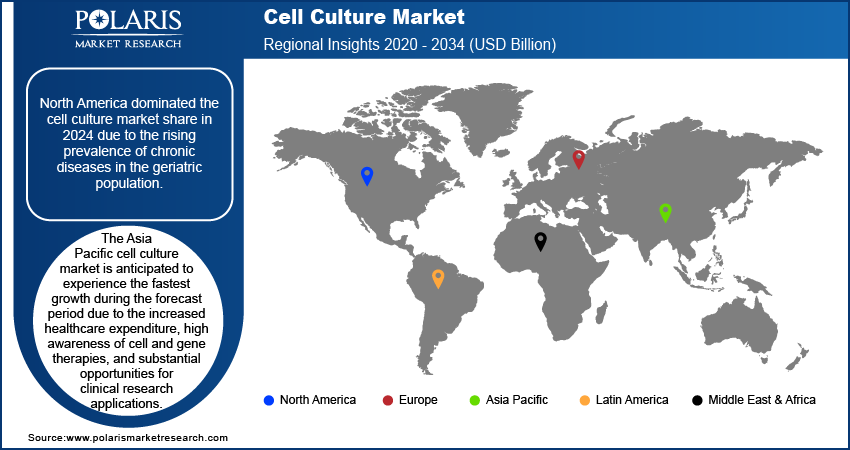
Source: Polaris Market Research Analysis
Key Players and Competitive Analysis
The cell culture market is highly competitive. International market leaders and local players compete to capture market share through partnerships, technological innovation, and expansion into new regions. Thermo Fisher Scientific, Merck KGaA, Lonza, and GE Healthcare use their extensive research and development capabilities, along with their strong distribution networks, to develop new cell culture media, reagents, and equipment. The cell culture market trends indicate that biopharmaceuticals, tissue engineering, and regenerative medicine are driving demand for advanced cell culture solutions.
Companies in regional markets of emerging economies, such as the Asia Pacific, focus on meeting specific local requirements while delivering budget-friendly solutions. The cell culture market is seeing competitive strategies such as mergers and acquisitions, partnerships with academic institutions, and the development of unique products. The cell culture market's development shows that innovation and regional investments, together with market adaptability, drive its growth.
Competitive strategies in the cell culture industry focus on the use of specialized media formulations, automation platforms. These approaches are shaping a market environment that brings forth new business opportunities. A few major cell culture market players include Sartorius AG; Danaher; Merck KGaA; Thermo Fisher Scientific, Inc.; Corning Inc.; Avantor, Inc.; BD; Eppendorf SE; Bio-Techne; and PromoCell GmbH.
Thermo Fisher Scientific Inc. develops diagnostic tools to enhance patient health, support life sciences research, solve difficult analytical challenges, and boost laboratory efficiency. The company operates its business through multiple brands, including Thermo Scientific, Invitrogen, Applied Biosystems, Unity Lab Services, Fisher Scientific, Patheon, and PPD. Its team provides customers with advanced technology solutions, simple purchasing options, and comprehensive pharmaceutical services. Thermo Fisher Scientific introduced its Stellar mass spectrometer and presented updated Orbitrap Ascend Tribrid models at ASMS 2024. The company developed these new products to enhance its capacity for translational omics research and to meet specific pharmaceutical and biopharma research needs.
Danaher Corporation is an American multinational conglomerate founded in 1984. The company is based in Washington, D.C. It develops various medical, industrial, and commercial solutions. The company operates through three main segments: Life Sciences, Diagnostics, and Environmental & Applied Solutions. These segments make use of the Danaher Business System (DBS) to drive operational efficiency and continuous improvement. Danaher Corporation began as an industrial company but became a scientific and technological leader through its focus on acquisitions.
List of Key Companies
- Avantor, Inc.
- BD
- Bio-Techne
- Corning Inc.
- Danaher
- Eppendorf SE
- Merck KGaA
- PromoCell GmbH
- Sartorius AG
- Thermo Fisher Scientific, Inc.
Cell Culture Industry Developments
In May 2025, BD Biosciences introduced the BD FACSDiscover A8 Cell Analyzer. The new system is a next-generation spectral analyzer equipped with real-time imaging. It combines BD CellView Image Technology with BD SpectralFX Technology. The analyzer enables researchers to capture high-resolution images while performing spectral flow cytometry.
In July 2024, Avantor introduced the J.T.Baker Cell Lysis Solution and J.T.Baker Endonuclease to expand its life sciences product line. The new products offer advanced research tools for improved cell analysis and molecular research.
Cell Culture Market Segmentation
By Product Outlook (Revenue – USD Billion, 2021–2034)
- Consumables
- Sera
- Fetal Bovine Serum
- Other
- Reagents
- Albumin
- Others
- Media
- Serum-Free Media
- CHO Media
- HEK 293 Media
- BHK Medium
- Vero Medium
- Other Serum-Free Media
- Serum-Free Media
- Sera
- Classical Media
- Stem Cell Culture Media
- Chemically Defined Media
- Specialty Media
- Other Cell Culture Media
- Instruments
- Culture Systems
- Incubators
- Centrifuges
- Cryostorage Equipment
- Biosafety Equipment
- Pipetting Instruments
By Application Outlook (Revenue – USD Billion, 2021–2034)
- Biopharmaceutical Production
- Monoclonal Antibodies
- Vaccines Production
- Other Therapeutic Proteins
- Drug Development
- Diagnostics
- Tissue Culture & Engineering
- Cell & Gene Therapy
- Toxicity Testing
- Other Applications
By End Use Outlook (Revenue – USD Billion, 2021–2034)
- Pharmaceutical & Biotechnology Companies
- Hospitals & Diagnostic Laboratories
- Research & Academic Institutes
- Others
By Regional Outlook (Revenue, USD Billion, 2021–2034)
- North America
- US
- Canada
- Europe
- Germany
- France
- UK
- Italy
- Spain
- Netherlands
- Russia
- Rest of Europe
- Asia Pacific
- China
- Japan
- India
- Malaysia
- South Korea
- Indonesia
- Australia
- Vietnam
- Rest of Asia Pacific
- Middle East & Africa
- Saudi Arabia
- UAE
- Israel
- South Africa
- Rest of Middle East & Africa
- Latin America
- Mexico
- Brazil
- Argentina
- Rest of Latin America
Cell Culture Market Report Scope
| Report Attributes | Details |
| Market Size in 2025 | USD 22.69 billion |
| Market Size in 2026 | USD 25.40 billion |
| Revenue Forecast by 2034 | USD 63.12 billion |
| CAGR | 12.0% |
| Base Year | 2025 |
| Historical Data | 2021–2024 |
| Forecast Period | 2026–2034 |
| Quantitative Units | Revenue in USD billion, and CAGR from 2026 to 2034 |
| Report Coverage | Revenue Forecast, Market Competitive Landscape, Growth Factors, and Trends |
| Segments Covered |
|
| Regional Scope |
|
| Competitive Landscape | Cell Culture Industry Trend Analysis (2025) Company profiles/industry participants profiling include company overview, financial information, product/service benchmarking, and recent developments |
| Report Format | PDF + Excel |
| Customization | Report customization as per your requirements with respect to countries, regions, and segmentation. |
Source: Polaris Market Research Analysis
Cell Culture Market FAQ's
The global cell culture market size was valued at USD 22.69 billion in 2025 and is projected to grow to USD 63.12 billion by 2034.
The global market is projected to register a CAGR of 12.0% during the forecast period.
North America held the largest market share in 2025.
A few key players in the market are Sartorius AG; Danaher; Merck KGaA; Thermo Fisher Scientific, Inc.; Corning Inc.; Avantor, Inc.; BD; Eppendorf SE; Bio-Techne; and PromoCell GmbH.
The consumables segment held a larger share of the market in 2025.
The diagnostics segment is expected to register the highest CAGR during the forecast period in the market during the forecast period.
Download Sample Report of Cell Culture Market
Please fill out the form to request a customized copy of the research report.


