
Cloud Managed Services Market Share, Size, Trends, Industry Analysis Report, 2026 - 2034
REPORT DETAILS
Cloud Managed Services Market Summary
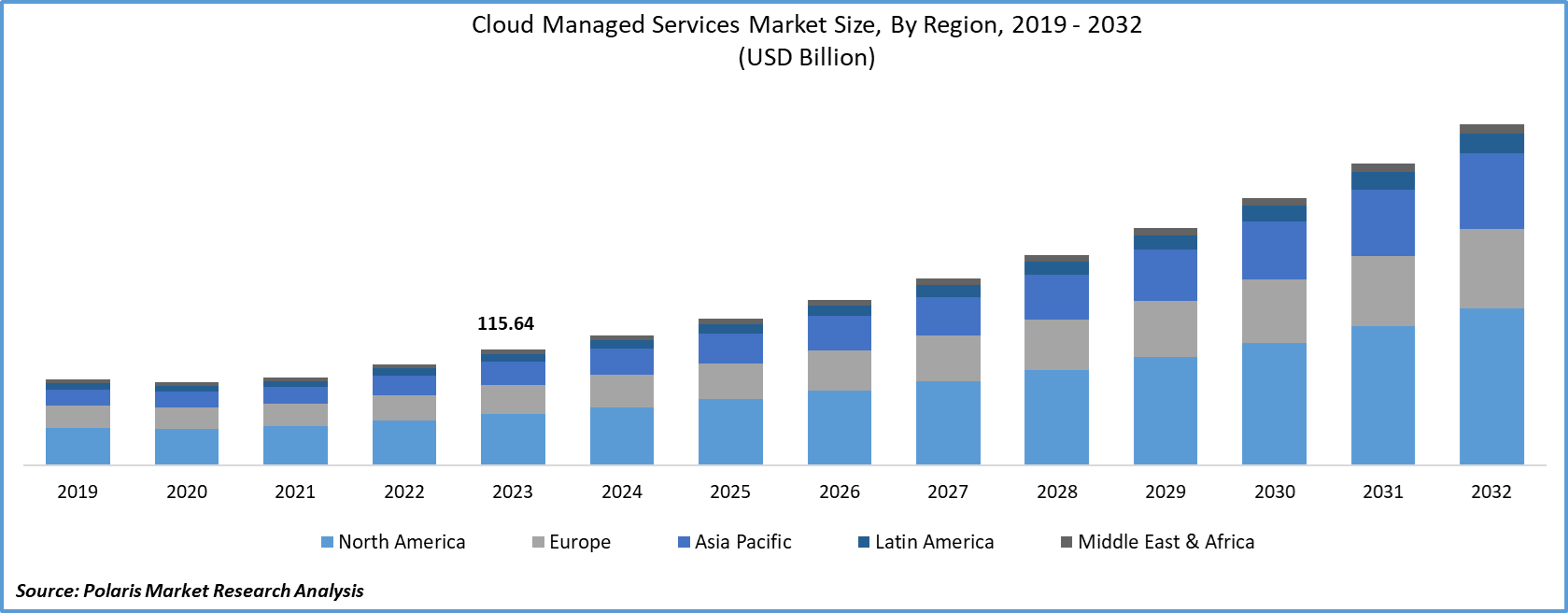
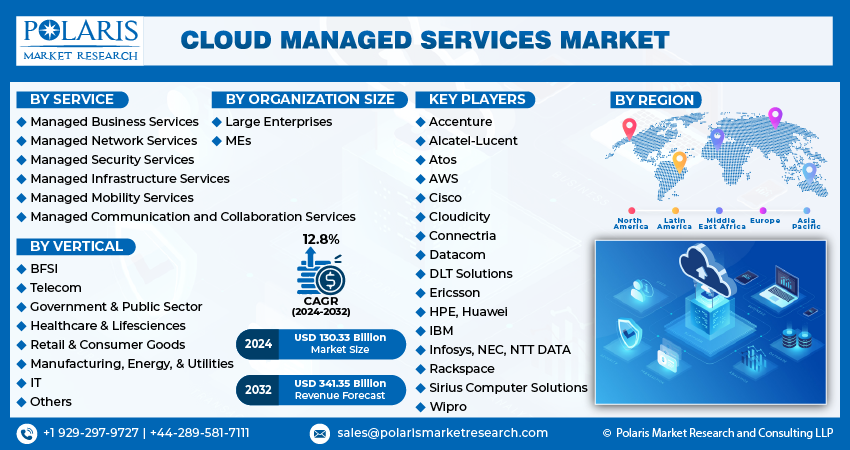
The cloud managed services market size was valued at USD 153.78 billion in 2025. It is projected to register a CAGR of 14.6% from 2026 to 2034. The growing adoption of the cloud and the increasing need for IT cost optimization are driving the market for managed clouds forward. Additionally, the greater need for secure data protection solutions, combined with the need to work from remote locations, is driving companies to outsource managed cloud services.
Market Statistics
Key Takeaways
- In 2025, the large enterprises segment accounted for the largest cloud managed services market share. Large enterprises favor cloud managed services because their IT environments are complex and heavily regulated. They also have the scale and budgets to commit to long-term outsourcing agreements. This helps them manage risk and maintain consistent service levels.
- The managed infrastructure services segment accounted for a significant share in 2025, as these services are essential in core IT operations.
- In 2025, North America emerged as the dominant region in the global market. North America has an established cloud ecosystem. There is large-scale usage of cloud platforms in enterprise environments in North America. The region also has a high adoption of managed security services and has been at the forefront of AIOps-enabled cloud operations.
- Asia Pacific is rapidly emerging as the fastest-growing area. The Asia Pacific cloud managed services market growth is fueled by the region’s accelerating digitalization of industries and small to mid-sized companies’ adoption of cloud solutions.
Beyond cost savings, enterprise organizations are moving toward cloud-managed services to navigate an increasingly complex hybrid and multi-cloud world. Managing diverse cloud platforms requires specialized skills and constant monitoring. It also involves strict compliance management. As a result, organizations are increasingly turning to managed service providers to maintain performance and scale operations smoothly. Managed services also help keep IT systems secure and free up internal staff to better focus on core business priorities.
Industry Dynamics
- The rising emphasis on digital transformation and operational efficiency has created demand for cloud-managed services.
- Increasing incidents of cybersecurity threats, including data breaches and ransomware attacks, are posing challenges for businesses across all sectors. As a result, the growing demand for proactive cybersecurity solutions is a key driver of industry growth.
- The growing complexity is a significant driver of demand in the cloud managed services market.
- Dependence on third-party providers hinders market expansion.
AI Impact on Cloud Managed Services Market
- Artificial intelligence technology is used to automate routine tasks such as monitoring, incident resolution, and patching. It minimizes downtime and enhances service reliability.
- Machine learning models predict system failures before they happen. This facilitates proactive support and reduces operational costs.
- The AI tools flag threats, detect anomalies, and respond to breaches in real time. It strengthens cloud infrastructure against cyber risks.
- The tools optimize cloud resource usage by analyzing demand patterns. This improves cost-efficiency and scalability for clients.
Cloud managed services refer to the delegation of various IT management tasks related to specific cloud applications to a service provider. These services include monitoring, maintenance, enhancement, security, and support for an organization's cloud ecosystem, whether it be public, private, or hybrid. This approach allows businesses to take full advantage of the flexibility and scalability of cloud computing without having to manage the complexities of administration. Such a shift enables organizations to achieve greater operational efficiency and resource optimization. All of this is critical in today's technological landscape.
Source: Polaris Market Research Analysis
The cloud managed services market demand has increased significantly due to the growing complexity of the cloud environment, especially as enterprises adopt multi-cloud and hybrid cloud strategies. The demand for specialized skills generally leads an organization to prefer external managed service providers. This is because external platforms integrate varied capabilities to meet compliance needs. Another key factor driving the market is cybersecurity. With an increase in cyber threats and data breaches, demand for comprehensive security solutions is growing. In encryption, intrusion detection, and compliance management, all major risk factors are reduced, along with the potential for financial loss.
Industry Dynamics
Increasing Complexity of Cloud Environments
With the increased adoption of multi- and hybrid clouds in the business world, managing these environments has become harder. This is because different clouds use their own tools, configurations, and compliance settings, making it challenging for the in-house IT department to handle these environments. This has been known to lead to increased operational costs, security weaknesses, and performance issues.
Cloud managed service providers have the expertise required to optimize business processes, integrate various platforms smoothly, and comply with different managed cloud governance regulations. Organizations can reduce in-house burdens and improve system functionality. They also allow businesses to focus on achieving their objectives by delegating responsibility for cloud management. Thus, increased complexity is one of the major drivers of the market for multi-cloud managed services.
Increasing Cybersecurity Risks
Rising cybersecurity threats, such as ransomware, data breaches, and phishing, pose challenges to the growth of the business world. For instance, it has been reported that the number of cryptojacking attacks rose by 659% in 2023, totaling 1.06 billion, compared to the previous year, 2022, as indicated in the “2024 SonicWall Cyber Threat Report.” This indicates the extent of this threat's spread in the business environment. Organizations face the challenge of ensuring they have appropriate in-house security in the face of ever-evolving cybersecurity threats, such as ransomware, data breaches, and phishing attacks. This has increased reliance on cloud managed service providers. Cloud managed service providers offer sophisticated security solutions such as real-time threat detection, data encryption, vulnerability management, and regulatory compliance. This provides the business world with ways to ensure the safety of its important data while at the same time ensuring stakeholders remain confident in the business environment. The increasing threats are driving an urgent need for cloud security managed services that deliver zero-trust cloud security architecture, real-time threat detection, and automated cloud security compliance.
Focus on Digital Transformation and Operational Efficiency
Organizations globally are actively adopting digital transformation strategies to support competitive positioning and boost customer engagement. Cloud computing serves as a critical factor for these initiatives. It offers the necessary scalability and infrastructure flexibility to support advanced applications. However, maximizing the value of cloud adoption needs effective resource management and ongoing cost-performance optimization. This transformation is increasing due to the collaborations between major cloud providers to expand service accessibility. For instance, in April 2025, Oracle and Google Cloud launched a joint partner program, allowing their partners to resell Oracle Database and Google Cloud through private marketplace offers. The solution enables technology partners to integrate seamlessly and provides customers with deployment flexibility.
Vendor Dependency and Lock-in Risks
Using third-party providers of cloud services may make operations less flexible. It may also impact effectiveness by creating lock-in effects. Organizations that rely on a single provider might not have control over operational costs. They might also not be able to easily transfer data from one platform to another. They may also not have the opportunity to customize services. Therefore, most of these organizations are turning to multiple providers, including a focus on fair service-level agreements.
Emerging Trends in Cloud Managed Services Market
The market for cloud managed services is shifting from simple infrastructure monitoring to smarter and result-oriented service approaches. Vendors are improving cloud managed services with automation and cloud expense management capabilities. Their focus is on allowing businesses to remain flexible in a dynamic environment.
| Trend | Description |
| AI-Driven Cloud Operations (AIOps) | A growing use of AI/ML in technologies to automate monitoring functions & anomaly detection. |
| Multi-Cloud and Hybrid Cloud Orchestration | Cloud complexity is on the rise because of multiple clouds being adopted by organizations. |
| Cloud Security and Zero-Trust Integration | Increasing demand for managed security services and zero trust architecture. |
| FinOps and Cloud Cost Optimization | Vendors are offering continuous budgeting capabilities along with auto-rightsizing. |
| Industry-Specific Managed Cloud Solutions | Customized solutions for different industries like health, consumer goods, BFSI, manufacturing, and the government. |
| Edge-Cloud Managed Services | Edge computing growth is propelling edge and cloud application and service management towards the sources of their data. |
| Sovereign Cloud & Data Localization | Rise of demands for data residency support, region-specific managed services, and cloud infrastructure based on compliance. |
Source: Polaris Market Research Analysis
These cloud managed services market trends point to a changing landscape in buyer expectations, where managed service providers are no longer seen as support vendors but as strategic partners in digital transformation journeys.
Source: Polaris Market Research Analysis
Segment Insights
Market Assessment By Organization Size
In 2025, large enterprises dominated the cloud managed services market. Usually, organizations of this size have extensive IT infrastructures with a presence in several regions. This necessitates advanced and secure cloud environments. Budgets are larger, with a strong focus on uptime and compliance management. This leads to higher investments in managed services. Large enterprises also commonly follow multi- and hybrid cloud approaches to integrate different systems for varied loads and use cases.
Small- and medium-sized enterprises (SMEs) are also expected to see significant growth in the cloud-managed services market during the forecast period. This is due to the increased awareness of cloud computing technologies among SMEs and their resource constraints. Many SMEs lack IT departments with workstations for experts to design complex cloud implementation strategies. This makes cloud-managed services an economically viable alternative. With cloud managed services, SMEs can access enterprise-class technology without incurring high costs.
With the growing importance of AI in addressing cyber threats and the increasing regulatory landscape, small- to medium-sized businesses are now turning to managed service providers. These service providers play an important role in ensuring the security of sensitive data and preventing disruptions, and they are contributing to the growing adoption of cloud-managed services.
Market Evaluation By Service
Managed infrastructure services hold a significant share of the cloud managed services market. This is due to their importance in maintaining core IT operations. As more companies transition to the cloud, they require reliable services to support their servers, storage, networks, and virtual machines. Cloud managed services are useful because they ensure the smooth, continuous operation of the entire system and minimize the risk of downtime. As all these tasks require expertise and consume many resources, many companies find it easier to outsource the whole thing and focus on the important issues in their business, while ensuring that the IT infrastructure remains stable and manageable.
Managed security services are increasingly being applied to cloud services due to rising cyberattacks. This is because cloud computing is increasingly adopted for its cost-effectiveness and efficiency, thereby increasing the risk to critical data and applications. Many organizations lack the expertise to meet their enhanced security requirements, thereby making managed services a useful alternative. Managed service providers can provide round-the-clock threat monitoring and response, compliance, and data security to help a business minimize risks and build customer confidence.
Market Evaluation By Vertical
BFSI (Banking, Financial Services, and Insurance) is a major contributor to the cloud managed services market, as it requires robust data management, high availability around the clock, and compliance and reliability. Digital payments, online banking, and the rising volume of data are expected to boost the banking and financial services sectors. For that, banks and financial institutions require reliable infrastructure and robust cybersecurity to manage all transactions and threats. This is provided by cloud managed services that are robust, reliable, and compliant.
The healthcare and life sciences industry is witnessing the most rapid adoption of cloud managed services. This is due to the need for a secure data storage solution, compliance, and effective patient data management. The rise of telemedicine, electronic health records (EHRs), and digital diagnostics has led to the increased usage of cloud solutions. The role of managed service providers is to ensure that healthcare organizations safeguard critical information, ensure application availability, and provide seamless integration of multiple digital platforms. Because of this, healthcare organizations are increasingly preferring cloud managed services to enhance healthcare delivery.
Source: Polaris Market Research Analysis
Regional Analysis
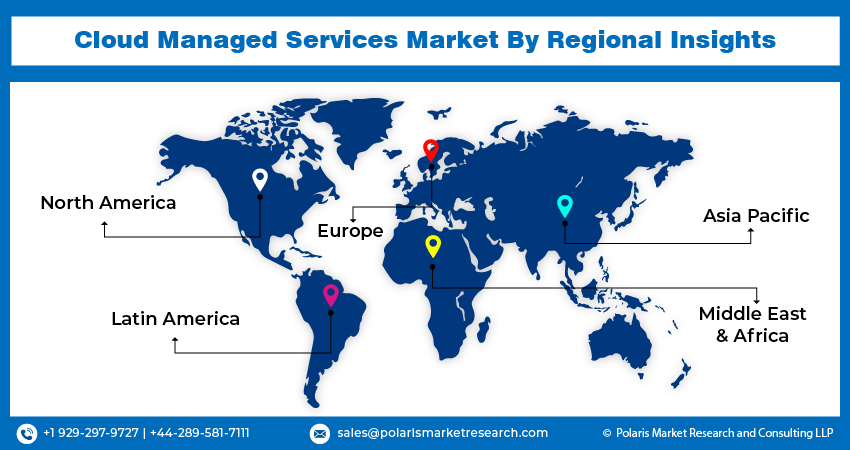
The cloud managed services market presents varied patterns across regions based on factors such as technological readiness, regulatory enablers and compliance, the pace of digital adoption, and general economic conditions. Each follows its own growth path, driven by local investments, policy frameworks, and priorities among enterprises. It shows that such regional differences govern the level of adoption of cloud managed services and the scale at which they grow in terms of value and usage.
In 2025, the North America cloud managed services market emerged as the dominant region. This is due to the adoption and implementation of advanced technology and the presence of prominent cloud service players in the market. The BFSI, healthcare, and IT sectors also contributed significantly to the adoption and popularity of cloud managed services in this market. The focus on digitalization and security in this region also promotes the growth of the cloud managed services market. Companies in this region have also begun outsourcing the management of their IT infrastructure and security to be more efficient and cost-effective.
The Asia Pacific market for cloud managed services is growing rapidly and is considered one of the most promising sectors. This is due to the adoption of digital transformation across all sectors, the acceptance of cloud in small to medium-sized businesses, and government-led developments in cloud technology infrastructure. Countries such as China, India, and Southeast Asia are in high demand for economical IT infrastructure. Moreover, to be secure, local, and efficient, businesses are shifting to third-party cloud managed services vendors.
Source: Polaris Market Research Analysis
Key Players and Competitive Insights
There are a number of established players that play an integral role in the cloud managed services market and provide a broad spectrum of solutions to help enterprises on their cloud journey. These players include Amazon Web Services (AWS), Microsoft Azure (Microsoft Corporation), Google Cloud (Alphabet Inc.), IBM Consulting (IBM), Accenture plc, Capgemini, Wipro Limited, Tata Consultancy Services (Tata Group), HCLTech, Kyndryl, Infosys Limited, and Cognizant. The top cloud managed service providers offer end-to-end services to meet the growing needs of a cloud-centric business.
The cloud managed services market has been undergoing dynamic changes. Technological advancements and mergers & acquisitions drive these changes. The competitive advantages for service offerings lie in expertise in different cloud platforms and industry-centric solutions. Automation, AIOps, and security are becoming increasingly popular.
In the competition for market share, cloud managed service market players also emphasize global service delivery and strict adherence to policy frameworks. They also focus on strong partnerships across different ecosystems. The current demand for efficiency and the need for digital transformation also influence the cloud marketplace.
The market leaders distinguish themselves through platform-agnostic service delivery, high levels of automation, and industry know-how. Partnerships with hyperscale cloud providers also enhance their positioning in the market.
List of Key Companies
- Accenture plc
- Amazon Web Services (AWS)
- Capgemini
- Cognizant
- Google Cloud (Alphabet Inc.)
- HCLTech
- IBM Consulting (IBM)
- Infosys Limited
- Kyndryl
- Microsoft Azure (Microsoft Corporation)
- Tata Consultancy Services (Tata Group)
- Wipro Limited
Industry Developments
- May 2025: Kyndryl, along with Microsoft, announced the extension of its Kyndryl Distributed Cloud services based on the Microsoft adaptive cloud approach using AI technology.
- April 2025: Accenture expanded its strategic relationship with Google Cloud and introduced new offerings to enable enterprises to adopt the most advanced cloud and AI computing technologies.
Cloud Managed Services Market Segmentation
By Organization Size Outlook (Revenue – USD Billion, 2021–2034)
- Large Enterprises
- Small and Medium-Sized Enterprises
By Service Outlook (Revenue – USD Billion, 2021–2034)
- Managed Business Services
- Managed Network Services
- Managed Security Services
- Managed Infrastructure Services
- Managed Mobility Services
- Managed Communication & Collaboration Services
By Cloud Deployment Outlook (Revenue – USD Billion, 2021–2034)
- Public
- Private
By Vertical Outlook (Revenue – USD Billion, 2021–2034)
- BFSI
- Telecom
- Government & Public Sector
- Healthcare & Lifesciences
- Retail & Consumer Goods
- Manufacturing
- Energy
- Utilities
- IT
- Others
By Regional Outlook (Revenue, USD Billion, 2021–2034)
- North America
- US
- Canada
- Europe
- Germany
- France
- UK
- Italy
- Spain
- Netherlands
- Russia
- Rest of Europe
- Asia Pacific
- China
- Japan
- India
- Malaysia
- South Korea
- Indonesia
- Australia
- Vietnam
- Rest of Asia Pacific
- Middle East & Africa
- Saudi Arabia
- UAE
- Israel
- South Africa
- Rest of Middle East & Africa
- Latin America
- Mexico
- Brazil
- Argentina
- Rest of Latin America
Cloud Managed Services Market Report Scope
| Report Attributes | Details |
| Market Size in 2025 | USD 153.78 billion |
| Market Size in 2026 | USD 175.93 billion |
| Revenue Forecast by 2034 | USD 524.28 billion |
| CAGR | 14.6% |
| Base Year | 2025 |
| Historical Data | 2021–2024 |
| Forecast Period | 2026–2034 |
| Quantitative Units | Revenue in USD billion, and CAGR from 2026 to 2034 |
| Report Coverage | Revenue Forecast, Market Competitive Landscape, Growth Factors, and Trends |
| Segments Covered |
|
| Regional Scope |
|
| Competitive Landscape | Cloud Managed Services Industry Trend Analysis (2025) Company profiles/industry participants profiling include company overview, financial information, product/service benchmarking, and recent developments |
| Report Format | PDF + Excel |
| Customization | Report customization as per your requirements with respect to countries, regions, and segmentation. |
Source: Polaris Market Research Analysis
Cloud Managed Services Market FAQ's
The cloud managed services market is expected to reach USD 524.28 billion by 2034. It is projected to account for a CAGR of 14.6% between 2026 and 2034.
Cloud managed services involve monitoring, maintenance, security, backup, and support for public, private, or hybrid cloud environments. They help businesses optimize infrastructure without the internal complexity of managing it.
With the increasing complexity of multi-cloud and hybrid environments, there is a need for advanced skills and continuous monitoring that most organizations lack internally. So, businesses are outsourcing to expert providers to improve efficiency.
BFSI, healthcare, and IT are at the forefront of implementation. They leverage managed services for enhanced security, compliance, and business continuity requirements.
North America accounts for the largest share of the cloud managed services space. This is due to strong technology adoption, substantial IT investments, and the presence of major providers like AWS, Microsoft Azure, and Google Cloud.
The following are some of the market trends: ? Shift Toward AIOps and Automation: There is a heightened focus on applying AI and machine learning for IT operations (AIOps), which encompasses automating mundane tasks, anticipating and resolving potential issues, and optimizing resource allocation for the cloud. ? Increased Attention to Cloud Security and Compliance: With the increased cyber threat landscape, along with more stringent regulations, compliance, maintenance, and threat detection have resulted in a significant demand for managed security services.
Cloud managed services mean that the infrastructure and the operation management of the cloud is externalized to a service provider, and the organization itself no longer has to oversee the management of the cloud resources, whether they be private, public, or hybrid. With the advancement of technology, companies no longer have to manage their cloud resources on a daily basis because these services offer them the sustained assistance needed in efficiency, security, and performance.
Download Sample Report of Cloud Managed Services Market
Please fill out the form to request a customized copy of the research report.


