
Crude Glycerine Market Business Overview, and Strategic Insights, 2025 - 2034
REPORT DETAILS
Crude Glycerine Market Summary
The global crude glycerine market size was valued at USD 925.24 million in 2024, growing at a CAGR of 8.1% from 2025–2034. Key factors driving demand for crude glycerine include growth of the biodiesel industry and government policies and biofuel mandates.
Market Statistics
Key Takeaways
- The 80%-90% segment accounted for the largest revenue share in 2024. This is due to an ideal combination of cost-effectiveness and functionality for use in animal feed, chemicals and, wastewater treatment, among others.
- The biogas segment is expected to witness the fastest growth. This is attributed to its beneficial input for biogas plants aiming for energy maximization.
- Asia Pacific crude glycerine market held the largest global market share in 2024. The availability of large oleochemical and feed processing industries ensures a constant demand for glycerine raw materials in a variety of value chains.
- The market in North America is driven by an emphasis on circular production systems, which results in the reuse of side products such as crude glycerine as low-cost raw material in various?downstream applications.
Industry Dynamics
- Growth of the biodiesel industry is driving the market growth.
- Government policies and biofuel mandates expand the expansion opportunities.
- Biodiesel overproduction and price volatility creates challenges
- The demand for bio-based chemicals creates growth opportunities.
What Does Crude Glycerine Market Includes?
Crude glycerol is a byproduct generated in the processing of biodiesel and soap production. It is a low cost, multi-purpose feed stock for a variety of downstream industries. The crude glycerine market is progressively evolving as industrial consumers are gaining knowledge about its potential to aid in sustainable and cost-effective chemical productions. Growing application of crude glycerine in oleochemicals as a major raw material for the production of fatty acid, fatty alcohols and glycerol derivatives are contributing to the growth. Producers are turning to crude glycerin to fulfill the growing demand for sustainable ingredients and the alliance of green chemistry principles with commodity chemicals, enabling the shift away from petroleum-based chemicals and towards bio-based solutions. This renewed focus on sustainable production systems is continuing to drive the demand for crude glycerine in oleochemical industry.
Source: Polaris Market Research Analysis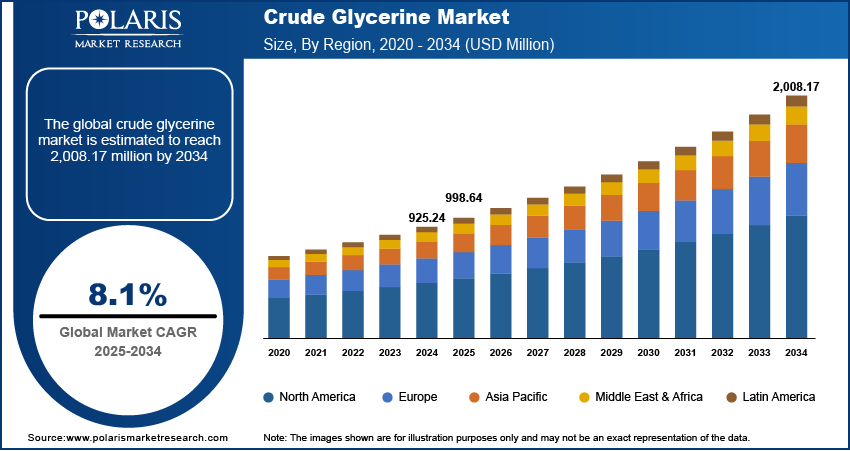
The increasing utilization of crude glycerine in animal feed applications also accounts for the growth of the market. This is due to the digestibility and functional advantages for inclusion in animal diets, nutritional formulators have begun using crude glycerine as an energy source that is cost effective. Its humectancy also contributes to feed quality by enhancing moisture stabilization, thus improving palatability and consistency. Crude glycerine is now considered as one of the promising feed additives that may be used in feed formulations, with the live stock and poultry industry gradually becoming more economy-conscious in terms of feed nutrition. This emerging significance in animal nutrition is also positively impacting the overall demand outlook of the crude glycerine market, highlighting it as a versatile industrial material.
Drivers & Opportunities
What are the Factors Driving the Market Growth?
Growth of the Biodiesel Industry: Crude glycerol, a by-product of biodiesel production, is anticipated to boost the market growth. The quantities of crude glycerine available for industrial processing are increasing as the production of biodiesel is increasing to meet the demand for the renewable fuel. According to a World Bioenergy Association, in 2023 biodiesel production accounted for 50 million liters. This reliable and scalable material flow facilitates a range of downstream industries that can depend on crude glycerine as a cost-effective feedstock, such as temporarily, pharmaceuticals, personal care and animal nutrition. In addition, increasing preference for green, bio-based, and other sustainable production methods further strengthens the position of crude glycerine as an important feedstock in various manufacturing ecosystems. The production and commercial value of crude glycerine were experiencing an upward trend as bio-diesel producers improved their productivity and capacity, which further solidifies its demand in more and more end use industries.
Government Policies and Biofuel Mandates: The crude glycerine market is experiencing robust growth. This is due to positive effect of production of biodiesel driven by government support and biofuel mandates, which among other factor are driving the market growth. Renewable energy legislation introduces blending requirements and production targets that incentivize refiners to produce more biodiesel. That growth, which is policy-driven, translates directly into a growing crude glycerine supply, providing a steady stream of raw materials for industries that make glycerine-based products. Feedstock availability is somewhat less uncertain because high-level basic supportive mandates convey a signal to feedstock producers in the absence of charge to feedstock producers making a feedstock commitment. This surge effect further reinforces crude glycerine availability and utilization in global value chains as clean fuel and reduction of negative environmental footprints are becoming more prioritized by local governments.
Premium Insights- Emerging Technological Advancements
| Technological Advancement | Description |
| Microwave-Assisted Transesterification (MAT) | Novel microwave-assisted process to create glycerol carbonate from refined crude glycerin with higher efficiency, lower energy use, and scalability potential. |
| Glycerin to Propylene Glycol (G2PG) Process | Sustainable hydrogenolysis technology converting glycerin into propylene glycol with ~60% lower emissions using a proprietary copper catalyst. |
| Plant-Based Propylene Glycol Production | Transesterification and refining of crude glycerin from biodiesel feedstock (soybean/canola oil) into bio-based propylene glycol meeting U.S. bio-preferred standards. |
| Catalytic Synthesis of Lactate Salts | Proprietary catalytic process converting waste glycerol into valuable lactate salts, adding value to crude glycerin streams. |
Source: Polaris Market Research Analysis
Source: Polaris Market Research Analysis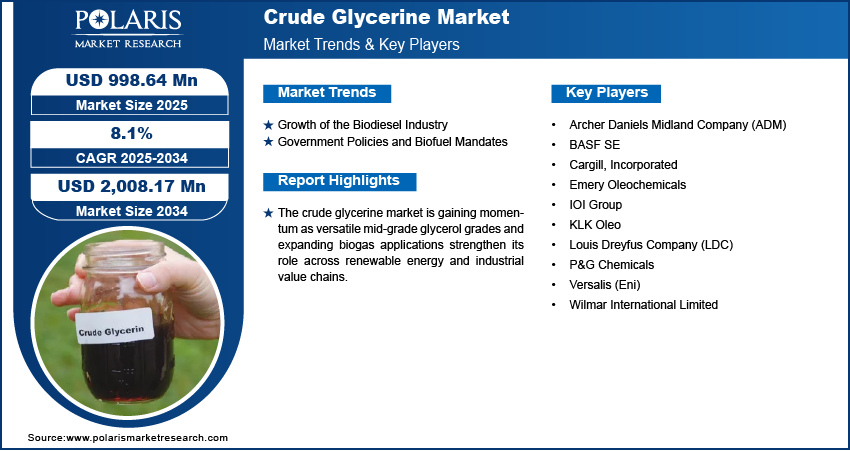
Segmental Insights
Which Segments Contributed to the Market Expansion?
Glycerol Analysis
Based on glycerol, the segmentation includes less than 80%, 80%-90%, and more than 90%. The 80%-90% segment accounted for the largest revenue share in 2024. This is attributable to its neutral composition, which can be applied in multiple industries without requiring processing. This level of purity provides an ideal combination of cost effectiveness and functionality for use in animal feed, chemicals and waste water treatment, among others. The consistency of its quality enables downstream producers to use it in applications that do not require pharmaceutical grade glycerine but still need assured chemical specifications. The 80%-90% glycerine group is likely to retain the overall market with industries now focused on raw materials that are both inexpensive and amenable to a consistent supply.
Application Analysis
In terms of application, the segmentation includes animal feed, wastewater treatment, biogas, oleo chemistry, and others. The biogas segment is expected to witness the fastest growth, the availability of crude glycerine is being recognized more as an effective co-substrate for anaerobic digestion systems. It is a beneficial input for biogas plants that are interested in energy maximization with a good methanol yield due to high organic content. The compatibility of crude glycerine in terms of mixing and its fast biodegradability also contribute to its use in continuous digestion systems. Crude glycerine is being added by biogas producers to enhance production efficiency and stabilize processes as governments ramp up renewable energy and resource valorization in many parts of the world. This trend is expected to drive the biogas segment area within the overall crude glycerine applications market.
Source: Polaris Market Research Analysis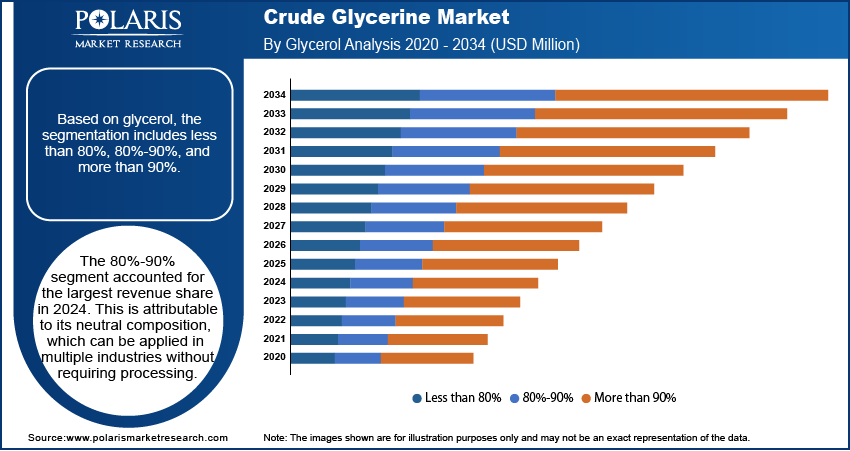
Regional Analysis
How Regions Affected the Overall Market Revenue?
Asia Pacific Crude Glycerine Market Assessment
Asia Pacific crude glycerine market held the largest global market share in 2024. This dominance is attributed to the robust production and consumption boosting crude glycerine usage in various industrial clusters. Growing biodiesel production and the availability of large oleochemical, and feed processing industries ensures a constant demand for glycerine raw materials in a variety of value chains. The high propensity for bio-based industrial inputs in the region further adds to the competitiveness of crude glycerine in its extension into chemical, agro and energy applications. This endures to attain good consumption on the key end use sectors in Asia Pacific region with the manufacturing based countries more and more focusing on efficient use of resource and renewable resource.
North America Crude Glycerine Market Insights
The market in North America is driven by established industries that use crude glycerine as a raw material in the personal care, pharmaceutics, chemicals, and bioenergy among others. The regional emphasis on circular production systems results in the reuse of side products such as crude glycerine as low-cost raw material in various downstream applications. Adoption of advanced technology facilitates effective refinement and conversion processes which allow vendors to meet customers’ demand for both inferior and high purity glycerine. Additionally, better alignment amongst industry on sustainable and renewable feedstocks further solidifies the positioning in domestic supply chains and will continue to provide growth opportunities throughout the North American market.
Source: Polaris Market Research Analysis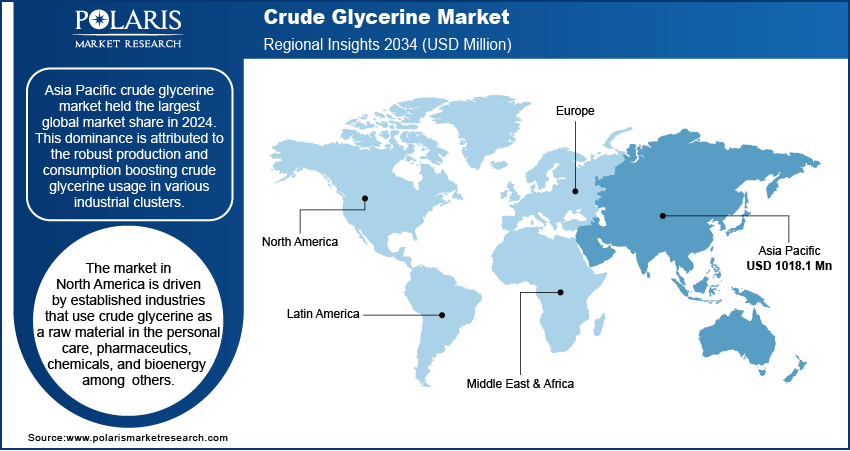
Key Players & Competitive Analysis Report
Competition in the crude glycerine market is intense, as it is a by-product of biodiesel. Integrated supply chains from top producers such as ADM, Cargill & Wilmar bring the formidable new entrant situation for small and medium scale firms already staring at them. Competing, acquisitive and strategic mentioned players are investing strategically in their purification capacity, and to develop sustainable value chains adapted to newly emerging market segments in oleochemistry and animal feed. Strategic growth is focused on leveraging business and market development opportunities in emerging markets for growth in biodiesel production and in developed markets through new applications.
Major companies operating in the crude glycerine industry include Archer Daniels Midland Company (ADM); BASF SE; Cargill, Incorporated; Emery Oleochemicals; IOI Group; KLK Oleo; Louis Dreyfus Company (LDC); P&G Chemicals; Versalis (Eni); and Wilmar International Limited.
Key Players
- Archer Daniels Midland Company (ADM)
- BASF SE
- Cargill, Incorporated
- Emery Oleochemicals
- IOI Group
- KLK Oleo
- Louis Dreyfus Company (LDC)
- P&G Chemicals
- Versalis (Eni)
- Wilmar International Limited
Industry Developments
- May 2025, Louis Dreyfus Company (LDC) inaugurated its glycerin refining plant and edible oil packaging line in Lampung. This production plant has annual production capacity of 55,000 metric tons and expected to fulfill the demand for high-purity, USP-grade glycerin.
- October 2024: Argent Energy, a biofuels manufacturer launched Europe’s largest facility to producing bio-based, technical-grade glycerine at its Port of Amsterdam site. This refinery will upgrade crude glycerine, a by-product of Argent’s waste-based biodiesel process, into 99.7% pure technical-grade glycerine.
Crude Glycerine Market Segmentation
By Glycerol Outlook (Revenue, USD Million, 2020–2034)
- Less than 80%
- 80%-90%
- More than 90%
By Source Outlook (Revenue, USD Million, 2020–2034)
- Biodiesel Manufacturing
- Fat Splitting
- Fatty Acid Production
- Soap Manufacturing
By Application Outlook (Revenue, USD Million, 2020–2034)
- Animal feed
- Wastewater Treatment
- Biogas
- Oleo chemistry
- Others
By Regional Outlook (Revenue, USD Million, 2020–2034)
- North America
- US
- Canada
- Europe
- Germany
- France
- UK
- Italy
- Spain
- Netherlands
- Russia
- Rest of Europe
- Asia Pacific
- China
- Japan
- India
- Malaysia
- South Korea
- Indonesia
- Australia
- Vietnam
- Rest of Asia Pacific
- Middle East & Africa
- Saudi Arabia
- UAE
- Israel
- South Africa
- Rest of Middle East & Africa
- Latin America
- Mexico
- Brazil
- Argentina
- Rest of Latin America
Crude Glycerine Market Report Scope
| Report Attributes | Details |
| Market Size in 2024 | USD 925.24 Million |
| Market Size in 2025 | USD 998.64 Million |
| Revenue Forecast by 2034 | USD 2,008.17 Million |
| CAGR | 8.1% from 2025 to 2034 |
| Base Year | 2024 |
| Historical Data | 2020–2023 |
| Forecast Period | 2025–2034 |
| Quantitative Units | Revenue in USD Million and CAGR from 2025 to 2034 |
| Report Coverage | Revenue Forecast, Competitive Landscape, Growth Factors, and Industry Trends |
| Segments Covered |
|
| Regional Scope |
|
| Competitive Landscape |
|
| Report Format |
|
| Customization | Report customization as per your requirements with respect to countries, regions, and segmentation. |
Source: Polaris Market Research Analysis
Crude Glycerine Market FAQ's
The global market size was valued at USD 925.24 million in 2024 and is projected to grow to USD 2,008.17 million by 2034.
The global market is projected to register a CAGR of 8.1% during the forecast period.
Asia Pacific crude glycerine market held the largest global market share in 2024.
A few of the key players in the market are Artivion, Inc; Aroa Crude Glycerine; B. Braun SE; Baxter; BD; INTEGRA LIFESCIENCES; Johnson & Johnson Services, Inc; Medtronic; Pfizer Inc; Sanofi; and Stryker.
The 80%-90% segment accounted for the largest revenue share in 2024.
The biogas segment is expected to witness the fastest growth.
Download Sample Report of Crude Glycerine Market
Please fill out the form to request a customized copy of the research report.


