
Curcumin Market Industry Report 2034: Size, Share, Trends and Opportunities
REPORT DETAILS
Curcumin Market Summary
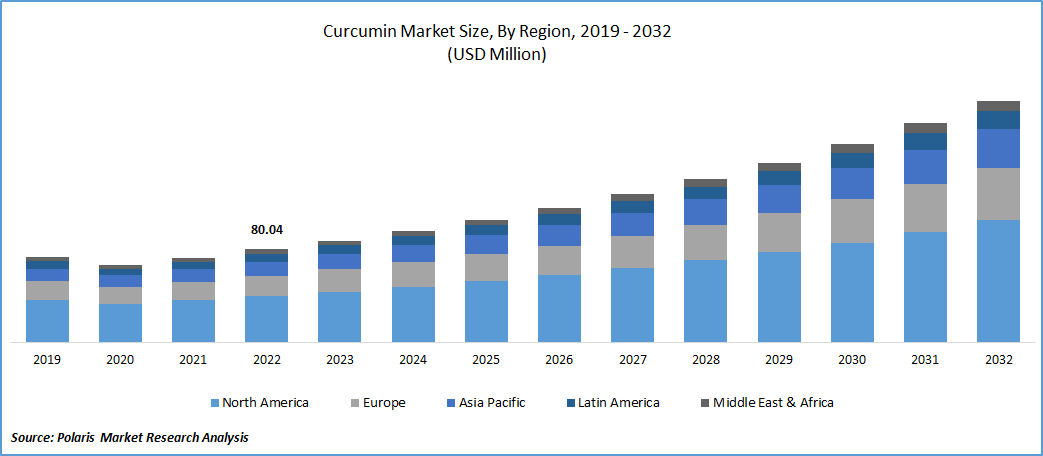
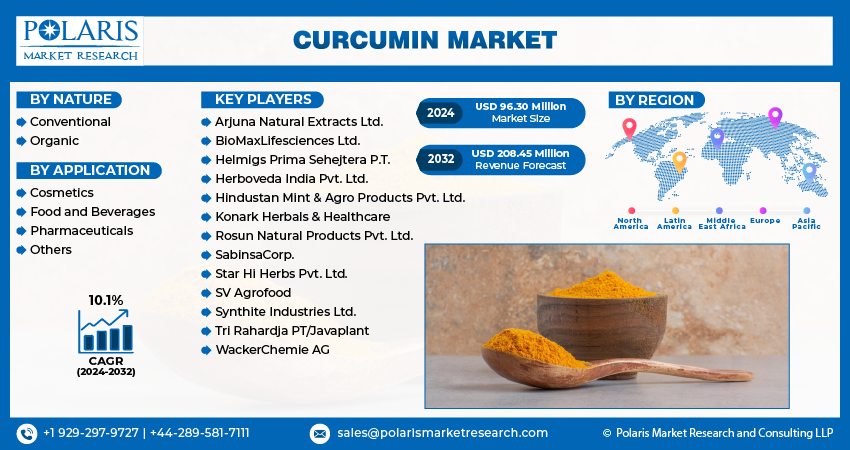
The global curcumin market is estimated at USD 104.23 million in 2026 and is projected to reach USD 115.30 million in 2027, expanding to USD 239.08 million by 2034 at a CAGR of 10.98% during 2027–2034. Growing use of curcumin in dietary supplements for joint health and inflammation is the main demand driver. Improved bioavailability formulations and use as a natural colour in foods and cosmetics are widening its application base.
Market Statistics
Key Takeaways
• Powder curcumin holds the largest form share, an estimated 72.9% of revenue in 2026.
• Conventional curcumin holds the largest nature-based share, estimated at 77.75% in 2026
• Food and beverage (natural colour) accounts for an estimated 33.6% share.
• Bioavailability-enhanced formulations command premium prices.
• North America represented an estimated 27.8% in 2026, supported by dietary supplements, nutraceuticals and premium botanical ingredients.
• Asia Pacific is expected to grow fastest, currently at an estimated 34.2%, led by India.
• Competition is shaped by patented bioavailable forms and Indian turmeric processors.
The expansion in this market can be attributed to the inherent properties of the product, including its anti-cancer, anti-oxidant, and anti-inflammatory attributes. Additionally, its widespread utilization in skincare applications, such as preventing ringworms, eye infections, leech bites, sore skin, bruising, and swelling, among others, is anticipated to fuel market growth in the forecast period. Curcumin, extracted from turmeric and ginger, serves as an active ingredient with therapeutic properties. Turmeric is extensively consumed in South East Asian countries in both culinary and medical products due to its healing characteristics.
The growing awareness among consumers regarding its health benefits and rising recognition of its medicinal values will stimulate product demand globally. A shift in consumer trends and heightened awareness of the advantages associated with using organic and natural ingredients in medical, cosmetic, and food applications will further contribute to increased product demand throughout the forecast period.
To Understand More About this Research: Download Sample Report
Curcumin, characterized by its hydrophobic and lipophilic properties, finds considerable application in the pharmaceutical industry, primarily owing to its traditional therapeutic uses. Ongoing research explores the utilization of diverse nanoparticles, including dendrimers, polymeric nanoparticles, and nanogels, as carriers for delivering curcumin in cancer treatment and the therapy of neurological diseases. Its established health benefits, coupled with its potential to prevent diseases such as Alzheimer's, coronary heart diseases, and cancer, have been substantiated.
In recent years, the United States has experienced an upsurge in demand for the product, driven by increasing consumer awareness of its medicinal properties and health benefits. Additionally, the product has found substantial application in tissue engineering, prompting companies to invest significantly in research to explore its pharmaceutical industry applications, mainly attributed to its non-toxic nature. Consumers in developed economies, such as the U.S., Denmark, and Germany, are well-informed about these research findings, indicating potential high demand.
Industry Dynamics
-
Growth Drivers
-
Growing consumer awareness of health and well-being is expected to drive market growth.
Prioritizing health and wellness has become a global consumer trend. The demand for natural products with immune-boosting properties has witnessed a substantial increase in recent years. Natural extracts, known for their benefits against various ailments, have gained prominence. Turmeric, utilized in medicinal and cosmetic formulations since ancient times, continues to be incorporated into modern cosmetic products, particularly in countries like India. Clinical trials conducted by research organizations worldwide have demonstrated that curcumin possesses antioxidant and anti-inflammatory properties, making it suitable for developing medicinal supplements and cosmetic formulations. Consequently, the demand for such products has experienced significant growth.
Report Segmentation
The market is primarily segmented based on nature, application, and region.
| By Nature | By Application | By Region |
|
|
|
Source: Polaris Market Research Analysis
To Understand the Scope of this Report: Request Customization
By Nature Analysis
-
The Conventional segment held the largest revenue share in 2023
Curcumin is derived from turmeric, primarily grown in South East Asian countries and India. India stands out as the leading producer of turmeric, contributing to approximately 80% of global production, followed by China, Myanmar, Nigeria, and Bangladesh. In these countries, farmers typically have lower annual incomes compared to their counterparts in Europe and North America, leading them to choose agro products that are both affordable and readily available.
Conventional products, being easily accessible and cost-effective in comparison to organic alternatives, are widely adopted, making conventional farming the predominant practice in these regions. As a result, the conventional segment is expected to maintain a significant Curcumin market share throughout the forecast period, sustaining its dominance in the years to come.
Moreover, there has been a noticeable increase in the popularity and awareness of organic farming in recent years. Given the demand for organic products and consumers' willingness to pay premium prices for them, farmers are increasingly choosing organic cultivation practices. This factor is anticipated to drive the growth of the organic segment, with the highest expected CAGR during the forecast period.
By Application Analysis
-
The Pharmaceuticals segment accounted for the highest market share during the forecast period
Curcumin, prized for its antioxidant, anti-inflammatory, and anti-cancer properties, is in high demand in Ayurvedic medicine, cosmetics, functional food, and the natural additive industries. As the cosmetic industry expands and consumers show a growing preference for traditional medicines, the market is expected to experience significant growth in the forecast period.
Turmeric, a staple in Indian cuisine for centuries, is witnessing increasing demand from the Western food and beverage industry due to a rising awareness of natural herbs and spices. The use of yellow turmeric in the food and beverages sector as a coloring agent, taste enhancer, and flavoring agent in beverages has been steadily rising over the past few years.
The cosmetics sector has experienced significant growth in recent years as consumers continually seek innovative products. The increasing utilization of natural herbs in the cosmetic industry is a notable trend, anticipated to drive the demand for curcumin in this sector. Consequently, the cosmetic industry is expected to register the highest Compound Annual Growth Rate (CAGR) over the forecast period.
Regional Insights
-
Asia Pacific dominated the largest market in 2026
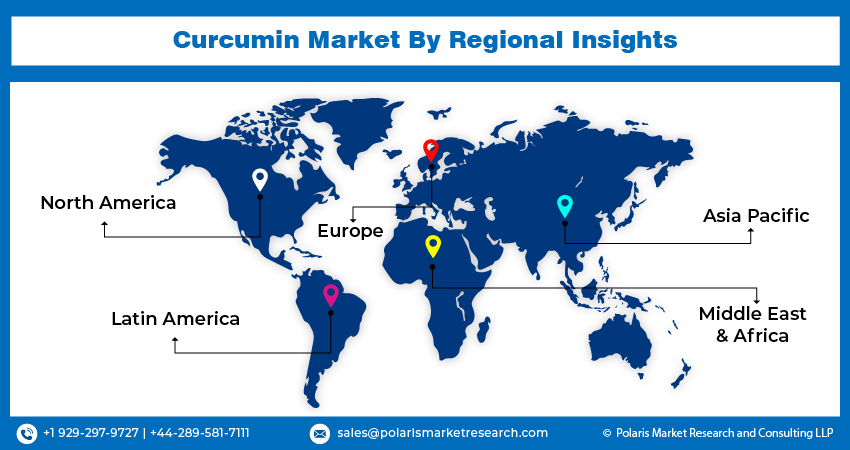
Asia Pacific commands the largest market share in the curcumin industry, primarily driven by the demand for curcumin in the food and beverage sectors of India, China, and Bangladesh, as well as the traditional medicine industry in India and China. In India, turmeric has been a key ingredient in various cuisines since ancient times. While its use in the food and beverage industry had been limited in recent years, ongoing research and analysis have led to an increased demand for turmeric as a flavor-enhancing and coloring agent. Additionally, growing consumer awareness of traditional medicines is contributing to the steady expansion of the traditional medicine market. This factor is anticipated to boost consumption during the forecast period, thereby propelling the global market.
Europe serves as a major turmeric importer, primarily utilized in the cosmetic industry after being transformed into curcumin. As a global hub for cosmetics, the region hosts major manufacturing sites of prominent cosmetic companies, resulting in a persistent increase in demand. The swift expansion of Europe's food and beverage industry creates openings for turmeric processors to launch novel and innovative products in the region. This aligns with the overall growth of the cosmetic industry in Europe.
Key Market Players & Competitive Insights
The market is characterized by intense competition, with established players relying on advanced technology, high-quality products, and a strong brand image to drive revenue growth. These companies employ various strategies such as research and development, mergers and acquisitions, and technological innovations to expand their product portfolios and maintain a competitive edge in the market.
Some of the major players operating in the global market include:
- Arjuna Natural Extracts Ltd.
- BioMaxLifesciences Ltd.
- Helmigs Prima Sehejtera P.T.
- Herboveda India Pvt. Ltd.
- Hindustan Mint & Agro Products Pvt. Ltd.
- Konark Herbals & Healthcare
- Rosun Natural Products Pvt. Ltd.
- SabinsaCorp.
- Star Hi Herbs Pvt. Ltd.
- SV Agrofood
- Synthite Industries Ltd.
- Tri Rahardja PT/Javaplant
- WackerChemie AG
Recent Developments
In June 2026, India's CSIR–National Botanical Research Institute had secured an Indian patent for a nanoformulation of curcumin that would make it more readily absorbed and stable. This research tackles a major limitation of traditional curcumin ingredients – their relatively low bioavailability. The technology is indicative of the ongoing progress in particle-engineering technologies which could result in improved curcumin formulations for nutritional and pharmaceutical research purposes. (Source: CSIR)
In June 2025, Arjuna Natural published technical and commercial material regarding a United States patent for its BCM-95 curcumin composition. This technology relates to the formulation and stability of curcuminoids and to the bioavailability characteristics of the ingredient. The development is a sign that branded curcumin makers are continuing to seek intellectual property as a means of differentiating standardized turmeric extracts in dietary supplements and specialty nutrition. Delivery methods patented by suppliers can help to differentiate their products in a market where conventional curcumin has well known absorption problems. (Source: Arjuna Natural)
In May 2025, Sabinsa will showcase its Curcumin C3 Reduct at Vitafoods Europe in Barcelona. The ingredient contains tetrahydrocurcuminoids, metabolites of curcumin, and is marketed for nutraceutical uses highlighting the benefits of antioxidants and improved formulation efficacy. The ingredient was an EFSA-authorised tetrahydrocurcuminoid novel food, Sabinsa said. This showcase highlights ongoing commercial investment in differentiated curcumin-derived ingredients and specialty formulations, especially where bioavailability, ingredient standardization and regulatory recognition are key purchasing criteria. (Source: Sabinsa Corporation)
Curcumin Market Report Scope
| Report Attributes | Details |
| Market size value in 2027 | USD 115.30 million |
| Revenue forecast in 2034 | USD 239.08 million |
| CAGR | 10.98% from 2027 – 2034 |
| Base year | 2026 |
| Historical data | 2022-2025 |
| Forecast period | 2027 – 2034 |
| Quantitative units | Revenue in USD million/billion and CAGR from 2027 to 2034 |
| Segments Covered | By Nature, By Application, By Region |
| Regional scope | North America, Europe, Asia Pacific, Latin America; Middle East & Africa |
| Customization | Report customization as per your requirements with respect to countries, region and segmentation. |
Source: Polaris Market Research Analysis
Curcumin Market FAQ's
The curcumin market is valued at USD 104.23 million in 2026 and is expected to reach USD 115.30 million in 2027 and USD 239.08 million by 2034, according to Polaris Market Research.
The curcumin market is projected to grow at a CAGR of 10.98% from 2027 to 2034, adding roughly USD 123.78 million in value over the forecast period.
Growing use of curcumin in dietary supplements for joint health and inflammation is the main demand driver. Improved bioavailability formulations and use as a natural colour in foods and cosmetics are widening its application base.
The main applications are nutraceuticals & supplements, food (natural colour), cosmetics, and pharmaceuticals. Supplements and bioavailable formulations are the growth engine.
Curcumin Market report covering key segments are nature, application, and region.

Download Sample Report of Curcumin Market
Please fill out the form to request a customized copy of the research report.


