
Dental Suction Systems Market Share, Size, Trends, Industry Analysis Report, 2022 - 2030
REPORT DETAILS
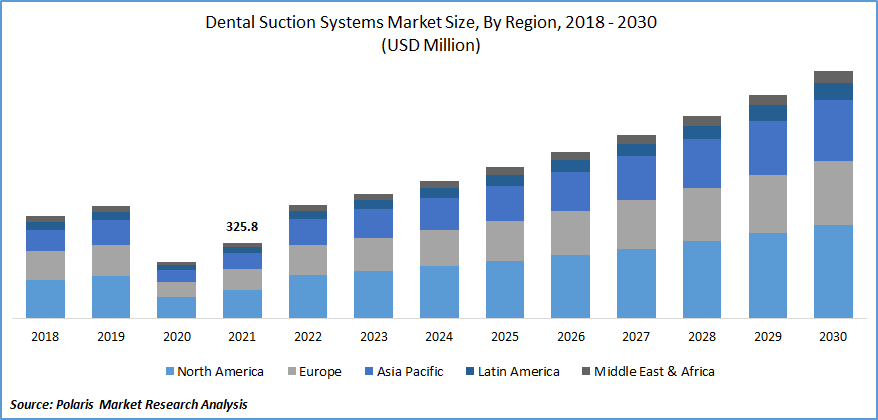
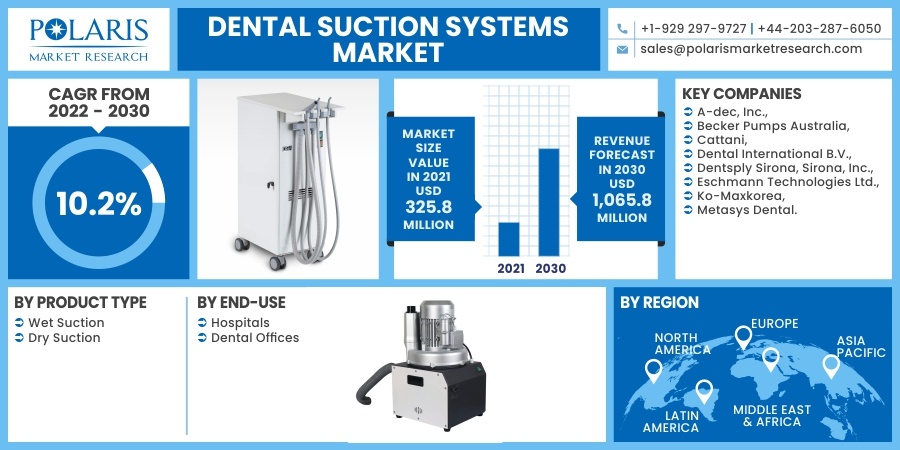
The global dental suction systems market was valued at USD 325.8 million in 2021 and is expected to grow at a CAGR of 10.2% during the forecast period. The constant product development is coupled with the growing awareness for dental problems, and the rise in cases of these problems is fueling the market growth across the globe.
Source: Polaris Market Research Analysis
Know more about this report: Download Sample ReportBesides, increasing sedentary lifestyles and the emergence of next-generation technologies in the field of suction systems are projected to create new growth avenues for the dental suction systems market around the world. The arrival of the COVID-19 has drastically influenced every industry and affects the global economy's state. It leads to postponing non-emergency checkups because of the spreading of contracting the novel coronavirus infection which in turn has hampered the suction systems industry.
In addition, the government issued guidelines during that pandemic, which allows public endodontist practices and hospitals to treat merely at the urgent situation, a large number of private practices were bunged, particularly those dentists who carry out mainly non-emergency services. Therefore, the outbreak of the COVID-19 pandemic brings a significant downfall in the global dental suction systems market.
Source: Polaris Market Research Analysis
Know more about this report: Download Sample Report
Industry Dynamics
Growth Drivers
The growing demand for cosmetic dentistry has gained a huge acceptance over the last years, which may positively impact the global economy. Cosmetic dentistry focuses on enhancing the appearance and meets the demand of its end-users. In the present scenario, the overall focus is on appearance has led to the popularity of smile makeovers that propels the demand for cosmetic dentistry. In addition, rising consumer responsiveness is creating a major opportunity that augments the demand for cosmetic dentistry through social media platforms, improved media coverage of endodontist practices, and its promotion.
Besides, cosmetic dentistry is not only used by the female population but also a large population base of males using cosmetic dentistry. Thereby, the primary impelling factors of the cosmetic dentistry market are changes in lifestyle and the rising disposable income of individuals. Moreover, the youthful populations of business executives who want to look their best for better professions and substantial advancements in the industry itself have led to the growth of cosmetic dentistry. Hence, these factors may positively influence suction system market growth around the world.
Report Segmentation
The market is primarily segmented on the basis of product type, end-use, and region.
| By Product Type | By End-use | By Region |
|
|
|
Source: Polaris Market Research Analysis
Know more about this report: Download Sample Report
Insight by Product Type
The wet suction systems are expected to capture a major revenue share in 2021. These units are extremely reliable than dry systems because of their attribute of easier maintenance. The wet suction systems further featured a reverse flow valve and incorporation of central amalgam separation. These features make it a modern system and contribute towards its vast demands, which, in turn, reflect the dental suction systems market growth at a global scale.
The dry product segment is anticipated to register a significant CAGR from 2022 to 2029, owing to the benefits related to these systems. These systems are energy-efficient and have features, such as variable speed motor functionality that improves extraction power consistency. Moreover, these systems do not need a water connection for operation and can provisionally reconnect to the shop vacuum in case of a primary motor breakdown. These features are further expected to strengthen its demand, which, in turn, will become a key factor to augment the segment growth globally.
Insight by End-Use
The dental office segment is leading with the highest shares in the global market in 2021. This can be attributed to the rise in the number of treatment procedures associated with dental diseases across these healthcare settings. Due to the widespread of novel COVID-19 diseases, many people were frequently prevented from visiting hospitals and offices. Further, various clinics and associated facilities remain shut down during the pandemic.
According to the Agency for Healthcare Research and Quality, about 198,000 offices were closed in August 2020, intending to prevent the spread of diseases. Further, as the situation appears to be normal, endodontist offices have started and undertaken initiatives, such as implementing safety measures to provide improved safety to staff and patients alike.
Therefore, the use of extra-oral suction systems was begun to use for the protection of staff and patient by offices, particularly to prevent the spread of the virus. These factors are projected to accelerate the segment growth. The office segment is also projected to register the fastest CAGR, backed by the escalating demand for diagnosis & treatments. The presence of a large number of endodontist specialists across healthcare settings is expected to drive the segment growth.
Geographic Overview
Europe and North America are the two key regional markets for suction systems. This is due to the growing awareness of dental issues in Europe, followed by North America. In addition, the easy availability of quality medical facilities, early adoption of advanced treatment options, and the rise in government efforts into endodontist healthcare infrastructure. Therefore, these factors may fuel the market demand across North America in the forthcoming years.
Presently, the Asia Pacific, Middle East & Africa, and Latin America are becoming lucrative investments in healthcare settings. Factors such as the rising geriatric population coupled with rising diseases are likely to boost the market in the region. Growing health care infrastructure and increasing patient awareness levels regarding substitute treatment options are becoming the significant factors that are likely to support the market in the Asia Pacific.
Competitive Insight
Some of the major players operating the global market include A-dec, Inc., ADS Dental System, Inc., Becker Pumps Australia, Cattani, Dental International B.V., DentalEZ, Inc., Dentsply Sirona, Sirona, Inc., Eschmann Technologies Ltd., Ko-Maxkorea, and Metasys Dental.
Dental Suction Systems Market Report Scope
| Report Attributes | Details |
| Market size value in 2021 | USD 325.8 million |
| Revenue forecast in 2030 | USD 1,065.8 million |
| CAGR | 10.2% from 2022 - 2030 |
| Base year | 2021 |
| Historical data | 2018 - 2020 |
| Forecast period | 2022 - 2030 |
| Quantitative units | Revenue in USD million/billion and CAGR from 2022 to 2030 |
| Segments covered | By Product Type, By End-Use, By Region |
| Regional scope | North America, Europe, Asia Pacific, Latin America, Middle East & Africa |
| Key Companies | A-dec, Inc., Becker Pumps Australia, Cattani, Dental International B.V., Dentsply Sirona, Sirona, Inc., Eschmann Technologies Ltd., Ko-Maxkorea, and Metasys Dental. |
Source: Polaris Market Research Analysis
Download Sample Report of Dental Suction Systems Market Share, Size, Trends, Industry Analysis Report, 2022 - 2030
Please fill out the form to request a customized copy of the research report.


